Infection &
Chemotherapy
Received: November 24, 2016 Accepted: January 8, 2017 Published online: November 8, 2017 Corresponding Author : Nam Su Ku, MD
Department of Internal Medicine, Yonsei University College of Medicine, 50-1 Yonsei-ro, Seodaemun-gu, Seoul 03722, Korea
Tel.: +82-2-2228-2277, Fax: +82-2-393-6884 E-mail: [email protected]
This is an Open Access article distributed under the terms of the Creative Commons Attribution Non-Commercial License (http://creativecommons.org/licenses/by-nc/3.0) which permits unrestricted non-commercial use, distribution, and repro- duction in any medium, provided the original work is properly cited.
Copyrights © 2017 by The Korean Society of Infectious Diseases | Korean Society for Chemotherapy
www.icjournal.org
A Case of Community-Acquired Pneumonia Caused by Multidrug-Resistant Acinetobacter baumannii in Korea
Young Woong Son
1, In Young Jung
1, Mi Young Ahn
1, Yong Duk Jeon
1, Hea Won Ann
1,2, Jin Young Ahn
1,2, Nam Su Ku
1,2, Sang Hoon Han
1,2, Jun Young Choi
1,2, Young Goo Song
1,2, and June Myung Kim
1,21Department of Internal Medicine, and 2AIDS Research Institue, Yonsei University College of Medicine, Seoul, Korea
Acinetobacter baumannii is an aerobic Gram-negative coccobacillus that causes nosocomial pneumonia in patients on me- chanical ventilation or previously treated with broad-spectrum antibiotics. Nevertheless, community-acquired pneumonia (CAP) caused by A. baumannii, especially multi-drug resistant (MDR) strains, is rare. We experienced the first case of CAP caused by MDR A. baumannii in Korea in a 78-year-old man. This case shows that MDR A. baumannii can cause CAP in Korea.
Key Words: Acinetobacter baumannii; Community-acquired pneumonia; Multi-drug-resistance https://doi.org/10.3947/ic.2017.49.4.297
Infect Chemother 2017;49(4):297-300
ISSN 2093-2340 (Print) · ISSN 2092-6448 (Online)
Case Report
Introduction
Acinetobacter baumannii is an aerobic Gram-negative coc- cobacillus [1]. It causes nosocomial pneumonia, especially in patients on mechanical ventilation or after treatment with broad-spectrum antibiotics [1, 2]. Interestingly, communi- ty-acquired pneumonia (CAP) caused by A. baumannii has a higher mortality rate than that of hospital-acquired pneumo- nia (HAP), although CAP caused by A. baumannii, especially multi-drug resistant (MDR) A. baumannii, is rare [3]. Recent- ly, MDR A. baumannii has increased as an emerging problem because of restricted therapeutic options [4]. Here, we report
the first case of CAP caused by MDR A. baumannii in Korea in a 78-year-old man.
Case Report
A 78-year-old man presented to the emergency department with dyspnea and fever for 6 hours. He was not currently em- ployed and had no history of cigarette smoking or alcohol in- gestion. He had no underlying disease. Besides, he had no hospital admission, antimicrobial use history and healthcare institution visiting record in 1 year. On admission, he ap-
Son YW, et al. • CAP by MDR A. baumannii www.icjournal.org
298
peared acutely ill. His blood pressure was 104/57 mmHg, re- spiratory rate 20 breaths per minute, pulse rate 110 beats per minute, and body temperature 38.2°C. A regular heart rhythm was observed. There were coarse breath sounds with crackles in the right lung field.
The laboratory results were as follows: white blood cell count 3,900/mm3 (72.5% neutrophils, 20.4% lymphocytes, 4.7% monocytes, 2.82% eosinophils), hemoglobin 12.2 g/dL, platelet count 197,000/mm3, C-reactive protein 1.24 mg/dL, blood urea nitrogen 28.2 mg/dL, creatinine 1.24 mg/dL, as- partate aminotransferase 16 UI/L, alanine aminotransferase 10 IU/L, total bilirubin 0.9 mg/dL, total protein 6.0 g/dL, and
albumin 3.5 g/dL. The arterial blood gas analysis breathing room air was pH 7.44, pCO2 24.1 mmHg, pO2 59.0 mmHg, HCO3
–
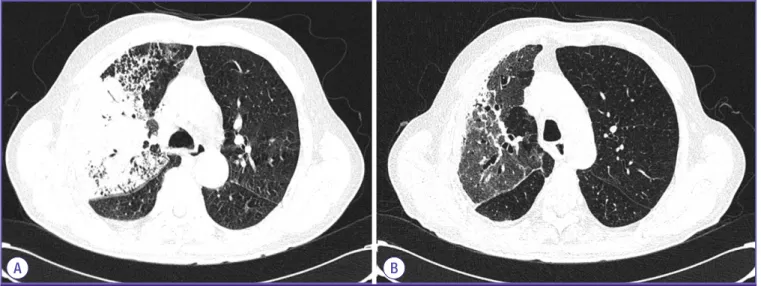
17 mmol/L, and O2 saturation 87%. A plain chest radiograph showed patchy consolidations in the right middle and lower lobes (Fig. 1A). Chest computed tomography (CT) showed lobar pneumonia in the right middle and lower lobes (Fig. 2A). He was diagnosed with CAP. Intravenous piperacillin/tazobactam and ciprofloxacin were administered empirically.
Five hours after admission, his respiratory distress wors- ened, and he was treated with oxygen at 6 L/min via mask. On the second day after admission, intravenous teicoplanin was administered because of a persistent fever. On the third day, A.
Figure 1. Chest radiography. (A) The chest radiograph on admission showed lobar pneumonia in the right upper and middle lobes. (B) On the 48th day after admission, the chest radiograph showed improvement in the consolidations of the right and middle lobes.
A B
Figure 2. Chest computed tomography (CT). (A) On admission, CT showed lobar pneumonia in the right upper and middle lobes with a parapneumonic effusion. (B) At the 48th day after admission, CT showed improvement in the consolidations of the right upper and middle lobes.
A B
https://doi.org/10.3947/ic.2017.49.4.297 • Infect Chemother 2017;49(4):297-300
www.icjournal.org 299
baumannii was identified in cultures of both sputum and in two of three pairs of blood samples taken on admission. A.
baumannii was identified using Matrix-assisted laser desorp- tion/ionization time-of-flight mass spectrometry (MAL- DI-TOF MS, Bruker Daltonics GmbH, Bremen, Germany) on a Microflex spectrometer (Bruker Daltonics GmbH, Germany).
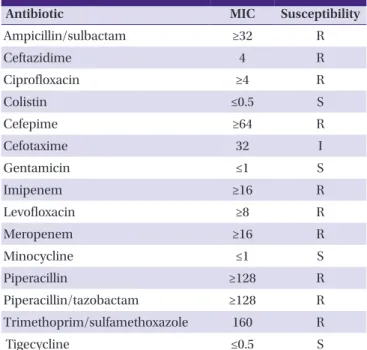
Antimicrobial susceptibilities were determined using VITEK-2 system (bioMerieux, Marcy I’Etoile, France). The bacterial iso- late was resistant to multiple drugs, except colistin, tigecy- cline, minocycline, amikacin, and gentamicin (Table 1).
Therefore, the antibiotics were changed to intravenous colistin and oral minocycline.
On the 6th day after admission, his vital signs stabilized and the fever subsided. Follow-up chest radiography and CT showed improved consolidation. No A. baumannii grew in the follow-up blood cultures. On the 26th day after admission, because of colistin-induced nephropathy, the antibiotics were switched to tigecycline. On the 48th day after admission, the chest radiograph and chest CT showed that the pneumonia had improved (Fig.1B and 2B). The patient was discharged on day 56 and followed as an outpatient with no significant com- plications.
Discussion
Organisms in the genus Acinetobacter were isolated and
first described by the microbiologist Beijerinck in 1911 [2]. A.
baumannii is an aerobic Gram-negative coccobacillus that occurs in fresh water and soil [1]. A. baumannii is regarded as a significant pathogen causing nosocomial pneumonia [1, 2].
By contrast, community-onset A. baumannii infection is un- common and usually occurs in patients with solid tumor, pri- or receipt of antimicrobial agents within 30 days and central venous catheterization [5]. Especially CAP caused by A. bau- mannii tends to progress rapidly to a fulminate clinical course [1-3, 6]. Recently, the incidence of carbapenem-resistant A.
baumannii has increased [7, 8].
Five cases of CAP caused by A. baumannii have been re- ported in Korea; in all cases, A. baumannii was identified in sputum cultures, blood cultures, or biopsy. Fortunately, the A.
baumannii was susceptible to piperacillin/tazobactam, cef- tazidime, cefepime, meropenem, and tobramycin [9-13]. In our case, susceptibility tests showed that the A. baumannii was resistant to piperacillin/tazobactam, ceftazidime, cefepime, imipenem, meropenem, and tobramycin but sus- ceptible to colistin, tigecycline, minocycline, amikacin, and gentamicin.
Although this is the first reported case of CAP caused by MDR A. baumannii in Korea, it is expected to increase with the incidence of MDR A. baumannii. MDR A. baumannii should be considered if empirical antibiotics do not work in CAP. Recommended empirical antibiotics for CAP caused by A. baumannii include anti-pseudomonal penicillins, cipro- floxacin, aminoglycoside, and imipenem [14-16]. However, A.
baumannii resistance to carbapenem has increased recently, limiting the treatment options [4]. MDR A. baumannii has few treatment options and a poor prognosis, although colistin, tigecycline, or minocycline are options [16-18]. Our patient responded to colistin (with minocycline) and tigecycline, de- spite a long treatment period.
This case is an example of the successful treatment of CAP caused by MDR A. baumannii, in a patient without medical comorbidities, and is the first reported case of CAP caused by MDR A. baumannii in Korea. MDR A. baumannii should be considered as a pathogen causing community-acquired pneu- monia, and further epidemiological studies are needed to control infection.
Conflicts of Interest
No conflicts of interest.
Table 1. The antibiotic susceptibility of the Acinetobacter baumannii isolate
Antibiotic MIC Susceptibility
Ampicillin/sulbactam ≥32 R
Ceftazidime 4 R
Ciprofloxacin ≥4 R
Colistin ≤0.5 S
Cefepime ≥64 R
Cefotaxime 32 I
Gentamicin ≤1 S
Imipenem ≥16 R
Levofloxacin ≥8 R
Meropenem ≥16 R
Minocycline ≤1 S
Piperacillin ≥128 R
Piperacillin/tazobactam ≥128 R
Trimethoprim/sulfamethoxazole 160 R
Tigecycline ≤0.5 S
MIC, minimum inhibitory concentration; R, resistant; I, intermediate resistance; S, susceptible
Son YW, et al. • CAP by MDR A. baumannii www.icjournal.org
300
ORCID
Nam Su Ku https://orcid.org/0000-0002-9717-4327 Young Woong Son https://orcid.org/0000-0002-0285-8268
References
1. Fournier PE, Richet H. The epidemiology and control of Acinetobacter baumannii in health care facilities. Clin In- fect Dis 2006;42:692-9.
2. Towner KJ. Acinetobacter: an old friend, but a new enemy.
J Hosp Infect 2009;73:355-63.
3. Leung WS, Chu CM, Tsang KY, Lo FH, Lo KF, Ho PL. Fulmi- nant community-acquired Acinetobacter baumannii pneu- monia as a distinct clinical syndrome. Chest 2006;129:102-9.
4. Papp-Wallace KM, Endimiani A, Taracila MA, Bonomo RA. Carbapenems: past, present, and future. Antimicrob Agents Chemother 2011;55:4943-60.
5. Kang SJ, Kang CI, Park SY, Ha YE, Joo EJ, Chung DR, Peck KR, Lee NY, Song JH. Epidemiology and clinical features of community-onset Acinetobacter baumannii infections.
Infect control Hosp Epidemilo 2012:33:1053-5.
6. Falagas ME, Karveli EA, Kelesidis I, Kelesidis T. Communi- ty-acquired Acinetobacter infections. Eur J Clin Microbiol Infect Dis 2007;26:857-68.
7. Richet HM, Mohammed J, McDonald LC, Jarvis WR.
Building communication networks: international network for the study and prevention of emerging antimicrobial resistance. Emerg Infect Dis 2001;7:319-22.
8. Lee K, Kim MN, Kim JS, Hong HL, Kang JO, Shin JH, Park YJ, Yong D, Jeong SH, Chong Y; KONSAR Group. Further increases in carbapenem-, amikacin-, and fluoroquino- lone-resistant isolates of Acinetobacter spp. and P. aerugi- nosa in Korea: KONSAR study 2009. Yonsei Med J 2011;52:793-802.
9. Han SH, Na DJ, Yoo YW, Kim DG, Moon YR, Moon KM, Lee YD, Cho YS, Han MS, Yoon HJ. A case of probable
community acquired Acinetobacter baumannii pneumo- nia. Tuberc Respir Dis 2007;63:273-7.
10. Kang CI, Song JH, Oh WS, Ko KS, Chung DR, Peck KR;
Asian Network for Surveillance of Resistant Pathogens (ANSORP) Study Group. Clinical outcomes and risk factors of community-acquired pneumonia caused by gram-nega- tive bacilli. Eur J Clin Microbiol Infect Dis 2008;27:657-61.
11. Na JY, Min BW, Chung SH, Kim MY, Lee YJ, Park JT, Kim HS. A probable community-acquired pneumonia due to Acinetobacter baumannii infection presenting the posi- tive pneumothorax test at autopsy. Korean J Leg Med 2010;34:125-8.
12. Lee Y, Yoon S, Lee HS, Kang BH, An J, Kim YJ, Hong SB, Choi SH. A case of severe community-acquired Acinetobacter baumannii pneumonia with bacteremia. Infect Chemother 2012;44:71-4.
13. Oh YJ, Song SH, Baik SH, Lee HH, Han IM, Oh DH. A case of fulminant community-acquired Acinetobacter baumannii pneumonia in Korea. Korean J Intern Med 2013;28:486-90.
14. Ong CW, Lye DC, Khoo KL, Chua GS, Yeoh SF, Leo YS, Tambyah PA, Chua AC. Severe community-acquired Acinetobacter baumannii pneumonia: an emerging high- ly lethal infectious disease in the Asia-Pacific. Respirology 2009;14:1200-5.
15. Anstey NM, Currie BJ, Withnall KM. Community-acquired Acinetobacter pneumonia in the Northern Territory of Australia. Clin Infect Dis 1992;14:83-91.
16. Kempf M, Rolain JM. Emergence of resistance to carbap- enems in Acinetobacter baumannii in Europe: clinical impact and therapeutic options. Int J Antimicrob Agents 2012;39:105-14.
17. Lee CS, Doi Y. Therapy of infections due to crbapen- em-rsistant Gram-ngative pthogens. Infect Chemother 2014;46:149-64.
18. Zavascki AP, Bulitta JB, Landersdorfer CB. Combination therapy for carbapenem-resistant Gram-negative bacteria.
Expert Rev Anti Infect Ther 2013;11:1333-53.