CASE REPORT
진정 적혈구계 무형성증이 합병된 중증 급성 A형간염 1예
임평숙, 김인희, 김성훈, 이승옥, 김상욱
전북대학교 의학전문대학원 내과학교실, 임상의학연구소
A Case of Severe Acute Hepatitis A Complicated with Pure Red Cell Aplasia
Pyoung Suk Lim, In Hee Kim, Seong Hun Kim, Seung Ok Lee and Sang Wook Kim
Department of Internal Medicine, Research Institute of Clinical Medicine, Chonbuk National University Medical School, Jeonju, Korea
Hepatitis A is typically a self-limited acute illness that does not progress to chronic hepatitis. In rare cases, acute hepatitis A can be associated with serious complications (such as fulminant hepatitis or acute kidney injury) and may result in death or liver transplantation. Pure red cell aplasia (PRCA) is a rare hematologic disorder characterized by anemia, reticulocytopenia in the blood, and isolated erythroblastopenia with normal granulopoiesis and megakaryopoiesis in the bone marrow. PRCA is a rare hematopoietic complication of acute viral hepatitis, and few cases associated with hepatitis A virus infection have been reported. Recently, we experienced a case of severe hepatitis A complicated by fulminant hepatitis and acute kidney injury followed by PRCA which showed a favorable response to oral corticosteroids. (Korean J Gastroenterol 2012;60:177-181) Key Words: Hepatitis A; Severe hepatitis; Pure red-cell aplasia
Received June 21, 2011. Revised September 23, 2011. Accepted September 26, 2011.
CC This is an open access article distributed under the terms of the Creative Commons Attribution Non-Commercial License (http://creativecommons.org/licenses/
by-nc/3.0) which permits unrestricted non-commercial use, distribution, and reproduction in any medium, provided the original work is properly cited.
교신저자: 김인희, 561-712, 전주시 덕진구 건지로 20, 전북대학교 의학전문대학원 내과학교실, 임상의학연구소
Correspondence to: In Hee Kim, Department of Internal Medicine, Research Institute of Clinical Medicine, Chonbuk National University Medical School, 20, Geonji-ro, Deokjin-gu, Jeonju 561-712, Korea. Tel: +82-63-251-1677, Fax: +82-63-254-1609, E-mail: [email protected]
Financial support: This study was supported by research funds of Research Institute of Clinical Medicine, Chonbuk National University Hospital. Conflict of interest:
None.
INTRODUCTION
Hepatitis A infection is caused by HAV, which is transmitted through the fecal-oral route. The incidence of adult hepatitis A has recently been increasing in Korea.1,2 The clinical mani- festations of HAV infection depend on patient age: HAV in- fection is usually asymptomatic in children, while about 80%
of infected adults experience severe hepatitis with remark- ably elevated serum aminotransferases.3 Hepatitis A is most often a self-limited acute illness and does not progress to chronic hepatitis. In rare cases, however, acute hepatitis A is associated with serious complications such as fulminant hepatitis and acute kidney injury and may ultimately result in death or liver transplantation. In addition, hepatitis A is asso- ciated with various extrahepatic manifestations, such as
hematologic abnormalities, pleural or pericardial effusion, acute reactive arthritis, acute pancreatitis, acalculous chol- ecystitis, mononeuritis, and Guillain-Barré syndrome.3
Pure red cell aplasia (PRCA) is a rare cause of anemia char- acterized by the absence of erythroid precursors in the bone marrow without changes in other cell lineages.4 Patients have severe anemia, low reticulocyte count, and normal pla- telet and granulocyte counts. PRCA is classified as acute or chronic and can be congenital or acquired. The acute form of PRCA is secondary to a virus - and drug - induced impairment of erythroid progenitor cells. The acquired chronic form of PRCA is associated with thymomas, lymphoproliferative dis- orders, autoimmune disorders, and immunocompromised states.4 PRCA is a rare hematopoietic complication of acute viral hepatitis, with very few reported cases of PRCA asso-
Fig. 1. Photomicrographs of bone marrow aspirate (A, Wright-Giemsa stain, x400), and bone marrow biopsy (B, H&E, x400) showing hypoplasia of erythroid precursors with normal myeloid and megakaryocytic cells.
ciated with HAV infection.5-9 Here, we report on our recent ex- perience with a case of severe hepatitis A complicated by ful- minant hepatitis and acute kidney injury followed by PRCA that a showed favorable response to oral corticosteroids.
CASE REPORT
A 39-year-old previously healthy woman was transferred to our hospital due to worsening jaundice, oliguria, and ence- phalopathy. She had been admitted to another hospital with general weakness and jaundice. The interval between the on- set of jaundice and encephalopathy was 5 days. She had no known history of previous liver disease, heavy alcohol use, toxic agent exposure, or herbal medicine intake.
Vital signs were as follows: blood pressure 130/80 mmHg, pulse rate 86 beats/min, respiratory rate 20/min, body tem- perature 38.1oC. Physical examination showed generalized icterus, mild pretibial edema, and no hepatosplenomegaly.
She had grade III hepatic encephalopathy with marked con- fusion and incoherent speech. She spent most of the time sleeping but could be aroused by vocal stimuli.
Laboratory tests on admission were as follows: hemoglo- bin (Hb) 11.6 g/dL, mean corpuscular volume 86.4, white blood cell (WBC) count 12.100/mm3, platelet count 98,000/
mm3, erythrocyte sedimentation rate 25 mm/hour, CRP 23.5 mg/L, PT INR 1.56, AST 2,457 IU/L, ALT 4,176 IU/L, ALP 629 IU/L, GGT 430 IU/L, total bilirubin 4.1 mg/dL, direct bilirubin 3.2 mg/dL, total protein 6.1 g/dL, albumin 3.2 g/dL, ammo-
nia 117 μmol/L (N: 11-32), cholesterol 97 mg/dL, glucose 136 mg/dL, BUN 93.5 mg/dL, creatinine 9.4 mg/dL, CK 841 IU/L (N: 32-187), LDH 1,111 IU/L (N: 218-472). Anti-HAV IgM and anti-HAV IgG were positive. Serological results for hep- atitis B virus, hepatitis C virus, hepatitis E virus, human im- munodeficiency virus, cytomegalovirus, and Epstein-Barr vi- rus were negative. Serum copper and ceruloplasmin levels were normal. Anti-nuclear antibody, anti-dsDNA, anti-liver kidney microsome-1 antibody, and anti-smooth muscle anti- body were negative. Urinalysis was notable for dark-colored urine with 1+ bilirubin, 3+ blood, and 1+ proteinuria. A chest roentgenogram initially showed mild pulmonary congestion, and abdominal ultrasonography was unremarkable.
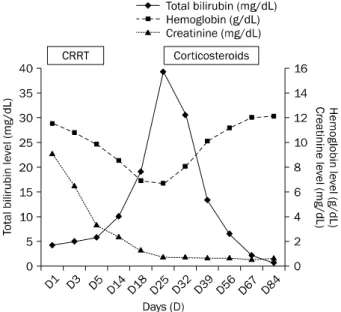
On the basis of the history and laboratory findings, acute viral hepatitis A complicated by acute kidney injury and ful- minant hepatitis was diagnosed. She was admitted to the in- tensive care unit. Urine output was less than 30 mL/hour and did not increase with furosemide administration. With sup- portive care and close monitoring of hemodynamic and renal parameters, continuous renal replacement therapy was ini- tiated. On the 5th hospital day, she was alert, and urine out- put had improved to within normal limits. Therefore, renal re- placement therapy was stopped. On the 18th hospital day, despite improvements in serum AST, ALT, and creatinine lev- els, she showed a marked increase in bilirubin levels (total 19.4 mg/dL, direct bilirubin 14.4 mg/dL). In addition, Hb de- creased to 6.9 g/dL with 0.14% reticulocytes; WBC and plate- let counts were within normal limits. Peripheral blood smear
Fig. 2. Changes in serum hemoglobin, total bilirubin, and creatinine levels during the illness. CRRT, continuous renal replacement therapy.
revealed a normochromic, normocytic anemia. Other labo- ratory values were notable for serum ferritin >2,000 ng/mL, vitamin B12 1,134 pg/mL (N: 200-950), and folate 9.47 ng/mL (N: 3-17). Haptoglobin level was normal and a direct Coombs’ test was negative. Parvovirus B19 IgM antibody was also negative. Stool occult blood was negative, and upper gastroendoscopy showed mild superficial gastritis. Bone marrow aspiration and biopsy showed a markedly elevated myeloid-erythroid ratio and the absence of red cell pre- cursors with a normal range of myeloid and megakaryocytic cells (Fig. 1). The patient was diagnosed with viral hepatitis A-associated PRCA. She received repeated blood trans- fusions with no notable response. On the 25th hospital day, prednisone therapy was initiated at a dose of 1 mg/kg/day.
Two weeks later, she gradually became transfusion-inde- pendent with a progressively increased Hb level (10.1 g/dL) and reticulocyte count (3.12%). In addition, total bilirubin lev- el decreased, reaching 10.34 mg/dL. After 4 weeks of pre- dnisolone therapy, it was tapered and stopped after 8 weeks of administration (Fig. 2). On the 24th weeks follow up, the patient remains asymptomatic with normal range of blood cell counts and liver function tests.
DISCUSSION
Improvements in the social and economic status and gen-
eral public health of Korea over the last 30 years have changed the seroprevalance pattern of hepatitis A. Seropos- itivity for anti-HAV dropped to <10% in children and adoles- cents and 20-30% in young adults, while seropositivity is greater than 90% in adults over 40 years.10 These epidemio- logic shifts led to a changing pattern of hepatitis A infection in Korea, ranging from an asymptomatic childhood infection to a increasing incidence of symptomatic disease in adults.
Hepatitis A is most often a self-limited acute illness. However, it can rarely be complicated by fulminant hepatitis and acute kidney injury, resulting in death or liver transplantation. It has been suggested that factors influencing the severity of viral hepatitis A include chronic liver disease, increasing age, heavy alcohol consumption, human immunodeficiency virus infection, and pregnancy.11,12 It also has been very rarely as- sociated with extrahepatic manifestations, such as hemato- logic abnormalities, pleural or pericardial effusion, acute re- active arthritis, acute pancreatitis, acalculous cholecystitis, mononeuritis, and Guillain-Barré syndrome.3 Many hemato- logic abnormalities can result from hepatitis A, including au- toimmune hemolytic anemia, aplastic anemia, PRCA, and au- toimmnue thrombocytopenia purpura. Hemolysis is pre- cipitated by viral hepatitis, including hepatitis A, in patients with glucose-6-phosphate dehydrogenase deficiency.13 In addition, red cell survival in the absence of an underlying red cell abnormality can be shortended by acute infectious hep- atitis (presumptive hepatitis A). Hemolysis may be auto- immune in nature, associated with antibodies to triphos- phate isomerase, and can be severe. Other hematologic ab- normalities include aplastic anemia, virus-associated hemo- phagocytic syndrome, autoimmune thrombocytopenic pur- pura, and PRCA.14,15
PRCA is a condition in which erythroid precursors in the bone marrow are nearly absent, while megakaryocytes and WBC precursors are present at normal levels.4 Erythroid pre- cursors in the bone marrow are the primary targets in PRCA.
As a result, patients can develop a normoblastic normochro- mic anemia and a virtual absence of reticulocytes. The acute form of PRCA is secondary to virus- and drug-induced impair- ment of erythroid progenitor cells. Respiratory infections, gastroenteritis, primary atypical pneumonia, infectious mon- onucleosis, mumps, and viral hepatitis may trigger PRCA.
Most cases of acute transient PRCA are caused by parvovirus B19 infection. PRCA associated with acute hepatitis A is rare,
with few cases having been reported.5-9 The mechanism of bone marrow suppression seen in many cased of viral hep- atitis has not yet been elucidated. However, several possible mechanisms underlying the pathogenesis of PRCA asso- ciated with acute viral hepatitis have been suggested, includ- ing a direct effect of the hepatitis virus on erythropoiesis, the production of an antibody or inhibitor of erythropoietin, nutri- tional deficiency related to a hepatic disorder, and cell-medi- ated autoimmune suppression of erythropoiesis.7 Cytokines such as interleukin and circulating immune complexes are thought to be the triggers of erythropoiesis suppression.16
Initial management of PRCA involves the treatment of as- sociated infections or other illness and discontinuation of of- fending drugs. An adequate Hb concentration (ranging from 8 to 10 g/dL) should be maintained with transfusion therapy.
Treatment of PRCA usually includes corticosteroids or im- munosuppressive or immunomodulating agents.17 Predni- sone induces remission in approximately 45% of cases. In adults, prednisone therapy begins at 1-2 mg/kg per orally ad- ministered daily or 4-6 weeks and is tapered gradually when no longer indicated. If the underlying cause of PRCA is im- munological and the response to corticosteroids has been in- adequate, the next level of treatment is with cytotoxic or im- munosuppressive drugs. Cyclophosphamide, 6-mercapto- purine, azathioprine, and cyclosporine have all been used.
Plasmapheresis, autologous and nonmyeloablative alloge- neic peripheral stem cell transplantation may be considered in patients who are refractory to other therapies. In the cur- rent case, following steroid administration, the level of Hb was increase to normal range within 8 weeks. There was no recurrence of hepatitis in our patient. During the admin- istration of prednisolone, there were no complications or ad- verse events in association with the immunosuppression. It would be mandatory, however, to evaluate the possibility of recurrence of hepatitis following the discontinuation of pre- dnisolone with monitoring of the clinical courses.
In conclusion, symptomatic hepatitis A in adults is cur- rently increasing. Therefore, the incidence of more severe complications, such as fulminant hepatitis and acute kidney injury, is also expected to increase. Although rare, PRCA should be suspected in hepatitis A patients with anemia and low reticulocyte count along with a normal WBC and platelet count. Our patient, a 39-year-old woman, was diagnosed with acute hepatitis A complicated by fulminant hepatitis and
acute kidney injury. In addition, she developed severe ane- mia with selective erythroid hypoplasia compatible with PRCA. Corticosteroid treatment was effective in improving clinical course of patient without replasing hepatitis.
REFERENCES
1. Jung YK, Kim JH. Epidemiology and clinical features of acute hepatitis A: from the domestic perspective. Korean J Hepatol 2009;15:438-445.
2. Kim YJ, Lee HS. Increasing incidence of hepatitis A in Korean adults. Intervirology 2010;53:10-14.
3. Jeong SH, Lee HS. Hepatitis A: clinical manifestations and management. Intervirology 2010;53:15-19.
4. Djaldetti M, Blay A, Bergman M, Salman H, Bessler H. Pure red cell aplasia--a rare disease with multiple causes. Biomed Pharmacother 2003;57:326-332.
5. Tanri R, Nishimura H, Nakamura K, et al. A case of acute hep- atitis A complicated with acute pure red cell aplasia. Nihon Naika Gakkai Zassh 1990;79:947-948.
6. Ide T, Sata M, Nouno R, Yamashita F, Nakano H, Tanikawa K.
Clinical evaluation of four cases of acute viral hepatitis compli- cated by pure red cell aplasia. Am J Gastroenterol 1994;
89:257-262.
7. Tomida S, Matsuzaki Y, Nishi M, et al. Severe acute hepatitis A associated with acute pure red cell aplasia. J Gastroenterol 1996;31:612-617.
8. Koiso H, Kobayashi S, Ueki K, et al. Pure red cell aplasia accom- panied by autoimmune hemolytic anemia in a patient with type A viral hepatitis. Rinsho Ketsueki 2009;50:424-429.
9. Chehal A, Sharara AI, Haidar HA, Haidar J, Bazarbachi A. Acute viral hepatitis A and parvovirus B19 infections complicated by pure red cell aplasia and autoimmune hemolytic anemia. J Hepatol 2002;37:163-165.
10. Song YB, Lee JH, Choi MS, et al. The age-specific seropreva- lence of hepatitis A virus antibody in Korea. Korean J Hepatol 2007;13:27-33.
11. Willner IR, Uhl MD, Howard SC, Williams EQ, Riely CA, Waters B. Serious hepatitis A: an analysis of patients hospitalized dur- ing an urban epidemic in the United States. Ann Intern Med 1998;128:111-114.
12. Kim JI, Kim YS, Jung YK, et al. Factors influencing the severity of acute viral hepatitis A. Korean J Hepatol 2010;16:295-300.
13. Abid S, Khan AH. Severe hemolysis and renal failure in glu- cose-6-phosphate dehydrogenase deficient patients with hep- atitis E. Am J Gastroenterol 2002;97:1544-1547.
14. Brown KE, Tisdale J, Barrett AJ, Dunbar CE, Young NS.
Hepatitis-associated aplastic anemia. N Engl J Med 1997;336:
1059-1064.
15. Tai CM, Liu CJ, Yao M. Successful treatment of acute hepatitis A-associated hemophagocytic syndrome by intravenous immunoglobulin. J Formos Med Assoc 2005;104:507-510.
16. Wilson HA, McLaren GD, Dworken HJ, Tebbi K. Transient pure
red-cell aplasia: cell-mediated suppression of erythropoiesis associated with hepatitis. Ann Intern Med 1980;92:196-198.
17. Charles RJ, Sabo KM, Kidd PG, Abkowitz JL. The pathophysiol-
ogy of pure red cell aplasia: implications for therapy. Blood 1996;87:4831-4838.