운동중재가 중년남성의 체성분, 혈액성상 및 건강 체력 요인에
미친 효과 크기 분석
심재근, 이소영, 김애정*
경기대학교 일반대학원 대체의학과
Meta-Analysis of the Effect of Exercise Interventions on
Body Composition, Serum Levels and Physical Activities
in Middle-Aged Men
Jae-Geun Shim, So-Young Lee, Ae-Jung Kim*
Department of Alternative Medicine Graduate School Kyonggi University
요 약 본 연구에서는 운동중재가 중년남성의 체성분, 혈액성상 및 건강 체력 요인에 미친 효과 크기를 알아보고자 최근 10년간(2011-2021년) 발표된 관련 문헌들을 수집하여 메타 분석하였다. 본 연구 목적에 부합하는 총 연구물 총 50편을 선정하여 분석한 결과 전체 효과크기는 0.506(중간 효과크기)으로 나타났다. 본 연구물에 대한 분석결과 이질성(Q값)이 695.154, Higgin's I2값이 92.951. 표준오차의 값이 0.043으로 나타나 신뢰성이 높게 나타났다. 본 연구물에 대한 처음 관측값과 보정한 관측값이 0.446으로 동일하게 나타났으며, Q 값도 656.154로 동일하게 나타 나 출판편향도 나타나지 않았다. 신체조성의 경우 체지방량과 BMI에 대한 효과크기는 각각 0.646과 0.552로 모두 중간 효과크기를 나타냈다. 건강 체력 요인의 경우 균형성과 근력에 대한 효과크기가 각각 0.713과 0.685로 모두 중간 효과크기를 보였다. 혈액성상의 경우 인슐린, LDL-콜레스테롤, 중성지방이 각각 0.710, 0.612, 0.551로 모두 중간 효과크기를 나타냈다. 운동기간의 경우 17-24주와 9-12주가 각각 0.690과 0.583으로 모두 중간 효과크기였 다. 이상의 결과를 종합해볼 때 중년남성의 경우 17-24주 동안의 운동중재가 체성분, 혈액성상 및 건강 체력 요인 에 긍정적인 영향을 미친 것으로 보인다. 차후 본 연구 결과를 바탕으로 노인기를 대비한 중년남성 맞춤형의 운동 중재 프로그램이 개발 및 보급되길 기대한다.
Abstract This study was carried out to analyze the effect sizes of exercise interventions on body composition, serum levels, and health-related physical activities in middle-aged men based on articles published in the period 2011-2021. The results of the 50 studies demonstrated a medium effect size of 0.506. In terms of heterogeneity, the Q value was 695.154, the Higgin's I2 value was 92.951, and the standard error value was 0.043, indicating high reliability. The initial observation value and the adjusted observation value were the same (0.446), (656.154), indicating that there was no publication bias for this study. In the case of body composition, the effect sizes for body fat and body mass index (BMI) were 0.646 and 0.552, respectively. For physical fitness, the medium effect sizes of balance and muscle strength were 0.713 and 0.685, respectively. In the case of blood lipids, insulin, the effect sizes of low density lipoprotein (LDL)-cholesterol, and triglycerides were 0.710, 0.612, and 0.551, respectively. In the case of experimental periods of 17-24 weeks and 9-12 weeks, the effect sizes were 0.690 and 0.583, respectively. Considered together the results of this meta-analysis showed that exercise interventions were effective in improving body composition, serum levels, and health-related physical fitness in middle-aged men. It is expected that these results would be useful in the development of exercise intervention programs for middle aged-men in the future.
Keywords : Exercise, Middle-Aged Men, Serum Levels, Body-Cmposition, Meta-Analysis
*Corresponding Author : Ae-Jung Kim(Kyonggi Univ.) email: [email protected]
Received August 2, 2021 Revised August 27, 2021 Accepted September 3, 2021 Published September 30, 2021
1. 서론
우리나라 국민의 기대수명은 2000년 76세에서 2019 년 83.3세로 꾸준히 증가하는 추세로, OECD회원국에 비해 남자는 2.2년, 여자는 2.9년만큼 기대수명이 높은 것으로 나타났다[1]. 그러나 2018년 우리나라 국민의 건 강수명이 64.4세로 기대수명 82.7세와 약 17년 정도의 갭이 나타났다[2].
21세기 들어 우리나라 국민의 평균수명은 꾸준히 증 가하고 있으나, 신체적 기능은 노화과정이 진행됨에 따 라 매년 0.75-1%의 감소 현상을 보이고 있다[3].
Nilwik 등(2013)은 노화에 따라 점진적으로 근섬유의 크기가 감소되는데, 특히, 1형(지근) 근육보다 2형(속근) 근육의 감소가 두드러지게 나타난다고 하였다[4]. 근섬유 의 손실은 근육량 감소로 이어져 골밀도의 감소와 전신 반응 속도 및 균형성 저하로 보행능력의 장애를 초래하 며 나아가 체력저하 및 만성피로를 초래하게 되어 근골 격계 질환의 원인이 된다[5]. 인간의 생애를 기준으로 중 년기는 개인을 포함하여 가족 및 사회적으로 최고의 영 향력을 행사하고, 안정된 생활을 영위하지만 과도한 업 무와 잦은 회식으로 인한 신체활동의 부족, 은퇴 후 노후 에 대한 불안 및 다양한 사회적 변화에 적응해야 하는 부 담감 등으로 신체적·정신적 건강이 쇠퇴하는 시기라고 할 수 있다[6,7]. 또한, 중년기는 신체적으로 순발력, 스 피드, 근력 등의 체력 저하와 호흡, 혈액순환, 대사질환 등의 생리적 기능이 저하되어 노화 현상이 가속되는 시 기이기도 하다[8-14].
질병관리청은 한국인의 사망원인 중 1-2위가 심혈관 계 질환이며, 중년 이후 더욱 빠르게 증가하고 있다고 보 고하였다[15].
특히, 한국 중년남성의 경우는 인구 10만 명당 심장질 환은 60.4명, 폐렴은 45.1명, 뇌혈관질환은 42명으로 중 년여성에 비해 약 3배에 가까운 사망률에 이르고 있다 [2]. 이는 중년남성의 경우 과도한 업무에 비해 낮은 빈 도의 신체활동이 가장 큰 원인으로 보여지며[6,7], 중년 남성의 근력 감소에도 영향을 미치게 된다. 근력의 저하 는 30세 이후부터 해마다 0.75-1% 정도 감소하는데, 노 화 보다 신체활동의 부족이 더 큰 원인이다[16]. 중년기 남성들의 건강한 체력은 면역력 강화와 스트레스에 대한 대비, 원만한 사회생활 등을 유지하기 위해 적절한 운동 이 반드시 필요하다[17]. 즉, 규칙적인 신체활동을 기반 으로 한 중년남성의 건강 체력은 고혈압, 당뇨병, 비만 등 대사증후군의 발병률을 낮추는 데도 중요한 요인이
된다[18,19].
그러나, 건강 체력을 갖추기 위해 운동프로그램에 참 여하는 중년남성의 60%는 운동초기 1개월 내에 운동을 포기하는 실정이고, 80.4%가 운동의 필요성을 느끼고 있 으나 운동프로그램의 참여율은 3.6%에 그치고 있다 [20,21]. 문화체육관광부에 따르면 중년남성의 경우 운 동과 스포츠 활동 등의 적극적인 신체활동에 참여하는 비율이 매우 적은 것으로 나타났다[22].
중년기 이후 규칙적인 운동을 실행하지 않으면 근력의 감소와 체지방량 증가가 빠르게 진행된다[23,24]. 근력 감소의 원인은 근 단면적 감소, 속근 섬유비율 감소, 신 체활동 감소와 같은 여러 가지 원인으로 보고되고 있다 [25]. 따라서 중년남성은 골격근 유지에 도움이 되는 운 동을 적용하여 제지방량을 증가시켜야 할 필요성이 있다 [19,26].
우리나라 성인 남성의 경우, 중년기 이후부터 신체적 기능감소를 예방 및 관리를 위한 운동중재 노력이 갱년 기 여성들에 비해 부족한 실정이다. 이로 인해 여성에 비 해 남성의 평균수명이나 기대수명이 낮은 것으로 나타났 다[5]. 그동안의 한국 중년기 운동중재 프로그램이 주로 갱년기 여성들에게 집중되어 중년남성 맞춤형 운동중재 프로그램의 실행이 매우 미비한 실정이었다.
따라서 본 연구에서는 중년남성 맞춤형 운동중재 프로 그램 개발을 위한 기초자료로 제공하고자 최근 10년간 (2011-2021년) 발표된 중년남성의 전반적인 운동의 효 과, 중년남성의 운동중재가 체성분, 혈액성상 및 건강 체 력에 미친 효과크기에 대한 연구자료를 수집하여 메타분 석을 실시하였다.
1.1 연구방법
본 연구는 운동중재가 중년남성의 체성분과 건강 체력에 미친 효과 크기를 알아보고자 메타분석(meta-analysis) 을 실시하였다. 선정된 선행 연구는 연구 설계, 연구시 기, 중년남성, 실험집단의 수, 실험기간, 운동종류, 신체 조성, 건강 체력, 혈중지질 개선에 관련된 16개의 중재변 인(BMI, LBM, 제지방량, 골 질량, 피하 및 복부지방, 허 리둘레, 근력, 균형성, 유연성, 중성지방, 총콜레스테롤, HDL, LDL, 인슐린, 염증지표, 간 손상)을 선정하여 각각 의 효과크기를 산출하였다.
1.2 문헌검색 및 선정기준
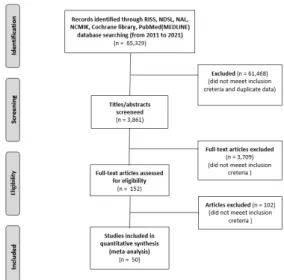
2011-2021년(10년간) 발표된 관련 문헌들은 총 65,329편이었으며, 연구의 관련성 여부에 따라 연관이
없는 내용을 제외한 3,861편을 중심으로 1차 분석을 실 시하였다. 논문 초록과 주제를 중심으로 2차 분석을 실 시하여 채택한 논문은 총 152편이었으며, 그중 연구 목 적에 부합하는 총 50편을 선정하여 종합적으로 분석하였 다(Fig. 1).
문헌 자료의 검색은 국내의 경우 한국교육학술정보서 비스(RISS), 과학기술정보통합서비스(NDSL), 국회도서 관(NAL), 국립의과학지식센터(NCMIK)를 이용하였고, 국외의 경우 Cochrane Library, PubMed (MEDLINE), Embase를 중심으로 검색하였다. 본 연구의 분석에 필요 한 자료의 선정은 PICOS 형식에 따라 설정하였다.
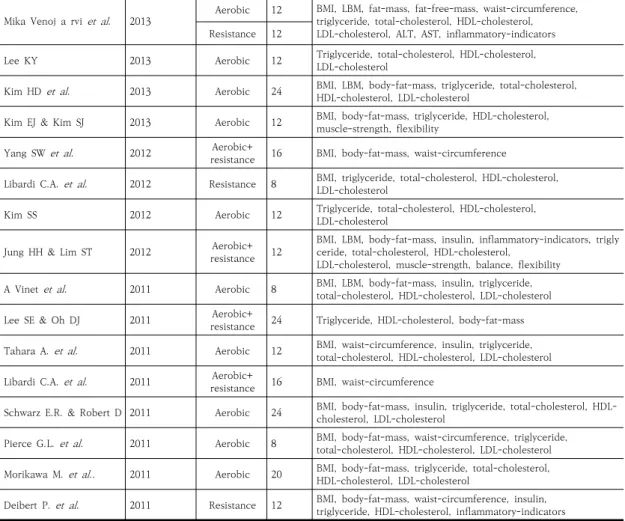
연구집단(population/participants)은 중년남성을 대상으로 실험기간과 운동중재를 실시한 실험군(case group)이며, 중재변인은 신체조성(BMI, LBM, 제지방 량, 골 질량, 피하 및 복부지방, 허리둘레), 건강체력(근 력, 균형성, 유연성), 혈중지질 개선(중성지방, 총콜레스 테롤, HDL, LDL, 인슐린, 염증지표, 간 손상)에 관련된 16개로 구성되었다. 대조군(control group)은 운동을 하지 않은 중년남성이다. 본 연구는 수량화된 평균값과 표준편차를 제시한 실험군과 대조군의 사전-사후를 비교 하는 연구로 설계되어 실험결과의 수량화된 데이터가 없 고, 그래프의 경우 평균과 표준편차가 제시되지 않은 결 과와 논문 전체를 공개하지 않거나 일부분만 제시한 경 우, 대조군이 없는 경우, 한 집단의 사전 값이나 사후의 값이 없는 경우는 분석대상에서 제외하였다. 위와 같이 제시된 선정기준과 배제기준에 의거하여 선정된 최종 연 구논문의 선정과정은 Fig. 1에 최종 선정된 연구논문의 특성은 Table 1에 제시하였다.
1.3 효과크기
효과크기(effect size)는 실험집단의 평균과 대조군의 평균을 비교한 표준점수로 두 집단 간의 차이를 통해 효 과를 판별하고, 종합한 연구결과를 비교, 해석, 통합할 수 있도록 표준화한 값이다[27,28].
실험집단과 대조군의 사전-사후를 비교하여 효과크기 를 분석하기 위해 d-family의 효과크기 산출방법을 사 용하였다. 산출된 효과크기에 대한 해석방법은 Cohen의 어림법칙에 의거하여 효과크기가 0.2-0.5이하면 작은 효 과크기, 0.5-0.7이하일 경우 중간 효과크기, 0.8 이상이 면 큰 효과크기라고 해석하였다[29]. 또한, 각각의 연구 물에서 분석된 효과크기는 95% 신뢰구간 사이에 0을 포 함하는지 확인하여 통계적 유의성을 확인하였다[27].
Fig. 1. Prisma flow diagram
1.4 이질성 검정
이질성(heterogeneity)이란 개별 연구논문에 제시된 결과의 통합된 요약 추정치를 정량적으로 분석하고, 양 적인 데이터를 하나로 통합하여 결과를 도출할 때 나타 나는 연구 간의 차이를 말한다[27,28]. 통계적인 이질성 은 개별 연구논문의 효과크기가 각각의 연구결과에 있어 차이가 있는가를 의미한다[30]. 본 연구에서는 이질성 여 부를 확인하고자 숲도표(forestplot)를 통해 신뢰구간을 확인하였고, 정확성을 위해 Cochran’s Q 검정(카이제 곱 검정법) 및 Higgin's I2 statistics로 확인하였다[30].
1.5 출판편향
출판편향(publication bias)이란 체계적 오류(systematic error)로서 통계적으로 유의한 연구결과의 연구물들이 분석 시 높게 포함되는 경향을 말한다[30]. 즉, 출판된 연 구들만 종합하여 분석하면 결과가 왜곡될 수 있다는 것 을 의미한다. 본 연구에서는 출판편향을 확인하고자 깔 대기도표(funnel plot)와 trim-and-fill 기법, 안전성 계 수 검증법 등을 사용하였다[31].
1.6 통계분석
본 연구에서는 운동중재가 중년남성의 체성분과 건강 체력에 미친 효과 크기를 분석하고자 Biostat (Englewood, USA)사가 개발한 메타분석 전문프로그램인 CMA3 (comprehensive meta-analysis version 3)를 사용하 였다. 먼저 표준화된 평균의 차이(standardized mean
Author Publication
year Exercise Week Variable
Zdzieblik D. et al. 2021 Resistance 12 Fat-free-mass, bon-mass, waist-circumference, muscle-strength Razi O. et al.. 2021 Aerobic 8 Triglyceride, HDL-cholesterol, LDL-cholesterol
Bagheri R. et al. 2020 Aerobic 8 BMI, body-fat-mass
Poon E.T. et al. 2020 Aerobic 8 BMI, waist-circumference, fat-free-mass, total-cholesterol, triglyceride, HDL-cholesterol, LDL-cholesterol
Kim JJ 2020 Aerobic 12 Fat-free-mass, muscle-strength, balance, flexibility
Yun SJ 2019 Aerobic 12 BMI, fat-free-mass, total-cholesterol, triglyceride, HDL-cholesterol, LDL-cholesterol
Bagheri R. et al. 2019 Resistance 8 BMI, LBM, body-fat-mass, bon-mass, muscle-strength
Kim JH 2018 Aerobic 1 Fat-free-mass, muscle-strength, flexibility, total-cholesterol, trig lyceride, HDL-cholesterol, LDL-cholesterol
Wittke A. et al. 2017 Resistance 22 LBM, body-fat-mass, muscle-strength
Motiani P. et al. 2017 Aerobic 2 BMI, body-fat-mass, waist-circumference, insulin, total-cholesterol, triglyceride, HDL-cholesterol, LDL-cholesterol, inflammatory-indicators
Lee KS et al. 2017 Aerobic 8 BMI, LBM, body-fat-mass, total-cholesterol, triglyceride, HDL-c holesterol, LDL-cholesterol, inflammatory-indicators
An YJ et al. 2017 Aerobic+
resistance 8 BMI, body-fat-mass, muscle-strength, balance, flexibility
Yun SJ 2017 Aerobic+
resistance 8 Body-fat-mass, bon-mass, total-cholesterol, triglyceride, HDL-cholesterol, LDL-cholesterol
Joshua H. F. Cooper et a
l. 2016 Aerobic 12 Fat-free-mass, body-fat-mass, inflammatory-indicators
Mora-Rodríguez R. et al. 2016 Aerobic 16 BMI, waist-circumference, fat-free-mass, body-fat-mass Kemmler W. et al. 2016 Resistance 16 Waist-circumference, body-fat-mass, triglyceride,
HDL-cholesterol
Aatashak S. et al. 2016 Aerobic+
resistance 8 BMI, body-fat-mass, waist-circumference, triglyceride, HDL-cholesterol, LDL-cholesterol
Schreuder T.H.A. et al. 2015 Resistance 8 BMI, insulin, triglyceride, HDL-cholesterol, LDL-cholesterol Heo DS et al. 2015 Aerobic 12 BMI, insulin, ALT, AST, inflammatory-indicators,
muscle-strength, balance, flexibility Brunelli D.T. et al.. 2015 Aerobic+
resistance 24 BMI, waist-circumference, fat-free-mass, body-fat-mass Eskelinen J. et al. 2015 Resistance 2 BMI, insulin, fat-free-mass, body-fat-mass, total-cholesterol Zilinski J.L. et al. 2015 Aerobic 18 Triglyceride, total-cholesterol, HDL-cholesterol, LDL-cholesterol,
inflammatory-indicators
Lee JM & Lee SE 2015 Aerobic 12 Fat-free-mass, body-fat-mass, triglyceride, total-cholesterol, HDL -cholesterol, LDL-cholesterol
Nishiwaki M. et al. 2015 Aerobic 4 BMI, body-fat-mass, fat-free-mass, muscle-strength Mendham A.E. et al.. 2014 Aerobic 8 BMI, inflammatory-indicators
Arsalan D. et al. 2014 Aerobic 8 Waist-circumference, insulin, triglyceride, HDL-cholesterol Liira H. et al. 2014 Aerobic 12 Triglyceride, total-cholesterol, HDL-cholesterol, LDL-cholesterol Mair J.L. et al. 2014 Aerobic 10 BMI, body-fat-mass, fat-free-mass
Cho SB 2014 Resistance 12 BMI, body-fat-mass, insulin
Kim JK 2014 Aerobic 12 Body-fat-mass, muscle-strength
Kim JD 2014 Aerobic 12 BMI, body-fat-mass, triglyceride, total-cholesterol, HDL-cholesterol, LDL-cholesterol
Paoli A. et al. 2013 Aerobic 12 Total-cholesterol, HDL-cholesterol, LDL-cholesterol Lee CW et al. 2013 Aerobic 8 BMI, triglyceride, total-cholesterol, HDL-cholesterol,
LDL-cholesterol Table 1. Total exercise effect size of middle-aged men
Mika Venoj a rvi et al. 2013 Aerobic 12 BMI, LBM, fat-mass, fat-free-mass, waist-circumference, triglyceride, total-cholesterol, HDL-cholesterol, LDL-cholesterol, ALT, AST, inflammatory-indicators Resistance 12
Lee KY 2013 Aerobic 12 Triglyceride, total-cholesterol, HDL-cholesterol,
LDL-cholesterol
Kim HD et al. 2013 Aerobic 24 BMI, LBM, body-fat-mass, triglyceride, total-cholesterol, HDL-cholesterol, LDL-cholesterol
Kim EJ & Kim SJ 2013 Aerobic 12 BMI, body-fat-mass, triglyceride, HDL-cholesterol, muscle-strength, flexibility
Yang SW et al. 2012 Aerobic+
resistance 16 BMI, body-fat-mass, waist-circumference
Libardi C.A. et al. 2012 Resistance 8 BMI, triglyceride, total-cholesterol, HDL-cholesterol, LDL-cholesterol
Kim SS 2012 Aerobic 12 Triglyceride, total-cholesterol, HDL-cholesterol,
LDL-cholesterol Jung HH & Lim ST 2012 Aerobic+
resistance 12 BMI, LBM, body-fat-mass, insulin, inflammatory-indicators, trigly ceride, total-cholesterol, HDL-cholesterol,
LDL-cholesterol, muscle-strength, balance, flexibility A Vinet et al. 2011 Aerobic 8 BMI, LBM, body-fat-mass, insulin, triglyceride,
total-cholesterol, HDL-cholesterol, LDL-cholesterol Lee SE & Oh DJ 2011 Aerobic+
resistance 24 Triglyceride, HDL-cholesterol, body-fat-mass Tahara A. et al. 2011 Aerobic 12 BMI, waist-circumference, insulin, triglyceride,
total-cholesterol, HDL-cholesterol, LDL-cholesterol Libardi C.A. et al. 2011 Aerobic+
resistance 16 BMI, waist-circumference
Schwarz E.R. & Robert D 2011 Aerobic 24 BMI, body-fat-mass, insulin, triglyceride, total-cholesterol, HDL- cholesterol, LDL-cholesterol
Pierce G.L. et al. 2011 Aerobic 8 BMI, body-fat-mass, waist-circumference, triglyceride, total-cholesterol, HDL-cholesterol, LDL-cholesterol Morikawa M. et al.. 2011 Aerobic 20 BMI, body-fat-mass, triglyceride, total-cholesterol,
HDL-cholesterol, LDL-cholesterol
Deibert P. et al. 2011 Resistance 12 BMI, body-fat-mass, waist-circumference, insulin, triglyceride, HDL-cholesterol, inflammatory-indicators
difference, SMD)를 분석하여 신뢰도 검증을 하였다.
이질성을 검정하기 위해 Q 검정(cochran’s Q-statistics) 을 한 후 p값이 0.001보다 작은 것을 확인하고, Higgin’s I2 값으로 효과크기를 판단한 후 랜덤효과 모형 을 선택하여 조정된 분석결과를 최종분석 자료로 사용하 였다.
2. 본론
2.1 중년남성의 운동중재에 대한 전체 효과크기 중년남성의 운동중재에 대한 연구물의 편수는 총 50 편, 사례 수는 596개로 산출되었으며, 연구단위로 분석 한 연구의 수는 총 50개였다. 연구물에 대한 효과 크기의 분석결과는 Table 2에 제시하였다. 중년남성의 운동중 재에 대한 연구결과는 0.506으로 중간 효과 크기였다.
95% 신뢰구간의 범위는 0.420-0.591로 0을 포함하지 않아 통계적으로 유의하였다.
K1) ES2) 95% CI3) Q4) p-value I2 5) SE6) 50 0.506 0.420-0.591 695.154 p<0.001 92.951 0.043
1)K: Number of study, 2): Effect size (point estimate), low=0.2-0.5, middle=0.5-0.7, high=over 0.8,
3)CI: Confidence interval, 4)Q: Q statistics,
5)I2: Higgin’s I2 statistics, 6)SE: Standard error.
Table 2. Total exercise effect size of middle-aged men
2.2 이질성
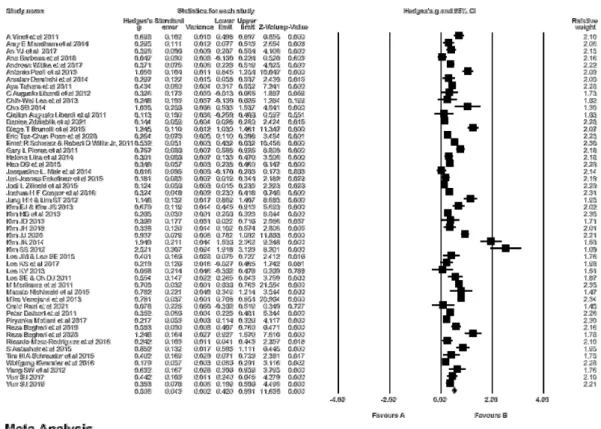
연구단위로 분석한 50편의 논문에 대한 이질성은 Table 3에 숲도표(forest plot)는 Fig. 2에 제시한 바와 같다. Q 검정을 실시한 결과 Q 값이 695.154, Higgin's
Fig. 2. Forest plot of meta-analysis of overall exercise intervention in middle-aged men I2 값이 92.951로 각각의 연구가 이질성이 있다고 확인
되었다. 이질성의 확인으로 랜덤효과모형(random effect model)을 선택하여 효과크기를 분석하였다. 숲 도표(forest plot)를 살펴보면, 95% 신뢰구간이 각각의 연구들 간에 겹치지 않고, 상한값과 하한값의 범위에 0 을 포함하지 않아 통계적으로 유의하였다. 또한, 표준오 차의 값이 0.043으로 크기가 작아 총 50편의 연구에 대 한 신뢰성도 높았다.
Studies trimmed Point
estimate
95% CI1)
Q2) SE3) Lower
limit Upper limit Observed
values - 0.446 0.425 0.467 656.154 0.043
Adjusted
values 0 0.446 0.425 0.467 656.154 0.043
1)CI: Confidence interval, 2)Q: Q statistics,
3)SE: Standard error.
Table 3. Duval and Tweedie’s trim and fill test results
2.3 중년남성의 운동중재에 대한 연구의 출판편향 본 연구결과에 대한 타당성을 확보하기 위한 출판편향 은 깔대기도표(funnel plot)를 통해 Fig. 3에 제시하였 다. 깔대기도표를 살펴보면, 연구결과의 효과크기가 대 부분 깔대기도표의 윗부분에 분포하여, 연구물들 간의 신뢰성이 높은 것을 알 수 있다. 그러나 깔대기도표를 통 한 출판편향을 확인하는 것은 시각적인 판단이기 때문에 타당도를 저해할 수 있다. 따라서 정확한 분석을 위해 Duval과 Tweedie’s trim-and-fill 기법으로 추가 분석 한 결과를 Table 2에 제시하였다. 처음 관측값과 보정한 관측값이 0.446으로 동일하며, Q 값도 656.154로 동일 하여 본 연구물에 대한 출판편향은 없는 것으로 나타났다.
2.4 중년남성의 운동 중재변인 중 신체조성에 대한 효과크기
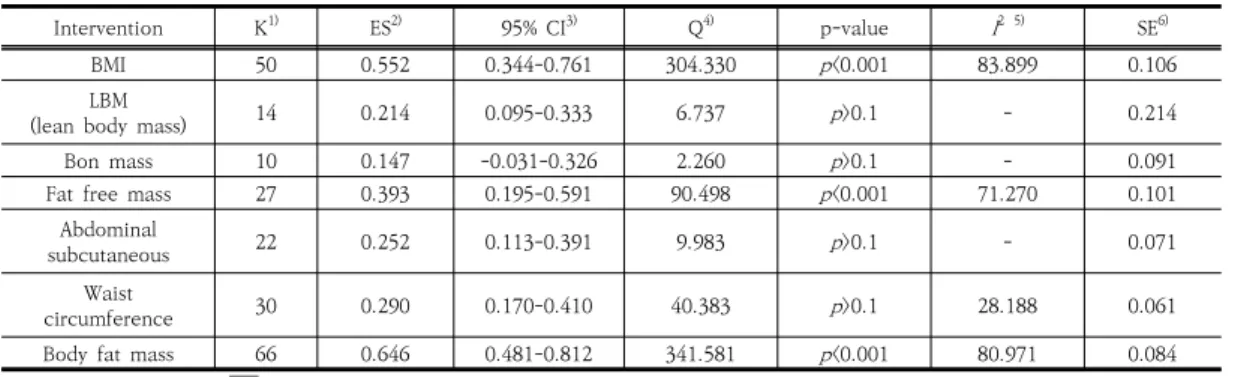
중년남성의 운동 중재변인 중 신체조성은 BMI, LBM (lean body mass), 골 질량(bon mass), 제지방량(fat free mass), 피하 및 복부지방(abdominal subcutaneous), 허리둘레(waist circumference), 체지방량(body fat
Intervention K1) ES2) 95% CI3) Q4) p-value I2 5) SE6)
BMI 50 0.552 0.344-0.761 304.330 p<0.001 83.899 0.106
(lean body mass)LBM 14 0.214 0.095-0.333 6.737 p>0.1 - 0.214
Bon mass 10 0.147 -0.031-0.326 2.260 p>0.1 - 0.091
Fat free mass 27 0.393 0.195-0.591 90.498 p<0.001 71.270 0.101
Abdominal
subcutaneous 22 0.252 0.113-0.391 9.983 p>0.1 - 0.071
Waist
circumference 30 0.290 0.170-0.410 40.383 p>0.1 28.188 0.061
Body fat mass 66 0.646 0.481-0.812 341.581 p<0.001 80.971 0.084
1)K: Number of study, 2): Effect size(point estimate), low=0.2-0.5, middle=0.5-0.7, high=over 0.8,
3)CI: Confidence interval, 4)Q: Q statistics, 5)I2: Higgin’s I2 statistics, 6)SE: Standard error.
Table 4. The exercise effects size of middle-aged men by body composition (a)
(b)
Fig. 3. Funnel plot for evaluation of publication bias on overall exercise intervention studies of in middle-aged men: (a) Observed values (b) Adjusted values
Intervention K1) ES2) 95% CI3) Q4) p-value I2 5) SE6)
Muscle strength 31 0.685 0.500-0.870 37.606 p<0.1 20.226 0.094
Balance 28 0.713 0.557-0.869 28.542 p<0.1 5.402 0.080
Flexibility 11 0.403 0.178-0.627 6.336 p>0.1 - 0.114
1)K: Number of study, 2): Effect size(point estimate), low=0.2-0.5, middle=0.5-0.7, high=over 0.8,
3)CI: Confidence interval, 4)Q: Q statistics, 5)I2: Higgin’s I2 statistics, 6)SE: Standard error.
Table 5. The exercise effects size of middle-aged men by physical activities
mass)으로 분류하였고, 효과크기의 분석결과는 Table 4 에 제시하였다. 중재변인의 종류에 따른 효과크기의 사 례 수는 BMI가 50개, LBM이 14개, 골질량이 10개, 제 지방량이 27개, 피하 및 복부지방이 22개, 허리둘레가 30개, 체지방량이 66개였으며, 효과크기의 총 사례 수는 219개였다.
2.5 중년남성의 운동 중재변인 중 건강 체력 요인에 대한 효과크기
중년남성의 운동 중재변인 중 건강 체력은 근력 (muscle strength), 균형성(balance), 유연성(flexibility) 으로 분류하였고, 효과크기의 분석결과는 Table 5에 제 시하였다. 중재변인의 종류에 따른 효과크기의 사례 수 는 근력이 31개, 균형성이 28개, 유연성은 11개였으며, 효과크기의 총 사례 수는 86개였다.
중년남성의 운동 중재변인 중 균형성의 효과가 0.713 으로 중간 효과크기였다. 그 다음으로 근력이 0.685로 중간 효과크기를 보였다. 유연성은 0.403의 낮은 효과크 기였다. 즉, 중년남성의 경우 운동을 꾸준히 하면 근력과 균형성이 향상되는 것을 알 수 있었다.
Intervention K1) ES2) 95% CI3) Q4) p-value I2 5) SE6)
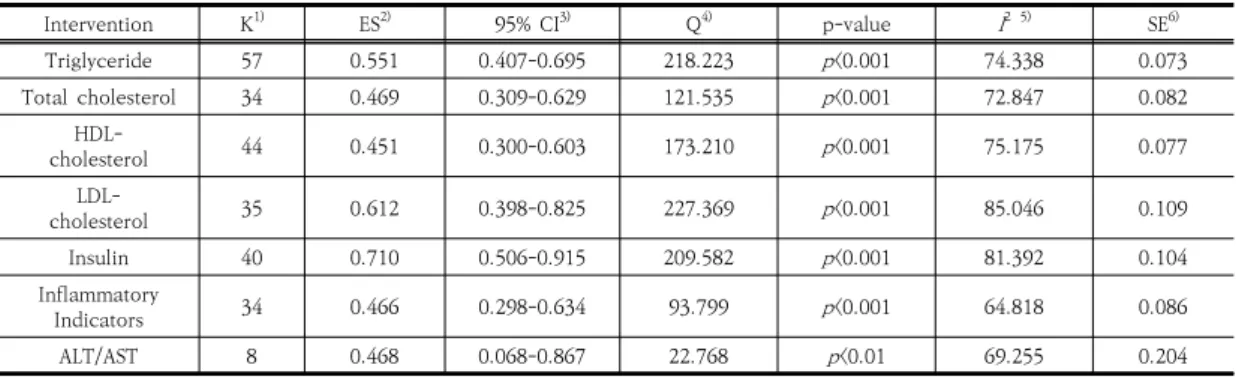
Triglyceride 57 0.551 0.407-0.695 218.223 p<0.001 74.338 0.073
Total cholesterol 34 0.469 0.309-0.629 121.535 p<0.001 72.847 0.082
cholesterolHDL- 44 0.451 0.300-0.603 173.210 p<0.001 75.175 0.077
cholesterolLDL- 35 0.612 0.398-0.825 227.369 p<0.001 85.046 0.109
Insulin 40 0.710 0.506-0.915 209.582 p<0.001 81.392 0.104
Inflammatory
Indicators 34 0.466 0.298-0.634 93.799 p<0.001 64.818 0.086
ALT/AST 8 0.468 0.068-0.867 22.768 p<0.01 69.255 0.204
1)K: Number of study, 2): Effect size(point estimate), low=0.2-0.5, middle=0.5-0.7, high=over 0.8,
3)CI: Confidence interval, 4)Q: Q statistics, 5)I2: Higgin’s I2 statistics, 6)SE: Standard error.
Table 6. The exercise effects size of middle-aged men by serum lipids levels
Weeks K1) ES2) 95% CI3) Q4) p-value I2 5) SE6)
1-8 239 0.448 0.387-0.508 394.824 p<0.001 39.720 0.031
9-12 254 0.583 0.509-0.658 937.456 p<0.001 73.012 0.038
13-16 34 0.237 0.148-0.325 28.030 p>0.1 - 0.045
17-24 63 0.690 0.558-0.822 768.351 p<0.001 91.931 0.067
1)K: Number of study, 2): Effect size(point estimate), low=0.2-0.5, middle=0.5-0.7, high=over 0.8,
3)CI: Confidence interval, 4)Q: Q statistics, 5)I2: Higgin’s I2 statistics, 6)SE: Standard error.
Table 7. The exercise effects size of middle-aged men by weeks
2.6 중년남성의 운동 중재변인 중 혈액 성상에 대한 효과크기
중년남성의 운동 중재변인 중 혈액 성상은 중성지방 (triglyceride), 총 콜레스테롤(total cholesterol), HDL-콜레스테롤(HDL-cholesterol), LDL-콜레스테롤 (LDL-cholesterol), 인슐린(insulin), 염증지표 (inflammatory indicators), 간손상(ALT/AST)으로 분 류하였고, 효과크기의 분석결과는 Table 6에 제시하였 다. 중재변인의 종류에 따른 효과크기의 사례 수는 중성 지방이 57개, 총 콜레스테롤이 34개, HDL-콜레스테롤 이 44개, LDL-콜레스테롤이 35개, 인슐린이 40개, 염증 지표가 34개, 간세포 손상(ALT/AST)이 8개였으며, 효과 크기의 총 사례 수는 252개였다.
중년남성의 운동 중재변인 중 혈액 성상에 대한 효과 크기의 결과는 다음과 같다(Table 6). 혈액 성상의 항목 중 인슐린의 수치가 개선되는 효과가 가장 높았으며, 0.710의 중간 효과크기를 보였다. 그 다음으로 LDL-콜 레스테롤과 중성지방이 향상되었으며, 각각 0.612, 0.551 로 중간 효과크기였다. 총 콜레스테롤(0.469), HDL-콜 레스테롤(0.451), 염증지표(0.466), 간손상(0.468)은 낮 은 효과크기였다. 즉, 중년남성의 경우 운동을 꾸준히 하
면 인슐린과 LDL-콜레스테롤이 가장 많이 향상되는 것 을 알 수 있었다. 즉, 운동중재가 중년남성의 인슐린 수 치와 LDL-콜레스테롤 수치 개선에 효과적임을 알 수 있 었다.
2.7 중년남성의 운동 중재변인 중 운동 기간에 대한 효과크기
중년남성의 운동 중재변인 중 운동 기간은 1-8주, 9-12주, 13-16주, 17-24주로 분류하였고, 효과크기의 분석결과는 Table 7에 제시하였다. 운동 기간에 따른 효 과크기의 사례 수는 1-8주가 239개, 9-12주가 254개, 1-8주가 34개, 17-24주가 63개 였으며, 효과크기의 총 사례 수는 590개였다.
중년남성의 운동 중재변인 중 운동 기간에 대한 효과 크기의 결과는 다음과 같다. 중년남성의 체성분과 체력 의변화를 가장 많이 볼 수 있는 운동기간은 17-24주였 으며, 0.690으로 중간 효과크기를 보였다. 그 다음으로 9-12주가 0.583으로 중간 효과크기였다.
1-8주와 13-16주는 각각 0.448, 0.237로 낮은 효과 크기였다. 위의 결과를 볼 때 중년남성이 운동을 꾸준히 하여 체성분과 체력의 변화를 확인할 수 있는 기간은
12-24주 동안 지속적으로 운동해야 한다는 것을 알 수 있었다.
3. 결론
본 연구에서는 최근 10년간(2011-2021년) 발표된 중 년남성의 전반적인 운동의 효과, 중년남성의 운동중재가 체성분, 혈액성상 및 건강 체력 요인에 미친 효과크기에 대한 연구자료를 수집하여 메타분석을 실시하였다. 총 50편의 연구물에 대한 전체 효과크기는 0.506으로 중간 효과크기였다. 연구단위로 분석한 20편의 논문에 대한 Q 값은 695.154, Higgin's I2 값은 92.951로 각각의 연 구가 독립적인 연구임이 확인되었다. 95% 신뢰구간이 각각의 연구들 간에 겹치지 않고, 상한값과 하한값의 범 위에 0을 포함하지 않아 통계적으로 유의하였으며, 표준 오차의 값이 0.043으로 신뢰성도 높았다. 처음 관측값과 보정한 관측값이 0.446으로 동일하며, Q 값도 656.154 로 동일하여 본 연구물에 대한 출판편향은 없었다.
신체조성에 대한 효과크기는 체지방량에 대한 효과가 변인들 중 가장 높게 나타났으며, 0.646으로 중간 효과 크기를 보였다. 그 다음으로 BMI가 0.552로 중간 효과 크기를 나타냈다.
건강 체력 요인에 대한 효과크기는 균형성의 효과가 가장 높은 것으로 나타났으며, 0.713으로 중간 효과크기 였다. 그 다음으로 근력이 0.685로 중간 효과크기를 보 였다. 유연성은 0.403의 낮은 효과크기였다.
혈액성상에 대한 효과크기는 인슐린의 수치가 개선되 는 효과가 가장 높았으며, 0.710의 중간 효과크기를 보 였다. 그 다음으로 LDL-콜레스테롤과 중성지방이 향상 되었으며, 각각 0.612, 0.551로 중간 효과크기를 나타냈다.
운동기간에 대한 효과크기는 17-24주였으며, 0.690 으로 중간 효과크기를 보였다. 그 다음으로 9-12주가 0.583으로 중간 효과크기였다. 1-8주와 13-16주는 각 각 0.448, 0.237로 낮은 효과크기였다.
이와 같이 운동중재가 중년남성의 체성분(체지방량과 BMI), 혈액성상(인슐린과 LDL-콜레스테롤) 및 건강 체 력 요인(근력과 균형성)에 긍정적인 효과를 미쳤으며, 운 동중재 효과가 가장 크게 나타난 운동 기간은 17-24주 로 나타났다. 단, 운동 종류(저항운동, 유산소 운동, 복합 운동)에 대한 효과크기는 연구물의 편수부족으로 분석할 수 없었다.
결론적으로 중년기부터 중년남성이 꾸준히 운동중재
프로그램에 참여한다면 체성분, 혈액성상 및 건강 체력 요인이 향상되어 노인기에 접어들어도 건강체력 유지에 도움이 될 것으로 생각된다.
차후, 운동종류에 대한 효과크기를 분석할 수 있는 많 은 수의 연구가 지속되길 바라며, 본 연구결과를 바탕으 로 노인기를 대비한 중년남성 맞춤형의 운동중재 프로그 램이 개발 및 보급되길 기대한다.
References
[1] KOSTAT, Life expectancy by health level, KOSTAT, 2020 [cited 2020 Oct. 20], Available From:
https://kosis.kr/statHtml/statHtml.do?orgId=101&tblId
=DT_1B46&conn_path=I3 accessed May 09, 2021) [2] KOSTAT, Life expectancy (life expectancy of 0 years)
and life expectancy excluding prevalence period (health life expectancy), KOSTAT, 2021 [cited 2021 Jan. 13], Available From:
http://www.index.go.kr/potal/main/EachDtlPageDetai l.do?idx_cd=2758 accessed Mar. 20, 2021)
[3] J. A. Faulkner, L. M. Larkin, D. R. Claflin, S. V.
Brooks, “Age-related changes in the structure and function of skeletal muscles”, Clinical and experimental pharmacology & physiology, Vol.34, No.11, pp.1091-1096, Nov. 2007.
DOI: https://dx.doi.org/10.1111/j.1440-1681.2007.04752.x [4] R. Nilwik, T. Snijders, M. Leenders, B.B.L. Groen, J.
van Kranenburg, L.B. Verdijk, L.J.C. van Loon, “The decline in skeletal muscle mass with aging is mainly attributed to a reduction in type II muscle fiber size”, Experimental Gerontology, Vol.48, pp.492-498, Feb.
2013.
DOI: https://dx.doi.org/10.1016/j.exger.2013.02.012 [5] S. K. Park, J. H. Park, “The effects of aerobic exercise
on heart function and enzyme in obesity women”, The Korean Journal of Physical Education, Vol.40, No.3, pp.719-729, May 2001.
[6] R. S. Paffenbarger Jr., R. T. Hyde, A. L. Wing, C. C.
Hsieh, “Physical activity, all-cause mortality, and longevity of college alumni”, The New England journal of medicine, Vol.314, No.10, pp.605-613, Mar. 1986.
DOI: https://dx.doi.org/10.1056/NEJM198603063141003 [7] S. B. Choi, S. G. Ko, Women's health and exercise,
p.150, Hongseong, 2001, pp.1-150
[8] H. K. Jo, W. H. Lee, “Effect of regular swimming and walking exercise on body composition and physical fitness in obese middle-aged women”, Korea Sport Research, Vol.17, No.6, pp.73-82, Dec. 2006.
[9] K. H. Kwon, “Variables related to sense of crisis in middle-aged men”, Journal of Korean Academy of Nursing Conference, Journal of Korean Academy of
Nursing, Daegu, Korea, Vol.2004, No.5, p.157, May 2004.
[10] G. S. Ko, Study on the psychological crisis of middle-aged men, Ph.D dissertation, Sungkyunkwan University, Seoul, Korea, pp.116-133, 2003.
[11] G. H. Park, Study on the correlation between the meaning of life and the mental health of middle-aged males of the korean society, Master's thesis, Ewha Women University, Seoul, Korea, pp.68-75, 2004.
[12] J. J. Kim, “PADAM (Partial Androgen Deficiency in the Aging Male) and hormone replacement therapy”, The World Journal of Men's Health, Vol.22 No.2, pp.45-51, Aug. 2004.
[13] S. Y. Lee, Maintaining health of middle-aged men : Based on grounded theory methods, Master's thesis, Hallym University, Chuncheon, Korea, pp.114-120, 2003.
[14] Y. S. Lee, A study on middle-aged men's life Insecurity and provision for their old age, Master's thesis, Dongguk University, Seoul, Korea, pp.1-174, 2005.
[15] KDCA, Main results of the Korean national health and nutrition examination survey (chronic disease), KDCA, Available From:
https://knhanes.kdca.go.kr/knhanes/sub01/sub01_05_
02.jsp#s5_02 (accessed Mar. 21, 2021)
[16] H. S. Kim, C. G. Jung, G. S. Lee, “The effect of strengthening exercise program on the physical activity, activities of daily living, social behavior and functional performance of the elderly in a home for the aged”, Journal of Preventive Medicine and Public Health, Vol.35 No.2, pp.107-115, May 2002.
[17] D. J. Oh, H. J. Kim, “The effects of rhythmic Taekwondo exercise on physical fitness and blood lipids on obesity in middle school girls”, Journal of Korean Physical Education Association for Girls and Women, Vol.21 No.2, pp.1-12, Apr. 2007.
[18] ACSM, ACSM’s Guidelines for exercise testing and prescription. 11th ed., p.339, Wolters Kluwer Health, 2020, pp.211-222
[19] S. W. Jo, B. Y. Park, B. K. Lee, “The study on body composition and healthrelated physical fitness in public servants of middle-aged men for long serving”, The Korean Society of Sports Science, Vol.20, No.4, pp.799-808, Aug. 2011.
[20] K. P. Scott, Total finess and wellness 8th ed., p.423, Benjamine Cummings, 2019, pp.185-214
[21] H. G. Seok, “A study on the dietary habits and exercise behavior change in salaried workers”, The Korean Journal of Physical Education, Vol.48 No.4, pp.655-662, July 2009.
[22] Culture and Sports Ministry, National leisure activities survey, p.261, Jinjin M&B publishing, 2014, pp.1-261 [23] Y. S. Jung, “The differences of adults male and female
for fast twitch muscle(%)decrement with changes according to isokinetic leg muscle strength”, Journal of Sport and Leisure Studies, Vol.0 No.31, pp.1247-1256, Nov. 2007.
DOI: https://dx.doi.org/10.51979/KSSLS.2007.11.31.1247 [24] H. M. Kim, “The effects of resistance training on muscle strength and on thigh in older men”, Korean Society for the Study of Physical Education, Vol.8 No.3, pp.167-175, Dec. 2003.
[25] A. Aniansson, M. Hedberg, G. B. Henning, G. Grimby,
“Muscle morphology, enzymatic activity, and muscle strength in elderly: A follow-up study”, Muscle and nerve, Vol.9, No.7, pp.585-591, Sep. 1986.
DOI: https://dx.doi.org/10.1002/mus.880090702 [26] R. R. Kalyani, Y. Tra, H. C. Yeh, J. M. Egan, L.
Ferrucci, F. L. Brancati, “Quadriceps strength, quadriceps power, and gait speed in older U.S. adults with diabetes mellitus: Results from the National Health and Nutrition Examination Survey, 1999-2002”, Journal of the American Geriatrics Society, Vol.61, No.5, pp.769-775, Apr. 2013.
DOI: https://dx.doi.org/10.1111/jgs.12204
[27] S. K. Myung, W. Ju, D. D. McDonnell, Y. J. Lee, G.
Kazinets, C. T. Cheng, J. M. Moskowitz, “Mobile phone use and risk of tumors: A meta-analysis”, Journal of Clinical Oncology, Vol.27, No.33, pp.5565-5572, Nov. 2009.
DOI: https://doi.org/10.1200/JCO.2008.21.6366 [28] H. Kang, “Statistical considerations in meta-analysis”,
Hanyang Medical Reviews, Vol.35, No.1, pp.23-32, Feb. 2015.
DOI: https://doi.org/10.7599/hmr.2015.35.1.23 [29] S. H. Yoon, A meta-analysis on the relationship
between principals' leader-ship and teachers' job satisfaction, Ph.D dissertation, Korea National University of Education, Cheongju, Korea, pp.50-54, 2017
[30] K. Dickersin, “The existence of publication bias and risk factors for its occurrence”, Journal of the American Medical Association, Vol.263, No.10, pp.1385-1389, Mar. 1990.
DOI: https://doi.org/10.1001/jama.1990.03440100097014 [31] S. Duval, R. Tweedie, “Trim and fill: A simple
funnel-plot-based method of testing and adjusting for publication bias in meta-analysis”, Biometrics, Vol.56, No.2, pp.455-463, June 2000.
DOI: https://doi.org/10.1111/j.0006-341x.2000.00455.x
심 재 근(Jae-Geun Shim) [정회원]
• 2003년 2월 : 대전대학교 건축공 학과 (건축공학사)
• 2010년 2월 : 경기대학교 스포츠 과학대학원 스포츠재활전공 (스포 츠재활석사)
• 2017년 2월 : 경기대학교 일반대 학원 대체의학과 박사수료
• 2018년 8월 : 한국방송통신대학교 생활과학부 식품영양 학전공 (식품영양학사)
• 2015년 8월 ~ 현재 : CJ 미래경영연구원
<관심분야>
스포츠재활, 임상운동, 기능성식품
이 소 영(So-Young Lee) [정회원]
• 2002년 2월 : 영남대학교 가정관 리학과 (생활과학학사)
• 2004년 2월 : 영남대학교 일반대 학원 가정학과 조리및주거학전공 (생활과학석사)
• 2017년 8월 : 경기대학교 대체의 학대학원 식품치료전공 (대체의학
• 2020년 8월 : 경기대학교 일반대학원 대체의학과 (대체의석사) 학박사)
• 2021년 9월 ~ 현재 : 경기대학교 대체의학대학원 강사
<관심분야>
임상영양, 기능성식품, 식문화
김 애 정(Ae-Jung Kim) [정회원]
• 1986년 2월 : 숙명여자대학교 식 품영양학과 (가정학 학사)
• 1988년 8월 : 숙명여자대학교 자 연과학대학원 식품영양학과 (가정 학 석사)
• 1992년 8월 : 숙명여자대학교 자 연과학대학원 식품영양학과 (이학
• 1993년 3월 ~ 2011년 8월 : 혜전대학교 식품영양과 교수박사)
• 2011년 9월 ~ 현재 : 경기대학교 대체의학대학원 교수
<관심분야>
임상영양, 기능성식품, 식문화