369
Antifibrotic activity a fermentation filtrate of Ganoderma lucidum
Sang-Chul Kwon
1, Yun-Bae Kim
2*
1
Food Safety Support Organization, Korea Food Industry Association, Seoul, Korea
2
College of Veterinary Medicine, Chungbuk National University, Cheongju, Korea
The effects of a fermentation filtrate of Ganoderma lucidum (FGL) on carbon tetrachloride (CCl
4)-induced hepatic fibrosis were investigated in rats. Male Sprague-Dawley rats were orally administered with FGL (20 or 100 mg/kg) for 33 days, and orally administered with CCl
4(1.0 mL/kg; 2 mL/kg of 50% in corn oil) at 3-day intervals 1 h after FGL treatment. Body and liver weights, blood and histopathological findings in accordance with hydroxyproline concentrations were analyzed. Chronic exposure to CCl
4reduced the body weight gain, but increased liver weights and fibrosis, resulting in 3.35-fold increase in hydroxyproline level. Although FGL did not significantly reduce the CCl
4-induced body and liver weight changes, it attenuated the increases in the hepatic fibrosis and hydroxyproline contents. Taken together, it is suggested that FGL might prevent hepatic fibrosis, and that FGL or its ingredient could be a potential candidate for the prevention of chronic hepatic disorders.
Key words: Carbon tetrachloride (CCl
4), hepatic fibrosis, Ganoderma lucidum, fermentation filtrate
Hepatitis, a high incidence ailment in modern societies, is caused by hepatitis viruses, chronic alcohol intake, lipid peroxidative products and various drugs [1]. Chronic liver injury results in hepatic fibrosis and end stage cirrhosis. This is one of the major public health problems, related to life- threatening complications of portal hypertension, liver failure and finally increased incidence of hepatocellular carcinoma [2].
The relationship between oxidative damage and hepatocellular injury was observed in many previous studies showing strong hepatoprotective activities of antioxidative Oriental traditional herbs, such as Scutellaria radix [1], Ginkgo biloba [3] and Ganoderma lucidum (GL) [4]. GL, a traditional Oriental medicinal mushroom, has been widely used for the treatment of chronic hepatopathy of various etiologies with little or no side effects [5]. Polysaccharide and triterpenoid components in GL have been proposed as the bioactive constituents responsible for the protective activities against toxin- and ethanol-induced liver injuries [5,6]. It was also reported that triterpenoids and peptides isolated from GL protect against carbon tetrachloride (CCl
4)- and
D-galactosamine-induced
hepatic injuries through its antioxidative and free radical- scavenging abilities [7-9]. In addition, we showed that culture extract of GL exerted anti-allergic and anti-atopic effects [10,11].
Notably, it is well known that fermentation of natural products leads to increases in active ingredients and to production of novel compounds. Based on the antioxidative, anti-inflammatory and anti-allergic, and acute hepatoprotective activities of GL, a fermentation filtrate of Ganoderma lucidum (FGL) was expected to improve chronic active hepatic fibrosis.
In the present study, we investigate the antifibrotic effects of FGL in CCl
4-induced chronic hepatic fibrosis model.
Dried GL was minced, macerated, and adjusted to 25- 30% precipitates by adding purified water. Into the homogenate, cultivated Saccharomyces (strain HM 2104) was added up to 4% and fermented at 45
oC and pH 5.5 for 30-40 h. The crude culture precipitates were removed by centrifugation and microfiltration (pore size, 0.05 µm), and the alcohol produced during fermentation was fully removed in a vacuum evaporator [12].
Letter
Lab Anim Res 2011: 27(4), 369-371 http://dx.doi.org/10.5625/lar.2011.27.4.369
*Corresponding author: Yun-Bae Kim, College of Veterinary Medicine and Research Institute of Veterinary Medicine, Chungbuk National University, 52 Naesudongro (Gaesin-dong), Cheongju, Chungbuk 361-763, Korea
Tel: +82-43-261-3358; FAX: +82-43-271-3246; E-mail : [email protected]
This is an Open Access article distributed under the terms of the Creative Commons Attribution Non-Commercial License (http://creativecommons.org/licenses/
by-nc/3.0) which permits unrestricted non-commercial use, distribution, and reproduction in any medium, provided the original work is properly cited.
370
Sang-Chul Kwon, Yun-Bae KimLab Anim Res | Secember, 2011 | Vol. 27, No. 4
Seven-week-old male Sprague-Dawley rats were orally administered with FGL (20 or 100 mg/kg) for 33 days, and, 1 h later, orally administered with CCl
4at a dose of 1.0 mL/
kg (50% in corn oil, 2 mL/kg) at 3-day intervals [13]. Body weights were recorded throughout the experimental period, and twenty four h after the final treatment, liver weights were measured. Liver tissues were fixed in 10% formalin, and paraffin-embedded sections (4 µm) were stained with hematoxylin-eosin for microscopic examination.
A part of liver tissue was homogenized in a 6 N HCl solution to make 3% homogenate, and boiled at 120
oC for 20 min [14,15]. Into an aliquot (50 µL) of the homogenate, chloramine-T solution (400 µL) was added and incubated for 25 min at room temperature. Again, Ehrlich’s solution (500 µL) was added, incubated in a 65
oC water bath for 20 min, and the absorbance was read at 550 nm [13].
Data were expressed as the mean±SEM. Statistical analysis was performed using an analysis of variance (ANOVA) with the aid of SPSS for Windows v.10.0 (Chicago, Illinois, USA).
A P value <0.05 was considered statistically significant.
CCl
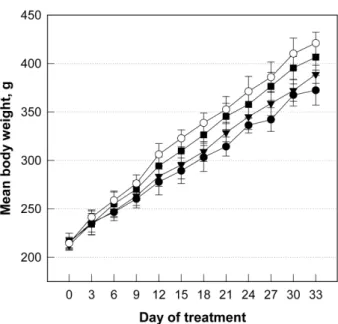
4(1.0 mL/kg) treatment at 3-day intervals decreased the body weight gain by 12%, which was attenuated by treatment with FGL in a dose-dependent manner (Figure 1).
Especially, daily treatment with a high dose (100 mg/kg) of FGL recovered the CCl
4-induced decrease in the body weight gain by 70%. In contrast to the decrease in the body weight gain, CCl
4not only increased liver weight by 24%, but also
enhanced the hydroxyproline contents to 3.35 folds control level (Table 1). The increased hydroxyproline content was confirmed by microscopic findings, exhibiting severe fibrosis (Figure 2). The liver weights increased by exposure to CCl
4were attenuated by FGL in a dose-dependent manner, especially to the near-normal level in a high dose (100 mg/
kg). Notably, the increased hydroxyproline contents were significantly recovered by FGL, in accordance with the microscopic observations.
In spite of tremendous strides in the modern medicine, there are not much drugs available for the treatment of liver disorders [16]. Liver fibrosis results from the fibrogenic activation of fibrocytes and hepatic stellate cells, called Ito cells, following continuous hepatocytic injury and cholestasis, sometimes leading to liver cirrhosis and hepatocellular carconoma [2,17-19]. In the present study, repeated administration of CCl
4also induced serious hepatic fibrosis, in parallel with the increased hydroxyproline contents [13].
Since oxidative stress is one of the most-causative factors Figure 1. Change in body weights of rats administered with
carbon tetrachloride (CCl
4; 1 mL/kg) for 33 days at 3-day intervals and/or a fermentation filtrate of Ganoderma lucidum (FGL; 20 or 100 mg/kg daily). ○, normal; ●, CCl
4alone; ▼, CCl
4+20 mg/kg FGL; ■, CCl
4+100 mg/kg FGL.
Figure 2. Representative hepatic fibrosis of the liver of rats administered with carbon tetrachloride (CCl
4, 1 mL/kg) for 33 days at 3-day intervals and/or a fermentation filtrate of Ganoderma lucidum (FGL; 20 or 100 mg/kg daily). A, normal;
B, CCl
4alone; C, CCl
4+20 mg/kg FGL; D, CCl
4+100 mg/kg FGL.
Table 1. Effect of a fermentation filtrate of Ganoderma lucidum (FGL) on the liver weights and hepatic fibrosis induced by treatment with carbon tetrachloride (CCl
4, 1 mL/kg) for 33 days at 3-day intervals
Treatment (mg/kg)
Absolute liver weight
(g)
Relative liver weight
(%)
Hydroxyproline (µg/kg) Normal 11.22±1.07 2.66±0.22
07.32±2.02CCl
4alone 13.86±1.42* 3.72±0.38* 24.55±5.15*
+FGL (20) 13.12±1.34 3.37±0.44 17.36±4.21
#+FGL (100) 11.65±0.84
#2.87±0.19
#11.02±2.13
#*Significantly different from normal control (P<0.05). #Significantly different from CCl4 alone (P<0.05).
Antifibrotic activity of Ganoderma lucidum
371
Lab Anim Res | December, 2011 | Vol. 27, No. 4