INTRODUCTION
The proportion of older patients within the general population is gradually increasing, especially in advanced countries. Coro- nary artery disease is the leading cause of death in the elderly, and chronic conditions associated with coronary artery disease are an important health issue.
1In daily clinical practice, medi- cal treatment rather than percutaneous coronary intervention (PCI) is typically preferred in elderly patients due to a higher in- cidence of multiple extra-cardiac comorbidities, fragile physical performance, and an increased risk of complications resulting from this invasive procedure in this population. Therefore, el-
Percutaneous Coronary Intervention Is More Beneficial Than Optimal Medical Therapy in Elderly Patients with Angina Pectoris
Hoyoun Won
1*, Ae-Young Her
2*, Byeong-Keuk Kim
3,4, Yong Hoon Kim
2, Dong-Ho Shin
3,4, Jung-Sun Kim
3,4, Young-Guk Ko
3,4, Donghoon Choi
3,4, Hyuck Moon Kwon
5, Yangsoo Jang
3,4,6, and Myeong-Ki Hong
3,4,61Cardiovascular and Arrhythmia Center, College of Medicine, Chung-Ang University, Seoul;
2Department of Medicine, School of Medicine, Kangwon National University, Chuncheon;
3Division of Cardiology, Severance Cardiovascular Hospital, Yonsei University Health System, Seoul;
4Cardiovascular Research Institute, Yonsei University College of Medicine, Seoul;
5Division of Cardiology, Gangnam Severance Hospital, Yonsei University College of Medicine, Seoul;
6Severance Biomedical Science Institute, Yonsei University College of Medicine, Seoul, Korea.
Purpose: Data comparing the clinical benefits of medical treatment with those of percutaneous coronary intervention (PCI) in an
elderly population with angina pectoris are limited. Therefore, we evaluated the efficacy of elective PCI versus optimal medical treatment (OMT) in elderly patients (between 75 and 84 years old) with angina pectoris.
Materials and Methods: One hundred seventy-seven patients with significant coronary artery stenosis were randomly assigned to
either the PCI group (n=90) or the OMT group (n=87). The primary outcome was a composite of major adverse events in the 1-year follow-up period that included cardiovascular death, non-fatal myocardial infarction, coronary revascularization, and stroke.
Results: Major adverse events occurred in 5 patients (5.6%) of the PCI group and in 17 patents (19.5%) of the OMT group (p=0.015).
There were no significant differences between the PCI group and the OMT group in cardiac death [hazard ratio (HR) for the PCI group 0.454; 95% confidence interval (CI) 0.041–5.019, p=0.520], myocardial infarction (HR 0.399; 95% CI 0.039–4.050, p=0.437), or stroke (HR 0.919; 95% CI 0.057–14.709, p=0.952). However, the PCI group showed a significant preventive effect of the composite of major adverse events (HR 0.288; 95% CI 0.106–0.785, p=0.015) and against the need for coronary revascularization (HR 0.157; 95% CI 0.035–0.703, p=0.016).
Conclusion: Elective PCI reduced major adverse events and was found to be an effective treatment modality in elderly patients
with angina pectoris and significant coronary artery stenosis, compared to OMT.
Key Words: Percutaneous coronary intervention, elderly patient, angina pectoris Yonsei Med J 2016 Mar;57(2):382-387
http://dx.doi.org/10.3349/ymj.2016.57.2.382 pISSN: 0513-5796 · eISSN: 1976-2437
Received: March 17, 2015 Revised: June 2, 2015 Accepted: June 16, 2015
Corresponding author: Dr. Myeong-Ki Hong, Division of Cardiology, Severance Cardiovascular Hospital, Yonsei University College of Medicine, 50-1 Yonsei-ro, Seodaemun-gu, Seoul 03722, Korea.
Tel: 82-2-2228-8458, Fax: 82-2-393-2041, E-mail: [email protected]
*Hoyoun Won and Ae-Young Her contributed equally to this work.
•The authors have no financial conflicts of interest.
© Copyright: Yonsei University College of Medicine 2016
This is an Open Access article distributed under the terms of the Creative Com- mons Attribution Non-Commercial License (http://creativecommons.org/licenses/
by-nc/3.0) which permits unrestricted non-commercial use, distribution, and repro- duction in any medium, provided the original work is properly cited.
derly patients have mostly been excluded from study popula- tions in randomized PCI trials. Nevertheless, data indicate that PCI is an effective treatment option for myocardial infarction in elderly patients.
2,3As the technical skills of those administering PCI advance along with the device technology itself, PCI-relat- ed adverse cardiovascular events have progressively decreased over time in elderly patients.
4-6Indeed, a recent observational study reported that PCI reduced mortality in older patients with acute coronary syndrome.
7Furthermore, PCI may alleviate symptoms and improve the quality of life in elderly patients.
However, there is limited data directly comparing the effects of PCI to that of medical treatment in elderly patients with angina pectoris. Therefore, the objective of this study was to compare clinical outcomes of elderly patients (≥75 years old) with angina pectoris who were treated with optimal medical treatment (OMT) to those who were treated with elective PCI with drug- eluting stent implantation.
MATERIALS AND METHODS
This study was a prospective, multicenter, randomized clini- cal trial conducted at six centers in Korea (ClinicalTrials.gov, NCT01508663). Inclusion criteria were patients between 75 and 84 years of age; a clinical diagnosis of stable angina or unstable angina (Braunwald classification IB); and significant stenosis in at least one proximal epicardial coronary artery (diameter ste- nosis of ≥70% by visual estimation). Exclusion criteria were a clinical diagnosis of unstable angina (Braunwald classification IIB or IIIB) or acute myocardial infarction; left ventricular ejec- tion fraction less than 30%; history of prior PCI within 6 months;
small vessel lesions not suitable for PCI; or a non-cardiac mor- bidity with a life expectancy less than 2 years. This study was approved by the Institutional Review Board of each institute, and written informed consent was obtained from each patient.
Using an interactive web-based response system, patients were randomly assigned into either the PCI group or the OMT group. In the PCI group, patients were randomly assigned in a 1:1 ratio to receive the Resolute zotarolimus-eluting stent (En- deavor-Resolute stent, Medtronic vascular, Santa Rosa, CA, USA) or the everolimus-eluting stent (Xience, Abbott Vascular, Santa Clara, CA, USA). All patients in the PCI group received at least 75 mg of aspirin and a loading dose of 300 mg of clopidogrel at least 12 hours pre-PCI. Unfractionated heparin was adminis- tered to maintain the activated clotting time >250 seconds. All PCI procedures were performed according to current standard techniques. Post-procedure, dual antiplatelet therapy with as- pirin (100 mg) and clopidogrel (75 mg) daily was prescribed for 12 months. Procedural success was defined as the achievement of a final in-stent diameter stenosis of 30% or less by online quantitative coronary angiographic analysis or visual assess- ment over the entire stent length, with normal coronary-artery flow. Medical treatment in both PCI and OMT groups included
aspirin, statin, isosorbide nitrate, calcium-channel blocker, long- acting beta-blocker, and angiotensin converting enzyme inhibi- tor or angiotensin receptor blocker alone or in combination. All patients were scheduled to visit the clinic at 3, 6, 9, and 12 months after coronary angiography. Revascularization was rec- ommended when patients had recurrent or refractory angina symptom after discharge from treatment by randomization.
Data were collected from and documented in electronic clin- ical research forms by dedicated research coordinators. The primary end point was the composite of cardiovascular death, stroke, non-fatal myocardial infarction, and coronary revascu- larization for 1 year after the randomization. Clinical events were defined according to the Academic Research Consor- tium.
8All deaths were considered cardiac deaths unless a defi- nite non-cardiac cause was established. Myocardial infarction was defined as the presence of clinical symptoms, electrocar- diographic changes, or abnormal imaging findings of myocar- dial infarction, combined with an increase in the creatine ki- nase myocardial band fraction above the upper normal limits or an increase in troponin-T/troponin-I to greater than the 99th percentile of the upper normal limit. Clinical assessment was performed during a scheduled visit to an outpatient clinic.
In the PCI group, quantitative coronary angiographic analysis was performed using an off-line quantitative coronary angio- graphic system (CASS system, Pie Medical Instruments, Maas- tricht, the Netherlands), before and after stent implantation, by analysts in an independent core laboratory at the Cardiovascu- lar Research Center, Seoul, Korea. Using the guiding catheter for magnification-calibration, the diameters of the reference vessel and the minimal luminal diameter were measured be- fore and after stenting from diastolic frames in a single matched view showing the smallest minimal luminal diameter.
The sample size was calculated using a two-sample inequality test. Based on previous data showing the composite of cardio- vascular death, stroke, nonfatal myocardial infarction, or coro- nary revascularization occurred in 23.5% of the PCI-treated group and in 30.0% of the OMT-treated group,
9,10we assumed that PCI would reduce the composite events by 6.5% compared to the OMT group in our study. Assuming a two-sided alpha lev- el of 0.05, statistical power of 80%, and estimated dropout rate of 10%, we calculated 800 hundred patients were needed for each arm.
For comparing categorical variables we conducted the χ
2test
or Fisher’s exact test. To compare continuous variables the Stu-
dent t-test was conducted. Cumulative incidences of composite
events at 12 months (the primary outcomes) were calculated us-
ing Kaplan-Meier estimates. Comparison between the two
groups was performed using the log-rank test. Univariate and
multivariate logistic regression models were applied to deter-
mine risk factors for the composite events. Statistical analysis was
performed using the SPSS software (version 18.0.0; SPSS Inc., Chi-
cago, IL, USA). A value of p<0.05 was considered statistically sig-
nificant.
RESULTS
Patients were enrolled between December 2010 and June 2012.
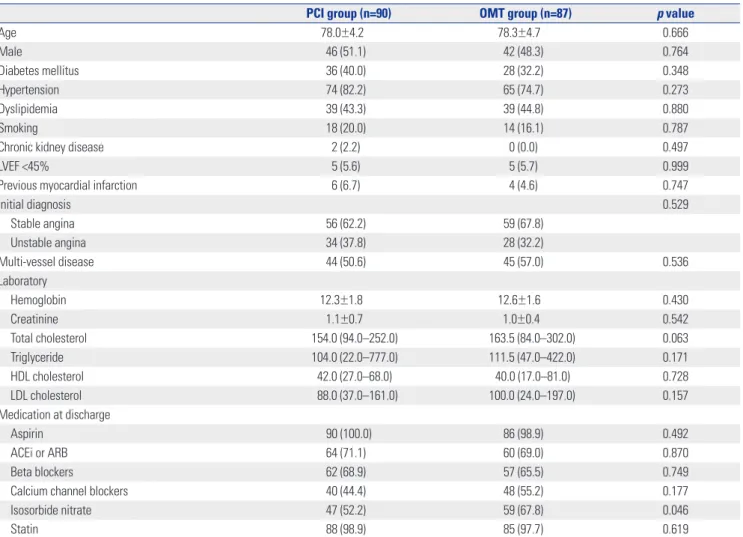
The recruitment process was prematurely terminated due to dif- ficulty in enrolling patients due to physician or patient prefer- ence. During the study period, 182 patients were included in this study. A total of 5 patients were excluded. Three patients withdrew informed consent, and 2 patients violated study pro- tocol. Of the remaining 177 patients, 87 OMT group patients and 90 PCI group patients (zotarolimus-eluting stent in 46 pa- tients and everolimus-eluting stent in 44 patients) were includ- ed in the final analysis. Baseline clinical characteristics were similar between the two groups (Table 1). Lesion and procedur- al characteristics of the PCI group are listed in Table 2. The tran- sradial approach was performed at a similar rate between two groups (58.9% in PCI and 60.9% in OMT, p=0.783). All PCI pro- cedures were successfully performed without complications.
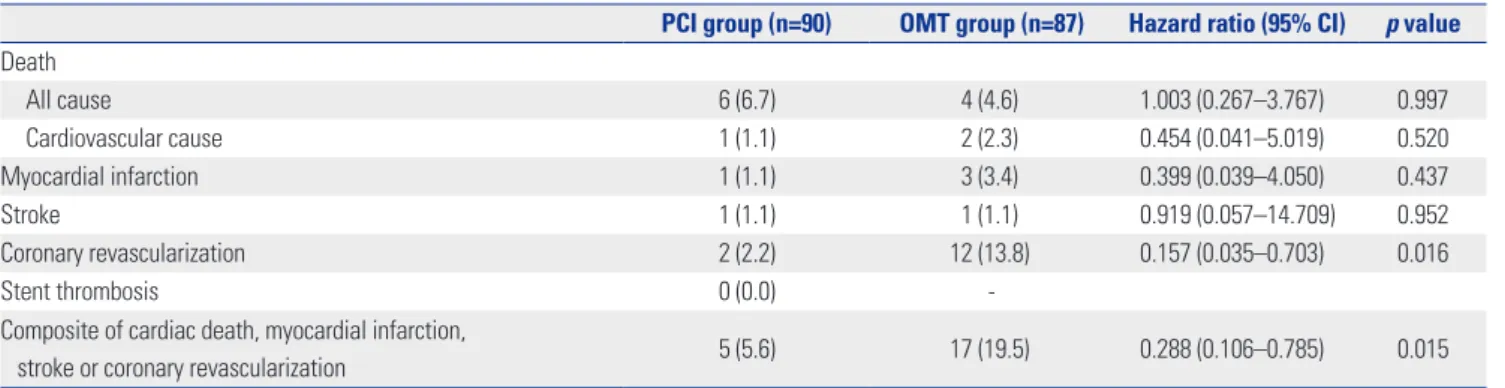
One year clinical outcomes between of both groups are shown in Table 3. Although cardiac mortality, myocardial infarction, and stroke were not statistically different between the two groups,
coronary revascularization was significantly greater in the OMT group than in the PCI group (13.8% vs. 2.2%, respectively,
p=0.016). The composite of adverse events during the one-yearfollow-up period occurred in five patients (5.6%) in the PCI group and in 17 patients (19.5%) in OMT group (log rank p=0.010) (Fig.
1). The improved outcome primarily resulted from the differ- ence of coronary revascularization due to recurrent angina in elderly patients.
Of these patients in the PCI group, major adverse events in- cluded one stroke in a patient with a zotarolimus-eluting, one cardiac death, one myocardial infarction, and two target-lesion revascularization procedures were conducted in everolimus- eluting stent-treated patients (p=0.152). By multivariate Cox re- gression analysis, PCI was an independent predictor for the composite of adverse events (hazard ratio=0.285, 95% confi- dence interval 0.102–0.796, p=0.017) (Table 4).
Table 1. Baseline Clinical Characteristics
PCI group (n=90) OMT group (n=87) p value
Age 78.0±4.2 78.3±4.7 0.666
Male 46 (51.1) 42 (48.3) 0.764
Diabetes mellitus 36 (40.0) 28 (32.2) 0.348
Hypertension 74 (82.2) 65 (74.7) 0.273
Dyslipidemia 39 (43.3) 39 (44.8) 0.880
Smoking 18 (20.0) 14 (16.1) 0.787
Chronic kidney disease 2 (2.2) 0 (0.0) 0.497
LVEF <45% 5 (5.6) 5 (5.7) 0.999
Previous myocardial infarction 6 (6.7) 4 (4.6) 0.747
Initial diagnosis 0.529
Stable angina 56 (62.2) 59 (67.8)
Unstable angina 34 (37.8) 28 (32.2)
Multi-vessel disease 44 (50.6) 45 (57.0) 0.536
Laboratory
Hemoglobin 12.3±1.8 12.6±1.6 0.430
Creatinine 1.1±0.7 1.0±0.4 0.542
Total cholesterol 154.0 (94.0–252.0) 163.5 (84.0–302.0) 0.063
Triglyceride 104.0 (22.0–777.0) 111.5 (47.0–422.0) 0.171
HDL cholesterol 42.0 (27.0–68.0) 40.0 (17.0–81.0) 0.728
LDL cholesterol 88.0 (37.0–161.0) 100.0 (24.0–197.0) 0.157
Medication at discharge
Aspirin 90 (100.0) 86 (98.9) 0.492
ACEi or ARB 64 (71.1) 60 (69.0) 0.870
Beta blockers 62 (68.9) 57 (65.5) 0.749
Calcium channel blockers 40 (44.4) 48 (55.2) 0.177
Isosorbide nitrate 47 (52.2) 59 (67.8) 0.046
Statin 88 (98.9) 85 (97.7) 0.619
PCI, percutaneous coronary intervention; OMT, optimal medical treatment; LVEF, left ventricular ejection fraction; HDL, high-density lipoprotein; LDL, low-density lipoprotein; ACEi, angiotensin converting enzyme inhibitor; ARB, angiotensin receptor blocker.
DISCUSSION
This prospective randomized study showed that, compared to OMT, PCI reduces major adverse outcomes in elderly patients
≥75 years of age.
The Trial of Invasive versus Medical Therapy in Elderly Pa- tients with Chronic Symptomatic Coronary Artery Disease (TIME) trial was the first randomized controlled trial to com- pare invasive revascularization including PCI and coronary ar- tery bypass surgery with OMT in elderly patients (≥75 years)
Table 2. Angiographic & Procedural Characteristics in PCI GroupTreated number of lesions n=104
Location of lesion
Left main artery 3 (2.9)
Left anterior descending artery 49 (47.1)
Left circumflex artery 20 (19.2)
Right coronary artery 32 (30.8)
Type of lesion, B2/C 75 (72.1)
Bifurcation lesion 7 (6.4)
Baseline
Reference vessel diameter, mm 2.8±0.5
Minimal lumen diameter, mm 1.0±0.6
% diameter stenosis 65.5±18.1
Post-PCI
Reference vessel diameter, mm 2.9±0.4
Minimal lumen diameter, mm 2.6±0.5
% diameter stenosis 9.3±8.9
Stent length, mm 21.7±7.3
Stent size, mm 2.9±0.4
Maximal inflation pressure 16.2±2.4
PCI, percutaneous coronary intervention.
Table 3. Clinical Outcomes through 1 Year
PCI group (n=90) OMT group (n=87) Hazard ratio (95% CI) p value Death
All cause 6 (6.7) 4 (4.6) 1.003 (0.267–3.767) 0.997
Cardiovascular cause 1 (1.1) 2 (2.3) 0.454 (0.041–5.019) 0.520
Myocardial infarction 1 (1.1) 3 (3.4) 0.399 (0.039–4.050) 0.437
Stroke 1 (1.1) 1 (1.1) 0.919 (0.057–14.709) 0.952
Coronary revascularization 2 (2.2) 12 (13.8) 0.157 (0.035–0.703) 0.016
Stent thrombosis 0 (0.0) -
Composite of cardiac death, myocardial infarction,
stroke or coronary revascularization 5 (5.6) 17 (19.5) 0.288 (0.106–0.785) 0.015
PCI, percutaneous coronary intervention; OMT, optimal medical treatment; CI, confidence interval.
Table 4. Univariate and Multivariate Cox Regression Analysis for Prediction of Major Adverse Cardiac Events
Variable Univariate Multivariate
Hazard ratio 95% confidence interval p value Hazard ratio 95% confidence interval p value
Age 1.061 0.943–1.193 0.328 1.099 0.964–1.254 0.158
Male 0.681 0.291–1.596 0.377 0.661 0.252–1.737 0.401
Hypertension 2.774 0.646–11.916 0.170 1.968 0.567–6.823 0.286
Diabetes mellitus 2.136 0.904–5.045 0.084 1.838 0.732–4.616 0.195
Smoking history 0.484 0.113–2.078 0.329 0.673 0.140–3.229 0.620
Multivessel disease 1.654 0.658–4.154 0.284 1.887 0.730–4.877 0.190
Unstable angina 0.716 0.280–1.832 0.486 0.873 0.325–2.342 0.787
Percutaneous coronary intervention 0.288 0.106–0.785 0.015 0.285 0.102–0.796 0.017
Fig. 1. Rate of composite adverse events for the 1 year follow-up duration.
OMT, optimal medical treatment; PCI, percutaneous coronary interven- tion; CI, confidence interval.
Composite adverse event free rate
(%)
100
80
60
40
20
0
0 120 240 360 Follow-up duration (days)
90 82 79 37 87 76 63 37
Log rank p=0.010 Hazard ratio 0.288 95% CI 0.106–0.785, p=0.015
OMT group PCI group
PCI group OMT group
with stable angina. In that study, invasive revascularization re- duced adverse cardiovascular events, an effect mainly due to reduced re-hospitalization with medically uncontrolled angina symptoms during the 6 months of follow-up.
11However, it is important to note that differences in symptom control and qual- ity of life improvement between the two study groups were not observed within 1 year of follow-up.
12Furthermore, after 4 years of follow-up, the long term survival rate was similar between the invasive and medically treated groups.
13However, symptom relief and improved quality of life in the invasive treatment group, compared to the medical treatment group, was main- tained over the duration of the 4-year follow-up period.
13In the TIME trial, coronary revascularization, including both PCI and coronary bypass graft surgery, was compared with medical therapy. This made it difficult to evaluate the effect of PCI alone on long-term clinical outcomes. Furthermore, PCI was per- formed with a bare-metal stent. With evolving PCI technologies and techniques, as well as adjunctive medical therapy, adverse cardiovascular events after PCI have significantly decreased over time in elderly patients.
4-6In the current study, PCI using second-generation drug-eluting stents was directly compared with medical therapy in elderly patients.
The importance of statin therapy for the treatment and pre- vention of coronary artery disease has been increasingly em- phasized over the last decade. In the TIME trial, about 20% of patients were on statin treatment, while in our study, almost all patients took a statin. In the TIME trial, major adverse cardio- vascular events during the 1-year follow-up occurred in 25.5%
of the invasive revascularization group and in 64.2% of the medical treatment group; all-cause mortality was 11.1% and 8.1%, respectively.
12In the present study, the rate of major ad- verse cardiovascular events was significantly lower. Advances in PCI techniques, accumulated technical experience, and ad- vances in devices, as well as medical therapy, likely improved the clinical outcomes for elderly patients in both the PCI and OMT groups included in our study.
Over the past decade, the average life expectancy in Korea has increased about 5 years, and is now greater than 75 years.
14Furthermore, a reduced rate of disability in older Koreans has led to a substantially improved functional status of this popula- tion.
15Similar trends of prolonged survival and declined disabil- ity are observed in developed countries.
16-18Despite improved physical functioning in elderly population, the prevalences of chronic diseases like ischemic heart disease have contin- ued.
14,19In elderly patients with angina pectoris, relieving an- gina symptoms may lead a higher quality of life over the in- creased life expectancy. Treating angina pectoris in elderly patients with medical treatment alone may increase in the suffering and psychological distress related to the condition.
A recent study reported that the quality of life and symptom relief in octogenarian patients with coronary artery disease fol- lowing PCI improved to a level similar to that observed in younger patients.
20In terms of cost-effectiveness, one study re-
ported that invasive treatment had a similar benefit to medical management in elderly patients with chronic angina symp- toms.
21However, within clinical practice, PCI is underused in older patients (≥75 years old) with acute coronary syndrome, especially in those with more complex risk factors.
7Advanced age is an independent risk factor for mortality and morbidity in PCI.
4,22This safety issue is an important factor when considering PCI in elderly patients. The higher prevalence of diffuse disease, severe calcification, and tortuosity in the el- derly may explain the high risk of complications and procedur- al failure in this population. Over the last 10 years, therapeutic developments have improved clinical outcomes following PCI.
4-6,23Increased frequency of the transradial approach has reduced vascular complications and major bleeding.
24,25Elderly patients have a significantly higher risk of arterial access com- plications. Therefore, a lower incidence of vascular complica- tions may be particularly beneficial in this patient population.
26In the present study, transradial PCI was performed in about 60% of patients without any resulting complications. Moreover, a recent study from the SHINANO registry, in which 63.2% of the procedures were transradial, reported that the procedure success rate and in-hospital major adverse cardiovascular out- comes in an octogenarian cohort were similar to those ob- served in younger patients who underwent elective PCI.
27Simi- larly, elective PCI in elderly patients had favorable clinical outcomes in a study from the New York State Angioplasty Reg- istry.
22In the present study, PCI had favorable outcomes and did not increase procedure-related or bleeding complications.
The present study has limitations. First, statistical power was reduced because of the small number of patients enrolled in this study. Second, the results of this study may not be applica- ble to patients with myocardial infarction or asymptomatic pa- tients. Third, the decision of revascularization in re-admitted patients was at the discretion of physicians, although we rec- ommended revascularization in patients with recurrent angina.
Furthermore, we have not assessed quality of life, but most recur- rently symptomatic patients were treated by revascularization.
In summary, PCI improved chest symptoms and reduced re- admission related to recurrent angina, compared to optimal medical treated elderly patients; meanwhile, no reductions in mortality and myocardial infarction were noted. These data in- dicate that PCI is effective and feasible in symptomatic elderly patients with angina pectoris. Chronological age alone should not be considered as a contraindication for PCI, and PCI should be considered as a primary treatment strategy in this patient population.
ACKNOWLEDGEMENTS
This study was supported by a grant from the Korea Healthcare
Technology R&D Project, Ministry for Health, Welfare&Family
Affairs, Republic of Korea (Nos. A085136 and A102064) and the
Cardiovascular Research Center, Seoul, Korea.
REFERENCES
1. Murphy SL, Xu J, Kochanek KD. Deaths: final data for 2010. Natl Vital Stat Rep 2013;61:1-117.
2. Hamm CW, Bassand JP, Agewall S, Bax J, Boersma E, Bueno H, et al. ESC Guidelines for the management of acute coronary syn- dromes in patients presenting without persistent ST-segment ele- vation: The Task Force for the management of acute coronary syn- dromes (ACS) in patients presenting without persistent ST-segment elevation of the European Society of Cardiology (ESC). Eur Heart J 2011;32:2999-3054.
3. Anderson JL, Adams CD, Antman EM, Bridges CR, Califf RM, Casey DE Jr, et al. 2011 ACCF/AHA Focused Update Incorporated Into the ACC/AHA 2007 Guidelines for the Management of Pa- tients With Unstable Angina/Non-ST-Elevation Myocardial Infarc- tion: a report of the American College of Cardiology Foundation/
American Heart Association Task Force on Practice Guidelines.
Circulation 2011;123:e426-579.
4. Batchelor WB, Anstrom KJ, Muhlbaier LH, Grosswald R, Wein- traub WS, O’Neill WW, et al. Contemporary outcome trends in the elderly undergoing percutaneous coronary interventions: results in 7,472 octogenarians. National Cardiovascular Network Collabo- ration. J Am Coll Cardiol 2000;36:723-30.
5. From AM, Rihal CS, Lennon RJ, Holmes DR Jr, Prasad A. Temporal trends and improved outcomes of percutaneous coronary revascu- larization in nonagenarians. JACC Cardiovasc Interv 2008;1:692-8.
6. Rao SV, Hess CN, Dai D, Green CL, Peterson ED, Douglas PS.
Temporal trends in percutaneous coronary intervention outcomes among older patients in the United States. Am Heart J 2013;166:
273-81.e4.
7. Di Bari M, Balzi D, Fracchia S, Barchielli A, Orso F, Sori A, et al. De- creased usage and increased effectiveness of percutaneous coro- nary intervention in complex older patients with acute coronary syndromes. Heart 2014;100:1537-42.
8. Cutlip DE, Windecker S, Mehran R, Boam A, Cohen DJ, van Es GA, et al. Clinical end points in coronary stent trials: a case for standardized definitions. Circulation 2007;115:2344-51.
9. Boden WE, O’Rourke RA, Teo KK, Hartigan PM, Maron DJ, Kos- tuk WJ, et al. Optimal medical therapy with or without PCI for sta- ble coronary disease. N Engl J Med 2007;356:1503-16.
10. Teo KK, Sedlis SP, Boden WE, O’Rourke RA, Maron DJ, Hartigan PM, et al. Optimal medical therapy with or without percutaneous coronary intervention in older patients with stable coronary dis- ease: a pre-specified subset analysis of the COURAGE (Clinical Outcomes Utilizing Revascularization and Aggressive druG Eval- uation) trial. J Am Coll Cardiol 2009;54:1303-8.
11. TIME Investigators. Trial of invasive versus medical therapy in el- derly patients with chronic symptomatic coronary-artery disease (TIME): a randomised trial. Lancet 2001;358:951-7.
12. Pfisterer M, Buser P, Osswald S, Allemann U, Amann W, Angehrn W, et al. Outcome of elderly patients with chronic symptomatic coronary artery disease with an invasive vs optimized medical treatment strategy: one-year results of the randomized TIME trial.
JAMA 2003;289:1117-23.
13. Pfisterer M; Trial of Invasive versus Medical therapy in Elderly pa- tients Investigators. Long-term outcome in elderly patients with chronic angina managed invasively versus by optimized medical
therapy: four-year follow-up of the randomized Trial of Invasive versus Medical therapy in Elderly patients (TIME). Circulation 2004;110:1213-8.
14. Yang S, Khang YH, Harper S, Davey Smith G, Leon DA, Lynch J.
Understanding the rapid increase in life expectancy in South Ko- rea. Am J Public Health 2010;100:896-903.
15. Jang SN, Kim DH. Trends in the health status of older Koreans. J Am Geriatr Soc 2010;58:592-8.
16. Freedman VA, Martin LG, Schoeni RF. Recent trends in disability and functioning among older adults in the United States: a system- atic review. JAMA 2002;288:3137-46.
17. Aijänseppä S, Notkola IL, Tijhuis M, van Staveren W, Kromhout D, Nissinen A. Physical functioning in elderly Europeans: 10 year chang- es in the north and south: the HALE project. J Epidemiol Commu- nity Health 2005;59:413-9.
18. Manton KG, Gu X, Lamb VL. Change in chronic disability from 1982 to 2004/2005 as measured by long-term changes in function and health in the U.S. elderly population. Proc Natl Acad Sci U S A 2006;103:18374-9.
19. Murabito JM, Pencina MJ, Zhu L, Kelly-Hayes M, Shrader P, D’Agostino RB Sr. Temporal trends in self-reported functional limi- tations and physical disability among the community-dwelling el- derly population: the Framingham heart study. Am J Public Health 2008;98:1256-62.
20. Johnman C, Mackay DF, Oldroyd KG, Pell JP. Quality of life follow- ing percutaneous coronary interventions in octogenarians: a sys- tematic review. Heart 2013;99:779-84.
21. Claude J, Schindler C, Kuster GM, Schwenkglenks M, Szucs T, Buser P, et al. Cost-effectiveness of invasive versus medical man- agement of elderly patients with chronic symptomatic coronary artery disease. Findings of the randomized trial of invasive versus medical therapy in elderly patients with chronic angina (TIME).
Eur Heart J 2004;25:2195-203.
22. Feldman DN, Gade CL, Slotwiner AJ, Parikh M, Bergman G, Wong SC, et al. Comparison of outcomes of percutaneous coronary in- terventions in patients of three age groups (<60, 60 to 80, and >80 years) (from the New York State Angioplasty Registry). Am J Cardiol 2006;98:1334-9.
23. Choi YJ, Kim JB, Cho SJ, Cho J, Sohn J, Cho SK, et al. Changes in the Practice of Coronary Revascularization between 2006 and 2010 in the Republic of Korea. Yonsei Med J 2015;56:895-903.
24. Achenbach S, Ropers D, Kallert L, Turan N, Krähner R, Wolf T, et al.
Transradial versus transfemoral approach for coronary angiogra- phy and intervention in patients above 75 years of age. Catheter Cardiovasc Interv 2008;72:629-35.
25. Louvard Y, Benamer H, Garot P, Hildick-Smith D, Loubeyre C, Rigattieri S, et al. Comparison of transradial and transfemoral ap- proaches for coronary angiography and angioplasty in octogenar- ians (the OCTOPLUS study). Am J Cardiol 2004;94:1177-80.
26. Piper WD, Malenka DJ, Ryan TJ Jr, Shubrooks SJ Jr, O’Connor GT, Robb JF, et al. Predicting vascular complications in percutaneous coronary interventions. Am Heart J 2003;145:1022-9.
27. Miura T, Miyashita Y, Motoki H, Shimada K, Kobayashi M, Nakaji- ma H, et al. In-hospital clinical outcomes of elderly patients (≥80 years) undergoing percutaneous coronary intervention. Circ J 2014;
78:1097-103.