Related Factors of Age-Appropriate Immunization among Urban-Rural Children Aged 24-35 Months in a 2005 Population-Based Survey in Nonsan, Korea
Eun-Young Kim and Moo-Sik Lee
Department of Preventive Medicine, College of Medicine, Konyang University, Daejeon, Korea.
Received: November 24, 2009 Revised: February 23, 2010 Accepted: March 29, 2010
Corresponding author: Dr. Moo-Sik Lee, Department of Preventive Medicine, College of Medicine, Konyang University, 28 Wonangmaeul 1-gil, Seo-gu, Daejeon 302-718, Korea.
Tel: 82-42-600-6404, Fax: 82-42-600-6401 E-mail: [email protected]
∙ The authors have no financial conflicts of interest.
© Copyright:
Yonsei University College of Medicine 2011 This is an Open Access article distributed under the terms of the Creative Commons Attribution Non- Commercial License (http://creativecommons.org/
licenses/by-nc/3.0) which permits unrestricted non- commercial use, distribution, and reproduction in any medium, provided the original work is properly cited.
Purpose: This study was aimed to determine the status and related factors of age- appropriate immunization among urban-rural children aged 24-35 months in a 2005 population-based survey in Nonsan, Korea. Materials and Methods: We conducted household survey and provider check using questionnaire and checklist to obtain data on immunization status for children, aged 24-35 months. Age-ap- propriate immunization was defined as status of receiving the fourth diphtheria- tetanus-pertussis (4 DTP), 3 Polio, the first measles-mumps-rubella (1 MMR) dos- es, and the 4 : 3 : 1 series. Results: Age-appropriate immunization rates were 51.7% for 4 DPT, 88.0% for 3 Polio, 87.9% for 1 MMR, and 50.3% for the 4 : 3 : 1 series. First-born children, lower perceived barrier scores, and higher perception of immunization data were significantly related to age-appropriate immunization.
Conclusion: The findings indicated that age-appropriate immunization rate could be improved by implementing reminder/recall service and providing the knowl- edge about immunization. Identification and consideration related factors would improve immunization rate and age-appropriate immunization.
Key Words: Related factors, age-appropriate immunization, DPT, Polio, MMR
INTRODUCTION
Childhood immunization is recognized as the most effective medical means to control infectious diseases; it is cost-effective, reduces morbidity, and prevents fur- ther outbreaks of infectious disease.1 Although immunization is remarkably effec- tive, children are still becoming infected with preventable diseases, resulting in de- bilitating disorders and even death. Support for immunization over other public health issues has been signaled as a social priority.2
An outbreak of a measles epidemic among U.S. children focused attention on the adequacy of and barriers to immunization. The primary cause of measles epi- demic was a failure to provide vaccines on schedule. When compliance with a vaccination schedule occurs that results in a high national level of vaccination, the risk of periodic epidemics decreases. In the USA, the proportion of children who are immunized against measles has increased dramatically over the past few de-
by their mothers and primary caregiver. In recent years, be- liefs and attitudes about preventive activities have been em- phasized as an important disease prevention. Understanding these beliefs and attitude can help explain why caregivers make decisions regarding age-appropriate immunization.
Once an understanding of attitudes has been established, ef- fective strategies to educate and change behaviors can be implemented. Most studies of childhood immunization have been focused on the socio-demographic characteris- tics, and belief and attitude of primary caregiver or mother.
Findings suggest that mother’s age is an important factor, the older she is, the more likely her infants will be immu- nized in a timely manner; that is, mothers under 30 have low age-appropriate immunization rates for their children.3
The purpose of this study was to investigate the preva- lence and related factors of age-appropriate immunization as it occurs for 4 : 3 : 1 series (4 DPT, 3 Polio, 1 MMR), sug- gesting integrative and comprehensive information of im- munization for defining specific intervention strategies and increasing immunization compliance in a urban-rural chil- dren of Korea. The risk of vaccine-preventable disease epi- demics increases in spite of high national level of vaccina- tion (e.g., measles). Inappropriate vaccination (e.g., early and/or late) is an important issue, since any inappropriate period represents inadequate protection against vaccine- preventable disease (e.g., DTP, Polio). Vaccination of BCG and Hepatitis B was excluded in this study because it could be determined by provider immediately after birth, and vac- cination of varicella was also excluded because it was in- cluded in Korean National Immunization Program in 2005.
This study attempted to find immunization rates with a belief that the rates would increase attention to and resolu- tions for barriers to immunization.
MATERIALS AND METHODS
Subjects of research and methods of survey
Nonsan city has both urban and rural population and a low rate of migration. The subjects of this study were children, aged 24-35 months, in Nonsan city, Korea. Local residence registry data indicated that there were 1,038 children avail- able. We excluded children whose caregivers lived outside of the city (n = 163), refused to answer (n = 111), or did not complete the survey (n = 47). There was no significant dif- ference in gender, age and residential area between children who were included for the analysis and those who were not.
cades. To avoid future outbreaks, it is crucial to attain high coverage levels by ensuring timely vaccinations. Even with an expected outbreak of measles and pertussis in the future, age-appropriate immunization will prevent another resur- gence and epidemic of measles.3
To achieve maximal protection against vaccine-prevent- able disease, age-appropriate immunization means that children receive all immunization within recommended age intervals fully “on-time”. Maximum immunity is not achieved if children have too early or delayed vaccination.4 Age-appropriate immunization indicators more accurately reflect adequacy of protection for childhood than up-to-date indicators at both individual and population levels. There- fore, age-appropriate immunization can be an indicator for problems of accessibility of immunization services.5-7
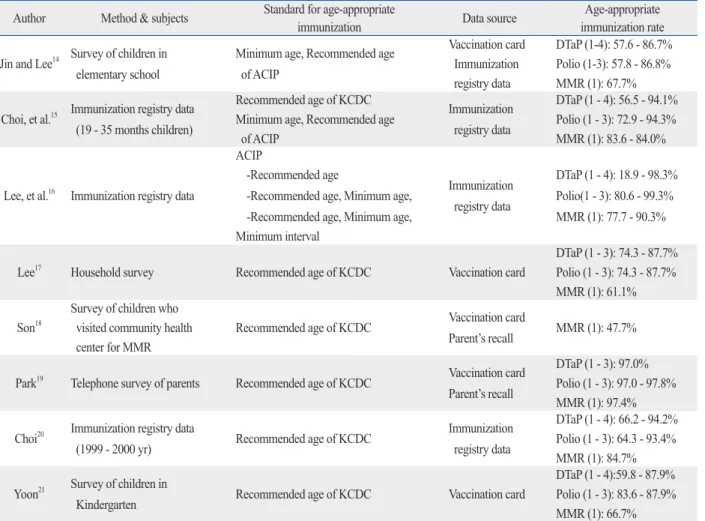
Age-appropriate immunization has been defined as being on schedules by a number of public healthcare agencies such as: CDC,8 Immunization Guidelines of Advisory Committee on Immunization Practice (ACIP), American Academy of Pediatricians, and American Academy of Family Physicians (AAFP). Age-appropriate immunization is generally defined as being not more than 1 month be- tween minimum age and the final time of immunization schedule. When an interval to next dose by each vaccine meets the minimum interval to next dose, it is classified as an age-appropriate immunization. For example, it is report- ed that DPT and Polio vaccines are not effective when they are conducted at too early an age,9 and the vaccine of mea- sles and Hepatitis B, and Haemophilus influenza vaccine can’t take maximum effect if not provided at the optimum age-appropriate time.3,10,11 As a result, some countries changed their targets for immunization to enhance immuni- zation rates by ensuring age-appropriate immunizations.12,13 In Korea, age-appropriate immunization rate was highly variable due to application of different standard for age-ap- propriate immunization (recommended age, minimum age, minimum interval and grace period), survey methods (house- hold survey, registry data, provider check, questionnaire, in- terview, telephone survey), and subjects (different age), and data source (vaccination card, parent’s recall, registry data) (Table 1).14-21 The immunization rate for the vaccine of the National Immunization Program was variable, and this may be due to different study design, time, subject, geographical area and other factors. We carefully considered such factors to ensure more valid and reliable results.
As infants have no capacity to make decisions for them- selves, their immunization or non-immunization is decided
ceived susceptibility to disease, perceived severity of dis- ease being vaccinated against, cues to action, self-efficacy, and knowing when the next shot will be. Each dimension of the questionnaire consisted of 1 or 2 items with 5 point score scale. Immunization history was identified according to a child’s vaccination card with additional immunization data collected from medical records of private clinics and immunization registry data of public health center.
Age-appropriate immunization
In this study, age-appropriate immunization was defined as having occurred when a child receives all doses in 4 : 3 : 1 series within 30 days of the recommended age considering minimum recommended age and intervals between doses according to Guideline of Immunization of Korea Centers for Disease Control and Prevention. Age-appropriate im- munization was counted from minimum age to recom- mended age for routine administration according to birth date. For example, the time of age-appropriate immuniza- tion for the first dose of DTaP/DTP can be counted from 43 The children’s caregivers were contacted and permission
was given for 717 children to participate in the study. The group of 717 was divided into rural and urban, based on residence.
A household survey was conducted between February and April, 2005. Interviewers were students from medical schools or schools of public health, who were trained on the study objectives and interviewing methods. We sent a letter to the study subjects before the survey and visited their house. When we could not meet the subjects after three visits, we ascertained the subjects’ whereabouts by neighbours or representatives of the town. Many of them did not reside in the town or were living in facilities for or- phans or the poor. The primary caregivers of all the chil- dren were interviewed and gave written informed consent.
The questionnaire was composed of socio-demographic characteristics and mother’s beliefs about childhood immu- nization. The questionnaire measured mother’s beliefs re- garding immunization and included perceived barriers to immunization, perceived benefit of immunization, per-
Table 1. A Studies That have Examined Age-Appropriate Immunization in Korea Author Method & subjects Standard for age-appropriate
immunization Data source Age-appropriate
immunization rate Jin and Lee14 Survey of children in
elementary school
Minimum age, Recommended age of ACIP
Vaccination card Immunization registry data
DTaP (1-4): 57.6 - 86.7%
Polio (1-3): 57.8 - 86.8%
MMR (1): 67.7%
Choi, et al.15 Immunization registry data (19 - 35 months children)
Recommended age of KCDC Minimum age, Recommended age of ACIP
Immunization registry data
DTaP (1 - 4): 56.5 - 94.1%
Polio (1 - 3): 72.9 - 94.3%
MMR (1): 83.6 - 84.0%
Lee, et al.16 Immunization registry data
ACIP
-Recommended age
-Recommended age, Minimum age, -Recommended age, Minimum age, Minimum interval
Immunization registry data
DTaP (1 - 4): 18.9 - 98.3%
Polio(1 - 3): 80.6 - 99.3%
MMR (1): 77.7 - 90.3%
Lee17 Household survey Recommended age of KCDC Vaccination card
DTaP (1 - 3): 74.3 - 87.7%
Polio (1 - 3): 74.3 - 87.7%
MMR (1): 61.1%
Son18
Survey of children who visited community health center for MMR
Recommended age of KCDC Vaccination card
Parent’s recall MMR (1): 47.7%
Park19 Telephone survey of parents Recommended age of KCDC Vaccination card Parent’s recall
DTaP (1 - 3): 97.0%
Polio (1 - 3): 97.0 - 97.8%
MMR (1): 97.4%
Choi20 Immunization registry data
(1999 - 2000 yr) Recommended age of KCDC Immunization
registry data
DTaP (1 - 4): 66.2 - 94.2%
Polio (1 - 3): 64.3 - 93.4%
MMR (1): 84.7%
Yoon21 Survey of children in
Kindergarten Recommended age of KCDC Vaccination card
DTaP (1 - 4):59.8 - 87.9%
Polio (1 - 3): 83.6 - 87.9%
MMR (1): 66.7%
ACIP, Advisory committee on Immunization Practice; KCDC, Korea Centers for Disease Control and Prevention.
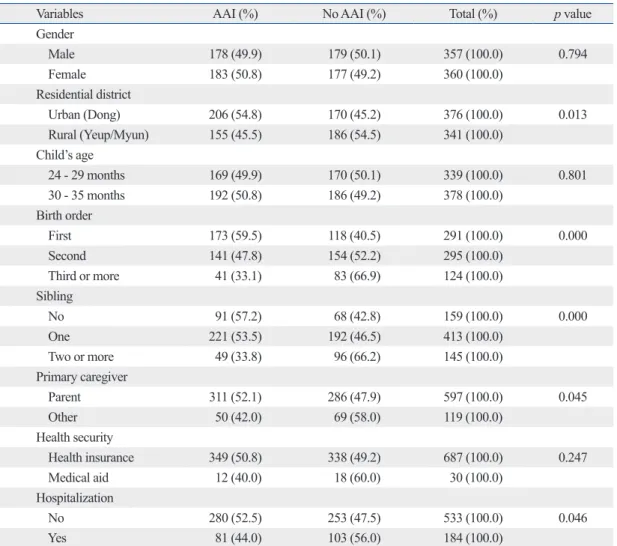
cator for age-appropriate immunization; the later the birth order, the lower the age-appropriate immunization rate (p <
0.01). Number of siblings in the family was also an indica- tor for age-appropriate immunization; the more siblings in the family, the lower the rate of age-appropriate immuniza- tion (p < 0.01). However, age-appropriate immunization was not statistically significant by the variables such as gender, age, and health security (Table 3).
Age-appropriate immunization by characteristics of mothers and a household
The educational attainment of mother/caregiver had an af- fect on age-appropriate immunization rates of their chil- dren; mothers who did not graduate from college had chil- dren with age-appropriate immunization rates of 47.9%, while college graduates had children with age-appropriate immunization rates of 55.8% (p < 0.05).
Marital status affected age-appropriate immunization rates, with 50.8% compliance with mothers who had a spouse, and 25.0% compliance in a single parent family (p
< 0.05).
Economic status of a household also affected compliance rates, with poor households reporting 40.4% of age-appro- priate immunization rates, while average to above house- holds reported 52.1% of age-appropriate immunization rates (Table 4).
Mother’s belief scores about child immunization The perceived barrier to childhood immunization was a measure of accessibility as distance and time. In the failure- to-comply age-appropriate immunization group the per- ceived barrier score was 5.36, while the perceived barrier to immunization was 5.08 for the compliance to age-appropri- ate immunization group.
The perceived benefit of childhood immunization was similar between the failure-to-comply age-appropriate im- munization group and compliance to age-appropriate im- munization group. There was also no significant difference days to 92 days according to the minimum age for the first
dose of DTaP/DTP “6 weeks” and recommended age for routine administration “2 months” after birth. And when immunization was administered within a 4 day-grace peri- od, it was regarded as the age-appropriate immunization.
The 4-day grace period was defined as 4 days before the specified minimum age, and 4 days before or after mini- mum interval to next dose.
Statistical analysis
For analysis, respondents were classified into two groups according to age-appropriate immunization status in the 4 : 3 : 1 series. The difference in the age-appropriate immuni- zation according to the socio-demographic characteristics of household was analyzed by χ2 test. The difference in be- liefs about childhood immunization was analyzed using a t- test. Finally, logistic regression analysis was used to deter- mine related factors with age-appropriate immunization status by inputting the variables significantly deduced in the univariate analysis and mother’s beliefs. All statistical anal- yses were done with SPSS win software, version 13.0 (SPSS Inc., Chicago, USA). In implementing the analysis, non-responses were treated as missing values.
RESULTS
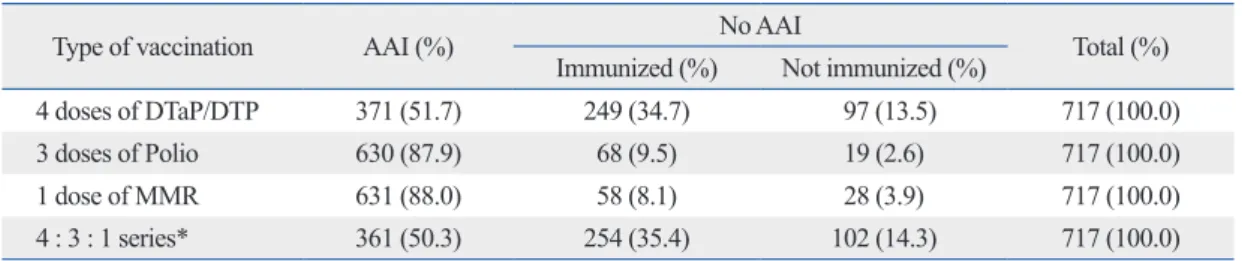
Age-appropriate immunization rate by vaccination type Age-appropriate immunization rates varied; 51.7%, 88.0%, and 87.9% for each 4 DPT, 3 Polio, and 1 MMR, respec- tively. Only 50.3% had received all vaccinations in 4 : 3 : 1 series (Table 2).
Age-appropriate immunization by general characteristics of children
The age-appropriate immunization was higher for those liv- ing in the urban area (54.8%), compared with those living in the rural area (45.5%, p < 0.05). Birth order was an indi-
Table 2. Age-Appropriate Immunization at 4 : 3 : 1 Series*
Type of vaccination AAI (%) No AAI
Total (%) Immunized (%) Not immunized (%)
4 doses of DTaP/DTP 371 (51.7) 249 (34.7) 97 (13.5) 717 (100.0)
3 doses of Polio 630 (87.9) 68 (9.5) 19 (2.6) 717 (100.0)
1 dose of MMR 631 (88.0) 58 (8.1) 28 (3.9) 717 (100.0)
4 : 3 : 1 series* 361 (50.3) 254 (35.4) 102 (14.3) 717 (100.0)
AAI, age-appropriate immunization; MMR, measles-mumps-rubella.
*4 doses of DTaP/DTP, 3 doses of Polio, and 1 dose of MMR.
Unit: n (%)
Table 4. Age-Appropriate Immunization by General Characteristics of Mother and Household
Variables AAI (%) No AAI (%) Total (%) p value
Mother’s age
≤ 30 yrs 132 (52.8) 118 (47.2) 250 (100.0) 0.157
≥ 31 yrs 229 (58.1) 237 (41.9) 466 (100.0)
Mother’s employment
No 265 (51.5) 250 (48.5) 515 (100.0) 0.406
Yes 95 (48.0) 103 (52.0) 198 (100.0)
Mother’s education
≤ High school 216 (47.9) 235 (52.1) 451 (100.0) 0.043
≥ College 145 (55.8) 115 (44.2) 260 (100.0)
Marital status
Married 350 (50.8) 339 (49.2) 689 (100.0) 0.023
Other 5 (25.0) 15 (75.0) 20 (100.0)
Economic status
Low 40 (40.4) 59 (59.6) 99 (100.0) 0.030
Medium to high 319 (52.1) 293 (47.9) 612 (100.0)
AAI, age-appropriate immunization.
Total may not sum to 717 owing to missing values.
Table 3. Age-Appropriate Immunization by General Characteristics of Children
Variables AAI (%) No AAI (%) Total (%) p value
Gender
Male 178 (49.9) 179 (50.1) 357 (100.0) 0.794
Female 183 (50.8) 177 (49.2) 360 (100.0)
Residential district
Urban (Dong) 206 (54.8) 170 (45.2) 376 (100.0) 0.013
Rural (Yeup/Myun) 155 (45.5) 186 (54.5) 341 (100.0)
Child’s age
24 - 29 months 169 (49.9) 170 (50.1) 339 (100.0) 0.801
30 - 35 months 192 (50.8) 186 (49.2) 378 (100.0)
Birth order
First 173 (59.5) 118 (40.5) 291 (100.0) 0.000
Second 141 (47.8) 154 (52.2) 295 (100.0)
Third or more 41 (33.1) 83 (66.9) 124 (100.0)
Sibling
No 91 (57.2) 68 (42.8) 159 (100.0) 0.000
One 221 (53.5) 192 (46.5) 413 (100.0)
Two or more 49 (33.8) 96 (66.2) 145 (100.0)
Primary caregiver
Parent 311 (52.1) 286 (47.9) 597 (100.0) 0.045
Other 50 (42.0) 69 (58.0) 119 (100.0)
Health security
Health insurance 349 (50.8) 338 (49.2) 687 (100.0) 0.247
Medical aid 12 (40.0) 18 (60.0) 30 (100.0)
Hospitalization
No 280 (52.5) 253 (47.5) 533 (100.0) 0.046
Yes 81 (44.0) 103 (56.0) 184 (100.0)
AAI, age-appropriate immunization.
Total may not sum to 717 owing to missing values.
Unit: n (%)
likely to have their age-appropriate immunization [95%
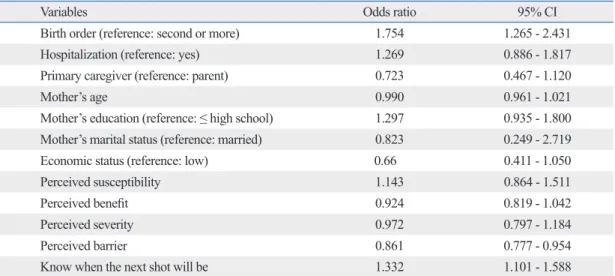
confidence interval (CI): 1.27-2.43]. Also, the higher the perceived barrier scores, the lower the age-appropriate im- munization (95% CI: 0.78-0.95), and the higher the percep- tion of immunization date (95% CI: 1.10-1.59), the more the age-appropriate immunization (Table 6).
DISCUSSION
One of the questions which this research set out to answer was at what rate was Korean children having age-appropri- ate immunizations. Results from this research showed that indicate 50.3% of the children in Nosan city of Korea re- ceived all doses in their 4 : 3 : 1 series on time. Age-appro- priate immunization was higher for antigen-specific series that required fewer doses than series requiring more doses.
Single dose MMR compliance rates were high, while 4 dose DTaP compliance was low. DTaP vaccine compliance between the two groups in regard to the susceptibility to
diseases that are preventable if vaccinated.
However, the perception of when the next shot would be immunization date was higher in the age-appropriate im- munization group (Table 5).
Multivariate logistic regression model on the related factors of age-appropriate immunization
Using logistic regression, the input variables were birth or- der, primary care-giver, experience of hospitalization, edu- cational level, marital status of mother, the economic status of a household, mothers’ beliefs, perceived barrier, per- ceived susceptibility, perceived severity, perceived benefit, cue to action, and knowing when the next shot would be.
Results of the logistic regression model showed birth order, perceived barrier, and the perception of an immunization date predicted age-appropriate immunization status (p <
0.01). Compared with second or more late-born children, those who were first born children were 1.75 times more
Table 5. Mothers’ Belief Scores about Childhood Immunization
Variables* AAI No AAI Total p value
Perceived barrier 5.08 ± 1.42 5.36 ± 1.52 5.22 ± 1.48 0.013
Perceived benefit 7.29 ± 1.12 7.23 ± 1.13 7.26 ± 1.12 0.470
Perceived susceptibility 3.51 ± 0.91 3.43 ± 0.95 3.47 ± 0.93 0.281
Perceived severity 4.33 ± 0.74 4.29 ± 0.75 4.32 ± 0.74 0.517
Cue to action 5.50 ± 1.69 5.36 ± 1.62 5.43 ± 1.65 0.236
Self-efficacy 4.16 ± 0.58 4.16 ± 0.54 4.16 ± 0.56 0.840
Know when the next shot will be 3.89 ± 0.75 3.66 ± 0.90 3.78 ± 0.84 0.000 AAI, age-appropriate immunization.
*Each dimension of questionnaire consist of 1 or 2 items with 5 point score scale.
Values are presented as mean ± SD.
Table 6. Related Factors of Age-Appropriate Immunization for 4 : 3 : 1 Series*
Variables Odds ratio 95% CI
Birth order (reference: second or more) 1.754 1.265 - 2.431
Hospitalization (reference: yes) 1.269 0.886 - 1.817
Primary caregiver (reference: parent) 0.723 0.467 - 1.120
Mother’s age 0.990 0.961 - 1.021
Mother’s education (reference: ≤ high school) 1.297 0.935 - 1.800
Mother’s marital status (reference: married) 0.823 0.249 - 2.719
Economic status (reference: low) 0.66 0.411 - 1.050
Perceived susceptibility 1.143 0.864 - 1.511
Perceived benefit 0.924 0.819 - 1.042
Perceived severity 0.972 0.797 - 1.184
Perceived barrier 0.861 0.777 - 0.954
Know when the next shot will be 1.332 1.101 - 1.588
CI, confidence interval.
*4 doses of DTaP/DTP, 3 doses of Polio, and 1 dose of MMR, analyzed by multivariate logistic regression analysis.
In the present study, birth order and the number of sib- lings were related with the implementation of the age-ap- propriate immunization. These findings are consistent with what has often been reported; i.e., later birth order and more siblings result in less compliance to age-appropriate immunization.6,7,25,28-37 The present study showed that being born first lowered the perceived barrier scores, and raised the knowledge of the next immunization dates, resulting in higher compliance to age-appropriate immunization. There might be a number of factors contributing to the failure of late order siblings to complete immunization series. Lack of time and resources with larger families can result in at- tention dispersal. Also, growing confidence in the role of being a mother, as their children grow, may result in per- ceptions of children as less threatened or better protected by a mother’s perceived competency.
The economic level and income conditions are important factors for compliance of immunization and age-appropri- ate immunization.34 Nevertheless, attempts to relieve eco- nomic impacts on immunization rates by providing free im- munization12 have not resulted in increased immunization rates among those in lower economic categories.38,39 In Ko- rea, free immunization is also provided when people use public health centers, and the present study also indicates that barriers-including economic factors affect age-appro- priate immunization.
There was no difference in the scores of benefit of immu- nization and the susceptibility and severity of a disease be- tween two groups. Surveys were conducted after immuni- zation, not before it. Therefore, if the side effect of vaccine didn’t happen and an infant didn’t suffer from an infectious disease, we can conclude that the immunization of the past was good. Since it is perceived that there is little possibility to be sick because of the previous immunization, it is thought that the relationship between the susceptibility and severity of a disease and the fulfillment of behavior wasn’t discovered.
There was no statistically significant difference in the scores of benefit of immunization. In addition, the suscepti- bility and severity of a disease, cue to action, and self-effi- cacy were higher in the age-appropriate immunization group than in the no age-appropriate immunization group.
However, perceptions of immunization dates were high in the age-appropriate immunization group. Knowing when immunization is scheduled enhances the possibility of car- rying out the behavior.29 Especially, if the caregiver thinks that it is important to be immunized timely, the caregiver is was low in achieving age-appropriate immunization levels
because non or delayed immunization was high in the 4th dose.3,22-24 Since the period between the 3rd and the 4th dose of DTaP is long and most national mandatory vacci- nation is completed within 12 months after birth, non and delayed immunization for DTaP and Polio are high, com- pared with other immunizations. An intervention focusing on the 4th dose of DTaP vaccination enhances the age-ap- propriate immunization rates of 4 : 3 : 1 series, and has been shown to result in a 10% increase in completed series.25,26
As the importance of the age-appropriate immunization is well established, why are the rates not higher? Perhaps, it is difficult for caregivers to know whether their children have received/completed all mandatory immunizations as there are so many. This is further complicated by poor re- cord keeping. A review of research reveals that very little is known about the risk factors for age-appropriate immuniza- tion in childhood immunization.
According to our present study, the related factors for age-appropriate immunizations were residential district, birth order, the number of siblings, primary care-giver, mother’s educational level, marital status, and economic status. In regards to residential district, the age-appropriate immunization rate was higher in the urban area than in the rural area. This can in part be interpreted by easy accessibil- ity to a medical institution, because there are more facilities in the urban areas, and shorter traveling times make them more accessible to the facilities. The results from this study are consistent with those which showed that age-appropri- ate immunizations are low when people residing in a region have difficulty to access to a medical institution because of long distance.13,27 In Korea, residential districts can be a barrier for accessibility to medical institutions as they can limit the date and time when immunizations are provided.
If a working caregiver is denied time-off from her work place and the local health district is also inflexible with pro- viding available times for immunization, there is clearly a conflict. Given the fact that more than 60% of national mandatory immunization were implemented by public health centers in the survey area, this may alone explain the difference in the age-appropriate immunization; the degree of the perception of barriers in terms of distance and time.
Until now, the strategies to reduce barriers to immunization have carried out by emphasizing the economic aspects (free immunization). However, it is necessary in the future to consider the accessibility, in terms of distance and time, to the institution providing immunization.
munity Health Services; American Academy of Pediatrics Com- mittee on Practice and Ambulatory Medicine. Increasing immuni- zation coverage. American Academy of Pediatrics Committee on Community Health Services. American Academy of Pediatrics Committee on Practice and Ambulatory Medicine. Pediatrics 2003;112:993-6.
3. Luman ET, McCauley MM, Stokley S, Chu SY, Pickering LK.
Timeliness of childhood immunizations. Pediatrics 2002;110:935-9.
4. Freeman VA, DeFriese GH. The challenge and potential of child- hood immunization registries. Annu Rev Public Health 2003;
24:227-46.
5. Bolton P, Hussain A, Hadpawat A, Holt E, Hughart N, Guyer B.
Deficiencies in current childhood immunization indicators. Public Health Rep 1998;113:527-32.
6. Dombkowski KJ, Lantz PM, Freed GL. Role of health insurance and a usual source of medical care in age-appropriate vaccination.
Am J Public Health 2004;94:960-6.
7. Dombkowski KJ, Lantz PM, Freed GL. Risk factors for delay in age-appropriate vaccination. Public Health Rep 2004;119:144-55.
8. Centers for Disease Control and Prevention (CDC). National, state, and urban area vaccination coverage among children aged 19-35 months--United States, 2004. MMWR Morb Mortal Wkly Rep 2005;54:717-21.
9. The measles epidemic. The problems, barriers and recommenda- tions. The national vaccine advisory committee. JAMA 1991;
266:1547-52.
10. Steiner RP, Hughes JA, Richardson TL, Looney SW, Clover RD, Rowe MG. Minimum time interval adjustment for 4-3-1 immuni- zation rates among two-year-old children. Am J Prev Med 1999;
16:189-94.
11. Atkinson WL, Pickering LK, Schwartz B, Weniger BG, Iskander JK, Watson JC. General recommendations on immunization. Rec- ommendations of the Advisory Committee on Immunization Prac- tices (ACIP) and the American Academy of Family Physicians (AAFP). MMWR Recomm Rep 2002;51:1-35.
12. Santoli JM, Setia S, Rodewald LE, O’Mara D, Gallo B, Brink E.
Immunization pockets of need: science and practice. Am J Prev Med 2000;19:89-98.
13. Hull BP, McIntyre PB. Timeliness of childhood immunisation in Australia. Vaccine 2006;24:4403-8.
14. Jin SM, Lee SG. Vaccination status in school entry aged-children and associated factors on timeliness of vaccinations. J Korean Soc Matern Child Health 2007;11:44-53.
15. Choi YK, Kim KY, Lee MS, Na BJ, Kim EY, Shim YB, et al.
Timeliness of infant immunization rate at public health centers. J Korean Soc Matern Child Health 2008;12:181-98.
16. Lee SK, Lee KS, Lee MS, J SY, Kwon SS, Ryu SY, et al. Evalua- tion of expanded programme of immunization. Gunpo City Public Health Center; 2006.
17. Lee HS. Immunization rates of children receiving medical Assis- tance and An analysis of related factors for Immunization. MPH thesis. Seoul: Yonsei University; 2004.
18. Son YJ. Cognition and behaviors for the optimal MMR vaccina- tion among the parents of 4-6 aged children. MPH thesis. Busan:
Inje University; 2004.
19. Park JH. A survey on the vaccination status of young children in one area of Seoul. MPH thesis. Seoul: Seoul National University;
2003.
20. Choi SA. The use of immunization registry in public health center and its applications. MPH thesis. Seoul: Seoul National Universi-
likely to act in a timely way.2,9,28,30,40 These results imply that it is necessary to make a policy to reduce the barrier to time and distance.
To our best knowledge, this study is the first report on the factors associated with age-appropriate immunization for 4 : 3 : 1 series (4 DPT, 3 Polio, 1 MMR) in Korea. However, our data were obtained from one limited area, and there- fore, are not representatives of entire Korea. We conducted household survey and provider check using the question- naire and checklist to obtain data. But, immunization histo- ry was identified according to a child’s vaccination card with additional immunization data collected from medical records of private clinics and immunization registry data of public health center. Therefore, children without a vaccina- tion card and/or medical data, and registry data were ex- cluded. As a result, we might have overestimated the im- munization rate. This study was cross-sectional design, therefore, it was not possible to clearly state that exposure or outcome was the cause and which effect. Our study was focused primarily on socio-demographic characteristics and mother’s beliefs about childhood immunization, therefore, did not include many other factors, especially clinical con- dition of children and more objective measurement about the geographic distance between house and hospital or clin- ic. Children with clinical conditions (e.g., URI) that were contraindication of vaccination were 22.2-60.0%, which ranged widely, depending on the type and dose of vaccina- tion. Prevalence of clinical condition was 60% in 1 dose of DTaP/DTP, 25% in 2 doses of DTaP/DTP, 35.3% in 3 doses of DTaP/DTP, 25.6% in 4 dose of DTaP/DTP, 40.0% in 1 dose of polio, 22.2% in 2 doses of polio, 35.3% in 3 doses of polio, and 40.0% in 1 dose of MMR. These were not cat- egorized according to age-appropriate immunization; there- fore, we might have underestimated the immunization rate.
ACKNOWLEDGEMENTS
This work was supported by a grant from the Korea Cen- ters for Disease Control and Prevention.
REFERENCES
1. Ross A, Kennedy AB, Holt E, Guyer B, Hou W, Hughart N. Initi- ating the first DTP vaccination age-appropriately: a model for un- derstanding vaccination coverage. Pediatrics 1998;101:970-4.
2. Wood DL; American Academy of Pediatrics Committee on Com-
sion making for childhood immunization. Aust N Z J Public Health 1999;23:543-5.
32. Angelillo IF, Ricciardi G, Rossi P, Pantisano P, Langiano E, Pavia M. Mothers and vaccination: knowledge, attitudes, and behaviour in Italy. Bull World Health Organ 1999;77:224-9.
33. Hughart N, Strobino D, Holt E, Guyer B, Hou W, Huq A, et al.
The relation of parent and provider characteristics to vaccination status of children in private practices and managed care organiza- tions in Maryland. Med Care 1999;37:44-55.
34. Brenner RA, Simons-Morton BG, Bhaskar B, Das A, Clemens JD;
NIH-D.C. Initiative Immunization Working Group. Prevalence and predictors of immunization among inner-city infants: a birth cohort study. Pediatrics 2001;108:661-70.
35. Trauth JM, Zimmerman RK, Musa D, Mainzer H, Nutini JF. Do beliefs of inner-city parents about disease and vaccine risks affect immunization? J Natl Med Assoc 2002;94:820-32.
36. Heininger U, Zuberbühler M. Immunization rates and timely ad- ministration in pre-school and school-aged children. Eur J Pediatr 2006;165:124-9.
37. Dayan GH, Shaw KM, Baughman AL, Orellana LC, Forlenza Rl, Ellis A, et al. Assessment of delay in age-appropriate vaccination using survival analysis. Am J Epidemiol 2006;163:561-70.
38. Bates AS, Fitzgerald JF, Dittus RS, Wolinsky FD. Risk factors for under immunization in poor urban infants. JAMA 1994;272:1105- 39. Szilagyi PG, Humiston SG, Shone LP, Barth R, Kolasa MS, 10.
Rodewald LE. Impact of vaccine financing on vaccinations deliv- ered by health department clinics. Am J Public Health 2000;90:
739-45.
40. Richards A, Sheridan J. Reasons for delayed compliance with the childhood vaccination schedule and some failings of computerised vaccination registers. Aust N Z J Public Health 1999;23:315-7.
ty, Graduate School of Public Health; 2003.
21. Yoon SJ. Research on the current status and need for vaccination in one area of Seoul. MPH thesis. Seoul: Yonsei University; 1998.
22. Dombkowski KJ, Lantz PM, Freed GL. The need for surveillance of delay in age-appropriate immunization. Am J Prev Med 2002;
23:36-42.
23. Strine TW, Luman ET, Okoro CA, McCauley MM, Barker LE.
Predictors of age-appropriate receipt of DTaP dose 4. Am J Prev Med 2003;25:45-9.
24. Mell LK, Ogren DS, Davis RL, Mullooly JP, Black SB, Shinefield HR, et al. Compliance with national immunization guidelines for children younger than 2 years, 1996-1999. Pediatrics 2005;
115:461-7.
25. Bobo JK, Gale JL, Thapa PB, Wassilak SG. Risk factors for de- layed immunization in a random sample of 1163 children from Oregon and Washington. Pediatrics 1993;91:308-14.
26. Rodewald L, Maes E, Stevenson J, Lyons B, Stokley S, Szilagyi P.
Immunization performance measurement in a changing immuni- zation environment. Pediatrics 1999;103:889-97.
27. Cotter JJ, Bramble JD, Bovbjerg VE, Pugh GB, McClish DK, Tipton G, et al. Timeliness of immunization of children in a Med- icaid primary care case management managed care program. J Natl Med Assoc 2002;94:833-40.
28. Miller LA, Hoffman RE, Barón AE, Marine WM, Melinkovich P.
Risk factors for delayed immunization against measles, mumps, and rubella in Colorado two-year-olds. Pediatrics 1994;94:213-9.
29. Lieu TA, Black SB, Ray P, Chellino M, Shinefield HR, Adler NE.
Risk factors for delayed immunization among children in an HMO. Am J Public Health 1994;84:1621-5.
30. Strobino D, Keane V, Holt E, Hughart N, Guyer B. Parental atti- tudes do not explain underimmunization. Pediatrics 1996;98:
1076-83.
31. Marshall S, Swerissen H. A qualitative analysis of parental deci-