• 검색 결과가 없습니다.

Psychological Symptoms and Stress Coping Styles in College Students with Somatization

N/A
N/A
Protected

Academic year: 2021

Share "Psychological Symptoms and Stress Coping Styles in College Students with Somatization"

Copied!
10
0
0

로드 중.... (전체 텍스트 보기)

전체 글

(1)

Corresponding author: Jee Young Lee, Department of Nursing, Joongbu University, 101 Daehang-ro, Chubu-myeon, Geumsan 312- 702, Korea

Tel: +82-41-750-6244, E-mail: [email protected] Received August 8, 2014, Revised August 15, 2014

Accepted September 19, 2014

This is an open access article distributed under the terms of the Creative Commons Attribution Non-Commercial License (http://creativecommons.org/licenses/by-nc/3.0) which permits unrestricted non-commercial use, distribution, and reproduction in any medium, provided the original work is properly cited.

Psychological Symptoms and Stress Coping Styles in College Students with Somatization

Department of Nursing, Joongbu University, Geumsan, Korea

Jee Young Lee

The purpose of this study was to identify stress coping styles and psychological symptoms and to examine the influences of stress coping styles and psychological symptoms on somatization in college students. A sample of 98 college students who included in the somatic group was compared with 76 college students who included in the normal healthy group. The SCL-90-R and Ways of Coping Checklist were used. Data was analyzed by independent t-test, Pearson correlation coefficient and multiple regression analysis using PASW 18.0. All the scores of psychological symptoms except obsession-compulsion and psychoticism in somatic students were significantly higher, whereas the scores of problem-focused coping and emotion-focused coping were significantly lower than normal controls. In the somatic group, depression, anxiety, hostility, phobic anxiety, and emotion focused coping had positive correlations with somatization. And these 4 variables except hostility accounted for 47.2% of variance in somatization.

The findings show that the college students with somatization have various psychological problems and insufficient stress coping.

These results suggest that mental health providers need to be aware of the depression, anxiety, phobic anxiety and the tendency to emotion focused coping in college students with somatization, as these factors influence their somatic symptoms. (Korean J Str Res 2014;22:149∼158)

Key Words: Coping, Psychological symptoms, Somatization

INTRODUCTION

Among the different stages of human development, college students in the latter stages of adolescence face uncertainty and

instability as they transition into adulthood (Kang BM, 2003;

Park KH et al., 2007).Their state of mental health demands much attention as they experience unprecedented psychological burdens and stress from anxiety about an uncertain future, feelings of relative helplessness within a rapidly changing modern society, pressure to achieve successful educations and careers, as well as from financial concerns, amidst fierce competition.

Up to now, some of the primary mental health issues of college

students have been depression, anxiety, and somatization (Lee HJ

et al., 2010; Kim JM et al., 2011); there have been a

comparatively large accumulation of previous studies and

intervention measures for depression and anxiety, but few studies

on somatization.

(2)

Somatization is a tendency to experience and communicate physical pain and symptoms that cannot be explained by pathological findings (Lipowski, 1986). Furthermore, somatization can be considered as having a direct relationship with mental health since it is accompanied by secondary psychosocial problems, such as depression, anxiety, hypochondriasis, and/or school maladjustment, in addition to physical discomfort.

Somatization is a psychological symptom that is steadily increasing in modern society and it has been reported that Koreans, in particular, have a high tendency for somatization, which physically interprets and expresses the difficulties and pains in life (Kim GI et al., 1989).

According to studies on somatic symptoms associated with the developmental stages of children and the youth (Campo et al., 1994; Kim JM et al., 2011), somatic symptoms increased as they advanced from primary to secondary and high schools, and then to college. The reason why somatic symptoms continued to demonstrate a steady increase during development into adulthood may be the result of a more mature self-assessment that recognizes and distinguishes the emotions that affect somatic symptoms. On the other hand, such results can also be interpreted as an indication of college students continuing to display characteristics of childhood and adolescence, where their feelings were expressed through physical indications rather than words, when faced with psychological burdens and stress (Gregory et al., 1997).

Previous studies on somatization mostly focused on individuals’

emotional and cognitive factors that affect somatic symptoms, with reports indicating negative emotions, such as depression, anxiety, and anger, being closely related to somatic symptoms (Avila, 2006; Lee HJ et al., 2010; Garralda, 2010; Liu et al., 2011). In addition, other studies have reported on relationships with cognitive factors, such as self-identity (Koo SS et al., 2011);

automatic thinking (Kim JM et al., 2011); cognitive assessment, such as symptom assessment and sensory amplification related to stimuli or physical senses (Na YS et al., 2004); and coping with stress (Lee JY et al., 2006; Luo et al., 2009; Hall et al., 2011).

Among the leading studies on somatization and coping styles, Hall et al. (2011) reported that a higher use of avoidant coping in patients with somatization disorders resulted in increased somatization; Hah YS et al. (2010) reported that emotion-focused

coping styles had a stronger correlation with somatization than problem-focused coping styles in college students; and Luo et al.(2009) reported a positive correlation between negative coping styles and somatization. However, studies on stress coping styles, which may stem from the individual’s cognitive factors rather than emotional factors, like depression and anxiety, are still at an unsatisfactory level. Furthermore, most of the previous studies were clinical studies conducted with patients with somatization disorders, whereas studies on the identification of emotional and cognitive factors that affect somatization and investigate their impact on somatization in college students were rare to find.

Hence, in this study, we intend to determine the somatic and psychological symptoms in college students and their stress coping styles; closely examine the differences in the stress coping styles between groups divided based on their somatization scores;

and investigate how these sub-factors are related to and affect somatization, thereby providing the basic material necessary to develop intervention programs, as well as for consultation and management purposes, to address somatization problems in college students.

MATERIALS AND METHODS

1. Study design

This study was conducted as a descriptive survey study to closely examine the differences in the psychological symptoms and stress coping styles between the divided groups, based on somatization scores, and to investigate the effects of psychological symptoms and coping styles on somatization in the somatic group.

2. Subjects and data collection

A convenience sample of 350 subjects who consented to

participate in this study, consisting of 1

st

and 2

nd

year students

from a single university in Chungnam Province, Korea, was used

for this study. From May 1 to May 10, 2013, the researchers

informed the subjects of the purpose and scope of the data

collection, explained about the confidentiality of the data, and

informed them of their refusal and termination rights if they did

not wish to participate. Explanations for completing the

questionnaire were given and a total of 350 questionnaires were

(3)

distributed, with 322 returned (response rate=92%). The SCL-90-R (Symptom Checklist-90-Revision) was then admini- stered to the respondents, used solely for this study; 174 subjects met the selection criteria, with98 allocated to the somatic group, and 76 to the control group.

To be included in the somatic group, subjects had to meet two conditions from the SCL-90-R : a somatic symptom score higher than 8 other psychological symptom scores, and a somatic symptom score higher than the subclinical range (T score≥50);

98 subjects met these criteria and were assigned to the somatic group. For comparison to the somatic group, 76 subjects who had scores in the normal range (T score<50) in all nine psychological symptom dimensions were assigned to the control group. The final analysis was conducted using data from a total of 174 subjects.

The number of subjects for this study was determined based on a t-test, which examined the differences between the two groups to calculate the sample size. Using G*Power 3.1, a minimum sample size of 64 subjects was derived, with a significance level of .05, statistical power of .80, and an effect size of .5;the minimum sample size was met in each group. Additionally, for the somatic group, based on a regression analysis to verify the effects of the predicator variables, a minimum sample size of 92 subjects was calculated with a significance level of .05, statistical power of .80, an effect size of .15, and 5 predictor variables; this was also satisfied.

3. Research tools

1) Somatic and psychological symptoms mea- surement: To measure the somatic and psychological symptoms of the study subjects, the Korean version of the SCL-90-R (Symptom Checklist-90-Revision) was used. The Korean version of the SCL-90-R is a multidimensional self-report instrument that has been standardized for domestic use by Kim GI et al.(1985) using the Brief Symptom Inventory & Matching Clinical Rating Scale, which was originally developed by Derogatis (1977). It consists of 90 items to measure nine psychological symptom dimensions (somatization, obsessive-compulsive disorder , interper- sonal sensitivity, depression, anxiety, hostility, phobic anxiety, paranoia, and psychosis), with each item being scored on a 5-point likert-type scale, using 0 (not at all) to 4 (very severe).

To make the relative comparison and interpretation of the original score of each symptom dimension easier, T-scores were used, converted to a distribution with a mean score of 50 and a standard deviation of 10. The higher T-score in each symptom dimension, the more severe the corresponding psychological symptom and disability. For each symptom dimension T-score, scores of ˂50, ≥50, and ≥70 were considered to be within normal, subclinical, and clinical ranges, respectively (Kim GI et al., 1985; Lee JY et al., 2006). The instrument reliability by Derogatis(1977) at the time of its development was given by Cronbach's α=.77∼.90; in the study by Kim GI et al.(1984) Cronbach's α=.73∼.83; and in this study Cronbach's α=.79

∼.87.

2) Measurement of stress coping styles: A 24-item instrument was used in this study to measure stress coping styles.

Lee JY(2010) used factor analysis to condense each category from the 62 items conceptualized by Kim JH(1987), based on the Ways of Coping Checklist developed by Lazarus et al.(1984):

active problem solving, seeking social support, emotional relief, and wishful thinking. Active problem solving and seeking social support can be categorized as problem-focused coping styles, and emotional relief and wishful thinking as emotion-focused coping styles. Each item was scored on a 4-point likert-type scale, using 1 (do not use at all) to 4 (use very often), where higher scores indicate more frequent use of the coping style. Regarding instrument reliability, the study by Kim JH(1987) reported Cronbach's α=.87∼.95; in the study by Lee JY(2010), Cronbach's α=.82∼.88; and in this study, Cronbach's α=.84

∼.90.

4. Data analysis

The collected data was analyzed using the PASW 18.0 statistical program in the following manner. A descriptive analysis was performed on the mean scores and standard deviations of somatization, psychological symptoms, and stress coping styles.

To evaluate the differences in psychological symptoms and stress

coping styles between the groups divided based on somatization

scores, an independent t-test was used. In addition, Pearson's

correlation coefficients were calculated to ascertain relationships

between the variables, and a multiple regression analysis was

performed to determine the effects of psychological symptoms and

(4)

Table 1. Comparison of psychological symptom scores between somatic group and normal group.

Variables

Somatic group (n=98)

Normal group

(n=76) t (p)

Mean SD Mean SD

Somatization

Obsession-compulsion

Interpersonal sensitivity

Depression

Anxiety

Hostility

Phobic anxiety

Paranoid ideation

Psychoticism

64.19

47.72

47.73

56.69

53.84

48.77

51.96

47.98

45.63 8.71

3.04

3.40

6.34

7.09

5.48

6.93

4.50

3.68 45.22

47.01

46.09

45.57

45.26

45.54

44.05

45.25

44.72 3.24

2.01

2.98

2.90

3.25

2.91

2.79

2.69

2.52

19.85 (<.001)

1.94 (.054) 3.33 (.001) 15.41 (<.001)

10.61 (<.001)

4.98 (<.001)

10.26 (<.001)

4.96 (<.001)

1.93 (.055)

Table 2. Comparison of stress coping styles between somatic group and normal group.

Variables

Somatic group (n=98)

Normal group

(n=76) t (p)

Mean SD Mean SD

Problem-focused coping

Seeking social support

Active problem solving

Emotion-focused coping

Wishful thinking

Emotional relief

28.24

14.27

13.98

29.17

14.73

14.44 3.60

2.52

2.22

3.47

2.07

2.78 30.63

15.45

15.18

32.93

16.63

16.30 4.15

2.12

3.58

3.69

2.43

2.71

−3.98 (<.001)

−3.34 (.001)

−2.57 (.011)

−6.88 (<.001)

−5.54 (<.001)

−4.43 (<.001 )

stress coping styles on somatization.

RESULTS

1. Study subject characteristics

1) Somatization and psychological symptoms: The somatic group had 34 males (34.7%) and 64 females (65.3%), totaling 98 subjects; the normal control group had 31males (40.8%) and 45 females (59.2%), totaling 76 subjects. In the somatic group, the psychological symptom with the highest score was somatization (64.19±8.71). The second highest was depre- ssion (56.69±6.34), followed by anxiety (53.84±7.09), phobic anxiety (51.96±6.93), and hostility (48.77±5.48). On the other hand, in the control group, the psychological symptom with the highest score was obsession-compulsion (47.01±2.01). The second highest was interpersonal sensitivity (46.09±2.98), followed by depression (45.57± 2.90), hostility (45.54±2.91), and anxiety (45.26±3.25), with the mean scores for all of these symptoms falling in the normal range (Table 1).

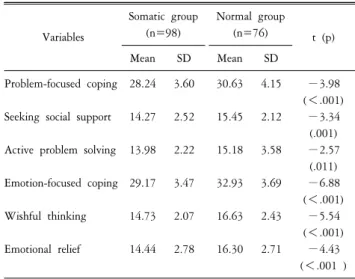
2) Stress coping styles: In the somatic group, the order of the sub-category scores for the stress coping styles were wishful thinking (14.73±2.07), emotional relief (14.44±2.78), seeking

social support (14.27±2.52) and active problem solving (13.98±

2.22); the scores for emotion-focused coping styles (29.17±3.47) were slightly higher than for problem-focused coping styles (28.24±3.60). On the other hand, in the control group, the order of the sub-category scores for the stress coping styles was wishful thinking (16.63±2.43), emotional relief (16.30±2.71), seeking social support (15.45±2.12), and active problem solving (15.18±3.58); the scores for emotion-focused coping styles (32.93±3.69) were higher than for problem-focused coping styles (30.63±4.15) (Table 2).

2. Differences in psychological symptom scores

and stress coping styles between groups

1) Differences in psychological symptom scores

between groups: An examination of the differences in

psychological symptom scores between the somatic and normal

control groups revealed statistically significant differences in 7

dimensions except obsession-compulsion and psychoticism (Table

1). The somatization score for the somatic group (64.19±8.71)

was significantly higher (t=19.85, p<.001) than for the control

group (45.22±3.24), and the depression score for the somatic

group (56.69±6.34) was significantly higher (t=15.41, p<.001)

than the control group (45.57±2.90). In addition, the anxiety

score for the somatic group (53.84±7.09) was significantly higher

(t=10.61, p<.001) than the score for the control group

(45.26±3.25), and the phobic anxiety score for the somatic group

(5)

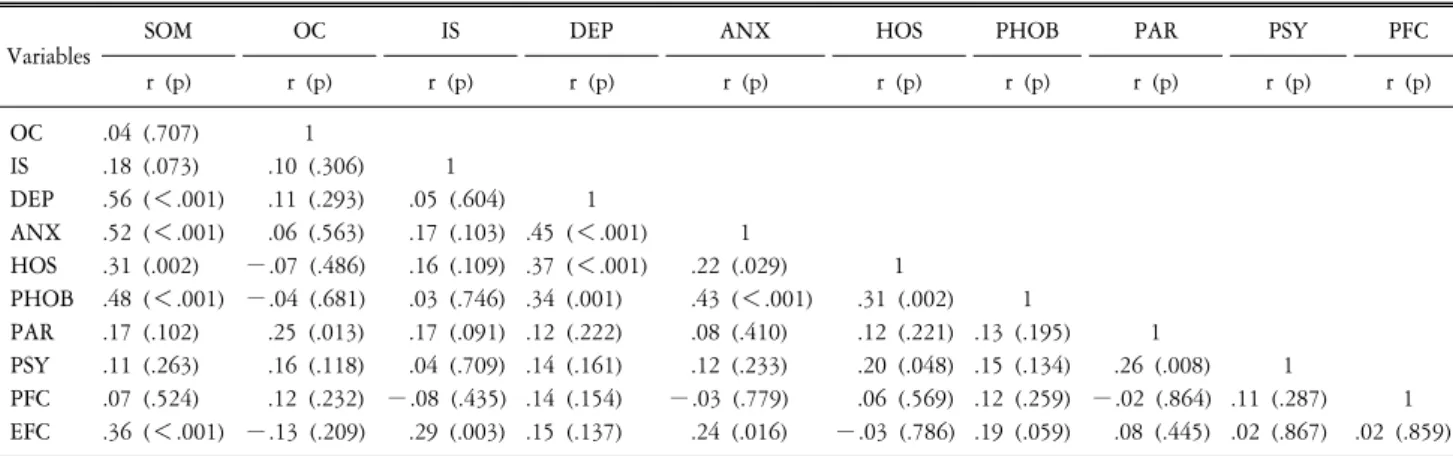
Table 3. Correlations among psychological symptoms and stress coping styles in somatic group (n=98).

Variables SOM OC IS DEP ANX HOS PHOB PAR PSY PFC

r (p) r (p) r (p) r (p) r (p) r (p) r (p) r (p) r (p) r (p)

OC IS DEP ANX HOS PHOB PAR PSY PFC EFC

.04 (.707) .18 (.073) .56 (<.001) .52 (<.001) .31 (.002) .48 (<.001) .17 (.102) .11 (.263) .07 (.524) .36 (<.001)

1 .10 (.306) .11 (.293) .06 (.563)

−.07 (.486)

−.04 (.681) .25 (.013) .16 (.118) .12 (.232)

−.13 (.209) 1 .05 (.604) .17 (.103) .16 (.109) .03 (.746) .17 (.091) .04 (.709)

−.08 (.435) .29 (.003)

1 .45 (<.001) .37 (<.001) .34 (.001) .12 (.222) .14 (.161) .14 (.154) .15 (.137)

1 .22 (.029) .43 (<.001) .08 (.410) .12 (.233)

−.03 (.779) .24 (.016)

1 .31 (.002) .12 (.221) .20 (.048) .06 (.569)

−.03 (.786) 1 .13 (.195) .15 (.134) .12 (.259) .19 (.059)

1 .26 (.008)

−.02 (.864) .08 (.445)

1 .11 (.287) .02 (.867)

1 .02 (.859) SOM: Somatization, OC: Obsession-compulsion, IS: Interpersonal sensitivity, DEP: Depression, ANX: Anxiety, HOS: Hostility, PHOB: Phobic anxiety, PAR: Paranoid ideation, PSY: Psychoticism, PFC: Problem-focused coping, EFC: Emotion-focused coping.

(51.96±6.93) was also significantly higher (t=10.26, p<.001) than the control group’s score (44.05±2.79).

2) Differences in stress coping styles between groups: The examination of the differences in stress coping styles between the somatic and control groups revealed statisti- cally significant differences in all sub-categories, problem-focused coping scores, and emotion-focused coping scores (Table 2).

Among the sub-categories of stress coping styles, the seeking social support score for the somatic group (14.27±2.52) was significantly lower (t=−3.34, p<.01) than for the control group (15.45±2.12), and the active problem solving score for the somatic group (13.98±2.22) was significantly lower (t=−2.57, p

<.05) than for control group (15.18±3.58). In addition, the wishful thinking score for the somatic group (14.73±2.07) was significantly lower (t=−5.54, p<.001) than for the control group (16.63±2.43), and the emotional relief score for the soma- tic group (14.44±2.78) was also significantly lower (t=−4.43, p

<.001) than for the control group (16.30±2.71).

The results of the examination of the four sub-categories of stress coping styles, distinguishing between problem-focused and emotion-focused coping styles, indicated that the problem-focused coping style score for the somatic group (28.24±3.60) was lower (t=−3.98, p<.001) than for the control group (30.63±4.15), and the emotion-focused coping style score for the somatic group (29.17±3.47) was also significantly lower (t=−6.88, p<.001) than for the control group (32.93±3.69).

3. Relationships between psychological symp- toms and stress coping styles

The results of examining the relationship between psychological symptoms and stress coping styles in the somatic group are as follows (Table 3): the strongest correlation was seen in the positive relationship between somatization and depression (r=.56, p<.001), and somatization also demonstrated significant positive correlations with anxiety (r=.52, p<.001), phobic anxiety (r=.48, p<.001), and hostility(r=.31, p<.01). Significant positive correlations were observed in the relationships between obsession-compulsion and paranoid ideation (r=.25, p<.05);

depression and anxiety (r=.45, p<.001); depression and hostility (r=.37, p<.001); depression and phobic anxiety (r=.34, p

<.01); anxiety and hostility (r=.22, p<.05); and anxiety and phobic anxiety (r=.43, p<.001); hostility and phobic anxiety (r=.31, p<.01); paranoid ideation and psychoticism (r=.26, p

<.01). In addition, for the stress coping styles of the somatic group, the emotion-focused coping style demonstrated positive correlations with somatization (r=.36, p<.001) and interpersonal sensitivity(r=.29, p<.01), and anxiety (r=−.24, p<.05).

4. Effects of psychological symptoms and stress coping styles on somatization

Before conducting a regression analysis to investigate the

factors that affect somatization in the somatic group, multicolli-

nearity between the independent variables was verified. The

(6)

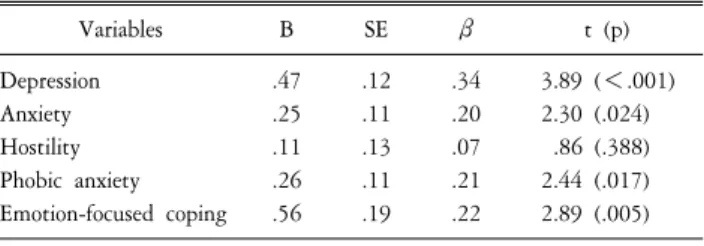
Table 4. Influences of psychological symptoms and stress coping styles on somatization (n=98).

Variables B SE β t (p)

Depression Anxiety Hostility Phobic anxiety Emotion-focused coping

.47 .25 .11 .26 .56

.12 .11 .13 .11 .19

.34 .20 .07 .21 .22

3.89 (<.001) 2.30 (.024) .86 (.388) 2.44 (.017) 2.89 (.005) R

2

=.500, Adj. R

2

=.472, F (p)=18.37 (<.001)

highest correlation coefficient observed between each of the variables was r=.56 (between somatization and depression) and since no variable with r>.80 was observed, the variables were determined to be independent, with a tolerance limit of .69∼.97 and a variance inflation factor (VIF) of 1.02∼1.44. Thus, it was determined that there were no problems with multicollinearity, and it was confirmed that no residual autocorrelation existed, as the Durbin-Watson statistic value was 1.67.

In order to investigate the effects of psychological symptoms and stress coping styles on somatization, 5 variables which had shown significant correlations with somatization, were inputted as independent variables and the results of the multi-regression analysis are presented below (Table 4). The calculated good- ness-of-fit for the regression model was determined to be satisfactory (F=18.37, p<.001), and the four variables were confirmed to have 47.2% explanatory power with respect to the somatization of the subjects. Depression (t=3.89, p<.001), anxiety (t=2.30, p<.05), phobic anxiety (t=2.44, p<.05), and the emotion-focused coping style (t=2.89, p<.01), which appeared most influential, demonstrated statistical significance, while hostility did not display statistical significance.

DISCUSSION

In this study, the differences in psychological symptoms and stress coping styles between college students with somatic tendencies and college students in the normal range were closely examined, and their effects on somatization were investigated.

The key results of this study are discussed as follows.

The SCL-90-R results presented different conditions in the somatic and control groups: the somatization score in the somatic

group was the highest, followed in order from high to low, by depression, anxiety, phobic anxiety, and hostility, with the mean scores of somatization, depression, anxiety, and phobic anxiety, being above the subclinical range. Since the somatic group in this study included both the clinical and subclinical ranges, a simple comparison to patient groups is difficult. However, the results of a study conducted on patients with somatization disorders (Lee JY et al., 2006) demonstrated the highest score for somatization, followed in order by anxiety, phobic anxiety, depression, and psychosis. With the exception of psychosis, high scores were recorded on the same scales, indicating similarities between those results and the results of this study.

Meanwhile, in the control group, the obsession-compulsion score was the highest, followed in order by interpersonal sensitivity, depression, and hostility, with the mean scores for these falling in the normal range. These results are similar to those of other studies: A study with an adult group during the standardization of the Korean version of the SCL-90-R (Kim GI et al., 1978) found obsession-compulsion to be the highest, followed in order by interpersonal sensitivity, depression, anxiety, paranoia, and then hostility. Another study with a college student group (Kim JH, 2012) found obsession-compulsion to be the highest. But such results should be compared with caution, as the subjects in this study all scored in the normal range in each symptom dimension and were part of a convenience sample for comparison to the somatic group.

The somatic and control groups presented similar conditions in the sub-categories of the stress coping styles; both groups did use emotion-focused coping style more often than problem-focused coping style. Furthermore, in the somatic group, the wishful thinking and emotional relief coping styles were found to be used more often, which partially agrees with overseas studies (Luo et al., 2009; Hall et al., 2011) that reported groups of patients with somatization disorders used passive coping styles more often.

Although the somatization tendency in college students is emerging as an important mental health issue, domestic studies on somatization and stress coping styles are few, and thus, there is a need for more replication studies with an expanded subject base.

The somatic group, in comparison to the control group,

demonstrated higher degrees of depression, anxiety, and phobic

(7)

anxiety, along with higher somatization scores. These results concur with those of Lee JY et al.(2006), who reported that patients with somatization disorders demonstrated higher degrees of depression, anxiety, and phobic anxiety than normal people.

They also reflect those of Na YS et al. (2004), who reported that somatization increased as anxiety played a significant role in individuals’ sensory amplification. In particular, depression and anxiety symptoms can act as causes that trigger somatization and can also be symptoms that accompany somatization (Lee HJ et al., 2010), and thus, it has been confirmed that they should be treated as the most common mental problems associated with somatization. Moreover, the somatic group in this study indicated a high degree of depression in addition to anxiety and phobic anxiety, which indicates greater pathological fears or physical symptoms than those in the control group, thereby suggesting that somatization should be addressed together with depression and anxiety from an intervention perspective in the future.

The stress coping styles in the somatic group were found to be lower in comparison to the control group, in all sub-categories:

seeking social support, active problem solving, wishful thinking, and emotional relief, as well as in the comparison between problem-focused and emotion-focused coping styles. These results concur with the results of the study by Hall et al. (2011), which reported that the somatic group used more avoidance and passive coping styles, and are in the same context with the study by Garralda (2010), which stated that sensitivity to stress and coping styles were related to complaints of unexplainable physical symptoms. The reason why the somatic group demonstrated lower stress coping scores than the control group reflects a relatively lower or ineffective use of coping styles by the somatic group; thus, this would suggest that future development of intervention programs for subjects with somatic problems must include the effective use of stress coping styles.

Among the relationships between psychological symptoms and stress coping styles in the somatic group, the highest correlation was between somatization and depression; somatization also had positive correlations with anxiety and phobic anxiety. The positive correlations between somatization with depression and anxiety are the same as the results of most of the preceding studies (Rhee et al., 2005; Garralda, 2010; Lee HJ et al., 2010; Kim JM et al., 2011). However, in the present study, phobic anxiety also had a

positive correlation with somatization, and this is believed to be related to fears stemming from employment concerns and uncertainties about the future, which, in recent times, is instigating even greater psychological stress in college students.

In addition, in the stress coping styles of the somatic group, the emotion-focused coping style was positively correlated with somatization, interpersonal sensitivity, and anxiety. These results are consistent with the results of other studies (Luo et al., 2009;

Ni et al., 2010) that have reported positive correlations between somatization and passive coping styles. Additionally, the relationships between somatization and the emotion-focused coping styles indicate the importance of the individual’s cognitive factors associated with somatization, unlike preceding studies that have focused solely on the individual’s emotional factors.

Therefore, an individual’s cognitive assessment and coping styles related to stress should be emphasized as important cognitive factors associated with somatization, along with other cognitive factors, such as symptom interpretation by the physical senses and sensory amplification; somatic attribution and automatic thought;

and preservative cognition, which have been examined in recent studies (Na YS et al., 2004; Luo et al., 2009; Kim JM et al., 2011; Park MG et al., 2011).

The effects of psychological symptoms and stress coping styles on somatization in the somatic group were found to have 47.2%

explanatory power through the four factors: depression, anxiety, phobic anxiety, and the emotion-focused coping style, which were correlated with somatization.

These results concur with the studies that have presented depression as the most influential factor in somatization (Rhee et al., 2005; Lee HJ et al., 2010), which seems to be the result of this study using data analysis of a combination of various psychological symptom dimensions to identify their influence.

And the studies of Aalto-Setala et al.(2002), who reported

anxiety and immature stress responses as predictive factors in

somatization; Sheehan et al.(1982), who reported that anxiety

disorders, such as panic disorders, affected a significant number of

patients with somatization disorders; and Hah YS et al.(2011),

who indicated that emotion-focused coping styles, such as

emotional relief and wishful thinking, together with stress and the

perception of health conditions, have supported these results

about predictive factors in somatization.

(8)

In addition, this study is similar to the study by Lee JY et al.(2006), who deduced that passive coping styles that deal with stress through emotional relief and wishful thinking could have influence as a cognitive process in somatization, indicated by a positive correlation between passive coping styles and psycho- logical attributions associated with symptom interpretation. These results confirm that an individual’s emotional and cognitive factors, together, influence the somatic symptoms of college students, and intervention programs for somatization must include the management of depression and anxiety, which were identified as the main predicative factor, and education on how to adequately use emotion and problem-focused coping styles in an effective manner.

This study was conducted to closely examine the differences in psychological symptoms and stress coping styles between college students with a somatic tendency and college students in the normal range, and to study their effects on somatization. As a result, the findings show that the college students with somatization have various psychological problems and insufficient stress coping. And this study presents the meaningful conclusion that psychological characteristics such as depression, anxiety, and phobic anxiety, as well as cognitive characteristics, such as individuals’ emotion-focused coping styles have influence on somatic symptoms. It is significant that this result can be used as preliminary data for the development of intervention programs and research on the somatization of college students. However, since the subjects for this study were part of a convenience sample in a specific region, there is a limitation in generalizing the results of this study. Moreover, this study has another clear limitation: It was unable to draw detailed conclusions since the number of subjects in the somatic group was not enough to divide into the clinical and subclinical ranges. I hope the results of this study can be used as preliminary data, not only for understanding the somatic problems of college students and for student guidance and counseling, but also for effective intervention, and would like to suggest that future studies addressing these limitations are needed.

REFERENCES

Aalto-Setala T, Poikolainen K, Marttunen M et al. (2002) Predictors of mental distress in adulthood: a five-year follow up of 709 high

school students. Nord J. Psychiatry. 56:121-125.

Avila IA (2006) Somatization or Psychosomatic symptoms. Psychoso- matics. 47:163-166.

Campo JV, Fritsch SL (1994) Somatization in children and adole- scents. J. Am Acad of Child Adolesc Psychiatry. 33:1223-1235.

Derogatis LR (1977) SCL-90(Revised) Manual 1. Clinical Psycho- metrics Research Unit. Baltimore, MD.

Garralda ME (2010) Unexplained physical complaints. Child Adolesc Psychiatr Clin N Am. 19:199-209.

Gregory KF, Sandra F, Owen H (1997) Somatoform disorder in children and adolescents.: A review of the past 10 years. J. Am Acad of Child Adolesc Psychiatry. 36:1329-1338.

Hah YS, Lee JY (2010) Perceived stress, stress symptoms, and ways of coping in Korean college students. J. Korean Acad. Psychiatr Ment Health Nurs. 19:457-465.

Hall NM, Kuzminskyte R, Pedersen AD et al. (2011) The relelation- ship between cognitive functions, somatization and behavioral coping in patients with multiple functional somatic symptoms.

Nord J. Psychiatry. 65:216-224.

Kang BM (2003) The causes of social stress and way of coping with stress on university students. Unpublished master's thesis, Konkuk University.

Kim GI, Won HT, Lee JH et al. (1978) Standardization study of symptom checklist -90 in Korea 1: Characteristics of normal responses. J. Korean Neuropsychiatr Assoc. 17:449-458.

Kim GI, Kim JH, Won HT (1985) Korean manual of Symptom Checklist90-Revision. Seoul CAJS.

Kim GI, Seo HH, Park YC et al. (1989) Follow-up study: public knowledge and attitude toward mental illness in Korea. Mental Health Research. 8:118-132.

Kim JH (1987) Relations of perceived stress, cognitive set, and coping behaviors to depression: a focus on freshmen's stress experiences. Unpublished doctoral dissertation, Seoul National University.

Kim JH (2012) The influence of university student's social support and mental health on their school life adaptation. Unpublished master's thesis, Paejae University.

Kim JM, Jee H (2011) A study on the emotional, cognitive and social variables for somatization by developmental stage. Korean J. of Counseling. 12:1109-1130.

Koo SS, Jung OH, Jang SH (2011) The relationships of ego-identity, social support and mental health of adolescents. J. Korea Contents Assoc. 11:225-237.

Lazarus RS, Folkman S (1984) Stress, appraisal and coping. Springer Publishing Co., New York, NY.

Lee HJ, Seo M (2010) Factors influencing somatization in adole- scents. J. Korean Soc. of School Health. 23:79-87.

Lee JY, Lee MS, Yoon JS et al. (2006) The strategies and psycho-

(9)

logical characteristics in patients with somatization disorder. J.

Korean Neuropsychiatr Assoc. 45:534-540.

Lee JY (2010) MBTI personality type, self-efficacy, and ways of coping in nursing students. Korean J. Str Res. 18:219-227.

Lipowski ZJ (1986) Somatization: the concept and its application. Am J Psychiatry. 145:1358-1368.

Liu L, Cohen S, Schultz MS et al. (2011) Sources of somatization:

exploring the roles of insecurity in relationships and styles of anger experience and expression. Soc Sci Med. 73:1436-1443.

Luo Y, Wang H (2009) Correlation research on psychological health impact on nursing students against stress, coping way and social support. Nurse Educ Today. 29:5-8.

Na YS, Jung HY, Kwon YJ et al. (2004) Cognitive characteristics in somatizers with anxiety symptoms. J. Korean Neuropsychiatr Assoc.

43:726-732.

Ni C, Liu X, Hua Q et al. (2010) Relationship between coping, self-esteem, individual factors and mental health among Chinese nursing students: a matched case-control study. Nurse Educ Today. 30:338-343.

Park KH, Hah YS (2007) Depression, self-efficacy, life satisfaction and coping behaviors of university students. Korean J. Str Res.

15:17-25.

Park MG, Son CN (2011) Mediating effects of worry in the relation of stress and somatization. Korean J. Str Res. 19:361-369.

Rhee H, Holditch-Davis D, Miles MS (2005) Patterns of physical symptoms and relationship with psychosocial factors in adole- scents. Psychosom Med. 67:1006-1012.

Sheehan DV, Sheehan KH (1982) The classification of anxiety and

hysterical states: toward a more heuristic classification. J. Clin

Psychopharm. 2:386-393.

(10)

= 국문초록 =

본 연구는 신체화 경향을 가진 대학생의 심리적 증상과 스트레스 대처방식을 확인하고, 신체화 집단과 정상집단간 의 심리적 증상과 스트레스 대처방식의 차이를 규명하며, 이들 하위요인들과 신체화 간의 관계 및 신체화에 미치는 영향을 탐색하기 위해 수행되었다. 연구도구는 한국판 간이정신진단검사와 스트레스 대처방식 측정도구를 이용하 였으며, 검사결과 신체화 증상차원에서 임상범위와 준 임상범위에 속하는 98명을 신체화 집단, 모든 증상차원에서 정상범위에 속하는 76명을 정상집단으로 구분하여 수집된 자료를 기술통계, t검정, 단순상관분석, 다중회귀분석을 이용하여 분석하였다. 본 연구의 결과 신체화 집단은 강박증과 정신증을 제외한 대인예민성, 우울, 불안, 적대감, 공 포불안, 편집증의 모든 심리적 증상영역에서 정상집단보다 유의하게 높은 점수를 보였고, 스트레스 대처방식에서는 문제중심 대처와 정서중심 대처 모두가 정상집단보다 유의하게 낮은 점수를 보여 효율적인 스트레스 대처방식을 사용하지 못하는 것으로 나타났다. 또한, 신체화 집단에서의 신체화는 우울, 불안, 공포불안, 적대감과 양적 상관성 을 가지며, 정서중심 대처와도 양적 상관을 갖는 것으로 나타났다. 신체화 집단의 신체화를 설명하는 가장 유의한 예측요인은 우울이었으며, 불안, 공포불안, 정서중심 대처와 함께 47.2%의 설명력을 갖는 것으로 확인되었다. 연구결 과를 토대로 대학생의 신체화 문제를 위한 중재는 우울과 불안에 대한 중재와 함께 이루어져야 하며, 보다 다양하고 효율적인 스트레스 대처방식을 사용할 수 있도록 중재해야 할 것으로 생각된다. 본 연구는 신체화 경향을 가진 대학 생의 심리적 증상과 스트레스 대처방식의 특성과 신체화에 미치는 영향력에 대한 의미 있는 결과를 제공함으로써 신체화 문제를 위한 중재프로그램의 개발과 연구는 물론, 신체화 경향을 가진 대학생의 상담과 관리를 위한 기초자 료로 활용할 수 있다는 데 그 의의가 있다.

중심단어: 대처방식, 심리적 증상, 신체화

수치

Table  1.  Comparison  of  psychological  symptom  scores  between  somatic  group  and  normal  group.
Table  3.  Correlations  among  psychological  symptoms  and  stress  coping  styles  in  somatic  group  (n=98).
Table  4.  Influences  of  psychological  symptoms  and  stress  coping  styles  on  somatization  (n=98)

참조

관련 문서

Consequently, the Stress Coping Training Program is effective for improving children's school adjustment and sub-factors of school adjustment such as

For students majoring in Computer Science have shown positive relationships with personal attitude and subjective norms, differing from those majoring in

In the university, the university conducted a survey of 400 persons and college students, conducted a questionnaire survey of 400 people through

The purpose of this study is to evaluate the marginal and internal fit of coping made by CAD/CAM using different scanning methods.. Zirconia coping was made

In this study, we investigated how the Korean-Chinese cultural differences and cognitive emotion regulation influence the spirituality and stress coping

Indeed, he exacerbates it: first he quotes specific modernist styles (like cubism and constructivism), and then he simulates entire codes of historical

A study on the relationship between body mass index and the food habits of college students. Keilins respiratory chain concept and its

Objectives: This study was performed to find the association of job stress with geriatric nursing, coping methods and work environment with turnover intention among nursing