Vol.21, No.3, (2019), pp.1~5 https://doi.org/10.9714/psac.2019.21.3.001
```
Nomenclature 𝛼 : Stekly parameter ε : dimensionless energy 𝜌𝑐 : electric resistivity of copper 𝜃 : dimensionless temperature
𝐴 : cross-sectional area of conductor, m2 𝐶 : volumetric heat capacity, J/K-m3 𝐸 : energy, J
𝐹 : stability function
𝑓 : volume fraction of copper, dimensionless 𝐺 : integration of current sharing function 𝑔 : current sharing function
ℎ : heat transfer coefficient, W/m2-K 𝐼 : current, A
𝑖 : current ratio, I/Ic
𝐽 : current density, A/m2
𝑘 : thermal conductivity, W/m-K 𝑃 : perimeter, m
𝑄 : Joule heat generation per unit area, W/m2 𝑞 : convection heat flux, W/m2
𝑠 : dimensionless temperature gradient 𝑇 : temperature, K
𝑡 : time, s
𝑥 : dimensionless coordinate
𝑧 : coordinate in conductor direction, m Subscript :
c : critical b : bath of coolant m : maximum temperature
min : position of minimum value of stability function max : position of maximum value of stability function mpz : minimum propagation zone
n : normal metal
s : cryogenic stability 1 : condition for 𝜃𝑚= 1
1. INTRODUCTION
The classical interpretation of superconductor stability has a sophisticated theoretical system leading to cryogenic stability, cold-end recovery, equal area theorem and MPZ (minimum propagation zone). In this paper, based on the integral formula, we intend to provide a simple and intuitive framework for understanding these theories.
The cryogenic stability (or unconditional stability) criterion [1, 2] suggests that conductors can recover superconductivity if the Joule heat generation across the conductor is less than the heat release to the coolant. This theory is most stable but can only deliver an operating current density that is too low for the critical current density. In cryogenic stability criterion, all parts of the conductor driven normal by a thermal perturbation (called normal zone) recover simultaneously.
Maddock [3] showed that unconditional stability can preserved at somewhat higher current densities. The so called cold-end recovery condition assumes that both ends are immersed in the coolant even if the temperature at which the disturbance energy is applied rises. The generated Joule heat can be released by the convection heat transfer to the coolant as well as by conduction heat transfer in the conductor length direction to the cold end.
This theory is summarized by the famous equal-area theorem, which suggests conditions that can not constitute an unstable equilibrium temperature distribution.
Large superconducting magnets operate under unconditional stability conditions. Even when operating under cold-end recovery conditions, the operating current density is still too low. The MPZ theory [4, 5] is developed
Stability of superconductor by integration formula
S. Y. Seol*
Chonnam National University, Gwangju, Korea
(Received 14 August 2019; revised or reviewed 18 September 2019; accepted 19 September 2019)
Abstract
The superconductor stability theories are consistently described by the integral formula. If the defined stability function is a simple decreasing function, it becomes a cryogenic stability condition. If the stability function has a maximum value and a minimum value, and the maximum value is less than 0, then it is a cold-end recovery condition. If the maximum value is more than 0, it can be shown that the unstable equilibrium temperature, that is, the MPZ (minimum propagation zone) temperature distribution can exist. The MPZ region is divided into two regions according to the current ratio. At the low current ratio, the maximum dimensionless temperature is greater than 1, and at the relatively high current ratio, the maximum dimensionless temperature is less than 1. In order to predict the minimum quench energy, the dimensionless energy was obtained for the MPZ temperature distribution.
In particular, it was shown that the dimensionless energy can be obtained even when the MPZ maximum temperature is 1 or more.
Keywords: superconductor, Stekly parameter, cryogenic stability, cold-end recovery, MPZ (minimum propagation zone), stability function, critical energy
* Corresponding author: [email protected]
to raise the current density above the Maddock limit, assuming that the perturbation energy is small. The MPZ theory finds the unstable equilibrium temperature distribution (MPZ temperature distribution) and calculates the energy of the temperature distribution to estimate the minimum quench energy.
The above theories are analyzed by using the one- dimensional heat conduction equation, but the analysis considering the two-dimensional heat transfer is also performed by extending it [6].
This paper considers the classical theories on the stability of superconductors in terms of the stability function proposed in this paper and presents the numerical results. It is shown that the current ratio (ratio of operating current to critical current) in a given condition (Stekly parameter) is sequentially categorized into cryogenic stability, cold-end recovery, and MPZ criterions. In addition, the MPZ region is divided into two regions having a dimensionless maximum temperature greater than 1 or less than 1. The MPZ temperature distribution was obtained and the MPZ formation energy was calculated by integration.
In cryogenic stability and cold-end recovery criterions, boiling heat transfer is assumed, which has several modes such as nucleate boiling, transition boiling, and film boiling. In this paper, it is assumed that all heat release to the coolant have a constant boiling heat transfer coefficient for the purpose of consistently examining the stability theory.
2. ANALYSIS
The following one-dimensional heat conduction equation is used for the stability analysis of a superconductor [4].
𝐶𝜕𝑇
𝜕𝑡 = 𝜕
𝜕𝑧(𝑘𝜕𝑇
𝜕𝑧) +𝑄𝑃 𝐴 − 𝑞𝑃
𝐴 (1)
The coordinate 𝑧 is the conductor length direction, and at 𝑧 = 0, the conductor has the highest temperature, and the temperature approaches the coolant temperature as 𝑧 increases in the positive and negative directions. Because of the symmetry, only the 𝑧 > 0 region is considered.
The Joule heat generation 𝑄 changes depending on the conductor temperature. When 𝑇 is greater than critical temperature 𝑇𝑐, all current flow in normal metal and the Joule heat generation becomes maximum value, 𝑄 = 𝑄𝑛= (𝜌𝑐𝑢𝐽2𝐴)/𝑓𝑃 . When 𝑇𝑏 < 𝑇 < 𝑇𝑐𝑠, all current flow in superconductor and 𝑄 = 0 , where 𝑇𝑏 is the bath temperature, and 𝑇𝑐𝑠 is the current sharing temperature.
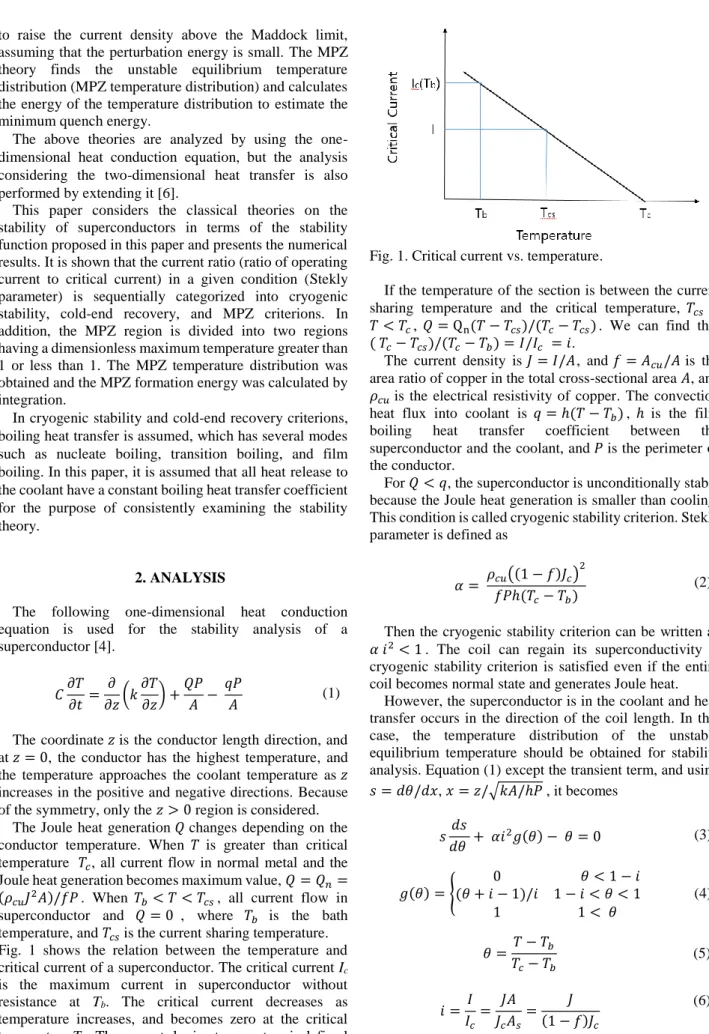
Fig. 1 shows the relation between the temperature and critical current of a superconductor. The critical current Ic
is the maximum current in superconductor without resistance at Tb. The critical current decreases as temperature increases, and becomes zero at the critical temperature Tc. The current sharing temperature is defined as the temperature at which the operating current is equal to the critical current.
Fig. 1. Critical current vs. temperature.
If the temperature of the section is between the current sharing temperature and the critical temperature, 𝑇𝑐𝑠 <
𝑇 < 𝑇𝑐, 𝑄 = Qn(𝑇 − 𝑇𝑐𝑠)/(𝑇𝑐− 𝑇𝑐𝑠) . We can find that ( 𝑇𝑐− 𝑇𝑐𝑠)/(𝑇𝑐− 𝑇𝑏) = 𝐼/𝐼𝑐 = 𝑖.
The current density is 𝐽 = 𝐼/𝐴, and 𝑓 = 𝐴𝑐𝑢/𝐴 is the area ratio of copper in the total cross-sectional area 𝐴, and 𝜌𝑐𝑢 is the electrical resistivity of copper. The convection heat flux into coolant is 𝑞 = ℎ(𝑇 − 𝑇𝑏) , ℎ is the film boiling heat transfer coefficient between the superconductor and the coolant, and 𝑃 is the perimeter of the conductor.
For 𝑄 < 𝑞, the superconductor is unconditionally stable because the Joule heat generation is smaller than cooling.
This condition is called cryogenic stability criterion. Stekly parameter is defined as
𝛼 = 𝜌𝑐𝑢((1 − 𝑓)𝐽𝑐)2
𝑓𝑃ℎ(𝑇𝑐− 𝑇𝑏) (2)
Then the cryogenic stability criterion can be written as 𝛼 𝑖2< 1 . The coil can regain its superconductivity if cryogenic stability criterion is satisfied even if the entire coil becomes normal state and generates Joule heat.
However, the superconductor is in the coolant and heat transfer occurs in the direction of the coil length. In this case, the temperature distribution of the unstable equilibrium temperature should be obtained for stability analysis. Equation (1) except the transient term, and using 𝑠 = 𝑑𝜃/𝑑𝑥, 𝑥 = 𝑧/√𝑘𝐴/ℎ𝑃 , it becomes
𝑠𝑑𝑠
𝑑𝜃 + 𝛼𝑖2𝑔(𝜃) − 𝜃 = 0 (3)
𝑔(𝜃) = {
0 𝜃 < 1 − 𝑖 (𝜃 + 𝑖 − 1)/𝑖 1 − 𝑖 < 𝜃 < 1
1 1 < 𝜃
(4)
𝜃 = 𝑇 − 𝑇𝑏
𝑇𝑐− 𝑇𝑏 (5)
𝑖 = 𝐼 𝐼𝑐
= 𝐽𝐴 𝐽𝑐𝐴𝑠
= 𝐽
(1 − 𝑓)𝐽𝑐
(6)
The above equations are cited by several researchers for superconductor stability analysis [4, 5].
If the thermal conduction is neglected in Equation (3), the boundary of the cryogenic stability condition 𝛼𝑖2= 1 is obtained under the condition that the maximum Joule heat generation is equal to the heat release amount.
The temperature distribution has a maximum temperature (𝜃 = 𝜃𝑚) at 𝑥 = 0 and 𝜃 = 0 at 𝑥 = ∞. Also, the temperature gradient at 𝑥 = 0 and 𝑥 = ∞ should be zero.
By separation of variables and integration, Equation (3) becomes
𝑠2= 2 𝛼𝑖2[𝐺(𝜃𝑚) − 𝐺(𝜃)] − (𝜃𝑚2 − 𝜃2) (7)
𝐺(𝜃) = ∫ 𝑔(𝜃)𝑑𝜃
𝜃 0
(8)
𝐺(𝜃) = {
0 𝜃 < 1 − 𝑖 (𝜃 + 𝑖 − 1)2
2𝑖 1 − 𝑖 < 𝜃 < 1 𝑖
2+ 𝜃 − 1 1 < 𝜃
(9)
Because 𝑠 = 0 at 𝜃 = 0 in Equation (7), the following equation can be derived.
𝐹(𝜃) = 2 𝛼𝑖2𝐺(𝜃) − 𝜃2 (10) Equation (10) is called a stability function in this paper.
To find the maximum and minimum values of stability function, set the derivative values zero. 𝐹′(𝜃) = 2[𝛼𝑖2𝑔(𝜃) − 𝜃]. The minimum value of 𝐹(𝜃) is between 1 − 𝑖 < 𝜃 < 1, and its position and value are as follows.
𝜃𝑚𝑖𝑛=𝛼𝑖(1 − 𝑖)
𝛼𝑖 − 1 (11)
𝐹𝑚𝑖𝑛= −𝛼𝑖(1 − 𝑖)2
𝛼𝑖 − 1 (12)
𝐹𝑚𝑖𝑛 is always negative because 𝛼𝑖2> 1, 0 < 𝑖 < 1.
The maximum value of the stability function can be obtained from 1 < 𝜃, and its position and maximum value are as follows.
𝜃𝑚𝑎𝑥 = 𝛼𝑖2 (13)
𝐹𝑚𝑎𝑥 = 𝛼𝑖2(𝛼𝑖2+ 𝑖 − 2) (14)
For the equation 𝐹(𝜃) = 0 to have a root, the maximum value 𝐹𝑚𝑎𝑥 must be greater than or equal to zero.
𝛼𝑖2+ 𝑖 − 2 ≥ 0 (15)
If 𝛼𝑖2+ 𝑖 − 2 < 0 , that is, 𝛼𝑖2< 2 − 𝑖 , there is no steady state temperature distribution. Even if the temperature rises above critical value, the conductor
recovers the superconducting state. In this condition, the stable region is larger than the cryogenic stability condition 𝛼𝑖2< 1.
If 𝛼𝑖2= 1 , 𝜃𝑚𝑖𝑛= 𝜃𝑚𝑎𝑥 = 1 . That is, the function 𝐹(𝜃) has an inflection point at 𝜃 = 1. That is, the function 𝐹(𝜃) becomes a monotone decreasing function when 𝛼𝑖2< 1.
In this paper, it is assumed that the convective cooling coefficient ℎ is constant. This assumption helps to conceptually understand the problem of superconductor stability. However, the superconductor immersed in liquid helium or liquid nitrogen causes boiling heat transfer at the surface, and the heat transfer coefficient of boiling depends on boiling modes such as nucleate boiling, transition boiling, and film boiling.
From the given Stekly parameter (𝛼 ), the minimum current ratio (𝑖𝑚𝑝𝑧) that makes up the MPZ can be obtained from 𝛼𝑖2+ 𝑖 − 2 = 0.
𝑖𝑚𝑝𝑧= −1 + √1 + 8𝛼 2𝛼
(16)
The maximum temperature at 𝑖 = 𝑖𝑚𝑝𝑧, 𝜃𝑚𝑝𝑧= 2 − 𝑖𝑚𝑝𝑧
(17)
If Stekly parameter 𝛼 = 10, the minimum current ratio to form MPZ becomes 𝑖𝑚𝑝𝑧=0.4. The maximum value of the MPZ temperature becomes 𝜃𝑚𝑝𝑧= 1.6.
Now, let us look at the root of 𝐹(𝜃) = 0 in the condition of 𝐹𝑚𝑎𝑥> 0. First, to find the roots in the condition of 1 <
𝜃𝑚< 𝜃𝑚𝑝𝑧, the following equation derived from Eqs. (9) and (10) must be solved.
2𝛼𝑖2(𝑖
2+ 𝜃 − 1) − 𝜃2= 0 (18) The quadratic equation for 𝜃 is solved as follows.
𝜃𝑚= 𝛼𝑖2[1 − (1 −2 − 𝑖 𝛼𝑖2)
1/2
] (19)
We can obtain 𝛼𝑖3< 1 by using 1 < 𝜃𝑚, which means that the maximum temperature is 1 or more if 𝑖 < 1/𝛼3 for a given α. We can also confirm that 𝜃𝑚= 𝜃𝑚𝑝𝑧 by substituting 𝑖 = 𝑖𝑚𝑝𝑧 in Eq. (19) and using 𝛼𝑖𝑚𝑝𝑧2 = 2 − 𝑖𝑚𝑝𝑧.
For 1 > 𝜃𝑚, the equations (9) and (10) become
2𝛼𝑖2(𝜃 + 𝑖 − 1)2
2𝑖 − 𝜃2= 0 (20)
and the solution
𝜃𝑚= (1 − 𝑖)√𝛼𝑖
√𝛼𝑖 − 1
(21)
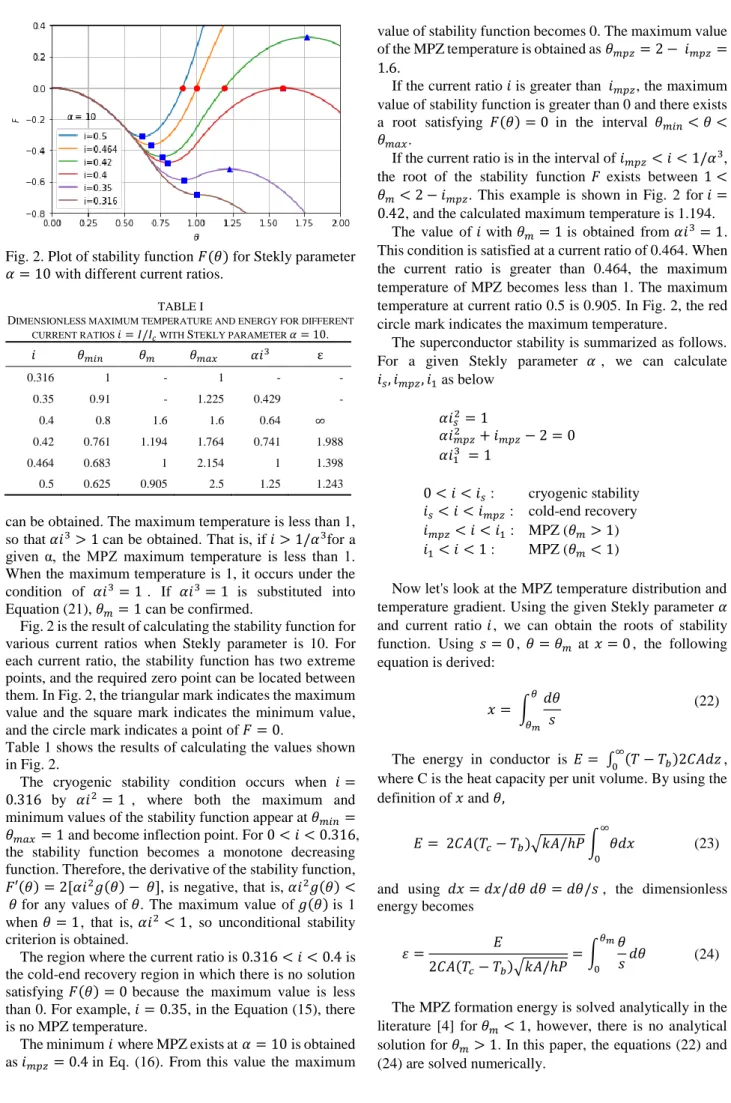
Fig. 2. Plot of stability function 𝐹(𝜃) for Stekly parameter 𝛼 = 10 with different current ratios.
TABLE I
DIMENSIONLESS MAXIMUM TEMPERATURE AND ENERGY FOR DIFFERENT CURRENT RATIOS 𝑖 = 𝐼/𝐼𝑐 WITH STEKLY PARAMETER 𝛼 = 10.
𝑖 𝜃𝑚𝑖𝑛 𝜃𝑚 𝜃𝑚𝑎𝑥 𝛼𝑖3 ε
0.316 1 - 1 - -
0.35 0.91 - 1.225 0.429 -
0.4 0.8 1.6 1.6 0.64 ∞
0.42 0.761 1.194 1.764 0.741 1.988
0.464 0.683 1 2.154 1 1.398
0.5 0.625 0.905 2.5 1.25 1.243
can be obtained. The maximum temperature is less than 1, so that 𝛼𝑖3> 1 can be obtained. That is, if 𝑖 > 1/𝛼3for a given α, the MPZ maximum temperature is less than 1.
When the maximum temperature is 1, it occurs under the condition of 𝛼𝑖3= 1 . If 𝛼𝑖3= 1 is substituted into Equation (21), 𝜃𝑚= 1 can be confirmed.
Fig. 2 is the result of calculating the stability function for various current ratios when Stekly parameter is 10. For each current ratio, the stability function has two extreme points, and the required zero point can be located between them. In Fig. 2, the triangular mark indicates the maximum value and the square mark indicates the minimum value, and the circle mark indicates a point of 𝐹 = 0.
Table 1 shows the results of calculating the values shown in Fig. 2.
The cryogenic stability condition occurs when 𝑖 = 0.316 by 𝛼𝑖2= 1 , where both the maximum and minimum values of the stability function appear at 𝜃𝑚𝑖𝑛 = 𝜃𝑚𝑎𝑥= 1 and become inflection point. For 0 < 𝑖 < 0.316, the stability function becomes a monotone decreasing function. Therefore, the derivative of the stability function, 𝐹′(𝜃) = 2[𝛼𝑖2𝑔(𝜃) − 𝜃], is negative, that is, 𝛼𝑖2𝑔(𝜃) <
𝜃 for any values of 𝜃. The maximum value of 𝑔(𝜃) is 1 when 𝜃 = 1, that is, 𝛼𝑖2< 1, so unconditional stability criterion is obtained.
The region where the current ratio is 0.316 < 𝑖 < 0.4 is the cold-end recovery region in which there is no solution satisfying 𝐹(𝜃) = 0 because the maximum value is less than 0. For example, 𝑖 = 0.35, in the Equation (15), there is no MPZ temperature.
The minimum 𝑖 where MPZ exists at 𝛼 = 10 is obtained as 𝑖𝑚𝑝𝑧= 0.4 in Eq. (16). From this value the maximum
value of stability function becomes 0. The maximum value of the MPZ temperature is obtained as 𝜃𝑚𝑝𝑧= 2 − 𝑖𝑚𝑝𝑧= 1.6.
If the current ratio 𝑖 is greater than 𝑖𝑚𝑝𝑧, the maximum value of stability function is greater than 0 and there exists a root satisfying 𝐹(𝜃) = 0 in the interval 𝜃𝑚𝑖𝑛< 𝜃 <
𝜃𝑚𝑎𝑥.
If the current ratio is in the interval of 𝑖𝑚𝑝𝑧< 𝑖 < 1/𝛼3, the root of the stability function 𝐹 exists between 1 <
𝜃𝑚< 2 − 𝑖𝑚𝑝𝑧. This example is shown in Fig. 2 for 𝑖 = 0.42, and the calculated maximum temperature is 1.194.
The value of 𝑖 with 𝜃𝑚= 1 is obtained from 𝛼𝑖3= 1.
This condition is satisfied at a current ratio of 0.464. When the current ratio is greater than 0.464, the maximum temperature of MPZ becomes less than 1. The maximum temperature at current ratio 0.5 is 0.905. In Fig. 2, the red circle mark indicates the maximum temperature.
The superconductor stability is summarized as follows.
For a given Stekly parameter 𝛼 , we can calculate 𝑖𝑠, 𝑖𝑚𝑝𝑧, 𝑖1 as below
𝛼𝑖𝑠2= 1
𝛼𝑖𝑚𝑝𝑧2 + 𝑖𝑚𝑝𝑧− 2 = 0 𝛼𝑖13 = 1
0 < 𝑖 < 𝑖𝑠 : cryogenic stability 𝑖𝑠< 𝑖 < 𝑖𝑚𝑝𝑧 : cold-end recovery 𝑖𝑚𝑝𝑧< 𝑖 < 𝑖1 : MPZ (𝜃𝑚> 1) 𝑖1< 𝑖 < 1 : MPZ (𝜃𝑚< 1)
Now let's look at the MPZ temperature distribution and temperature gradient. Using the given Stekly parameter 𝛼 and current ratio 𝑖 , we can obtain the roots of stability function. Using 𝑠 = 0 , 𝜃 = 𝜃𝑚 at 𝑥 = 0 , the following equation is derived:
𝑥 = ∫ 𝑑𝜃 𝑠
𝜃 𝜃𝑚
(22)
The energy in conductor is 𝐸 = ∫ (𝑇 − 𝑇0∞ 𝑏)2𝐶𝐴𝑑𝑧, where C is the heat capacity per unit volume. By using the definition of 𝑥 and 𝜃,
𝐸 = 2𝐶𝐴(𝑇𝑐− 𝑇𝑏)√𝑘𝐴/ℎ𝑃 ∫ 𝜃𝑑𝑥
∞ 0
(23)
and using 𝑑𝑥 = 𝑑𝑥/𝑑𝜃 𝑑𝜃 = 𝑑𝜃/𝑠 , the dimensionless energy becomes
𝜀 = 𝐸
2𝐶𝐴(𝑇𝑐− 𝑇𝑏)√𝑘𝐴/ℎ𝑃= ∫ 𝜃 𝑠𝑑𝜃
𝜃𝑚 0
(24)
The MPZ formation energy is solved analytically in the literature [4] for 𝜃𝑚< 1, however, there is no analytical solution for 𝜃𝑚> 1. In this paper, the equations (22) and (24) are solved numerically.
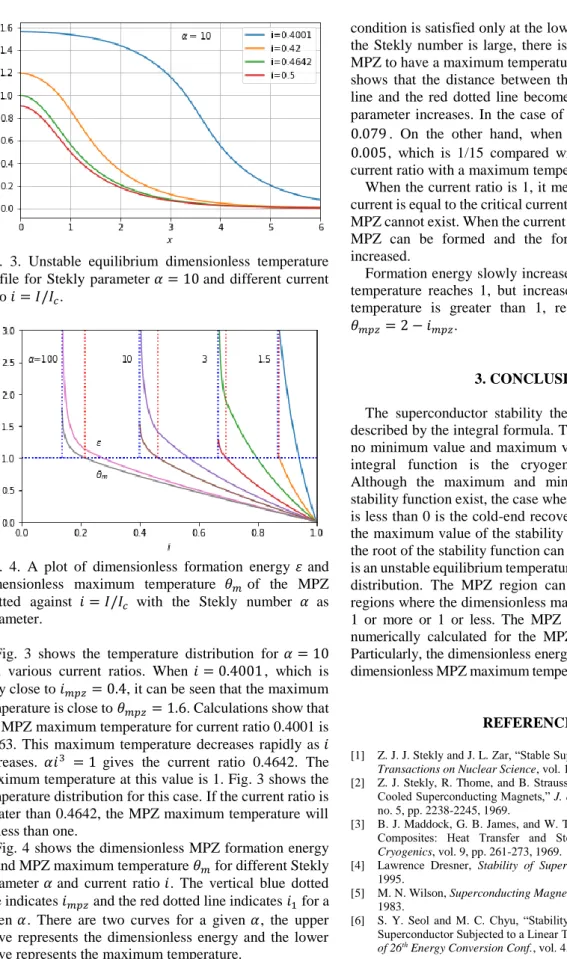
Fig. 3. Unstable equilibrium dimensionless temperature profile for Stekly parameter 𝛼 = 10 and different current ratio 𝑖 = 𝐼/𝐼𝑐.
Fig. 4. A plot of dimensionless formation energy 𝜀 and dimensionless maximum temperature 𝜃𝑚 of the MPZ plotted against 𝑖 = 𝐼/𝐼𝑐 with the Stekly number 𝛼 as parameter.
Fig. 3 shows the temperature distribution for 𝛼 = 10 and various current ratios. When 𝑖 = 0.4001 , which is very close to 𝑖𝑚𝑝𝑧= 0.4, it can be seen that the maximum temperature is close to 𝜃𝑚𝑝𝑧= 1.6. Calculations show that the MPZ maximum temperature for current ratio 0.4001 is 1.563. This maximum temperature decreases rapidly as 𝑖 increases. 𝛼𝑖3 = 1 gives the current ratio 0.4642. The maximum temperature at this value is 1. Fig. 3 shows the temperature distribution for this case. If the current ratio is greater than 0.4642, the MPZ maximum temperature will be less than one.
Fig. 4 shows the dimensionless MPZ formation energy 𝜀 and MPZ maximum temperature 𝜃𝑚 for different Stekly parameter 𝛼 and current ratio 𝑖. The vertical blue dotted line indicates 𝑖𝑚𝑝𝑧 and the red dotted line indicates 𝑖1 for a given 𝛼. There are two curves for a given 𝛼, the upper curve represents the dimensionless energy and the lower curve represents the maximum temperature.
For large Stekly parameter, the Joule heat generation is larger than the heat release, the cold-end recovery
condition is satisfied only at the low current ratio. Also, if the Stekly number is large, there is a lot of room for the MPZ to have a maximum temperature of 1 or more. Fig. 4 shows that the distance between the vertical blue dotted line and the red dotted line becomes wider as the Stekly parameter increases. In the case of 𝛼 = 100, 𝑖1− 𝑖𝑚𝑝𝑧= 0.079 . On the other hand, when 𝛼 = 1.5 , 𝑖1− 𝑖𝑚𝑝𝑧= 0.005, which is 1/15 compared with 𝛼 = 100. 𝑖1 is the current ratio with a maximum temperature of 1.
When the current ratio is 1, it means that the operating current is equal to the critical current of the superconductor, MPZ cannot exist. When the current ratio is smaller than 1, MPZ can be formed and the forming energy is also increased.
Formation energy slowly increases until the MPZ peak temperature reaches 1, but increases rapidly when peak temperature is greater than 1, resulting in infinity at 𝜃𝑚𝑝𝑧= 2 − 𝑖𝑚𝑝𝑧.
3. CONCLUSION
The superconductor stability theories are consistently described by the integral formula. The case where there is no minimum value and maximum value of the developed integral function is the cryogenic stability domain.
Although the maximum and minimum values of the stability function exist, the case where the maximum value is less than 0 is the cold-end recovery region. And, when the maximum value of the stability function is 0 or more, the root of the stability function can be obtained, and there is an unstable equilibrium temperature or MPZ temperature distribution. The MPZ region can be divided into two regions where the dimensionless maximum temperature is 1 or more or 1 or less. The MPZ formation energy was numerically calculated for the MPZ temperature profile.
Particularly, the dimensionless energy is obtained when the dimensionless MPZ maximum temperature is greater than 1.
REFERENCES
[1] Z. J. J. Stekly and J. L. Zar, “Stable Superconducting Coils,” IEEE Transactions on Nuclear Science, vol. 12, pp. 367-372, 1965.
[2] Z. J. Stekly, R. Thome, and B. Strauss, “Principles of Stability in Cooled Superconducting Magnets,” J. of Applied Physics, vol. 40, no. 5, pp. 2238-2245, 1969.
[3] B. J. Maddock, G. B. James, and W. T. Norris, “Superconducting Composites: Heat Transfer and Steady State Stabilization,”
Cryogenics, vol. 9, pp. 261-273, 1969.
[4] Lawrence Dresner, Stability of Superconductors, Plenum Press, 1995.
[5] M. N. Wilson, Superconducting Magnets, Oxford University Press, 1983.
[6] S. Y. Seol and M. C. Chyu, “Stability Analysis for a Composite Superconductor Subjected to a Linear Thermal Disturbance,” Proc.
of 26th Energy Conversion Conf., vol. 4, pp. 515-520, 1991.