• 검색 결과가 없습니다.

Long-term recurrence-free survival of a patient with advanced pure primary ovarian squamous cell carcinoma treated with dose-dense paclitaxel combined with carboplatin

N/A
N/A
Protected

Academic year: 2022

Share "Long-term recurrence-free survival of a patient with advanced pure primary ovarian squamous cell carcinoma treated with dose-dense paclitaxel combined with carboplatin"

Copied!
6
0
0

로드 중.... (전체 텍스트 보기)

전체 글

(1)

https://doi.org/10.5468/ogs.2017.60.6.587 pISSN 2287-8572 · eISSN 2287-8580

Introduction

Ovarian squamous cell carcinoma (SCC) is a rare entity with several reported etiologies, as follows: 1) malignant transfor- mation of mature cystic teratoma (MCT); 2) differentiation from other ovarian neoplasms (e.g., Brenner tumor, endo- metrioid adenocarcinoma, and mixed mesodermal tumor);

3) development from ovarian endometriosis; 4) pure ovarian SCC; and 5) metastasis from other organs (e.g., uterine cervix, vagina, lung, esophagus, and neck). Prognosis of ovarian SCC is very poor, and as it worsens with clinical stage, it is espe- cially poor in advanced cases. The present report describes a case of advanced-stage pure ovarian SCC treated by adjuvant chemotherapy with a total of 6 courses of dose-dense pa- clitaxel combined with carboplatin (dd-TC) and 3 courses of combination chemotherapy with irinotecan and cisplatin (CPT- P) after suboptimal surgery. Fortunately, the patient has main- tained long-term recurrence-free survival up to this point. To our knowledge, this is the first reported case of a patient with

advanced ovarian SCC to maintain long-term recurrence-free survival for over 5 years.

Case report

A 71-year-old woman, para 2, with lower abdominal and back pain was referred to our hospital for the evaluation

Long-term recurrence-free survival of a patient with

advanced pure primary ovarian squamous cell carcinoma treated with dose-dense paclitaxel combined with

carboplatin

Hiroyuki Yazawa 1 , Tsuyoshi Hiraiwa 2 , Fumihiro Ito 1 , Keiya Fujimori 2

Department of Obstetrics and Gynecology,

1

Fukushima Red Cross Hospital,

2

Fukushima Medical University, Fukushima, Japan

We describe an extremely rare case of advanced pure primary ovarian squamous cell carcinoma (SCC), treated by adjuvant chemotherapy with dose-dense paclitaxel combined with carboplatin (dd-TC) plus the combination chemotherapy with irinotecan and cisplatin (CPT-P), with long-term recurrence-free survival. A 71-year-old woman complaining of lower abdominal pain was referred to our hospital and a 7-cm-diameter solid tumor was identified.

She was diagnosed with a left ovarian tumor that was highly suspicious for malignancy based on ultrasonography, magnetic resonance imaging, and contrast-enhanced computed tomography. Bilateral salpingo-oophorectomy, low-anterior colon resection, and colostomy were performed. Intra- and post-operative histopathological diagnosis revealed International Federation of Gynecology and Obstetrics stage IIIc well-differentiated pure ovarian SCC.

As adjuvant chemotherapy, 2 courses of dd-TC were administered, followed by 3 courses of CPT-P; the patient then underwent 4 additional courses of dd-TC. Both regimens were effective and there has been no recurrence or metastasis thus far in the 5 years since the operation.

Keywords: Ovarian neoplasms; Squamous cell carcinoma; Dose-dense therapy; Paclitaxel; Carboplatin

Articles published in Obstet Gynecol Sci are open-access, distributed under the terms of the Creative Commons Attribution Non-Commercial License (http://creativecommons.

org/licenses/by-nc/3.0/) which permits unrestricted non-commercial use, distribution, and reproduction in any medium, provided the original work is properly cited.

Copyright © 2017 Korean Society of Obstetrics and Gynecology

Received: 2017.02.28. Revised: 2017.05.06. Accepted: 2017.05.24.

Corresponding author: Hiroyuki Yazawa

Department of Obstetrics and Gynecology, Fukushima Red Cross Hospital, Irie-cyo 11-31, Fukushima 960-8530, Japan

E-mail: [email protected]

https://orcid.org/0000-0001-5773-0299

(2)

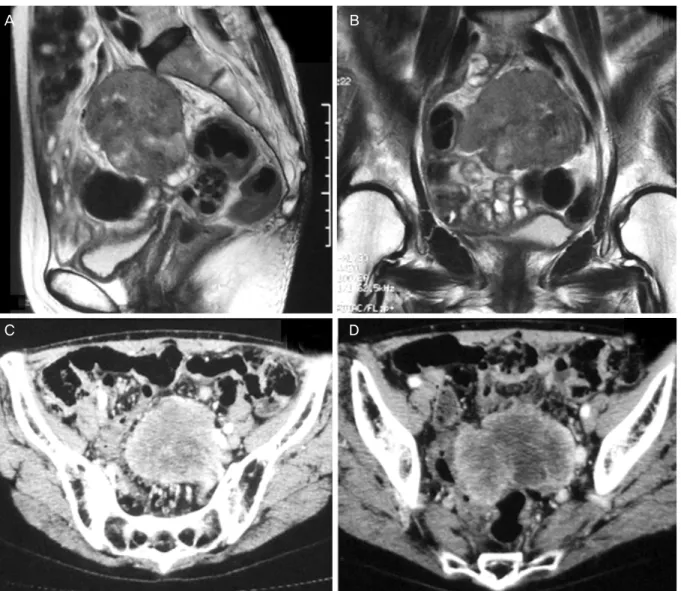
and treatment of pelvic cavity tumor that was identified at a nearby clinic. A solid tumor of the left ovary, 70×50 mm in diameter, was identified on transvaginal ultrasonography, magnetic resonance imaging (MRI), and contrast-enhanced computed tomography (CE-CT) (Fig. 1). The tumor seemed to adhere to the uterus and sigmoid colon, but no metastasis to distant organs or lymph nodes was identified. Uterine cervical and endometrial cancer screening demonstrated no evidence of abnormal cytology. Blood and urinary chemistry parameters were all within the normal range. Tumor markers for epithelial ovarian cancer were as follows: carbohydrate antigen (CA) 125, 61.1 U/mL; CA 19-9, 2.1 IU/mL; and carcinoembryonic antigen, 2.0 ng/mL. Upper and lower gastrointestinal tract endoscopy demonstrated no abnormal findings except for a

benign polyp of the colon.

Laparotomy revealed a left ovarian tumor, smaller than fist size, that was adherent to the uterus, peritoneum, rectum, and sigmoid colon. A small amount of ascites was identified and collected. Because of the severe adhesion to the vesico- uterine pouch and pouch of Douglas, due to peritonitis carci- nomatosa, optimal surgery for ovarian cancer was thought to be impossible. We first resected the left ovarian tumor, then performed a right salpingo-oophorectomy. Histopathological examination of frozen sections during the operation showed SCC of the left ovary, and cytology of the ascites was positive for SCC. Low-anterior colon resection and colostomy were then performed because the sigmoid colon and its mesen- terium showed deep and widespread invasion by the carci-

Fig. 1. Magnetic resonance (A-C) and contrast-enhanced computed tomography (D) images revealed a solid tumor of the left ovary, 70×50 mm in diameter. Malignancy and adhesion to the adjacent intestine were highly suspected.

A B

C D

(3)

noma, and preservation of these structures was judged to be impossible. There were no obvious tumors on the surfaces of the liver, diaphragm, or omentum in the upper abdomen, although there were some thin remnant tumors >2 cm in size clinging to the surfaces of the peritoneum and mesenterium after the tumor was removed.

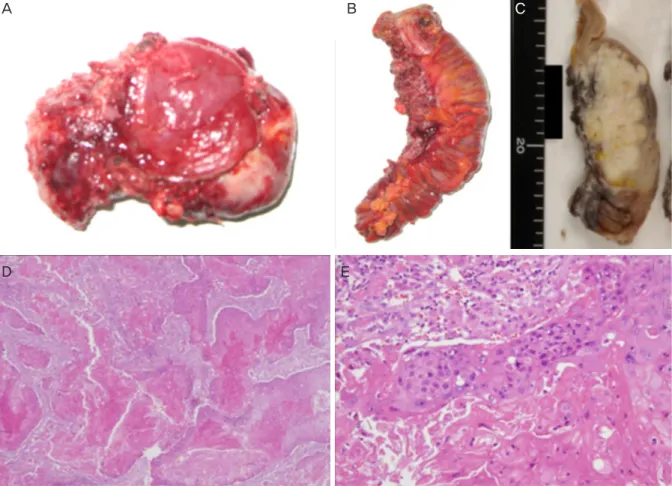
The serum level of SCC antigen measured just after the op- eration was slightly elevated at 3.5 ng/mL. Post-operative his- topathological diagnosis revealed well-differentiated SCC of the left ovary, with direct invasion into the submucosal layer of the sigmoid colon (Fig. 2). No other components, such as cystic teratoma, Brenner tumor, endometriosis, or endometri- oid adenocarcinoma, were identified, although there was a small mucinous-adenoma-like component that displayed no evidence of differentiation to squamous epithelial cells. Based on these findings, the patient was diagnosed with Interna- tional Federation of Gynecology and Obstetrics (FIGO) stage IIIc pure primary ovarian SCC.

As the first-line adjuvant chemotherapy, 2 courses of dd-TC (paclitaxel, 80 mg/m

2

[Bristol-Myers Squibb Company, Prince- ton, NJ, USA] and carboplatin, area under the curve of 5 [Bris- tol-Myers Squibb Company]) were administered, followed by 3 courses of CPT-P (CPT-11, 48 mg/m

2

[Pharmacia & Upjohn, Inc., Peapack-Gladstone, NJ, USA] and cisplatin, 48 mg/m

2

[Bristol-Myers Squibb Company]). Then 4 additional courses of dd-TC were given. After 2 courses of dd-TC chemotherapy, the patient developed ileus that we suspected might be due to the progression of her disease. We therefore switched the regimen from dd-TC to CPT-P. The ileus was managed con- servatively and no signs of recurrence were detected. After 3 courses of CPT-P, the patient developed renal dysfunction, and thus we changed the chemotherapy regimen from CPT-P back to dd-TC. Positron emission tomography-computed to- mography (PET-CT) performed 10 months after the operation demonstrated no residual tumor, and complete response was considered to have been achieved. We periodically evaluated

Fig. 2. Macroscopic findings of the left ovary (A) and sigmoid colon (B). Squamous cell carcinoma (SCC) directly invaded the submucosal layer of the sigmoid colon (C). Histopathologic findings of the left ovarian tumor (D, E) (objective magnification ×4 and ×20) revealed well-differentiated pure ovarian SCC.

A B

D E

C

(4)

the status of the patient’s disease during and after chemo- therapy by imaging and tumor marker measurements, with no signs of SCC recurrence at the time of this writing.

Three years after the operation the patient developed breast cancer, and left mastectomy and sentinel lymph node biopsy were performed at the Department of Surgery of the Fuku- shima Medical University Hospital. Post-operative histopatho- logical diagnosis revealed invasive ductal carcinoma, papillo- tubular carcinoma of the left breast, T1cN0M0 stage I primary breast cancer. Pre-operative PET-CT revealed no abnormalities except for the tumor of the left breast, thus confirming the absence of any recurrences of ovarian SCC. Since the breast cancer operation, the patient has been treated with the mo- lecular-targeted agent trastuzumab (Genentech, Inc., South San Francisco, CA, USA).

The patient has been free from recurrence of ovarian SCC for over 5 years since her first ovarian surgery, as determined by extensive evaluations including transvaginal ultrasonogra- phy, CE-CT, PET-CT, uterine cervical and endometrial cytology, and tumor marker measurements.

Discussion

Primary ovarian SCC is a rare disease with a very poor prog- nosis, especially in advanced-stage cases [1]. In our case, although the patient was diagnosed with FIGO stage IIIc advanced ovarian cancer with peritonitis carcinomatosa, she has achieved recurrence-free survival of over 5 years since the initial operation. Although her surgery was suboptimal for ovarian cancer because of severe adhesions in the pelvic cav- ity, adjuvant chemotherapy with a total of 6 courses of dd- TC and 3 courses of CPT-P was highly effective and resulted in long-term complete response. After 2 courses of dd-TC, ileus occurred but it was successfully managed with conserva- tive treatment. Because we suspected progressive disease at that time, the chemotherapy regimen was changed from dd- TC to CPT-P, although in fact no signs of progressive disease could be identified by later imaging studies or tumor marker measurements. After 3 courses of CPT-P, the patient devel- oped renal dysfunction; thus, we changed the chemotherapy regimen from CPT-P back to dd-TC, as the latter had earlier been considered to be clinically effective. After the first course of this second phase of dd-TC chemotherapy, fever with bone marrow suppression was observed; therefore, the doses were

reduced (paclitaxel, 60–70 mg/m

2

; carboplatin, area under the curve of 4). We did not perform a second debulking surgery during or after chemotherapy, for several reasons: no remnant tumor was detected by imaging, the surgery would be diffi- cult due to the patient’s colostomy, and primarily because she did not desire it.

Most cases of primary ovarian SCCs arise from MCT, al- though rare cases originate from endometriosis, Brenner tumor, or mucinous adenocarcinoma. MCT is one of the most common benign ovarian tumors, with an incidence of malig- nant transformation estimated at 1%–2% [2,3]. SCC is the most common transformation, although adenocarcinoma, sarcoma, and carcinoid have also been rarely reported [3]. The prognosis of SCC arising from MCT is strongly dependent on surgical stage. Kikkawa et al. [4] reported that the 5-year survival rate was 95% for stage I patients and 80% for stage II patients, but 0% for stage III and IV patients. Fortunately, over 60% of SCC arising from MCT are identified at stage I or II, because in many cases suspicious morphological changes are detected in MCT during follow-up, resulting in early discovery of malignant transformations. Such transformations are also occasionally identified during the post-operative pathological examination of resected MCT tumors that were considered to be benign.

Recently, the incidence of ovarian carcinoma arising from endometrial cysts was reported as 0.7% by Kobayashi et al.

[5]. The most frequent neoplasms arising from ovarian en- dometriosis are clear cell adenocarcinoma or endometrioid adenocarcinoma, and only rarely SCC [5,6]. The prognosis of SCC arising from ovarian endometriosis is poor because such patients are more likely to have advanced disease at diagnosis (stage III or IV) than patients with MCT. Although a few stud- ies have reported the efficacy of chemotherapeutic regimens such as paclitaxel-cisplatin [7] or weekly paclitaxel-carboplatin [8], there is currently no established effective therapy.

Pure ovarian SCC is extremely rare, with just over 30 report- ed cases, and its prognosis depends on its clinical stage. The prognosis of patients with advanced-stage disease (stage III or IV) is extremely poor, and most die within 1 year regardless of surgical outcomes or adjuvant chemotherapy regimens [1,9].

There is no evidence that radiation therapy improves survival, and also no established effective chemotherapy regimen [1,9].

The literature contains only 2 case reports of pure ovarian

SCCs that responded to adjuvant chemotherapy. One case

was treated with weekly paclitaxel combined with carboplatin

(TC) [10] and the other with weekly irinotecan [11]; respon-

(5)

siveness was maintained for up to 19 and 18 months, respec- tively. The pathogenetic mechanisms of pure ovarian SCC are unclear. Park et al. [12] posited a relationship between ovarian SCC and human papilloma virus infection, because 11 of 27 patients with ovarian SCC had cervical carcinoma in situ, cervical intraepithelial neoplasia, or vulvar intraepithelial neoplasia [13]. Shimamatsu et al. [14] estimated that the ma- lignant transformation from squamous metaplasia of ovarian epithelial inclusion cysts is one of the causes of ovarian SCC.

Recently, a phase III study performed by the Japanese Gyne- cologic Oncology Group (JGOG) demonstrated the superiority of dd-CT over TC for stage II–IV epithelial ovarian carcinoma (JGOG3016) [15]. The regimen prolonged both progression- free survival and overall survival in patients with serous or endometrioid adenocarcinoma, although it did not prolong overall survival for clear cell adenocarcinoma or mucinous adenocarcinoma [15]. CPT-P chemotherapy was proven effec- tive for refractory or recurrent ovarian cancer, with an overall response rate of 40% [16]. Although it was unclear whether these regimens would be effective against the SCC of our patient, we selected dd-TC as the first-line chemotherapy and CPT-P as a temporary second-line chemotherapy, and fortu- nately both regimens performed well in our case.

In conclusion, we report a case of pure ovarian SCC that remarkably responded to adjuvant chemotherapy with dd-TC and CPT-P. To our knowledge, this is the first reported case of a patient with advanced ovarian SCC to maintain long-term recurrence-free survival for over 5 years. Due to the rarity of ovarian SCC, it may be difficult to establish standard treat- ment protocols by performing randomized trials. We hope that this report will be useful in terms of accumulating cases with positive responses to ovarian SCC in order to establish effective treatment regimens in the future.

Conflict of interest

No potential conflict of interest relevant to this article was reported.

References

1. Pins MR, Young RH, Daly WJ, Scully RE. Primary squa- mous cell carcinoma of the ovary. Report of 37 cases.

Am J Surg Pathol 1996;20:823-33.

2. Stamp GW, McConnell EM. Malignancy arising in cystic ovarian teratomas. A report of 24 cases. Br J Obstet Gynaecol 1983;90:671-5.

3. Rekhi B, Parikh P, Deodhar KK, Menon S, Maheshwari A, Kerkar R, et al. Squamous carcinoma coexistent with teratoma of ovary: a clinicopathological study of 12 cas- es diagnosed over a 10-year period at a tertiary cancer referral center. J Cancer Res Ther 2015;11:211-5.

4. Kikkawa F, Nawa A, Tamakoshi K, Ishikawa H, Kuzuya K, Suganuma N, et al. Diagnosis of squamous cell carci- noma arising from mature cystic teratoma of the ovary.

Cancer 1998;82:2249-55.

5. Kobayashi H, Sumimoto K, Moniwa N, Imai M, Takakura K, Kuromaki T, et al. Risk of developing ovarian can- cer among women with ovarian endometrioma: a cohort study in Shizuoka, Japan. Int J Gynecol Cancer 2007;17:37-43.

6. Yamakawa Y, Ushijima M, Kato K. Primary squamous cell carcinoma associated with ovarian endometriosis:

a case report and literature review. Int J Clin Oncol 2011;16:709-13.

7. Eltabbakh GH, Hempling RE, Recio FO, O’Neill CP. Re- markable response of primary squamous cell carcinoma of the ovary to paclitaxel and cisplatin. Obstet Gynecol 1998;91:844-6.

8. Ohtani K, Sakamoto H, Masaoka N, Shimada K, Kanae- da T, Kurihara M, et al. A case of rapidly growing ovar- ian squamous cell carcinoma successfully controlled by weekly paclitaxel-carboplatin administration. Gynecol Oncol 2000;79:515-8.

9. Park JW, Bae JW. Pure primary ovarian squamous cell carcinoma: a case report and review of the literature.

Oncol Lett 2015;9:321-3.

10. Maruyama T, Sakai K. A case report of pure primary squamous cell carcinoma of the ovary. Jpn J Gynecol Oncol 2009;27:69-75.

11. Nakamura Y, Kamei T, Shinagawa M, Sakamoto Y, Miwa I. Case of pure ovarian squamous cell carcinoma resis- tant to combination chemotherapy with paclitaxel and carboplatin but responsive to monotherapy with weekly irinotecan. J Obstet Gynaecol Res 2015;41:809-12.

12. Park JY, Song JS, Choi G, Kim JH, Nam JH. Pure primary

squamous cell carcinoma of the ovary: a report of two

cases and review of the literature. Int J Gynecol Pathol

(6)

2010;29:328-34.

13. Mai KT, Yazdi HM, Bertrand MA, LeSaux N, Cathcart LL.

Bilateral primary ovarian squamous cell carcinoma asso- ciated with human papilloma virus infection and vulvar and cervical intraepithelial neoplasia. A case report with review of the literature. Am J Surg Pathol 1996;20:767-72.

14. Shimamatsu K, Iemura A, Nakashima O, Taguchi J, In- oue M, Higaki K, et al. Squamous cell carcinoma of the ovary--a case report. Kurume Med J 1994;41:177-82.

15. Katsumata N, Yasuda M, Takahashi F, Isonishi S, Jobo T, Aoki D, et al. Dose-dense paclitaxel once a week in com- bination with carboplatin every 3 weeks for advanced ovarian cancer: a phase 3, open-label, randomised con- trolled trial. Lancet 2009;374:1331-8.

16. Sugiyama T, Yakushiji M, Nishida T, Ushijima K, Okura

N, Kigawa J, et al. Irinotecan (CPT-11) combined with

cisplatin in patients with refractory or recurrent ovarian

cancer. Cancer Lett 1998;128:211-8.

수치

Fig. 1. Magnetic resonance (A-C) and contrast-enhanced computed tomography (D) images revealed a solid tumor of the left ovary,  70×50 mm in diameter
Fig. 2. Macroscopic findings of the left ovary (A) and sigmoid colon (B). Squamous cell carcinoma (SCC) directly invaded the submucosal  layer of the sigmoid colon (C)

참조

관련 문서

ƒ 임계 에너지는 핵분열 하는 핵종에 따라서 다르므로 중성자를 흡수했다 해서 모든 핵종이 핵분열을 일으키는 것은 아님.. 235 U와 같이 정지상태의 중 성자를

Median overall survival of 28 multiple myeloma patients treated with Cyclophosphamide-Prednisone combination regimens as a primary therapy was 115 weeks.. Median

In addition, the expression of REDD1 was increased when Huh7 cells were treated with PA, and overexpression of REDD1 affected cell survival and lipid

Concentration-Dependent inhibition of cell viability by adenosine in human oral fibroblast and FaDu human head and neck squamous cell carcinoma · · ·

It also suggest that cell proliferation inhibits by a novel signal transduction for adenosine effect in human FaDu hypopharynx squamous cell carcinoma cells....

Differential Expression of Desmoglein1, Desmoglein3, Epithelial Membrane Antigen, Ber-EP4 and CD10 in Basal Cell Carcinoma and Squamous Cell Carcinoma

Objective: The purpose of this study was to analyze recent trend in incidence of basal cell carcinoma and squamous cell carcinoma in patients from the Gwangju City

ƒ 유도 핵반응은 자발적인 핵분열 (Spontaneous Nuclear Reaction)과는 달리 다른 물질과의 작 용으로 원자가 반응하여 여러 가지 생성물을 만들어