
9
경기만 서부 덕적도 사퇴의 탄성파층서 및 퇴적환경 연구
이윤오1·최상일1*·정교철2
1
광운대학교 환경공학과,
2안동대학교 지구환경과학과
Seismic Stratigraphy and Sedimentary Environment of the Dukjuk-Do Sand Ridge in Western Gyeonggi Bay, Korea
Yoon-Oh Lee
1, Sang-Il Choi
1*, and Gyo-Cheol Jeong
21
Department of Environmental Engineering, Kwangwoon University
2
Department of Earth and Environmental Sciences, Andong National University
서해 경기만의 덕적도 서부에 발달하고 있는 사퇴해역에서 획득된 고해상 탄성파탐사자료, 해저면측사탐사자료, 표층퇴적 물 및 주상코어시료에 대한 정밀분석과 연구가 실시되었다. 탄성파탐사 자료에 의하면 사퇴의 층서는 3개의 퇴적단위 (sequence I, II, III)로 구분되어진다. 최상부 퇴적단위 I은
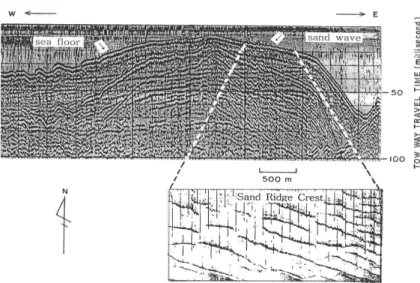
14C 연대측정 자료에 의하면 5,000~6,000 yr BP경 본 해역이 해 침을 받은 후 강한 왕복성 조류에 의하여 형성된 것으로 사료된다. 퇴적단위 II는 주상코어 자료에 의하면 니질이 주로 분 포하는 고 조간대 니질퇴적층으로 추정된다. 퇴적단위 III은 중생대에 관입한 화강암으로 분포된 음향기반암 상부에 플라이 스토세 말기로 추정되는 육성퇴적층인 자갈 내지는 조립질 퇴적물이 부정합으로 퇴적된 것으로 판단된다. 해저면측사탐사 자료에 의하면 사퇴 정상의 해저면은 모래파가 발달되어 있으며, 이는 대체로 조류의 방향과 일치하는 N20°W 방향이다.
사퇴 정상부에서 멀어지면 모래물결자국이 발달하고, 경사면에서는 균질한 사질로 분포한다. 표층퇴적물과 주상퇴적물(시료 VC-1, 2, 3)은 특정 내부 구조를 갖지 않는 비교적 균질한 중립토 내지 세립토(Mz, 1-2φ)로 분포하는 특징을 보인다.
주요어 : 탄성파층서, 사퇴, 음향기반암, 해저면측사탐사, 퇴적환경
We examined high-resolution seismic data, side scan sonar data, surface sediments, and vibrocore samples from a sand ridge off the western part of Dukjuk-Do in Gyeonggi Bay, with the aim of interpretation of seismic stratig- raphy and sedimentary environment. Based on the seismic data, the deposited sands are divided into three sedi- mentary units. 14C age data indicate that the top sequence (sequence I) formed at 5000-6000 yr BP, when a transgression resulted in strong shifting tides. Analyses of the vibrocore samples indicate that sequence II is a paleo-mudflat layer of intertidal sediments dominated by mud. Sequence III consists of terrestrial sediments that are presumed to have been deposited at the end of the Pleistocene, unconformably overlying the acoustic bedrock and Mesozoic granite. The side scan sonar data indicate that sand waves were formed on the seabed on top of the sand ridge. Generally, this is the direction of N20
oE, which coincides with the direction of tidal flow. Sand ripples occur away from the top of the sand ridge and are distributed homogeneously across a sandy slope. Vibrocore analyses indicate that the surface sediments and core sediments (samples VC-1, -2, and -3) are homogeneous, without any internal structures, and are characterized by a mixture of medium and fine sand (1-2 φ), respectively.
Key words : seismic stratigraphy, sand ridge, acoustic basement, side scan sonar, sedimentary environment
*Corresponding author: [email protected]
ⓒ 2014, The Korean Society of Engineering Geology
This is an Open Access article distributed under the terms of the Creative Commons Attribution Non-Commercial License (http://creativecommons. org/
licenses/by-nc/3.0) which permits unrestricted non-commercial use, distribution, and reproduction in any medium, provided the original work is prop- erly cited.


![외국인 PCR검사 가능 기관 [Referral Laboratories : 11sites]](data:image/gif;base64,R0lGODlhAQABAIAAAP///wAAACH5BAEAAAAALAAAAAABAAEAAAICRAEAOw==)