CO 2 농도 및 온도 상승이 하천변 잠재자연식생인 졸참나무와 갈참나무 잎의 형태학적 반응에 미치는 영향
조규태 · 김해란 · 정헌모 · 유영한
+공주대학교 생명과학과
Effects of Elevated CO 2 and Temperature on the Leaf Morphological Responses of Quercus serrata and Quercus aliena, Potential Natural Vegetation of Riverine
Kyu-Tae Cho ․ Hae-Ran Kim ․ Heon-Mo Jeong ․ Young-Han You
+Department of Life Science, Kongju University
요 약
한반도의 참나무 중 하천변 잠재자연식생인 졸참나무와 갈참나무를 대상으로 지구온난화의 핵심 요소인 CO2농도와 온도 를 상승시킬 때 잎의 형태학적 반응이 어떻게 일어나는지 알아보고자 유리온실 내에서 대기 중의 CO2농도를 그대로 반 영한 대조구와 이보다 CO2농도는 약 1.6배와 온도는 2.2℃상승시킨 온난화처리구에서 실험하여 관찰하였다. 그 결과, 졸 참나무와 갈참나무는 CO2농도와 온도의 상승으로 인하여 잎폭 길이, 잎몸 무게 그리고 엽면적이 증가하고 잎 수와 비엽 면적은 감소하는 경향을 나타냈다. 졸참나무는 잎폭 길이, 잎몸 길이, 잎몸 무게, 잎 수, 엽면적 그리고 비엽면적 모두 대 조구와 온난화처리구 간에 차이가 없었다. 그러나 갈참나무는 잎폭 길이와 잎몸 무게의 증가, 비엽면적의 감소가 뚜렷하 였다. 이상의 잎의 형태학적 반응으로 볼 때, 갈참나무는 CO2농도와 온도에 대하여 졸참나무 보다 민감하게 반응한다는 것을 알 수 있다. 주성분분석 결과, 두 종은 요인 1과 2에 의해 대조구와 온난화처리구에서 배열에 차이가 있었고, 온난 화처리에 대한 변화는 졸참나무보다 갈참나무에서 명확히 구별되었다.
핵심용어 : 잠재자연식생, 온난화처리구, 형태학적 반응, 비엽면적 Abstract
This study was conducted to find the leaf morphological responses of Quercus serrata and Q. aliena which are potential natural vegetation of riverine in Korea under elevated CO2 and increased temperature. Rising CO2 concentration was treated with 1.6 times than control(ambient) and increased temperature with 2.2℃ above the control(ambient) in the glass greenhouse. As a result, leaf width length, leaf lamina weight and leaf area of Q. serrata and Q. aliena was respectively increased, and number of leaves and specific leaf area(SLA) was decreased by elevated CO2 and temperature. Leaf width length, leaf lamina length, leaf lamina weight, number of leaves, leaf area, and specific leaf area of Q. serrata were not statistically significant difference between control and treatment. Leaf width length and leaf weight of Q. aliena was increased, but specific leaf area was decreased. These results indicated that Q. aliena was to be sensitive than Q. serrata in response to global warming situation. According to the principal component analysis(PCA), two oak species were arranged based on factor 1 and 2 in the control and warming treatment. And change on the warming treatment was clearly distinguishable from the Q. aliena than Q. serrata.
Keywords : potential natural vegetation, global warming situation, morphological responses, specific leaf area
+ 정회원 · 공주대학교 생명과학과 교수 · E-mail : [email protected]
1. 서 론
우리나라에서 자생하는 졸참나무 (Quercus serrata)와 갈참나무 (Q. aliena)는 낙엽성 참나무로써 한반도의 주 요 우점종에 해당되고(Park et al., 2005), 두 종은 서로 인접하여 출현한다 (You et al., 1995). 그리고 습한 저지
대의 토양적 극상종 (Lee, 2007; Song, 2008)으로써 뿌리 를 지하수위 보다 위쪽으로 뻗는 경목대에 생육하는 하천변 잠재자연식생이다(Kim et al., 2008; Kim, 2008).
졸참나무는 남부지방에서 숲 천이의 극상종으로 인식
되고, 갈참나무는 2차림의 하층식생을 구성하고 있다
(Song, 2008).
최근에 지구는 CO
2농도의 급격한 증가와 함께 기온이 빠르게 상승하고 있다 (Korea Meterological Adminstration, 2008). 인위적으로 발생하는 CO
2농도의 증가는 지구온 난화의 가장 큰 원인이다 (Kobayashi, 2006). 대기중 CO
2농도는 산업화 이전에 약 280ppm 이었으나(IPCC, 2007), 2009년에는 약 385ppm으로 산업화 이전에 비해 38% 증 가하였다 (Ho¨nisch et al., 2009).
우리나라의 CO
2농도는 2006년에 388.9ppm으로 보고 되었고 (You, 2010), 서울 등 6개 도시의 평균기온은 1.7℃
상승률로 전 지구적인 온난화 추세보다 빠르게 나타났 다 (Korea Meterological Adminstration, 2008).
현재와 같은 증가추세라면 2100년에는 대기중 CO
2농 도가 800ppm에 육박할 것이며(Houghton et al., 1990), CO
2농도가 2배가 되면 지구의 평균 표면온도가 2~3℃
증가한다고 예측하고 있다(Enoch and Hurd, 1977).
이러한 CO
2농도와 온도의 증가는 식물마다 종 특이성 을 갖고 있기 때문에 식물생리학 및 생태적 반응에 다 양하고 복합적으로 영향을 미치며(Albert et al., 2011;
Enoch and Honour, 1993; Kim and Kang, 2003), 식물의 생장과 발달에 영향을 미친다(He et al., 2005). 식물의 변화 중 CO
2농도와 온도 증가에 의해 가장 뚜렷하게 나 타나는 형태적 변화는 잎과 관련된 변수들이다 (Garbutt et al., 1990). 일반적으로 CO
2농도가 높아지면 잎수가 증 가하고 (Poorter et al., 1988), 잎의 두께가 두꺼워지고 (Tomas and Bazzaz, 1996), 비엽면적(Specific Leaf Area, SLA)은 감소한다(Norby and O'Neill, 1991). 그리고 잎 속으로 CO
2확산속도가 커지고 이용이 높아져 광합성 속도가 증대된다(Park, 2003). 이렇게 잎의 형태적 특성 은 생리활동과 생장반응에 큰 영향을 미친다 (Sim and Han, 2003). CO
2농도의 증가가 식물의 생장을 증진시키 는 것을 CO
2시비효과 (CO
2-fertilization effect)라 부른다 (Park, 1993; Park, 2003).
국내에서 CO
2농도 및 온도 증가에 따른 식물의 생육 에 관한 연구는 섬자리공과 미국자리공의 식물 계절 및 잎의 형태학적 반응(Kim and You, 2010), 한국특산식물 섬자리공의 식물계절학 및 번식생태학적 특성 (Shin et al., 2012), 단양쑥부쟁이의 종생태적 반응(Han et al., 2012) 등이 있으며, 참나무의 생육에 관한 연구는 환경 구배처리에 따른 상수리나무 , 굴참나무와 신갈나무의 생육 차이(Jeong et al., 2009), 지구온난화에 따른 상수 리나무와 굴참나무의 생육반응 (Jeong et al., 2010), 광, 수분 , 영양소에 따른 졸참나무와 갈참나무 유식물의 생 육차이(Lim et al., 2012), 환경구배처리에 따른 떡갈나무 의 생육반응 (Lee et al., 2010), 광도와 토양수분 구배에 따른 참나무류 치수의 발아 및 성장(Beon, 2000) 등이 있다 . 그러나, 참나무를 대상으로 CO
2농도 및 온도 증가
가 형태학적 반응에 어떠한 영향을 미치는지에 대한 실 험적 연구는 아직까지 진행된 바가 없다 .
따라서, 본 연구는 우리나라 참나무 중 하천변 잠재 자연식생인 졸참나무와 갈참나무를 대상으로 지구온난 화의 핵심 요소인 CO
2농도와 온도를 상승시켜 잎의 형 태학적 반응이 어떻게 일어나는지 알아보고자 시도하 였다 .
2. 재료 및 방법
2.1 종자 선정 및 파종
실험에 사용한 유식물은 졸참나무와 갈참나무 종자를 발아시켜 사용하였다 . 종자는 충청남도 공주시 신관동 인근 야산에서 2009년 10월에 채집하여 4℃에 냉장 저 장한 후 이듬해인 2010년 4월에 각 종별 크기가 유사한 종자를 선별하여 파종하였다 . 파종은 지름 24cm, 높이 23.5cm인 4개 화분에 각각 3개체씩 파종하였다.
2.2 환경요인 처리
대조구 (ambient CO
2-ambient temperature)는 유리온실 내에서 대기 중의 CO
2농도(평균 386.9±6.1ppm)를 그대로 반영하였고 , 온난화처리구 (elevated CO
2-elevated temperature)는 유리온실 내에서 지구온난화의 핵심 요소 인 CO
2농도와 온도를 조합하여 처리하였다.
CO
2농도 처리는 CO
2가스통 2개를 설치한 뒤, 각각 지 름 0.2mm인 호스를 연결하여 CO
2가스를 24시간 주입하 였고 , 온난화처리구 내 설치된 CO
2센서(TEL-7001, Onset computer, USA)를 통해 농도변화를 모니터링한 뒤, Gas regulator로 조절하여 대조구 CO
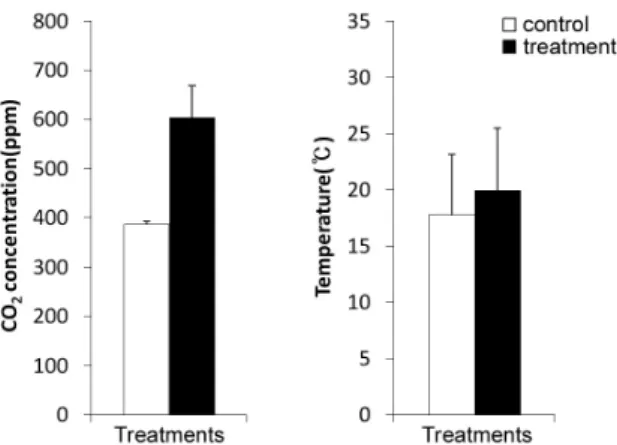
2농도의 약 1.6 배 (평균 602.7±64.1ppm)로 유지시켰다(Fig. 1a).
온도측정은 디지털 데이터 온도계(Thermo recorder TR-71U, Co., Japan)를 설치하여 30분마다 모니터링 하 였다 . 그 결과, 온난화처리구의 월별 평균기온은 대조구 보다 평균 2.2℃ 높았다(Fig. 1b).
나머지 환경요인인 광 , 수분 그리고 영양소는 모두 동 일하게 처리하였다. 광은 전일광(787.75±77.76 μmol m
-2s
-1)으로 처리하였고, 광도는 광합성측정기(LCI Ultra Compact Photosynthesis System. ADC 2005)로 측정하였 다. 수분공급은 증발이 빠른 여름철에는 3~4일 간격으 로 , 그 외 기간에는 7일 간격으로 500mL씩 공급하였다.
이때 사용된 물은 수돗물을 받아서 안정화시켜 사용하
였다 . 토양은 동일 입자 크기(2㎜ 이하)의 건조한 모래에
유기질비료 (주, 효성오엔비, 유기물 46.7%)를 토양무게의
5%를 혼합하여 처리하였다.
Fig. 1. Average CO
2concentration (a) and temperature (b) in control (ambient CO
2-ambient temperature) and treatment (elevated CO
2-elevated temperature) conditions. Error bar is the standard deviation.
2.3 형태학적 반응 측정
유식물은 2010년 4월에 파종한 뒤 180일 이후인 9월 에 화분에서 꺼낸 후 지하부는 물로 세척하여 흙을 완 전히 제거하였으며, 70℃ 건조기에서 48시간 건조시켰 다 . 측정은 각 개체에서 임의로 3장의 성엽을 선정하여 잎폭 길이(㎝), 잎몸 길이(㎝), 엽면적(㎠), 잎몸 무게(g) 를 측정하였고, 각 개체의 잎 수(ea), 전체 잎 무게(g)를 측정하였다 . 측정된 값을 이용하여 비엽면적을 계산하였 다. 비엽면적(specific leaf area)은 잎무게에 대한 엽면적 의 비를 말한다 .
잎폭 길이, 잎몸 길이, 엽면적은 엽면적계(SI700, Skye)를 이용하였고, 잎몸 무게, 전체 잎 무게의 건중량 은 전자저울 (UX400H)을 이용하여 측정하였다.
2.4 통계처리
CO
2농도 및 온도 상승에 따른 두 종의 생육반응을 밝 히기 위해 반응의 평균치를 이용하여 일원분산분석 (One-way ANOVA)을 실시하였다. 환경 처리에 따른 차 이는 포스트-훅 검정에 의해 평균치의 Fisher 최소유의차 법으로 5% 유의수준에서 차이를 검정하였다. 환경요인 에 따른 두 종의 전체적인 분포상태를 밝히기 위해 형 질의 측정치를 상관계수로 이용하여 주성분분석 (PCA)으 로 배열하였다. 이상의 통계학적 분석은 Statistica 8 통 계패키지(Statsoft Co. 2008)를 이용하였다.
3. 결과 및 고찰
3.1 형태학적 반응
잎폭 길이의 경우 졸참나무는 대조구에 비해 온난화 처리구에서 높은 경향을 나타냈으나 통계적 차이는 없 었고 , 갈참나무는 대조구에 비해 온난화처리구에서 높았
다(Fig. 2a). 이는 온난화처리구에서 상수리나무의 잎폭 길이가 증가하였고 (Jeong et al., 2010), 대조구(CO
2농도 350ppm)보다 350ppm 높은 CO
2처리구에서 사시나무속 (Populus)에 속하는 Beaupre′와 Robusta의 잎 넓이가 증가 하는 결과(Ceulemans et al., 1995)와 일치하였고, CO
2농 도와 온도 상승시 섬자리공과 미국자리공의 잎폭 길이 가 증가하는 결과와도 일치하였다 (Kim and You, 2010).
잎몸 길이는 졸참나무와 갈참나무 모두 대조구와 온 난화처리구 간에 차이가 없었다 (Fig. 2b). Tomas and Bazzaz (1996)의 연구에 의하면 서양민들레는 높은 CO
2농도 (700ppm) 조건에서 잎의 결각이 더 깊게 갈라지고 잎몸 길이가 감소하였고 , Kim and You (2010)의 연구에 서는 미국자리공의 잎몸 길이가 온난화처리구에서 증가 하였다 . 이러한 결과는 식물종에 따라 CO
2농도와 온도 에 대한 반응의 차이가 있는 것으로 판단된다.
잎몸 무게는 졸참나무와 갈참나무 모두 온난화처리구 에서 높은 경향을 보였으나 , 졸참나무는 대조구와 온난 화처리구 간에 통계적 차이가 없었고 , 갈참나무는 대조 구에 비해 온난화처리구에서 높았다 (Fig. 2c). 이것은 Radoglou and Jarvis(1990)가 CO
2농도가 높으면 엽육세포 의 크기가 커지고 기공내 공간이 넓어져 잎이 두꺼워지 기 때문이라고 발표한 결과로 해석할 수 있다 .
잎 수는 광합성 활동에 밀접하게 관련된다(Fender, 2011). Poorter et al. (1988)의 연구에 의하면 CO
2농도가 상승하면 잎 수가 증가하는 것으로 보고되었다. 그러나 졸참나무와 갈참나무는 모두 대조구와 온난화처리구에 서 통계적 차이는 없었으나 , 낮아지는 경향을 보였다 (Fig. 2d).
엽면적은 졸참나무와 갈참나무 모두 대조구와 온난화
처리구 간에 통계적 차이는 없었으나 , 높아지는 경향을
보여 차이가 있었다(Fig. 2e). 이것은 높아진 CO
2농도에
의하여 잎의 기공을 통해 CO
2확산속도를 증가시킴으로
써 광합성 속도를 증대시키기 위한 결과로 판단된다. 이
렇게 잎의 형태적 특성은 생리활동과 생장반응에 큰 영
향을 미치고 (Sim and Han, 2003), 식물의 광화학 및 생 화학에 큰 영향을 미친다 (Rasineni, 2011). 또한, CO
2농도 의 증가가 식물의 생장을 증진시키는 CO
2시비효과 (CO
2-fertilization effect)가 커진 결과라 할 수 있다.
비엽면적의 경우 졸참나무는 대조구에 비해 온난화처 리구에서 낮아지는 경향을 보였으나 통계적 차이는 없 었고 , 갈참나무는 대조구에 비해 온난화처리구에서 낮았 다(Fig. 2f). 비엽면적은 잎의 두께와 관련이 있다(Gunn et al., 1999). Norby and O'Neill (1991)은 CO
2농도가 상 승하면 광합성의 증가로 인해 비구조적 탄수화물의 축 적량이 증가하여 잎의 건중량이 증가한다고 하였으며 , Ranasinghe and Taylor (1996)는 CO
2농도와 온도의 상승 으로 인해 엽육세포의 수와 크기가 증가하여 엽면적이 넓고 두꺼운 잎을 생산한다고 하였다 . 그 결과 잎의 건 중량이 증가하여 비엽면적은 감소하는데 이것은 본 연 구결과와 일치하였다 . 한편, 높은 CO
2농도에서 비엽면적
이 증가하는 경우는 엽육세포의 생산량 감소에 의한 것 으로 보고 있다 (Ferris and Taylor, 1993).
실험결과를 종합해 볼 때, 졸참나무와 갈참나무는 CO
2농도와 온도의 상승으로 인하여 잎폭 길이 , 잎몸 무 게 그리고 엽면적이 증가하고 잎 수와 비엽면적은 감소 하는 경향을 나타냈다 . 졸참나무는 잎폭 길이, 잎몸 길 이 , 잎몸 무게, 잎 수, 엽면적 그리고 비엽면적 모두 대 조구와 온난화처리구 간에 통계적 차이가 없었다. 그러 나 갈참나무는 잎폭 길이와 잎몸 무게의 증가 , 비엽면적 의 감소가 통계적으로 뚜렷한 차이가 있었다 . 이것으로 미루어 볼 때 CO
2농도와 온도의 상승은 광합성기관인 잎의 형태학적 반응에 많은 영향을 미치며 , 갈참나무는 졸참나무 보다 CO
2농도와 온도에 대하여 민감하게 반응 하여 잎의 형태학적 변화가 크게 일어나는 것으로 판단 된다 .
Fig. 2. Leaf width length (a), leaf lamina length (b), leaf lamina weight (c), number of leaves (d), leaf area (e) and specific
leaf area (f) of Quercus serrata and Q. aliena under control (ambient CO
2-ambient temperature) and treatment (elevated
CO
2-elevated temperature) conditions. Alphabets on the bars mean significantly different between environmental treatment
within each species (Fisher's least significant difference, p<0.05). Error bar is the standard deviation.
3.2 PCA 분석
졸참나무와 갈참나무의 6가지 형질을 이용한 주성분 분석 (PCA) 결과, 두 종은 제1주성분과 제2주성분에 의해 대조구와 온난화처리구에서 배열에 차이를 보였으며, 제 1주성분과 제2주성분으로 전체 분산에 대한 설명력은 82.17%였다(Fig. 3).
배열법상 두 종의 개체간 거리는 대조구보다 온난화 처리구에서 가깝게 나타났고 , 분포하는 면적도 대조구보 다 온난화처리구에서 좁았다. 그리고 배열법에서 온난화 처리에 대한 변화는 졸참나무보다 갈참나무에서 명확히 구별되었다(Fig. 3). 이러한 결과는 두 종이 CO
2농도와 온도에 대하여 생태학적 반응에 영향을 받은 것으로 판 단되며 , 갈참나무가 졸참나무보다 CO
2농도와 온도에 대 한 생태학적 반응 정도가 큰 것으로 판단된다. 또한, 배 열법상 분포하는 면적과 간격이 줄어드는 것은 생태적 지위폭이 감소하는 것과 같다고 할 수 있으므로 갈참나 무가 졸참나무보다 지구온난화에 의한 경쟁력이 약화될 것으로 판단된다 .
본 연구는 선행된 Jeong et al. (2010)과 Cho et al.
(2012)의 결과에서 상수리나무, 굴참나무, 졸참나무 그리 고 갈참나무의 생태학적 반응이 CO
2농도와 온도에 대해 영향을 받은 결과와 일치하였다 . 이와 같이 CO
2농도와 온도에 따른 식물 생장특성의 영향은 식물마다 특이성 으로 인해 다양하고 복합적으로 이루어진다 (Kim and Kang, 2003). 따라서 지구온난화에 따른 식물의 생장특 성을 예측하기 위해서는 지구온난화 조건에서의 장기적 인 연구가 수행되어져야 할 것으로 생각된다 .
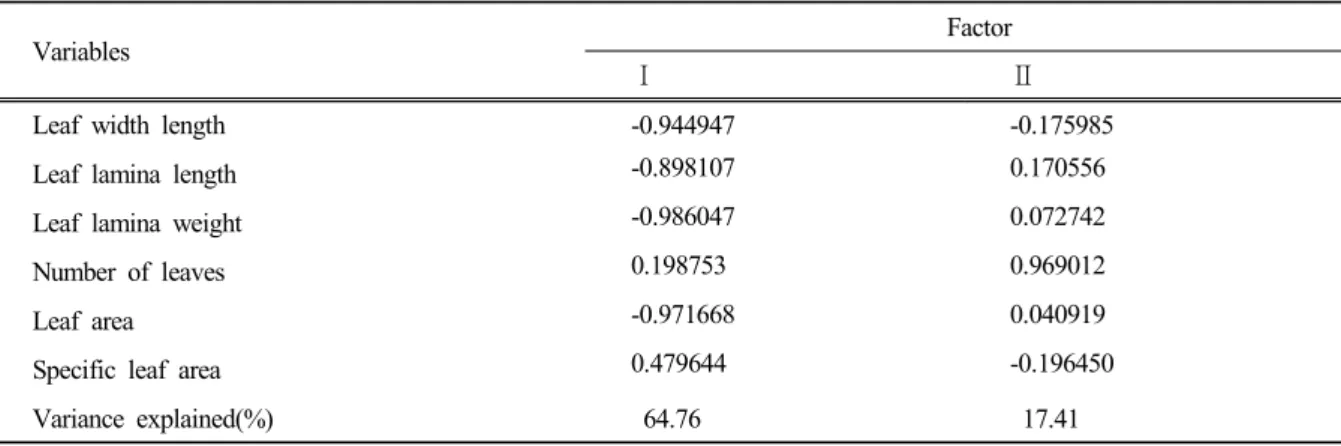
두 종의 PCA 배열법 상의 분포유형에 미치는 잎의 형질은 잎 수와 비엽면적 (r<0.5)보다 잎폭 길이, 잎몸 길 이 , 잎몸 무게, 엽면적이 더 많은 영향을 미치는 것으로 나타났다(Table 1). 이 결과는 두 종의 생태학적 반응이 잎의 핵심적인 소수의 형질에 의한 것이 아니라 여러 다양한 형질이 종합적으로 관여하는 것으로 판단되며 , 배열법 상의 분포유형은 실험대상 종 , 생육환경 그리고 식물체의 측정형질 등에 따라 차이가 있는 것으로 판단 된다.
Fig. 3. Principal component analysis ordination of 22 individuals of Quercus serrata and Q. aliena using 6 variables under control (ambient CO
2-ambient temperature) and treatment (elevated CO
2-elevated temperature) conditions.
Qs, Qal, C and T in figure mean Quercus serrata, Quercus aliena, control and treatment.
Table 1. Correlation matrix of 6 variables with the first two principal component scores of PCA analysis.
Variables Factor
Ⅰ Ⅱ
Leaf width length -0.944947 -0.175985
Leaf lamina length -0.898107 0.170556
Leaf lamina weight -0.986047 0.072742
Number of leaves 0.198753 0.969012
Leaf area -0.971668 0.040919
Specific leaf area 0.479644 -0.196450
Variance explained(%) 64.76 17.41
사 사
본 연구는 환경부의 국가장기생태연구사업 (2012)에 의 하여 지원되었다.
References