OPEN ACCESS
Citation: Kim JE, Kim KH, Kim KS, Kim YH, Kim DW, Park JC, Kim SC, Seol KH. 2016. Fermentative characteristics of wheat bran direct-fed microbes inoculated with starter culture. Korean Journal of Agricultural Science 43:387-393.
DOI: http://dx.doi.org/10.7744/kjoas.20160041
Editor : Cheorun Jo, Seoul National University, Korea
Received: April 25, 2016 Revised: July 12, 2016 Accepted: July 28, 2016
Copyright: ©2016 Korean Journal of Agricultural Science.
This is an Open-Access article distributed under the terms of the Creative Commons Attribution Non- Commercial License which permits unrestricted non- commercial use, distribution, and reproduction in any medium, provided the original work is properly cited.
ANIMAL
Fermentative characteristics of wheat bran direct-fed microbes inoculated with starter culture
Jo Eun Kim
1, Ki Hyun Kim
1, Kwang-Sik Kim
1, Young Hwa Kim
1, Dong Woon Kim
2, Jun-Cheol Park
1, Sam-Chul Kim
3, Kuk-Hwan Seol
1*
1
National Institute of Animal Science, Rural Development Administration, Cheonan 31000, Korea
2
National Institute of Animal Science, Rural Development Administration, Wanju 55365, Korea
3
Department of Animal Science (Insti. of Agri & Life Sci.), Gyeongsang National University, Jinju 52828, Korea
*Corresponding author: [email protected]
Abstract
This study was conducted to determine the fermentative characteristics of wheat bran inoculated with a starter culture of direct-fed microbes as a microbial wheat bran (DMWB) feed additive.
Wheat bran was prepared with 1% (w/w, 0.5% Lactobacillus plantarum and 0.5% of Saccharomyces cerevisiae) starter culture treatment (TW) or without starter culture as a control (CW). Those were fermented under anaerobic conditions at 30°C incubation for 3 days. Samples were taken at 0, 1, 2, and 3 days to analyze chemical composition, microbial growth, pH, and organic acid content. Chemical composition was not significantly different between CW and TW (p > 0.05).
In TW, the number of lactic acid bacteria and yeast increased during the 3 days of fermentation (p < 0.05) and the population of lactic acid bacteria was significantly higher than in CW (p < 0.05). After 3 days, the number of yeast in TW was 7.50 ± 0.07 log CFU/g, however, no yeast was detected in CW (p < 0.05). The pH values of both wheat bran samples decreased during the 3 days of fermentation (p < 0.05), and TW showed significantly lower pH than CW after 3 days of fermentation (p < 0.05). Contents of lactic acid and acetic acid increased significantly at 3rd day of fermentation in TW. However, no organic acids were generated in CW during testing period. These results suggest that 3 days of fermentation at 37°C incubation after the inoculation wheat bran with starter culture makes it possible to produce a direct-feed with a high population of lactic acid bacteria at more than 10
11CFU/g.
Keywords: direct-fed microbe, fermentation, microbial population, organic acids, wheat bran
Introduction
축산이 규모화 됨에 따라 각종질병에 대한 예방 및 치료를 위한 항생제 사용은 불가피하게 되
었고, 가축에 항생제의 사용은 질병의 치료뿐만 아니라 예방 및 생산성 증가 등의 효과를 보였다
(Hays, 1977). 농가에서 항생제의 사용빈도가 증가함에 따라 오남용 또한 증가하였고, 그에 따른
부작용으로 잔류문제와 항생제 내성균이 출현함으로써 그 위험성이 부각되었다(Lim et al.,
세계적으로 비 치료 목적의 항생제의 사용을 금지하자 우리나라도 2011년 7월부터 사료 내 항생제의 사용을 전면 금 지하였다.
항생제를 대체하기 위한 방법 중 하나인 생균제는 가축에 살아있는 미생물을 급여함으로써 장내 균총을 개선시키 고 숙주에 이로운 영향을 미치는 보조사료로(Fuller, 1989), 돼지에 있어 성장률과 사료효율 등이 개선되는 효과가 있 다고 보고되고 있다(Kim et al., 2001; Min et al., 2002). 단위가축에 있어 생균제로 쓰이는 대표적인 미생물인 젖산균 (Lactic acid bacteria) 은 통성혐기성 미생물로서 젖산을 생산하여 산도를 pH 4.0 내외로 저하시켜 유해미생물의 증식 을 억제한다. 이러한 유산균은 균종에 따라 젖산 이외의 여러 항생물질을 생산하기도 한다(Min et al., 2002). 그 외에 많이 쓰이는 미생물 중 하나로 효모를 들 수 있다. 효모는 주로 맥주, 청주, 빵 등의 발효에 사용되는 균주로서 알코올 과 같은 천연향미물질을 생산해 기호성을 증진시키고, 초산을 생산하며, 호기성 균주로서 산소를 이용하므로 장내 혐기성 균의 활성을 증진시키기도 한다(Min et al., 2002). 이 이외에도 고초균류(Bacillus spp.), 곰팡이류 등 다양한 균종이 사용되고 있으며, 국내에도 현재 29가지 균종이 사료공정서 상 보조사료용 생균제(미생물제)로 등록되어 있 다. 이러한 관심에 생균제 생산 업체들이 급증하였지만 유통되는 생균제의 가격 부담(Park, 2010) 및 제품의 신뢰도 에 문제가 제기되기도 하였다. 따라서 농가에서 농업기술센터에서 보급되는 종균을 최대한 활용 할 수 있는 기술의 개발이 필요한 실정이다.
농산부산물은 농산물 생산과정에서 부수적으로 생산되는 이용가치가 있는 생산물로서 가축의 사료자원으로 활 용이 가능하다. 대표적인 농산 부산물로 미강과 밀기울 등을 들 수 있는데, 이들 부산물들은 자원재활용이라는 차원 에서 그 가치를 인정받고 있다. Rosenfelder et al. (2013)은 밀기울이 미강과 유사한 양의 단백질, 섬유질 등을 포함하 고 있으며, 급여 시 장관 내 미생물의 활성을 자극해 장 환경을 유익하게 변화시킨다고 보고하였다. 미생물은 발효과 정 중에서 사료 내 영양분을 분해해 증식하며, 이때 발효산물로 생성된 유기산, 당류 등은 장 내 유익균의 성장을 촉 진시킨다.
따라서, 본 연구에서는 농가에서 쉽게 접할 수 있는 농산부산물인 밀기울을 활용하여 발효생균제를 제조하는 방 법을 제시하기 위하여 종균 접종에 따른 밀기울의 발효특성을 조사하였다.
Materials and Methods
공시재료
본 실험에 사용된 균주는 Lactobacillus plantarum M10 (KCTC91481P)와 Saccharomyces cerevisiae로 국립농업과 학원 농업유전자원센터에서 분양받아 사용하였다. L. plantarum은 MRS 액상배지(Lactobacilli MRS broth, BD Difco, Detroit, USA) 에 접종한 후 37℃ 배양기(MIR-253, Sanyo, Japan)에서 24시간 혐기배양하여 사용하였고, 균주 의 보존은 1% (w/v) glycerine을 첨가한 MRS 액상배지에 균주를 접종하여 –20℃에 동결하여 보관하였다. S.
cerevisiae의 경우 YM 액상배지(YM broth, BD Difco, USA)에 접종하여 37℃ 배양기에서 36시간 호기배양한 후 사 용하였고, 균주의 보존은 1% (w/v) glycerine을 첨가한 YM broth에 균을 접종하여 –20℃에 동결하여 보관하였다.
밀기울에 접종 전 L. plantarum과 S. cerevisiae의 활성을 높이기 위해 MRS 액상배지와 YM 액상배지에 각각 접종하 여 37℃ 배양기에서 24시간 배양한 후 사용하였다.
발효생균제 제조를 위한 밀기울은 농협중앙회에서 구입하여 사용하였다. 종균의 접종에 따른 발효특성을 조사하
기 위하여 밀기울 100 g에 증류수 35 mL를 가한 후 배양된 L. plantarum M10과 S. cerevisiae 배양액을 각각 500 μL
씩 분주하여 균일하게 혼합하여 polyestylene 용기에 150 g씩 밀봉하여 포장하였으며, 30℃ 배양기에서 혐기배양하
며 배양 0, 1, 2, 3일차에 품질 분석을 위한 시료로 사용하였다.
품질 분석
1) 일반성분분석
발효밀기울의 일반성분분석은 AOAC (1990)방법에 준하여 수행하였다. 조단백질은 Kjedahl법, 조지방은 Soxhlet 법, 조회분은 회화법으로 측정하였다. Neutral detergent fiber (NDF), Acid detergent fiber (ADF) 함량의 경우 Goering and Van Soest 법(1970)으로 분석하였다.
2) 미생물 균수 측정
멸균된 인산완충희석액(KH
2PO
4) 9 mL 에 발효밀기울 1 g 넣고 균질한 후 10진희석법으로 적정배율로 희석하였 다. 희석된 시료 1 mL을 취하여 영양배지(Nutrient agar, BD Difco, Detroit, USA), BCP배지(BCP agar, Eiken, Japan), YM 배지(YM agar, BD Difco, Detroit, USA), MacConkey배지(MacConkey agar, BD Difco, Detroit, USA)에 각각 분 주하여 37℃ 배양기에서 36 - 48시간 배양한 후 집락을 계수하였다.
3) pH 측정
발효밀기울의 pH는 시료 5 g에 증류수 45 mL를 가하여 1분간 균질한 후 digital pH meter (Seven Multi
TM, Metler Toledo, USA) 를 사용하여 측정하였다.
4) 유기산 분석
발효밀기울 내 유기산 함량은 액상크로마토그래피(HPLC, Shisedo 5200, Shisedo, Japan)를 이용하여 분석하였다.
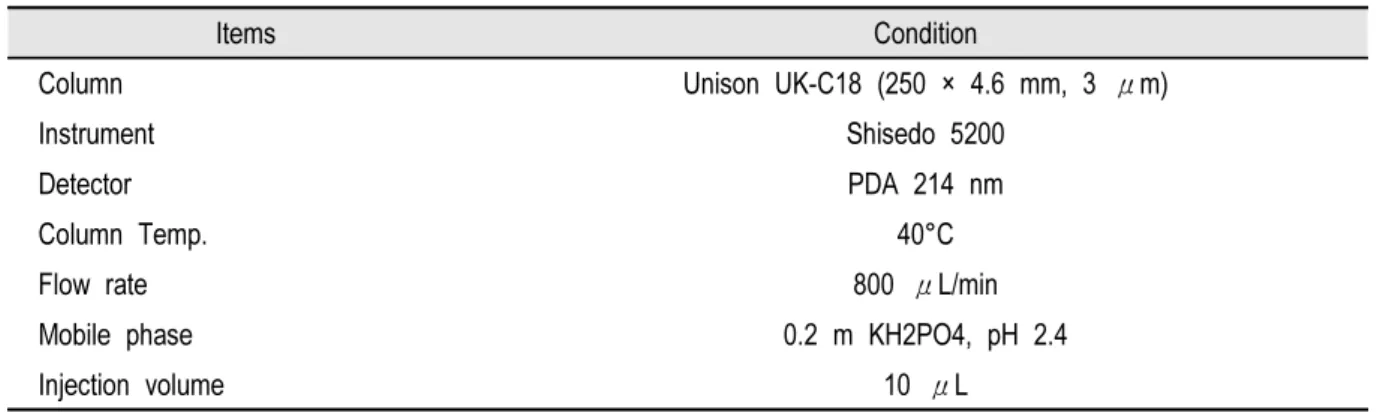
시료 2 g에 10배 증류수를 가하고 30분 동안 상온에서 교반 한 후, 상층액을 취하여 0.45 membrane filter로 여과하였 다. 여액을 HPLC를 이용하여 분석하였으며, 이 때 분석조건은 Table 1에 나타낸 바와 같다.
Table 1. Operating Conditions of HPLC for the analysis of organic acid.
Items Condition
Column Unison UK-C18 (250 × 4.6 mm, 3 μm)
Instrument Shisedo 5200
Detector PDA 214 nm
Column Temp. 40°C
Flow rate 800 μL/min
Mobile phase 0.2 m KH2PO4, pH 2.4
Injection volume 10 μL
통계분석
모든 실험은 각각 3회 반복실험을 수행하였다. 실험결과에 대한 통계분석은 SAS program for Windows V9.2 (Sas
Institute, Cary, NC, USA) 를 이용하여 분산분석(General linear model)을 실시하였고, 평균간 차이는 Duncan’s
multiple range test 에 의하여 5% 유의수준에서 검정하였다.
Results and Discussion
종균 접종에 의한 밀기울 발효생균제의 일반성분 변화
발효용 종균을 접종하지 않은 밀기울 대조구(CW)와 접종한 처리구(TW)의 발효 3일 후 일반성분 함량은 Table 2 에 나타낸 바와 같다. 발효 3일 후 밀기울 발효생균제의 조단백질(CP)과 조지방(EE), 조회분(CA)의 함량은 발효용 종균 접종 여부와 관계없이 유의적인 차이가 나타나지 않았으며(p > 0.05), 종균 접종 처리구에서 중성세제불용성섬 유(neutral detergent fiber, NDF)의 비율이 증가하는 경향을 보였으나 이 역시 유의적인 차이는 나타나지 않았다(p >
0.05). 이는 알팔파 사일리지 제조 시 L. plantarum을 접종하여 45일간 발효시킨 결과 비접종구와 접종구의 조단백질 과 섬유소 함량이 유사하였다는 Choi et al. (2015)의 보고와 일치하였다.
Table 2. Chemical composition of wheat bran at 3 days after fermentation.
Treatment CP
t(DM%)
EE
u(DM%)
CA
v(DM%)
NDF
w(DM%)
ADF
x(DM%) CW
y10.94 ± 0.34 5.13 ± 2.09 3.55 ± 0.43 25.60 ± 0.69 8.82 ± 0.45 TW
z10.80 ± 0.34 5.45 ± 2.66 3.82 ± 0.41 26.57 ± 0.67 9.26 ± 0.45 Values are Mean ± standard deviation.
t
CP: crude protein,
uEE: ether extracts,
vCA: crude ash,
wNDF: neutral detergent fiber,
x
ADF: acid detergent fiber,
yCW: control wheat bran,
zTW: fermented wheat bran inoculated with L. plantarum M10 and S. cerevisiae.
발효기간 중 밀기울 발효생균제의 미생물 수 변화
밀기울 발효생균제의 발효기간 중 미생물 수 변화는 Table 3에 나타낸 바와 같다. 유산균의 경우 대조구와 처리구 모두 유의적으로 증가하였으며(p < 0.05), 그 수는 발효 3일차에 처리구가 11.81 ± 0.18 log CFU/g으로 대조구의 5.20
± 0.96 log CFU/g 보다 유의적으로 높았고(p < 0.05), 효모 수도 처리구에서 발효가 진행됨에 따라 유의적으로 증가 하였으나, 대조구의 경우 효모가 검출되지 않았다. 이는 밀기울에 유산균과 효모를 접종한 후 혐기조건에서 24시간 배양하였을 때 각각 2 × 10
9CFU/g, 8 × 10
7CFU/g 의 생균수를 나타내었다는 Savolainen et al. (2014)의 보고와, 쌀보 Table 3. Changes of microbial population of wheat bran during fermentation period (log CFU/g).
Item Treat. Days
0 1 2 3
Lactic acid bacteria
CW
y1.00 ± 1.15cB 4.45 ± 0.00bB 5.73 ± 0.35aB 5.20 ± 0.96aB TW
z5.83 ± 0.06dA 8.30 ± 0.18cA 10.60 ± 0.35bA 11.81 ± 0.18aA Yeast CW Not detectedB Not detectedB Not detectedB Not detectedB
TW 4.52 ± 0.04cA 6.70 ± 0.17bA 6.79 ± 0.24bA 7.50 ± 0.07aA Aerobic
bacteria
CW 3.98 ± 0.19cB 7.49 ± 0.11a 6.48 ± 0.36bA 6.19 ± 0.39b TW 6.43 ± 0.18abA 7.36 ± 0.09a 5.26 ± 0.45bcB 4.80 ± 1.60c Mold CW 3.27 ± 0.10bA 3.00 ± 0.21bA 4.16 ± 1.01aA 3.35 ± 0.26abA
TW 1.00 ± 1.73B NDB NDB NDB
Values are Mean ± standard deviation.
리에 생균제를 접종하여 혐기발효를 하였을 때 발효 7일차까지 유산균 및 효모가 10
9CFU/g 이상을 나타내었다는 Ahn et al. (2015) 의 보고와 일치하였다.
일반세균수는 대조구와 처리구 모두에서 1일차에 높게 나타났다가 발효가 진행됨에 따라 감소하였으며, 처리구 는 4.80 ± 1.60 log CFU/g으로 대조구의 6.19 ± 0.39 log CFU/g보다 유의적으로 낮게 나타났다(p < 0.05). 곰팡이의 경 우 대조구는 발효기간 동안 3.00 - 4.16 log CFU/g의 균수를 유지하였고, 처리구의 경우 0일차에 일부 검출되다가 1 일차부터 시험 종료시점까지 검출되지 않았다. Choi et al. (2015)에서 알팔파 사일리지 제조 시 L. plantarum을 접종 할 경우 곰팡이수가 감소하였다는 결과와 일치하였으며, Sung et al. (2010)은 잘 저장된 사일리지는 pH가 낮고 혐기 상태가 유지됨으로써 곰팡이가 성장하기 힘들다고 보고하였는데 본 연구에서도 낮은 pH와 혐기발효가 곰팡이의 성 장에 영향을 미친 것으로 사료된다. 대조구에 비해 처리구의 경우 종균으로 L. plantarum과 S. cerevisiae를 접종함으 로써 유용미생물인 유산균류와 효모류의 균수가 각각 발효 3일차에 11.81 ± 0.18 log CFU/g, 7.50 ± 0.07 log CFU/g을 나타내고, 대조구와 곰팡이가 발효 1일차부터 검출되지 않은 결과를 종합하여 볼 때 밀기울 발효생균제 제조 시 유 용 미생물 접종이 발효기간 중 안전성 증진에 기여할 수 있을 것으로 사료된다.
발효기간 중 밀기울 발효생균제의 pH 변화
밀기울 발효생균제의 발효기간 중 pH변화는 Table 4와 같다. 발효가 진행됨에 따라 대조구와 처리구 모두에서 유 의적으로 pH 감소가 일어났고(p < 0.05), 발효용 종균을 접종한 처리구의 pH가 더 빠르게 감소하였다. 시험 종료시 점인 발효 3일차에는 대조구와 처리구 각각 6.22 ± 0.02, 5.14 ± 0.02로서 처리구의 pH가 대조구에 비해 유의적으로 낮게 나타났다. 이는 Savolainen et al. (2014)의 연구에서 밀기울에 유산균과 효모를 접종하여 혐기 또는 호기로 발효 하였을 때 미생물의 성장과 관련하여 pH 변화가 있었다는 보고와, Ahn et al. (2015)의 쌀보리에 생균제를 접종하였 을 때 대조구에 비해 pH 저하속도가 빨랐다는 보고와 일치하는 결과이다.
Table 4. Changes of pH of wheat bran during fermentation period.
Treatment Days
0 1 2 3
CW
y6.28 ± 0.01a 6.28 ± 0.01aA 6.18 ± 0.03cA 6.22 ± 0.02bA TW
z6.27 ± 0.02a 6.23 ± 0.03bB 5.28 ± 0.03cB 5.14 ± 0.02dB Means ± standard deviation.
a-d: Means in the same row with different letters are significantly different (p < 0.05).
A, B: Means in the same column with different letters are significantly different (p < 0.05).
y
CW: Control wheat bran,
zTW: fermented wheat bran inoculated with L. plantarum M10 and S. cerevisiae.
발효기간 중 밀기울 발효생균제의 유기산 함량 변화
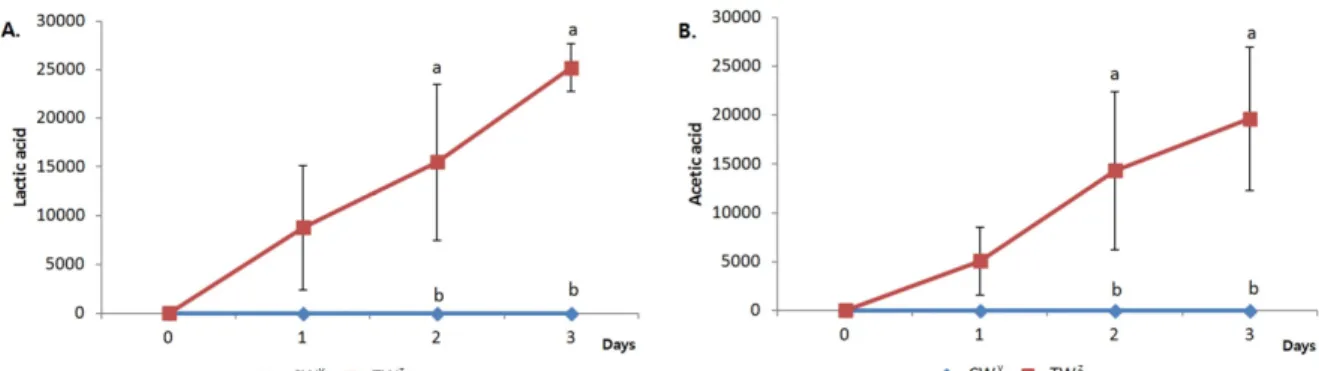
밀기울 발효생균제의 발효초기 유기산 변화는 Fig. 1에 나타낸 바와 같다. 젖산(Lactic acid)의 경우 대조구(CW)는
발효가 진행되어도 젖산과 초산의 함량변화가 없었으나, 종균 접종구(TW)의 경우 발효가 진행됨에 따라 함량이 유
의적으로 증가하여(p < 0.05), 발효 3일차에 CW와 TW 각각 0.00 ± 0.00 mg/kg, 25,175.80 ± 2,451.01 mg/kg으로 TW
가 유의적으로 높았다(p < 0.05). 초산(Acetic acid)의 경우도 TW에서 발효가 진행됨에 따라 함량이 유의적으로 증가
하였고(p < 0.05), CW의 경우 함량변화가 없었고, 발효 3일차에 CW와 TW 각각 0.00 ± 0.00 mg/kg, 19,622.98 ±
7,336.07 mg/kg 으로 TW가 유의적으로 높았다(p < 0.05). Savolainen et al. (2014)은 밀기울에 유산균과 효모를 접종
또한 Choi et al. (2015)의 알팔파에 L. plantarum을 접종한 결과 발효 후 젖산 함량이 증가하였다는 보고와 일치하는 결과이다. 따라서 위 결과를 종합하여볼 때 본 연구에서 젖산과 초산의 함량이 증가하는 경향을 나타낸 것은 유산균 및 효모류의 성장과 관련이 있을 것으로 사료된다.
Fig. 1. Changes of organic acid concentration of wheat bran during fermentation period (mg/kg).
A: concentration of lactic acid, B: concentration of acetic acid.
y