This is an Open Access article distributed under the terms of the Creative Commons Attribution Non-Commercial License (http: //creativecommons.org/licenses/by- nc/4.0/) which permits unrestricted non-commercial use, distribution, and reproduction in any medium, provided the original work is properly cited.
Copyright: © 2018 Korean Journal of Agrcultural Science
ANIMAL
https://doi.org/10.7744/kjoas.20180004
Effect of different phase levels of medium
chain triglycerides on the growth performance, excreta microflora and blood profiles of
broilers
Jing Hu1, Jae Hong Park1, Jian Ying Zhang1, Jong Sang Yoo2, Jin Young Cheong2, In Ho Kim1*
1Department of Animal Resource and Science, Dankook University, Cheonan 31116, Korea,
2Daehan Feed Co., Ltd, 13, Bukseongpo-gil, Jung-gu, Incheon 22300, Korea [email protected]
Introduction
Thetermmediumchaintriglycerides (MCTs) obtainedbythehydrolysisofcoconut oilfollowedbythefractionationofthefattyacids referstomixedtriglycerides of saturatedfattyacidswithachainlengthof6 – 10carbons. Comparedtolong-chain triglycerides (LCT), MCT displays some specific physicochemical and biological OPEN ACCESS
Accepted: February 3, 2018 Revised: January 29, 2018 Received: August 8, 2017 Editor: Jung Min Heo, Chungnam National University
DOI:
Citation: Hu J, Park JH, Zhang JY, Yoo JS, Cheong JY, Kim IH. 2018. Effect of different phase levels of medium chain triglycerides on the growth performance, excreta microflora and blood profiles of broilers. Korean Journal of Agricultural Science. https://doi.org/10.7744/kjoas.20180004
*Corresponding author:
Medium chain triglycerides (MCTs) provide polka dot grouper Chromileptes altevelis with a more readily utilizable source of energy than long-chain fatty acids (LCFAs) and significantly elevate the plasma cholesterol level of chickens. As a possible alternative to feed antibiotics, this study investigated the effect of different phase levels of medium chain triglycerides on the growth performance, excreta microflora and blood profiles in broilers. A total of 450 ROSS 308 mixed-sex broilers with an average initial body weight of 49 ± 0.79 g (1 day of age) were used in this trial. They were randomly assigned to the following 3 treatments (15 birds / 10 replications): CON (Basal diet); MCT1 (Starter, Grower, Finisher: Basal diet + 0.1%, 0.075%, 0.05%
of MCT) and MCT2 (Starter, Grower, Finisher: Basal diet + 0.1%, 0.1%, 0.1% of MCT). The results show that supplementing the diets with different phase levels of MCT did not have a significant impact on the body weight gain (BWG), feed intake (FI) and feed conversion ratio (FCR) during the overall experimental period. Additionally, there were no differences in the blood profiles and excreta microflora among the treatments. However, this study found that the BWG was increased by 2.3%, and the FCR was decreased by 0.6% in the broiler fed MCT1 treatment group during overall experiment phase. Therefore, the results suggest that MCTs could be used as an alternative to growth promoting feed additives. Moreover, further research should be done to evaluate the effect of the different levels of MCTs.
blood profiles, broilers, excreta microflora, growth performance, medium chain triglycerides
Abstract
Keywords :
characteristics. MCTprovidespolkadotgrouperChromileptesalteveliswithamorereadilyutilizable sourceofenergythanlong-chainfattyacid (LCFA), andsignificantlyelevatedtheplasmacholesterol levelofchickens (FisherandKaunitz, 1964; Mabayoetal., 1992; Akibaetal., 1993; Smithetal., 2005).
MCTsarecurrentlyusedinclinicalnutritionasenergy-yieldingsubstrates, andhavebeenadvocated forthreedecadesasausefulmeanforbodyweightreduction (Bachetal., 1996). Also, MCTiswidely usedinobesenondiabetichumansforinducingfatlossanddecreasingbloodlevelsofketonebodies (Martenetal., 2006; Hanetal., 2007). MCTsreducefatmass, throughdown-regulationofadipogenic genes as well as peroxisome proliferator activated receptor-γ. MCTs improved several features contributing to enhanced insulin sensitivity. Under certain in vitro conditions, MCTs exert proinflammatoryeffects, butinvivoMCTsmayreduceintestinalinjuryandprotectfromhepatotoxicity (Martenetal., 2006; Leveilleetal., 2016).
TheobjectiveofthisstudywastoinvestigatetheeffectofdifferentphaselevelofMCTongrowth performance, excretamicrofloraandbloodprofilesinbroilersforformulatingcosteffectivefeeds.
Materials and Methods
All animal-based procedures were in accordance with the Guidelines for the Care and Use of ExperimentalAnimalsofDankookUniversity.
Experimental material
TheMCT (AveMix) waspreparedandsuppliedintheformofpowderbyacommercialcompany (AveveGroupCo. Ltd, Leuven, Belgium). Thecompositionofthefinalproductcontained55% MCToil (C6: 50%, C8: 50%) andSilicacarrier45%.
Experimental birds and diets
Atotalof450ROSS308mixed-sexbroilerswithanaverageinitialbodyweight (BW) 49 ± 0.79g (1dof age) wereusedinthistrial. Theywererandomlyassignedto3treatments, with15birdsof10replications ineachtreatmentoffollowing: CON (Basaldiet); MCT1 (Starter, Grower, Finisher: Basaldiet + 0.1%, 0.075%, 0.05% ofMCT); MCT2 (Starter, Grower, Finisher: Basaldiet + 0.1%, 0.1%, 0.1% ofMCT). The experimentwasconductedin3phasesconsistingofstarterphase (fromd1to7), growerphase (fromd 8to21) andfinisherphase (fromd22to38). Ingredientsandcalculatednutrientcompositionofbasal dietsfromstartertofinisherphasewerepresentedinTable1. Broilerswereraisedinatemperature- controlledroom with three floors of stainless steel pensof identical size (1.75 × 1.55 m2). Room temperaturebeganat33°Cfromday1today3andwasreducedgraduallyto24°Cbytheendofthe experiment. Artificiallightwasprovided24h/dbytheuseoffluorescentlights. Therelativehumidity wasaround60%. Birdshadfreeaccesstofeedandwaterthroughoutthestudy.
Sampling and Chemistry analysis
ThebroilerchicksweremeasuredBWandfeedintake (FI) wasrecordedond1, 21and28. Attheend oftheexperiment, 30broilerswererandomlyselectedfromeachtreatmentandbloodsampleswere collectedfromthewingveinintoasterilesyringe. Aftercollectingandbloodsamplesweretransferred intovacuumtubescontainingK3EDTA (Becton, Dickinson, FranklinLakes, NJ). Bloodsampleswere centrifuged (3000 × g) for15minat4°Ctoobtainserum. Theconcentrationsofwhitebloodcell (WBC) andlymphocytepercentagewereanalysedbyusinganautomaticbloodanalyzer (ADVID120, Bayer, USA). ImmunoglobulinGwasanalyzedbyusinganautomaticbiochemistryanalyzer (HITACHI747, Tokyo, Japan).
Fecalsamplesfreshedwerecollectedattheendofexperiment (4weeks). Thenserialdilution (10-4to Table 1. Basal diet composition (as-fed basis).
Items Starter Grower Finisher
Raw materials (%)
Corn 50.48 47.34 51.43
Wheat 5.00 15.00 15.00
Wheat bran 0.30 0.30 0.30
Soybean meal (CP 45%) 30.92 19.54 12.69
Rape seed meal (CP 38%) 3.00 3.00 4.00
Distillers dried grain soluble 3.00 5.00 5.00
Meat meal (CP 60%) 3.00 7.00 8.00
Tallow 1.00 2.00 2.90
Soy oil 0.78 - -
Limestone 0.70 - -
Monocalcium and dicalcium phosphate 1.06 0.23 0.10
Salt 0.20 0.09 0.08
NaHCO3 0.16 0.10 0.10
Vitamin premixy 0.20 0.20 0.20
Trace mineral premixz 0.20 0.20 0.20
Calculated composition (%)
Dry matter 87.54 87.74 87.87
Crude protein 22.00 20.91 18.99
Crude fat 4.30 4.99 6.22
Crude fiber 2.28 2.26 2.20
Crude ash 5.83 4.86 4.56
Calcium 0.96 0.93 0.94
Totla phosphate 0.21 0.18 0.15
Available phosphate 0.39 0.35 0.34
Methionine + cysteine 1.09 1.01 0.97
Digestible lysine 1.28 1.15 1.07
Digestible meth-cyst 0.95 0.87 0.82
yProvided per kilogram of diet: 15,000 IU of vitamin A, 3,750 IU of vitamin D3, 37.5 mg of vitamin E, 2.55 mg of vitamin K3, 3 mg of thiamin, 7.5 mg of riboflavin, 4.5 mg of vitamin B6, 24 μg of vitamin B12, 51 mg of niacin, 1.5 mg of folic acid, 0.2 mg of biotin, and 13.5 mg of pantothenic acid.
zProvided per kilogram of diet: 37.5 mg of Zn, 37.5 mg of Mn, 37.5 mg of Fe, 3.75 mg of Cu, 0.83 mg of I, 62.5 mg of S and 0.23 mg of Se.
10-7) ofdigestasampleswasmadeusinganaerobicdiluentsandplacedonMacConkeyagarplates (Difco Laboratories, Detroit, MI) andLactobacillimediumIIIagarplates (Medium638; DSMZ, Braunschweig, Germany) to isolate the Escherichia coli (E.coil) and Lactobacillus, respectively. The Lactobacilli mediumIIIagarplateswerethenincubatedfor48hat39℃ underanaerobicconditions. TheMacConkey agarplates were incubated for 24 h at 37℃. The E.coli and Lactobacillus colonies were counted immediatelyafterremovalfromtheincubator.
Statistical analysis
AllexperimentaldatawereanalyzedbyANOVAusingthegenerallinearmodel (GLM) procedure (SAS Inst. Inc., Cary, NC) withthecagebeingdefinedastheexperimentalunit. Differencesamongtreatments wereseparatedbyDuncan’smultiplerangetest. Theresultswereexpressedastheleastsquaresmeans andstandarderror. Acriterionαlevelofp < 0.05wasusedtodeterminestatisticalsignificance.
Results and Discussion
Growth performance
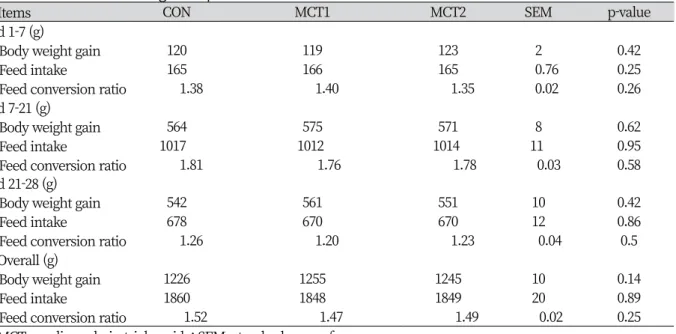
Theeffects ofMCT ongrowthperformancewere shownin Table2. Theseresultsindicatedthe supplementingthedietswithdifferentphaselevelofMCTdidnothavesignificantimpactonBWG, FI andfeedconversionratio (FCR) duringtheoverallexperimentalperiod.
Table 2. Effect of MCT on growth performance in broilersz.
Items CON MCT1 MCT2 SEM p-value
d 1-7 (g)
Body weight gain 120 119 123 2 0.42
Feed intake 165 166 165 0.76 0.25
Feed conversion ratio 1.38 1.40 1.35 0.02 0.26
d 7-21 (g)
Body weight gain 564 575 571 8 0.62
Feed intake 1017 1012 1014 11 0.95
Feed conversion ratio 1.81 1.76 1.78 0.03 0.58
d 21-28 (g)
Body weight gain 542 561 551 10 0.42
Feed intake 678 670 670 12 0.86
Feed conversion ratio 1.26 1.20 1.23 0.04 0.5
Overall (g)
Body weight gain 1226 1255 1245 10 0.14
Feed intake 1860 1848 1849 20 0.89
Feed conversion ratio 1.52 1.47 1.49 0.02 0.25
MCT, medium chain triglyceride; SEM, standard error of means.
z Starter, CON, basal diet; MCT1, basal diet + 0.1% MCT; MCT2, basal diet + 0.1% MCT.
Grower, CON, basal diet; MCT1, basal diet + 0.075% MCT; MCT2, basal diet + 0.1% MCT.
Finisher: CON, basal diet; MCT1, basal diet + 0.05% MCT; MCT2, basal diet + 0.1% MCT.
MCTsareauniqueformofdietaryfatthatimpartawiderangeofpositivehealthbenefits. Thereare afewstudiesaboutMCTsonbroilers. ChickendietarysupplementingMCTtothechickdietwould improvebodyweightgainandproteinutilisation (Yenetal., 2015b). TheMCTshasbeenextensively studiedinotheranimals. SomestudiesindicatedthatthepigsfedMCTdietshadhigheraveragedaily gain (ADG), improvedtheapparenttotaltractdigestibility (energy, drymatterandnitrogen) andgain- to-feedratio, alsodecreasedcoliformscountsincolonandrectumcontent (Mabayoetal., 1993; Gatlin etal., 2002; Hongetal., 2012; Yenetal., 2015a). Hernández andPluske (2008) resultsindicatedthatthere wasnodifferencebetweenexperimentaldietsbyaddingMCTonpigperformance. Nielsenetal. (2005) andAsdarietal. (2014) reportedthattheadditionofMCTtothediethaddifferenteffectsongrowth performanceandproteincontentofthefish. Inthisstudy, wefoundthattheBWGwasincreased2.3% andFCRweredecreased0.6% inbroilerfedMCT1intheoverallexperimentphase. Thustheaddition of0.1% MCTseemstohavegreaterADGthanCON, althoughtherewasnostatisticaldifference. Furuse etal. (1993) reportdemonstratedthatchicks preferredtheLCT-supplementeddietcomparedwith eitherofthedietscontainingMCT. Similarresultswerefoundbyotherresearcherthatitwasobtained thatgiventreatmentseffectiveonfeedintake, weightgainandthefeedconversionwerenotsignificant whengiventhebasaldietplus0.1, 0.15or0.2% forperiod1 – 21dayofage, 0.15% forperiod21 – 36day ofageand0.1% forperiod36 – 42dayofagefromMCFA (Shahrametal., 2013). Inourpreviousstudy, we usedonehundredandtwentyweaningpigstoevaluatetheeffectofMCTongrowthperformance, apparent total tract digestibility (ATTD) of nutrients and blood profile. Results indicated that the additionofMCTintheweaningpigsdietcouldimprovetheADGanddigestibilityduringtheearlier period (first2wks), buthadlittleeffectonthebloodcharacteristics (Hongetal., 2012).
Blood characteristics
Table 3. showed the effect of MCT on blood profiles throughout the experiment. The results demonstratedthattheconcentrationofwhitebloodcells, lymphocyteandIgG, wereunaffectedby MCTsupplementationinthisstudy.
Changes in blood parameters reflect the body's metabolic changes. IgG in the blood is mainly producedbytheBcellsintoplasmacellsaftersecretion, whenthebodyisstimulatedbytheantigen, thebloodlevelsofantibodies, IgGlevelswill beincreased. IgGcanbecombinedwiththespecific antigen, causingimmuneresponsetoprotectthebody. itslevelofcontenttoacertainextentreflects Table 3. Effect of MCT on blood profiles in broilersz.
Items CON MCT1 MCT2 SEM p-value
White blood cell (103/㎕) 18.87 18.71 19.04 0.73 0.95
Lymphocyte (%) 46.6 46.1 46.9 2 0.97
Immunoglobulin G (mg/dL) 229 232 226 10 0.91
MCT, medium chain triglyceride; SEM, standard error of means.
z Starter, CON, basal diet; MCT1, basal diet + 0.1% MCT; MCT2, basal diet + 0.1% MCT.
Grower, CON, basal diet; MCT1, basal diet + 0.075% MCT; MCT2, basal diet + 0.1% MCT.
Finisher: CON, basal diet; MCT1, basal diet + 0.05% MCT; MCT2, basal diet + 0.1% MCT.
thelevelofthebodyresistance. MCTaddedindietaryhadnosignificanteffectonbloodprofileand excretamicroflorainbroiler. HernándezandPluske (2008) andHongetal. (2012) alsoreportedthatno effectwasobservedonthebloodprofiles (WBC, IgGandlymphocyteconcentration) measured.
Excreta microflora
TheeffectofMCTonexcretamicroflorainbroilerwasshowninTable4. Theresultsdemonstrated thatnosignificanteffectwasobservedin Lactobacillus and E.coil throughouttheentireexperimental period.
Anyeffectswerenotfoundonexcretamicroflorainbroiler. Withsimilarstudy, Zenteketal. (2013)’s researchdemonstratedthattheMCFAinducedonlyminorchangesinthegastrointestinalmicrobiota butincreasedcellcountsfortheEscherichia-Hafnia-Shigellagroupinthejejunumandtheclostridial clusterXIVainthecolondigesta. Also, similarresultswerereportedbyShahrametal. (2013) thatthere wasnostatisticallysignificanceonmicrobialpopulation (lactobacilus) inMCFAdiets. However, Yenet al. (2015a) reportedthatsupplementationwithMCT indietcouldimprovetheintestinalmicrobial environmentandthefeedutilizationefficiencyofnewlyweanedpigs. Thisinconsistencymaybedue todifferentdosageandcompositionofMCTsandexperimentalconditionsusedintheseinvestigations. Insummary, wesuggestedthatMCTscouldbeusedasanalternativetogrowthpromotionadditive. Moreover, itisalsosuggestedthatfurtherresearchshouldbeperformedtoevaluatetheeffectofthe differentlevelofMCTs.
Table 4. Effect of MCT on excreta microflora in broilerz.
Items, log10 cfu/g CON MCT1 MCT2 SEM p-value
Lactobacillus 7.56 7.62 7.63 0.03 0.34
E.coil 6.55 6.44 6.46 0.06 0.39
MCT, medium chain triglyceride; SEM, standard error of means.
z Starter, CON, basal diet; MCT1, basal diet + 0.1% MCT; MCT2, basal diet + 0.1% MCT.
Grower, CON, basal diet; MCT1, basal diet + 0.075% MCT; MCT2, basal diet + 0.1% MCT.
Finisher: CON, basal diet; MCT1, basal diet + 0.05% MCT; MCT2, basal diet + 0.1% MCT.
References
Akiba Y, Hah, TW, Murakami H, Horiguchi M, Yamazaki M. 1993. Metabolizableenergy value and effect on amino acid availability of medium-chain triglycerides in diets fed to chickens of different ages.
Animal Feed Science and Technology 43:259-268.
Asdari R, Biswas A, Yamamoto S, Araki H, Kawashima K, Hashim R, Takii K. 2014. Effect of dietary palm oil and medium chain triglycerides on growth and fatty acid profiles of Japanese catfish Silurus asotus juveniles. Aquaculture Science 62:45-54.
Bach AC, Ingenbleek Y, Frey A. 1996. The usefulness of dietary medium-chain triglycerides in body weight control: Fact or fancy? Journal of Lipid Research 37:708-726.
Fisher H, Kaunitz H. 1964. Effects of medium- and long-chain saturated triglycerides on blood and liver
cholesterol of chickens and rats. Experimental Biology and Medicine 116:278-280.
Furuse M, Mabayo RT, Choi YH, Denbow DM, Okumura J. 1993. Feeding behaviour in chickens given diets containing medium chain triglyceride. British Poultry Science 34:211–217.
Gatlin LA, Odle J, Soede J, Hansent JA. 2002. Dietary medium- or long-chain triglycerides improve body condition of lean-genotype sows and increase suckling pig growth. Journal of Animal Science 80:38.
Han JR, Deng B, Sun J, Chen CG, Corkey BE, Kirkland JL, Ma J, Guo W. 2007. Effects of dietary medium- chain triglyceride on weight loss and insulin sensitivity in a group of moderately overweight free- living type 2 diabetic Chinese subjects. Metabolism 56:985-991.
Hong SM, Hwang JH, Kim IH. 2012. Effect of medium-chain triglyceride (MCT) on growth performance, nutrient digestibility, blood characteristics in weanling Pigs. Asian-Australas Journal of Animal Science 25:1003-1008.
Leveille GA, Pardini RS, Tillotson JA. 2016. Influence of medium-chain triglycerides on lipid metabolism in the chick. Lipids 2:461-466.
Mabayo RT, Furuse M, Kita K, Okumura J. 1993. Improvement of dietary proteinutilisation in chicks by medium chain triglyceride. British Poultry Science 34:121-130.
Mabayo RT, Furuse M, Okumura J. 1992. Energy utilisation of medium chain triglyceride in comparison with long chain triglyceride in growing chicks. British Poultry Science 33:883-887.
Marten B, Pfeuffer M, Schrezenmeir J. 2006. Medium-chain triglycerides. International. Dairy Journal 16:1374-1382.
Nielsen NS, Göttsche JR, Holm J, Xu X, Mu H, Jacobsen C. 2005. Effect of structured lipids based on fish oil on the growth and fatty acid composition in rainbow trout (Oncorhynchus mykiss). Aquaculture 250:411-423.
Hernández A, Pluske J. 2008. Using dietary medium-chain triglycerides to improve post-weaning performance of pigs.
Shahram M, Habib AS, Yahya E, Alireza A, Behnam T. 2013. Effect of different levels of medium chain fatty acids on performance, and some of microbial population of gastro in broiler chicks. South pacific of technology and science 1:10-14.
Smith DM, Williams IH, Williams KC, Barclay MC, Venables WN. 2005. Oxidation of medium-chain and long-chain fatty acids by polka dot grouper cromileptes altivelis. Aquaculture nutrition 11:41-48.
Yen HC, Lai WK, Lin CS, Chiang SH. 2015a. Medium-chain triglyceride as an alternative of in-feed colistin sulfate to improve growth performance and intestinal microbial environment in newly weaned pigs.
Animal Science 86:99-104.
Yen HC, Lai WK, Lin CS, Chiang SH. 2015b. Medium-chain triglyceride as an alternative of in-feed colistin sulfate to improve growth performance and intestinal microbial environment in newly weaned pigs.
Animal Science 86:99-104.
Zentek J, Ferrara F, Pieper R, Tedin L, Meyer W, Vahjen W. 2013. Effects of dietary ombinations of organic acids and medium chain fatty acids on the gastrointestinal microbial ecology and bacterial metabolites in the digestive tract of weaning piglets. Animal Science 91:3200-3210.