3T3-L1 세포분화 중 지방축적 및 활성산소종 생성에 대한 국내 산림자원 5종 추출물의 효과
⁃ 연구노트 ⁃
최선일1․이종석2․이사라2․이혜진2․여주홍2․조봉연1․이진하1 김재민1․정태동1․최승현1․김종예1․강석남3․이옥환1
1강원대학교 식품생명공학과
2국립생물자원관 유용자원분석과
3대구대학교 동물자원학과
Effects of Extracts of Five Species of Korean Native Forest Plants on Lipid Accumulation and Reactive Oxygen Species Production
during Differentiation of 3T3-L1 Preadipocytes
Sun-Il Choi1, Jong Seok Lee2, Sarah Lee2, Hye Jin Lee2, Joohong Yeo2, Bong-Yeon Cho1, Jin-Ha Lee1, Jae-Min Kim1, Tae-Dong Jung1, Seung-Hyun Choi1,
Jong-Yea Kim1, Suk-Nam Kang3, and Ok-Hwan Lee1
1Department of Food Science and Biotechnology, Kangwon National University
2Biological and Genetic Resources Assessment Division, National Institute of Biological Resources
3Department of Animal Resource, Daegu University
ABSTRACT This study investigate the effects of extracts of five species of Korean native forest plants on lipid accumulation and reactive oxygen species (ROS) production during the differentiation of 3T3-L1 cells. Our results show that Korean native forest plants extracts significantly reduced lipid accumulation and ROS production during adipogenesis in 3T3-L1 cells. Especially, Rubus coreanus Miq. was most effective in the inhibition of lipid accumulation and ROS production at a concentration of 100 μg/mL. Moreover, Rubus coreanus Miq. extracts significantly inhibited adipocyte differentiation, which is dependent on down-regulation of peroxisome proliferator-activated receptor gamma, CCAAT/enhancer-binding protein alpha, and adipocyte-specific fatty acid binding protein, a key adipogenic transcription factor. Therefore, these results suggest that Rubus coreanus Miq. might be a valuable source of bioactive compounds with anti-adipogenic activity.
Key words: 3T3-L1 cell, adipocyte differentiation, lipid accumulation, reactive oxygen species, Korean native forest plants
Received 12 January 2017; Accepted 9 February 2017
Corresponding author: Ok-Hwan Lee, Department of Food Science and Biotechnology, Kangwon National University, Chuncheon, Gangwon 24341, Korea
E-mail: [email protected], Phone: +82-33-250-6454
서 론
체내 지방은 모든 생리적 기관에서 필요로 하는 필수 영양 소이며, 에너지 항상성 유지에 중요한 역할을 수행한다. 하 지만 사회적・경제적 발달로 인한 서구화된 식습관과 생활습 관으로 에너지 섭취와 소비의 불균형을 초래하여 비만 (obesity)을 야기하며, 이러한 비만은 당뇨, 고혈압, 고지혈 증, 동맥경화, 심장병, 뇌졸중 등 각종 대사성 질환, 심혈관 계 질환의 직간접적인 발병 원인으로 알려져 있다(1-3). 비 만의 원인인 체내 지방의 축적은 체내 지방세포에서 분비되
는 호르몬(adipokine)의 생산과 분비를 통하여 지방세포의 분화가 일어나 비대(hypertrophy)와 과형성(hyperplasia) 으로 지방축적이 일어나며, 지방질 생합성(lipogenesis) 작 용으로 생성된 지방구 축적에 의하여 유도된다(4,5). 또한, 지방세포 과형성은 전지방세포(preadipocytes)의 증식과 분화 과정으로 인하여 유도되는데, 전지방세포에서 dex- amethasone(DEX), 3-isobutyl-1-methylxanthine(IBMX), insulin 등의 자극으로 C/EBPβ, C/EBPγ 초기 분화 시 활성 화되며, 이들은 상호작용으로 PPARγ 및 C/EBPα의 발현을 조절한다. 또한, PPARγ와 C/EBPα는 분화 초기에 발현되어 지방세포분화에 관여하며, 이들은 분화 후기에는 다양한 adipogenic 유전자들의 발현을 유도한다. 따라서 adipo- genesis를 억제하는 것은 항비만 연구에 있어서 중요한 타 깃으로 연구되고 있다(6-8). 최근 연구에 의하면 지방세포 내 활성산소종(ROS)의 과도한 생성은 세포 내 산화적 스트
레스를 유발하게 하여 생체 내의 세포막, 단백질, DNA 손상 등을 일으켜 암, 노화 등의 각종 질병을 유발할 뿐만 아니라 인슐린 저항성을 야기하여 당뇨의 원인으로도 밝혀진 바 있 다(9-11).
나고야의정서로 인한 국내 유전자원의 보호를 위해 유전 자원 관련 전통지식(traditional knowledge associated with genetic resources)을 확보하려는 노력이 필요한 시 점에서 국내 산림자원 중 식품원재료 database에 등재된 원료에 대한 효능을 평가하는 것은 매우 시의적절한 연구로 생각한다. 본 연구팀은 전보(12)에서 국내 자생식물 45종을 국립생물자원관으로부터 제공받아 항산화 활성 등을 평가 하였다. 현재까지 국내 산림지역 자생 식물을 이용하여 열매 를 제외한 잎, 줄기 및 잔가지 추출물의 항비만 활성에 관한 연구는 많지 않고 이를 식품가공 원료로 적용한 연구도 초기 단계에 불과하다. 따라서 전보(12)에서 국내 산림지역 자생 식물 중 항산화 활성이 우수하였던 밤나무(Castanea cren- ata Siebold & Zucc.), 진달래(Rhododendron mucronula- tum Turcz.), 산수유(Cornus officinalis Siebold & Zucc.), 복분자딸기(Rubus coreanus Miq.), 갈참나무(Quercus aliena blume)를 선별하여 각각의 산림자원의 잎 및 잔가지 부분을 70% 에탄올로 추출하여 지방세포 분화 억제 및 ROS 생성 억제 효능을 평가하였다.
재료 및 방법
실험재료 및 시약
본 연구에서 사용된 산림자생 식물은 2014년에 수집한 것으로 국립생물자원관에서 제공받아 사용하였다. 전보(12) 에서 총 45종의 추출물의 항산화 활성을 평가한 후 효능이 우수한 5종(밤나무, 진달래, 산수유, 복분자딸기, 갈참나무) 을 선별하여 지방세포 분화 및 ROS 생성 억제 실험에 사용 하였다. 전지방세포(3T3-L1) 배양 및 분화에 사용된 시약 으로 penicillin-streptomycin(P/S), insulin, dexameth- asone(DEX), 3-isobutyl-1-methylxanthine(IBMX), ni- troblue tetrazolium(NBT), Oil Red O(ORO), isopropyl alcohol, N-acetyl-L-cysteine(NAC)은 Sigma-Aldrich Co.(St. Louis, MO, USA)에서 구입하여 사용하였다. Dul- becco’s modified Eagle’s medium(DMEM), fetal bovine serum(FBS), bovine serum(BS), phosphate-buffered saline(PBS) 및 trypsin-EDTA 등은 Gibco(Gaithersburg, MD, USA)로부터 구입하여 사용하였다.
추출물 제조
선별된 산림자생 식물(밤나무, 진달래, 산수유, 복분자딸 기, 갈참나무)의 추출물 제조는 다음과 같이 각 시료 100 g 에 70% 에탄올 1,000 mL를 첨가하여 침지시킨 후 실온에 서 24시간 동안 추출하였다. 상기 추출 과정을 3회 반복하고 얻어진 추출액은 모두 합하여 filter paper(No. 3, What-
man, Maidstone, UK)로 여과한 후 회전진공농축기(N- 3000, EYELA, Tokyo, Japan)를 사용하여 감압 농축한 다 음, 동결건조(Ilshinbiobase Co., Ltd., Yangju, Korea) 하 여 분말화하였다.
3T3-L1 세포 배양 및 분화
마우스 유래 3T3-L1 세포는 American Type Culture Collection(ATCC, CL-173, Manassas, VA, USA)으로부 터 분양받아 사용하였다. 3T3-L1 전지방세포는 실험목적 에 따라 100Φ, 24-well 및 96-well plate에 각각 1×10⁶ cells/well을 seeding 한 후, BS(10%) 및 P/S(1%)를 함유 한 고농도 포도당 DMEM(89%)에서 100% confluence 될 때까지 배양하였다. 이로부터 2일 후에 지방세포 분화유도 물질(1 μg/mL insulin, 1 μM DEX, 0.5 mM IBMX)과 FBS (10%) 및 P/S(10%)를 함유한 DMEM으로 전지방세포를 지 방세포로 분화 유도하였다. 지방세포 분화(day 0) 시 DMEM 에 시료를 각각 25, 50 및 100 μg/mL로 처리하였고, 양성 대조군에는 항산화제인 NAC 5 mM을 처리하여 비교하였다.
XTT assay를 이용한 세포독성 평가
3T3-L1에 대한 산림자생 식물 추출물의 세포독성 평가 는 XTT[2,3-bis(2-methoxy-4-nitro-5-sulfophenyl)- 2H-tetrazolium-5-carboxanilide innersalt] assay kit을 이용하여 측정하였고, microplate reader(Spectramax i3, Molecular Devices, Sunnyvale, CA, USA)를 이용하여 450 nm 흡광도 값에서 690 nm의 흡광도 값을 뺀 결과 값으 로 세포독성을 계산하였다(13).
Oil Red O staining을 이용한 지방축적량 관찰
분화 과정에 따른 지방세포 내 지방축적량을 측정하고자 각각의 시료를 처리하여 8일 동안 분화된 3T3-L1 세포에 10% formalin 용액 500 μL를 첨가하여 5분간 실온에서 방 치한 뒤 제거하고, 동량의 formalin 용액으로 분화된 3T3- L1 세포 1시간 이상 실온에서 방치하여 plate에 고정시켰 다. 60% isopropanol 용액 500 μL로 세척하여 세포를 완전 히 건조시킨 후, 미리 제조해 둔 Oil Red O working sol- ution(ORO : DDW=6:4)으로 세포 내 축적된 지방성분들을 충분히 염색하였다. 증류수를 이용하여 세포를 3~4회 세척 후, 세포 내 축적된 지방 성분과 결합한 ORO는 100% iso- propanol을 이용하여 모두 용출시킨 다음 microplate read- er를 이용하여 490 nm에서 흡광도를 측정하였다(14).
NBT assay를 이용한 ROS 함량 측정
분화 과정에 따른 지방세포 내 ROS 생성량을 측정하고자 각각의 시료를 처리하여 8일 동안 분화된 3T3-L1 세포에 PBS를 이용하여 2회 세척 후, 0.2% NBT 용액 200 μL를 첨가하여 CO2 incubator에서 90분간 반응시킨 다음 DMSO 와 1 N KOH를 7:3 혼합용액으로 dark blue formazan을
Table 1. Gene specific primer used for RT-PCR Sequence PPAR γ Forward
Reverse
CCA GAG TCT GCT GAT CTG CG GCC ACC TCT TTG CTC TGA TC C/EBP α Forward
Reverse
GCA GTG TGC ACG TCT ATG CT AGC CCA CTT CAT TTC ATT GG aP2 Forward
Reverse
GAC CTG GAA ACT CGT CTC CA CAT GAC ACA TTC CAC CAC CA β-Actin Forward
Reverse
ATG GAT GAC GAT ATC GCT GC GCT GGA AGG TGG ACA GTG AG
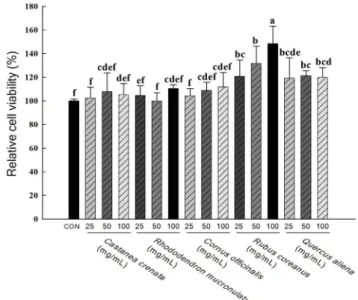
Fig. 1. Effects of ethanol extracts of 5 species in Korean native forest plants on cell viability. Cell viability was measured by XTT assay. The exponentially growing cells were plated into 96-well plates at a density of 1×10⁶ cells/well in DMEM/BS medium and incubated for 24 h prior to treatment at 37°C in 5% CO2. Cells were divided into a control group and a treatment groups. Each value is the mean±SD. Bars with different letters indicate statistically significant differences among groups at P<
0.05 by one-way ANOVA.
용출시켰다. 용출물은 microplate reader를 이용하여 490 nm에서 흡광도를 측정하였다(15).
지방축적과 연관된 주요 유전자 발현 조사
지방세포 분화의 전사인자의 유전자 발현을 조사하기 위 하여 지방세포에 존재하는 total RNA를 추출한 후, 역전사 중합효소(reverse transcriptase)를 사용하여 cDNA(com- plementary DNA)를 합성하였다. 합성된 cDNA와 prime을 PCR(polymerase chain reaction)로 증폭시켜 유전자의 발 현 정도를 측정하였다. 실험에 사용한 primer는 perox- isome proliferator-activated receptor gamma(PPARγ), CCAAT/enhancer-binding protein alpha(C/EBPα), adi- pocyte-specific fatty acid binding protein(aP2), β-ac- tin으로 Table 1과 같다. PCR 산물은 2% agarose gel에서 전기영동 후 UV에서 증폭된 DNA band를 확인하였고 DNA band는 care stream MI SE(Carestream Health Inc., Rochester, NY, USA) 프로그램을 이용하여 band in- tensity로 수치화하여 나타내었다.
통계분석
모든 실험 결과는 SAS(ver 9.4, SAS Institute Inc., Cary, NC, USA)를 이용하여 통계분석 하였다. 유의성 분석 은 ANOVA 검정을 실시하였으며 Duncan의 다중범위 검정 법(Duncan’s multiple rage test)으로 유의성은 P<0.05 수 준에서 검정하였다.
결과 및 고찰
국내 산림자생 식물 추출물의 세포독성
지방전구 세포에서 국내 산림자생 식물 5종의 세포독성 평가는 XTT assay 방법을 이용하여 측정하였다. 국내 산림 자생 식물 5종 에탄올 추출물은 25, 50 및 100 μg/mL의 농도로 지방전구 세포에 처리하였으며, 모든 농도의 추출물 에서 세포 내 독성을 보이지 않았고 현미경 상에서 mor- phology의 변화도 관찰되지 않았다(Fig. 1). 따라서 본 연구 에서는 국내 산림자생 식물 5종 추출물을 25, 50 및 100 μg/mL의 농도로 지방전구 세포에 처리하여 지방세포 분화
억제 및 ROS 생성 저감 효능 평가를 실시하였다.
3T3-L1 분화과정 중 국내 산림자생 식물 추출물의 분화 억제 효과
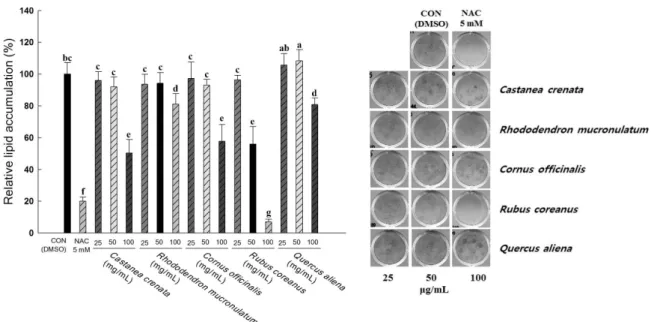
3T3-L1 세포 분화 억제 효능을 확인하기 위하여 중성지 방만을 붉은색으로 염색하는 Oil Red O 염색법을 통해 3T3-L1 지방세포 내 생성된 중성지방의 양을 측정하였으 며, 그 결과는 Fig. 2와 같다. 국내 산림 식물 5종을 처리한 50 및 100 μg/mL 군에서 모두 대조군보다 지방세포 분화 과정에서의 지질축적이 감소하는 경향을 나타내었다. 그중 밤나무, 산수유, 복분자딸기 추출물(100 μg/mL)을 처리한 지방세포에서 대조군(100% 기준)보다 각각 50, 57 및 7%
수준의 지방만이 축적되어 양성대조군으로 사용된 NAC (17)와 유사한 수준의 효능을 보였다. 복분자딸기 추출물의 경우 저농도(50 μg/mL)로 처리한 지방세포에서 지방축적 량 55% 수준으로 나타나 높은 분화 억제 효능을 나타내었 다. 이러한 결과는 Jung 등(18)의 연구에서 보고된 바와 같 이 복분자딸기를 처리한 지방세포는 세포 내 지방 축적을 억제하였다는 연구 결과와 유사한 경향을 보였다.
3T3-L1 분화과정 중 국내 산림자생 식물 추출물의 ROS 생성 억제 효과
NBT assay는 NBT 용액이 지방세포 내에 축적된 ROS와 반응하여 dark blue formazan을 생성하게 되며, 이를 용출 하여 세포 내 ROS의 생성량을 알 수 있다. 3T3-L1 분화과
Fig. 2. Effect of the ethanol extracts of 5 species in Korean native forest on lipid accumulation in 3T3-L1 cells during the adipogenesis.
CON, control cells which were differentiated with MDI; NAC, positive control cells which differentiated with MDI in the presence of NAC. All values are presented as the mean±SD. Bars with different letters indicate statistically significant differences among groups at P<0.05 by one-way ANOVA.
Fig. 3. Effect of the ethanol extracts of 5 species in Korean native forest on reactive oxygen species (ROS) production in 3T3-L1 cells during the adipogenesis. CON, control cells which were differentiated with MDI; NAC, positive control cells which differentiated with MDI in the presence of NAC. All values are presented as the mean±SD. Bars with different letters indicate statistically significant differences among groups at P<0.05 by one-way ANOVA.
정 중 국내 산림자생 식물 추출물의 ROS 생성 억제 효과를 확인하기 위하여 시료를 농도별(25, 50, 100 μg/mL)로 처 리하면서 분화를 유도하였으며, 이때 생성되는 ROS를 NBT assay를 통해 평가하였다(Fig. 3). 국내 산림 식물 5종을 처리(50 및 100 μg/mL)한 모든 지방세포에서 대조군보다 ROS 생성이 억제되는 경향을 보였다. 그중 밤나무, 산수유, 복분자딸기 추출물을 처리한 지방세포에서 지방세포 분화 억제 효능과 마찬가지로 ROS 생성 저감 효과도 우수한 것으 로 나타났다. Lee 등(19)의 연구에서 복분자딸기에는 비타
민 C와 E 같은 항산화성 비타민이 다량 함유되어 있으며, 안토시아닌과 폴리페놀 등과 같은 ROS를 소거할 수 있는 bioactive compound의 함량이 높아 지방세포 분화 시 생성 되는 ROS도 유의적으로 억제할 수 있을 것으로 판단된다.
지방세포의 분화 관련 유전자 분석
PPARγ 및 C/EBPα는 지방세포에서 나타나는 특이적인 전사인자로서 전구지방세포에서 지방세포로 분화 시 aP2와 같은 adipogenic protein 발현을 유도한다(20). 국내 산림
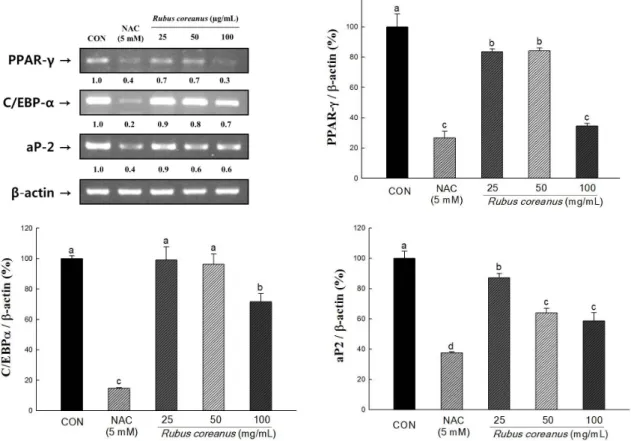
Fig. 4. mRNA expressions of adipogenic transcription factors in Rubus coreanus-treated 3T3-L1 adipocyte. Rubus coreanus were pretreated without or with different concentrations and 5mM NAC. Graphs represent mRNA expression of PPAR-γ, C/EBP-α and aP2 were measured by RT-PCR and quantitative RT-PCR after normalization to β-actin mRNA. All values are presented as the mean±SD. Bars with different letters indicate statistically significant differences among groups at P<0.05 by one-way ANOVA.
자생 식물 중 가장 효과가 우수한 복분자딸기 추출물에 대한 PPARγ, C/EBPα 및 aP2의 유전자 발현을 분석한 결과 Fig.
4와 같다. 복분자딸기 추출물을 3T3-L1 세포에 농도별(25, 50, 100 μg/mL)로 처리하여 PPARγ, C/EBPα 및 aP2의 유 전자 발현 억제 효능을 평가하였다. 3T3-L1 세포에 아무것 도 처리하지 않은 대조군과 비교한 결과, 양성대조군으로 처리한 NAC는 3T3-L1의 분화과정 중 PPARγ, C/EBPα 및 aP2의 유전자 발현 억제하는 것으로 나타났다. 100 μg/
mL의 농도로 복분자딸기 추출물을 처리한 지방세포에서는 PPARγ, C/EBPα 및 aP2 발현이 대조군보다 각각 0.3, 0.7 및 0.6 수준으로 발현이 억제되는 경향을 볼 수 있었다. 복분 자딸기에 함유된 cyanidin-3-glucoside는 항산화 활성, 항 암, 항염증 효능을 나타낸다고 알려져 있다(21). 또한, Wei 등(22)의 연구에서 Cy-3-g를 당뇨모델 마우스에 공급 시 중성지질 대사 개선 및 항비만 효능을 나타낸다고 보고하였 다. 이와 같은 이유로 인하여 본 연구에 사용된 국내 산림 식물 추출물 5종 중 복분자딸기 추출물에서 가장 높은 항비 만 활성을 보인 것으로 생각한다.
요 약
본 연구는 국내 산림자생 식물 추출물 5종(밤나무, 진달래,
산수유, 복분자딸기, 갈참나무)에 대한 지방세포 분화 억제 및 활성산소종(ROS) 생성 억제 효능을 평가하였다. 지방세 포 분화 중 세포 내 지방축적 및 ROS 생성량을 비교한 결과, 국내 산림 식물 5종 모두 지방축적량 및 ROS 생성량을 농도 유의적으로 감소키는 것으로 나타났다. 특히 복분자딸기 추 출물을 처리한 지방세포에서 지방 축적 및 ROS 저감에 가장 크게 나타났으며 양성대조군으로 사용된 N-acetyl-L- cysteine과 유사한 결과를 나타내었다. 또한, 복분자딸기 추 출물을 처리함으로써 지방세포의 분화를 조절하는 전사인 자인 PPARγ, C/EBPα 및 aP2 발현이 억제됨을 확인하였다.
국내 산림 식물 5종 추출물은 천연물에서 유래한 항비만 및 항산화 활성 기능성식품 소재로 활용 가능할 것으로 생각한 다.
감사의 글
본 연구는 정부(환경부)의 재원으로 국립생물자원관(NIBR 201528101) 및 2016년도 강원대학교 전임교원 기본연구 비 지원사업(520160437)에서 지원받아 수행되어 이에 감 사드립니다.
REFERENCES
1. Spiegelman BM, Flier JS. 2001. Obesity and the regulation of energy balance. Cell 104: 531-543.
2. Kwon OJ. 2016. Anti-adipogenic effect of Mori Follium ex- tract in 3T3-L1 cells. Kor J Herbol 31: 47-53.
3. Marcelin G, Chua S Jr. 2010. Contributions of adipocyte lipid metabolism to body fat content and implications for the treatment of obesity. Curr Opin Pharmacol 10: 588-593.
4. Berry R, Jeffery E, Rodeheffer MS. 2014. Weighing in on adipocyte precursors. Cell Metab 19: 8-20.
5. Attie AD, Scherer PE. 2009. Adipocyte metabolism and obesity. J Lipid Res 50: S395-S399.
6. Liu F, Kim JK, Li Y, Liu XQ, Li J, Chen X. 2001. An extract of Lagerstroemia speciosa L. has insulin-like glucose up- take-stimulatory and adipocyte differentiation-inhibitory ac- tivities in 3T3-L1 cells. J Nutr 131: 2242-2247.
7. Rosen ED, Hsu CH, Wang X, Sakai S, Freeman MW, Gon- zalez FJ, Spiegelman BM. 2002. C/EBPα induces adipo- genesis through PPARγ: a unified pathway. Genes Dev 16:
22-26.
8. Kim KH. 2009. Perspective in regulation of adipogenesis by bioactive food components. Food Science and Industry 42(4): 51-57.
9. Lee OH, Kwon YI, Hong HD, Park CS, Lee BY, Kim YC.
2009. Production of reactive oxygen species and changes in antioxidant enzyme activities during differentiation of 3T3-L1 adipocyte. J Korean Soc Appl Biol Chem 52: 70-75.
10. Valko M, Leiibfritz D, Moncol J, Cronin MTD, Mazur M, Telser J. 2007. Free radicals and antioxidants in normal physiological functions and human disease. Int J Biochem Cell Biol 39: 44-84.
11. Gardner PR, Fridovich I. 1991. Superoxide sensitivity of the Escherichia coli aconitase. J Biol Chem 266: 19328-19333.
12. Cho ML, Lee JS, Lee S, Son YK, Bae CH, Yeo J, Lee HS, Ma JG, Lee OK, Kim JY. 2015. Antioxidant activity of 11 species in Korean native forest plants. Korean J Food Nutr 28: 1098-1106.
13. Furukawa S, Fujita T, Shimabukuro M, Iwaki M, Yamada Y, Nakajima Y, Nakayama O, Makishima M, Matsuda M, Shimomura I. 2004. Increased oxidative stress in obesity
and its impact on metabolic syndrome. J Clin Invest 114:
1752-1761.
14. Lee OH, Seo MJ, Choi HS, Lee BY. 2012. Pycnogenol®
inhibits lipid accumulation in 3T3-L1 adipocytes with the modulation of reactive oxygen species (ROS) production as- sociated with antioxidant enzyme responses. Phytother Res 26: 403-411.
15. Lee YJ, Yoon BR, Choi HS, Lee BY, Lee OH. 2012. Effect of Sargassum micracanthum extract on lipid accumulation and reactive oxygen species (ROS) production during differ- entiation of 3T3-L1 preadipocytes. Korean J Food Preserv 19: 455-461.
16. Oh JW, Lee JH, Lee OH, Kim KH, Kim HR, Lee HK. 2015.
Effect of hot water and ethanol extracts from Nelumbo nuci- fera Gaertner flower on lipid accumulation and reactive oxygen species (ROS) production in adipogenesis of 3T3- L1 cells. Korean J Food Preserv 22: 744-750.
17. Calzadilla P, Sapochnik D, Cosentino S, Diz V, Dicelio L, Calvo JC, Guerra LN. 2011. N-Acetylcysteine reduces markers of differentiation in 3T3-L1 adipocytes. Int J Mol Sci 12: 6936-6951.
18. Jung MA, Cho SH, Lee SY, Kim JH, Oh K, Kim YS, Yoo GS, Lee DW, Kim S. 2014. Effects of unripe Rubus cor- eanus Miquel extract on improvement of lipid metabolism in C57BL/6 mice fed a high-cholesterol diet. J Korean Soc Food Sci Nutr 43: 650-655.
19. Lee SM, You Y, Kim K, Park J, Jeong C, Jhon DY, Jun W. 2012. Antioxidant activities of native Gwangyang Rubus coreanus Miq.. J Korean Soc Food Sci Nutr 41: 327-332.
20. Cowherd RM, Lyle RE, McGehee RE Jr. 1999. Molecular regulation of adipocyte differentiation. Semin Cell Dev Biol 10: 3-10.
21. Choung MG, Lim JD. 2012. Antioxidant, anticancer and immune activation of anthocyanin fraction from Rubus cor- eanus Miquel fruits (Bokbunja). Korean J Med Crop Sci 20: 259-269.
22. Wei X, Wang D, Yang Y, Xia M, Li D, Li G, Zhu Y, Xiao Y, Ling W. 2011. Cyanidin-3-O-β-glucoside improves obe- sity and triglyceride metabolism in KK-Ay mice by regulat- ing lipoprotein lipase activity. J Sci Food Agric 91: 1006- 1013.