• 검색 결과가 없습니다.

Cryptotanshinone Inhibits Lipid Accumulation in Differentiating 3T3-L1 Preadipocytes by Down-regulating C/EBP-α, PPAR-γ, FAS, Perilipin A, and STAT-3

N/A
N/A
Protected

Academic year: 2021

Share "Cryptotanshinone Inhibits Lipid Accumulation in Differentiating 3T3-L1 Preadipocytes by Down-regulating C/EBP-α, PPAR-γ, FAS, Perilipin A, and STAT-3"

Copied!
10
0
0

로드 중.... (전체 텍스트 보기)

전체 글

(1)

© Copyright

Keimyung University School of Medicine 2019

Differentiation of preadipocyte, also named adipogenesis, leads to the phenotype of mature adipocyte that is filled with many lipid droplets.

Excessive lipid accumulation in adipocytes leads to the development of obesity. In this study, we investigated the effect of 11 different natural compounds on lipid accumulation during the differentiation of 3T3-L1 preadipocytes into 3T3-L1 adipocytes. Strikingly, among the natural compounds, cryptotanshinone at 10 μM most strongly reduced triglyceride (TG) contents in 3T3-L1 cells after 8 days of the differentiation.

Furthermore, cryptotanshinone at 10 μM significantly suppressed lipid accumulation in 3T3-L1 cells after 8 days of the differentiation.

Cryptotanshinone at 1 to 10 μM tested did not affect the survival of 3T3-L1 cells after 8 days of the differentiation. On mechanistic levels, cryptotanshinone time-differentially decreased the expression levels of CCAAT/enhancer-binding protein-α (C/EBP-α), peroxisome proliferator- activated receptor-γ (PPAR-γ), fatty acid synthase (FAS), and perilipin A but also the phosphorylation levels of signal transducer and activator of transcription-3 (STAT-3) during the 3T3-L1 cell differentiation. Taken together, these findings demonstrate that cryptotanshinone inhibits lipid accumulation in differentiating 3T3-L1 cells, which appears to be mediated through the reduced expression and/or phosphorylation levels of C/EBP-α, PPAR-γ, FAS, Perilipin A, and STAT-3.

Keywords: Cryptotanshinone, CCAAT/enhancer-binding protein-α, Perilipin A, Perilipin A transcription-3

Received: October 15, 2019 Revised: October 22, 2019 Accepted: October 30, 2019

Corresponding Author: Byeong Churl Jang, Department of Molecular Medicine, Keimyung University School of Medicine, 1095 Dalgubeol-daero, Dalseo-gu, Daegu 42601, Korea

Tel: +82-53-258-7404

E-mail: [email protected] (B-C Jang)

• The authors report no conflict of interest in this work.
Department of Molecular Medicine, Keimyung University School of Medicine, Daegu, Korea Yu Kyoung Park, Byeong Churl Jang

Cryptotanshinone Inhibits Lipid Accumulation in Differentiating 3T3-L1 Preadipocytes by Down-regulating C/EBP-α, PPAR-γ, FAS,

Perilipin A, and STAT-3

(2)

Introduction

Obesity is a serious public health epidemic with about 2 billion adults overweight or obese. The association between obesity and adverse health consequences, including hyperlipidemia, cardiovascular disease, type 2 diabetes, and cancer, are well established [1]. As a result, obesity is now among the leading factors for global morbidity and mortality [2]. Increasing evidence also indicates that obesity is induced as a result of excessive adipocyte dif ferentiation, also known as adipogenesis, in the adipose tissues and adipocytes [3,4]. Any compound that inhibits excessive lipid accumulation in adipocytes could therefore be a potential preventive and therapeutic option for obesity.

A d i p o g e n e s i s i s a b i o l o g i c a l p r o c e s s characterized by morphological, cellular, and biochemical changes [4]. The differentiation process requires fibroblast-like preadipocytes to develop into mature adipocytes [3] under the control of adipogenesis-related transcription factors, including CCAAT/enhancer-binding proteins (C/EBPs), peroxisome proliferator- activated receptors (PPARs), and signal transducer and activator of transcription (STAT) proteins [5-8], fatty acid synthase (FAS) and lipid droplet (LD) associated proteins like perilipin A [9,10]. Central t o t h e e a r l y s t a g e o f 3T3-L1 a d i p o c y t e d i f f e r e n t i a t i o n, i s t h e e x p r e s s i o n a n d phosphorylation of STAT-3 which then induces C/EBP-β transcription [6,11].

The potential application of natural products as traditional herbal medicines for the treatment of obesity by reducing lipid accumulation, adipocyte cell size and/or stimulating lipid metabolism are w e l l d o c u m e n t e d [12]. I n t h i s s t u d y, w e investigated the effect of 12 different natural compounds with anti-oxidative, anti-inflammatory,

and/or anti-cancerous activities, including azomycin, amygdalin, hesperetin, bergenin, cryptotanshinone, astragaloside A, sodium danshensu, tetrandrine, rotundine, indirubin, and chrysophanic acid, on lipid accumulation in 3T3-L1 adipocytes. Here we demonstrate that among the 12 natural compounds tested, cryptotanshinone most strongly inhibits lipid accumulation in differentiating 3T3-L1 preadipocytes and the inhibition is mediated through control of the expression and/or phosphorylation levels of C/EBP-α, PPAR-γ, FAS, perilipin A, and STAT-3.

Materials and Methods

Materials

Antibodies of C/EBP-α, C/EBP-β, PPAR-β, PPAR-γ, STAT-3, phospho (p)-STAT-3, STAT-5, and p-STAT-5 were purchased from Santa Cruz Biotechnology (Delaware, CA). FAS antibody was purchased from BD Bioscience (San Jose, CA).

Cryptotanshinone was purchased from Selleckchem (Houston, TX). Antibody of β-actin was purchased from Sigma (St. Louis, MO). Perilipin A antibody was purchased from Bio Vision (Milpitas, CA).

3T3-L1 Cell culture and differentiation

3T3-L1 murine white preadipocytes (ATCC, Manassas, VA) were grown up to the contact inhibition stage and remained in the post-confluent stage for 2 days in DMEM supplemented with 10%

calf bovine serum (Gibco, Waltham) and penicillin-

streptomycin (Welgene, Daegu). Differentiation

was induced by changing the medium to DMEM

supplemented with 10% FBS (Welgene, Daegu)

plus a cocktail of hormones (MDI) that include 0.5

m M I B M X (M) (S i g m a, S t. L o u i s), 0.5 μ M

(3)

dexamethasone (D) (Sigma, St. Louis), and 5 μg/ml insulin (I) (Sigma, St. Louis) in the absence or presence of individual natural substance at 10 μM concentration or cryptotanshinone at the indicated concentrations. After 48 h MDI-induction, the differentiation medium was replaced with DMEM supplemented with 10% FBS and 5 μg/ml insulin in the absence or presence of individual natural substance at 10 μM or cryptotanshinone at the indicated concentrations for additional 3 days. The cells were then fed every other day with DMEM containing 10% FBS in the absence or presence of individual natural substance at 10 μM or cryptotanshinone at the indicated concentrations until day 8.

Oil red O staining

On day 8 of differentiation, control or cryptotanshinone-treated 3T3-L1 cells were washed twice with PBS, fixed with 10% formaldehyde for 2 h at room temperature (RT), washed with 60%

isopropanol and dried completely. The fixed cells were then stained with Oil Red O working solution for 1 h at RT and then washed twice with distilled water. Lipid droplets were observed by light microscopy (Nikon).

Cell count analysis

3T3-L1 preadipocytes were seeded in 24-well plates and incubated overnight. Cells were similarly grown under the above-mentioned differentiation conditions. On day 8 of differentiation, control or cryptotanshinone-treated 3T3-L1 cells, which cannot be stained with trypan blue dye, was counted under microscope. The cell count assay was done in triplicates. Data are mean ± standard error (SE) of three independent experiments.

Quantification of intracellular TG content by AdipoRed assay

On day 8 of differentiation, intracellular TG contents in control or cryptotanshinone-treated 3T3-L1 cells was measured using a commercially available AdipoRed Assay Reagent kit according to the manufacturer's instructions (Lonza, Basel).

After a 10 min incubation, fluorescence was measured on Victor

3

(Perkin Elmer, Waltham) with an excitation at 485 nm and an emission at 572 nm.

Preparation of whole cell lysates

At the designated time point, 3T3-L1 cells were washed twice with PBS and exposed to a modified RIPA buffer [50 mM Tris-Cl (pH 7.4), 150 mM NaCl, 0.1% sodium dodecyl sulfate, 0.25% sodium deoxycholate, 1% Triton X-100, 1% Nonidet P-40, 1 mM EDTA, 1 mM EGTA, proteinase inhibitor cocktail (1x)]. The cell lysates were collected and centrifuged at 12,000 rpm for 20 min at 4°C. The supernatant was saved and protein concentrations were determined with Bradford reagent (Bio-Rad, Hercules).

Western blot analysis

Proteins (50 μg) were separated by SDS-PAGE

(10%) and transferred onto nitrocellulose

m e m b r a n e s (M i l l i p o r e, B u r l i n g t o n). T h e

membranes were washed with TBS (10 mM Tris,

150 mM NaCl) supplemented with 0.05% (vol/vol)

Tween 20 (TBST) followed by blocking with TBST

containing 5% (w/v) non-fat dried milk. The

membranes were incubated overnight with

antibodies specific for C/EBP-α (1:1,000), C/EBP-β

(1:1,000), PPAR-β (1:1,000), PPAR-γ (1:1,000),

p-STAT-3 (1:2,000), STAT-3 (1:2,000), p-STAT-5

(1:2,000), STAT-5 (1:2,000), FAS (1:1,000), perilipin

(4)

A (1:2,000) or β-actin (1:10,000) at 4°C. The membranes were then exposed to secondary antibodies coupled to horseradish peroxidase for 2 h at RT. The membranes were washed three times with TBST at RT. Immunoreactivities were detected by ECL reagents. Equal protein loading was assessed by the expression level of actin protein.

Statistical analyses

Cell count analysis was done in triplicates and repeated three times. Data were expressed as mean

± SE. The significance of dif ference was determined by One-Way ANOVA. All significance testing was based upon a P value of <0.05.

Results

Cryptotanshinone at 10 μM strongly reduces triglyceride (TG) contents in differentiating 3T3-L1 preadipocytes with no cytotoxicity

The goal in this study was to identify natural compounds that inhibits lipid accumulation during the differentiation of 3T3-L1 preadipocytes into adipocytes. Fig. 1A is a scheme of 3T3-L1 preadipocyte differentiation. Initially, we measured the effect of each of 12 natural compounds at a final concentration of 10 μM on intracellular triglyceride (TG) contents in 3T3-L1 cells on D8 of differentiation. As shown in Fig. 1B, high triglyceride (TG) contents were observed in control 3T3-L1 cells incubated with MDI, insulin, and FBS on D8 of differentiation. Strikingly, among the natural compounds tested, cryptotanshinone most strongly reduced intracellular TG contents in 3T3- L1 cells. Notably, tetrandrine or indirubin also substantially reduced TG contents in 3T3-L1 cells.

Next, we investigated the effect of each of 12

natural compounds at 10 μM on the survival of 3T3- L1 cells on D8 of differentiation using cell count analysis. As shown in Fig. 1C, no cytotoxicity to 3T3-L1 cells was noted for individual of 12 natural compounds tested. Because of the strongest lipid- lowering effect with no cytotoxicity, we chose cryptotanshinone in further studies.

Cryptotanshinone at 10 μM largely inhibits lipid a c c u m u l a t i o n i n d i f f e r e n t i a t i n g 3T3-L1 preadipocytes

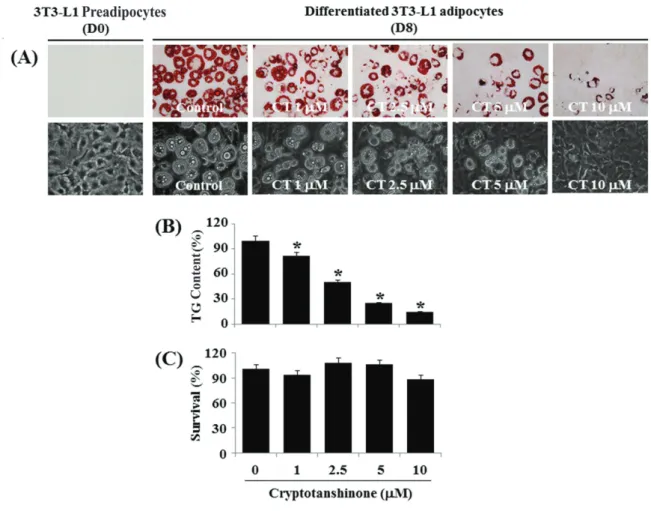
We next investigated the treatment effect of various concentrations of cryptotanshinone on lipid a c c u m u l a t i o n i n d i f f e r e n t i a t i n g 3T3-L1 preadipocytes by an Oil Red O staining. As shown in Fig. 2A (upper panels), many lipids were formed in control 3T3-L1 cells on D8 of differentiation, compared with undifferentiated cells on D0.

However, treatment of the preadipocytes with cryptotanshinone for 8 days blocked lipid a c c u m u l a t i o n i n d i f f e r e n t i a t i n g 3T3-L1 preadipocytes in a dose-dependent manner. The cryptotanshinone’s inhibitory effect on lipid a c c u m u l a t i o n i n d i f f e r e n t i a t i n g 3T3-L1 preadipocytes was also confirmed by light microscopic measurement (Fig. 2A, lower panels).

As shown in Fig. 2B, cryptotanshinone also dose- dependently reduced intracellular TG contents in differentiating 3T3-L1 preadipocytes on D8.

Apparently, 10 μM of cryptotanshinone maximally

inhibited lipid accumulation and reduced TG

contents in these cells. Results of cell count

analysis further revealed that cryptotanshinone at 1

to 10 μM tested did not affect the survival of 3T3-L1

cells on D8 (Fig. 2C). Due to the strong repressive

effects on lipid accumulation and TG contents with

n o c y t o t o x i c i t y, w e c h o s e t h i s 10 μ M o f

cryptotanshinone in further studies.

(5)

Cryptotanshinone at 10 μM decreases the expression and/or phosphorylation levels of C / E B P - α , P P A R - γ , a n d S T A T - 3 i n differentiating 3T3-L1 preadipocytes

We next examined the effect of cryptotanshinone at 10 μM on the protein expression and/or activity (phosphorylation) of adipogenic transcription factors (C/EBPs, PPARs, and STATs) by Western blotting analysis. Notably, cryptotanshinone

strongly reduced the expression levels of C/EBP-α in differentiating 3T3-L1 cells on D5 and D8.

However, cryptotanshinone did not alter the expression levels of C/EBP-β in differentiating 3T3- L1 cells on D2 and D5; rather this small molecule enhanced the expression levels of C/EBP-β in these cells. Cryptotanshinone also had no effects on the expression levels of PPAR-β in differentiating 3T3- L1 cells on the time periods tested. On the other hand, the expression levels of PPAR-γ were Fig. 1. Effects of 12 natural compounds on the triglyceride (TG) contents and survival of differentiating 3T3-L1 preadipocytes. (A) Experimental scheme for 3T3-L1 preadipocyte differentiation. (B) Quantification of the intracellular TG contents in vehicle control (none) (DMSO, 0.1%) or individual natural compounds (10 μM)-treated 3T3-L1 preadipocytes on day 8 (D8) of differentiation using AdipoRed assay. (C) 3T3-L1 preadipocytes were grown under the above-mentioned 3T3-L1 preadipocyte differentiation condition in Figure 1B. On D8, the viability of vehicle control (none) or individual natural compounds (10 μM)-treated 3T3-L1 preadipocytes was measured by cell proliferation assay. Data are mean

± SE of three independent experiments, each done in triplicate. *p<0.05 vs. control (no natural compounds).

(6)

substantially reduced in differentiating 3T3-L1 cells on D2, D5, and D8. In addition, although c r y p t o t a n s h i n o n e d i d n o t a f f e c t t h e phosphorylation levels of STAT-3 in differentiating 3T3-L1 cells on D2, it largely reduced the protein phosphorylation levels in differentiating 3T3-L1 cells on D5 and D8. Distinctly, while the

expression levels of total STAT-3 proteins remained constant in differentiating 3T3-L1 cells on D2 and D5, there was a large reduction of total STAT-3 expression on D8. Cryptotanshinone did not influence STAT-5 phosphorylation and total expression levels in differentiating 3T3-L1 cells on D2, D5 and D8.

Fig. 2. Effects of cryptotanshinone on lipid accumulation, triglyceride (TG) contents, and survival of differentiating 3T3-L1 preadipocytes. (A) Measurement of the cellular lipid (lipid droplets) accumulation in 3T3-L1 preadipocytes (undifferentiated, D0) or differentiated adipocytes on day 8 (D8) of differentiation in the absence (vehicle control; DMSO, 0.1%) or presence of cryptotanshinone (CT) at the indicated concentrations by Oil Red O staining. Phase-contrast images were also taken after the treatment (lower panels in A). (B) Quantification of the cellular TG contents in vehicle control or cryptotanshinone- treated 3T3-L1 preadipocytes on D8 by AdipoRed assay. (C) 3T3-L1 preadipocytes were grown under the above-mentioned 3T3-L1 preadipocyte differentiation condition in Figure 2A. On D8, the number of surviving cells in vehicle control or cryptotanshinone-treated 3T3-L1 preadipocytes was measured by trypan blue dye exclusion. Data are mean ± SE of three independent experiments, each done in triplicate.

*p<0.05 vs. control (no cryptotanshinone).

(7)

Cryptotanshinone at 10 μM also down- regulates the expression levels of FAS and p e r i l i p i n A i n d i f f e r e n t i a t i n g 3 T 3 - L 1 preadipocytes

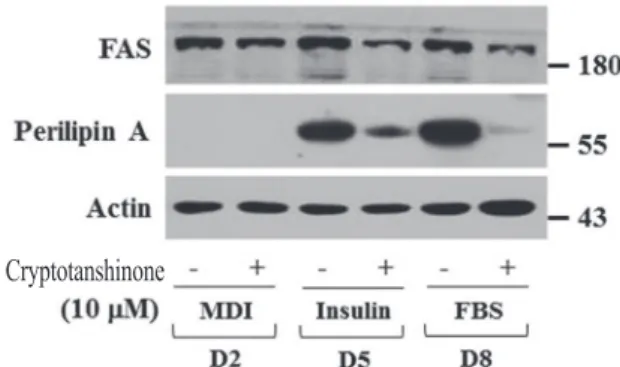
We n e x t i n v e s t i g a t e d t h e e f f e c t o f cryptotanshinone at 10 μM on the expression levels of FAS, a lipogenesis-related protein, and perilipin A, a LD-interacting protein during 3T3-L1 preadipocyte differentiation. As shown in Fig. 4,

cryptotanshinone reduced the expression levels of both FAS and perilipin A in differentiating 3T3-L1 preadipocytes on D2, D5, and D8.

Discussion

There is a wealth of information that excessive preadipocyte differentiation (adipogenesis) and the resultant high fat accumulation leads to the Fig. 3. Effect of cryptotanshinone on the expression and/or phosphorylation levels of C/EBP-α, C/EBP-β, PPAR-β, PPAR-γ, STAT-3, and STAT-5 in differentiating 3T3-L1 cells. 3T3-L1 preadipocytes were induced to differentiate with induction medium in the absence (vehicle control, 0.1%) or presence of cryptotanshinone (10 μM), and harvested at day (D) 2, 5, and 8, respectively. Cellular protein at the indicated time period was extracted and analyzed by Western blotting analysis using respective antibody of C/EBP-α, C/EBP-β, PPAR-β, PPAR-γ, STAT-3, and STAT-5. p-STAT-3: phosphorylated STAT-3, T-STAT-3: total STAT-3, p-STAT-5: phosphorylated STAT-5, T-STAT-5: total STAT-5.

Cryptotanshinone

(8)

development of obesity [2,3]. In this study, we report that cryptotanshinone strongly inhibits lipid accumulation and reduces TG contents in differentiating 3T3-L1 preadipocytes and the effects are mediated through control of the expression and phosphorylation levels of C/EBP-α, PPAR-γ, FAS, perilipin A, and STAT-3.

It is documented that adipocyte differentiation is controlled by the expression and activity of several adipogenic transcription factors, including C/EBP-α, C/EBP-β, PPAR-β, PPAR-γ, and STAT-3/5 [3-6, 13-15]. It has been previously reported that cryptotanshinone, one of tanshinones found in Salvia miltiorrhiza Bunge (Lamiaceae), reduces lipid accumulation in 3T3-L1 cells and the reduction is mediated through down-regulation of C/EBP-α, C/EBP-β, and PPAR-γ along with inhibition of STAT-3 phosphorylation in the early phase of 3T3- L1 preadipocyte differentiation [16]. We here also observed that cryptotanshinone strongly inhibits

lipid accumulation and reduces TG contents in differentiating 3T3-L1 preadipocytes, further supporting its lipid-lowering effect in culture.

However, in this study, we further found that cryptotanshinone reduces the expression levels of C/EBP-α, but not C/EBP-β, in differentiating 3T3-L1 preadipocytes. Furthermore, the present study showed that while cryptotanshinone does not inhibit STAT-3 phosphorylation in the early (D2) phase of 3T3-L1 preadipocyte differentiation, it markedly inhibits STAT-3 phosphorylation in the middle (D5) and late (D8) phase of the cell differentiation. Difference in cryptotanshinone regulation of C/EBP-α, C/EBP-β, PPAR-γ, and STAT- 3 between the present study and previous one may be due to use of different passage of 3T-3L1 cells, u s e o f d i f f e r e n t d u r a t i o n o f 3T3-L1 c e l l differentiation, and use of different cell lysis buffers to prepare whole cell lysates (proteins).

N e v e r t h e l e s s, t h e s e r e s u l t s s u g g e s t t h a t cryptotanshinone’s inhibitory effect on lipid accumulation in differentiating 3T3-L1 cells is closely attributable to down-regulation of the expression and phosphorylation levels of C/EBP-α, PPAR-γ, and STAT-3.

We and others have demonstrated that the expressions of FAS and perilipin A proteins are also increased in 3T3-L1 preadipocyte differentiation [17-20]. At present, little is known about cryptotanshinone regulation of FAS and perilipin A in 3T3-L1 cells. Notably, we found that crypto- tanshinone reduces the expression levels of both FAS and perilipin A in differentiating 3T3-L1 cells.

Given that FAS is a lipogenic enzyme responsible for the synthesis of fatty acid [21], and perilipin A interacts with and stabilizes the newly formed LDs during 3T3-L1 preadipocyte differentiation [9,22], it is likely that down-regulation of FAS and perilipin A may further contribute to the cryptotanshinone’s anti-lipogenic (lipid-lowering) effects.

Fig. 4. Effects of cryptotanshinone on the expression of FAS and perilipin A in differentiating 3T3-L1 preadipocytes. 3T3-L1 preadipocytes were induced to differentiate with induction medium in the absence (vehicle control, 0.1%) or presence of cryptotanshinone (10 μM), and harvested at day (D) 2, 5, and 8, respectively. Cellular protein at the indicated time period was extracted and analyzed by Western blotting analysis using respective antibody of FAS and perilipin A.

Cryptotanshinone

(9)

Although it is obvious that cryptotanshinone has abilities to inhibit lipid accumulation and reduce TG contents in 3T3-L1 cells, it should be noted that 3T3-L1 cells used herein are cultured cell-lines and that the effective doses of cryptotanshinone may be different in in vivo white (pre)adipocyte cells and tissues. Therefore, future studies are warranted to evaluate the anti-adipogenesis (anti-obesity) effects of cryptotanshinone on obese animal models.

In summary, our study shows that cryptotanshinone has strong anti-adipogenic and anti-lipogenic effects in differentiating 3T3-L1 preadipocytes and the effects are linked to the reduced expression and phosphorylation levels of C/EBP-α, PPAR-γ, FAS, perilipin A, and STAT-3. These findings advocate that this natural phytochemical cryptotanshinone may have preventive and/or therapeutic potential against obesity.

Acknowledgements

We deeply thank Mr. Anil Kumar for technical help.

References

1. Kopelman PG. Obesity as a medical problem. Nature 2000;404:635-43.

2. Karageorgi S, Alsmadi O, Behbehani K. A review of adult obesity prevalence, trends, risk factors, and epidemiologic methods in Kuwait. J Obes 2013;2013:378650.

3. Ali AT, Hochfeld WE, Myburgh R, Pepper MS.

Adipocyte and adipogenesis. Eur J Cell Biol 2013;92:229-36.

4. Rosen ED, MacDougald OA. Adipocyte differentiation from the inside out. Nat Rev Mol Cell Biol 2006;7:885-96.

5. Cao Z, Umek RM, McKnight SL. Regulated expression of three C/EBP isoforms during adipose conversion of 3T3-L1 cells. Genes Dev 1991;5:1538- 52.

6. Farmer SR. Transcriptional control of adipocyte formation. Cell Metab 2006;4:263-73.

7. Lefterova MI, Lazar MA. New developments in adipogenesis. Trends Endocrinol Metab 2009;20:107- 14.

8. Lehrke M, Lazar MA. The many faces of PPARgamma. Cell 2005;123:993-9.

9. Beller M, Bulankina AV, Hsiao HH, Urlaub H, Jäckle H, Kühnlein RP. Perilipin-dependent control of lipid droplet structure and fat storage in Drosophila. Cell Metab 2010;12:521-32.

10. Kern PA, Gregorio GD, Lu T, Rassouli N, Ranganathan G. Perilipin expression in human adipose tissue is elevated with obesity. J Clin Endocrinol Metab 2004;89:1352-8.

11. Zhang K, Guo W, Yang Y, Wu J. JAK2/STAT3 pathway is involved in the early stage of adipogenesis through regulating C/EBPbeta transcription. J Cell Biochem 2011;112:488-97.

12. Yun JW. Possible anti-obesity therapeutics from nature:a review. Phytochemistry 2010;71:1625-41.

13. Stephens JM, Morrison RF, Pilch PF. The expression and regulation of STATs during 3T3-L1 adipocyte differentiation. J Biol Chem 1996;271:10441-4.

14. Tang QQ, Otto TC, Lane MD. CCAAT/enhancer- binding protein beta is required for mitotic clonal expansion during adipogenesis. Proc Natl Acad Sci U S A 2003;100:850-5.

15. Berger J, Moller DE. The mechanisms of action of PPARs. Annu Rev Med 2002;53:409-35.

16. R a h m a n N , J e o n M , S o n g H Y, K i m Y S . Cryptotanshinone, a compound of salvia miltiorrhiza inhibits pre-adipocytes differentiation by regulation of adipogenesis-related genes expression via STAT3 signaling. Phytomedicine 2016;15:58-67.

17. Park YK, Obiang-Obounou BW, Lee J, Lee TY, Bae

(10)

MA, Hwang KS, et al. Anti-adipogenic effects on 3T3-L1 cells and Zebrafish by tanshinone IIA. Int J Mol Sci 2017;18(10):pii:E2065.

18. Jang BC. Artesunate inhibits adipogeneis in 3T3-L1 preadipocytes by reducing the expression and/or phosphorylation levels of C/EBP-alpha, PPAR- gamma, FAS, perilipin A, and STAT-3. Biochem Biophys Res Commun 2016;474:220-5.

19. Park M, Sharma A, Lee HJ. Anti-adipogenic effects of delphinidin-3-O-β-glucoside in 3T3-L1 preadipocytes and primary white adipocytes.

Molecules 2019;24:1848.

20. Natori Y, Nasui M, Kihara-Negishi F. Neu1 sialidase interacts with perilipin 1 on lipid droplets and inhibits lipolysis in 3T3-L1 adipocytes. Genes Cells 2017;22:485-92.

21. Lakshmanan MR, Nepokroeff CM, Porter JW.

Control of the synthesis of fatty-acid synthetase in rat liver by insulin, glucagon, and adenosine 3′:5′ cyclic monophosphate. Proc Natl Acad Sci USA 1972;69:3516-9.

22. Wolins NE, Brasaemle DL, Bickel PE. A proposed

model of fat packaging by exchangeable lipid droplet

proteins. FEBS Lett 2006;580:5484-91.

수치

Fig. 2. Effects of cryptotanshinone on lipid accumulation, triglyceride (TG) contents, and survival of  differentiating 3T3-L1 preadipocytes
Fig. 4.  Effects of cryptotanshinone on the  expression of FAS and perilipin A in  differentiating 3T3-L1 preadipocytes

참조

관련 문서

In differentiated 3T3-L1 cells, mRNA expression levels of lipid metabolism-regulating factors, such as amplifying mouse fatty acid-binding protein 2, leptin, lipoprotein

Effect of Sargassum micracanthum extract on lipid accumulation and reactive oxygen species (ROS) production during differentiation of 3T3-L1

Keywords: Allium senescens L., 3T3-L1 cell, adipocyte differentiation, reactive oxygen species, lipid

따라서 EEMF가 3T3-L1 preadipocytes 의 adipogenesis 과정에서 나타나는 lipid droplet 생성에 어떠 한 영향을 미치는 지를 확인하기 위하여 분화유도 시 EEMF를 적정농도로 처리한 다음

ethanol) and there was no cytotoxicity. Oil red O staining was employed to identify the effect of PA on lipid accumulation in 3T3-L1. In the present study, PA water extraction

Effect of defatted grape seed extracts (DGSE) on lipid accumulation (% control) in differentiated 3T3-L1 adipocytes.. Assays were performed in triplicates for each

Pycnogenol® inhibits lipid accumulation in 3T3-L1 adipocytes with the modulation of reactive oxygen species (ROS) production as- sociated with antioxidant enzyme

Hot air-dried ramie leaf (HR) or freeze-dried ramie leaf (FR) extracts decreased triglyceride accumulation in 3T3-L1 cells (A) and pig preadipocytes (B).. Reported