Design of PKMS for Business Innovation based on Knowledge Management in Public Organization
1)지 승 현*
요 약
Based on a comprehensive framework that reflects lifecycle requirements of KMs and BPMs, we propose an PKMS(Process based KMS) for integrating KMs and BPMs in order to combine the advantages of the two paradigms. This paper first defines the priority order of knowledge according to knowledge type and classifies it into three groups which consist of Basic KM, Practical KM and Reference KM. Then, it suggests PKMS knowledge map composed of much core-knowledge each of which has information about a unit of the related business process. Using the PKMS Knowledge map, we can directly provide related core-knowledge related for the business process while a person is working a unit of business process. This paper designed the PKMS applied to employment insurance business part. Long term goal of the concepts is to concern a change management organization of knowledge on PKMS.
▸Keyword : KM(Knowledge Management), BPM(Business Process), PKMS, PKMS knowledge, Knowledge lifecycle
∙제1저자 : 지승현
*
1. 서론
Human problem solving in many fields is based on business processes and knowledge. Specially, in order to execute a process in public organizations, it is very important to tackle the management of business process and knowledge, particularly those aspects related to organizational mobility, the movement or circulation of a staff from one unit to another within an organization. Organizational mobility is increasingly commonplace in public organizations. There has been various efforts to support and enhance a staffs' performance by automatically providing them with the knowledge required at the time they are actually performing the process. Recently, interest in the notion of process based on knowledge management have been significantly increased. Since knowledge management(KM) and business process management (BPM) were proposed independently, separate lifecycles were proposed and adopted.
Based on a comprehensive framework that reflects lifecycle requirements of both KM and BPM, this paper proposes an architecture for integrating knowledge management systems(KMSs) and business process management systems(BPMs) to combine the advantage of the two paradigms. This paper focuses on step-by-step knowledge provision considering priority order of knowledge for each process. In order to do so, this research classifies knowledge into three groups, basic knowledge, practical knowledge, and reference knowledge, and suggests PKMS knowledge composed of much essential knowledge selected in all of knowledge groups per a process. This paper also proposes different knowledge change management per knowledge group since each knowledge lifecycle keeps a different flow for knowledge management according to knowledge group. We provide an idea to integrate and manage throughout lifecycles of business process and knowledge to fully deliver the combined advantages.
This paper constructed the PKMS applied to employment insurance business in public organization and demonstrates the advantages of the PKMS concept. Section 2 presents step-by-step knowledge provision considering priority order of knowledge per a process. Section 3 introduces PKMS cycle, which integrates KM lifecycle and BPN lifecycle. In Section 4, an integrated PKMS system architecture supporting the framework is proposed and introduces PKMS system in real circumstance.
Section 5 concludes the paper.
II. knowledge-access strategies in public organization
2.1. mutual dependence between process and knowledge
Generally, a staff would like to offer step-by-step appropriate knowledge that facilitates their work according to their need instead of getting whole knowledge related to the process. In this section, To evaluate mutual dependence between process and knowledge according to knowledge type, we investigate it to business staffs in public organizations(the number of staff: 100, the number of public organization: 16). Evaluation parameters are defined as follows: continuous knowledge usability, process dependency, specificity of knowledge creater, knowledge refinement, knowledge management on time, direct usability, endeavor of knowledge creation.
Considering mutual dependence between business process and knowledge, we choose the vital evaluation parameters as process dependency and knowledge management on time.
Then, we re-classify knowledge into three groups according to the main evaluation parameters. As Fig.
1, knowledge, which is mainly used in public organization, is classified as basic knowledge,
Basic KMS law
law Administration rule Administration rule
Practical KMS Business standard
Business standard Business form Business form Debate reply
Debate reply
Know-How Know-How Q&A
Q&A
By-product By-product case case
Reference KMS statistics
statistics Education report Education report ISP ISP trends trends Benchmark report
Benchmark report Business classification
Process unit Process unit
Activity unit Activity unit
Application unit Application unit
Process without regular workflow
Essential knowledge Essential knowledge
Information Retrieval
agent Information
Retrieval agent
② indirect- connection
① direct-connection
Process with regular workflow
news news Business manual Business manual PKMS KMS
Automatic Selection by evaluation
parameters
Knowledge classification
[Fig.2] step-by-step knowledge-access strategy
Basic Knowledge Basic Knowledge
Reference Knowledge Reference Knowledge Practical Knowledge Practical Knowledge
C3
News
C5 C2 C1
C7 C4
C6
Evaluation parameter
Applied Knowledge Practice Knowledge Expert Knowledge By-Product Knowledge
Current Knowledge
etc Knowledge type Basic Knowledge
C3
News
C5 C2 C1
C7 C4
C6
Evaluation parameter
Applied Knowledge Practice Knowledge Expert Knowledge By-Product Knowledge
Current Knowledge
etc Knowledge type Basic Knowledge
mutual dependence between process and knowledge
low
high middle
Knowledge grouping
C1: continuous knowledge usability C2: process dependency, C3: specificity of knowledge creater C4: knowledge refinement, C5: Knowledge Management on time C6: direct usability
C7: endeavor of knowledge creation
[Fig.1] mutual dependence between process and knowledge
practical knowledge, and reference knowledge and themutual dependence among the groups is as follows;
basic knowledge>practical knowledge>reference knowledge. We demonstrate that there is an priority order of knowledge in public organization, specially, basic knowledge and process has the highest mutual dependence, on the other hand, reference knowledge and process has the lowest mutual dependence.
Basic knowledge defines explicit knowledge, which is based on business process standard in public
organization. It includes law, business manual and so on. Basic knowledge, the highest refined knowledge, is not required to extra-refinement, but it should be changed at right time in order to correctly support public services. Practical knowledge defines tacit knowledge, which is created by business staffs while they are performing the process. It includes Know-how, by-product, experience and so on.
Reference knowledge doesn't affect the execution of a process, as compared with basic knowledge and
practical knowledge. But, reference knowledge is very useful to upgrade a quality of a process result. It includes news, trends, statistics and so on.
2.2 step-by-step knowledge-access strategy Fig 2 shows step-by-step knowledge-access strategy considering mutual dependance of knowledge and process shown in Fig. 1. The object of this strategy is to offer appropriate knowledge step-by-step per a process, first step is direct-connection and second step is indirect-connection.
Direct-connection means a provision of essential knowledge per a process for effective execution without information retrieval. On the other hand, Indirect-connection means knowledge retrieval related to the process from all of knowledge repositories with information retrieval agent. In order to realize the step-by-step knowledge-access strategy, we suggest PKMS knowledge composed of much essential knowledge selected in all of knowledge groups per a process and organize the PKMS KMS, which keeps its own lifecycle. At that time the knowledge elements in PKMS KMS are organized as essential knowledge selected from basic and practical KMSs, which has high mutual depencence between process and knowledge. At that time, the evaluation parameters to select knowledge are ratio of mutual dependence, reference number, research number and so on.
As mentioned above, the step-by-step knowledge-access strategy provides a staff to automatically and gradually get appropriate knowledge for a process.
III. integration of KM lifecycle & BPM lifecycle
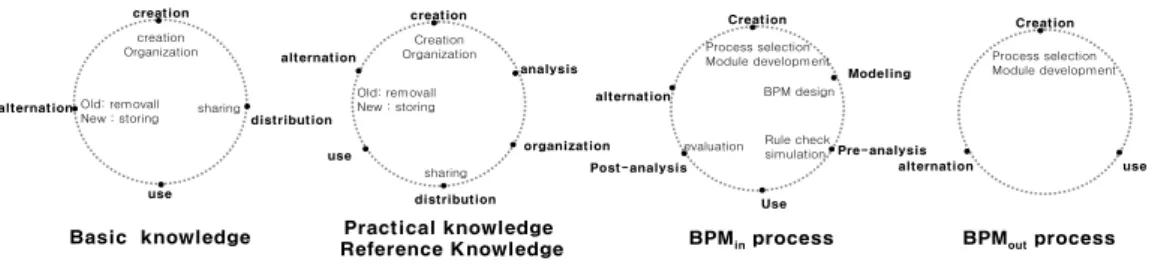
This section discusses the BPM lifecycle and the KM lifecycle in which processes and knowledge are created and managed, respectively. Paying attention to the lifecycle helps to find requirements of process management and knowledge management.
3.1 KM lifecycle & BPM lifecycle
This paper classifies knowledge as three groups, each of which has its own lifecycle. In this research, KM lifecycle consists of two types; one type is for basic knowledge and the other is for practical knowledge and reference knowledge. In case of basic knowledge, KM lifecycle consists of four phases: creation, distribution, use, alternation. Basic knowledge, which is created from law and business manual, is stored as coded knowledge according to knowledge organizing mechanism in public organization. When staffs require knowledge, they can find and use proper knowledge by accessing basic KMS. In case of practical knowledge and reference knowledge, KM lifecycle consists of six phases: creation, evaluation, organization, distribution, use, alternation. the knowledge, which is created from staffs' practical experience and know-how, is organized, distributed, and is stored as coded knowledge according to knowledge organizing mechanism in public organization. When staffs require the knowledge, they can find and use proper knowledge by accessing practical and reference KMSs.
Business processes have various features. Since some process are performed by a regular workflow and inputs of an activity, an atomic process, should be delivered to outputs of next activity. Other processes should be performed independently. The paper classifies business processes into two groups:
BPMin and BPMout. BPMin means a process that follows an regular workflow by activities or processes and each phase of the workflow can be related to another staffs. On the other hand, BPMout means process that performs independently and mainly consist of a few activities. Due to the feature, BPMin and BPMout has different phases for it's own business process management. The BPMin lifecycle consists of six phases: creation, Modeling, pre-analysis, use, post-analysis, alteration. The BPMout lifecycle consists of three phases: creation, distribution, use, alteration.
[ BPM lifecycle ] Basic knowledge
creation
distribution
use alternation
creation Organization
sharing
[ KM lifecycle ]
Old: removall New : storing
Practical knowledge Reference Knowledge
creation
distribution use
alternation
Creation Organization
sharing Old: removall New : storing
organization analysis
BPM in process
Creation
Use Post-analysis
alternation
Pre-analysis Modeling
Rule check simulation BPM design Process selection Module development
evaluation
BPM out process
Creation
alternation use
Process selection Module development
[Fig.3] KM lifecycle and BPM lifecycle
3.2 PKMS lifecycle
Fig.4 depicts the interrelationships between KM and BPM requirements. The figure shows how the requirements in terms of the BPM lifecycle are related to the KM cycle. We named the interrelationship as PKMS cycle. In the figure, cycle means a BPM lifecycle and rectangle means KM lifecycle. PKMS cycle is defined as follows: After a process is created as BPMin process during 'creation' phase, 'modeling' and 'pre-analysis' phases of the process requires modeling and pre-analysis of the process and simultaneously requires 'collection' and 'distribution' phases of knowledge related to the process in order to share the knowledge to other staffs. Then the process is passed in 'use' phase and 'post-analysis' phase. The basic knowledge is continuously shared and used during the same time.
If the process is required to alternate, 'alternation' phase of the process is overlapped as 'alternation' phase of the basic knowledge. Besides, practical knowledge is created and used from 'creation' phase to 'use' phase and changed during 'alternation' phase of the process.
Basic knowledge
Creation
Use Post- analysis alternation
Pre- analysis Modeling
creation
distribution alternation
use Creation evaluation organization distribution
use alternation Practical Knowledge Reference Knowledge
[Fig. 4] PKMS lifecycle
Ⅳ. Integrated PKMS system Architecture
Fig. 5 shows PKMS system architecture. It shows components for process-oriented knowledge management from the BPM lifecycle perspective. The PKMS system consists of business process repositories(BPMin and BPMout), four knowledge management systems(basic knowledge, applied knowledge, reference knowledge, PKMS knowledge), BPM-PKMS knowledge map, business analysis repository(common statestics, BPM real-time statistics). BPM-PKMS knowledge map contains an link information between PKMS knowledge and a process, for examples, information is included in process type, process id, and PKMS knowledge per process unit. This section discusses components for the BPM lifecycle perspective.
4.1 BPM lifecycle
○ process creation and modeling phase: After a process creation, the process sholud be modeled and the information should be stored in business process repositories. The components in this phase is process module development, BPM modeler, and knowledge creater/collector.
○ process pre-analysis phase : Components related to pre-analysis are Rule checker and simulator.
During the phases, BPM application for each process
Knowledge Management System (KMS) Business process repository Business
classification (MAP)
0 0
0 0
0 0
0 0 0
Knowledge classification
( MAP)
0 0
0 0
0 0
0 0 0
PKMS 업무-지식 맵
업무화면 (PKMS 지식 Web screen
S e rvi c e M o d u le
지식 통합 검색
Basic
KMS Reference
KMS Practical
KMS
BPM performer BPM engine Alarm/monitoring BPM validator
Module development
Knowledge creation
& collection BPM modeler
Creation/modeling use
BPM-PKMS Knowledge Connection
PKMS KMS PKMS knowledge
collection simulator Business rule
analyzer Pre-analysis
Business result analyzer Post-analysis
Business Analysis
storage Web browser
Knowledge retrieval agent BPM
Real-time statistics BPM in
BPM out
Knowledge searching result
OLAP
total Statistics
(DW)
[Fig. 5] PKMS system architecture
is finished. Basic knowledge and reference knowledgeare collected and stored in each KMS. Then essential knowledge is selected by knowledge expert and is stored in PKMS KMS.
○ process use phase : When a staff starts to execute a process, process performer brings information from the BPM-PKMS knowledge connection. The process performer is set up special conditions for process instance such as staffs, resources, due date, and other information required by staff. BPM execution engine supports process monitoring and alarm function for due day announcement. During this phase, practical and reference knowledge is continuously created and shared to oher users, that performs process related to the process.
○ process post-analysis phase : process-output analyzer analyzes staffs' execution information, which has execution time and the number of instance per a person and status monitoring and evaluates the result. BPM real-time statistics are stored in Fig. 6.
○ process alternation phase : If the process is required to alternate due to changes of process activities, the related knowledge should be changed.
Components of BPM lifecycle mentioned above focus on BPMin process. The Components of BPMout process are excluded in this section because it's lifecycle is simple and general. In this paper, BPM lifecycle includes BPMin and BPMout.
V. Conclusion
This paper proposed an PKMS(Process based KMS) system architecture for integrating KMs and BPMs in order to combine the advantages of the two paradigms. This paper first suggests an importance of the priority order of knowledge considering mutual dependence between process and knowledge and classifies it into three groups which consist of Basic knowledge, Practical knowledge and Reference knowledge. Then, it suggests PKMS knowledge composed of much essential knowledge per aeach process. Using the PKMS Knowledge, we can directly provide the essential knowledge related for the process without information retrieval while a person is working a unit of business process. This paper designed PKMS to integrate and manage throughout
lifecycles of business process and knowledge to fully deliver the combined advantages.
A study on the detailed functionalities related to knowledge management is underway. Business authirity related to BPM application, several process mining techniques are being explored as candidate techniques. The proposed PKMS approach should also be applied against various areas in public organizations.
참고문헌
[1] Ministry Of Labor in korea(2006), PKMS system construction result report
[2] KEIS(2007), employment-policy PKMS system architecture result reoprt
[3] Haeyoung Song(2006), Knowledge Management Research based on BPM, a doctoral dissertation, soongsil university in south korea.
[4] Budzik, J. and K. J. Hammand(2000), User Interactions with Everyday Applications as Context for Just-in-time information Access.
Proceedings intelligent User Interfaces 2000.
ACM.
[5] Schnurr, H-P., Y. Sure, R. Studer, and H.
Akkermans(2000), On-To- Knowledge Methodology -Baseline Version. onToKnowledge-Deliverable Project D15. URL:www.ontoknowledge.org
[6] Jisoo Jung, Injun Choi(2007). “An Integration architecture for knowledge management systems and business process management systems”, Computers in industry, pp21-34.
[7] A. Abecker, A. Bernardi, J. Maus, M. Sintek, C.
Wenzel(2000), Information supply for business process: coupling workflow with document analysis and information retrieval, Knowledge Based systems 13 271-284.
[8] A. Berztiss and SYSLAB(2000), Knowledhe and work flow systems, in: Proceedings of the 11th international workshop on Database and Expert systems Applications, pp. 1102-1106.
[9] Steffen Staab, Rudi Studer and etc(2001),
Knowledge process and ontology, IEEE Intelligence systems, pp.26-34.
[10] WfMC(2001), Workflow Management definition interface: xml process definition language(XPDL), WfMC standards, WFMC-TC-1025, The Workflow Management Coalition