http://dx.doi.org/10.4491/KSEE.2015.37.8.472 ISSN 1225-5025, e-ISSN 2383-7810
낙동강 수계에서의 자외선 차단제류 검출 특성: 본류, 지류 및 하수처리장 방류수 Occurrence of UV Filters in Nakdong River Basin :
Mainstreams, Tributaries and STP Effluents
서창동․손희종†․최진택․유평종․장성호*
Chang-Dong Seo․Hee-Jong Son†․Jin-Taek Choi․Pyung-Jong Yoo․Seong-Ho Jang*
부산광역시 상수도사업본부 수질연구소․*부산대학교 바이오환경에너지학과
Water Quality Institute, Water Authority․*Department of Bioenvironmental Energy, Pusan National University
(Received July 15, 2015; Revised August 28, 2015; Accepted August 30, 2015)Abstract : This study was investigated occurrence and distribution patterns of UV filters in Nakdong River basin (mainstream, tri- butaries and sewage treatment plant (STP) effluents). 5 (EHS, BP-3, 4-MBC, BZC and EHMC) out of 7 UV filters were detected in 5 out of 20 sampling sites (mainstream and tributaries), 7 UV filters were not detected in mainstream samples, and the EHS, BP-3, 4-MBC, BZC and EHMC concentration levels in tributary samples were ND~60.8 ng/L, ND~72.1 ng/L, ND~57.2 ng/L, ND~60.1 ng/L and ND~85.2 ng/L, respectively. 5 (EHS, BP-3, 4-MBC, BZC and EHMC) out of 7 UV filters were detected in effluents of 11 STPs around the Nakdong River basin. The EHS, BP-3, 4-MBC, BZC and EHMC concentration levels in 11 STP effluents were ND~89.3 ng/L, ND~90.8 ng/L, ND~88.1 ng/L, ND~118.5 ng/L and ND~104.4 ng/L, respectively. According to the sampling season, distribution patterns and detected concentrations of 5 UV filters were similar in June and September 2014, but change ranges of distribution patterns and detected concentrations of 5 UV filters were highly variable in April and November 2014.
Key Words : UV Filters, Personal Care Products, Nakdong River Basin, STP Effluent, GC-MS/MS
요약 : 낙동강 수계에서의 자외선 차단제류 검출현황을 조사한 결과, 본류 및 지류 20지점 중 5지점에서 EHS, BP-3, 4-MBC, BZC 및 EHMC 5종이 검출되었으며, 본류에서는 검출되지 않았다. 지류의 경우는 금호강 상류, 신천, 금호강 하류, 진천천 및 양산천에서 EHS가 ND~60.8 ng/L, BP-3가 ND~72.1 ng/L, 4-MBC가 ND~57.2 ng/L, BZC가 ND~60.1 ng/L 및 EHMC가 ND~
85.2 ng/L의 농도로 검출되었다. 낙동강 주변에 위치한 11개 하수처리장 방류수들에서는 EHS, BP-3, 4-MBC, BZC 및 EHMC 5종이 각각 ND~89.3 ng/L, ND~90.8 ng/L, ND~88.1 ng/L, ND~118.5 ng/L 및 ND~104.4 ng/L의 농도로 검출되었다. 낙동강 수 계 및 낙동강 주변에 위치한 11개 하수처리장 방류수들에서의 계절별 자외선 차단제류의 분포비율은, 6월과 9월에는 대체적 으로 유사한 분포 특성을 나타내었으나, 4월과 11월에는 검출농도 뿐만 아니라 구성종 비율의 변화폭도 매우 크게 나타났다.
주제어 : 자외선 차단제, 개인위생용품, 낙동강 수계, 하수처리장 방류수, GC-MS/MS
1. 서 론
최근 사용한 후 폐기되는 과정에서 유출되거나 생활하는 가운데 유출되는 다양한 생활기인 오염물질들에 대한 관심 이 증가하고 있다. 이들 생활기인 오염물질들은 대부분이 개 인위생 용품 등으로 이들은 환경 중에서의 높은 잔류성과 생 물 농축성으로 인해 새로운 유해물질로 부각되고 있다. 전 세계적으로 수환경 중에서의 잔류 의약품들 및 개인위생 용 품들(pharmaceuticals and personal care products, PPCPs)의 검출 및 분포에 대한 조사가 활발히 진행 중이다.
최근에는 자외선 조사량 증가에 따른 화상, 피부노화 및 피부암 등으로부터 피부를 보호하기 위한 자외선 차단제품 의 사용량이 급증하는 추세에 있다.1) 자외선 차단을 위해 사용되는 자외선 차단물질은 유기계와 무기계로 나뉘며,2)
para-amino benzoate계, cinnamate계, benzophenone계, diben-
zoylmethane계, camphor derivative계 및 benzimidazole계 등 의 유기계와 titanium dioxide (TiO2)와 zinc oxide (ZnO)의 무기계가 있으며, 무기계에 비해 유기계의 사용량이 월등히많은 것으로 알려져 있다.3~5)
유기계 자외선 차단제는 자외선 방지크림뿐만 아니라 일 반적으로 미용 목적으로 사용되는 스킨, 크림 및 로션과 같 은 각종 화장품류, 헤어 스프레이 및 샴푸 와 같은 다양한 생활용품 등에 함유되어 있으며, 그 사용량은 해마다 증가 하고 있는 추세이다. 각종 생활용품 등에 첨가되는 자외선 차 단제의 함유량은 0.1%~10% 정도인 것으로 보고되고 있다.6) 최근에는 자외선 조사량의 증가에 따라 자외선 차단지수 (sun protect factors, SPFs)가 높은 제품의 제조 및 판매량 이 급증하고 있으며, 또한, 섬유, 플라스틱, 페인트 및 자동 차 광택제 등에도 제품의 보호를 위해 첨가된다.7) 자외선 차단제들의 수환경 중으로 유입경로는 계곡 및 강에서 물 놀이나 수영을 통해 직접 유입되거나 샤워 및 세탁 후 가정 하수로 배출된 자외선 차단제들이 하수처리장에서 완전히 제거되지 않고 강이나 호수 등으로 유출되는 간접적인 유 입경로가 있다.8~10) 하수처리 공정에서의 자외선 차단제류 의 제거 특성을 평가한 연구결과에서 2-phenylbenzimidazole- 5-sulfonic acid (PBSA)는 21% 정도의 제거율을 나타내었
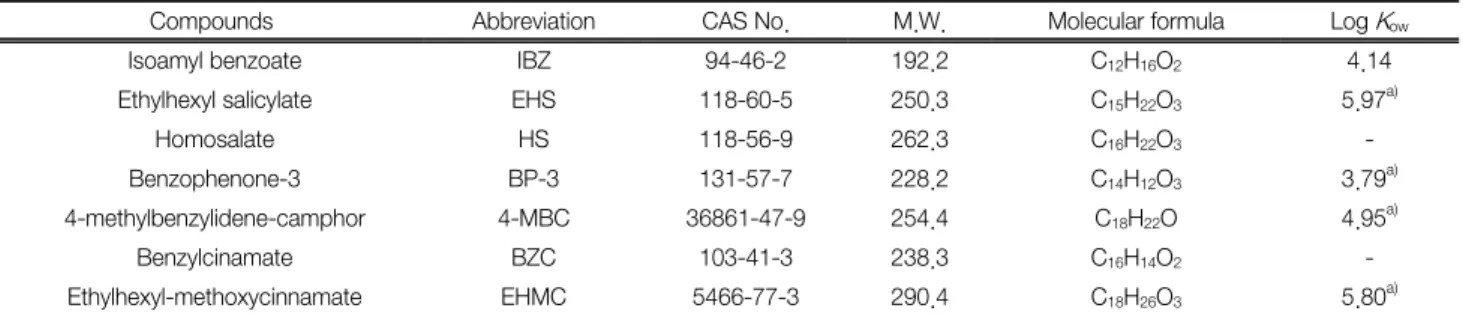
Table 1. Physico-chemical properties of 7 UV filters
Compounds Abbreviation CAS No. M.W. Molecular formula LogKow
Isoamyl benzoate IBZ 94-46-2 192.2 C12H16O2 4.14
Ethylhexyl salicylate EHS 118-60-5 250.3 C15H22O3 5.97a)
Homosalate HS 118-56-9 262.3 C16H22O3 -
Benzophenone-3 BP-3 131-57-7 228.2 C14H12O3 3.79a)
4-methylbenzylidene-camphor 4-MBC 36861-47-9 254.4 C18H22O 4.95a)
Benzylcinamate BZC 103-41-3 238.3 C16H14O2 -
Ethylhexyl-methoxycinnamate EHMC 5466-77-3 290.4 C18H26O3 5.80a)
a)Experimental values from database of physico-chemical properties. Syracuse Research Corporation: http://www.syrres.com/esc/physdemo.htm.
S1: Banbyeon-cheon (Yongjeonggyo) S2: Andong (Younghodaegyo) S3: Naseong-cheon (Gyeongjingyo) S4: Sangju (Sangpunggyo) S5: Nakdong (Nakdangyo) S6: Gam-cheon (Seonjugyo) S7: Gumi (Gumigyo) S8: Woegwan (Woegwangyo) S9: Geumho-up (Mutaegyo) S10: Shin-cheon (Chimsangyo) S11: Guemho-down (Gangchanggyo) S12: Jincheon-cheon (Gura2gyo) S13: Goryeong (Goryunggyo) S14: Daeam (Ugokgyo) S15: Jeokpo (Jeokpogyo) S16: Namgang (Songdogyo) S17: Namji (Namjigyo)
S18: Samrangjin (Samrangjingyo) S19: Mulgeum (Withdrawl point) S20: Yangsan-cheon (Hopodaegyo)
Fig. 1. Description of the sampling sites in Nakdong river basin.
으며, 2-hydroxy-4-methoxybenzophenone (benzophenone-3, BP-3)와 5-benzoyl-4-hydroxy-2-methoxy-benzenesulfonic acid (benzophenone-4, BP-4)의 경우는 60% 정도의 제거율을 나 타낸 것으로 보고되었다.11) 지표수에서의 최대 검출농도는 하절기에 2,700 ng/L에 육박하였으며8,12) 일부 유기계 자외 선 차단제류는 친유성(lipophilic)으로 인해 높은 생물 농축 성을 나타내며, 어류를 비롯한 다양한 수생 생물들에서 고 농도로 검출된다.12~15) 또한, 이들의 생체 내에서 발정 및 항 발정 호르몬 작용(estrogenic and antiestrogenic activity)을 유발하는 것으로 알려져 있다.16,17) 유기계 자외선 차단제인 BP-3와 BP-4는 어류의 성호르몬을 교란하여 생식에 악영향 을 끼치며, 간과 콩팥에 장기독성(chronic toxicity)을 일으키 기도 한다.15,18~20)
본 연구에서는 최근 수중에 함유된 미량 오염물질들의 전 처리에 간편하면서도 효율적인 교반막대 추출법(stir bar sorp- tive extraction, SBSE)을 이용21,22)하여 낙동강 수계의 본류, 주요지천 및 하수처리장의 방류수에 함유된 유기계 자외선 차단제 7종에 대한 수환경에서의 잔류량 평가 및 물질별 검 출 특성을 분석함으로써 향후 생활기인 오염물질의 관리 방 안 마련을 위한 기초자료를 제공하고자 하였다.
2. 실험재료 및 방법
2.1. 표준물질
유기계 자외선 차단제 7종은 isoamyl benzoate (IBZ), ethyl- hexyl salicylate (EHS), homosalate (HS), benzophenone-3 (BP-3), 4-methylbenzylidene-camphor (4-MBC), benzylcinna- mate (BZC), ethylhexyl-methoxycinnamate (EHMC)이며, Sigma- aldrich사(USA), TCI사(Japan) 및 Accustandard사(USA)의 제 품을 사용하였고, 내부표준물질로 사용된 BP-d10은 Sigma- aldrich사(USA)의 제품을 사용하였다. 본 실험에 사용된 자외 선 차단제 7종의 물리․화학적 특성을 Table 1에 나타내었다.
2.2. 낙동강 및 하수처리장 방류수 채수
시료는 2014년 4월, 6월, 9월 및 11월에 걸쳐 4회 채수하 였으며, 1 L 갈색 유리병에 채수한 후 시료의 변질을 막기 위해 0.5% 메탄올 (v/v)을 첨가하여 분석 전까지 4℃로 냉 장 보관하였다.
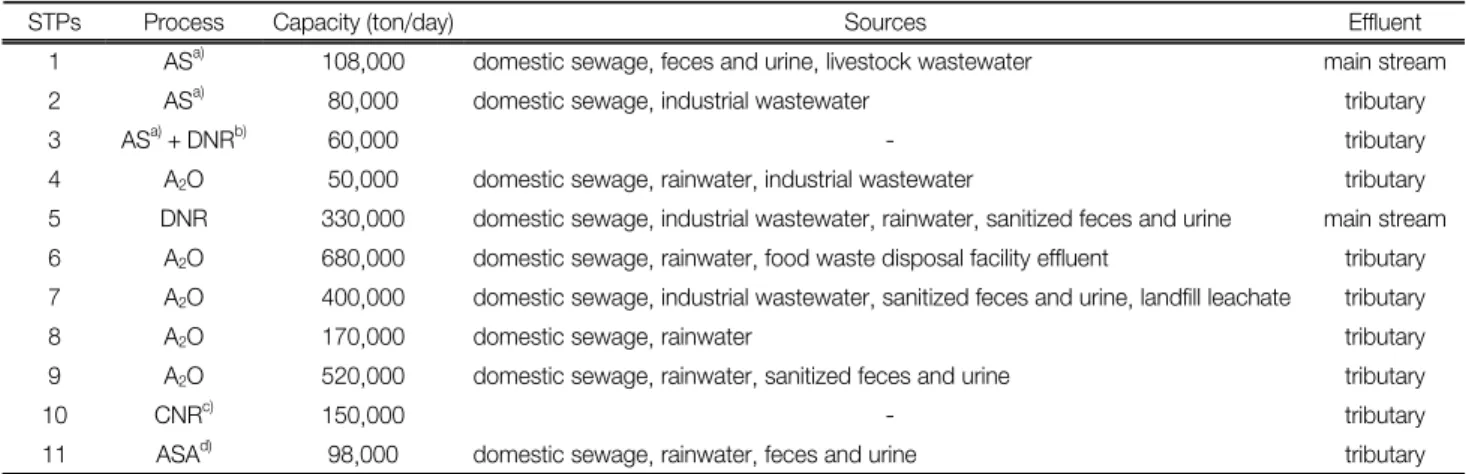
시료채수 지점은 낙동강 본류 11지점, 지류 9지점 및 낙동 강(본류 및 지류)으로 방류되는 하수처리장(처리용량 50,000 톤/일 이상) 방류수 11지점을 선택하여 채수하였다. 낙동강
Table 2. Description of the 11 surveyed sewage treatment plants (www.konetic.or.kr)
STPs Process Capacity (ton/day) Sources Effluent
1 ASa) 108,000 domestic sewage, feces and urine, livestock wastewater main stream
2 ASa) 80,000 domestic sewage, industrial wastewater tributary
3 ASa)+ DNRb) 60,000 - tributary
4 A2O 50,000 domestic sewage, rainwater, industrial wastewater tributary
5 DNR 330,000 domestic sewage, industrial wastewater, rainwater, sanitized feces and urine main stream 6 A2O 680,000 domestic sewage, rainwater, food waste disposal facility effluent tributary 7 A2O 400,000 domestic sewage, industrial wastewater, sanitized feces and urine, landfill leachate tributary
8 A2O 170,000 domestic sewage, rainwater tributary
9 A2O 520,000 domestic sewage, rainwater, sanitized feces and urine tributary
10 CNRc) 150,000 - tributary
11 ASAd) 98,000 domestic sewage, rainwater, feces and urine tributary
a)AS : activated sludge process, b)DNR : Daewoo nutrient removal process (modified A2O process), c)CNR : Cilium nutrient removal process (modified A2O process), d)ASA : Advanced step aeration process
본류(■), 지류(●) 및 하수처리장 방류수(★)에 대한 채수지 점을 Fig. 1에 나타내었으며, Table 2에는 11개 하수처리장 의 처리공정, 용량 및 유입원 등을 나타내었다.
2.3. 시료 전처리 및 기기 분석22)
시료수의 전처리는 교반막대 추출법(SBSE)을 이용하였 으며, 교반막대 추출 시 40 mL VOC 바이알에 시료수 40
Table 3. Analytical conditions of the TD and GC TD
- Pre-purge : 2 min
- Desorption temperature : 270℃ - Desorption time : 10 min - Trap setting
・pre-trap fire purge 1 min, trap low 10℃
・heating rate : 100℃/sec
・trap high 300℃, trap hold 5 min - Split flow (ratio) : 9 mL/min (10 : 1) - Flow path temp. : 180℃
GC
- Column: 60 m (L) × 250 μm (ID) × 0.25 μm (film thickness) - Oven temp.
・Initial Temp. 60℃, Hold 2 min
・1st rate 10℃ to 200℃, Hold 10 min
・2nd rate 10℃ to 280℃, Hold 12 min
Table 4. Analytical parameters of MS/MS for UV filters Compounds RT
(min)
Precursor (m/z)
Product (m/z) Quantification (collision energy)
Confirmation (collision energy)
IBZ 19.320 105 77 (10 V) 51 (40 V)
BP-d10 (IS) 23.768 110 82 (20 V) 54 (40 V)
EHS 28.698 120 92 (10 V) 63 (40 V)
HS 30.971 109 67 (10 V) 81 (20 V)
BP-3 34.065 151 52 (40 V) 95 (20 V)
4-MBC 34.641 254 105 (30 V) 106 (20 V) BZC 35.265 131 103 (10 V) 77 (30 V) EHMC 38.952 178 161 (20 V) 133 (20 V)
mL를 취한 후 시료수의 pH를 7로 조절하였으며, PDMS (poyldimethyl siloxane)가 내외부에 코팅되어있는 교반막대 (32 mm SPE-tD, Markes, UK)를 넣어 1,000 rpm으로 120분 간 흡착한 후 정제수로 세척, 수분을 제거하여 분석에 사용 하였다. 수중의 자외선 차단제류들을 교반막대(Markes, UK) 에 흡착시킨 후 Markes사의 thermal desorber (TD-100, Markes, UK)를 이용하여 300℃에서 탈착시켜 GC-MS/MS (7890N, Agilent, USA / 7000 triple Quad, Agilent, USA)로 주입하였 다. TD의 흡착관(cold trap)은 general purpose hydrophobic trap (U-T2GPH-2S, Markes, UK)을 사용하였고, GC 컬럼은 DB-5MS (J&W Scientific, USA)를 사용하였다. TD와 GC 및 MS/MS의 분석조건을 Table 3과 4에 각각 나타내었다.
모든 시료수에서 자외선 차단제류들의 LOQ (limit of quan- tification)는 6.8~27.5 ng/L 범위였다.
3. 결과 및 고찰
3.1. 낙동강 수계에서의 자외선 차단제류 검출 현황 및 특성
2014년 4월, 6월, 9월 및 11월에 채수하여 분석한 낙동강 본류 11지점과 지류 9지점에서 검출된 자외선 차단제류 5 종의 검출현황을 Table 5에 나타내었다.
낙동강 본류 및 지류의 20개 채수지점 중 본류에 위치한 채수지점들에서는 검출되지 않았으며, 지류들 중에서도 금 호강 상류(S9), 신천(S10), 금호강 하류(S11), 진천천(S12) 및 양산천(S20)에서만 EHS, BP-3, 4-MBC, BZC 및 EHMC 5 종이 검출되었다. 이들 지류 5지점들은 직접적으로 하수처 리장 방류수의 영향을 받고 있는 지류들로 금호강과 신천 (S9~S11) 및 진천천(S12)은 STP6~STP9가 위치하고 있으 며, 양산천(S20)은 STP11이 위치하고 있어 이들 하수처리 장들의 방류수에 함유된 자외선 차단제류들이 영향을 미친 것으로 보이며, 서 등23)과 손 등24)의 연구결과에서도 하수 처리장 방류수에서 기인하는 인공 사향물질이나 과불화 화
Table 5. Detected concentrations (ng/L) of 5 UV filters in Nakdong river basin (20 sites) from Jun. to Nov. 2014
Sampling site EHS BP-3 4-MBC BZC EHMC
Apr Jun Sep Nov Apr Jun Sep Nov Apr Jun Sep Nov Apr Jun Sep Nov Apr Jun Sep Nov
S1 : Banbyeon-cheona) ND ND ND ND ND ND ND ND ND ND ND ND ND ND ND ND ND ND ND ND
S2 : Andong ND ND ND ND ND ND ND ND ND ND ND ND ND ND ND ND ND ND ND ND
S3 : Naseong-cheona) ND ND ND ND ND ND ND ND ND ND ND ND ND ND ND ND ND ND ND ND
S4 : Sangju ND ND ND ND ND ND ND ND ND ND ND ND ND ND ND ND ND ND ND ND
S5 : Nakdong ND ND ND ND ND ND ND ND ND ND ND ND ND ND ND ND ND ND ND ND
S6 : Gam-cheona) ND ND ND ND ND ND ND ND ND ND ND ND ND ND ND ND ND ND ND ND
S7 : Gumi ND ND ND ND ND ND ND ND ND ND ND ND ND ND ND ND ND ND ND ND
S8 : Woegwan ND ND ND ND ND ND ND ND ND ND ND ND ND ND ND ND ND ND ND ND
S9 : Geumho-upa) <LOD <LOQ 18.1 <LOD <LOQ 11.4 11.2 <LOD ND <LOQ <LOQ <LOD <LOD <LOQ <LOD <LOD <LOD <LOQ <LOQ <LOD S10 : Shin-cheona) <LOQ 15.1 14.2 <LOD 11.2 23.8 19.2 <LOQ <LOQ 23.1 20.9 <LOD <LOD <LOQ 20.2 <LOD <LOD 27.6 <LOQ <LOD S11 : Guemho-downa) <LOQ 14.0 12.7 <LOQ <LOQ 26.7 22.3 <LOQ <LOQ 22.6 21.2 <LOQ ND 23.7 20.1 <LOD <LOQ 28.3 <LOQ <LOD S12 : Jincheon-cheona) 14.2 60.8 50.3 <LOQ 30.6 72.1 54.0 12.7 <LOQ 57.2 47.4 22.4 ND 60.1 47.0 <LOQ 42.1 85.2 74.4 <LOQ
S13 : Goryeong ND ND ND ND ND ND ND ND ND ND ND ND ND ND ND ND ND ND ND ND
S14 : Daeam ND ND ND ND ND ND ND ND ND ND ND ND ND ND ND ND ND ND ND ND
S15 : Jeokpo ND ND ND ND ND ND ND ND ND ND ND ND ND ND ND ND ND ND ND ND
S16 : Namganga) ND ND ND ND ND ND ND ND ND ND ND ND ND ND ND ND ND ND ND ND
S17 : Namji ND ND ND ND ND ND ND ND ND ND ND ND ND ND ND ND ND ND ND ND
S18 : Samrangjin ND ND ND ND ND ND ND ND ND ND ND ND ND ND ND ND ND ND ND ND
S19 : Mulgeum ND ND ND ND ND ND ND ND ND ND ND ND ND ND ND ND ND ND ND ND
S20 : Yangsan-cheona) ND 23.4 <LOQ ND ND 32.2 20.5 ND <LOQ 23.2 <LOQ ND ND 22.5 <LOQ ND <LOD 30.8 <LOQ ND Avg. 14.2 28.3 23.8 - 20.9 33.2 25.4 12.7 - 31.5 29.8 22.4 - 35.4 29.1 - 42.1 43.0 74.4 -
SD - 22.1 17.8 - 13.7 23.0 16.5 - - 17.1 15.2 - - 21.4 15,5 - - 28.2 - -
Min. ND ND ND ND ND ND ND ND ND ND ND ND ND ND ND ND ND ND ND ND
Max. 14.2 60.8 50.3 <LOQ 30.6 72.1 54.0 12.7 <LOQ 57.2 47.4 22.4 <LOD 60.1 47.0 <LOQ 42.1 85.2 74.4 <LOQ DF 1/20 4/20 4/20 0/20 2/20 5/20 5/20 1/20 0/20 4/20 3/20 1/20 0/20 3/20 3/20 0/20 1/20 4/20 1/20 0/20
a)tributary, Avg : average, SD : standard deviation, DF : detection frequency
Fig. 2. Detected concentrations (numerical, ng/L) and proportion rates of UV filters in 5 tributaries of Nakdong river.
합물과 같은 미량오염물질들이 비교적 고농도로 검출되는 것으로 보고하고 있다.
Fig. 2에서와 같이 채수시기에 따른 이들 지류들(S9~S12 및 S20)에서의 검출농도를 살펴보면 4월에는 11.2~86.9 ng/L 의 농도로 검출되었으나 6월과 9월에는 각각 11.4~335.4 ng/L 및 20.5~273.1 ng/L의 농도범위로 검출되었으며, 11월에는 진천천(S12)에서만 35.1 ng/L의 농도로 검출되었다. 비교적
저농도로 검출된 4월과 11월에는 검출된 지류들의 수도 각 각 2지점(S10과 S12)과 1지점(S12)으로 Fig. 2(b)와 (c)에 나타낸 6월과 9월의 결과에 비해 검출농도와 검출빈도가 낮았다. 이는 자외선 량이 증가하는 6월과 9월의 경우, 자 외선 차단제류 함량이 높은 각종 개인위생용품들의 사용량 증가에 기인한 것으로 이러한 현상은 해변과 하수처리장 방류수가 영향을 미치는 지역에서의 자외선 차단제류의 검
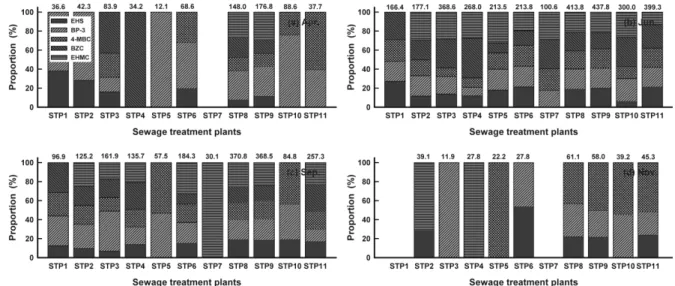
Fig. 3. Detected concentrations (numerical, ng/L) and proportion rates of UV filters in final effluents of 11 STPs.
출 특성을 조사한 Li 등25)과 Rodríguez 등26)의 연구결과에 서도 보고되었다.
4월~11월까지 5개(금호강 상류(S9), 신천(S10), 금호강 하 류(S11), 진천천(S12) 및 양산천(S20))의 지류들에서 검출된 자외선 차단제류들의 구성비율을 Fig. 2에 나타내었다. 자외 선 차단제류들의 구성비율을 나타낸 Fig. 2에서 자외선 차 단제류가 1~2개의 지류에서만 검출된 4월과 11월의 결과 를 제외한 6월과 8월의 결과를 보면 6월의 S9(금호강 상 류)와 8월의 S20(양산천)을 제외하면 검출된 지천에서 EHS, BP-3, 4-MBC, BZC 및 EHMC의 구성비율이 유사하게 나 타났다. 이것은 다양한 종류의 자외선 차단제류들이 다양한 제품들에 함유되고 있으며, 직․간접적인 경로를 통하여 수 계로 유출되는 것을 의미한다.
3.2. 하수처리장 방류수에서의 자외선 차단제류 검출 현황 및 특성
낙동강 본류와 지류로 방류되는 하수처리장(STP) 중에서 50,000 m3/day 이상의 처리용량을 가진 11곳의 하수처리장 최종방류수를 분석한 결과를 Fig. 3에 나타내었다. 4월, 6월, 8월 및 11월에 채수한 시료수들에 대한 결과를 살펴보면 7 종의 자외선 차단제류들 중에서 EHS, BP-3, 4-MBC, BZC 및 EHMC 5종이 검출되었다. 특히, STP8과 STP9의 방류수 에서의 자외선 차단제류들의 검출농도가 각각 61.1~413.8 ng/L 및 58.0~437.8 ng/L의 범위로 나타나 가장 높은 검출 농도를 나타내었다. 또한, STP7의 경우는 ND~100.6 ng/L로 11개 하수처리장 중에서 가장 낮은 검출농도를 나타내었으 며, 9월의 경우는 EHMC 단 1종만이 검출되었다. 이러한 이유로는 유입수 중의 공업폐수 비율이 타 하수처리장들에 비해 높아 개인위생용품에서 기인하는 자외선 차단제류들 의 유입농도가 낮기 때문인 것으로 판단된다. 또한, 낙동강 5개 지천들에서의 자외선 차단제류들의 검출 농도와 구성 비율을 나타낸 Fig. 2에서와 같이 Fig. 3의 4월(a)과 11월(d) 에서의 경우에도 전체적으로 하수처리장 방류수에서의 검출
농도가 낮게 나타나고 있으며, 구성종의 수도 적은 것을 알 수 있다. 이는 하수처리장의 처리 효율과는 무관하게 하수 처리장 유입수 중의 자외선 차단제류들의 유입 농도가 6월 과 9월에 비해 낮기 때문인 것으로 판단된다.25,26) 하수처리 장 방류수의 경우도 앞에서 서술한 낙동강 지류들의 검출특 성 결과와 마찬가지로 채수시기에 따라 검출농도 뿐만 아니 라 구성종 비율의 변화폭도 매우 큰 것으로 조사되었다.
중국 홍콩의 5개 하수처리장 방류수에 대해 12종의 자외 선 차단제류 검출특성을 조사한 Tsui 등의 연구결과27)에서 는 방류수 중의 자외선 차단제류의 검출농도는 19.3~2,671.4 ng/L로 나타났고, 주요 검출종은 BP-3, EHMC, BMDM (butyl methoxydibenzoylmethane) 및 BP-4 순으로 보고하고 있으 며, 각각의 하수처리장 방류수에 함유된 자외선 차단제류 의 구성종들은 유사하게 나타났으나, 이들의 검출농도는 하 수처리장에 따라 많은 차이를 보였다. 또한, 호주의 한 하 수처리장을 대상으로 계절변화에 따라 처리공정별로 6종 의 자외선 차단제류에 대한 제거특성을 조사한 Liu 등28)의 연구결과에서는 BP-3와 4-MBC가 주요 검출종이었으며, 검 출농도는 각각 32 ng/L~273 ng/L 및 ND~90 ng/L로 보고하 고 있다.
스위스의 11개 하수처리장 공정별 자외선 차단제류의 제 거특성을 연구한 Balmer 등의 연구결과8)에서는 하수처리 공정을 거치면서 4-MBC, BP-3 및 EHMC의 제거율이 각각 18%~97%, 68%~99% 및 97%~99%의 범위로 보고하고 있 어 하수처리 공정에서 비교적 높은 제거율을 보이는 것으로 나타났다. Kupper 등의 연구결과29)에서는 자외선 차단제류 들은 활성 슬러지에 대한 흡착 제거율뿐만 아니라 생물분 해율 또한 높기 때문에 하수처리 공정에서의 제거율이 다 른 개인위생용품 기인 오염물질(합성 향 물질 등)들에 비해 높은 것으로 보고하고 있다.
Table 6에는 4, 6, 9월 및 11월에 채수한 하수처리장 방류 수에서 검출된 EHS, BP-3, 4-MBC, BZC 및 EHMC의 평균 검출농도, 최소 및 최대 검출농도 및 검출빈도(detection fre-
Table 6. Concentration levels of UV filters in the final effluents of 11 STPs
EHS BP-3 4-MBC BZC EHMC
Apr Jun Sep Nov Apr Jun Sep Nov Apr Jun Sep Nov Apr Jun Sep Nov Apr Jun Sep Nov Avg. 14.1 50.5 31.2 12.6 32.8 55.6 44.8 15.2 22.0 47.3 38.8 24.5 31.5 68.0 42.2 - 45.7 69.2 52.4 27.9 SD 3.2 25.6 24.1 1.7 19.8 25.7 22.1 3.9 1.1 23.4 18.1 3.2 4.7 35.0 19.2 - 7.4 24.5 27.4 0.1
Min. ND ND ND ND ND 17.8 ND ND ND 22.6 ND ND ND 22.4 ND - ND ND ND ND
Max. 20.4 89.3 70.5 14.9 67.3 90.8 82.1 21.1 23.8 88.1 72.1 29.2 36.3 118.5 72.8 - 50.9 104.4 93.5 28.0 DF 6/11 10/11 9/11 5/11 9/11 11/11 10/11 6/11 6/11 11/11 10/11 5/11 4/11 11/11 8/11 0/11 2/11 11/11 8/11 2/11 Avg. : average, SD : standard deviation, DF : detection frequency
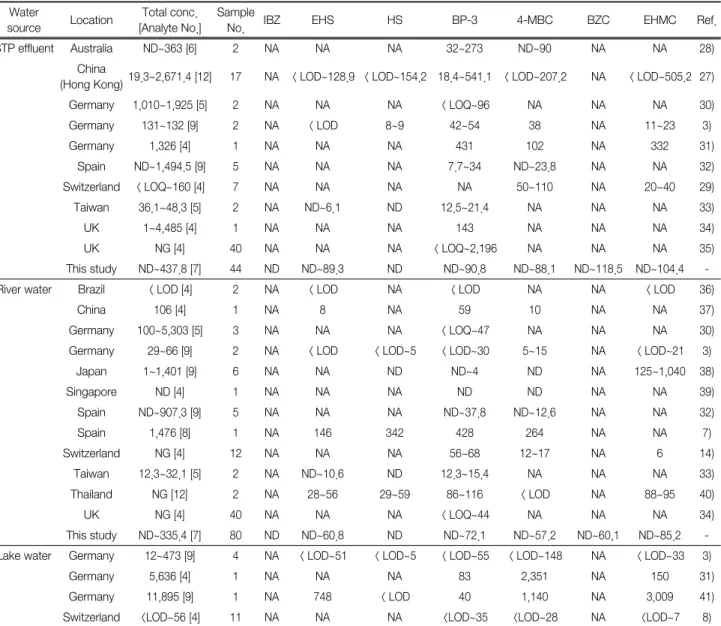
Table 7. Comparison of detected concentrations (ng/L) of UV filters in various water sources around the world Water
source Location Total conc.
[Analyte No.]
Sample
No. IBZ EHS HS BP-3 4-MBC BZC EHMC Ref.
STP effluent Australia ND~363 [6] 2 NA NA NA 32~273 ND~90 NA NA 28)
China
(Hong Kong)19.3~2,671.4 [12] 17 NA < LOD~128.9 < LOD~154.2 18.4~541.1 < LOD~207.2 NA < LOD~505.2 27)
Germany 1,010~1,925 [5] 2 NA NA NA < LOQ~96 NA NA NA 30)
Germany 131~132 [9] 2 NA < LOD 8~9 42~54 38 NA 11~23 3)
Germany 1,326 [4] 1 NA NA NA 431 102 NA 332 31)
Spain ND~1,494.5 [9] 5 NA NA NA 7.7~34 ND~23.8 NA NA 32)
Switzerland < LOQ~160 [4] 7 NA NA NA NA 50~110 NA 20~40 29)
Taiwan 36.1~48.3 [5] 2 NA ND~6.1 ND 12.5~21.4 NA NA NA 33)
UK 1~4,485 [4] 1 NA NA NA 143 NA NA NA 34)
UK NG [4] 40 NA NA NA < LOQ~2,196 NA NA NA 35)
This study ND~437.8 [7] 44 ND ND~89.3 ND ND~90.8 ND~88.1 ND~118.5 ND~104.4 -
River water Brazil < LOD [4] 2 NA < LOD NA < LOD NA NA < LOD 36)
China 106 [4] 1 NA 8 NA 59 10 NA NA 37)
Germany 100~5,303 [5] 3 NA NA NA < LOQ~47 NA NA NA 30)
Germany 29~66 [9] 2 NA < LOD < LOD~5 < LOD~30 5~15 NA < LOD~21 3)
Japan 1~1,401 [9] 6 NA NA ND ND~4 ND NA 125~1,040 38)
Singapore ND [4] 1 NA NA NA ND ND NA NA 39)
Spain ND~907.3 [9] 5 NA NA NA ND~37.8 ND~12.6 NA NA 32)
Spain 1,476 [8] 1 NA 146 342 428 264 NA NA 7)
Switzerland NG [4] 12 NA NA NA 56~68 12~17 NA 6 14)
Taiwan 12.3~32.1 [5] 2 NA ND~10.6 ND 12.3~15.4 NA NA NA 33)
Thailand NG [12] 2 NA 28~56 29~59 86~116 < LOD NA 88~95 40)
UK NG [4] 40 NA NA NA < LOQ~44 NA NA NA 34)
This study ND~335.4 [7] 80 ND ND~60.8 ND ND~72.1 ND~57.2 ND~60,1 ND~85.2 - Lake water Germany 12~473 [9] 4 NA < LOD~51 < LOD~5 < LOD~55 < LOD~148 NA < LOD~33 3)
Germany 5,636 [4] 1 NA NA NA 83 2,351 NA 150 31)
Germany 11,895 [9] 1 NA 748 < LOD 40 1,140 NA 3,009 41)
Switzerland <LOD~56 [4] 11 NA NA NA <LOD~35 <LOD~28 NA <LOD~7 8) NG : not given, NA : not analyzed, ND : not detected
quency, DF) 등을 간략히 요약하여 나타내었다. BP-3가 4 월, 6월, 9월 및 11월에 각각 9개, 11개, 10개 및 6개 하수 처리장의 방류수에서 검출되어 검출빈도가 가장 높았으며 다음으로 4-MBC > EHS > BZC 및 EHMC 순이었다.
세계 각국의 하수처리장 방류수, 하천수 및 호소수에서 검 출된 자외선 차단제류들의 농도를 비교한 것을 Table 7에 나
타내었다. Table 7에서 볼 수 있듯이 본 연구에 사용된 자 외선 차단제류 7종 중에서 BP-3, 4-MBC 및 EHMC가 최대 검출농도를 나타낸 횟수가 비교적 많았으며, 이는 Table 6 에 나타낸 낙동강 주변에 위치한 하수처리장 방류수에서의 검출 특성을 조사한 본 연구결과와 유사한 결과이다. 또한, Table 7에 나타낸 본 연구의 결과와 외국의 경우를 비교할
경우, 낙동강 주변에 위치한 하수처리장의 방류수들과 낙동 강의 지류들에서의 검출농도가 비교적 낮은 편으로 나타났다.
4. 결 론
낙동강 수계와 낙동강 주변에 위치한 하수처리장들의 최 종 방류수들에서의 자외선 차단제류 검출 특성을 조사한 결 과 다음과 같은 결론을 얻을 수 있었다.
1) 낙동강 수계에서 자외선 차단제류가 검출된 지점은 지 류 5지점에서 EHS, BP-3, 4-MBC, BZC 및 EHMC 5종이 검출되었으며, 본류에서는 검출되지 않았다.
2) 낙동강 수계에서의 검출농도 범위는 하수처리장 방류 수의 영향을 받는 지류들인 금호강 상류, 신천, 금호강 하류, 진천천 및 양산천에서 EHS가 ND~60.8 ng/L, BP-3가 ND~
72.1 ng/L, 4-MBC가 ND~57.2 ng/L, BZC가 ND~60.1 ng/L 및 EHMC가 ND~85.2 ng/L의 농도로 검출되었다.
3) 낙동강 주변에 위치한 11개 하수처리장 방류수들에서 는 EHS, BP-3, 4-MBC, BZC 및 EHMC 5종이 각각 ND~89.3 ng/L, ND~90.8 ng/L, ND~88.1 ng/L, ND~118.5 ng/L 및 ND~104.4 ng/L의 농도로 검출되었으며, 낙동강 하류에 위 치한 STP11의 방류수에서 총 자외선 차단제류 농도가 58.0~
437.8 ng/L로 가장 높게 나타났다.
4) 낙동강 수계 및 낙동강 주변에 위치한 11개 하수처리 장 방류수들에서의 계절별 자외선 차단제류 분포비율은 6 월과 9월에는 유사한 분포 특성을 나타내었으나, 4월과 11 월의 경우에는 검출농도 뿐만 아니라 구성종 비율의 변화 폭도 매우 크게 나타났다.
5) 외국의 지표수 및 하수처리장 방류수에서의 검출현황 을 조사한 연구결과들에서도 BP-3, 4-MBC 및 EHMC 3종 이 주요 검출종으로 나타났으며, 낙동강의 지류들 및 낙동 강 주변에 위치한 하수처리장 방류수들에서의 검출농도가 외국에 비해서 비교적 낮은 편이었다.
References
1. Gasparro, F. P., “Sunscreens, skin photobiology, and skin cancer: The need for UVA protection and evaluation of effi- cacy,” Environ. Health Perspect., 108, 71~78(2000).
2. Gasparro, F. P., Mitchnick, M. and Nash, J. F., “A review of sunscreen safety and efficacy,” Photochem. Photobiol.,
68, 243~256(1998).
3. Rodil, R. and Moeder, M., “Development of a method for the determination of UV filters in water samples using stir bar sorptive extraction and thermal desorption-gas chromatography- mass spectrometry,” J. Chromatogr. A, 1179, 81~88(2008).
4. Giokas, D. L., Salvador, A. and Chisvert, A., “UV filters:
from sunscreens to human body and the environment,” Trends
Anal. Chem., 26, 360~374(2007).
5. Shaath, N. A., “Ultraviolet filters,” Photochem. Photobiol. Sci.,
9(4), 464~469(2010).
6. Schlumpf, M., Cotton, B., Conscience, M., Haller, V., Stein- mann, B. and Lichtensteiger, W., “In vitro and in vivo estro- genicity of UV screens,” Environ. Health Perspect., 109, 239~244(2001).
7. Román, I. P., Chisvert, A. and Canals, A., “Dispersive solid- phase extraction based on oleic acid-coated magnetic nano- particles followed by gas chromatography-mass spectrometry for UV-filter determination in water samples,” J. Chromatogr.
A, 1218, 2467~2475(2011).
8. Balmer, M. E., Buser, H. R., Müller, M. D. and Poiger, T.,
“Occurrence of some organic UV filters in wastewater, in surface waters, and in fish from Swiss Lakes,” Environ. Sci.
Technol., 39, 953~962(2005).
9. Peck, A. M., “Analytical methods for the determination of persistant ingredients of personal care products in environ- mental matrices,” Anal Bionanal. Chem. 386, 907~939(2006).
10. Plagellat, C., Kupper, T., Furrer, R., Alencastro, L. F., Grandjean, D. and Tarradellas, J., “Concentrations and sp- ecific loads of UV filters in sewage sludge originating from a monitoring network in Switzerland,” Chemosphere., 62, 915~925(2006).
11. Rodil, R., Quintana, J. B., Concha-Grana, E., Lopez-Mahia, P., Muniategui-Lorenzo, S. and Prada-Rodriguez, D., “Emerging pollutants in sewage, surface and drinking water in Galicia (NW Spain),” Chemosphere, 86, 1040~1049(2012).
12. Poiger, T., Buser, H. R., Balmer, M. E., Bergqvist, P. A.
and Muller, M. D., “Occurrence of UV filter compounds from sunscreens in surface waters: regional mass balance in two Swiss lakes,” Chemosphere, 55, 951~963(2004).
13. Buser, H. R., Balmer, M. E., Schmid, P. and Kohler, M.,
“Occurrence of UV filters 4-methylbenzylidene camphor and octocrylene in fish from various swiss rivers with inputs from wastewater treatment plants,” Environ. Sci. Technol.,
40, 1427~1431(2006).
14. Fent, K., Zenker, A. and Rapp. M., “Widespread occurrence of estrogenic UV-filters in aquatic ecosystems in Switzerland,”
Environ. Pollut., 158, 1817~1824(2010).
15. Gago-Ferreo, P. and Diaz-Cruz, M. S., “An overview of UV- absorbing compounds (organic UV filters) in aquatic biota,”
Anal. Bioanal. Chem., 404, 2597~2610(2012).
16. Fent, K., Kunz, P. Y. and Gomez, E., “UV filters in the aquatic environment induce hormonal effects and affect fer- tility and reproduction in fish,” Chimia, 62, 368~375(2008).
17. Santos, A. J. M., Miranda, M. S. and Esteves da Silva, J.
C. G., “The degradation products of UV filters in aqueous and chlorinated aqueous solutions,” Water Res., 46, 3167~
3176(2012).
18. Blüthgen, N., Zucchi, S. and Fent, K., “Effects of the UV filter benzophenone-3 (oxybenzone) at low concentrations in zebrafish (Danio rerio),” Toxicol. Appl. Pharmacol., 263, 184~194(2012).
19. Zucchi, S., Bluthgen, N., Ieronimo, A. and Fent, K., “The UV-absorber benzophenone-4 alters transcripts of genes in- volved in hormonal pathways in zebrafish (Danio rerio) eleuthero-embryos and adult males,” Toxicol. Appl. Pharmacol.,
250, 137~146(2011).
20. Garbicova, K., Fedorova, G., Burkina, V., Steinbach, C., Schmidt-Posthaus, H., Zlabek, V., Kroupova, H. K., Garbic, R. and Randak, T., “Presence of UV filters in surface water and the effects of phenylbenzimile sulfonic acid on rainbow trout (Oncorhynchus mykiss) following a chronic toxicity test,”
Ecotoxicol. Envoron. Safety, 96, 41~47(2013).
21. Seo, C. D., Son, H. J., Yoom, H. S., Choi, J. T., Ryu, D.
C., Kwon, K. W. and Jang, S. H., “Analysis of synthetic fragrances (SFs) in water using stir bar sorptive extraction (SBSE) and GC-MS/MS,” J. Korean Soc. Environ. Eng., 36 (6), 387~395(2014).
22. Seo, C. D., Son, H. J., Jung, J. M., Choi, J. T. and Jang, S.
H., “Analysis of UV filters in water using stir bar sorptive extraction (SBSE) and GC-MS/MS,” J. Environ. Sci. Intl.,
23(6), 1037~1047(2014).
23. Seo, C. D., Son, H. J., Lee, I. S. and Oh, J. E., “Detection of synthetic musk compounds (SMCs) in Nakdong river basin,” J. Korean Soc. Environ. Eng., 32(6), 615~624(2010).
24. Son, H. J., Hwang, Y. D., Yoom, H. S., Choi, J. T. and Kwon, K. W., “Detection of perfluorinated compounds (PFCs) in Nakdong river basin,” J. Korean Soc. Environ. Eng., 35(2), 84~93(2013).
25. Li, W., Ma, Y., Guo, C., Hu, W., Liu, K., Wang, Y. and Zhu, T., “Occurrence and behavior of four of the most used sunscreen UV filters in a wastewater reclamation plant,”
Water Res., 41, 3506~3512(2007).
26. Rodríguez, A. S., Sanz, M. R. and Rodríguez, B., “Occurrence of eight UV filters in beaches of Gran Canaria (Canary Islands). An approach to environmental risk assessment,”
Chemosphere, 131, 85~90(2015).
27. Tsui, M. M. P., Leung, H. W., Lam, P. K. S. and Murphy, M. B., “Seasonal occurrence, removal efficiencies and preli- minary risk assessment of multiple classes of organic UV filters in wastewater treatment plants,” Water Res., 53, 58~
67(2014).
28. Liu, Y., Ying, G., Shareef, A. and Kookana, R. S., “Occur- rence and removal of benzotriazoles and ultraviolet filters in a municipal wastewater treatment plant,” Environ. Pollut.,
165, 225~232(2012).
29. Kupper, T., Plagellat, C., Brändli, R. C., de Alencastro, L.
F., Grandjean, D. and Tarradellas, J., “Fate and removal of polycyclic musks, UV filters and biocides during waste- water treatment,” Water Res., 40, 2603~2612(2006).
30. Wick, A., Fink, G. and Ternes, T. A., “Comparison of elec- trospray ionization and atmosphere pressure chemical ioniza- tion for multi-residue analysis of biocides, UV-filters and benzothiazoles in aqueous matrices and activated sludge by liquid chromatography-tandem mass spectrometry,” J. Chro-
matogr. A, 1217, 2088~2103(2010).
31. Moeder, M., Schrader, S., Winkler, U. and Rodil, R., “At- line microextraction by packed sorbent-gas chromatography- mass spectrometry for the determination of UV filter and polycyclic musk compounds in water samples,” J. Chromatogr.
A, 1217, 2925~2932(2010).
32. Gago-Ferrero, P., Mastroianni, N., Díaz-Cruz, M. S., Barceló, D., “Fully automated determination of nine ultraviolet filters and transformation products in natural waters and waste- waters by on-line solid phase extraction-liquid chromatography- tandem mass spectrometry,” J. Chromatogr. A, 1294, 106~
116(2013).
33. Wu, J. W., Chen, H. C. and Ding, W. H., “Ultrasound-assisted dispersive liquid-liquid microextraction plus simultaneous silylation for rapid determination of salicylate and benzo- phenone-type ultraviolet filters in aqueous samples,” J.
Chromatogr. A, 1302, 20~27(2013).
34. Kasprzyk-Hordern, B., Dinsdale, R. M. and Guwy, A. J.,
“The removal of pharmaceuticals, personal care products, en- docrine disruptors and illicit drugs during wastewater treat- ment and its impact on the quality of receiving waters,”
Water Res., 43, 363~380(2009).
35. Kasprzyk-Hordern, B., Dinsdale, R. M. and Guwy, A. J.,
“Multiresidue methods for the analysis of pharmaceuticals, personal care products and illicit drugs in surface water and wastewater by solid-phase extraction and ultra performance liquid chromatography-electrospray tandem mass spectrometry,”
Anal. Bioanal. Chem., 391, 1293~1308(2008).
36. da Silva, C. P., Emídio, E. S. and de Marchi, M. R. R.,
“Method validation using weighted linear regression models for quantification of UV filters in water samples,” Talanta,
131, 221~227(2015).
37. Liu, H., Liu, L., Xiong, Y., Yang, X. and Luan, T., “Simul- taneous determination of UV filters and polycyclic musks in aqueous samples by solid-phase microextraction and gas chromatography-mass spectrometry,” J. Chromatogr. A, 1217, 6747~6753(2010).
38. Kameda, Y., Kimura, K. and Miyazaki, M., “Occurrence and profiles of organic sun-blocking agents in surface waters and sediments in Japanese rivers and lakes,”Environ. Pollut.,
159, 1570~1576(2011).
39. Ge, D. and Lee, H. K., “A new 1-hexyl-3-methylimidazolium tris(pentafluoroethyl)trifluorophosphate ionic liquid based ultrasound-assisted emulsification microextraction for the determination of organic ultraviolet filters in environmental water samples,”J. Chromatogr. A, 1251, 27~32(2012).
40. Tsui, M. M., Leung, H. W., Wai, T. C., Yamashita, N., Taniyasu, S., Liu, W., Lam, P. K. and Murphy, M. B.,
“Occurrence, distribution and ecological risk assessment of multiple classes of UV filters in surface waters from diffe- rent countries,” Water Res., 67, 55~65(2014).
41. Rodil, R., Schrader, S. and Moeder, M., “Non-porous mem- brane-assisted liquid-liquid extraction of UV filter com- pounds from water samples,” J. Chromatogr. A, 1216, 4887~
4894(2009).