Kor. J. Mater. Res.
Vol. 23, No. 10 (2013)
543
Effects of Mechanically Activated Milling and Calcination Process on the Phase Stability and Particle Morphology of Monoclinic Zirconia
Synthesized by Hydrolysis of ZrOCl 2 Solution
Young-Geun Lee, Soon-Chul Ur, Iqbal Mahmud and Man-Soon Yoon †
Department of Materials Science and Engineering / RIC-ReSEM, Korea National University of Transportation, Daehakno, Chungju, Chungbuk 380-702, Korea
(Received June 13, 2013 : Received in revised form July 18, 2013 : Accepted July 19, 2013)
Abstract
The purpose of this paper was to investigate the effect of a high-energy milling (HEM) process on the particle morphology and the correlation between a thermal treatment and tetragonal/monoclinic nanostructured zirconia powders obtained by a precipitation process. To eliminate chloride residue ions from hydrous zirconia, a modified washing method was used. It was found that the used washing method was effective in removing the chloride from the precipitated gel. In order to investigate the effect of a pre-milling process on the particle morphology of the precipitate, dried Zr(OH)4 was milled using a HEM machine with distilled water. The particle size of the Zr(OH)4 powder exposed to HEM reduced to 100~150 nm, whereas that of fresh Zr(OH)4 powder without a pre-milling process had a large and irregular size of 100 nm~1.5µm.
Additionally, modified heat treatment process was proposed to achieve nano-sized zirconia having a pure monoclinic phase. It was evident that two-step calcining process was effective in perfectly eliminating the tetragonal phase, having a small average particle of ~100 nm with good uniformity compared to the sample calcined by a single-step process, showing a large average particle size of ~300 nm with an irregular particle shape and a broad particle size distribution. The modified method is considered to be a promising process for nano-sized zirconia having a fully monoclinic phase.
Key words
high energy milling, SEM, XRD, calcination.1. Introduction
Zirconia(ZrO
2) has found widespread applications due to its unique physical and chemical properties. It has been used as a structural material because of its high strength, toughness, high chemical resistance, and thermal stability.
Compared to other ceramic metal oxides, zirconia pos- sesses much better alkali resistance, showing an out- standing resistance to dissolution at a high temperature.
1)Because of these favorable properties and the presence of acid-base or oxidation reduction centers, zirconia has been used in catalytic applications as a support or an active phase.
2-4)Recent studies have shown that the use of nano- structured zirconia instead of conventional micrometer- sized zirconia enhances efficiency in many applications.
5)Monoclinic phase zirconia is widely used for construction ceramics including refractory and insulation materials,
medical use and the electrolyte in solid oxide fuel cell (SOFC). Moreover it is an important component of lead- zirconia-titanate(PZT) piezoelectric ceramics. Monoclinic phase zirconia can be used as an additive to enhance the properties of other oxide refractories, setter sands, thermal coatings, and as separation media. These products are also used in other applications that require an inert material, high melting point, and low thermal conductivity. It is par- ticularly advantageous when added to high-fired magnesia and alumina bodies. It promotes sinterability and with alumina, contributes to abrasive characteristics. Pure ultrafine /nanoscale monoclinic phase of zirconia has advantages in producing excellent PZT ceramics. Fine powder of monoclinic phase zirconium oxide is very important starting material for the manufacturing of various dielectric, pie- zoelectric ceramics. Zirconia exists in three polymorphic modifications: monoclinic, tetragonal, and cubic, with in-
†
Corresponding author
E-Mail : [email protected] (M.-S. Yoon, Korea Nat’l Univ.)
© Materials Research Society of Korea, All rights reserved.
This is an Open-Access article distributed under the terms of the Creative Commons Attribution Non-Commercial License (http://creative-
commons.org/licenses/by-nc/3.0) which permits unrestricted non-commercial use, distribution, and reproduction in any medium, provided the
original work is properly cited.
creasing temperature. Although the monoclinic form is stable at room temperature at a low surface area,
6,7)nano- crystalline zirconia synthesized at room temperature is tetragonal.
8)In bulk, the tetragonal phase is stable only above 1170
oC and transforms into the cubic phase near 2370
oC. This stabilization of the tetragonal phase in the nanocrystalline regime is attributed to the difference in the surface energies of monoclinic and tetragonal phases, the latter being smaller.
9-11)Therefore, it is difficult to synthesis the fully stabilized monoclinic phase in nano- sized ZrO
2. In order to prepare ZrO
2nanocrystalline powder, several methods have been used. Among them, precipitation route
12-13)is relatively simple and easy scale- up process with low energy consumption, comparison to other various wet chemistry processes such as hydro- thermal
14-18)processing, sol-gel processing,
19)and so forth.
Furthermore, chloride residue is known to retard ZrO
2densification in this process.
20)The main purpose of this paper is to synthesize a nano- sized monoclinic zirconia powders with regular particle shape and to correlate phase stability with calcination con- dition. For these purpose, the monoclinic ZrO
2are fabricated by precipitation process.
2. Experimental Procedure
Aqueous solution with Zr
+4concentration of 0.1 M was prepared using ZrOCl
2-8H
2O (99.0 % purity: Zhejiang Shenghua Biok Biology Co., Ltd, China) as a starting material. A solution of 1 M ammonia was then slowly added to the solution to control pH value with vigorous stirring at room temperature until pH reached 11. This alkaline solution was continuously stirred for 1 h and aged for 24 h until a gel like precipitate appeared, which was washed several times with distilled water. The washed precipitate was subsequently washed again with 8 % ammonia solution for complete removal of Cl
−ions. The two step washed precipitate was washed several times with distilled hot water of 80
oC. After final washing process, the removal of Cl
−ions was verified by means of 3 M AgNO
3solution titration. The precipitate gel was then dehydrated with absolute EtOH and isopropyl alcohol (IPA). The dehydrated gel was converted into slurry with distilled water. The slurry was milled to enhance the rea- ction kinetics and ensure the particle uniformity during the calcination step using a high energy milling machine (MINICER/MINIPUR-NETZSCH). Milling process was conducted with zirconia balls of 0.1 mm diameter for 1 h with rotor speed of 3500 rpm. The powder was then heat treated in air at 400
oC~1000
oC for 4 h to obtain cry- stalline ZrO
2powder. After calcining, an additional milling step using HEM was conducted to obtain a nano-particle size. The powder morphologies of the all samples were
investigated using a scanning electron microscope(SEM;
FEI Company Quanta 400). The chemical composition of the powder was determined by X-ray fluorescence spec- troscopy(SHIMADZU, ED-XRF 720). The volume fraction of monoclinic phase, V
m, was evaluated by the Toraya method.
21)V
m= 1.311 X
m/ (1 + 0.311 X
m) (1) X
m= { I
(-111)m+ I
(111)m} / { I
(111)t+ I
(-111)m+ I
(111)m} (2) Where X
mis the integrated intensity ration and the subscripts m and t of I represent the peak intensities of Kα
1for monoclinic and tetragonal phases, respectively, after peak separation and fitting. The average crystallite size (d
XRD) of the monoclinic phase was estimated according to the Scherrer equation.
22)d
XRD= 0.94 λ / βcosθ (3)
Where, θ is the diffraction angle of the (111) peak, β is the full width at half-maximum(FWHM) of the (111) peak.
The Brenauer-Emmett-Teller(BET) surface area was mea- sured by nitrogen physisorption at 76.5 K using an ASAP 2020 analyzer(Micromeritics Co. Ltd., Norcross, GA).
3. Results and Discussion
3.1 Effect of washing method on chlorine removal The chemical compositions of the powder as determined by X-ray fluorescence spectroscopy(XRF) was shown in Table 1. According to these results, residual Cl
−ions was not observed. The removal of Cl
−ions is very important step because residual chlorine greatly interferes with the sintering of zirconia powders at low temperatures.
20)In general, ammonia water induced the chloride removal with a simple reaction(Cl
−+ NH
3(aq)→ NH
4Cl
(aq)). In addition to this reaction, the precipitate was subsequently washed with distilled hot water(80
oC). It is well known that sol- ubility of NH
4Cl is much higher at hot water rather than cold/normal temperature water. Therefore, higher solubility of NH
4Cl in hot water enhanced the chloride removal from the precipitated gel during filtration process. Thus, it could be predicted that the used washing method was effective in removing the chloride ions of precipitated Table 1. Analyzed XRF data for the precipitated gel.
Analyte Result(%) Int.(cps/ µA)
Zr 73.06 2564.2653
P 23.778 2.6796
Si 2.074 0.1138
Hf 1.087 15.3542
gel. Furthermore, ethanol washing step decreased the ag- glomeration of precipitates.
3.2 Thermal analysis and crystal structure of pre- cipitate
The DSC curve of hydrous-zirconia particles obtained from precipitation is shown in Fig. 1. The first endo- thermic peak is appeared at 137
oC followed by a second endothermic peak at 360
oC. The first endothermic peak corresponds to the elimination of residual water and solv- ent, the second endothermic peak is due to the decom- position of Zr(OH)
4into amorphous ZrO
2. The exothermic peak appeared at 475
oC, indicating the crystallization of amorphous ZrO
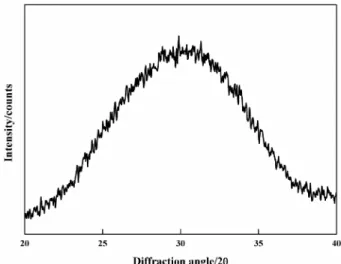
2to crystal structure. An X-ray diffraction pattern for the precipitate dried at 75
oC is shown in Fig.
2. The broad band, in the range of 2 θ~30
o, indicates an essentially amorphous precipitate with some nearest-
neighbor ordering. 3.3 Effect of pre-milling process on particle mor-
phology of the precipitate
Before calcining, the gels were converted to slurry and mechanically milled by high energy milling machine to ensure fine and uniform particle size. Fig. 3 shows the SEM micrographs of fresh and pre-milled precipitate powder. From the micrograph results of the pre-milled powders, it is evident that the process causes a significant change in powder morphology, accompanying the powder shape change from an irregular shape to a uniform shape.
The particle morphology of the powder exposed to high energy milling promoted particle uniformity without ag- glomeration.
3.4 Effect of heat treatment
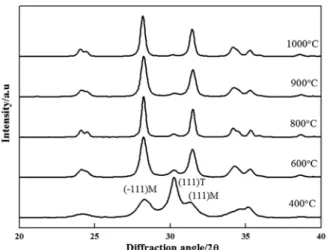
The data obtained from X-ray diffraction of the calcined powders as a function of heat treatment temperature are shown in Fig. 4. The result indicates that the Zr(OH)
4crystallize into tetragonal phase at 400
oC, showing (111) peak at 2 θ = 30
o(Fig. 4). Zirconia exists in three poly- Fig. 2. X-ray diffraction pattern of Zr(OH)
4dried at 75
oC.
Fig. 3. Scanning electron micrograph of (a) high energy milled (b) fresh Zr(OH)
4. Fig. 1. The DSC profile of the Zr(OH)
4prepared with precipitation
technique.
morphic modification; monoclinic, tetragonal and cubic with increasing temperature. While the monoclinic phase is stable at room temperature, nanocrystaline zirconia is stabilized in tetragonal phase at room temperature.
8)A model was proposed for explaining the stabilization of the tetragonal phase. According to this model, OH
−ions and Zr vacancies in the crystalline structure play a role of tetragonal phase stabilizers. The model also explained the irreversible phase transformation of the tetragonal to monoclinic phase, which was observed in annealed sam- ples.
8)The tetragonal phase is stable even at 400
oC because of the reduction of the surface energy, which is caused by nano-sized crystallites. After annealing the amorphous Zr(OH)
4at 400
oC, it shows the coexistence of tetragonal and monoclinic phase.
9,10)It can be noted that three different lines respectively assigned to the most intense (111) line of the tetragonal phase at 2 θ = 30
oand the ( −111) and (111) lines of the monoclinic phase at 2 θ = 28 and 31.46
o. On further increasing of annealing temperature to 600
oC, the increasing of the monoclinic phase takes place, lowering the content of tetragonal phase. This is probably caused by the increase of crystal size as a function of temperature in accordance with the Garvie theory.
8)As increasing the annealing temperature
up to 1000
oC, tetragonal phase tends to decrease and monoclinic phase increases as shown in Fig. 4. This is also evident from the calculated volume fraction of mono- clinic phase. Even though calcining temperature increased to 1000
oC, the tetragonal phase of 3 % existed with monoclinic phase as shown in Table 2. Existence of tetragonal phase can be explained by the crystallite size effect. Typical micrographs of the calcined powder ob- tained in a scanning electron microscope are shown in Fig.
5. The sample calcined at 800
oC has a smaller average particle size and a more weakened neck growth compared with those of the samples calcined at 900
oC and 1000
oC, respectively. Based on the analysis above, Zr(OH)
4is decided to calcined at low temperature to obtain the nano size particles, whereas it should be calcined at elevated temperature to increase the monoclinic phase.
3.5 Effect of two step calcination process on the sta- bility of monoclinic phase and powder morphology
As can be seen from the previous sub-section, the stability of monoclinic phase depends on the annealing temperature. Furthermore, the prolonged calcination time can increase the neck growth hindering the effective milling. Therefore, it could be concluded that the in- creased calcinations time is ineffective in eliminating the tetragonal phase and obtaining the fine particle. In order to achieve a nano-sized zirconia having a pure mono- clinic phase, two step calcination process was proposed in this work. Schematic representation of the temperature profile for single and two step calcination is shown in Fig.
6(a-b). For two step calcination process, firstly, powders were heated at 850
oC with the heating rate of 5
oC/min Fig. 4. X-ray diffraction patterns of ZrO
2calcined between 400
oC
and 1000
oC for 4 h, (T) tetragonal (M) monoclinic phase.
Table 2. Volume fraction of monoclinic phase.
Annealing temperature /
oC Monoclinic phase %
400 52.24
600 92.56
800 96.75
900 96.86
1000 97.03
Fig. 5. Scanning electron micrographs of the powders calcined at (a) 800
oC, (b) 900
oC, (c) 1000
oC.
and maintained for 3 h in air atmosphere. Secondly, the temperature was elevated to 1000
oC with the heating rate of 3
oC/min and kept at this temperature for 4 h and the sample was then cooled down to room temperature.
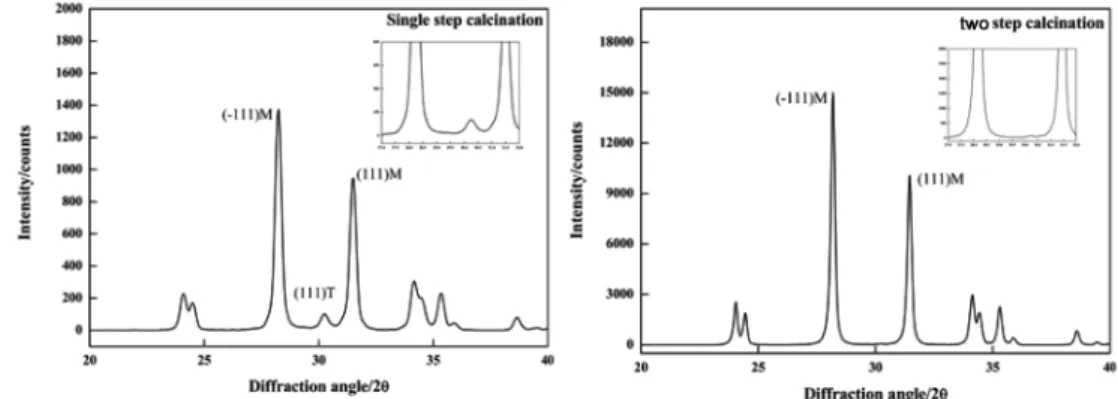
For the two step calcined powder, the tetragonal (111) peak completely diminished, whereas tetragonal (111) peak still existed for the single step calcined powder in the 2 θ range of 20-40
oand 27-32
o(Fig. 7). To compare the effect of two step calcining process with that of the single step annealing process, another powder sample was prepared at 1000
oC for 7 h Fig. 6(a). The X-ray diffraction patterns for the two differently calcined powders were shown in Fig. 7. From the X-ray data, volume fraction of mono- clinic phase was again calculated using the equation (1) and (2) depicted in Table 3. It is clear that two step calcining process is more effective than the increase of calcinations time in perfectly eliminating the tetragonal phase.
In addition to this, Fig. 8 shows the SEM micrograph of calcined powders fabricated by single step and two step process. The powder fabricated by two step process
has a smaller particle size and weaker neck growth than those of the powder fabricated by single step process. A comparison of the result of Fig. 8 with that of Table 3 indicates that the proposed process is effective in elimin- ating the tetragonal phase and decreasing the particle size compared with single step process. According to previous model,
8)OH
−ions and Zr vacancies in the crystalline structure can restrict the stabilization of monoclinic phase.
In order to eliminate the defects such as OH
−ions, Zr vacancies and limit the grain growth, an annealing pro- cess was chosen during the heat treatment. Regarding the hydroxyl ions [OH
−ions] effects, Vivekanandan and Kutty
23)explained the source of lattice strain as from point defects caused by the presence of hydroxyl ions in the oxygen sub-lattice are compensated by cation va- cancies, and result in strain leading to the presence of tetragonal phase. Thus, the annealing step at 850
oC/3 h can remove the defects and reduce the strain with an accompanying the stabilization of the monoclinic phase, thereby reducing the final calcination temperature and sustaining time in order to obtain the ultrafine and fully monoclinic stabilized ZrO
2. Furthermore, it takes less processing time than single step process. Therefore, it is expected that the two step calcinations method enhances the monoclinic stabilization due to the increase of cry- stallite size, and decreases the particle size, weakens neck growth.
Fig. 6. Schematic profile of calcinations process (a) single step and (b) two step method.
Fig. 7. X-ray diffraction patterns of monoclinic ZrO
2powders calcined by (a) single step and (b) two step process.
Table 3. Monoclinic phase transition with calcination condition.
Calcination Monoclinic phase %
Single step 97.03
Two step 100.00
To obtain fine particle, the powders were mechanically milled with nano-mill under the same milling condition.
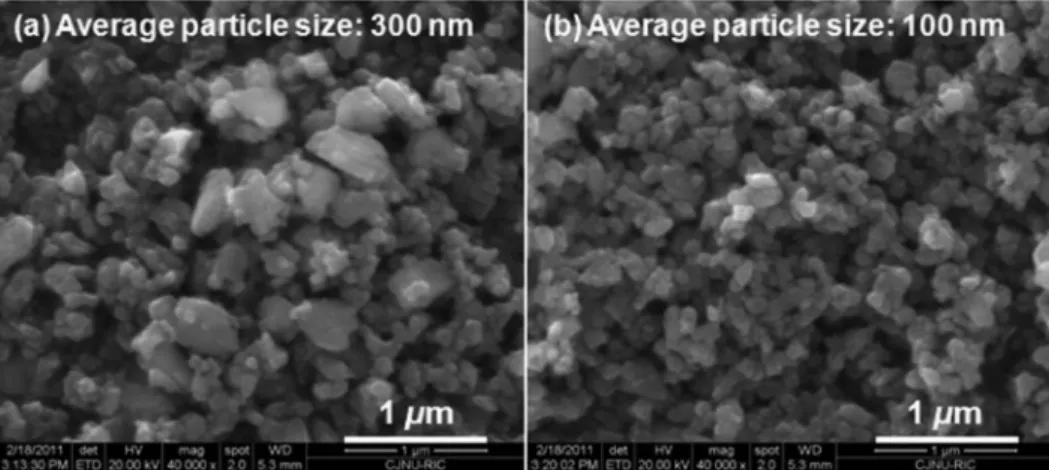
Fig. 9(a) and (b) show the SEM morphologies of the nano-milled powders calcined by single step and two step process, respectively. It indicates that two step calcined powder was more easily and homogenously grinded by milling process due to the weakened neck growth. As shown in Fig. 9 and Table 4, the sample calcined by the two step process has a small average particle of ~100 nm(BET surface area: 24.6256 m
2/g) with a uniform particle shape. On the other hand, the sample calcined by the single step process has a large average particle of
~300 nm(BET surface area: 17.0620 m
2/g) with an ir- regular particle shape and broad particle size distribution compared to the former process. In addition to this, the crystallite size measurements also showed that the double step calcined sample crystallite size is greater than Garvie limit. According to the proposed “crystal size theory” by Garvie, the microcrystals below a critical size of about 30 nm are stabilized against the tetragonal to monoclinic (t → m) transformation.
24)Crystallite size of single step calcined powder is 29.15 nm which is around the Garvie limit; whereas crystallite size of two steps calcined powder is 43.14 nm, which is over the Garvie limit. Thus, two step calcinations can be stabilized in fully monoclinic phase powders. From the results, it is evident that the two step calcination process is more effective to fabricate the nano-sized and uniform-shaped zirconia powder with fully monoclinic stabilized structure and crystallite size is not significantly affected by the milling process.
4. Conclusion
The effects of mechanically activated milling and calci- Fig. 8. The SEM morphology of calcined powder fabricated by (a) single step process, (b) two step process.
Fig. 9. The SEM morphology of high energy-milled powders calcined by (a) single step process, (b) two step process.
Table 4. Comparison of crystallite size(measured using the Scherrer equation from XRD) and particle size(measured using the SEM) of the nano-milled powder.
Calcination
Particle size(nm) (From SEM)
BET surface area(m
2/g)
Crystallite size(nm) (From XRD)
Single step 300 17.0620 29.13
Two step 100 24.6256 43.09
nations process on the phase stability and particle mor- phology of zirconia produced by hydrolysis of ZrOCl
2were systemically investigated. It was proven that the used washing method was more effective in perfectly removing the chloride ions of precipitated gel from the results of XRF. The effect of pre-milling process on particle mor- phology of the precipitate was examined using the dried Zr(OH)
4.The particle size of the Zr(OH)
4powder ex- posed to high energy milling reduced to 100~150 nm, whereas that of fresh Zr(OH)
4powder without pre- milling process had a large and irregular size of 100 nm
~1.5 µm. Additionally, it is clear that the two step cal- cination process is more effective to fabricate the nano- sized and uniform-shaped zirconia powder with pure monoclinic phase showing a small average particle of
~100 nm with a uniform particle shape compared to the sample calcined by the single step process.
Acknowledgements
The research was supported by a grant from the Aca- demic Research Program of Korea National University of Transportation in 2013.
References
1. J. Nawrocki, M. P. Rigney, A. McCormick and P. W.
Carr, J. Chromatogr. A, 657(2), 229 (1993).
2. I. S. Metcalfe, Catal. Today, 9(1-2), 236 (1991).
3. X. Song and A. Sayari, Catal. Rev. Sci. Eng., 38(3), 329 (1996).
4. K. Tanabe and T. Yamaguchi, Catal. Today, 20(2), 185 (1994).
5. S. Zhou, G. Garnweitner, M. Niederberger and M.
Antonietti, Langmuir, 23(18), 9178 (2007).
6. R. J. Ackermann, S. P. Garg, E. G. Rauh, High Temp.
Sci., 11(3), 199 (1979).
7. J. P. Coughlin and E. G. King, J. Am. Chem. Soc., 72(5), 2262 (1950).
8. R. C. Garvie, J. Phys. Chem., 69(4), 1238 (1965).
9. M. W. Pitcher, S. V. Ushakov, A. Navrotsky, B. F.
Woodfield, G. S. Li, J. Boerio-Goates and B. M. Tissue, J. Am. Ceram. Soc., 88(1), 160 (2005).
10. H. F. Holmes, E. L. Fuller Jr. and R. B. Gammage, J.
Phys. Chem., 76(10), 1497 (1972).
11. I. Kasatkin, F. Girgsdies, T. Ressler, R. A. Caruso, J. H.
Schattka, J. Urban and K. Weiss, J. Mater. Sci., 39(6), 2151 (2004).
12. M. Dechamps, B. Djuricic and S. Pickering, J. Am.
Ceram. Soc., 78(11), 2873 (1995).
13. K. Matusui, H. Suzuki, M. Ohagi and H. Arashi, J. Am.
Ceram. Soc., 78(1), 146 (1995).
14. W. Pyda, K. Haberko and M. M. Bucko, J. Am. Ceram.
Soc., 74(10), 2622 (1991).
15. H. Nishizawa, N. Yamasaki, K. Matsuoka and H.
Mitsushio, J. Am. Ceram. Soc., 65(7), 343 (1982).
16. G. Dell’Agli and G. Mascolo, J. Eur. Ceram. Soc., 20(2), 139 (2000).
17. E. Tani, M. Yoshimura and S. Somiya, J. Am. Ceram.
Soc., 64(12), C-181 (1981).
18. E. Tani, M. Yoshimura and S. Somiya, J. Am. Ceram.
Soc., 66(1), 11 (1983).
19. H. Kumazawa, T. Inoue and E. Sada, Chem. Eng. J., 55, 93 (1994).
20. C. E. Scott and J. S. Reed, Am. Ceram. Soc. Bull., 58, 587 (1979).
21. H. Toraya, M. Yoshimura and S. Somiya, J. Am. Ceram.
Soc., 67(6), C-119 (1984).
22. A. Guinier, Theorie et Technique de la Radiocristallogr- aphie, 3rd ed., p.482, Dunod Paris, France, (1964).
23. R. Vivekanandan and T. R. N. Kutty, Powder Technology, 57, 181 (1989).
24. R. Srinivasan, C. R. Hubbard, O. B. Cavin and B. H.
Davis, Chem. Mater., 5, 27 (1993).