붉은장목수수 추출물의 생리활성
김주석, 이예지, 양금봉, 사여진, 김명옥, 박종혁1, 박동식2, 유창연, 김명조*
강원대학교 식물자원응용공학부, 1강원대학교 한방Bio연구소, 2농촌진흥청 국립농업과학원
Biological Activity of Sorghum bicolor M. cv.
Bulgeunjangmoksusu Extracts
Joo-Seok Kim, Yea-Ji Lee, Jinfeng Yang, Yeo-Jin Sa, Myeong-Ok Kim, Jong-Hyuk Park1, Dong-Sik Park2, Chang-Yeon Yu and Myong-Jo Kim*
1Division of Bio-resources Technology, Kangwon National University, Chunchon 200-701, Korea
2Oriental Bio-herb Research Institute, Kangwon National University, Chunchon 200-701, Korea
3Funtional Food & Nutrition Division, Rural Development Administration, Suwon 441-853, Korea
Abstract - The objective of this study was to determine the biological activities of Sorglum bicolor extracts. Organic fractions, including n-Hexane, EtOAc, and n-BuOH fractions were obtained from the methanol extract of Sorglum bicolor M.. In DPPH radical scavenging activity, SC50 values of methanol extract and EtOAc fraction were exhibited 0.66±0.26 μ g/mL and 1.03±0.02 μg/mL, respectively. Contents of total polyphenol and flavonoids in EtOAc fraction, which were much higher than those of other fractions, were 58.12 mg/g and 4.79 mg/g respectively. Also, effects of reducing power was strongly showed in EtOAc fraction. α-Glucosidase and α-amlyase inhibition activities were showed the higher effect in D.W. fraction (2.83 μg/mL, 36.64 μg/mL). In MTT assay in the AGS, HT29 and HCT116 cell lines were significantly higher in the n-BuOH fraction than in the other fractions at 50 μg/mL concentration of extracts.
Key words - Antioxidant, Total flavonoid contents, Total polyphenol contents, MTT assay, DPPH assay, AGS, HT29, HCT116
*교신저자(E-mail) :[email protected]
서 언
수수(Sorglum Bicolor)는 외떡잎식물 벼목 화본과의 한 해살이풀로, 내건성이 강해 척박한 땅이나 건조한 땅에서 도 자생하여 아시아 및 아프리카 전역에서 중요한 식량원 으로 재배되고 있으며 우리나라에서도 쌀, 보리, 밀, 옥수 수와 함께 식량자원으로 재배되고 있다. 다양한 품종이 존 재하며 용도에 따라 곡용수수(grain sorghum), 단수수 (sorgo), 장목수수(broom-corn)분류된다. 장목수수는 이 삭에 마디가 없고, 꼬투리에 달린 줄기의 길이는 20~30 cm이며 열매는 껍질이 두꺼워 탈곡을 해도 껍질이 까지지 않기 때문에 종자로만 이용한다. 민간요법에서는 식욕개 선, 소화촉진, 체온유지, 위장보호, 해독 등에 여러 가지
증상에 이용 해왔다(Ryu et al., 2006). 수수는 식이섬유, phenolic compounds, tannins 등의 유효 성분이 다량함 유 되어있다고 알려져 있지만, 붉은수수는 tannin이 포함되 어 있지 않는 특징이 있다(Chae and Hong, 2006). Phenolic compounds는 주로 flavonoids, phenolic acids, antocyanins 등으로 구성되어 있으며, 대부분이 flavonoids로 알려져 있다(Kim et al., 2006). 또한 활성산소종(reactive oxygen species, ROS)에는 superoxide anion, hydroxyl radical, hydrogen peroxide 등이 있으며, 단백질 불활성화, 지질 과산화, DNA 변성 등을 초래하여 세포의 기능장애를 유발 하고, 암을 비롯하여 동맥경화증, 당뇨병, 파킨슨 질병 등 수많은 질병을 일으키는 것으로 보고되고 있다(Halliwell et al., 1992; Thannickal and Fanburg, 2000). 따라서, 최근에는 이러한 ROS를 제거해줌으로써 생체 내에서 산화 성 스트레스로 인하여 생성되는 산화물질들을 방어하는 항
Scheme 1. Extraction and solvent partitions from Sorghum bicolor M.
산화제의 활용이 증가하고 있고, 특히 식물계에 널리 분포 되어 있는 천연물 소재를 찾으려는 연구가 증가하고 있다 (Kang and Kim, 2010; Yang et al., 2011).
최근 건강에 대한 관심과 영양지식이 증대됨에 따라 잡 곡의 소비가 점차 증가되고, 그로 인해 다양한 수수에 대한 연구도 진행되고 있으며, 항암, 항돌연변이, 발암 promotion 억제효과가 보고된 바 있다(Awika et al., 2009; Kwak et al., 2004; Choi et al., 1998). 붉은장목수수 또한 이전에 보고된 연구에서 뛰어난 항산화 활성과 항균작용이 보고되 었다(Sa et al., 2010.). 그러나 항산화 활성, 항균작용 외 활성에 대한 연구는 미비한 실정이다. 따라서 본 연구에서 는 붉은장목수수 MeOH추출물과 n-Hexane, EtOAc, n-BuOH, D.W fraction의 항산화 활성, 항당뇨 활성을 연구하여 기능성 식품의 기초자료로 제공하고자 한다.
재료 및 방법
실험재료
본 실험에 사용되어진 붉은장목수수는 2010년 농촌진흥 청으로부터 동정된 것을 제공받아 실험에 사용하였다.
추출 및 분획
붉은장목수수 시료를 MeOH에 침지하여 1시간 동안 24
시간 간격으로 sonic bath(60 Hz, Power sonic 420, Hwashin, Daegu, Korea)을 이용하여 3반복 추출하였다.
추출물은 여과한 후 rotary vacuum evaporator(NE-2001
& AC-1112A, Eyela Co, Tokyo, Japan)로 감압 농축하 여 얻어진 추출물은 물에 현탁시켜 분획플라스크에 넣은 후 계통학적 추출방법에 따라 n-Hexane부터 EtOAc, n- BuOH순으로 분획하여 회전농축한 후 얻어진 분획물로 본 연구를 진행하였다(Scheme 1.).
DPPH radical 소거능 검정
DPPH radical 소거능 검정은 Blois(1958)의 방법을 변 형하여 측정하였다(Blois, 1958). 추출물 100 μL에 0.15 mM DPPH(1,1-diphenyl-2-picrylyhdrazyl) 100 μL를 혼합하여 실온에서 30분간 안정화시킨 다음 515 nm에서 흡광도를 측정하였다. DPPH radical 소거능은 아래와 같 이 계산하여 SC50값으로 나타내었으며, 소거효과 비교를 위한 대조군으로는 α-Tocopherol과 Ascorbic Acid를 사 용하였다.
DPPH radical 소거능(%)
= (1-absorbance value of sample/ absorbance value of control) × 100
환원력 측정
환원력 측정은 Oyaizu(1986)의 방법을 변형하여 측정하 였다(Oyaizu, 1986). 붉은장목수수 추출물 100 μL에 0.2 M sodium phosphate buffer(pH 6.6) 100 μL, 1% potassium ferricyanide(K3Fe(CN)6) 100 μL를 각각 혼합하여 50℃
에서 20분 동안 반응시킨 후 10% trichloroacetic acid (CCl3COOH) 100 μL를 가한 후에 증류수 400 μL를 혼합 한 후에 0.1% ferric chloride(FeCl3·6H2O)를 10 μL를 가 하여 혼합한 반응액의 흡광도 값을 700 nm에서 측정하였다.
총 페놀 및 플라보노이드 함량 측정
붉은장목수수 추출물의 총 페놀 함량은 Taga(1984) 등 에 의해 보고 되어진 Folin-ciocalteacu방법을 사용하였 다(Taga et al., 1984). 추출물 100 μL(1 mg/mL)에 Folin-ciocalteau reagent 50 μL를 가하고 5분간 상온에 서 안정화 시킨 후 20% sodium carbonate 300 μL를 가 하고, 상온에서 15분 동안 안정화 시킨 후 증류수 1 mL를 넣어 혼합한 후에 UV-vis spectrophotometer(V-530, Jasco Co., Tokyo, Japan)를 이용하여 725 nm에서 흡광 도를 측정하였다. 페놀화합물 함량은 표준물질 gallic acid 를 이용하여 검량선을 작성한 다음 정량하여 GAE(gallic acid equivalents)로 나타내었다.
총 플라보노이드함량은 Moreno(2000)등에 방법을 변형 하여 측정하였다(Moreno et al., 2000). 추출물 100 μL(1 mg/mL)에 10% aluminum nitrate 20 μL, 1M potassium acetate 20 μL 그리고 80% 에탄올 860 μL를 차례로 가하 여 혼합하고 실온에서 40분 동안 안정화시킨 다음 415 nm 에서 흡광도를 측정하였다. Quercetin을 표준물질로 이용 하여 검량선을 작성한 다음 QE(quercetin equivalents)로 타나내었다.
α-Glucosidase 저해활성
붉은장목수수 추출물 50 μL를 0.2 U/mL α-glucosidase 효소액 50 μL, 200 mM potassium phosphate buffer (pH6.8) 50 μL와 혼합하여 37℃에서 15분간 배양한 후 3 mM pNPG(p-nitrophenyl α-D-glucopyranoside) 100 μL를 가하여 37℃에서 10분간 반응시켰다. 0.1 M sodium carbonate 750 μL로 반응을 정지시키고 405 nm에서 흡 광도를 측정하였다. Sample 무첨가구는 negative control 로 사용하였으며, 기질 무첨가구는 blank로 사용하였다.
Acarbose를 positive control로 사용하였으며, α-glucosidase 저해활성은 아래와 같이 계산하였다.
Inhibition rate (%)
= {1-(ABSsample-ABSblank)/ABScontrol}X100
ABSsample:Absorbanceoftheexperimentalsample ABSblank:Absorbanceoftheblank
ABScontrol:Absorbanceofthecontrol
α-Amylase 저해활성
붉은장목수수 추출물 40 μL를 α-Amylase 효소액 100 μL와 혼합하여 20℃에서 5분간 반응시킨 후 0.5% starch 100 μL를 첨가 후 20℃에서 10분 동안 추가반응 시키고, 48 mM DNS(3,5-dinitrosalicylic acid)를 첨가하여 10 0℃에서 15분 동안 발색시켰다. 발색시킨 반응물에 증류수 100 μL를 첨가하여 96well plate에 100 μL씩 분주 후 540 nm에서 흡광도를 측정하였다. Sample 무첨가구는 negative control로 사용하였으며, 기질 무첨가구는 blank로 사용 하였다. Acarbose를 positive control로 사용하였으며, α -glucosidase 저해활성은 아래와 같이 계산하였다.
Inhibition rate (%)
= {1-(ABSsample-ABSblank)/ABScontrol}X100
ABSsample:Absorbanceoftheexperimentalsample ABS blank:Absorbanceoftheblank
ABScontrol:Absorbanceofthecontrol
세포배양
본 실험은 한국 세포주 은행에서 분양받은 HCT116(human colon cancer cell), HT29(human colon cancer cell), AGS(Human stomach cancer cell)를 이용하였으며, 10%
fetal bovine serum(FBS)를 첨가한 RPMI 1640배지를 첨 가하여 37℃, 5% CO2 incubator에서 배양하였다.
MTT assay
1×10⁵cell/well의 밀도로 각 종양세포를 96well plate 의 각 well에 seeding하여 24시간 동안 배양하여 실험을 진행하였다. 96well plate에 배지와 세포 90 μL씩 분주하 고 10, 20, 50, 100 μg/mL 농도의 시료를 10 μL씩 첨가하 여 5%CO2 incubator에서 24시간 배양하였다. 이 후
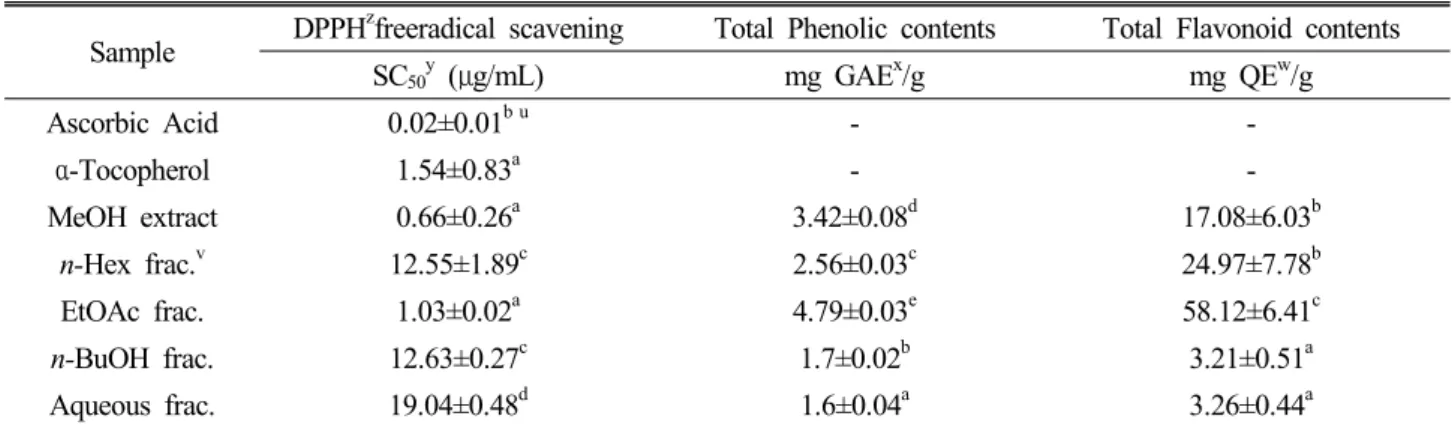
Table 1. Antioxidant activity of extracts and fractions from Sorghum bicolor L.
Sample DPPHzfreeradical scavening Total Phenolic contents Total Flavonoid contents SC50y (μg/mL) mg GAEx/g mg QEw/g
Ascorbic Acid 0.02±0.01b u - -
α-Tocopherol 1.54±0.83a - -
MeOH extract 0.66±0.26a 3.42±0.08d 17.08±6.03b
n-Hex frac.v 12.55±1.89c 2.56±0.03c 24.97±7.78b
EtOAc frac. 1.03±0.02a 4.79±0.03e 58.12±6.41c
n-BuOH frac. 12.63±0.27c 1.7±0.02b 3.21±0.51a
Aqueous frac. 19.04±0.48d 1.6±0.04a 3.26±0.44a
zDPPH: 1,1-diphenyl-2-picrylhydrazyl.
ySC50: Amount required for 50% reduction of DPPH after 30min. Each value is mean ± standard derivation of three replicate tests.
xGAE: gallic acid equivalent, Each value is mean ± standard derivation of three replicate tests.
wQE: gallic acid equivalent, Each value is mean ± standard derivation of three replicate tests.
vFraction of Sorghum bicolor L.
uAny mean in the same column followed by the same letter are not significantly (p<0.05) different by Duncan’s multiple range test.
MTT(3-(4,5-dimethylthiazol-2-yl)-2,5-diphenyltet razolium bromide) 10 μL를 새로운 배지 90 μL와 함께 첨가하여 3시간 동안 배양한 후, 배지를 제거하고 DMSO (Dimethyl sulfoxide) 100 μL를 첨가하여 발색시켜 540 nm에서 흡광도를 측정하였다.
통계분석
모든 생리활성 실험은 동일한 농도로 3반복으로 진행하 였으며, 통계분석은 one-way ANOVA로 분석한 뒤 신뢰 구간 p<0.05에서 Duncan’s multiple range test를 실시 하였다.
결과 및 고찰
DPPH radical 소거능 검정
Free radical인 DPPH는 홀수 전자에 의해 517 nm에서 강한 흡수를 보이나 전자공여체와 반응을 하게 되면 전자 또는 hydrogen radical을 받아 phenoxy radical을 생성 하게 되고, 비가역적으로 결합한 전자 수와 비례하여 탈색 된다. Sample이 free radical을 환원시키거나 상쇄시키는 능력이 크면 높은 항산화 활성 및 활성산소를 비롯한 다른 radical에 대한 소거활성을 기대할 수 있고 인체 내의 활성 산소에 의한 노화를 억제하는 척도로 이용될 수 있다. 붉은 장목수수 분획물의 소거능 검정결과는 MeOH, EtOAc,
n-Hexane, n-BuOH, D.W.순으로 활성을 나타냈으며, MeOH extract(0.66 ± 0.26 μg/mL)와 EtOAc fraction (1.03 ± 0.02 μg/mL)은 positive control로 사용한 α -tocopherol (1.54 ± 0.83 μg/mL)보다 우수한 활성을 나타냈다(Table 1).
총 페놀 및 플라보노이드 함량
페놀과 플라보노이드는 항산화 활성을 가지고 있는 대표 적인 물질로 알려져 있으며 함량과 항산화 활성이 간접적 으로도 알려져 있다. 페놀 함량은 EtOAc, MeOH, n-Hexane, n-BuOH, D.W. fraction순으로 함유하며, 플라보노이드 함량은 EtOAc, n-Hexane, MeOH, D.W., n-BuOH fraction 순으로 함량이 나타나 EtOAc fraction(4.79 ± 0.03 mg/g and 58.12 ± 6.41 mg/g)의 총 페놀과 플라보노이드의 함 량이 가장 높은 것을 확인하였다. 또한 n-BuOH fraction 과 D.W. fraction의 총 페놀 및 플라보노이드의 함량은 크 게 높이 함유하고 있지는 않았다(Table 1).
환원력 측정
환원력은 일반적으로 수소원자에 의해 free radical 사 슬을 끊어서 항산화 기능을 하는 reductones의 존재와 관 련 있으며 reductants의 존재는 Fe3-ferricyanide 혼합물 의 감소를 일으키는 원인이 된다. 즉 ferricyanide 혼합물 이 Fe2로 전환되면서 노란색에서 녹색으로 변하는 prussian
α-Tocoperol zAscorbicAcidyMeOHextract n-Hexane frac. EtOAc frac. n-BuOH frac. D.W.
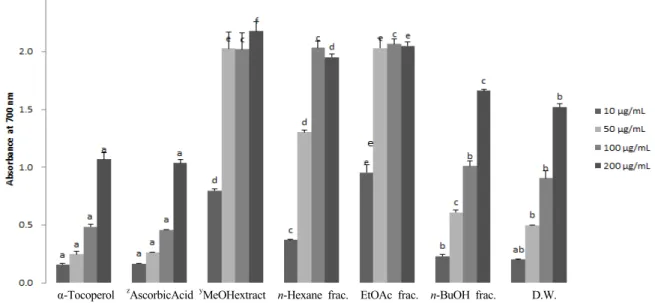
Fig. 1. Reducing power of extract and fractions from Sorghum bicolor M.
zα-tocopherol, yAscorbic acid was used as the positive control(concentration were 5, 10, 20, 50 μg/mL). Each value represents the mean±SD(n=3). a-evalues in the same row not sharing the same superscript are significantly different by Duncan’s multiple range test(p<0.05).
Table 2. Antidiabetic activity of extract and fractions from Sorghum bicolor M.
Sample α-glucosidase inhibition α-amlyase inhibition IC50z (μg/mL) IC50 (μg/mL)
Acarbose 0.000003±0.00a x 6.3±0.3a
MeOH extract 5.34±0.73c 72.89±2.93c
n-Hex frac.y 9.19±0.43d 128.63±20.7d
EtOAc frac. 14.68±4.05e -
n-BuOH frac. 4.05±1.59c 52.9±6.22b
Aqueous frac. 2.83±1.83bc 36.64±5.23b
zIC50: Amount required for 50% inhibition of α-glucosidase and α-amlyase. Each value is mean ± standard derivation of three replicate tests.
yFraction of Sorghum bicolor L.
xAny mean in the same column followed by the same letter are not significantly (p<0.05) different by Duncan’s multiple range test.
blue의 형성을 관찰하고 absorbance 값으로 나타낸다.
MeOH과 n-Hexane, EtOAc는 50 μg/mL부터에서 1.0 abs이상의 흡광값으로 상당한 환원력을 나타내었다. n- BuOH fraction과 D.W. fraction의 경우 시료 처리 농도 가 증가할수록 증가하는 양상을 확인 할 수 있었다(Fig. 1).
α-Glucosidase 저해활성 및 α-Amlyase 저해활성 α-Glucosidase는 흡수되기 쉬운 단당류로 만들기 위해 혼합물 carbohydrate에 있는 glycosidic bonds를 쪼개며,
주로 소장세포의 점막에 존재하는 maltase의 활성을 억제 시킨다. 또한 α-amlyase는 글리코겐 전분의 α-1,4- glycoside결합을 선택적으로 가수분해하여 아밀로오스에 서는 올리고당을 생산하고, 아밀로펙틴, 글리코겐과 같은 분지다당류에서는 외측의 직쇄(a-chain)에서 올리고당을 내부쇄(b-chain, c-chain)에서 분지올리고당을 생성한다.
반응이 진행될수록 전분의 점도는 급속히 저하하며 옥소전 분반응은 청-자-적-황색으로 변화하여 반응액의 환원력 도 증가한다. 올리고당은 다시 저분자화하며 최종적으로는
5-FUz MeOH extract n-Hexane frac. EtOAc frac. n-BuOH frac. D.W.
5-FUz MeOH extract n-Hexane frac. EtOAc frac. n-BuOH frac. D.W.
5-FUz MeOH extract n-Hexane frac. EtOAc frac. n-BuOH frac. D.W.
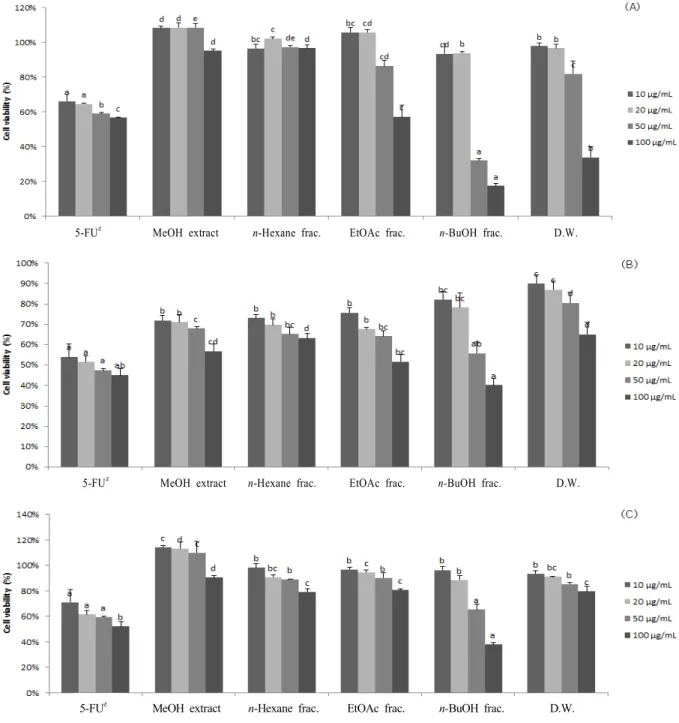
Fig. 2. Cell viability of extracts and fractions from Sorghum bicolor M.
A: AGS(Human stomach cancer cell) B: HT29(human colon cancer cell) C: HCT116(human colon cancer cell). zFluorouracil was used as the positive control(concentration were 1, 5, 10, 100 μg/mL). each value represents the mean±SD(n=3).
maltose를 주성분으로하여 glucose, maltotriose로 분해 된다. 붉은장목수수의 α-glucosidase와 α-amlyase저해 활성은 D.W., n-BuOH, MeOH, n-Hexane, EtOAc fraction 의 순서로 α-glucosidase와 α-amlyase를 억제하였으며, D.W. fraction의 경우 IC50값이 각각 2.83 μg/mL, 36.64 μg/mL의 높은 저해활성을 나타냈다. 그 밖에도 n-BuOH
fraction과 MeOH extract도 α-glucosidase 4.05 μg/mL, 5.34 μg/mL, α-amlyase 52.9 μg/mL, 72.89 μg/mL의 IC50값을 나타내었다. 반면, 항산화 활성에서 뛰어난 활성 을 보인 EtOAc fraction은 α-glucosidase, α-amlyase 저해에 큰 활성을 나타내지 못하였다(Table 2).
MTT assay
MTT는 colorimetic assay로 mitochondrial succinate dehydrogenase에 의해 3-(4,5-dimethylthiazol-2-yl) -2,5-diphenyltetrazolium bromide(MTT)가 환원되는 정도를 측정하는 것으로 세포 독성을 평가하는 실험방법이 다. 본 연구에서는 HCT116(human colon cancer cell), HT29(human colon cancer cell), AGS(Human stomach cancer cell) 세가지 cell line으로 실험을 진행하였다.
Fig. 2에 (A), (B), (C)는 각각 AGS, HT29, HCT116세포 에 대한 fraction의 세포독성을 나타낸 그래프로 모든 세 포에서 EtOAc, n-BuOH, D.W. fraction을 처리한 처리 군에서 독성을 보였고, 그 중 n-BuOH fraction은 농도가 증가할수록 강한 세포독성을 확인할 수 있었다. 또한 MeOH extract의 경우 암세포에 대한 독성을 나타내지 않 는 것을 확인할 수 있었다(Fig. 2).
적 요
본 연구에서는 붉은장목수수(Sorglum Bicolor M.) MeOH 추출물과 분획물들의 다양한 생리활성을 비교하기 위하여 항산화(DPPH assay, 환원력, 총 페놀 및 플라보노이드 함 량), 항당뇨(α-Glucosidase 저해활성 및 α-Amlyase 저 해활성), 항암(MTT assay) 활성을 관찰 하였다. 항산화활 성의 경우 EtOAc fraction이 높은 총 페놀과 플라보노이 드 함량을 나타내었으며, DPPH assay와 reducing power 결과 역시 EtOAc fraction과 MeOH fraction이 positive control로 사용한 α-tocopherol보다 우수한 활성을 나타 냈다. α-Glucosidase, α-amlyase 저해능 평가 결과 D.W.
fraction이 가장 높은 활성을 보였으며 n-BuOH fraction 과 MeOH extract도 활성을 나타내었다. 암세포인 AGS, HT29, HCT116세포주에 대한 세포독성 연구인 MTT assay 에서는 EtOAc, n-BuOH, D.W. fraction을 처리한 처리 구에서 독성을 보였으며 이중 n-BuOH fraction이 모든 세포주에서 농도 의존적으로 세포독성을 가지는 것을 확인 할 수 있었다. 연구결과 붉은장목수수의 추출물 EtOAc fraction의 항산화활성, D.W. fraction의 항당뇨활성, n- BuOH fraction의 암세포에 대한 독성과 관련된 화합물의 분리 및 구조규명에 관한 연구가 필요 할 것으로 사료되어 지며, normal cell에 대한 MTT assay를 진행하여 항암활 성에 관한 연구를 진행하여 붉은장목수수 추출물을 이용한
다양한 건강기능식품과 의약품 개발을 통해 건강 증진과 질병으로부터 보호 받을 수 있을 것으로 기대한다.
사 사
본 연구는 농촌진흥청의 2009년 어젠다과제(PJ007818) 에 의해 수행된 결과의 일부로서 이에 감사드립니다.
인용문헌
Awika, J.M., L. Yang, J.D. Browning and A. Faraj. 2009.
Comparative antioxidant, antiproliferative and phase II enzyme inducing potential of sorghum (Sorghum bicolor) varieties. Food Sci. Technol. 42:1041-1046.
Blois, M.S. 1955. Antioxidant determination by the use of a stable free radical. Nature 181:165.
Chae, K.Y. and J.S. Hong. 2006. Quality characteristics of sulgidduk with different amounts of waxy sorghum flour.
Korean J. Food Cookery Sci. 22:363-369.
Choi, Y.H., M.Y. Kang and S.H. Nam. 1998. Inhibition effect of various cereal and bean extracts on carcinogenicity in vitro. Korean J. Food Sci. Technol. 30:964-969.
Kim, H.S. and Y.H. Kang. 2010. Antioxidant activity of ethanol extracts of non-edible parts (stalk, stem, leaf, seed) from oriental melon. Korean J. Plant Res. 23(5):451-457.
Kim, K.O., H.S. Kim and H.S. Ryu. 2006. Effect of Sorghum bicolor L. Moench(sorghum, su-su) water extracts on mouse immune cell activation. J. Korean Diet. Assoc. 12:82-88.
Kwak, C.S., S.J. Lim, S.A. Kim, S.C. Park and M.S. Lee. 2004.
Antioxidative and antimutagenic effects of Korean buckwheat, sorghum, millet, and job’s tears. J. Korean Soc. Food Sci.
Nutr. 33:921-929.
Moreno, M.I.N., M.I. Isla, A.R. Sampietro and M.A. Vattuone.
2000. Comparison of the free radical-scavenging activity of propolis from several regions of Argentina. J. Ethnopharmacology.
71(1–2):109-114.
Oyaizu, M. 1986. Studies on products of browning reactions:
antioxidative activities of products of browning reaction prepared from glucosamine. Jap. J. Nutr. 44:307-315.
Ryu, H.S., J. Kim and H.S. Kim. 2006. Enhancing effect of Sorghum bicolor L. Moench (sorghum, su su) extracts on mouse spleen and macrophage cell activation. J. Korean Diet. Assoc. 19:176-182.
Sa, Y.J., J.S. Kim, M.O. Kim, H.J. Jeong, C.Y. Yu, D.S. Park
and M.J. Kim. 2010. Comparative study of electron donating ability, reducing power, antimicrobial activity and Inhibition of α-glucosidase by Sorghum bicolor extracts. Korean J.
Food Sci. Technol. 42:598-604.
Taga, M.S., E.E. Miller and D.E. Pratt. 1984. Chia seeds as a source of natural lipid antioxidants. J. Am. Oil Chem. Soc.
61:928-931.
Thannickal, V.J. and B.L. Fanburg. 2000. Reactive oxygen species in cell signaling. Am. J. Physiol. Lung Cell Mol.
Physiol. 279:L1005-L1029.
Yang, Y.J., H.J. Kim, S.H. Kang and S.C. Kang. 2011.
Screening of natural herb resources for anti-oxidative effects in Korea. Korean J. Plant Res. 24:1-9 (in Korean).
(Received 9 November 2012 ; Revised 29 January 2013 ; Accepted 12 February 2013)