JESK
http://jesk.or.kr eISSN:2093-8462Effect of Heel Height and Speed on Gait, and the Relationship Among the Factors and Gait Variables
Sumin Park1, Jaeheung Park1,2
1Department of Transdisciplinary Studies, Seoul National University, Seoul, 08826
2Digital Human Center, Advanced Institutes of Convergence Technology, Suwon, 16229
Corresponding Author Jaeheung Park
Department of Transdisciplinary Studies, Seoul National University, Seoul, 08826 Mobile : +82-10-9077-2947
Email : [email protected]
Received : August 13, 2015 Revised : August 27, 2015 Accepted : October 06, 2015
Objective:This paper investigates gait changes according to different heel heights and speeds, and the interaction between the effects of the heel height and the speed during walking on stride parameters and joint angles. Furthermore, the relationship among heel height, speed and gait variables is investigated using linear regression.
Background: Gait changes by heel height or speed have been studied respectively, but has not been reported whether there is an interaction effect between heel height and speed. It would be necessary to understand how gait changes when a person wears heels in different heights at various speeds, for example, high-heeled walking at fast speed, since it may cause unusual gait patterns and musculoskeletal disorders.
Method: Ten females were asked to walk at five fixed cadences (94, 106, 118, 130 and 142 steps/min.) wearing three shoes with different heel heights (1, 5.4 and 9.8cm). Nineteen gait variables were analyzed for stride parameters and joint angles using two-way repeated measure analysis of variance and regression analysis.
Results: Both heel height and speed affect movement of ankle, knee, spine and elbow joint, as well as stride length and Double/Single support time ratio. However, there is no significant interaction effect between heel height and speed. The regression result shows linear relationships of gait variables with heel height and speed.
Conclusion: Heel height and speed independently affect stride parameters and joint angles without a significant interaction, so the gait variables are linearly amplified or diminished by the two factors.
Application: Walking in high heels at fast speed should be careful for musculoskeletal disorders, since the amplified movement of knee and spine joint can lead to increased moment. Also, the result might give insight for animators or engineers to generate walking motion with high heels at various speeds.
Keywords: Gait analysis, High heels, Walking speed, Interaction effect, Regression analysis
Copyright@2016 by Ergonomics Society of Korea. All right reserved.
○
ccThis is an open-access article distributed under the terms of the Creative Commons Attribution Non-Commercial License (http://creativecommons.org/licenses/by-nc/3.0/), which permits unrestricted non-commercial use, distribution, and reproduction in any medium, provided the original work is properly cited.
1. Introduction
Walking is one of the most basic motion for human, so various studies to understand the walking mechanics have been carried out for different purposes. In addition, walking in particular conditions and factors bas been studied, since the walking is changed by shoes, speed, age, mental status, and etc.
Perry analyzed what normal gait is and how different the normal gait is with pathological gait by deformity, muscle weakness, impaired control, and pain for orthopedics and physical therapy (Perry, 1992). The study indicated that human has heel strike at initial contact in which ankle dorsi flexion occurs and toe off at terminal stance in which ankle plantar flexion occurs. However, stroke patients frequently show foot-drop in the paretic limb because of the excessive ankle plantar flexion at the stance and swing phase. It is difficult for stroke patients to switch from ankle plantar flexion to ankle dorsi flexion rapidly and smoothly, so rehabilitation of walking is performed for them (Intiso et al., 1994).
Gender differences during walking and running have been studied in the field of sport sciences and sports medicine, as female runners are reported to sustain patellofemoral pain syndrome and iliotibial band friction twice compared to male runners (Taunton et al., 2002; Ferder et al., 2003). Chumanov et al. presented that female and male have different walking and running mechanics on level and inclined surfaces, indicating greater non-sagittal motion for females (Chumanov et al., 2008). The non-sagittal motion such as hip internal rotation may result in misalignment of the patellofemoral joint, which leads to anterior knee pain (Tiberio, 1987). Wunderlich et al. indicated that foot function during walking is different between female and male (Wunderlich et al., 2008).
In the study, females show higher peak pressures in the first metatarsal, which may be related to overuse injuries.
The studies about gait change when wearing different shoes have been focused for ergonomics and biomechanics, since the changed walking mechanics could reduce efficiency of locomotion and lead to musculoskeletal disorders. Walking when wearing soft-soled, rigid-soled, medium-heeled and high-heeled shoes were analyzed by Soames and Evans (Soames and Evans, 1987).
The movement range of the foot decreases when wearing high-heeled shoes compared to medium-heeled shoes, and it becomes greater when wearing soft-soled shoes than when wearing rigid-soled shoes. The gait pattern in particular when wearing shoes with a rounded soft sole was studied (Demura et al., 2012). In the study, it is shown that step width and walking angle increase when wearing shoes with a rounded soft sole compared to flat-bottomed shoes, and range of motion for the hip and the knee flexion reduce. Park et al. indicated that wearing high heels generates excessively bent knee joint during the stance phase and short stride length, which finally lead slow walking speed and less efficient locomotion (Park et al., 2013). The effect of high-heeled shoes on lumbar lordosis has been reviewed by Russell (Russell, 2010). The literature review explained that high-heeled walking can cause an increase of the lordotic curve of the lumbar spine with low back pain. Furthermore, Kim et al. illustrated that walking pattern considerably changes according to different shoes, so a gait recognition algorithm could categorize the different shoes (Kim et al., 2013).
Meanwhile, walking at fast speed and slow speed has been compared to understand walking mechanics and stability change at different speeds. Stride length and vertical ground reaction force at peak increased as walking speed increases, while stride time and vertical impulse decreased as the speed increases (Jordan et al., 2007). For lower limb, hip flexion/extension and knee flexion increased at fast speed, although ankle dorsi/plantar flexion had no significant differences (Chung and Wang, 2010). In case of center of motion (COM) displacement at a faster speed, vertical COM fluctuates more, but mediolateral COM does less (Orendurff et al., 2004). England and Granata suggested that dynamic stability during walking is affected by gait velocity and increases at slower velocities (England and Granata, 2007).
Also, gait of the elderly has been shown to have a larger variability of stride width and step length than young adults (Grabiner et al., 2001), because of the loss of muscle strength and flexibility (Kang and Dingwell, 2008). The study by Cluss et al. presented that emotions of anger and joy generate greater stride length and velocity than those of sad and neutral states (Cluss et al., 2006).
Similarly, it is shown by Montepare et al. that the stride length and the arm swing become greater at angry gait and decrease at sad gait, meanwhile standing up straight is noticeable at proud gait (Montepare et al., 1987).
As indicated above, human walking could be changed and categorized by various factors and conditions. Some conditions exaggerate gait motion which may increase risk of musculoskeletal diseases, whereas other factors constrain movement of walking
which may decrease efficiency of locomotion. Therefore, the purpose of this study is to analyze gait change by two different factors which are heel height and speed. The interaction effect between the heel height and the speed on gait is investigated additionally, because particular gait change by one factor might be diminished or amplified by another factor. Furthermore, a unique walking could be generated by two combined factors. Finally, statistical relationships among gait variables and the particular conditions of walking are derived by multiple linear regression.
In this study, the heel height and the speed are focused among numerous factors during gait. High-heeled footwear is typically worn today for aesthetic reasons. Moreover, the number of men in heels has been increased including a heel insert. Analyzing the effects of heel height and speed is necessary to understand the walking mechanics with high-heeled shoes at various speeds, which may result in musculoskeletal disorders. Also, this study could give insights for animators or engineers to generate a fast walking or high-heeled walking using the linear relationship among gait variables and the factors.
2. Method 2.1 Subjects
Ten females with the average age of 21.5 ± 0.85 years, the average height of 159.88 ± 4.45cm, the average weight of 50.1 ± 3.31kg and the average shoes size of 234.5 ± 2.84mm participated in this study. The values nearly correspond with the statistics from the Korea National Statistical Office in the 20 to 24 age group (height: 160.40 ± 5.27cm, weight: 53.1 ± 7.96kg, feet length:
230.0 ± 9.8mm). Because of the small deviation in the leg length (84.8 ± 2.1cm), the effect of the leg length on gait has been ignored (Murray et al., 1964). The subjects reported no musculoskeletal or neurological injuries and had much experience of walking with various types of shoes and heels. The written consent for the subjects was approved by the Institutional Review Board of Seoul National University.
2.2 Instrumentation
Walking data were captured using VICON motion capture system with 12 cameras on a 5m walkway at 100Hz (VICON T160, VICON Motion Systems, Oxford, UK). Plug-in-Gait Marker set was used to obtain kinematic information using 35 reflective markers of 14mm spheres. Three shoes with different heel heights were utilized for experiment (Flat shoes with a sole of 1cm height, medium heels with 5.4cm height and high heels with 9.8cm height).
2.3 Procedures
In this study, cadence was controlled for speed change during experiment. Subjects were asked to walk at five fixed cadences from slow (94 steps/min.) to fast (142 steps/min.) hearing the sound of a metronome at each type of shoes. The normal cadence was determined to 118 steps/min. which is known as the average cadence for women (Perry, 1992). Slow cadences were chosen to be 10% slower speed (106 steps/min.) and 20% slower speed (94 steps/min.) compared to the normal walking. Fast cadences were chosen to be 130 and 142 steps/min. in a similar way. Before capturing motion, subjects had sufficient training time to adapt to the experimental shoes and the five fixed cadences. Average cadences of the subjects were 95.25 ± 3.27, 106.90 ± 2.37, 118.57 ± 3.13, 129.50 ± 2.99 and 140.10 ± 4.53 steps/min. respectively for the five cadences.
2.4 Data process and statistical analysis
From the attached marker positions and anthropometric data of the subjects (height, weight, leg length, knee width, ankle width, and etc.), body segments and joint positions were obtained, and then joint angles were calculated by relative movement between
two connected body segments using VICON Nexus software and Plug-in-Gait Model. Nexus software uses a cubic spline to interpolate data, and applies Woltring filter to filter the data (Woltring, 1986). The filter is commonly used in a field of motion analysis (Hughes et al., 2012). Then, VICON Polygon software were used to obtain stride parameters and to normalize the data in a cycle based on a left leg. Double/Single support time ratio (unitless), which is double support time (sec.) divided by single support time (sec.), is calculated to investigate an absolute change of the support time. Average, maximum value, minimum value and range of motion (ROM) for the joint angles were calculated depending on gait phases (swing phase/stance phase) using MATLAB (MathWorks, Massachusetts, USA). Two-way repeated measure analysis of variance (Two-way repeated measure ANOVA) with paired T-test and multiple linear regression (stepwise selection) were performed using SPSS statistics (IBM, New York, USA).
The significance level was less than 0.05.
3. Results
3.1 Gait change according to two factors; heel height and cadence
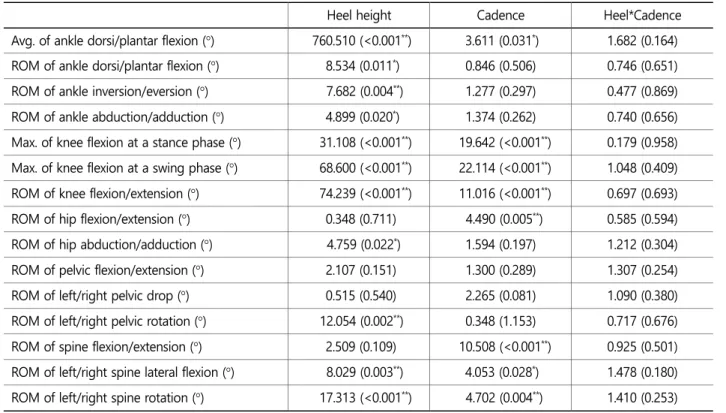
Stride parameters and joint angles were analyzed using two-way repeated measure ANOVA according to two factors; heel height and cadence. The statistical significances of gait change are shown in Table 1.
It shows that both the heel height and the cadence changed the following gait variables; average of ankle dorsi/plantar flexion, maximum knee flexion at a stance phase, maximum knee flexion at a swing phase, ROM of knee flexion/extension, ROM of spine lateral flexion, ROM of spine rotation, ROM of elbow flexion/extension, stride length and Double/Single support time ratio.
However, there was no interaction effect between the heel height and the cadence for those gait variables.
Table 1. Two-way repeated measure ANOVA according to heel height and cadence
Heel height Cadence Heel*Cadence
Avg. of ankle dorsi/plantar flexion (°) 760.510 (<0.001**) 3.611 (0.031*) 1.682 (0.164) ROM of ankle dorsi/plantar flexion (°) 8.534 (0.011*) 0.846 (0.506) 0.746 (0.651) ROM of ankle inversion/eversion (°) 7.682 (0.004**) 1.277 (0.297) 0.477 (0.869) ROM of ankle abduction/adduction (°) 4.899 (0.020*) 1.374 (0.262) 0.740 (0.656) Max. of knee flexion at a stance phase (°) 31.108 (<0.001**) 19.642 (<0.001**) 0.179 (0.958) Max. of knee flexion at a swing phase (°) 68.600 (<0.001**) 22.114 (<0.001**) 1.048 (0.409) ROM of knee flexion/extension (°) 74.239 (<0.001**) 11.016 (<0.001**) 0.697 (0.693) ROM of hip flexion/extension (°) 0.348 (0.711) 4.490 (0.005**) 0.585 (0.594) ROM of hip abduction/adduction (°) 4.759 (0.022*) 1.594 (0.197) 1.212 (0.304) ROM of pelvic flexion/extension (°) 2.107 (0.151) 1.300 (0.289) 1.307 (0.254) ROM of left/right pelvic drop (°) 0.515 (0.540) 2.265 (0.081) 1.090 (0.380) ROM of left/right pelvic rotation (°) 12.054 (0.002**) 0.348 (1.153) 0.717 (0.676) ROM of spine flexion/extension (°) 2.509 (0.109) 10.508 (<0.001**) 0.925 (0.501) ROM of left/right spine lateral flexion (°) 8.029 (0.003**) 4.053 (0.028*) 1.478 (0.180) ROM of left/right spine rotation (°) 17.313 (<0.001**) 4.702 (0.004**) 1.410 (0.253)
Additionally, the heel height affected frontal plane movements and transverse plane movements in general. The frontal plane movements were ankle inversion/eversion, hip abduction/adduction and step width. The transverse plane movements were ankle abduction/adduction and left/right pelvic rotation. On the other hand, sagittal plane movements such as hip flexion/extension and spine flexion/extension were influenced by the cadence.
ROM of Pelvic flexion/extension and ROM of left/right pelvic drop were not changed by the heel height or the cadence during walking.
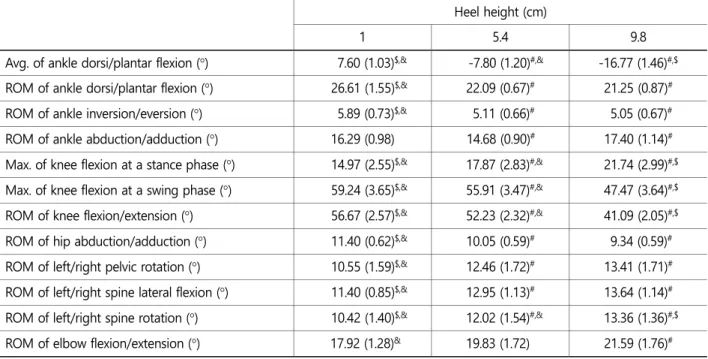
Descriptive statistics of the gait variables according to the heel height or the cadence are presented in Table 2 and Table 3 with statistical significances from paired T-test. From the tables, it is indicated that there are increasing or decreasing tendencies according to the factors.
Table 1. Two-way repeated measure ANOVA according to heel height and cadence (Continued)
Heel height Cadence Heel*Cadence
ROM of elbow flexion/extension (°) 4.896 (0.020*) 15.274 (<0.001**) 0.434 (0.441)
Stride length (m) 10.217 (0.001**) 4.474 (0.040*) 0.721 (0.673)
Step width (m) 40.968 (<0.001**) 0.378 (0.823) 2.027 (0.055)
Double/Single support time ratio 36.299 (<0.001**) 24.488 (<0.001**) 1.513 (0.168) Data are expressed as F (P).
* and ** significant at
p
< 0.05 andp
< 0.01 respectively.Table 2. Descriptive statistics of gait variables at different heel heights (n=50 for each heel height) Heel height (cm)
1 5.4 9.8
Avg. of ankle dorsi/plantar flexion (°) 7.60 (1.03)$,& -7.80 (1.20)#,& -16.77 (1.46)#,$
ROM of ankle dorsi/plantar flexion (°) 26.61 (1.55)$,& 22.09 (0.67)# 21.25 (0.87)# ROM of ankle inversion/eversion (°) 5.89 (0.73)$,& 5.11 (0.66)# 5.05 (0.67)# ROM of ankle abduction/adduction (°) 16.29 (0.98) 14.68 (0.90)# 17.40 (1.14)# Max. of knee flexion at a stance phase (°) 14.97 (2.55)$,& 17.87 (2.83)#,& 21.74 (2.99)#,$
Max. of knee flexion at a swing phase (°) 59.24 (3.65)$,& 55.91 (3.47)#,& 47.47 (3.64)#,$
ROM of knee flexion/extension (°) 56.67 (2.57)$,& 52.23 (2.32)#,& 41.09 (2.05)#,$
ROM of hip abduction/adduction (°) 11.40 (0.62)$,& 10.05 (0.59)# 9.34 (0.59)# ROM of left/right pelvic rotation (°) 10.55 (1.59)$,& 12.46 (1.72)# 13.41 (1.71)# ROM of left/right spine lateral flexion (°) 11.40 (0.85)$,& 12.95 (1.13)# 13.64 (1.14)# ROM of left/right spine rotation (°) 10.42 (1.40)$,& 12.02 (1.54)#,& 13.36 (1.36)#,$
ROM of elbow flexion/extension (°) 17.92 (1.28)& 19.83 (1.72) 21.59 (1.76)#
3.2 Relationship among gait variables, heel height and cadence
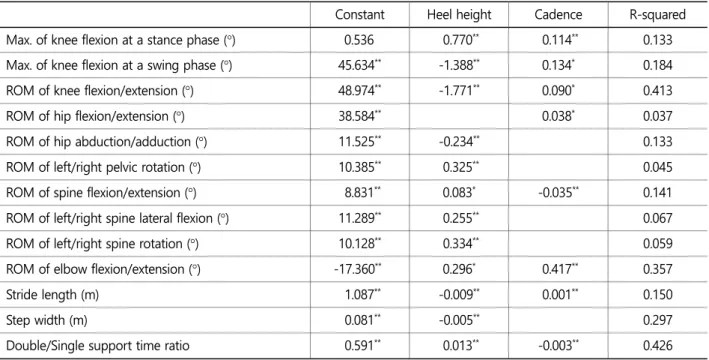
Multiple linear regression analysis was performed for the gait variables in Table 1. Before the regression analysis, scatter plot and Pearson's correlation coefficient were examined. Table 4 presents regression coefficients to show the linear relationship among the gait variables, the heel height and/or the cadence.
Table 2. Descriptive statistics of gait variables at different heel heights (n=50 for each heel height) (Continued) Heel height (cm)
1 5.4 9.8
Stride length (m) 1.242 (0.031)& 1.210 (0.024)& 1.162 (0.026)#,$
Step width (m) 0.087 (0.010)$,& 0.068 (0.010)#,& 0.038 (0.008)#,$
Double/Single support time ratio 0.232 (0.017)$,& 0.281 (0.022)#,& 0.349 (0.025)#,$
Data are expressed as average (standard deviation).
#, $ and & significantly different from the matching 1, 5.4 and 9.8cm respectively (
p
< 0.05).Table 3. Descriptive statistics of gait variables at different cadence (n=30 for each cadence) Cadence (steps/min.)
94 106 118 130 142
Avg. of ankle dorsi/plantar flexion (°) -6.11 (1.27) -6.06 (1.25)&,/,< -5.61 (1.27)$ -5.29 (1.10)$ -5.21 (1.11)$ Max. of knee flexion at a stance phase (°) 15.24 (3.15)&,/,< 16.70 (2.87)&,/,< 18.72 (2.90)#,$,< 19.70 (2.54)#,$,< 20.61 (2.41)#,$,&,/
Max. of knee flexion at a swing phase (°) 49.88 (3.88)$,&,/,< 53.59 (3.57)#,/,< 54.76 (3.74)# 56.20 (3.35)#,$ 56.60 (3.29)#,$
ROM of knee flexion/extension (°) 46.64 (2.22)$,&,/,< 50.01 (2.51)# 50.54 (2.51)# 51.51 (2.05)# 51.27 (1.96)# ROM of hip flexion/extension (°) 41.32 (0.81)$,&,/ 43.22 (0.90)# 43.89 (0.94)# 43.81 (0.78)# 43.33 (1.04) ROM of spine flexion/extension (°) 5.90 (0.52)/,< 5.42 (0.50)/,< 5.41 (0.42)/,< 4.58 (0.41)#,$,& 4.19 (0.37)#,$,&
ROM of left/right spine lateral flexion (°) 11.95 (1.08)$,&,/ 12.66 (1.10)# 13.16 (1.10)# 13.07 (1.00)# 12.48 (0.78) ROM of left/right spine rotation (°) 10.46 (1.42)$,&,/,< 11.93 (1.50)# 12.32 (1.12)# 12.07 (1.61)#,< 12.89 (1.55)#,/
ROM of elbow flexion/extension (°) 12.76 (0.96)$,&,/ 15.22 (1.30)&,/,< 20.81 (1.56)#,$ 23.97 (2.36)#,$ 26.13 (2.90)#,$
Stride length (m) 1.152 (0.029)$,&,/ 1.200 (0.026)#,& 1.225 (0.027)#,$ 1.221 (0.025)# 1.226 (0.034) Double/Single support time ratio 0.381 (0.028)$,&,/,< 0.303 (0.022)#,/,< 0.288 (0.021)#,/,< 0.245 (0.021)#,$,& 0.219 (0.022)#,$,&
Data are expressed as average (standard deviation).
#, $, &, / and < significantly different from the matching 94, 106, 118, 130 and 142 steps/min. respectively (p < 0.05).
Table 4. Linear regression for relationship among gait variables, heel height and cadence (n=150)
Constant Heel height Cadence R-squared
Avg. of ankle dorsi/plantar flexion (°) 9.300** -2.769** 0.854
ROM of ankle dorsi/plantar flexion (°) 26.601** -0.608** 0.240
Maximum knee flexion at a stance phase (Figure 1(a)) and ROM of elbow flexion/extension had a positive relationship with the increase of both the heel height and the cadence. Maximum of knee flexion at a swing phase (Figure 1(b)), ROM of knee flexion/
extension and stride length had a negative relationship with the increase of heel height, but had a positive relationship with the cadence increase. While, ROM of spine flexion/extension and Double/Single support time ratio (Figure 1(c)) had a positive relationship with the increase of heel height, but had a negative relationship with the cadence increase.
ROM of left/right pelvic rotation, ROM of left/right spine lateral flexion (Figure 1(d)) and ROM of left/right spine rotation had a positive tendency only with the heel height increase. Average of ankle dorsi/plantar flexion, ROM of ankle dorsi/plantar flexion, ROM of hip abduction/adduction and step width (Figure 1(e)) had a negative tendency only with the heel height increase. In case of ROM of hip flexion/extension (Figure. 1(f)), there was a minor positive tendency only with the cadence increase, especially for medium-heeled and high-heeled shoes.
In summary, Table 5 shows the list of the gait variables affected by heel height and/or cadence and a dominant tendency (increasing or decreasing) by the factors for each plane.
4. Discussion
This research aims to investigate gait change by two factors; heel height and cadence, and the interaction effect between the factors during walking. It derives statistical relationships among gait variables, the heel height and the cadence by multiple linear regression.
Table 2 shows gait change according to the heel height. It indicates that the stride length and the maximum knee flexion at a swing phase decrease, and the maximum knee flexion at a stance phase increases when wearing high heels. Similarly, Gehlsen et Table 4. Linear regression for relationship among gait variables, heel height and cadence (n=150) (Continued)
Constant Heel height Cadence R-squared
Max. of knee flexion at a stance phase (°) 0.536 0.770** 0.114** 0.133
Max. of knee flexion at a swing phase (°) 45.634** -1.388** 0.134* 0.184
ROM of knee flexion/extension (°) 48.974** -1.771** 0.090* 0.413
ROM of hip flexion/extension (°) 38.584** 0.038* 0.037
ROM of hip abduction/adduction (°) 11.525** -0.234** 0.133
ROM of left/right pelvic rotation (°) 10.385** 0.325** 0.045
ROM of spine flexion/extension (°) 8.831** 0.083* -0.035** 0.141
ROM of left/right spine lateral flexion (°) 11.289** 0.255** 0.067
ROM of left/right spine rotation (°) 10.128** 0.334** 0.059
ROM of elbow flexion/extension (°) -17.360** 0.296* 0.417** 0.357
Stride length (m) 1.087** -0.009** 0.001** 0.150
Step width (m) 0.081** -0.005** 0.297
Double/Single support time ratio 0.591** 0.013** -0.003** 0.426
* and ** significant at
p
< 0.05 andp
< 0.01 respectivelyTable 5. Gait variables affected by heel height and/or cadence and a dominant tendency Gait variables affected by following factors
By both heel height and cadence By only heel height By only cadence Movement in
Sagittal plane Avg Ank(-), Kn Flex ST(+), Kn Flex SW(-),
Kn Flex(-), Elb Flex(+) Ank Flex(-) Hp Flex(+), Spn Flex(-)
Movement in
Frontal plane Spn Abd(+) Ank Inv(x), Hp Abd(-)
Figure 1. Gait variables according to heel height (cm) and cadence (steps/min.); (a) maximum of knee flexion at a stance phase, (b) maximum of knee flexion at a swing phase, (c) Double/Single support time ratio, (d) ROM of left/right spine lateral flexion, (e) step width and (f) ROM of hip flexion/extension
al. reported that step length and range of knee flexion/extension at a swing phase decrease when wearing high heels compared to barefoot or running shoes. However, range of knee flexion/extension at a stance phase was not significant in the study (Gehlsen et al., 1986). It is considered that difference of the results is due to difference of experimental shoes for high heels. In this study, all the subjects were asked to wear the identical high heels with 9.8cm heel height, whereas the subjects provided their own high heels within 6.0 to 10.7cm heel height in the study of Gehlsen et al. The heel height of 6cm may not be enough to influence the knee joint movement during a stance phase.
Double/Single support time ratio increases at high-heeled walking, and the result is consistent with the study of Chien et al. The study presents that double support time increases, but single support time decreases when wearing heeled shoes (3.9, 6.3 and 7.3cm) compared to barefoot condition (Chien et al., 2013). It would be reasonable that the Double/Single support time ratio increases during high-heeled gait, since the high heels reduce static balance (Gerber et al., 2012). Also, Gefen et al. (2002) reported that high-heeled shoe wearers are more vulnerable to fatigue for peroneus longus, which decreases the stability of the feet.
Therefore, it would be necessary to increase double support time in order to ensure the stability during high-heeled walking.
Meanwhile, Table 3 shows gait change according to the cadence. It presents that ROM of hip flexion/extension, ROM of knee flexion/extension and stride length increase as the cadence increases. Chung and Wang showed the consistent result, in which hip flexion, hip extension and knee flexion increase as walking speed increases (Chung and Wang, 2010). In addition, the study indicated that vertical ground reaction force increases with the walking speed increase, which represents the increased demand in lower extremity muscles. Jordan et al. also indicated that stride length increases with increasing speed, which is associated with an increase in muscle stress (Jordan et al., 2007).
As Table 2 and Table 3 show, both the heel height and the cadence change gait variables. Nevertheless, the factors are independent without the interaction effect as Table 1 presents. Therefore, most gait variables amplify or diminish linearly by the heel height and/or the cadence. The maximum knee flexion at a stance phase increases when wearing high heels, as well as increasing cadence.
Therefore, high-heeled walking at fast speed shows significantly bent knee joint at the stance phase (Figure 1 (a)), which may lead to accumulative musculoskeletal injuries (Yu et al., 2010). In case of the maximum knee flexion at a swing phase, it increases by increasing the cadence, although it decreases by increasing heel height of shoes. Also, the effect of cadence on the maximum knee flexion at a swing phase is noticeable when wearing high heels (Figure 1(b)). Finally, the maximum knee flexion of high- heeled walking at fast cadence has the comparable maximum knee flexion of medium-heeled walking at slow cadence during Table 5. Gait variables affected by heel height and/or cadence and a dominant tendency (Continued)
Gait variables affected by following factors
By both heel height and cadence By only heel height By only cadence Movement in
Transverse plane Spn Rot(+) Ank Abd(x), Plv Rot(+)
Stride parameters Std L(-), STR(-) Stp W(-)
Avg Ank: Avg. of ankle dorsi/plantar flexion (°), Ank Flex: ROM of Ankle flexion/extension (°), Ank Inv: ROM of ankle inversion/
eversion (°), Ank Abd: ROM of ankle abduction/adduction (°), Kn Flex ST: maximum of knee flexion at a stance phase (°), Kn Flex SW: maximum of knee flexion at a swing phase (°), Kn Flex: ROM of knee flexion/extension (°), Hp Flex: ROM of hip flexion/
extension (°), Hp Abd: ROM of hip abduction/adduction (°), Plv Rot: ROM of left/right pelvic rotation (°), Spn Flex: ROM of spine flexion/extension (°), Spn Abd: ROM of left/right spine lateral flexion (°), Spn Rot: ROM of left/right spine rotation (°), Elb Flex: ROM of elbow flexion/extension (°), Std L: Stride length (m), Stp W: Step width (m), STR: Double/Single support time ratio
(+): increasing tendency, (-): decreasing tendency, (x): uncertain tendency
a swing phase.
In order to increase walking speed, the efficiency of locomotion should be improved by increasing stride length and/or decreasing stride time. However, it is considered that high-heeled walking at fast speed has a limitation to improve the efficiency of locomotion, because it is hard to increase stride length when wearing high heels. In addition, the increased double support time disturbs to walk dynamically and to switch the center of motion of the body quickly (Figure 1 (c)). Despite of the reduced efficiency of locomotion at high-heeled walking, muscle stress and fatigue seem to be amplified considerably (Gefen et al., 2002; Jordan et al., 2007). Therefore, it is suggested that people should be careful of high-heeled running or walking at fast speed.
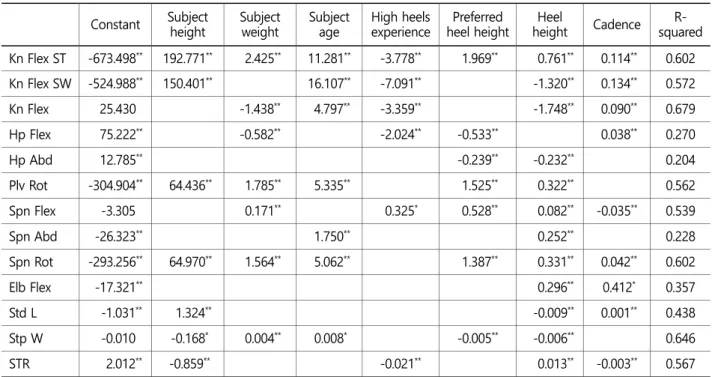
Table 4 shows the linear relationships among the gait variables, the heel height and the cadence. However, it does not signify that all the gait variables are essential parameters to represent characteristics of high-heeled walking or fast walking. The parameters with high R-squared value could be considered to be essential, because low R-squared value means that there might be other factors to explain gait patterns' change. Thus, ankle dorsi/plantar flexion, knee flexion/extension, elbow flexion/extension, step width and Double/Single support time ratio could be considered as particular parameters according to heel height and/or cadence.
Curved regression analysis was also performed, but the results were not distinguishable compared to that of linear regression in coefficient of determination (R-squared). However, ROM of ankle abduction/adduction additionally show curved relationship with the heel height (Constant: 15.408*, Heel height-squared: 0.17**, R-squared: 0.033, * and ** significant at
p
< 0.05 andp
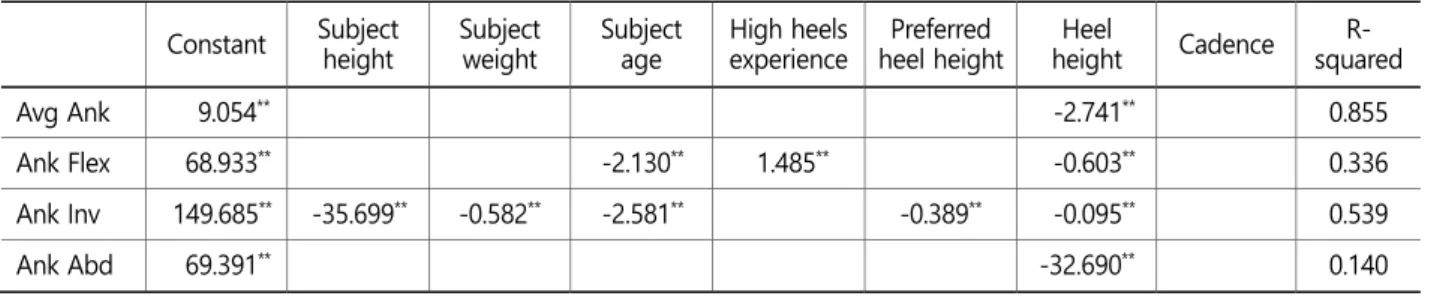
< 0.01 respectively). In this study, individual's characteristics has been ignored, since the subjects are in the similar range of the body size and the age. However, when the subject's information (height, weight, age, period of use for high heels and preferred heel height) is included for multiple linear regression, some gait variables show relationships with the factors and increased R-squared value (Table 6). It is considered that individual's characteristics influence gait patterns' change comparatively.Additionally, it would be better to check other factors affecting on gait, such as weather of the experiment day or errors from instrumentation and procedures. There are some errors from marker attachment for measurement during long experiment time, including movement of a marker position on the skin or clothes, reattachment by a detached marker. Also, the shoes in the experiment are made of different materials, manufacturers, and design of top side. These could be categorized and applied as others factors for future experiments to obtain better regression results.
The results from ANOVA and T-test are significant as shown in Table 2 and Table 3 although the standard deviation of data has large variability. The large variability might be due to a small size of subjects for experiment. In addition, each subject has considerably different gait patterns and range of motion, which generates large variability. However, the effect of heel height and cadence is indicated to be significant from the analysis using repeated measure ANOVA.
Table 6. Regression for relationship among gait variables, heel height and speed (n=150) Constant Subject
height Subject
weight Subject
age High heels
experience Preferred
heel height Heel
height Cadence R- squared
Avg Ank 9.054** -2.741** 0.855
Ank Flex 68.933** -2.130** 1.485** -0.603** 0.336
Ank Inv 149.685** -35.699** -0.582** -2.581** -0.389** -0.095** 0.539
Ank Abd 69.391** -32.690** 0.140
In this study, cadence was employed instead of speed during experiment to control stride frequency of a cycle. Although cadence is different from speed, it is considered to be appropriate for experiment since several studies indicated that cadence is not affected by high heels at preferred walking speed, but stride length is shortened by high heels which finally create decreased walking speed (Sato, 1991; Adrian and Karpovich, 1966). Therefore, controlling cadence is used for investigating gait change under heel height and speed differences.
5. Conclusion
Analyzing gait change by particular factors and the interaction effect between the factors would be necessary to understand the way of adaptation for walking under the particular conditions. In this paper, gait analysis was conducted especially for the condition of different heel heights and cadences. The results show that the two factors independently affect gait variables in the linear relationship, so the gait variables are linearly amplified or diminished. For future study, custom-designed shoes might be manufactured so that effects of specific factors of shoes can be exclusively investigated. Also, other equipment such as force plates and EMGs will be utilized to obtain kinetic data during walking.
Table 6. Regression for relationship among gait variables, heel height and speed (n=150) (Continued) Constant Subject
height Subject
weight Subject
age High heels
experience Preferred
heel height Heel
height Cadence R- squared Kn Flex ST -673.498** 192.771** 2.425** 11.281** -3.778** 1.969** 0.761** 0.114** 0.602 Kn Flex SW -524.988** 150.401** 16.107** -7.091** -1.320** 0.134** 0.572
Kn Flex 25.430 -1.438** 4.797** -3.359** -1.748** 0.090** 0.679
Hp Flex 75.222** -0.582** -2.024** -0.533** 0.038** 0.270
Hp Abd 12.785** -0.239** -0.232** 0.204
Plv Rot -304.904** 64.436** 1.785** 5.335** 1.525** 0.322** 0.562
Spn Flex -3.305 0.171** 0.325* 0.528** 0.082** -0.035** 0.539
Spn Abd -26.323** 1.750** 0.252** 0.228
Spn Rot -293.256** 64.970** 1.564** 5.062** 1.387** 0.331** 0.042** 0.602
Elb Flex -17.321** 0.296** 0.412* 0.357
Std L -1.031** 1.324** -0.009** 0.001** 0.438
Stp W -0.010 -0.168* 0.004** 0.008* -0.005** -0.006** 0.646
STR 2.012** -0.859** -0.021** 0.013** -0.003** 0.567
* and ** significant at
p
< 0.05 andp
< 0.01 respectivelyAvg Ank: Avg. of ankle dorsi/plantar flexion (°), Ank Flex: ROM of Ankle flexion/extension (°), Ank Inv: ROM of ankle inversion/
eversion (°), Ank Abd: ROM of ankle abduction/adduction (°), Kn Flex ST: maximum of knee flexion at a stance phase (°), Kn Flex SW: maximum of knee flexion at a swing phase (°), Kn Flex: ROM of knee flexion/extension (°), Hp Flex: ROM of hip flexion/
extension (°), Hp Abd: ROM of hip abduction/adduction (°), Plv Rot: ROM of left/right pelvic rotation (°), Spn Flex: ROM of spine flexion/extension (°), Spn Abd: ROM of left/right spine lateral flexion (°), Spn Rot: ROM of left/right spine rotation (°), Elb Flex:
ROM of elbow flexion/extension (°), Std L: Stride length (m), Stp W: Step width (m), STR: Double/Single support time ratio.
References
Adrian, M.J. and Karpovich, P.V., Foot instability during walking in shoes with high heels,
Research Quarterly. American Association for Health, Physical Education and Recreation
, 37(2), 168-175, 1966.Chien, H.L., Lu, T.W. and Liu, M.W., Control of the motion of the body's center of mass in relation to the center of pressure during high-heeled gait,
Gait and Posture
, 38(3), 391-396, 2013.Chumanov, E.S., Wall-Scheffler, C. and Heiderscheit, B.C., Gender differences in walking and running on level and inclined surfaces,
Clinical Biomechanics
, 23(10), 1260-1268, 2008.Chung, M.J. and Wang, M.J.J., The change of gait parameters during walking at different percentage of preferred walking speed for healthy adults aged 20~60 years,
Gait and Posture
, 31(1), 131-135, 2010.Cluss, M.B., Crane, E.A., Gross, M.M. and Fredrickson, B.L., Effect of emotion on the kinematics of gait,
American Society of Biomechanics
, 2006.Demura, T., Demura, S.I., Yamaji, S., Yamada, T. and Kitabayashi, T., Gait characteristics when walking with rounded soft sole shoes,
The Foot
, 22(1), 18-23, 2012.England, S.A. and Granata, K.P., The influence of gait speed on local dynamic stability of walking,
Gait and Posture
, 25(2), 172-178, 2007.Ferber, R., Davis, I.M. and Williams Iii, D.S., Gender differences in lower extremity mechanics during running,
Clinical Biomechanics
, 18(4), 350-357, 2003.Gefen, A., Megido-Ravid, M., Itzchak, Y. and Arcan, M., Analysis of muscular fatigue and foot stability during high-heeled gait,
Gait and Posture
, 15(1), 56-63, 2002.Gehlsen, G., Braatz, J.S. and Assmann, N., Effects of heel height on knee rotation and gait,
Human Movement Science
, 5(2), 149- 155, 1986.Gerber, S.B., Costa, R.V., Grecco, L.A.C., Pasini, H., Marconi, N.F. and Oliveira, C.S., Interference of high-heeled shoes in static balance among young women,
Human movement science
, 31(5), 1247-1252, 2012.Grabiner, P.C., Biswas, S.T. and Grabiner, M.D., Age-related changes in spatial and temporal gait variables,
Archives of physical medicine and rehabilitation
, 82(1), 31-35, 2001.Hughes, C.M., Seegelke, C., Spiegel, M.A., Oehmichen, C., Hammes, J. and Schack, T., Corrections in grasp posture in response to modifications of action goals,
Plos On
e, 2012.Intiso, D., Santilli, V., Grasso, M.G., Rossi, R. and Caruso, I., Rehabilitation of walking with electromyographic biofeedback in foot- drop after stroke,
Stroke
, 25(6), 1189-1192, 1994.Jordan, K., Challis, J.H. and Newell, K.M., Walking speed influences on gait cycle variability,
Gait and Posture
, 26(1), 128-134, 2007.Kang, H.G. and Dingwell, J.B., Effects of walking speed, strength and range of motion on gait stability in healthy older adults,
Journal of Biomechanics
, 41(14), 2899-2905, 2008.Kim, M., Kim, M., Park, S., Kwon, J. and Park, J., Feasibility study of gait recognition using points in three-dimensional space,
International Journal of Fuzzy Logic and Intelligent Systems
, 13(2), 124-132, 2013.Montepare, J.M., Goldstein, S.B. and Clausen, A., The identification of emotions from gait information,
Journal of Nonverbal Behavior
, 11(1), 33-42, 1987.Murray, M.P., Drought, A.B. and Kory, R.C., Walking patterns of normal men,
The Journal of Bone and Joint Surgery
, 46(2), 335-360, 1964.Orendurff, M.S., Segal, A.D., Klute, G.K., Berge, J.S., Rohr, E.S. and Kadel, N.J., The effect of walking speed on center of mass displacement,
Journal of Rehabilitation Research and Development
, 41(6A), 829-834, 2004.Park, S., Lee, M. and Park, J., The relationship among stride parameters, joint angles, and trajectories of the body parts during high-heeled walking of woman,
Journal of the Ergonomic Society of Korea
, 32(3), 245-252, 2013.Perry, J.,
Gait analysis: Normal and pathological function
, 1st ed., SLACK Incorporated, 1992.Russell, B.S., The effect of high-heeled shoes on lumbar lordosis: a narrative review and discussion of the disconnect between Internet content and peer-reviewed literature,
Journal of Chiropractic Medicine
, 9(4), 166-173, 2010.Sato, H., Sako, H., Mukae, H., Sato, A. and Takahashi, T., Gait patterns of young Japanese women,
Journal of Human Ergology
, 20(1), 85-88, 1991.Soames, R.W. and Evans, A.A., Female gait patterns: the influence of footwear,
Ergonomics
, 30(6), 893-900, 1987.Taunton, J.E., Ryan, M.B., Clement, D.B., McKenzie, D.C., Lloyd-Smith, D.R. and Zumbo, B.D., A retrospective case-control analysis of 2002 running injuries,
British journal of sports medicine
, 36(2), 95-101, 2002.Tiberio, D., The effect of excessive subtalar joint pronation on patellofemoral mechanics: a theoretical model,
Journal of Orthopaedic and Sports Physical Therapy
, 9(4), 160-165, 1987.Woltring, H.J., A FORTRAN package for generalized, cross-validatory spline smoothing and differentiation.
Advances in Engineering Software
, 8(2), 104-113, 1986.Wunderlich, R.E., Griffin, N.L. and Wickham, A.B., Gender differences in foot function during walking, running and turning:
Implications for overuse injuries in female athletes,
Clinical Biomechanics
, 23(5), 705-706, 2008.Yu, Y.L., Lin, C.F., Wang, S.T., Yang, C.H. and Guo, L.Y., "Kinematic and kinetic analysis of walking with different base size of high heel shoes for young female",
1st Asia-Pacific Conference on Ankle-Foot and Footwear
, Taiwan, 2010.Author listings
Sumin Park: [email protected]
Highest degree: MS, Department of Intelligent Convergence Systems, Graduate School of Convergence Science and Technology, Seoul National University
Position title: PhD candidate, Department of Transdisciplinary Studies, Graduate School of Convergence Science and Technology, Seoul National University
Areas of interest: Biomechanics, Human Factors, Robotics
Jaeheung Park: [email protected]
Highest degree: PhD, Department of Aeronautics and Astronautics, Stanford University
Position title: Associate professor, Department of Transdisciplinary Studies, Graduate School of Convergence Science and Technology, Seoul National University / Director, Digital Human Center, Advanced Institutes of Convergence Technology
Areas of interest: Robot Control, Whole-body Dynamic Control, Robot-Environment Interaction, Biomechanics, Human Motion Synthesis