41(1) : 26 30 (2010)
26
인삼열매의 피부노화 억제 효과
염명훈
*
·이진영·김지성·박찬웅·김덕희·김한곤 아모레퍼시픽기술연구원피부과학연구소 한방과학연구팀The Anti-aging effects of Korean Ginseng Berry in the Skin Myeong Hun Yeom
*, Jin Young Lee, Ji Seong Kim, Chan Woong Park,
Duck Hee Kim and Han Kon Kim
Hanbang application research team, Skin Research Institute, R&D center, Amorepacific corporation, Yongin 446-729, Korea
Abstract −
The root of Korean ginseng ( Panax ginseng C.A. Meyer) is a commonly used herbal medicine in China, Korea, Japan. However, the compositions and effects of Korean ginseng berry are not clear to date. In order to investigate the anti- aging effects in the skin, Korean ginseng berry was extracted with 70% ethanol and tested the biological effects. In the results, Korean ginseng berry extract showed an excellent anti-oxidant effect against oxidative stress and decreased MMP-1 over- expression induced by UV irradiation. Especially the main component of Korean ginseng berry extract, ginsenoside Re, increased hyaluronic acid in HaCaT keratinocytes. We improved Korean ginseng berry could be a good material for the anti- aging effect of skin.
Key words −
Panax ginseng , berry, anti-aging, ginsenoside Re, hyaluronic acid
인삼
(
Panax ginsengC.A. meyer)
은오가피과인삼속에속하는식물로질병을예방하고수명을연장시키기위
해서한국
,
중국및일본등지에서2,000
여년전부터사용되어온생약이다
.
인삼의대표적약효성분인사포닌
(
혹은ginsenoside)
는항암
,
1)면역증강,
2)혈압강화,
3)혈당강화,
4)항염증5)및항산화6)효과등매우다양한효능을가지는것으로알려져있 다
.
또한최근에는인삼다당류의항암,
저혈당효과,
7)단백질의 항바이러스 및항진균
,
8)oligopeptide
의antilipolytic activity,
9)페놀성성분의항산화활성10-12)등이밝혀지고있다.
그러나이와같은대부분의효능은인삼근에대한것이 다
.
인삼열매에대한연구는거의이루어지지않은상태로최근인삼열매의성분함량차이에대한연구가시작되었 다
.
인삼의대표적생리활성성분인ginsenoside
는인삼의지상및지하부에고르게분포되어있으나
,
인삼근(
뿌리),
인삼엽및인삼열매등부위에따라
ginsenoside
함량이다른것으로알려져있다
.
13)특히인삼열매는ginsenoside
의함량이인삼근과다르다
.
이런성분차이는항당뇨효능에서인삼근보다우수한효과를나타내는것으로보고 되었다
.
14)피부는나이가들어감에따라피부의두께가감소하고
,
주름이증가하며
,
탄력이감소하게된다.
이는내적으로신진대사를조절하는각종호르몬의분비가감소하고
,
피부세포들의활성이저하되어피부구성단백질들의생합성이 줄어들게되어서나타나는현상이다
.
또한강한주름과두꺼운피부로특징지어지는광노화피부는자외선에의해증 가되는자유라디칼및유해활성산소종에의한다
.
이런노화들이진행될수록피부를구성하는물질인
collagen, ellastin,
hyaluronic acid
등구조단백질을생성하는능력이감소하고타입
1
콜라게나아제(MMP, Matrix metalloproteinase)
의생합성이증가하여피부구조단백질을더많이분해하게 된다
.
또한누적되는산화적스트레스는이런피부노화를더촉진하게된다
.
15-17)인삼근추출물은피부노화를지연시키기위하여효과적 인한방소재로사용되고있다
.
인삼의주요활성성분인ginsenoside
에대한연구가주로수행되고있으며,
자외선(UVB)
으로인한피부노화억제,
18)피부내의hyaluronic acid
생성을통한피부노화억제19)등이보고되고있다
.
그러나인삼열매에대한피부효능연구는이루어진바가없다
.
*교신저자(E-mail):[email protected] (Tel): +82-31-280-5809
따라서본연구에서는인삼열매추출물이피부노화억제 에효과가있는지를확인하고자하였다
.
인삼열매추출물의항산화효능과피부구성단백질을분해하는타입
1
콜라게나아제
(MMP-1)
저해효과를평가하였고,
피부노화방지에중요한
hyaluronic acid
의생성능을평가하였다.
또한인삼근추출물과인삼열매추출물의성분분포를비교 하여인삼열매의피부노화억제주성분을확인하고자하였다
.
재료 및 방법
실험 재료 − 본실험에서사용한인삼근은충청남도금 산에서재배한
6
년근을경동시장에서구입하여사용하였고,
인삼열매는강원도정선에서재배한
4
년근인삼에서수확한것을농가로부터구입하여사용하였다
.
시약 및 기기 −
Trolox
TM((±)-6-Hydroxy-2,5,7,8- tetramethylchromane-2-carboxylic acid, 238813), DMSO (Dimethyl Sulfoxide, D2650)
은Sigma (St. Louis. MO.
USA)
제품을사용하였고, DCFH-DA(2',7-dichlorodihydro- fluorescein diacetate, D399)
는Molecular Probes (Eugene.
OR. USA).
제품을 사용하였으며, TGF-beta(Transforming Growth Factor-beta, 1.412272)
는Roche(indianapolis.IN.USA)
제품이다
. HA-ELISA (Hyaluronan Enzyme-linked Immuno- sorbent assay kit, K-1200)
은Echelon bioscience (Salt Lake, UT, USA)
에서구입하여사용하였다. MMP-1 ELISA (Matrix metalloproteinase-1 human Biotrak ELISA system, RPN2610)
은GE Healthcare (Buckinghamshire, HP7 9NA, UK)
제품이다. DMEM (Dulbecco’s modified eagle’s medium), HCSS (HEPES-buffered control salt solution), fetal bovine serum, penicillin-streptomycin soluton
등의 시약은
Lonza (Walkeisuville. MD. USA)
제품을사용하였다. Ginsenoside Re(072-05241)
는Waco
사(OSAKA 540-8605.
JAPAN)
로부터 표준품을 구입하여 사용하였다. AcCN,
MeOH
등의분석시약은모두HPLC
용시약을사용하여측정하였으며
,
추출및분획용용매는모두특급시약을사용하여실험하였다
.
기기는
ELISA reader (Molecular Devices, SpectraMax 190),
광학 현미경(Olmpus, CKX41),
자외선 조사등(Sankyo Denki, G15T8E ultraviolet 9K UVB), The Kodacel filter (Eastman Kodak)
등을사용하였다.
분석용HPLC
는Waters 2996,
검출기는Waters Photodiode Array Detector
를사용하였다.
세포는독일암연구센터의
Dr. Fusenig
로부터분양받은해캣세포주
(Human kerationocyte HaCaT cell line)
와연구용으로제공된생검조직에서일차배양된사람의정상섬 유아세포를사용하였다
.
각세포들은10% (v/v) FBS,
페니실린
100 U/ml
및스트렙토마이신100
µg/ml
의항생제를포함하는
DMEM
배지를 사용하여실험실에서37
oC, 5%
CO
2공급조건을갖춘동물세포배양기에서배양하였다.
추출
1)
인삼열매추출물(Ginseng Berry Extract, GB)
제조4
년근인삼으로부터생(
生)
인삼열매를수확하여종자를분리하여제거한후인삼열매의과육과과피를일광건조 또는열풍건조를통하여인삼열매건조원료를제조하였다
.
그리고인삼열매건조물
1 kg
에70%
에탄올5L
를가하여환류 추출한다음여과한후
40~45
oC
에서감압 농축하여인삼열매추출물
70 g
을얻었다.
이시료를이용하여실험을진행하였다
.
2)
인삼근추출물(Ginseng Root Extract, GR)
제조건조된
6
년근인삼1 kg
에70%
에탄올5 L
를가하여환류추출한다음여과한후
40~45
oC
에서감압농축하여인삼근추출물
85 g
을얻었다.
이시료를이용하여실험을진행하였다
.
자외선에 의한 활성산소종(reactive oxygen species, ROS) 생성 억제 효능 측정 − 해캣세포주
(Human kerationocyte HaCaT cell line)
로형광측정용96
공평판배양기에한공당
2×10
4개의농도로1
일간배양하였다.
인삼열매추출물과인삼근추출물을
24
시간처리하였다. HCSS(HEPES- buffered control salt solution)
에20
µM
로 준비된DCFH- DA(2',7-dichlorodihydro-fluorescein diacetate, Molecular Probes, Inc)
를100
µl
가하고37, 5% CO
2조건에서20
분간배양하고다시
HCSS
로세척하였다. 24
시간전처리했던각추출물을포함하는
HCSS
를100
µl
가한후초기에활성산소종
(ROS)
으로산화된DCF(dichlorofluorescein)
의형광강도를형광플레이트리더
(Ex=485 nm, Em=530 nm)
로측정하였다
. UVB(30 mJ/cm
2)
를처리하고처리직후및처리3
시간까지의 형광 강도를 형광플레이트 리더
(Ex=485 nm, Em=530 nm)
로측정하였다.
그결과를자외선으로ROS
생성을유도한대조군
(
자외선대조군)
을100
으로하여각시료의효능차이를평가하였다
.
자외선에 의한 타입 I 콜라게나제(MMP-1)의 생합성 억 제 효능 측정 − 인체섬유아세포를한공당
10
4개의농도로48
공평판배양기에배양하고, 24
시간후에자외선B
를30 mJ/
cm
2로조사한다음,
인삼열매추출물을포함한배지로교체하였다
. TGF-beta
를양성대조군으로사용하였다.
배양2
일째상등액을수확해서
ELISA
방법을사용하여생성된타입
I
콜라게나제의양을정량하였다.
그결과는자외선대조군을
100
으로하여비교하였다.
조 사포닌의 제조 및 ginsenoside 분석 − 제조된인삼
열매와인삼근추출물에에테르
(ether)
를처리하여지용성성분을제거한후
n-butanol
추출법으로조사포닌을추출한다음
, 40
oC
감압농축후메탄올5 ml
로정용하고0.45
µm
membrane filter
로여과하여각ginsenoside
함량을HPLC
(Waters 2996)
로 분석하였다. HPLC
조건은column
은Mightysil RP-18 (GP 250-4.6, 5
µm)
이며유속은1 ml/min, column
온도는25
oC,
시료주입량은10
µl
로UV 203 nm
에서분석하였다
.
또한이동상은용매A(10% acetonitrile)
과용매
B(90% acetonitrile)
의농도구배 조건(gradient condition)
을이용하였다
.
사용한농도구배 조건은0~10
분까지15%
용매
A, 10~70
분까지82.5%
용매A, 70~90
분까지82.5%
용매
A, 90~95
분까지15%
용매A, 95~120
분까지15%
용매A
를사용하였다
.
인간 피부 세포주 HaCat에서의 hyaluronic acid 발현 증가 −
HaCaT keratinocytes
를24 well plate
에 한 공 당2×10
5농도로seeding
하였다. serum free
배지에서24
시간starvation
시킨후실험에사용하기직전serum free
배지로세척하여세포가자라는동안생성하는
hyaluronic acid
를완전히제거하였다
. DMSO
에녹인ginsenoside Re
와인삼열매추출물를처리하고
24
시간배양하였다.
배양이끝난배지를원심분리하여상등액만취해
hyaluronic acid
발현량을 측정하였다
. Hyaluronic acid
의 분석은Hyaluronan Enzyme-linked Immunosorbent assay kit
를이용하여측정하였다
.
그결과는음성대조군을100
으로하여비교하였다.
결 과
자외선에 의한 활성산소종(reactive oxygen species, ROS) 생성 억제 효능 측정 − 자외선
(UV)
조사에의하여세포에서발생하는활성산소
(ROS; Reactive oxygen species)
를제거하는능력을비교하는실험을통하여항산화효과 를조사하였다
.
양성대조군으로서일반적으로항산화효과를비교하는데사용하는
Trolox
TM을사용하였다.
인삼열매추출물은
UV
에의해생성된활성산소를유의적으로소거하는효과를나타내었다
.
이는항산화물질의활성지표로사용되는
Trolox
TM와유사한정도의우수한활성이며,
유의적인소거활성이없는인삼근추출물과차이를보인다
.
인삼열매추출물은자외선에의해서생겨나는활성산소를 유의적으로소거하여피부노화의원인을억제할수있음 을확인하였다
.(Fig. 1)
자외선에 의한 타입 I 콜라게나제(MMP-1)의 생합성 억 제 효능 측정 − 자외선에의해서타입
1
콜라게나아제(MMP- 1)
가과발현되어피부구조단백질들이분해가되면피부주름이생성되어지는것으로알려져있다
.
인삼열매추출물은자외선에의해과발현을유도한콜라게나아제
(MMP- 1)
양을효과적으로억제하였다.
이를통해서인삼열매추출물은피부구조단백질의분해를억제할수있어서주름
생성을지연할수있을것으로보여진다
.(Fig. 2)
인삼열매 추출물의 ginsenoside 성분 및 함량 분석 − 인삼열매추출물의효능차이에따라서성분차이를확인
하고자하였다
.
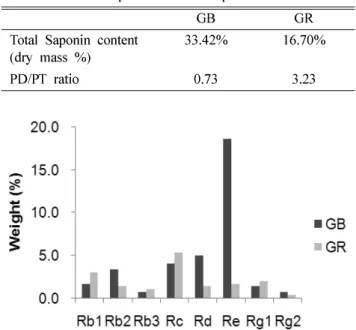
성분분석결과제조한인삼열매추출물은조사포닌함량에있어서제조한인삼근추출물의약
2
배함량을가지고있고
, ginsenoside
를PD(Protopanaxadiol)
계-
“ginsenoside Rb1, Rb2, Rc
및Rd”
및PT(Protopanaxatriol)
계
-“ginsenoside Re, Rg1
및Rg2”
의비율로구분하였을때각각
“0.73
과3.23
으로그조성에있어서인삼열매와인삼근은뚜렷한차이및특징을나타내었다
.(Table I)
특히
ginsenoside
의 종류별 함량을 비교했을 때PT
(Protopanaxatriol)
계-ginsenoside Re
의함량이인삼근추출물대비약
10
배이상높음을확인할수있었다.(Fig. 3)
따라서고함량의
ginsenoside Re
가인삼열매추출물의피부노화효능을줄것으로여겨진다
.
Hyaluronic acid 발현 증가 − 인간의피부에서
hyaluronic acid
의양은노화에따라감소되는것으로보고되었는데,
20-22)Fig. 1.
The anti-oxidant effects of GB compared RG in HaCaT cells treated for 24 hr with Trolox(10
µm), GR(10 ppm), GB(10 ppm) before UV irradiation(30 mJ/cm
2). ROS amounts were detected at 3 hrs after UV irradiation.
Fig. 2.
The inhibition of MMP-1 induced by UV irradiation
Normal human fibroblast cells treated for 48 hr with TGF-
b(10 mg/ml), GB(10 ppm) after UV irradiation(30 mJ/cm
2).
hyaluronic acid
양의감소는노화에따른피부탄력저하및수분함유량감소의직접적인원인중하나라고여겨지고 있다
.
인삼열매추출물과인삼열매추출물의주성분인ginsenoside Re
의hyaluronic acid
생성효과를측정하였다.
그결과인삼열매추출물과
ginsenoside Re
를처리하였을때모두
hyaluronic acid
양은유의적으로증가함을알수있으며인삼열매의효과는주성분인
ginsenoside Re
의효과일것으로보여진다
.(Fig. 4)
고 찰
인삼은동양의학에서사용되는대표적인보기재
(
補氣材)
이며전세계적으로활용되고있는생약이다
.
약으로쓰이는주부위는인삼의뿌리로홍삼
,
흑삼등도뿌리의가공법에따라성분을변화시켜효능을증진시켜이용하고있다
.
본연구에서는인삼근과성분의종류와함량이다른인 삼열매의피부노화억제효능을확인하고자하였다
.
따라서인삼열매추출물의피부노화를유발할수있는원인 인자들에대한효능을평가하여광노화를유발하는자외선 조사에따른활성산소종의증가와타입
1
콜라게나아제의과발현을억제하는효과를확인할수있었다
.
이는피부노화의가장큰외적요소인자외선에의한손상을방어할수 있음을알수있게한다
.
또한인삼열매추출물은피부노화를억제하는효과를위해서많이활용되던인삼근추출 물과달리뚜렷한활성산소종억제효과를보이고있고두 추출물의성분분석결과
,
함유하고있는ginsenoside
의종류와함량차이가뚜렷하여서로각기다른
ginsenoside
와세포효능기전에의해서작용할것으로사료된다
.
또한인삼열매추출물이
hyaluronic acid
의생성을촉진하는효능이확인되었다
.
피부내수분보유,
세포간간격유지
,
세포분열과분화이동에도많이관여하는hyaluronic
acid
의생성은피부에중요하다.
외부적자극이없이도자연적인노화에의하여서
hyaluronic acid
생성이감소하게되면쉽게건조해지는노화피부를유발하게되는데
hyaluronic
acid
생성촉진능을확인함으로써광노화뿐만아니라자연노화도억제할수있을것으로기대된다
.
또한인삼열매추출물의주성분인
ginsenoside Re
가hyaluronic acid
증가효과를보이므로이러한노화억제에주성분인
ginsenoside Re
가기여할것으로기대된다
.
따라서향후ginsenoside Re
와인삼열매추출물의광노화와자연노화의기전에대하여연 구를수행할예정이다
.
본연구의결과들을종합하여볼때인삼열매추출물은 자외선에의한광노화와세포활성이떨어지는자연노화 모두에적용가능한소재가될수있을것으로여겨지며이 러한효과는뚜렷이구별되는성분차이를기반으로인삼 근추출물과는다른기전에서영향을줄수있을것이다
.
따라서인삼열매추출물은피부노화를지연하고개선시킬수 있는신규한방소재로활용될수있을것으로사료된다
.
인용문헌
1. Jeon, H. K., Kim, S. G. and Jung, N. P. (1991) Effects of gin- seng saponin fraction and cyclophosphamide on the tumor- icidal activity of mouse macrophage and the antitumor effect.
Korean J. Ginseng Sci.
15: 99-105.
2. Kim, M. J. and Jung, N. P. (1987) The effect of ginseng sapo- nin on the mouse immune system. Korean J. Ginseng Sci.
11:
Table I.
The total saponin content compared with GB and RG
GB GR
Total Saponin content
(dry mass %) 33.42% 16.70%
PD/PT ratio 0.73 3.23
Fig. 3.
The comparison of ginsenoside composistions and contents in GB and GR.
Fig. 4.
Effects of GB and ginsenoside Re on the amount of
HA released by HaCaT cells. HaCat cells were treated for
24 hr with GB (10 ppm), ginsenoside Re (1
µM).
130-135.
3. Kang, S. Y. and Kim, N. D. (1992) The antihypertensive effect of red ginseng saponin and the endothelium-derived vascular relaxation. Korean J. Ginseng Sci.
16: 175-182.
4. Joo, C. N. and Kim, J. H. Study on the hypoglycemic action of ginseng saponin on streptozotocin induced diabetic rats (I).
Korean J. Ginseng Sci.
16: 190-197.
5. Oliveira, A. C. C., Perez, A. C., Merino, G., Prietp, J. G. and Alvarez A.I. (2001) Protective effects of Panax Ginseng on muscle injury and inflammation after eccentric exercise.
Comparative Biochemistry and Physiology Part C
130: 369- 6. Kim, J. S., Kim, K. W., Choi, K. J., Kwak, Y. K., Im, K. S., 377.
Lee, K. M. and Chung, H. Y. (1996) Screening of antiox- idative components from red ginseng saponin. Korean J. Gin- seng Sci.
20: 173-178.
7. Kim, K. H., Lee, Y. S., Jung, I. S., Park, S. Y., Chung, H. Y., Lee, I. R. and Yun, Y. S. (1998) Acidic polysaccharide from Panax ginseng , ginsan, induces Th1 cell and macrophage cytokines and generates LAK cells in synergy with r II-2.
Planta Med
. 64: 110-115.
8. Ng, T. B. and Wang, H. (2001) Panaxagin, a new protein from Chinese ginseng possesses antifungal, anti-viral, trans- lation-inhibiting and ribonuclease activities. Life Science
68: 739-749.
9. Kim, K. H., Na, J. Y., Jo, D. H. and Lee, C. Y. (1987) Extrac- tion and purification of ginseng oligopeptides with antili- polytic activities. Korean Agric. Chem. Soc.
30: 88-94.
10. Lee, J. W., Sohn, H. O. and Do, J. H. (2000) Function of the water soluble browning reaction products isolated from Korean red ginseng 2. Linoleic acid, Ox-brain autoxidant and Fe
2+ADP/NAD system. J. Ginseng Res.
24: 35-40.
11. Wee, J. J., Park, J. D., Kim, M. W. and Lee, H. J. (1989) Iden- tification of phenolic antioxidant components isolated from Panax ginseng . J. Korean Agric. Chem. Sco.
32: 50-56.
12. Shin, J. G., Park, J. W., Pyo, J. K., Chung, M. H. (1990) Pro- tective effects of a ginseng component, maltol(2-methyl-3- hydroxyl-4-pyrone) against tissue damages induced by oxy- gen radicals. Korean J. Ginseng Sci.
14: 187-190.
13. Wang, C. Z., Wu, J. A., Mcentee, E. and Yuan, C. S. (2006) Saponins composition in American ginseng leaf and berry assayed by high-performance liquid chromatography. J.
Agric. Food Chem.
54: 2261-2266.
14. Attele, A. S., Zhou, Y. P., Xie, J. T., Wu, J. A., Zhang, L., Dey, L., Pugh, W., Rue, P. A., Polonsky, K. S. and Yuan, C. S.
(2002) Antidiabetic effects of Panax ginseng berry extract and the identification of an effective component. Diabetes
51: 1851-1858.
15. Emerit, I. (1992) Free radicals and aging of the skin. EXE.
62: 328-341.
16. Brenneisen, P., Sies, H. and Scharffetter-Kochanek, K. (2002) Ultraviolet-B irradiation and matrix metalloproteinases : from induction via signaling to initial events. Ann N Y Acad Sci.
973
: 31-43.
17. Puizina-Ivic, N. (2008) Skin aging. Acta Dermatovenerol Alp Panonica Adriat.
17(2): 47-54.
18. Lee, E. H., Cho, S. Y., Kim, S. J., Shin, E. S., Chang, H. K., Kim, D. H., Yeom, M. H., Woo, K.S., Lee, J.S., Sim, Y.C.
and Lee, T.R. (2003) Ginsenoside F1 protects human HaCat keratinocytes from ultraviolet-B-induced apoptosis by main- taining constant levels of Bcl-2. J. Invest. Dermatol.
121(3): 607-613.
19. Kim, S. J., Kang, B. Y., Cho, S. Y., Sung, D. S., Chang, H. K., Yeom, M. H., Kim, D. H., Sim, Y. C. and Lee, Y. S. (2004) Compound K induces expression of hyaluronan synthase 2 gene in transformed human keratinocytes and increases hyaluronan in hairless mouse skin. Biochem. Biophys. Res.
Commun.
316: 348-355.
20. Fleischmajer, R., Perlish, J. S. and Bashey, R. I. (1972) Human dermal glycosaminoglycans and aging. Biochem.
Biophys. Acta
279: 265-275.
21. Longas, M. O., Russell, C. S. and He, X. Y. (1987) Evidence for structural changes in dermatan sulfate and hyaluronic acid with aging. Carbohydr. Res.
159: 127-136.
22. Ghersetich, I., Lotti, T., Campanile, G., Grappone, C. and Dini, G. (1994) Hyaluronic acid in cutaneous intrinsic aging.
Int. J. Dermatol.
33: 119-122.
(2009년 8월 28일 접수)