22(1) : 46-52 (2016)
http://dx.doi.org/10.20307/nps.2016.22.1.46
46
Ginsenoside Re Enriched Fraction (GS-F3K1) from Ginseng Berries Ameliorates Ethanol-Induced Erectile Dysfunction via Nitric Oxide-cGMP Pathway
Mi Kyung Pyo
1,*, Kwang-Hyun Park
2, Myeong Hwan Oh
1, Hwan Lee
1,Young Sik Park
1, Na Young Kim
1, So Hee Park
1, Ji Hye Song
1, Jong Dae Park
1, Se-Hee Jung
3, Bong-Gun Lee
3, Beom Young Won
4,
Ki Young Shin
4,5, and Hyung Gun Lee
41
International Ginseng and Herb Research Institute, Geumsan 312-804, Korea
2
Department of Oriental Pharmaceutical Development, Nambu University, Gwangju, 506-706, Korea
3
Huvet Co., Ltd., Iksan, 570-749, Korea
4
Braintropia Co.Ltd., Anyang, 431-060, Korea
5
Department of Microbiology, College of Natural Science, Dankook University, Cheonan, 330-714, Korea
Abstract − Erectile dysfunction (ED) is a highly prevalent disorder that affects millions of men and considered to be an early symptom of atherosclerosis and a precursor of various systemic vascular disorders. The aim of the present study was to prepare ginsenoside Re enriched fraction (GS-F3K1, ginsenoside Re 10%, w/w) from ginseng berries flesh and to investigate the enhanced activities of GS-F3K1 on alcohol-induced ED. GS-F3K1 was prepared by the continuous liquid and solid separating centrifugation and circulatory ultrafiltration from ginseng berries flesh. GS-F3K1 was administered for 5 weeks in ethanol-induced ED rat by oral administration of 20% ethanol. To investigate the effects of GS-F3K1 on ED model, the levels of nitrite expression, cyclic guanosine monophosphate (cGMP) and erectile response of the penile corpus cavernosum of rat were measured.
The erectile response of the corpus cavernosum was restored after GS-F3K1 administration, to a level similar to the normal group. The level of nitrite and cGMP expression in the corpus cavernosum of GS-F3K1-administered male rats was increased significantly compared to positive control group. GS-F3K1 from ginseng berries should effectively restore ethanol-induced ED in male rats and could be developed as a new functional food for the elderly men.
Keywords − GS-F3K1, Ginseng berry, Ethanol-induced erectile dysfunction, Nitrite, Cyclic guanosine monophosphate (cGMP)
Introduction
The root of Panax ginseng (Korean ginseng) has been considered as one of the traditional and folk medicines which are widely used for many therapeutic purposes in the oriental countries such as Korea, China and Japan for thousands of years. A novel source plant of ginseng is Panax ginseng Meyer (Araliaceae), a herb with fleshy roots which grows abundantly in cool and shady forests extending from Korea and North eastern China to far eastern Siberia.
1Ginseng has long been reported to have aphrodisiac properties tends to increasing stamina. In Asia, ginseng is routinely included in herbal formulations used for the treatment of sexual dysfunction. Ginsenosides
have been characterized as an therapeutic component of ginseng which are distributed in many parts of the ginseng plant, including the root, leaf and berry.
1,2Particularly, it has recently been reported that ginseng berry showed a distinctive saponin profile different from that of root and nevertheless, it has not traditionally been used for therapy.
Korean ginseng berries, a flesh part of the berries, was already found to contain as much as approximately 6% of ginsenoside Re, while Korean ginseng roots contains 3 to 4% of saponins, including different ginsenosides namely, Rb1, Rb2, Rc, Rd, Rg1 and Re.
3In recent times, ginseng berries have been known to exhibit enormous significant beneficial effects on various problems such as obesity- induced insulin resistance, diabetes, abnormal immune responses and penile erection.
4,5Furthermore, Zhang et al.
have reported that ginsenoside Re increases as then ozoospermic human sperm motility by enhancing the induction of nitric oxide synthase as well as promotes
*Author for correspondence
Mi Kyung Pyo, International Ginseng & Herb Research Institute, Geumsan, 312-804, Korea
Tel: +82-41-750-1641; E-mail: [email protected]
human sperm capacitation through nitric oxide-dependent pathway.
6,7In a parallel study, it was also found that ginsenoside Re-induced vasodilation which was mediated by releasing NO through a membrane sex steroid receptors, followed by relaxing vascular smooth muscle, acting on K channel.
8The phytoestrogen ginsenoside Re activates potassium channels of vascular smooth muscle cells through PI3K/Akt and nitric oxide pathways.
8This is the reason why research focused on the development of ginsenoside Re enriched fraction from ginseng berries flesh to induce the vasodilation and relaxation of penile corpus cavernosum. However, ginsenoside Re in the berries flesh of ginseng has been reported to be easily decomposed due to organic acid based hydrolysis by heating in the manufacturing process. In the previous study, we confirmed that ultrafiltration (UF) is the most efficient method to obtain biologically active compounds and to remove low molecular organic acid.
9Erectile dysfunction (ED) is a general problem in middle-aged male worldwide and defined as the insufficient maintenance of penile erection in sexual intercourse.
5,10ED induced by reduced nitric oxide (NO) bioavailability causes the decreased inflow of blood in the penile corpus cavernosum in chronic diseases such as diabetes, vascular problem and/or high alcohol consumption.
5,11The sexual and erectile activities of ginseng extract including ginseng berry on ED model have been previously reported,
5but very few are known to be effective on the next signaling pathway such as NO-cGMP pathway. Accordingly, we describe ginsenoside Re enriched fraction (GS-F3K1), which has been purified from ginseng berries flesh by ultrafiltration method, and the mechanisms of the action of GS-F3K1 on alcohol-induced erectile dysfunction.
Experimental
Material − The ginseng berries were collected from cultivated Panax ginseng at Geumsan (Korea) on July 15, 2013. The Red Ginseng (Panax ginseng Meyer) used in this experiment were purchased from local market Geumsaninsam cooperative association (Geumsan, Korea).
The specimen of ginseng berry (No.; GS201307) and root (No.; GS201105) were deposited in the International Ginseng and Herb Research Institute. The instruments used for ultrafiltration was Flex Stand benchtop pilot hollow fiber system (GE Healthcare, U.K.) with Hollow Fiber cartridge (Model; UFP-1-C-4M, molecular weight cut off (MWCO); 1 kDa, membrane area; 650 cm
2, GE Healthcare, U.K.). Ginsenoside standards were purchased from Ambo Institute (Daejeon, Korea). The acetonitrile
and methanol were of HPLC grade (Fisher Scientific, USA). All other chemicals were of analytical grade.
Preparation of ginseng berry flesh and red ginseng
extracts − Several kinds of ginseng berry flesh extracts
were prepared to measure the change in ginsenoside
composition based upon heating process. A flesh part of
the ginseng berries were freeze dried to produce ginseng
berry flesh powder (GBFP), which was extracted with
distilled water for 1 hour at room temperature using
microwave, followed by freeze drying to produce ginseng
berry flesh extract (FGBE). Another water extract was
evaporated and dried at 60
oC in vacuo to prepare ginseng
berry flesh extract (EGBE), and also to prepare heated
ginseng berry flesh extract (HGBE) by heating process at
90
oC for 3 hours. To prepare ginsenoside Re enriched
fraction (GS-F3K1), ginseng berries flesh was mixed with
the same amount of distilled water and then was
centrifuged at 15,000 × g using the continuous liquid and
solid separating centrifuges (HANILBIOMED Co., Ltd,
Gwangju, Korea). The liquid part of flesh was con-
centrated to 50% (vol) by circulatory ultrafiltration system
equipped with membrane filter (1 kDa). The inner fluids
were freeze dried (GS-F3K1) and stored at −80
oC, and
then immediately reconstituted before use (Fig. 1). The
other liquid part of flesh after continuous centrifugation
was freeze dried (GBE) for analysis of various ginseno-
sides. To produce RGE, a mixture (1 kg) of main body
and tail root of red ginseng (4:6, w/w) were extracted with
Fig. 1. Schematic representation of the purification procedure of
GS-F3K1 from ginseng berry. Gnsenoside Re enriched fraction
(GS-F3K1) from ginseng berries flesh was prepared by a combi-
nation of continuous centrifugation and ultrafiltration to remove
low molecular weight compounds.
1 liter of 70% ethanol under 70
oC for three times and concentrated in vacuo. The dried red ginseng extract (RGE) was found to contain ginsenoside-Rg1 7.4, Re 12.4, Rf 3.9, Rb1 32.6, Rc 22.7, Rb2 9.8, Rd 4.6 mg/g, respectively.
Analysis of ginsenosides − Ten mg of REG or 5 mg of GS-F3K1 powder was dissolved with 1 mL of methanol (MeOH) and filtered out by 0.45 µm membrane filter after extraction with ultrasonic waves for 30 min, then finally analyzed in HPLC. The HPLC system was Waters 1525 (Waters, MA, USA) with PDA detector (Waters, 2998). Waters XbridgeTM C18 column (250 mm × 4.6 mm, 5 µm, Waters, MA, USA) was also used. The detection wavelength, flow rate, injection volume, and column oven temperature were set at 203 nm, 1.0 mL/
min, 20 µL, and 40
oC, respectively. A mixture of purified water (A) and acetonitrile (B) was used as the following gradient program: 0 min 18% B, 0 - 42 min 24% B, 42 - 46 min 29% B, 46 - 75 min 40% B, 75 - 100 min 65% B, 100 - 135 min 85% B, and 135 - 180 min 18% B.
Animals − Sixty-six male Sprague-Dawley rats (6 weeks old, specific pathogens free) were purchased from SAMTAKOBIO Korea (Osan, Korea). The experiments were performedin accordance with the principles and approval from Ethics Committee of the Wonkwang Uni- versity (Approval No. WKU13-40). All animals, which were maintained in a temperature-controlled room (temperature 22 ± 2
oC, humidity 50 ± 5%) on a 12 h light/dark cycle, were acclimatized to the laboratory environment while housed in individual cages for 1 week before starting the experiment.
Animal model for erectile dysfunction (ED) − Rats were randomly divided into 6 groups: normal, control, low-dose (GS-F3K1, 0.1 g/kg), medium-dose (GS-F3K1 0.25 g/kg), high-dose (GS-F3K1, 0.5 g/kg) and positive control (RGE 0.5 g/kg). After a week of acclimation, the normal group was fed with standard chow without GS- F3K1 and water sterilized by ultraviolet radiation. All of the 30 rats, except for the rats comprising the normal group, were provided with water containing 20% ethanol, GS-F3K1, and RGE for 5 weeks. GS-F3K1 0.1, 0.25 and 0.5 g/kg, and RGE 0.5 g/kg alone were orally administered as low-, medium-, and high-dose groups, and positive control, respectively. We measured the average feeding rate for one week after the administration of GS-F3K1 but no significant differences were observed.
Measurement of erectile responses − Experimental animals were anesthetized with a 1:7 mixture of xylazine (23.3 mg/mL) and ketamine (57.68 mg/mL by intraperitoneal injection) (0.4 mL/250 g) and were maintained under
anesthesia with phenobarbital (Ruminal, Daihan Pharm Co., Ltd, Seoul, Korea) by intramuscular injection; this treatment had no effect on the blood pressure. Animals were sacrificed and erectile response was measured as reported previously.
12Briefly, the ventro dorsally positioned carotid artery of the animals was exposed and connected to Polyethylene 50 (Dow Corning, Midland, MO, USA) filled with heparinized saline (100 IU/mL). The silicone tube was connected to channel of the pressure transducer (MLT1199BP Transducer, AD Instruments, Colorado Springs, CO, USA). The right major pelvic ganglion was exposed by a low abdominal midline incision, and the corpus cavernous nerve on either side of the prostate was isolated through a skin incision overlying the penis. A bipolar platinum electrode and Stimulator HC (ML155, AD Instruments, Dunedin, New Zealand) were used to directly stimulate the right cavernous nerve. Next, the right base of the penis was exposed, and the right corporal body was cannulated with a 22-gauge needle primed with 100 U/mL heparin saline and connected to channel 2 of the pressure transducer (MLT1199BP Transducer, AD Instruments, Dunedin, New Zealand). The electrostimu- lation was controlled by an amplifier (Podbridge, AD Instruments) connected to a data acquisition system (ML846 Powerlab 4/26, AD Instruments, Dunedin, New Zealand). The intracavernous pressure (ICP) was recorded and analyzed using a data analysis software (Powerlab Program, AD Instruments). The average maximum ICP was represented by maximum ICP/mean arterial pressure (MAP) × 100.
Tissue extracts preparation − After the erectile response test, blood samples and the corpus cavernosum tissue of penis were collected for further experiments. The blood and other connective tissues of the corpus cavernosum tissues were removed by washing with ice- cold saline. The isolated tissues were homogenized with 4 mL of 0.1 M potassium phosphate buffer (pH 7.4) per gram tissue (IKA T10 basic; IKA Laboratory Equipment, Staufen GmbH & Co., Germany) and supernatant was collected after centrifugation at 10,000 × g for 10 min at 4
oC.
Measurement of the nitrite level − To measure the nitrite level in the corpus cavernosum tissue, we used a nitric oxide detection kit (INTRON Biotechnology, Inc., Gyeonggi, Korea) based on colorimetry using the Griess reaction. The method was performed, and the results were analyzed according to manufacturer’s protocol. Briefly, 50 µL of the sulfanilamide solution was added to 100 µL of the tissue-derived supernatant in a 96-well plate. The mixture was incubated at room temperature for 5 min.
Naphthylenediamine (50 µL) was then added to each
well, and the plate was incubated for 5 min, and the sample absorbance was finally measured at 540 nm using UV spectrometry. The standard curve was determined by measuring the absorbance of 0.98 - 1,000 µM nitrite stan- dards, and the results were expressed as µM nitrite per gram of tissue.
Measurement of the cGMP level − To measure the cGMP level in the corpus cavernosum tissue, we used a cGMP kit (Enzo Life sciences, Inc., FL, USA). The method was performed, and the results were analyzed according to manufacturer’s protocol. Briefly, 50 µL of the conjugate and antibody solution was added to 100 µL of the tissue-derived supernatant in a 96-well plate. The mixture was allowed for shaking incubation (500 rpm) at room temperature for 120 min. After washing out three times, pNpp substrate solution (200 µL) was added to each well, the plate was incubated for 60 min. Stock solution (50 µL) was added to each well, and the sample absorbance was measured at 504 nm by UV spectrometry.
Statistical analysis − All data were expressed as mean
± SD and differences between groups were analyzed using independent t test. All analyses were performed using SPSS 21 (SPSS Inc., Chicago, USA). Each value was the mean of at least 3 separate experiments in each group, and data with different superscript letters are significantly different when p value is less than 0.05.
Result
Preparation of GS-F3K1 by ultrafiltration from ginseng berry extract − To measure decomposition of ginsenoside Re by heat, three ginseng berry flesh extracts were prepared as follows; freeze dried ginseng berry extract (FGBE), evaporated ginseng berry extract at 60
oC (EGBE), and evaporated ginseng berry extract after heating at 90
oC for 3 hours (HGBE). As shown in Table 1, the content of ginsenoside Re was 50.1, 41.5, and 20.0 mg/g in FGBE, EGBE, and HGBE, respectively. The level of ginsenoside Re in HGBE was found to show lower values (60.1 and 51.8%) than those of FGBE and EGBE, indicating the possibility of decomposition by heating process such as concentration and sterilization.
Therefore, ginsenoside Re enriched fraction (GS-F3K1) from ginseng berries flesh was prepared by a combination of continuous centrifugation and ultrafiltration to remove low molecular organic acid and the ginsenoside Re content was analyzed. Extraction method by continuous centrifugation at 1,500 × g has found to increase 42.1% of ginsenoside Re content (GBE 86.4 mg/g vs FGBE 50.1 mg/g) to compare general extraction method (Table 1 and 2). GS-F3K1 was found to increase the content (109.0 mg/g) two times as much as that of FGBE (Table 1 and 2). The ginsenosides of GS-F3K1used for this experiment was confirmed to be G-Rg1 7.0 ± 0.46, G-Re 109.0 ± 1.26, G-Rb1 13.2 ± 0.31, G-Rc 10.5 ± 0.54, G-Rb2 12.4 ± 0.18, and G-Rd 12.1 ± 1.02 mg/g, respectively.
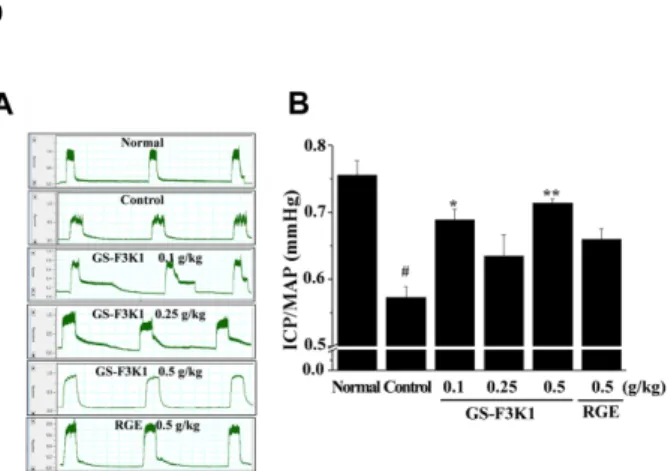
Effect of GS-F3K1 on the erectile response − The erectile response was assessed in all rats by measuring the maximum intra cavernous pressure (ICP) that was corrected by mean arterial pressure (MAP) in rats (Fig. 2). The ICP of the control group was significantly decreased compared with normal group (0.58 ± 0.02 and 0.76 ± 0.03 mmHg, respectively). In contrast, when compared to the control group, ICP in both the GS-F3K1 and RGE groups were 0.69 ± 0.017, 0.63 ± 0.71, 0.71 ± 0.02, and 0.66 ± 0.02 mmHg, respectively. Especially, treatment with 0.5 g/kg GS-F3K1 group exhibited markedly ICP compared with the control group, but no dose-dependent change was observed.
Effect of GS-F3K1 on the nitrite − In the corpus cavernosum, the nitrite level was decreased significantly in control group (11.37 ± 0.12 to 9.93 ± 0.08 µM), and increased in dose-dependent manner at 0.1 g/kg, 0.25 g/
kg, and 0.5 g/kg GS-F3K1 groups (10.39 ± 0.10, 10.98 ± 0.05, and 11.67 ± 0.13 µM, respectively) compared with the control group. In addition, although the nitrite level was higher in the 0.5 g/kg GS-F3K1 group compared with the 0.1 g/kg and 0.25 g/kg GS-F3K1 groups, but not increased compared to RGE group (11.57 ± 0.14 µM) (Fig. 3).
Effect of GS-F3K1 on the cGMP concentration − Finally, we investigated the effect of GS-F3K1 on cGMP level in ethanol-induced ED rats (Fig. 4). cGMP con- centration was markedly decreased compared to normal
Table 1. Change in ginsenoside composition of ginseng berry extract by heat Ginsenoside
(mg/g) Rg1 Re Rf Rb1 Rc Rb2 Rd S-Rg3 R-Rg3
FGBE
a)4.7±0.23 50.1±2.51 1.4±0.07 8.1±0.41 3.3±0.17 3.9±0.20 4.0±0.20 0.1±0.00 0.0±0.00 EGBE
b)4.1±0.20 41.5±2.08 1.0±0.05 6.5±0.32 1.8±0.09 2.3±0.11 2.1±0.10 0.2±0.00 0.2±0.00 HGBE
c)1.7±0.09 20.0±1.00 1.1±0.05 6.6±0.33 1.1±0.12 1.4±0.32 1.5±0.37 2.5±0.12 3.0±0.15
a)