• 검색 결과가 없습니다.

Effects of Proprioceptive Neuromuscular Facilitation Leg Patterns on Activity of Gluteus Medius at Opposite Side

N/A
N/A
Protected

Academic year: 2021

Share "Effects of Proprioceptive Neuromuscular Facilitation Leg Patterns on Activity of Gluteus Medius at Opposite Side"

Copied!
8
0
0

로드 중.... (전체 텍스트 보기)

전체 글

(1)

| Abstract |

Purpose: This study investigates the influence of applying proprioceptive neuromuscular facilitation (PNF) leg patterns on the activation of three types of mesogluteal fibers at the opposite side.

Methods: The target subjects of this study were 19 healthy men who voluntarily agreed to participate in the program. For all subjects, the following four PNF leg patterns were applied while they were in a standing position, and then, the activation of the gluteus medius at the opposite side was measured: (1) flexion abduction internal rotation pattern, (2) flexion adduction external rotation pattern, (3) extension abduction internal rotation pattern, and (4) extension adduction external rotation pattern. In each position, a pattern was executed three times in 5 s, and the average of each measurement was used for the statistics.

Results: Among the PNF leg patterns, the activation of the mesogluteal fibers at the opposite side was most significant under the application of the extension abduction internal rotation pattern. The activation of the back muscular fiber was significantly high under the application of the flexion abduction internal rotation pattern.

Conclusion: Selective application of PNF leg patterns can improve the functional activity of each mesogluteal fiber.

Key Words: Contralateral effects, Gluteus medius, Leg pattern, PNF

†Corresponding Author : Sang-Yeol Lee ([email protected]) PNF and Movement, 2016; 14(3): 195-202

https://doi.org/10.21598/JKPNFA.2016.14.3.195

Print ISSN: 2508-6227 Online ISSN: 2508-6472

Original Article Open Access

PNF 하지 패턴이 반대측 중둔근의 활성도에 미치는 영향

박인석⋅이상열

1†4)

워크재활의학병원,

1

경성대학교 물리치료학과

Effects of Proprioceptive Neuromuscular Facilitation Leg Patterns on Activity of Gluteus Medius at Opposite Side

In-Suk Park⋅Sang-Yeol Lee

1†

Wlak Rehabilitation Hospital

1

Department of Physical Therapy, Kyungsung University

Received: October 31, 2016 / Revised: November 18, 2016 / Accepted: November 18, 2016

ⓒ 2016 Journal of Korea Proprioceptive Neuromuscular Facilitation Association

This is an Open Access article distributed under the terms of the Creative Commons Attribution Non-Commercial License

(http://creativecommons.org/licenses/by-nc/3.0) which permits unrestricted non-commercial use, distribution, and reproduction

in any medium, provided the original work is properly cited.

(2)

ԹՁԾ ք ՘ՖՎԨթնլԨՕշվխյխնռԨ┚ԹԼઊԨ┚Ի㌶

Ⅰ. 서 론

고유수용성신경근촉진법 (proprioceptive neuromuscular facilitation, PNF)은 대각선과 운동 방향의 변화에 따른 운동패턴을 사용하여 선택적인 근육들의 협응력과 근 력을 증가시키는 효과적인 치료방법이라고 알려져 있 다(Adler et al., 2008). 최근 들어 PNF의 방산 운동효과 는 운동기능 향상과 근력증진을 목적으로 신체 한 쪽 의 근력증가를 유도해 반대측 신체의 근력을 향상시 키고자 하는 방법으로 진행되었다(Carroll et al., 2006).

반대쪽 사지와 체간에 안정성을 제공하기 위해 근 수 축을 유발한다(Hellebrandt, 1951; Lee & Caroll, 2007).

이러한 원리를 이용해 임상에서도 강한 근육에 저항 운동을 실시하여 약한 근육의 근 활성을 유발하는 것 을 반대측 효과라고 한다(Munn et al., 2004). PNF에서 는 직접적인 저항을 가할 수 없거나 기능적인 활동을 위한 자세에서 근수축을 유발하기 위하여 반대측 효 과를 이용한다(Kofotolis & Kellis, 2007; Zhou, 2000).

이때 저항의 방향은 선택적인 근력 강화를 위해 가장 중요한 요소 중 하나이다(Keiner et al., 2014; Sheppard

& Young, 2006)

특히 근육의 섬유별로 기능에 차이가 있는 경우 운동 방향은 필요한 목적에 맞게 선택적으로 고려되 어야 한다(Hoffman et al., 2007). 중둔근은 신체에서 섬유별 기능의 차이가 있는 대표적인 근육이다 . 또한 선 자세의 자세유지와 보행에서 전방으로 다리 뻗기, 보폭 조절에 중요한 기능을 담당한다(Krebs et al., 1998). 기능적으로 구분하면 전부섬유는 외전과 내회 전이 일어날 때 가장 활성화 되고 중부섬유는 입각기 에서 외전을 시작하게 하고 후부섬유는 입각기에서 체중을 지지하고 고관절을 안정화시킨다. 이와 같이 고관절의 안정성을 높이는 기능을 하는 중둔근에 발 생되는 기능이상은 고관절의 통증뿐만 아니라 허리의 통증과 무릎 및 기타 하지의 전반적인 통증을 일으키 는 원인이 된다(Earl, 2005; Nadler et al., 2002; Mascal et al., 2003). 이러한 이유로 보행 및 일상생활에서 불안 정성을 줄이기 위해 임상에서는 손상의 예방, 재활을

위해 중둔근의 활성화에 중점을 둔 많은 치료적 운동 들이 시행되고 있다. 최근 연구들에서 중둔근을 기능 적으로 구분하여 각 섬유의 근 활성도를 증가시키기 위한 방법으로 고관절 들기(hip clams), 옆으로 두발 뛰기 운동 (sideways hop exercise), 벽 누르기 운동(wall press exercise), 골반 떨어뜨리기 운동(pelvic drop exercise) 등 여러 운동 방법들이 소개되고 있다(Bolgla

& Uhl, 2005; Distefano et al., 2009).

하지만 대부분이 직접적으로 중둔근을 수축시키기 위한 운동 방법들이며 PNF 운동패턴의 변화 즉 운동 방향의 변화에 따른 선택적인 효과를 검증한 연구는 미비하다 . 따라서 본 연구는 PNF 운동 방향의 변화가 반대측 중둔근의 세 가지 섬유의 근 활성에 미치는 영향을 밝힘으로써 기능적인 활동을 위한 치료에 더 욱 발전적인 자료를 제공하고자 한다.

Ⅱ. 연구 방법

1. 연구대상자 특성

본 연구는 자발적으로 연구 참여에 동의한, 건강한 성인 남자 19명을 대상으로 하였다. 모든 대상자는 신경계 또는 근골격계의 질환이 없었으며, 본 연구의 목적에 대한 충분한 설명을 듣고, 자발적으로 연구에 참여하였다. 연구 대상자들의 평균연령은 28.4 세였으 며, 평균 신장은 175.3㎝, 평균체중은 71.6㎏이었다.

본 연구는 인제대학교 생명윤리 위원회의 승인을 거 쳐 진행하였다.

2. 측정 도구

중둔근의 활성도는 표면근전도(MP 150, BIOPAC Systems, Inc., USA)을 사용하여 측정하였다. 전극은 지름 이 3㎝인 일회용 염화-은(silver chloride) 전극을 사용하였 다 . 근전도 신호의 표본추출률(sampling rate)은 1000㎐로 하였고 , 주파수 대역폭(band-pass-filtered)은 20∼500㎐

이었다. 측정된 근전도 신호는 AcqKnowledge software

(ver. 3.9.1)를 이용하여 분석하였다. 근전도 측정 시

(3)

՘ՖՎԨ㉖⚾Ԩ〦⸲⑲Ԩᤖ࿾⬟Ԩ☏ᅒૺ⑖Ԩ㍚ḯჂ⋎Ԩ᣶⭖ྒԨ⋿㊣ ք ԹՁԿ

피부저항을 최소화하기 위해 전극 부착 부위에 털을 제거하고 , 사포로 피부의 각질을 제거한 다음, 알코올 솜으로 닦아 피부를 깨끗하게 하였다 . 전극의 부착부 위는 다음과 같다. 중둔근의 전부 섬유는 상전장골극 과 대전자 사이 50% 위치에 부착하고, 중부 섬유는 대전자와 장골능선 사이 50% 위치에 부착하며, 후부 섬유는 대전자와 후하방 장골 사이 33% 위치에 부착 하였다. 후하방 장골의 위치는 L4-L5 사이공간에서 장골능선까지의 20% 위치로 설정하였다. 접지 전극은 척골의 검상돌기에 부착하였다 (Hermens et al., 2000).

측정된 근전도 값을 정량화(normalization)하기 위 하여 모든 근육들의 최대 수의적 등척성 수축(maximal voluntary isometric contraction, MVIC)을 측정하였다.

중둔근의 최대 수의적 등척성 수축은 옆으로 누운 자 세에서 고관절 45° 외전, 슬관절 신전, 족관절 중립 상태를 유지하고, 대상자에게 다리를 위 방향으로 들 어 올리도록 지시하고 검사자는 족관절의 가까운 부 위에서 아래방향으로 저항을 주면서 측정하였다. 전 부 , 중부, 후부 섬유 모두 동일한 방법으로 측정하였다 (Kendall et al., 2005). 근전도 신호의 표본 추출률은 1000Hz로 설정하였고 증폭된 파형을 대역통과필터 20∼500Hz와 60Hz 노치필터를 이용하여 필터링하였 다 . 수집된 신호를 정량화하기 위해 실효평균값(RMS) 처리를 하였다. 측정은 각 자세에서 5초간 3회 반복 실시하였으며, 1회 측정이 끝나면 30초의 휴식을 주었 다. 5초 동안의 근전도 자료를 제곱근 평균제곱(root mean square, RMS)으로 처리하였고, 처음과 마지막에 각 1초를 제외한 중간 3초 동안의 평균 근전도 값을 이용해 %MVIC로 환산하여 통계에 사용하였다.

실험은 PNF 정규과정을 이수하여 전문성을 가진 검사자와 보조 인원에 의해 이루어졌다 . 한 명은 근전 도를 측정하였고 , 다른 한 명은 프로그램에 따라 실험 을 진행하였다 . 모든 연구대상자들이 실험 절차와 실 험방법에 익숙해지도록 자세히 설명한 후 1회의 예비 실험을 실시하였다. 반대측 효과를 알아보기 위한 근 전도 값의 측정은 대상자들이 미리 설치된 높낮이(up

& down) 테이블에 몸의 중심선이 일치되도록 선 자세

에서 실시하였다 . 몸통은 정면을 향하고, 선 자세에서 테이블에 한손을 닿도록(wrist flexion 90° on table) 한 후 운동을 수행하도록 하였다. 환자에게 운동측의 하 지 패턴(leg pattern)을 실시하였고, 운동측의 패턴이 적용되는 동안 반대측은 한발서기를 유지한 상태에서 실시되었으며, 모든 대상자들에게 우세측에 저항을 가하고 반대측인 비우세측 중둔근의 활성을 측정하였 다 . 본 연구에서는 네 가지 방향으로 하지 패턴을 적용 하였다; (1) 굴곡-외전-내회전 패턴(flexion abduction internal rotation pattern), (2) 굴곡-내전-외회전 패턴 (flexion adduction external rotation pattern), (3) 신전-외 전-내회전 패턴(extension abduction internal rotation pattern), (4) 신전-내전-외회전 패턴(extension adduction external rotation pattern). 패턴이 적용되는 동안 반대측 의 중둔근의 전부, 중부, 후부 섬유에서 발생하는 근 활성도를 측정하였다 . 데이터 수집을 위해 각각의 조 건마다 5초씩 3회 측정한 후, 중간 3초 동안의 근전도 신호를 이용하여 평균값을 구하였다. 측정 순서는 무 작위로 정하였고, 피로를 예방하기 위해서 각 조건 사이에 5분간 휴식시간을 제공하였다.

3. 분석 방법

본 연구는 PNF 패턴 운동 시 저항을 주는 운동측의 패턴변화가 반대측 중둔근의 전부, 중부, 후부섬유의 근 활성도에 미치는 효과를 알아보기 위한 것이다.

따라서 패턴변화에 따른 근섬유들의 근활성도 변화에

대해 반복측정 분산분석 (repeated one-way ANOVA)을

실시하였다. 분석 결과, 패턴변화에 따른 반대측 중둔

근의 전부 , 중부, 후부섬유의 근 활성도에 차이가 있을

경우, 사후검정으로 LSD (least significant difference

test)를 사용하여 실시하였다. 통계 프로그램은 SPSS

program (ver. 21.0)이었으며, 통계적인 유의성을 검정

하기 위한 유의수준(α)은 0.05로 하였다.

(4)

ԹՁՀ ք ՘ՖՎԨթնլԨՕշվխյխնռԨ┚ԹԼઊԨ┚Ի㌶

Ⅲ. 연구 결과

1. PNF 운동패턴에 따른 중둔근의 전부 섬유의 근 활성도 비교

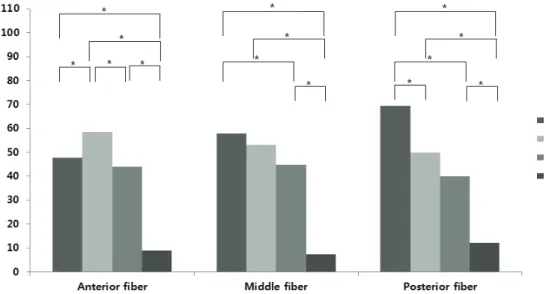
PNF 운동패턴에 따른 중둔군의 전부 섬유의 근활 성도 차이를 알아본 결과 PNF 운동패턴에 따라 유의 한 차이가 나타났다(p<0.05). 사후검증 결과, 내전 패 턴보다 외전 패턴 적용 시 유의하게 높았으며 (p<0.05), 외전 패턴 중에서도 굴곡-외전-내회전 패턴의 적용 보다 신전 -외전-내회전 패턴의 적용 시 유의하게 높은 근활성도를 보였다(p<0.05)(Table 1)(Fig. 1).

2. PNF 운동패턴에 따른 중둔근의 중부 섬유의 근 활성도 비교

PNF 운동패턴에 따른 중둔군의 중부 섬유의 근활 성도 차이를 알아본 결과 PNF 운동패턴에 따라 유의 한 차이가 나타났다(p<0.05). 사후검증 결과, 내전 패 턴보다 외전 패턴 적용 시 유의하게 높은 근활성도를 보였다(p<0.05)(Table 1)(Fig. 1).

3. PNF 운동패턴에 따른 중둔근의 후부 섬유의 근 활성도 비교

PNF 운동패턴에 따른 중둔군의 후부 섬유의 근활 성도 차이를 알아본 결과 PNF 운동패턴에 따라 유의

Subdivision Using PNF Pattern

F p

Pattern 1 Pattern 2 Pattern 3 Pattern 4

Anterior fiber 47.64±23.07† 58.43±21.14 44.05±21.26 8.95±5.12 31.79 0.00*

Middle fiber 57.87±18.37 53.14±24.69 44.91±19.36 7.46±4.01 44.23 0.00*

Posterior fiber 69.52±17.85 49.75±20.65 39.98±15.32 12.10±5.19 95.46 0.00*

Unit: %MVIC

Pattern 1: flexion abduction internal rotation pattern, Pattern 2: extension abduction internal rotation pattern; Pattern 3:

flexion adduction external rotation pattern; Pattern 4: extension adduction external rotation pattern.

† Mean±SD

* p<0.05

Table 1. Differences of muscle fiber activation at gluteus medius according to PNF pattern

Fig. 1. Comparision of opposite side gluteus medius activities according to PNF leg pattern.

(5)

՘ՖՎԨ㉖⚾Ԩ〦⸲⑲Ԩᤖ࿾⬟Ԩ☏ᅒૺ⑖Ԩ㍚ḯჂ⋎Ԩ᣶⭖ྒԨ⋿㊣ ք ԹՁՁ

한 차이가 나타났다(p<0.05). 사후검증 결과, 내전 패 턴보다 외전 패턴 적용 시 유의하게 높았으며 (p<0.05), 외전 패턴 중에서도 신전-외전-내회전 패턴보다 굴곡- 외전 -내회전 패턴 적용 시 유의하게 높은 근활성도를 보였다(p<0.05)(Table 1)(Fig. 1).

Ⅳ. 고 찰

본 연구는 PNF의 4가지 하지 패턴의 적용이 반대측 중둔근의 활성에 미치는 영향을 밝힘으로써 임상에서 기능적인 활동을 증가시키기 위한 PNF 패턴의 적용 시 반대측 영향을 이용한 치료에 발전적인 자료를 제 공하기 위하여 실시되었다.

PNF는 대각선상의 움직임 패턴을 적용함으로써 일 상생활동작에서 기능을 증진시키고 효과적인 동작을 만드는 기능적인 치료접근법이며, 기능을 증진시키기 위해 방산(irradiation) 현상을 이용한다. 방산에 대한 신경생리학적 개념은 치료 목적으로 강한 신체 부위 에 적용한 저항의 강도나 시간의 증가에 따라 반응이 확산되어 약한 신체 부위가 강화된다고 정의하고 있 다(Adler et al, 2008). 이러한 개념은 임상에서 간접치 료의 효과로 교차 운동(cross exercise), 교차 훈련(cross training), 교차 교육(cross education), 반대측 효과 (contralateral effect) 등 여러 단어로 쓰이고 있다. 교차 훈련의 효과를 Hortobagyi 등(2003)은 대뇌피질수준에 서 조절된다고 하였고, 이와 일치하게 Lagerquist 등 (2006)도 척수보다 상위의 수준에서 발생하는 것이라 고 제안하였다. 특히 Kristeva 등(1991)은 반대측과 동 측의 감각운동영역이 활성화되면서 교차훈련 효과가 나타나는 것으로 설명하였다. 반대측 효과란 한 쪽 사지에서 운동을 할 경우 그 훈련의 효과가 운동을 하지 않는 부위에도 영향을 미친다는 개념이다(Munn et al., 2004). 즉 한 가지 목적을 가지고 특정과제의 훈련이나 동일근육들을 활성화시키기 위해 사용되는 것을 말한다(Zhou, 2000). 신경학적인면에서는 운동계 획과 실행의 변화를 감지하는 신경회로가 적응성이

높아진 근육군에서 반대측 효과를 활성화시키는 것으 로 보고 있다. 반대측 효과와 관련하여 Shima 등(2002) 은 저항운동을 통한 교차훈련의 효과를 통합적 근전 도(integrated electromyogram, iEMG)를 이용하여 반대 측의 근활성도를 확인하였다. Yoo 등(2013)은 편측에 대한 근력 운동이 반대측 하지에 근력증강을 가져온 다고 하였고, Park 등(2012)도 PNF 패턴을 이용하여 훈련을 하지 않은 고정된 반대측 하지의 대퇴사두근 근력이 증가한다고 보고 하였다.

인체는 움직임을 할 때 근육들은 서로 연결 되어있 거나, 근육 사슬(muscle sling)에 의해 함께 작용한다 (Myers, 2014). 근육 사슬은 하체(lower body)로부터 상체 (upper body)까지 체간을 통해 힘을 전달한다. 또 한 이동(locomotion)과 같은 교대적인 움직임에서 안 정성과 움직임을 제공한다. Myers (2014)는 이러한 근 육 사슬을 해부학적 사슬(anotomy train)과 인체가 근 막으로 연결되어 있다는 이론을 통해 언급 하였다.

체간 근육 사슬 중 앞쪽 사슬에 따르면 , 편측의 고관절 외전근은 반대쪽 고관절 외전근과 근육 사슬로 연결 된다 (Page et al., 2010). 본 연구에서는 반대측 효과에 따라 편측에 PNF 하지 패턴 적용 시 반대측 중둔근의 근 활성도를 높인 것이라 생각되며 , 근육 사슬 이론에 따라 내전 패턴 보다는 외전 패턴 적용 시 반대측 중둔 근의 활성도가 높게 나타난 것으로 생각된다.

본 연구에서 PNF 운동 방향의 변화에 따라 반대측

중둔근의 세 가지 섬유의 근 활성도를 비교한 결과,

전부 섬유는 반대측 하지 신전-외전-내회전 패턴 시

가장 높았으며, 후부 섬유는 굴곡-외전-내회전패턴 시

가장 높게 나타났다 . 중부 섬유는 굴곡과 신전 패턴의

유의한 차이가 없었다. 일상생활활동에서 하지는 보

행이나 달리기와 같이 서로 교차되는 움직임 형태를

갖는다 (Enoka, 1988). 이와 같은 운동 형태는 교차 신전

-굴곡 반사(cross extension-flexion reflex)에 의해 더 큰

힘을 발휘 할 수 있고, 반대측 사지에 부가적인 운동

효과를 얻을 수 있다(Kannus et al., 1992). 중둔근을

기능적인 분절로 나눈다면 그 기능은 전부 섬유는 고

관절 외전과 굴곡을 담당하고, 중부 섬유는 외전, 후부

(6)

ԺԸԸ ք ՘ՖՎԨթնլԨՕշվխյխնռԨ┚ԹԼઊԨ┚Ի㌶

섬유는 외전과 신전에 도움을 준다(Kendall et al., 2005). 교대적 이동(reciprocal locomotion)을 위해 상체 와 하체사이의 통합은 중요하며, 특히 교대적인 팔과 다리의 움직임 패턴은 반대쪽 하체와 상체에 영향을 준다. 예를 들어, 걷는 동안 왼쪽 하지의 유각기 시 고관절 굴곡과 반대쪽 하지의 입각기 시 고관절 신전 은 같이 일어난다 (Page et al., 2010). Wannier 등(2001) 은 걷기, 기기 그리고 수영과 같은 다양한 활동에서 이러한 사지의 협응이 같이 일어난다고 하였다 . 체중 지지 동안 중둔근의 전부, 중부 섬유는 보행 시 단하지 지지기에서 가장 활성화되며 한 쪽을 지지하는 동안 요추골반부위에 안정성을 제공한다 . 후부섬유는 보행 주기의 뒤꿈치 닿기(heel strike)단계에서 가장 먼저 수 축하고 발가락떼기(toe off)까지 수축하며(Al-Hayani, 2009; Gottschalk et al., 1989), 점프와 런지(lunge) 동작 에서 중요하게 작용한다 (Neumann, 2002). Soderberg와 Dostal (1978)은 기능적 활동 동안 중둔근의 각 섬유의 활성을 중요시 해야 하며, 각 섬유들을 활성화 시킬 수 있는 적합한 운동을 수행해야 된다고 하였다. 본 연구에서는 편측에 PNF 하지 신전-외전-내회전 패턴 적용 시 반대측 중둔근의 전부 섬유의 근 활성도 가장 높고 , 굴곡-외전-내회전 패턴 적용 시 후부 섬유의 근 활성도가 가장 높게 나타난 이유는 각 섬유의 역할이 다르며, 교대적 협응에 따라 굴곡과 신전의 협응에 의해 차이가 난 것으로 생각된다.

본 연구는 결과를 일반화시키기에는 제한점이 있 으며 중둔근의 약화가 있는 대상자에게 맞춤형 프로 그램을 개발하여 중재에 대한 효과를 밝히기 위한 연 구가 더욱 이루어 져야 할 것으로 생각된다.

Ⅴ. 결 론

본 연구는 건강한 성인을 대상으로 PNF 운동 방향 의 변화가 반대측 중둔근의 세 가지 섬유의 근 활성도 에 어떠한 영향을 주는지 알아보기 실시하였다 . 편측 에 PNF 하지 신전-외전-내회전 패턴 적용 시 반대측

중둔근의 전부 섬유의 근 활성도가 가장 높았으며, 굴곡 -외전-내회전 패턴 적용 시 후부 섬유의 근 활성도 가 가장 높았다. PNF 하지 패턴의 선태적인 사용을 통하여 중둔근 각 섬유의 기능적 활동을 높이며 재활 의 과정에서 환자의 상태에 따라 적절한 패턴의 적용 이 이루어 질 수 있을 것으로 생각된다 . 향후 연구에서 는 근 약화가 있는 그룹을 대상으로 하는 연구와 다른 근육들을 선택적으로 활성화 시킬 수 있는 연구가 지 속적으로 이루어져야 할 것이다.

References

Adler SS, Beckers D, Buck M. PNF in practice. An illustrated guide, 3rd ed. Philadelphia. Springer. 2008.

Al-Hayani A. The functional anatomy of hip abductors. Folia Morphologica. 2009; 68(2):98-103.

Bolgla LA, Uhl TA. Electromyographic analysis of hip rehabilitation exercises in a group of healthy subjects.

Journal of Orthopaedic & Sports Physical Therapy.

2005;35(8):487-494.

Carroll TJ, Herbert RD, Munn J, et al. Contralateral effects of unilateral strength training: evidence and possible mechanisms. Journal of Applied Physiology. 2006;

101(5):1514-1522.

Distefano LJ, Blackburn JT, Marshall SW. Gluteal muscle activation during common therapeutic exercises.

Journal of Applied Physiology. 2009;39(7):532-540.

Earl JE. Gluteus medius activity during three variations of isometric single-leg stance. Journal of Sport Rehabilitation. 2005;14(1):1-11.

Enoka RM. Muscle strength and its development. New perspectives. Sports Medicine. 1988;6(3):146-168.

Gottschalk F, Kourosh S, Leveau B. The functional anatomy of tensor fasciae latae and gluteus medius and minimus.

Journal of Anatomy. 1989;166:179-189.

Hellebrandt FA. Cross-education; Ipsilateral and contralateral

(7)

՘ՖՎԨ㉖⚾Ԩ〦⸲⑲Ԩᤖ࿾⬟Ԩ☏ᅒૺ⑖Ԩ㍚ḯჂ⋎Ԩ᣶⭖ྒԨ⋿㊣ ք ԺԸԹ

effects of unimanual training. Journal of Applied Physiology. 1951;4(2):136-144.

Hermens HJ, Freriks B, Disselhorst-Klug C, et al. Development of recommendations for sEMG sensors and sensor placement procedures. Journal of Electromyography and Kinesiology. 2000;10(5):361-374.

Hoffman J, Ratamess N, Klatt M. Do bilateral power deficits influence direction-specific movement patterns?

Research in Sports Medicine. 2007;15(2):125-132.

Hortobagyi T, Taylor JL, Petersen NT, et al. Changes in segmental and motor cortical output with contralateral muscle contractions and altered sensory inputs in humans. Journal of Neurophysiology. 2003;90:

2451-2459.

Kannus P, Alosa D, Cook L, et al. Effect of one-legged exercise on the strength, power and endurance of the contralateral leg. A randomized, controlled study using isometric and concentric isokinetic training. European Journal of Applied Physiology. 1992;64(2):117-126.

Keiner M, Sander A, Wirth K. et al. Long-term strength training effects on change-of-direction sprint performance.

Journal of Strength and Conditioning. 2014;28(1):

223-231.

Kendall FP, McCreary EK, Provance PG, et al. Muscle: testing and function with posture and pain, 5th ed.

Philadelphia. Lippincott Williams & Wilkins. 2005.

Kofotolis ND, Kellis E. Cross‐training effects of a proprioceptive neuromuscular facilitation exercise programme on knee musculature. Physical Therapy in Sport. 2007;

8(3):109-116.

Krebs DE, Robbins CE, Lavine L, et al. Hip biomechanics during gait. Journal of Orthopaedic & Sports Physical Therapy. 1998;28(1):51-59.

Kristeva R, Cheyne D, Deecke L. Neuromagnetic fields accompanying unilateral and bilateral voluntary movements: topography and analysis of cortical sources. Electroencephalography and Clinical

Neurophysiology. 1991;81(4):284-298.

Lagerquist O, Zehr EP, Docherty D. Increased spinal reflex excitability is not associated with neural plasticity underlying the cross‐education effect. Journal of Applied Physiology. 2006;100(1):83-90.

Lee M, Caroll TJ. Cross education: Possible mechanisms for the contra lateral effects of unilateral resistance training. Sports Medicine. 2007;37(1):1-14.

Mascal CL, Landel R, Powers C. Management of patellofemoral pain targeting hip, pelvis, and trunk muscle function:

2 case reports. Journal of Orthopaedic & Sports Physical Therapy. 2003;3(11):647-660.

Munn J, Herbert RD, Gandevia SC. Contralateral effects of unilateral resistance training: a meta-analysis. Journal of Applied Physiology. 2004;96(5):1861–1866.

Myers T. Anatomy trains, 3rd ed. London. Churchill Livingstone. 2014.

Neumann DA. Kinesiology of the musculoskeletal system.

Saint Louis. Mosby Inc. 2002.

Nadler SF, Malanga GA, Bartoli LA, et al. Hip muscle imbalance and low back pain in athletes: Influence of core strengthening. Medicine & Science in Sports &

Exercise. 2002;34(1):9-16.

Page P, Frank CC, Lardner R. Assessment and treatment of muscle imbalance: human Kinetics: The Janda approach. Champaign. Human Kinetics. 2010.

Park IS, Han DW. The effects of self-induced and therapist-assisted lower-limb PNF pattern training on the activation of contralateral muscles. Journal of Physical Therapy Science. 2012;24(11):1123-1126.

Sheppard JM, Young WB. Agility literature review:

classifications, training and testing. Journal of Sports Science. 2006;24(9):919-932.

Shima N, Ishida K, Katayama K, et al. Cross education of

muscular strength during unilateral resistance training

and detraining. European Journal of Applied

Physiology. 2002;86(4):287-294.

(8)

ԺԸԺ ք ՘ՖՎԨթնլԨՕշվխյխնռԨ┚ԹԼઊԨ┚Ի㌶

Sorderberg GL, Dostal WF. Electromyographic study of three parts of the gluteus medius muscle during functional activities. Physical Therapy Journals. 1978;58(6):

691-696.

Wannier T, Bastiaanse C, Colombo G, et al. Arm to leg coordination in humans during walking, creeping and swimming activities. Experimental Brain Research.

2001;141(3):375-379.

Yoo B, Park H, Heo K, et al. The effects of abdominal hollowing in lower-limb PNF pattern training on the activation of contralateral muscles. Journal of Physical Therapy Science. 2013;25(10):1335–1338.

Zhou S. Chronic neural adaptations to unilateral exercise:

mechanisms of cross education. Exercise and Sport

Sciences Reviews. 2000;28(4):177-184.

수치

Fig. 1. Comparision of opposite side gluteus medius activities according to PNF leg  pattern.

참조

관련 문서

– Head rotation to the left causes extension of left arm and leg and flexion of right arm and leg; head rotation to the right causes extension of right arm and leg and

웹 표준을 지원하는 플랫폼에서 큰 수정없이 실행 가능함 패키징을 통해 다양한 기기를 위한 앱을 작성할 수 있음 네이티브 앱과

_____ culture appears to be attractive (도시의) to the

The spectrum of an FM wave contains a carrier component and and an infinite set of side frequencies located symmetrically on either side of the carrier at frequency separations of

ƒ Instead of having a bricklayer bend over and pick up a brick from a pile of bricks on a relatively unadjustable brickstand, rotate the brick to find the best side, and then

1 John Owen, Justification by Faith Alone, in The Works of John Owen, ed. John Bolt, trans. Scott Clark, &#34;Do This and Live: Christ's Active Obedience as the

**In matches where Round 3 requires a drill to be done on the Right side for half the round and Left side for the other half of the round, there will be a 10 second

Based on the results of root cause analysis, the following corrective action to mitigate the erosion and corrosion damage at hot leg check valve were