• 검색 결과가 없습니다.

Effect of Nanomesh Structure Variation on the Friction and Wear Characteristics of Carbon Nanotube Coatings

N/A
N/A
Protected

Academic year: 2021

Share "Effect of Nanomesh Structure Variation on the Friction and Wear Characteristics of Carbon Nanotube Coatings"

Copied!
5
0
0

로드 중.... (전체 텍스트 보기)

전체 글

(1)

DOI https://doi.org/10.9725/kts.2020.36.6.315

탄소나노튜브 코팅의 마찰/마모 특성에 대한 나노메쉬 구조의 영향

김해진1ㆍ김창래2†

1

경상대학교 기계항공공학부 조교수

2

조선대학교 기계공학과 조교수

Effect of Nanomesh Structure Variation on the Friction and Wear Characteristics of Carbon Nanotube Coatings

Hae-Jin Kim

1

and Chang-Lae Kim

2†

1

Assistant Professor, School of Mechanical and Aerospace Engineering, Gyeongsang National University

2

Assistant Professor, Dept. of Mechanical Engineering, Chosun University

(Received November 30, 2020 ; Revised December 9, 2020 ; Accepted December 16, 2020)

Abstract − In various fields, several studies based on carbon nanotubes (CNTs) have been conducted. The results of previous studies, wherein CNT coatings have been incorporated as solid lubricants, demonstrate that the friction and wear characteristics of CNT coatings can be improved through the absorption/dispersion of the contact pressure by controlling the stiffness of the nanomesh structure comprising CNT strands. In this study, the friction and wear characteristics of the following are compared: CNT coating formed by spin coating of CNT solution, compressed CNT coating, and compressed/heated CNT coating (wherein CNT strands are squeezed through compression and/

or heating). It is observed that the friction coefficient of the CNT coating having the largest number of voids between the CNT strands is significantly lower than those of the compressed CNT coating and the compressed/

heated CNT coating. The wear tracks of the compressed CNT coating and the compressed/heated CNT coating indi- cate that some parts become torn or adhere into a lump. However, in the case of the CNT coating, a smooth wear surface is formed by rubbing. Furthermore, as the void space between the squeezed and adhered CNT strands decreases, the resistance to structural deformation increases, thereby resulting in an increased frictional force and a wear pattern that becomes torn or forms a lump. Hence, the results obtained from this study corroborate that the friction and wear characteristics of CNT coatings can be enhanced through the absorption/dispersion of the contact pressure by controlling the stiffness of the nanomesh structure of CNT coatings.

Keywords − carbon nanotube coating(탄소나노튜브 코팅), friction(마찰), nanomesh structure(나노메쉬 구조), stiffness control( 강성 조절), wear(마모)

1. 서 론

지난 수십 년간 기계, 전기, 의료 및 바이오 등 다양한 분야에서 탄소나노튜브 (carbon nanotube, CNT)에 관한 연구들이 진행되어 왔다[1-3]. 특히, 나노미터 직경과 수

~ 수십 마이크로미터 길이의 튜브 형태인 CNT의 인장강

Corresponding author: Chang-Lae Kim Tel: +82-62-230-7048, Fax: +82-62-230-7048 E-mail: [email protected]

http://orcid.org/0000-0002-1983-0181

http://orcid.org/0000-0002-3443-3184 (Hae-Jin Kim)

ⓒ Korean Tribology Society 2020. This is an open access article distributed under the terms of the Creative Commons Attribution License(CC BY, https://creativecommons.org/

licenses/by/4.0/), which permits unrestricted use, distribution, and reproduction of the work in any medium, provided the original authors and source are properly cited.

Short Communication

(2)

도가 강철보다 100배 정도 크기 때문에 다양한 금속/고 분자들에 첨가하여 강도를 높이면서 경량화를 이룰 수 있다. 이와 같이, CNT를 활용하여 복합소재를 개발하는 연구들이 많이 수행되었으며, 표면 보호를 위한 코팅으 로 적용되기도 한다[4-6]. 우수한 강도와 저마찰 특성으 로 인해 표면의 마찰 및 마모를 저감시키기 위한 소재로 활용되는 것이다.

CNT 용액을 spin 코팅, dip 코팅 및 spray 코팅 방법 등을 통해 표면에 코팅 형태로 제작할 수 있다[6-11]. 이 러한 방법으로 형성된 CNT 코팅은 표면이 매끄럽게 보 이지만, 주사전자현미경 (scanning electron microscopy, SEM) 을 통해 확대하여 관찰하면, 나노미터 직경의 수많 은 CNT들이 무작위로 꼬여서 얽혀 있는 나노메쉬 구조 (nanomesh structure) 로 형성되어 있는 것을 확인할 수 있다.

선행 연구에서는 CNT 와이어들의 나노메쉬 구조가 접 촉압력에 의해 스프링과 같이 변형이 되면서 접촉표면 에서 강성을 조절할 수 있다는 가설을 주장하였다[10,11].

즉, CNT 구조의 강성 조절 효과로 인해 수직하중과 마 찰력에 의해 발생되는 응력을 흡수/분산시켜 코팅의 내구 성을 향상시킬 수 있다는 것이다. 해당 연구에서는 저마 찰 특성을 가진 금속인 은(silver, Ag) 원자들을 sputtering 방식으로 CNT 코팅 표면 위에 증착하여 CNT-Ag dual- layer 코팅을 형성시켰다. CNT-Ag dual-layer 코팅의 하 부층(lower layer)인 CNT의 완충작용에 의해 접촉압력 이 흡수/분산되고 상부층(upper layer)인 Ag에 의해 저 마찰 특성이 향상되어, CNT와 Ag가 각각 단일층(silng- layer) 으로 코팅된 경우보다 저마찰 특성을 나타내며 내 구성도 크게 향상된 것이 확인되었다. CNT와 Ag 성분들 의 복합적인 시너지 효과에 의해 마찰/마모 특성이 향상 된 결과는 논리적으로 타당하다고 볼 수 있다. 하지만, 단일 CNT 코팅 나노메쉬 구조의 완충작용에 의해 마찰 / 마모 특성이 향상되는 것에 대한 추가적인 검증이 필요 하다.

따라서, 본 연구에서는 CNT 코팅을 형성한 후 압축 과 가열 공정을 통해 CNT 와이어들을 압착시킨 시편들 을 준비하여 마찰/마모 특성을 비교하였다.

2. 연구방법 및 내용

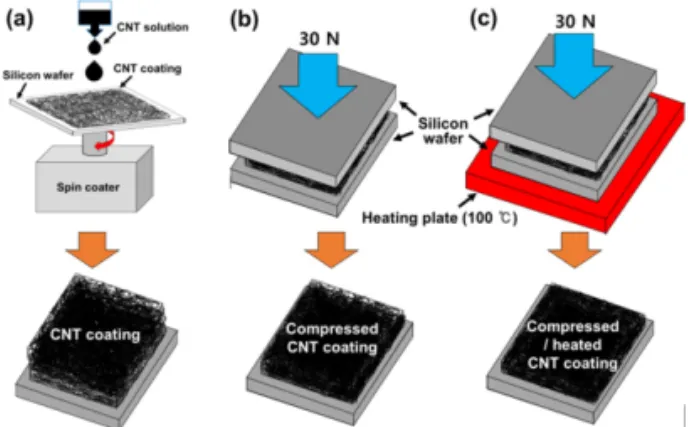
Fig. 1 과 같이, isopropyl alcohol(IPA) 용액에 3 mg/

mL 의 농도로 분산된 CNT(multi-walled CNT) 용액을 세척된 silicon wafer(10 mm × 10 mm) 표면 위에 떨어 뜨리고, spin coater 장비를 이용하여 2000 rpm의 속도로

60 초 동안 회전시켜 CNT 코팅 시편을 제작하였다. 이처 럼 제작된 CNT 코팅을 매끄러운 표면의 silicon wafer 로 덮은 후 30 N(압력: 약 30 MPa)의 수직하중을 가하 여 압착시켰다. 또한, 동일한 방법으로 압력을 가하면서 동시에 hot plate를 이용하여 100

o

C로 가열시켜 압착된 CNT 코팅을 제작하였다. 이와같은 방법으로 CNT 코팅, compressed CNT 코팅과 compressed/heated CNT 코팅 등 3가지의 CNT 코팅 시편들을 준비하였다. CNT 코팅 시편들의 중앙을 절단한 후, 시편의 측면을 SEM으로 분 석하여 코팅의 두께를 측정하였다.

이와 같은 방식으로 제작한 CNT 코팅들에 대하여 마 찰/마모 실험을 수행하였다. 0.5 mm 직경의 지르코니아 볼(ZrO

2

) 을 CNT 코팅 시편에 접촉시켜 20 mN의 수직 하중을 가한 후 왕복 미끄럼 운동방식으로 실험을 진행 하였다. 미끄럼 스트로크(sliding stroke)는 2 mm로 1 cycle 왕복에 의해 4 mm를 이동하며, 총 600 cycles 동 안 실험을 진행하였다. 같은 조건에서 3회 이상 실험을 반복하여, 각 CNT 코팅 조건에 따른 마찰 특성을 비교 하였다. 실험 전후의 CNT 코팅 시편 표면을 SEM으로 분석하여 표면 및 마모의 정도를 비교 분석하였다.

3. 결과 및 고찰

CNT 용액을 spin coater를 이용하여 silicon wafer 표 면 위에 형성시킨 CNT 코팅의 표면을 Fig. 2(a)와 같이 SEM 분석을 통해 관찰하였다. 이러한 CNT 코팅 표면에 압력을 가하여 압착시킨 compressed CNT 코팅 표면의 SEM 이미지는 Fig. 2(b)와 같다. 또한, 같은 방법으로 압 력을 가하면서 동시에 가열을 하여 압착시킨 compressed/

heated CNT 코팅 표면을 Fig. 2(c)와 같이 SEM 분석하 였다.

Fig. 1. Formation processes of (a) CNT, (b) compressed

CNT and (c) compressed/heated CNT coatings.

(3)

Fig. 2 (a)-(c) 에서 보는 것과 같이 다른 방법으로 준비 된 CNT 코팅 시편들의 표면에는 큰 차이가 없는 것을 확인할 수 있다. 이와 달리, 각 코팅 시편들의 두께에는 차이가 발생하였으며, 그 두께의 정량적인 수치는 Table 1 에 나타내었다. 이처럼 동일한 형태의 CNT 코팅들의 두 께가 다르다는 것은 코팅 부피당 CNT 와이어들의 밀도 가 달라진 것이라고 여길 수 있다.

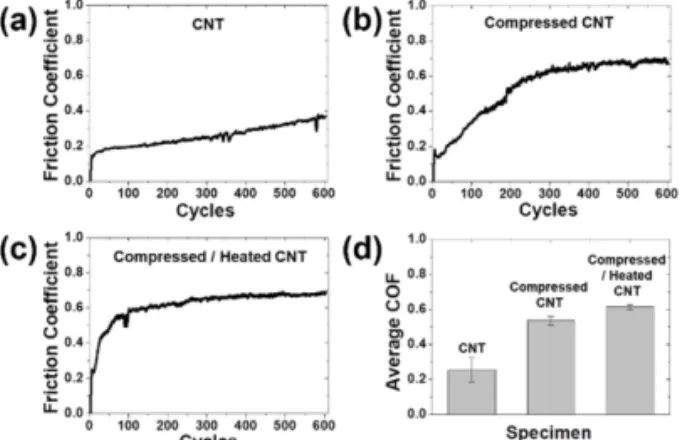
서로 다른 방법으로 형성된 3가지의 CNT 코팅 시편 들에 대해 왕복 미끄럼 운동방식의 마찰/마모 실험을 진 행한 결과, Fig. 3과 같이 마찰계수의 변화를 확인할 수

있다. Fig. 3(a)에서 보듯이, CNT 코팅의 경우, 초기 사 이클에서 0.15 이하의 마찰계수로 시작하여 서서히 증가 하여 최종 600 cycles에 도달했을 때, 0.38 이하의 값을 나타내었다. 이에 반해, Fig. 3(b)-(c)와 같이, compressed CNT 코팅과 compressed/heated CNT 코팅은 초기에는 대략 0.2 정도의 마찰계수를 나타내었지만, 급격히 증가 하여 두 시편 모두 마찰계수가 0.7 정도까지 도달하였 다. 이처럼, 단순히 코팅한 CNT 코팅에 비하여, 압축 및 가열 공정을 거친 CNT 코팅 시편들에서 상대적으로 큰 마찰계수 변화가 나타난 것을 확인할 수 있다. Fig. 3(d) 와 같이, 단순 코팅한 CNT 코팅의 평균 마찰계수가 0.25 정도로써, compressed CNT 코팅과 compressed/heated CNT 코팅에 비해서 대략 2~3배 정도 작은 값임을 확인 할 수 있다. 이것은 단순 CNT 코팅의 경우, CNT 와이 어들의 나노메쉬 구조가 접촉압력을 흡수/분산시켜주어 스프링과 같은 완충작용을 하는 반면, 압축 및 가열 공 정에 의해 압착된 CNT 나노메쉬 구조의 빈 공간들이 줄 어들었기 때문에 완충 효과가 저감된 것으로 판 단된다.

즉, compressed CNT 코팅과 compressed/heated CNT 코팅의 경우에는 코팅의 강성이 증대되어 변형에 대한 저항이 커짐으로써 마찰력이 증가한 것으로 사료된다. 또 한, compressed CNT 코팅에서는 대략 30~40 cycles까 지는 0.2 이하의 낮은 마찰계수를 유지하다가 200~300 cycles 까지 급격히 증가하는 마찰계수 변화를 보이고 있 다. 이에 반해, compressed/heated CNT 코팅은 초반 10 cycles 정도까지만 0.2 정도의 낮은 마찰계수를 나타내다 가 급격히 증가하여 100 cycles 이후 0.6 정도까지 마찰 계수가 급격히 증가한 것으로 확인된다. 이러한 결과는 CNT 코팅을 압축시킬 때, 추가적으로 가열을 동시에 진 행하여 CNT 와이어들의 변형이 심화되었기 때문인 것 으로 판단된다. 즉, 단순히 압력을 가한 compressed CNT 코팅보다 압축과 가열 공정을 동시에 진행한 compressed/

heated CNT 코팅이 더 많이 압착되어 CNT 와이어들의 빈 공간이 더욱 줄어들었고, 그 만큼 강성의 정도가 더 증 가했기 때문에 구조변형 및 마찰 저항이 증가한 것으로 사료된다. 전체적인 평균 마찰계수의 값도 compressed/

heated CNT 코팅이 가장 크게 측정된 것을 확인할 수 있다.

Fig. 4 와 같이, 마찰/마모 실험 후, CNT 코팅 시편들 표면에 형성된 마모트랙의 SEM 이미지를 비교하였다.

세 시편들 모두 선명한 마모트랙을 확인할 수 있으며, Fig. 4(a) 와 같이 단순 CNT 코팅의 경우, 반복적인 상대 미끄럼 운동에 의해 CNT 와이어들이 압착되어 문질러 진 흔적을 볼 수 있다. Fig. 4(b)와 같이 compressed Fig. 2. SEM images of (a) CNT, (b) compressed CNT

and (c) compressed/heated CNT coatings.

Table 1. Thickness of CNT coatings

Specimen Thickness (µm) CNT coating 3.2~3.6 Compressed CNT coating 1.4~1.7 Compressed/Heated CNT coating 0.7~1.2

Fig. 3. Variation of friction coefficient of (a) CNT, (b)

compressed CNT and (c) compressed/heated CNT coatings

with respect to sliding cycles and (d) average friction

coefficient

(4)

CNT 코팅의 경우에는 보다 더 매끄러운 표면을 형성하 며 CNT 와이어들이 문질러졌으며, 마모트랙 전체에 걸 쳐 덩어리째로 뜯겨져 나간 박리의 흔적들이 관찰되었 다. Fig. 4(c)와 같이 compressed/heated CNT 코팅에서 는 CNT 와이어들이 문질러지면서 표면에 덩어리째로 응 착되어 눌러 붙어 있는 마모 형상이 관찰되었다. 이것은 압축 및 가열 공정에 의한 효과로 CNT 와이어들이 응 착되어 들러붙게 되었고, 반복적인 미끄럼 운동에 의해 그대로 압착되어 형성된 것으로 사료된다. 이와 같이, 덩 어리째로 압착된 부분들과 박리 흔적들로 인해 마찰계 수가 증가한 것으로 사료된다.

4. 결 론

본 연구에서는 CNT 코팅의 나노메쉬 구조에 의한 강 성효과가 마찰 및 마모 특성에 미치는 영향을 분석하였 다. CNT 용액을 spin 코팅 방법으로 silicon wafer 위에 형성시킨 CNT 코팅을 제작하여 추가적으로 압축을 시 켜준 compressed CNT 코팅과 압축/가열 공정을 동시에 진행한 compressed/heated CNT 코팅 시편들을 준비하 였다. 이와 같이, CNT 와이어들의 나노메쉬 구조에 변 화를 주어 서로 다른 두께와 CNT 밀도를 가진 CNT 코 팅 시편들에 대해 마찰 및 마모 특성을 비교하였다. CNT 와이어들의 사이 공간이 가장 많을 것으로 판단되는 단 순 코팅한 CNT 코팅이 압축 및 가열 공정에 의해 압착

된 compressed CNT 코팅과 compressed/heated CNT 코팅에 비해 마찰 및 마모 특성이 우수한 것으로 확인되 었다. CNT 와이어들의 압착 및 응착에 의해 사이 공간 들이 줄어들어 코팅의 강성이 증대되었고, 이로 인해 구 조적 변형에 대한 저항이 커짐으로써 마찰력이 증가한 것으로 판단된다. 본 연구의 결과는 CNT 코팅과 같은 나 노메쉬 구조의 강성 효과로 인해 접촉압력을 흡수/분산 시켜 마찰 및 마모 특성을 향상시킬 수 있다는 것을 검 증하며, 관련 연구분야의 기초자료로 활용될 것으로 기 대된다. 하지만, 본 연구에 사용된 코팅 시편들의 두께 에 의한 영향을 확인하고, 강성의 정도를 정량적으로 비 교해야 하는 후속연구가 필요할 것으로 사료된다.

Acknowledgements

이 논문은 2020년도 정부(과학기술정보통신부) 의 재 원으로 한국연구재단의 지원을 받아 수행된 연구임(No.

2018R1C1B5085931).

References

[1] Wang, X., He, Y., Liu, X., Zhu, J., “Enhanced Direct Steam Generation via a Bio-inspired Solar Heating Method Using Carbon Nanotube Films”, Powder Technol., Vol.321, pp.276-285, 2017.

[2] Kumanek, B., Janas, D., “Thermal Conductivity of Carbon Nanotube Networks: A Review”, J. Mater.

Sci., Vol.54, pp.7397-7427, 2019.

[3] Liu, X. M., Huang, Z. D., Oh, S. W., Zhang, B., Ma, P. C., Yuen, M. M. F., Kim, J. K., “Carbon Nanotube (CNT)-Based Composites as Electrode Mate- rial for Rechargeable Li-ion Batteries: A Review”, Com- pos. Sci. Technol., Vol.72, No.2, pp.121-144, 2012.

[4] Ryu, B. H., Barthel, A. J., Kim, H. J., Lee, H. D., Pen- kov, O. V., Kim, S. H., Kim, D. E., “Tribological Prop- erties of Carbon Nanotube-Polyethylene Oxide Composite Coatings”, Compos. Sci. Technol., Vol.101, pp.102-109, 2014.

[5] Lim, W. S., Khadem, M., Anle, Y., Kim, D. E., “Fabri- cation of Polytetrafluoroethylene-Carbon Nanotube Composite Coatings for Friction and Wear Reduction”, Polym. Compos., Vol.39, No.S2, pp.E710-E722, 2018.

[6] Kim, C. L., Kim, D. E., Kim, H. J., “Tribological Properties of Carbon Nanotube Thin Films by using Electrodynamic Spraying Method”, Tribol. Lubr., Vol.34, No.6, pp.313-317, 2018, https://doi.org/

10.9725/kts.2018.34.6.313

[7] Mirri, F., Ma, A. W. K., Hsu, T. T., Behabtu, N., Eichmann, S. L., Young, C. C., Tsentalovich, D. E., Fig. 4. SEM images of wear track of (a) CNT, (b)

compressed CNT and (c) compressed/heated CNT

coatings.

(5)

Pasquali, M., “High-Performance Carbon Nanotube Transparent Conductive Films by Scalable Dip Coat- ing”, ACS Nano, Vol.6, No.11, pp.9737-9744, 2012.

[8] Abdelhalim, A., Abdellah, A., Scarpa, G., Lugli, P.,

“Fabrication of Carbon Nanotube Thin Films on Flexi- ble Substrates by Spray Deposition and Transfer Print- ing”, Carbon, Vol.61, pp.72-79, 2013.

[9] Kim, S., Yim, J., Wang, X., Bradley, D. D. C., Lee, S., deMello, J. C., “Spin and Spray Deposited Sin- gle Walled Carbon-Nanotube Electrodes for Organic Solar Cells”, Adv. Funct. Mater., Vol.20, No.14,

pp.2310-2316, 2010.

[10] Kim, D. E. Kim, C. L., Kim, H. J., “A Novel Approach to Wear Reduction of Micro-Components by Synthesis of Carbon Nanotube-Silver Composite Coating”, CIRP Ann-Manuf. Technol., Vol.60, pp.599- 602, 2011.

[11] Kim, C. L., Jung, C. W., Oh, Y. J., Kim, D. E., “A

Highly Flexible Transparent Conductive Electrode

based on Nanomaterials”, NPG Asia Mater., Vol.9,

No.e438, pp.1-9, 2017.

수치

Fig. 1 과  같이, isopropyl alcohol(IPA) 용액에  3 mg/
Fig. 3. Variation of friction coefficient of (a) CNT, (b)  compressed CNT and (c) compressed/heated CNT coatings  with respect to sliding cycles and (d) average friction  coefficient

참조

관련 문서

The purpose of this study was to prepare titanium based-nitride monolayer coating(TiAlN, TiCrN, CrN) and multilayer coating(TiAlN/CrN, TiAlN/ZrN, TiCrN/ZrN) by

Plots of discharge capacity versus cycle number for LOBs with CNT-only and MOF-C/CNT electrodes.. Schematic diagram illustrating the synthesis process

Noorul Haq : Effect of friction welding parameters on mechanical and metallurgical properties of ferritic stainless steel, The international journal of

In order to investigate the characteristics of Al/CFRP using friction spot joining, plunge depth, the rotation speed, and the dwell time were selected as parameters..

52 Sheet resistance and carrier mobility of the spin-coated Al substrates by using PTFE or PTFE/CNT powder with a different CNT contents · ·

In this regard, this study analyzes the effect of the job characteristics and work environment of workers with physical disabilities on job satisfaction

This study the changes in structure and mechanical characteristics by the analysis on mechanical characteristics of the welding part and the post weld

The purpose of the research is to suggest solution plan for trade friction and vitalize trade between Korea and China by analyzing the effect that Korea-China FTA has