Received: 6 July, 2012 Revised: 14 September, 2012 Accepted: 2 October, 2012 Corresponding author: Wan Hee Lee
Department of Physical Therapy, College of Health and Welfare, Sahmyook University, 815 Hwarang-ro, Nowon-gu, Seoul 130-742, Republic of Korea Tel: 82-2-3399-1633 Fax: 82-2-3399-1639 E-mail: [email protected]
This is an Open-Access article distributed under the terms of the Creative Commons Attribution Non-Commercial License (http://creativecommons.org/licens es/by-nc/3.0) which permits unrestricted non-commercial use, distribution, and reproduction in any medium, provided the original work is properly cited.
Copyright © 2012 Korean Academy of Physical Therapy Rehabilitation Science
pISSN 2287-7576 Phys Ther Rehabil Sci
eISSN 2287-7584 2012, 1 (1), 22-27
www.jptrs.org
Changes of spatio-temporal gait parameters according to experience falls in post-stroke patients
Ki Hun Choa, Wan Hee Leeb
aDepartment of Physical Therapy, Seoul Bukbu Hospital, Seoul, Republic of Korea
bDepartment of Physical Therapy, College of Health and Welfare, Sahmyook University, Seoul, Republic of Korea
Objective: Falls are defined as contact of the body with the floor after losing balance during activities of daily living. Falls com- monly occur among the elderly, and stroke patients in particular are at a high risk of falling. The purpose of this study was to inves- tigate the changes of temporal and spatial gait parameters and gait symmetry according to experience falls in post-stroke patients.
Design: Cross-sectional study.
Methods: Fifty three patients with stroke were recruited on a voluntary basis from the rehabilitation unit, who currently under- going physical therapy. All participants were asked to answer questions regarding the frequency of falls in the past 1 year.
Fifty-three patients with stroke were allocated 2 groups according to experienced falls: stroke with falls (n=26) during past 1 year and stroke without falls (n=27). The spatial and temporal gait parameters and gait symmetry ratio were measured using GAITRite system.
Results: The spatial gait parameters and the temporal gait parameters were significantly different between the stroke with falls group and the stroke without falls group (p<0.05). Furthermore, step length was the only significantly different among symmetry ratio (p<0.05).
Conclusions: Experience of falls can lead to impairment of gait ability in stroke patients. This result is expected to be used as a basic data for rehabilitation program development to prevent a fall of post-stroke patients.
Key Words: Fall, Gait, Stroke
Introduction
Falls are defined as contact of the body with the floor without external impact shocks after losing balance during the process of activities of daily living (ADL) [1]. A fall oc- curs across the whole process of a life, especially frequently for the elders more than 65 years old. It increases gently after 75 and reaches the climax between the ages of 80 to 84 range, and the survival and frequency reduce for more than 85 as there are often restrictions on activities [2].
A fall is caused by complex interactions of several factors rather than one factor [3]. The main factors known to fre- quently contribute to a fall are increases of the loss of lower
extremity strength which occur as one gets older, increase in postural sway which comes from decrease of muscle power supporting knees, and a decrease in stride length, reduction in walking speed, reduction of toe off and increase of double limb support period [4], and other factors are reported to also causes a fall are various ones such as environmental factors, psychological factors, pathological factors, etc [5]. In partic- ular, because stroke patients show decreases in postural con- trol, activities of daily living and mobility caused by various neurologic damages [6], such as caused by motor disorder, sensory disorder, cognition disorder, perception these acci- dents are reported to be included in a high risk of falling [7].
A fall of stroke patients leads to a restriction of activities and
life-dependent pattern, so various studies were conducted to understand and prevent patterns of a fall [8].
Hyndman and Ashburn [9] reported a cross-sectional study which recruited forty-eight mobile community-dwell- ing people with stroke to identify relationships between stroke patients’ attention, balance, function and a fall, a sig- nificant difference in balance and ADL ability between re- peat-fallers and non-fallers, and, Mansfield et al. [10] re- ported a significant relationship between motor impairment, postural sway, a fall experience and limb center of pressure synchronization was demonstrated.
For stable and independent walking for stroke patients, sufficient stance stability, rhythmic muscle activation pat- tern, and sufficient mechanical energy on an even surface are necessary, and the ability to adapt to environmental ob- stacles and constraints on an uneven surface is required [11].
Among stroke patients, gait patterns can differ from one another, but there are certain characteristics of gait of stroke patients which appear in general [12]. For example, these characteristics are decrease in gait cycle and walking speed due to timing, muscle hypertension, changes in mechanical property of soft tissue, and difference between paretic step length and non-paretic step length. Also, the characteristics include an asymmetrical gait pattern such as long stance phase and relatively short swing phase of paretic side [13].
These gait characteristics causes a clear difference of spatial and temporal gait parameters when compared to normal sub- jects [14], and increases energy consumption and decreases walking speed and endurance [15]. Furthermore, through various studies, it was found that when walking in complex environments such as a shopping mall, resolution of addi- tional cognitive task degrades postural control by influenc- ing gait parameters like walking speed, step and stride length, and double limb support period [16,17].
Despite that stroke patients’ gait patterns from neurologic damages have potential to be connected to falling accidents [18], the studies addressing gait of stroke patients with expe- rience of falling is deficient.
There is a previous study of comparison between stroke patients and nondisabled elderly people, which revealed that stroke patients have slower walking speed than nondisabled elderly people do [19], but nor a direct study regarding changes in temporal and spatial gait parameters caused by stroke patients’ experience of falling, nor a research about gait symmetry which is identifiable from temporal and spa- tial parameters of gait [20] is being conducted.
Thus, the purpose of this study was to investigate the changes of temporal and spatial gait parameters and gait symmetry according to experience falls in post-stroke patients.
Methods
Subjects and procedure
Subjects of this study are those who understand and agree to participate in this test among patients who are diagnosed with stroke in Korea Seoul Bukbu hospital rehabilitation medicine and currently have standard rehabilitation. All par- ticipating subjects were asked to answer questions regarding frequency of falls in the past one year [21], in which fall was defined as any unplanned, unexpected contacts with a sup- porting surface (ground, chair, wall, step, etc.) [22]. The sub- jects were divided into a 26-patient falls stroke group and a 27-patient non-falls stroke group.
Subjects were recruited according to the following in- clusion criteria: Mini-Mental State Examination [23], hemi- paretic from a single stroke occurring at least six months earlier. able to walk 10 m independently without an assistive device, no known musculoskeletal conditions that would af- fect the ability to safely walk repeatedly, and absence of seri- ous visual impairment or hearing disorder.
Outcome measures
Gait abilities were measured using an electrical walkway system (GAITRite, CIR System Inc., Clifton, NJ, USA). The system captures temporal and spatial gait parameters and con- nects to the serial port of a personal computer. It consists of an 810×89×0.625 cm (length×width×height) instrumented mat with 27,648 embedded pressure sensitive sensors spaced at 1.27 cm arranged in a 48×576 grid. The sampling rate was 80 Hz and the obtained data were analyzed using gait analysis software (GAITRite GOLD, ver. 3.2b, CIR System Inc., Clifton, NJ, USA). Subjects walked at their comfortable gait speed over 3 trials. Subjects initiated and terminated walking a minimum of 5 m from the start and end of the walkway to maintain the gait speed on the mat. A verbal command was given to initiate walking and one of the examiners accom- panied the subject to prevent a fall during walking. Gait veloc- ity, cadence, step length, stride length, single limb support and double limb support for both the affected and unaffected legs, and gait symmetry ratio were measured. Gait symmetry ratio were quantified using an index proposed by Patterson et al.
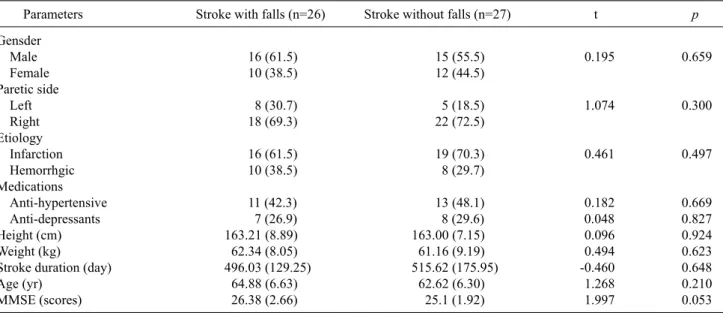
Table 1. General characteristics of the subjects
Parameters Stroke with falls (n=26) Stroke without falls (n=27) t p
Gensder
Male 16 (61.5) 15 (55.5) 0.195 0.659
Female 10 (38.5) 12 (44.5)
Paretic side
Left 8 (30.7) 5 (18.5) 1.074 0.300
Right 18 (69.3) 22 (72.5)
Etiology
Infarction 16 (61.5) 19 (70.3) 0.461 0.497
Hemorrhgic 10 (38.5) 8 (29.7)
Medications
Anti-hypertensive 11 (42.3) 13 (48.1) 0.182 0.669
Anti-depressants 7 (26.9) 8 (29.6) 0.048 0.827
Height (cm) 163.21 (8.89) 163.00 (7.15) 0.096 0.924
Weight (kg) 62.34 (8.05) 61.16 (9.19) 0.494 0.623
Stroke duration (day) 496.03 (129.25) 515.62 (175.95) -0.460 0.648
Age (yr) 64.88 (6.63) 62.62 (6.30) 1.268 0.210
MMSE (scores) 26.38 (2.66) 25.1 (1.92) 1.997 0.053
Values are presented as n (%) or mean (SD).
MMSE: Mini-Mental State Examination.
Table 2. Differences of temporal gait parameters Parameters Stroke with
falls (n=26)
Stroke without falls (n=27) t Velocity (cm/sec) 41.45 (13.98) 65.69 (18.87) -5.328***
Cadence (step/min) 69.05 (20.52) 90.35 (16.79) -4.141***
Values are presented as mean (SD).
***p<0.001.
[24].
The formula is as follows:
Gait symmetry ratio= paretic side (parameter valru) non-paretic side (parameter valru)
Data analysis
Statistical analyses were performed using SPSS ver. 15.0 software (SPSS Inc., Chicago, IL, USA). After confirming the normality of the data by using the Shapiro-Wilks test, General characteristics comparisons between groups were examined with independent t-test and chi-squared test.
Changes of spatial and temporal gait parameters and differ- ences of symmetry ratio were examined with independent t-test between groups comparison. The level of significance was chosen as 5% for all statistical analyses.
Results
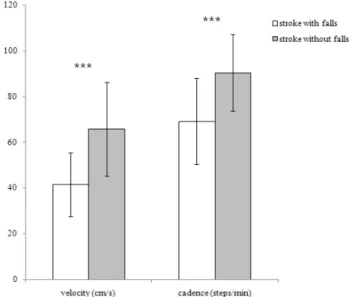
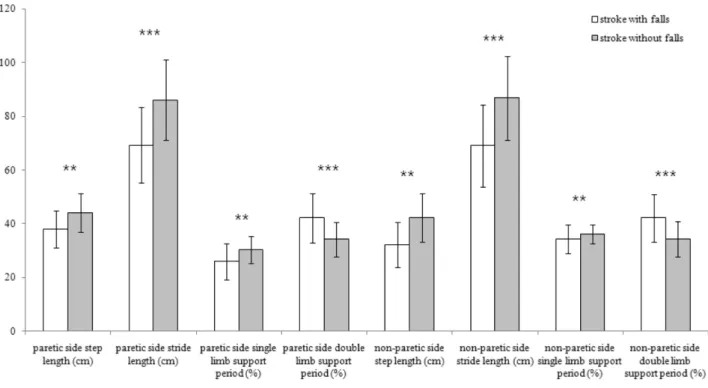
No significant differences in general characteristics at in- clusion were detected between groups (Table 1). The spatial gait parameters (velocity and cadence) and the temporal gait parameters (step length, stride length, sing limb support pe- riod, and double limb support period for both the paretic and non-paretic legs) were significantly different between the fall stroke group and the non falls stroke group (Tables 2, 3) (p<0.05). In additional, step length was the only signifi-
cantly different among symmetry ratio (Table 4) (p<0.05).
Discussion
Stroke patients with fall experiences are more likely to be exposed to hip fracture, Loss of independent mobility, and severely death than stroke patients without fall experience, so it is important to prevent a fall and assess correct mobility in a stage before post stroke [25]. In a clinic, reliability and validity are demonstrated to assess the gait ability of stroke patients, and 10 m walking test and Timed Up and Go test are mainly used for judging a degree of impairment from a stroke as the tests are closely correlated to a degree of dam- age [26]. However, the assessment has disadvantages of be- ing likely to be interrupted by subjective judgments, not be- ing able to find subtle changes and disability of quantitative assessment which is necessarily required for understanding pathological gait [11].
Table 3. Differences of spatial gait parameters
Parameters Stroke with falls (n=26) Stroke without falls (n=27) t
Step length (cm) P 38.07 (6.96) 44.07 (7.26) -3.068*
NP 32.19 (8.51) 42.35 (9.06) -3.071*
Stride length (cm) P 69.22 (14.07) 86.15 (15.04) -4.094**
NP 69.11 (15.24) 86.82 (15.61) -4.093**
Single limb support period (%) P 25.91 (6.75) 30.30 (5.08) -2.679*
NP 34.31 (5.40) 36.14 (3.61) -2.665*
Double limb support period (%) P 42.11 (9.05) 34.30 (6.41) 3.631**
NP 42.22 (8.92) 34.24 (6.59) 3.712**
Values are presented as mean (SD).
P: paretic side, NP: non-paretic side.
*p<0.05, **p<0.01.
Table 4. Differences of symmetry ratio between groups
Parameters Stroke with falls (n=26) Stroke without falls (n=27) t
Step length (cm) 1.25 (0.39) 1.05 (0.15) 2.410*
Stride length (cm) 1.00 (0.02) 0.99 (0.01) 1.695
Single limb support period (%) 0.75 (0.18) 0.84 (1.49) -1.863
Double limb support period (%) 0.99 (0.04) 1.00 (0.04) -0.507
Values are presented as mean (SD).
*p<0.05.
Figure 1. Differences of temporal gait parameters in stroke patients with and without fall experience. ***p<0.001.
Thus, in this study, changes in temporal and spatial gait parameters were identified by means of GAITRite system which is capable of objective and quantitative measurement in order to find a difference in gait ability between stroke pa- tients with fall experience and stroke patients without fall experience.
The result of this study, the spatial gait parameters (velo- city and cadence) and the temporal gait parameters (step length, stride length, sing limb support period, and double limb support period for both the paretic and non-paretic legs) were significantly different between the fall stroke group and the non falls stroke group (p<0.05) (Figures 1, 2).
Experience of a fall brings fear of falling, which causes limitation of activity due to loss of confidence and depend- ent life, and decrease of gait stability is reported as a main risk factor of a fall [27], van Haastregt et al. [28] reported that fear of falling leads to anxiety, depression, and increase of avoidance activities. In this study, the memory of stroke patients with fall experience about a fall is believed to work as fear and cause decrease in gait stability decrease and avoidance movement, having an influence on the decrease of temporal and spatial gait ability.
The causes of a fall are largely divided into intrinsic fac- tors (muscle weakness, poor balance ability) and extrinsic
factors (doses of various drugs, environmental changes), and psychological factors are also reported to be the factor of occurrence of a fall [5]. But, as this study lacked in inves- tigation of psychological factors in its subjects, future stud- ies are expected to complement these parts.
For stroke patients, increase of gait ability is an ultimate
Figure 2. Differences of spatial gait parameters in stroke patients with and without fall experience. **p<0.01, ***p<0.001.
goal of rehabilitation, which focuses many researchers’
great attention on assessment and improvement of walking speed [29]. However, it is limited in both its value to docu- ment post-stroke recovery and the information it provides regarding the underlying impairments [30]. In addition, gait velocity does not fully reflect all aspects of a typical stroke rehabilitation program and thus is limited as a solitary clin- ical measure to direct treatment and to reflect its outcomes [24]. Gait symmetry ratio is assessed in a manner of com- plementing this limitation. Gait symmetry ratio uses abso- lute value, and as ratio of the value get closer to 1, gait sym- metry ratio increases, and as it gets far from 1, gait symmetry ratio decreases [31]. Thus, this study identified a difference in gait symmetry ration between stroke patients with fall ex- perience and stroke patients without fall experience, and used the method of Patterson et al. [24] in order to get the gait symmetry ratio.
The results of this study, step length was the only sig- nificantly different among symmetry ratio (p<0.05). In par- ticular, step length symmetry ratio was higher as 1.25 cm than that of stroke patients with fall experience group as 1.05 cm, which showed asymmetry of step length. In case of asymmetry of gait, when stance starts to quickly move cen- ter of gravity to a non-paretic side, due to unstable paretic lower extremity, heel does not contact ground but sole or toe,
which shortens stance phase of paretic side and a swing phase of non-paretic side, and forward propulsion becomes difficult, which causes a pattern where step length is short- ened [29,32]. A direct comparison is not possible because there is no investigation on gait symmetry ratio of stroke pa- tients caused by experience of a fall, but we believe that gait asymmetry by a fall, in particular, possibility of asymmetry of step length are significant results.
This study has a limitation that its targets was chronic stroke patients whose onset period in and out of 500 days and therefore the results may not be generalizable to stroke pa- tients in the acute stage or to people who need assistance for ambulation. Thus, it is considered that further studies need to target various stages of stroke patients. In this study was to investigate the changes of temporal and spatial gait pa- rameters and gait symmetry according to experience falls in stroke patients with experience falls and stroke patients without experience falls, our finding show that, the spatial and temporal gait parameters were significantly different between the stroke with falls group and the stroke without falls group. Furthermore, step length was the only sig- nificantly different among symmetry ratio. This result is ex- pected to be used as a basic data for rehabilitation program development to prevent a fall of stroke patients.
References
1. Lord SR, Clark RD, Webster IW. Physiological factors asso- ciated with falls in an elderly population. J Am Geriatr Soc 1991;39:1194-200.
2. Runge JW. The cost of injury. Emerg Med Clin North Am 1993;11:241-53.
3. Steinweg KK. The changing approach to falls in the elderly. Am Fam Physician 1997;56:1815-23.
4. Bishop MD, Meuleman J, Robinson M, Light KE. Influence of pain and depression on fear of falling, mobility, and balance in older male veterans. J Rehabil Res Dev 2007;44:675-83.
5. Rubenstein LZ, Josephson KR. The epidemiology of falls and syncope. Clin Geriatr Med 2002;18:141-58.
6. Jung T, Lee D, Charalambous C, Vrongistinos K. The influence of applying additional weight to the affected leg on gait patterns during aquatic treadmill walking in people poststroke. Arch Phys Med Rehabil 2010;91:129-36.
7. Jørgensen L, Engstad T, Jacobsen BK. Higher incidence of falls in long-term stroke survivors than in population controls: de- pressive symptoms predict falls after stroke. Stroke 2002;33:
542-7.
8. Kanis J, Oden A, Johnell O. Acute and long-term increase in fracture risk after hospitalization for stroke. Stroke 2001;32:
702-6.
9. Hyndman D, Ashburn A. People with stroke living in the com- munity: Attention deficits, balance, ADL ability and falls.
Disabil Rehabil 2003;25:817-22.
10. Mansfield A, Mochizuki G, Inness EL, McIlroy WE. Clinical correlates of between-limb synchronization of standing balance control and falls during inpatient stroke rehabilitation. Neurore- habil Neural Repair 2012;26:627-35.
11. Weerdesteyn V, de Niet M, van Duijnhoven HJ, Geurts AC. Falls in individuals with stroke. J Rehabil Res Dev 2008;45:1195-213.
12. Kerrigan DC, Karvosky ME, Riley PO. Spastic paretic stiff-leg- ged gait: joint kinetics. Am J Phys Med Rehabil 2001;80:244-9.
13. Kahn JH, Hornby TG. Rapid and long-term adaptations in gait symmetry following unilateral step training in people with hemiparesis. Phys Ther 2009;89:474-83.
14. Lin PY, Yang YR, Cheng SJ, Wang RY. The relation between an- kle impairments and gait velocity and symmetry in people with stroke. Arch Phys Med Rehabil 2006;87:562-8.
15. Stein RB, Everaert DG, Thompson AK, Chong SL, Whittaker M, Robertson J, et al. Long-term therapeutic and orthotic effects of a foot drop stimulator on walking performance in progressive and nonprogressive neurological disorders. Neurorehabil Neural Repair 2010;24:152-67.
16. Plummer-D'Amato P, Altmann LJ, Saracino D, Fox E, Behrman AL, Marsiske M. Interactions between cognitive tasks and gait after stroke: a dual task study. Gait Posture 2008;27:683-8.
17. Hyndman D, Ashburn A, Yardley L, Stack E. Interference be- tween balance, gait and cognitive task performance among peo- ple with stroke living in the community. Disabil Rehabil 2006;
28:849-56.
18. Kottink AI, Hermens HJ, Nene AV, Tenniglo MJ, Groothuis- Oudshoorn CG, IJzerman MJ. Therapeutic effect of an implant- able peroneal nerve stimulator in subjects with chronic stroke and footdrop: a randomized controlled trial. Phys Ther 2008;88:
437-48.
19. Chen G, Patten C, Kothari DH, Zajac FE. Gait differences be- tween individuals with post-stroke hemiparesis and non-disabled controls at matched speeds. Gait Posture 2005;22:51-6.
20. Brandstater ME, de Bruin H, Gowland C, Clark BM. Hemiplegic gait: analysis of temporal variables. Arch Phys Med Rehabil 1983;64:583-7.
21. Hyndman D, Ashburn A, Stack E. Fall events among people with stroke living in the community: circumstances of falls and char- acteristics of fallers. Arch Phys Med Rehabil 2002;83:165-70.
22. Chyu MC, James CR, Sawyer SF, Brismée JM, Xu KT, Poklikuha G, et al. Effects of tai chi exercise on posturography, gait, physical function and quality of life in postmenopausal women with osteopaenia: a randomized clinical study. Clin Rehabil 2010;24:1080-90.
23. Folstein MF, Folstein SE, McHugh PR. "Mini-mental state". A practical method for grading the cognitive state of patients for the clinician. J Psychiatr Res 1975;12:189-98.
24. Patterson KK, Parafianowicz I, Danells CJ, Closson V, Verrier MC, Staines WR, et al. Gait asymmetry in community-ambulat- ing stroke survivors. Arch Phys Med Rehabil 2008;89:304-10.
25. Ramnemark A, Nilsson M, Borssén B, Gustafson Y. Stroke, a major and increasing risk factor for femoral neck fracture. Stroke 2000;31:1572-7.
26. Eng JJ, Chu KS, Dawson AS, Kim CM, Hepburn KE. Functional walk tests in individuals with stroke: relation to perceived ex- ertion and myocardial exertion. Stroke 2002;33:756-61.
27. Sherrington C, Whitney JC, Lord SR, Herbert RD, Cumming RG, Close JC. Effective exercise for the prevention of falls: a sys- tematic review and meta-analysis. J Am Geriatr Soc 2008;56:
2234-43.
28. van Haastregt JC, Zijlstra GA, van Rossum E, van Eijk JT, Kempen GI. Feelings of anxiety and symptoms of depression in community-living older persons who avoid activity for fear of falling. Am J Geriatr Psychiatry 2008;16:186-93.
29. Yan T, Hui-Chan CW, Li LS. Functional electrical stimulation improves motor recovery of the lower extremity and walking ability of subjects with first acute stroke: a randomized place- bo-controlled trial. Stroke 2005;36:80-5.
30. Lord SE, Halligan PW, Wade DT. Visual gait analysis: the devel- opment of a clinical assessment and scale. Clin Rehabil 1998;12:
107-19.
31. Sibley KM, Tang A, Patterson KK, Brooks D, McIlroy WE.
Changes in spatiotemporal gait variables over time during a test of functional capacity after stroke. J Neuroeng Rehabil 2009;6:
27.
32. Kosak MC, Reding MJ. Comparison of partial body weight-sup- ported treadmill gait training versus aggressive bracing assisted walking post stroke. Neurorehabil Neural Repair 2000;14:13-9.