Received: 26 May, 2017 Revised: 1 August, 2017 Accepted: 8 August, 2017
Ⓒ The Korean Society of Mycology
This is an Open Access article distributed under the terms of the Creative Commons Attrib- ution Non-Commercial License (http://creative- commons.org/licenses/by-nc/4.0/) which permits unrestricted non-commercial use, distribution, and reproduction in any medium, provided the original work is properly cited.
Kor. J. Mycol. 2017 September, 45(3): 246-250 https://doi.org/10.4489/KJM.20170030
pISSN : 0253-651X eISSN : 2383-5249
OPEN ACCESS
RESEARCH NOTE
Sclerotium rolfsii 에 의한 녹두 흰비단병
권진혁1*, 김민근1, 강동완1, 한인영1, 이병정1, 김진우2
1경상남도농업기술원, 2경상대학교 농업생명과학연구원
Sclerotium Rot of Mungbean (Phaseolus radiatus L.) Caused by Sclerotium rolfsii in South Korea
Jin-Hyeuk Kwon1*, Min-Keun Kim1, Dong-Wan Kang1, Inyoung Han1, Byeong-Jeong Lee1, Jinwoo Kim2
1Gyeongsangnam-do Agricultural Research and Extension Services, Jinju 52733, Korea
2Institute of Agriculture and Life Science, Gyeongsang National University, Jinju 52828, Korea
*Corresponding author: [email protected]
Abstract
Sclerotium rot was observed on mungbean (Phaseolus radiatus L.) plants cultivated in the exhibition field of Gyeongsangnam-do Agricultural Research and Extension Services in September 2015. The progression of rot was initially observed as water-soaked lesions on several parts of the affected plant. Severely infected plants were blighted and eventually died.
White mycelial mats spread over the lesions and numerous sclerotia formed on stems near the soil line. The sclerotia were globoid in shape, 1~3 mm in size, and white to brown in color. The optimum temperature for mycelial growth and sclerotia formation on potato dextrose agar (PDA) was 30°C and the hyphal width was 4~8 µm. Typical clamp connections were observed on the hyphae of fungus grown on PDA. For molecular identification, the complete internal transcribed spacer (ITS) ribosomal DNA (rDNA) of the causal fungus was sequenced and analyzed. Based on the mycological characteristics, ITS rDNA sequence analysis, and pathogenicity to host plants, the fungus was identified as Sclerotium rolfsii. This is the first report of Sclerotium rot on mungbean caused by S. rolfsii in Korea.
Keywords: Mungbean, Phaseolus radiatus L., Sclerotium rolfsii, Sclerotium rot
녹두(Phaseolus radiatus L.)는 콩과(Fabaceae)에 속하며 인도 원산의 일년생 식물로서 재 배하고 있으며 종자는 타원형이고 녹색 또는 갈색이다[1].
2015년 경상남도농업기술원 시험연구포장에 재배중인 녹두가 시들어 말라 죽는 이상 증 상을 관찰하였다. 포장에서 병든 식물체를 채집하여 실험실에 가져와 병반 부위에서 병원균 을 순수 분리하고 병원균의 균학적 특징과 internal transcribed spacer (ITS) rDNA 염기서열 분석을 통한 분자동정 결과 Sclerotium rolfsii Saccardo에 의한 녹두 흰비단병으로 동정되었다.
지금까지 우리나라에서 녹두 흰비단병에 대한 병해 발생 보고는 없었다[2]. 따라서 본 연구
에서는 녹두에 발생한 흰비단병의 병징과 병원균의 균학적 특징, 분자동정 및 병원성 조사 결 과를 보고한다.
병징
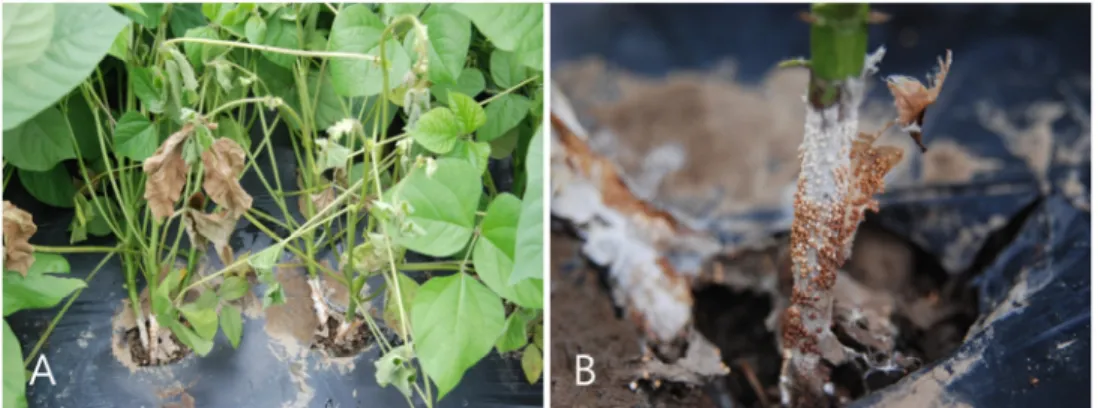
녹두 줄기의 아래쪽 땅 표면 닿는 지제 부위에서 수침상으로 물러지고 서서히 시들면서 나 중에 결국 말라 죽는다. 병든 식물체의 병반 부위에서 흰색의 곰팡이가 생기고 흰 균사체는 시간이 경과함에 따라 갈색의 작은 둥근 균핵을 병반 부위에 많이 형성하였다(Fig. 1A, 1B).
Fig. 1. Symptoms of Sclerotium rot of Mungbean (Phaseolus radiatus L.). A, B, typical symptoms of infected plants that eventually died in the field.
포장에서 발생 환경
2015년 8월 이후 경상남도농업기술원 시험연구포장에 재배중인 녹두가 생육이 왕성하여 잎과 줄기 및 잎자루가 서로 엉키어 통풍과 채광이 부족한 환경조건이었다. 이 시기에는 남부 지방 강우가 잦아 온도와 습도가 알맞게 유지되어 병해 발생이 잘되었다. 포장에서 감염된 녹 두의 줄기 부분이 수침상으로 물러지면서 갈색으로 변하고 식물체가 시드는 이상 증상이 군 데군데 나타났다. 병이 발생한 식물체는 서서히 시들면서 나중에 결국 말라 죽었다. 병든 식 물체의 줄기에서 흰색의 균사체와 갈색의 작은 둥근 균핵이 형성되었고 서서히 시들어 말라 죽기 때문에 포장에서 육안으로 쉽게 관찰되었다.
병원균 분리 및 균학적 특성
녹두에서 발생한 흰비단병의 병원균을 분리하기 위하여 병든 식물체를 채집하여 건전부와 병반부 경계 부위의 조직을 5 × 5 mm 크기로 50개를 잘랐다. 1% NaOCl 용액으로 1분간 표 면 소독한 후 멸균수에 3회 세척하였다. 알콜 램프에 화염 소독한 필터 종이를 이용하여 물기 를 제거한 후 크린 벤치에서 일회용 페트리디쉬 안에 넣고 24시간 시료를 건조시켰다. 감자한 천배지(potato dextrose agar, PDA) 위에 옮겨 25°C 항온기 내에서 4일간 배양한 후 자라 나 온 균사를 다시 떼어 내어 PDA 위에 옮긴 후 30°C 항온기 내에서 20일 배양하면서 병원균의 균학적 특성을 조사하였다(Table 1).
Table 1. Comparison of mycological characteristics of an isolate obtained from Mungbean (Phaseolus radiatus L.) and Sclerotium rolfsii described previously
Characteristics Present isolate Sclerotium rolfsiia
Colony color white white
Hypha size 4~9 µm 4.5~9 µm
Sclerotium clamp connection present present
shape globoid spherical
size 1~3 mm 1~2 mm
color white to brown brown
aDescribed by Mordue [4].
PDA 위에서 균총은 흰색이며 균사가 솜털처럼 왕성하게 자라며 흰색의 균핵 시원체가 형 성되고 배양 시간이 길어짐에 따라 지름 1~3 mm의 갈색의 작은 둥근 균핵을 많이 형성하였 다(Fig. 2A). 균사 생육 및 균핵 형성 적온은 30°C이었다. 5일간 배양한 균총에서 주사전자현 미경(scanning electron microscope, SEM)으로 균사 특유의 clamp connection 형태를 관찰 할 수 있었다(Fig. 2B). 균사의 폭은 4~9 µm이었다.
A B C
Fig. 2. Mycological characteristics of Sclerotium rolfsii isolated from Mungbean (Phaseolus radiatus L.). A, mycelial mats and sclerotia produced on potato dextrose agar after 20 days; B, scanning electron micrograph of clamp connection (arrow); C, symptoms induced by artificial inoculation.
ITS 염기서열 분석
병원균 동정을 확정하기 위해 White 등[3]이 제작한 프라이머 ITS1 (5'-TCCGTAGGT GAACCTGCGG-3')과 ITS4 (5'-TCCTCCGCTTATTGATATGC-3')를 사용하여 ITS rDNA 부분을 PCR로 증폭하였다. PCR 조건은 최종농도 10 mM Tris- HCl (pH 8.3), 50 mM KCl, 1.5 mM MgCl2, 200 nM dNTPs이고 10 pmol의 프라이머와 0.1 unit의 rTaq DNA polymerase (Takara Bio, Kusatsu, Japan)를 사용하였으며, 50 µL로 반응 용량을 맞추었다. PCR 반응 조 건은 predenaturation (98°C, 2 min), denaturation (98°C, 30 sec), annealing (55°C, 30 sec),
며, 증폭된 PCR 산물은 0.8% agarose gel에서 전기영동 후, ethidium bromide로 염색하여 UV transilluminator에서 DNA밴드를 확인하였다. 확인된 DNA밴드는 QIAquick PCR purification kit (Qiagen, Germantown, MD, USA)를 사용하여 분리 정제하였고 pGEM-T Easy 클로닝 벡터(Promega, San Luis Obispo, CA, USA)에 클로닝한 후 M13F와 M13R 프 라이머를 이용하여 염기서열을 분석하였다(Macrogen, Seoul, Korea). 병원 곰팡이의 분자 적인 동정을 위해 ITS rDNA 영역의 염기서열(681-bp)을 BLASTN 프로그램을 이용하여 분석하였으며 Pseudogynoxys cabrerae 흰비단병(GenBank accession no. KY216142), 닭 의장풀 흰비단병(HQ420816), 고구마 뿌리썩음병(KX186998), 우엉 흰비단병(KU60984), 제비난초 흰비단병(KJ546416), 백합 흰비단병(AY684917)을 일으키는 S. rolfsii와 99%의 상동성을 나타내었다. 이미 보고된 흰비단병균들과의 높은 상동성으로 인하여 계통학적 유 연관계 분석을 실시하지 않았다.
병원성 검정
2016년 6월 상순 건전한 녹두 종자 30개를 준비하여 와그너 포트(1/5,000 a)에 한알씩 심 은 후 경남농업기술원 비닐하우스에서 병원성 검정용으로 사용하기 위해 격리 재배를 하였 다. 8월 상순 건전한 식물체에 병원성을 검정하였다. 접종원은 직경 2.0 mm의 가는 체로 친 토양을 고압 멸균기에 3일 간격으로 30분간 3회 멸균하였다. 감자한천배지에 7일간 배양한 균총 30개를 수거하여 플라스틱 용기(56 × 35 × 13 cm)에 넣고 멸균한 토양 3 kg을 손으로 잘 섞은 다음 골고루 잘게 마쇄하였다. 유리 온실에 2주간 건조시킨 후 상온에 보관하면서 접종 원으로 사용하였다. 접종하기 전에 와그너 포트 내 토양이 건조하지 않게 하기 위해 포트당 500 mL씩 물을 준 다음 식물체 주변에 포트당 전염원 100 g씩 9 포트 인공접종하였다. 수분 증발을 방지하기 위해 A4 종이 한 장을 그 위에 올려 놓고 온실에 격리 재배하면서 발병을 관 찰하였다. 접종 6일 후 녹두의 줄기가 수침상으로 물러지고 부패되면서 흰색의 균사가 왕성 하게 자라고 식물체는 서서히 시들어 말라 죽었다. 병반 부위에 흰색의 균사와 갈색의 작은 둥근 균핵을 형성하였으며 흰비단병 특유의 병징이 나타났다(Fig. 2C).
이상과 같이 병원균의 균학적 특성, 병원성, ITS 염기서열 분석 결과, Mordue [4]가 보고한 Sclerotium rolfsii와 일치하였으며, 최근에 동부 흰비단병[5]에 발생 보고한 병징과 균학적 특징이 일치하였다. 따라서 본 연구에서 얻은 결과를 가지고 이 병을 S. rolfsii Saccardo에 의 한 녹두 흰비단병으로 명명하고자 한다. 녹두에서 분리한 S. rolfsii 균주는 농촌진흥청 국립 농업과학원 농업유전자원센터 미생물은행(KACC 48129)에 등록하였다.
적 요
2015년 9월 경상남도농업기술원 시험연구포장에 재배중인 녹두에서 흰비단병 증상이 발 생하였다. 병징은 녹두의 줄기 지제 부위가 수침상으로 물러지고 부패되어 서서히 시들면서 포기 전체가 말라 죽었다. 줄기의 병반부와 토양 표면에 흰색의 곰팡이가 발생하며 갈색의 작 은 둥근 균핵을 많이 형성하였다. 감자한천배지에서 균총은 흰색이고 잘 자라며 배양기간이 경과됨에 따라 갈색의 작은 둥근 균핵을 많이 형성하였다. 균핵의 크기는 1~3 mm이며 균사의 폭은 4~9 µm였다. 균사 생육과 균핵 형성 적온은 30°C이었다. 균사 특유의 clamp connection
이 관찰되었다. 녹두에서 발생한 병징과 병원균의 균학적 특징, internal transcribed spacer rDNA 염기서열 비교분석 결과를 토대로 이 병을 Sclerotium rolfsii Saccardo에 의한 녹두 흰 비단병으로 명명하고자 제안한다.
Acknowledgements
This work was supported by the Gyeongsangnam-do Agricultural Research and Extension Services Fund LP003140, Korea.
REFERENCES
1. Lee TB. Coloured flora of Korea. Hyangmoonsa: Seoul; 2003.
2. The Korean Society of Plant Pathology. List of plant diseases in Korea. 5th ed. Seoul:
Korean Society of Plant Pathology; 2009.
3. White TJ, Bruns TD, Lee SB, Taylor JW. Amplification and direct sequencing of fungal ribosomal RNA genes for phylogenetics. In: Innis MA, Gelfand DH, Sninsky JJ, editors.
PCR protocols: a guide to methods and applications. San Diego: Academic Press; 1990.
p. 315-22.
4. Mordue JE. Sclerotinia rolfsii. In: Commonwealth Mycological Institute (Great Britain), CAB International, editors. CMI descriptions of pathogenic fungi and bacteria. Wallingford:
CAB International; 1974. no. 410.
5. Kwon JH, Kang DW, Han IY, Choi YJ, Lee SD, Son DY. Sclerotium rot of cowpea (Vigna sinensis King) caused by Sclerotium rolfsii. Kor J Mycol 2016;44:61-3.