• 검색 결과가 없습니다.

Aspergillus fumigatus infection in an ostrich with an enlarged neck due to respiratory problems

N/A
N/A
Protected

Academic year: 2021

Share "Aspergillus fumigatus infection in an ostrich with an enlarged neck due to respiratory problems"

Copied!
4
0
0

로드 중.... (전체 텍스트 보기)

전체 글

(1)

pISSN 2466-1384 eISSN 2466-1392 Korean J Vet Res (2019) 59(4):227~230 https://doi.org/10.14405/kjvr.2019.59.4.227

227 CASE REPORT

Aspergillus fumigatus infection in an ostrich with an enlarged neck due to respiratory problems

Gye-Hyeong Woo*

Laboratory of Histopathology, Department of Clinical Laboratory Science, Semyung University, Jecheon 27136, Korea Abstract: This study describes a sudden death in an ostrich (Struthio camelus) with a big neck. Grossly, the air sacs were thickened.

Yellow to white, round or coalescent material was scattered on the air sacs. However, the cervical air sac was normal.

Histopathologically, multinucleated giant cells, heterophils, and macrophages had infiltrated the air sacs, and many hyphae were seen in the air sacs and on their surfaces. Pyogranulomatous inflammation with intralesional hyphae was observed throughout the lungs.

Aspergillus fumigatus was identified microbiologically. In conclusion, the affected animal died because of the respiratory disturbance caused by mycotic airsacculitis and pneumonia.

Keywords: Aspergillus fumigatus, hyhae, ostrich, pyogranulomatous airsacculitis, pneumonia

Aspergillosis is an opportunistic infection in animals and humans caused by fungi in the genus Aspergillus. Aspergillus species are distributed widely in the environment, including the soil, air, and decaying vegetation [1-5]. Asper- gillus species are an important cause of morbidity and mortality in birds.

Avian aspergillosis typically causes respiratory problems [2,4-6]. In the ostrich (Struthio camelus), Aspergillus infections have been reported in the respiratory tract, including the nasal cavity, air sacs, and lungs [7-9], and affected birds often have large necks that have been caused by this condition [10]. However, there are no reports on the pathogenesis of the size of the neck. In this study, we describe granulomatous airsacculitis and pneumonia caused by Aspergillus fumigatus in an ostrich with a big neck and also clarify the reason for the large neck.

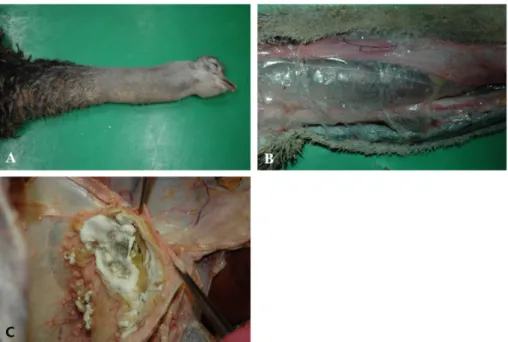
A 1-year-old male ostrich from a farm near Seoul, Korea was submitted for a diagnostic investigation. The bird rapidly developed severe clinical signs, such as anorexia, depression, and lethargy, and died suddenly. No clinical problems were observed in any other birds from this farm. The neck of the affected ostrich was markedly enlarged to more than three times its normal size (Fig. 1A and B). The bird was very emaciated. At necropsy, tissues from the brain, lungs, air sacs, heart, liver, spleen, kidneys, trachea, skin, proven- triculus, gizzard, and intestine were fixed in 10% buffered formalin, embed- ded in paraffin, and sectioned at 4 µm. The sections were stained with hematoxylin and eosin (H&E) and periodic acid Schiff (PAS) for histopathology.

To examine mycology, direct microscopic examination of the air sacs was performed with Lactophenol cotton blue stain (Fig. 2A). Tissue from the lungs and air sacs was cultured on Sabouraud dextrose agar and incubated at 25

o

C for 3–7 days. A fecal sample was collected for testing, and lung samples were cultured on both blood and MacConkey agars for bacterial isolation.

Direct microscopy examination showed features of Aspergillus species, such as septate hyphae, conidiophores, vesicles, and conidia (Fig. 2B). Fungi grew rapidly in fungal cultures. Initially, the colonies were white, but they became velvet white with a bluish-green center. Microscopically, the conidio- phores connected with septate hyphae that were short, smooth, and hyaline.

The vesicles expanding from the conidiophores were flask-shaped, 15–22 µm in diameter, and formed a single series of phialides on the upper 2/3 of the conidiophores only. The conidia that developed from the uniseriate phialides

*Corresponding author Gye-Hyeong Woo

Laboratory of Histopathology, Department of Clinical Laboratory Science, Semyung Univer- sity, 65 Semyeong-ro, Jecheon 27136, Korea Tel: +82-31-649-1539

Fax: +82-31-649-1537 E-mail: [email protected] ORCID:

Gye-Hyeong Woo

https://orcid.org/0000-0002-6947-0241 Conflict of Interest

The author declares no conflicts of interest.

Received: September 18, 2019

Revised: October 30, 2019

Accepted: November 5, 2019

(2)

228 Gye-Hyeong Woo

were globular to broadly ellipsoidal, 2.1–2.5 µm in diameter, and finely rough-walled (Fig. 2). When the conidia were pro- duced, the fungi became green in color. Based on mycology and pathological findings, the organism was identified as A.

fumigatus. No parasite eggs or bacteria were detected.

Grossly, the walls of the thoracic air sacs were thickened, and various-sized, yellow, round, crateriform material and white to green mold were scattered on the inner surfaces of the thoracic air sacs (Fig. 1C). The inner surfaces of the abdominal air sacs were covered with 4–6-mm, single or coalescent, yellow, round, crateriform material. The surfaces and cut surfaces of the lungs were scattered with 1–5-mm white to yellow foci. The cervical air sacs were simply expanded (Fig. 1B). No other gross lesions were seen.

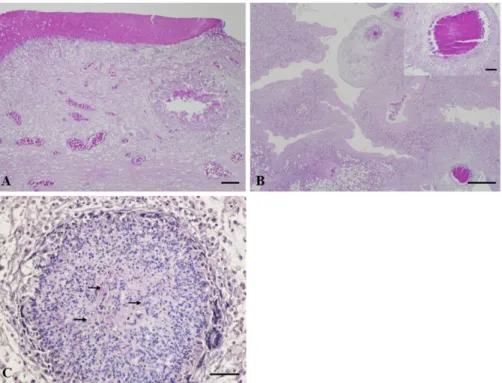
Histopathologically, multifocal to coalescing pyogranulo- matous inflammation was present in the air sacs and lungs

(Fig. 3A and B). The centers of the pyogranulomas con- sisted of cell debris, including heterophils and numerous hyphae surrounded by multinucleated giant cells and macro- phages. The cell debris and hyphae also covered the inner surfaces of the air sacs. Many conidia and conidial heads were observed on the inner surface bordered by air. On PAS staining, pale-red colored positive reactions were seen in the hyphae at the centers of the pyogranulomas (Fig. 3C). No histopathological findings were observed in other organs or tissues.

The diagnosis of Aspergillus infection was based on the morphological characteristics of the fungus and the isolation of A. fumigatus from air sacs and lungs. A. fumigatus is the main agent of avian aspergillosis [2,4-6], although Aspergil- lus flavus has been isolated in some cases [6,11]. These two fungi differ morphologically; A. fumigatus has conidiophores Fig. 1. Gross finding in the ostrich. (A) Enlarged neck. (B) Enlargement of the cervical air sac due to air accumulation. (C) Thickened thoracic air sac with various-sized, yellow, round, crateriform materials.

Fig. 2. Direct microscopic examination for mycology. (A) Direct stamp from the thoracic air sac. Conidiophores, vesicles, and conidia

are seen. Lactophenol cotton blue stain (Scale bar = 20 µm). (B) Direct stamp from a culture plate. Conidiophores, flask-shaped ves-

icles, phialides, and chains of conidia are observed (Scale bar = 20 µm).

(3)

Aspergillus fumigatus infection in an ostrich 229

with club- or flask-shaped vesicles, phialides, and columnar conidial heads, whereas A. flavus has conidiophores with glo- bose vesicles, phialides, and radiate conidia [6]. A. fumiga- tus, A. flavus, and Aspergillus niger have been identified as causative organisms of ostrich aspergillosis [11,12].

Avian aspergillosis can cause high rates of morbidity and mortality in young animals and, sporadically, in adults [2,6].

Although several lesions are observed in Aspergillus infec- tion, the characteristic lesions of this disease appear primar- ily in two patterns: airway aspergillosis and systemic aspergillosis [5,6]. The airway form is the most common in birds, includ- ing chickens, turkeys, captive raptors, and penguins, and is found frequently in young animals. Airway aspergillosis is also the main form in young ostriches [6]. Systemic aspergil- losis has been documented in young and mature ostriches [6,9], and the characteristic lesions have been observed in the spleen, gastrointestinal tract, and liver. In our case, multifo- cal granulomas were restricted to the air sacs and the lungs of a mature bird, which had the airway form of aspergillosis.

Gross edema of the neck has been identified in a previous report [10]. Our case also had a large neck caused by expan- sion of the cervical air sacs. In birds, the air flows in one direction through the lungs. The air passes through the tra- chea and moves into the posterior air sacs and lungs, and it then flows into the anterior air sacs through parabronchi, whereas the air flows out of the posterior air sacs through parabronchi and the trachea and simultaneously moves out of

anterior air sacs via the trachea. Therefore, in our case, the large neck was induced by the accumulation of air in the cer- vical air sacs, indicating the failure of air flow, especially during exhalation, because of thickened thoracic air sacs. The ostrich has paired cervical, lateral, and medial clavicular, cra- nial and caudal thoracic, and abdominal air sacs [13]. In con- clusion, the affected bird died because of the respiratory disturbance caused by mycotic airsacculitis and pneumonia.

Acknowledgments

This study was supported by a Semyung University Research Grant of 2018.

References

1. Bennett JW. An overview of the genus Aspergillus. In:

Machida M, Gomi K (eds). Aspergillus: Molecular Biology and Genomics. pp. 1-17, Caister Academic Press, Norfolk, 2010.

2. Fischer D, Van Waeyenberghe L, Failing K, Martel A, Lierz M. Single tracheal inoculation of Aspergillus fumigatus conidia induced aspergillosis in juvenile falcons (Falco spp.).

Avian Pathol 2018;47:33-46.

3. Nemeth NM, Gonzalez-Astudillo V, Oesterle PT, Howerth EW. A 5-year retrospective review of avian diseases diagnosed at the department of pathology, University of Georgia. J Comp Pathol 2016;155:105-120.

Fig. 3. Histopathology of the thoracic air sac and lungs. (A) A focal granuloma with a central necrotic area in a thickened air sac and

necrotic materials attached to the air sac (H&E, Scale bar = 50 µm). (B) Multifocal granulomas with a central necrotic area in the lungs

(H&E, Scale bar = 200 µm). Insert: Magnification of the section shown in Figure 3B (H&E, Scale bar = 20 µm). (C) Granulomatous

inflammation with intralesional fungus (arrows) (Periodic acid Schiff stain, Scale bar = 20 µm).

(4)

230 Gye-Hyeong Woo

4. Sabino R, Burco J, Valente J, Veríssimo C, Clemons KV, Stevens DA, Tell LA. Molecular identification of clinical and environmental avian Aspergillus isolates. Arch Microbiol 2019;201:253-257.

5. Seyedmousavi S, Guillot J, Arn P, de Hoog GS, Mouton JW, Melchers WJ, Verweij PE. Aspergillus and aspergilloses in wild and domestic animals: a global health concern with parallels to human disease. Med Mycol 2015;53:765-797.

6. Charlton BR, Chin RP, Barnes HJ. Fungal infections. In:

Swayne DE, Glisson JR, McDougald LR, Nolan LK, Suarez DL, Nair VL (eds.). Diseases of Poultry. 13th ed. pp. 1077- 1096, John Wiley & Sons Inc., Ames, 2013.

7. Fitzgerald SD, Moisan PG. Mycotic rhinitis in an ostrich.

Avian Dis 1995;39:194-196.

8. Khosravi AR, Shokri H, Ziglari T, Naeini AR, Mousavi Z, Hashemi H. Outbreak of severe disseminated aspergillosis in

a flock of ostrich (Struthio camelus). Mycoses 2008;51:557- 559.

9. Yokota T, Shibahara T, Wada Y, Hiraki R, Ishikawa Y, Kadota K. Aspergillus fumigatus infection in an ostrich (Struthio camelus). J Vet Med Sci 2004;66:201-204.

10. Rousseaux CG, Dalziel JB. Aspergillus pneumonia in an ostrich (Struthio camelus). Aust Vet J 1981;57:151-152.

11. Perelman B, Kuttin ES. Aspergillosis in ostriches. Avian Pathol 1992;21:159-163.

12. Pérez J, García PM, Méndez A, Astorga R, Luque I, Tarradas C. Outbreak of aspergillosis in a flock of adult ostriches (Struthio camelus). Vet Rec 2003;153:124-125.

13. Bezuidenhout AJ, Groenewald HB, Soley JT. An anatomical

study of the respiratory air sacs in ostriches. Onderstepoort J

Vet Res 1999;66:317-325.

수치

Fig. 2. Direct microscopic examination for mycology. (A) Direct stamp from the thoracic air sac
Fig. 3. Histopathology of the thoracic air sac and lungs. (A) A focal granuloma with a central necrotic area in a thickened air sac and necrotic materials attached to the air sac (H&E, Scale bar = 50 µm)

참조

관련 문서

Ross: As my lawfully wedded wife, in sickness and in health, until

glen plaids 글렌 플레이드와 캐시미어 카디건, 캐리지 코트, 그리고 케이프 -> 격자무늬의 캐시미어로 된 승마용 바지, 마부용 코트, 말 그림이 수

systemic circulation, in the right ventricle and oxygenated blood from the lungs, or pulmonary circulation, in the left ventricle, as in birds and mammals.. Two vessels,

(A) Interestingly, this has often been the case with English animal expressions.. As you may have observed, they make irregular twists and turns in their

다양한 번역 작품과 번역에 관한 책을 읽는 것은 단순히 다른 시대와 언어, 문화의 교류를 넘어 지구촌이 서로 이해하고 하나가

The index is calculated with the latest 5-year auction data of 400 selected Classic, Modern, and Contemporary Chinese painting artists from major auction houses..

The problems created by welding in industrial site are deformation and residual stress. They not only cause the nonlinear deformation but also have an influence

1. Free radical initiator abstract a hydrogen from polymer chains 2. Through chain transfer of propagating chain with polymer chain 3. Polymer mixtures are mechanically