김치에서 분리한 Lactobacillus plantarum 균주가 생산하는 박테리오신의 특성
정재혁1·배윤숙2·김연주2·이종훈1*
1경기대학교 식품생물공학과, 2(주)명인에프엔비
Characteristics of Bacteriocin Produced by a Lactobacillus plantarum Strain Isolated from Kimchi.
Chung, Jae Hyuk1, Yunsook Bae2, Yeonjoo Kim2, and Jong-Hoon Lee1*. 1Department of Food Science and Biotechnology, Kyonggi University, Suwon 443-760, Korea, 2Myungin F & B, Kwangju 464-863, Korea − Lactobacillus plantarum strain KK3 with tannase activity was isolated from Gochunipkimchi (red pepper leaf kimchi) and showed a high antagonistic activity against five kinds of food pathogens. Strain KK3 secreted antibacterial compound into culture medium and 24-h culture in MRS broth at 30oC was enough for the anti- bacterial compound production. The crude antibacterial compound prepared from culture supernatant inhib- ited the growth of some Gram-negative bacteria and Bacillus cereus but not Listeria monocytogenes. The antibacterial activity was sensitive to proteinase K treatment, confirming its proteinaceous nature (bacterio- cin). The crude bacteriocin was active in the pH range 3.5-8.5 and extremely stable after 15 min of heat treat- ment at 121oC. The strain KK3 produced equally active bacteriocin in Chinese cabbage juice as it produced in MRS broth.
Key words: Bacteriocin, Lactobacillus plantarum, kimchi
당류를 발효하여 유산을 비롯한 유기산을 생산하는 유산 균(lactic acid bacteria)은 침채류, 유제품, 육가공품 등의 발 효에 관여하여 관능성, 물성, 기능성의 증진 및 저장기간 연 장에 사용되어 왔다[13]. 또한 유산균이 가지고 있는 유당불 내증 개선효과, 항균활성, 항종양활성, 대장암 예방효과, 면 역활성 증진효과, 정장작용 등이 보고됨에 따라 대표적 프 로바이오틱스(probiotics) 미생물의 하나로 자리잡았다[3]. 또 한 식물체에 풍부하게 포함되어 있는 폴리페놀류 및 그들의 배당체를 분해할 수 있는 α-galactosidase와 β-glucosidase를 비롯한 다양한 효소에 대한 연구 결과가 보고되고 있어 유 산균을 이용한 고부가가치의 항산화물질(hydroxytyrosol, pyrogallol) 및 풍미성분(4-vinyl phenol, 4-vinyl guaiacol)의 생산에 대한 식품분야의 관심이 증가하고 있다[16]. 최근에 는 인삼에 함유된 ginsenosides, 콩에 함유된 isoflavone 배 당체 및 식물체 유래 기능성 배당체의 비배당체화를 통한 생 물활성(biological availability) 증진에 유산균의 이용이 시도 되고 있다[4, 9, 15].
본 연구자들은 tannase 활성을 보유한 유산균을 이용하여 식품보존제로 적용 가능한 gallic acid와 항산화제 propyl gallate의 생산 및 탄닌의 가수분해에 의한 생물활성 증진을 목표로 국내에서 쉽게 발견할 수 있는 김치류로부터 가수분 해성 탄닌(hydrolysable tannin)을 분해하는 Lactobacillus 속
유산균을 분리하였다[10]. 분리된 유산균들은 L. plantarum 과 L. pentosus로 동정되었고, 이들의 프로바이오틱스로서의 이용을 위한 내산성, 내담즙산염, 항균활성 등의 기초실험을 수행하였다(data not shown). 이들 중, 고춧잎김치로부터 분 리된 L. plantarum KK3 균주가 다른 분리균들에 비해 지시 균으로 사용한 Bacillus cereus KCCM 11341, Escherichia coli O157:H7 933, Listeria monocytogenes ATCC 19111, Salmonella typhimurium KCCM 11862, Staphylococcus aureus ssp. aureus ATCC 12692에 대한 높은 생육 저해활 성을 나타내었다. 따라서 KK3 균주가 생산하는 항균물질의 특성을 규명해 보았다.
KK3 균주가 생산하는 항균물질의 저해 스펙트럼 항균물질의 생산이 예상되는 KK3 균주를 MRS 배지 (Difco, USA)에서 배양한 다음, 배양상등액을 이용하여 식 품위해균을 포함하는 5종의 Gram 양성균과 4종의 Gram 음 성균을 대상으로 생육저해 스펙트럼을 검토하였다. 실험에 사용한 배양상등액은 30oC 미호기 조건에서 24시간 배양한 배양액을 원심분리 후 0.45 µm membrane filter (Millipore, USA)로 제균하여 제조하였다. 본 실험에 사용한 공시균은 Korean Collection for Type Cultures(KCTC), Korean Cul- ture Center for Microorganisms(KCCM), ATCC the global bioresource center로부터 구입하였고, E. coli O157:H7 933 균주는 경원대학교 식품생물공학과 박종현 교수로부터 분양 받았다. Ls. monocytogenes의 배양에는 BHI(brain heart
*Corresponding author
Tel: 82-31-249-9656, Fax: 82-31-253-1165 E-mail: [email protected]
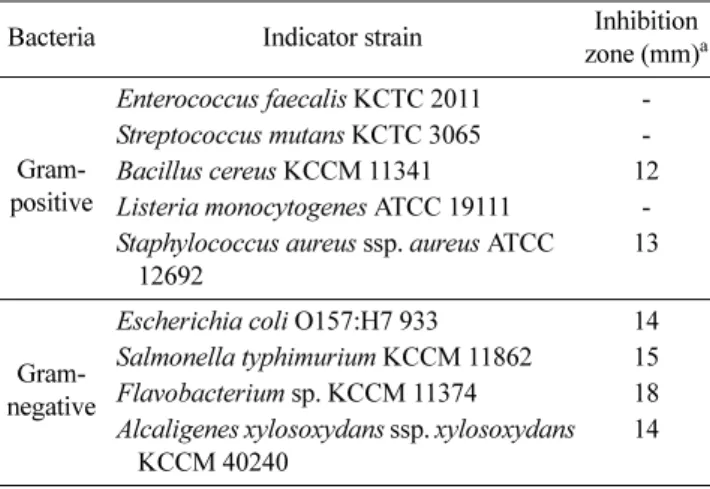
도말한 후, 공시균 용액이 건조되면 살균된 paper disk (Ø 6 mm, Whatman, UK)를 올려놓았다. Paper disk에 시료를 40 µL 첨가한 다음, 30oC에서 24시간 배양하여 생육저해환(clear zone)을 확인하고 그 크기를 측정하였다(Table 1).
배양상등액은 Gram 음성균에 대한 높은 생육저해를 나타 내었지만, B. cereus와 St. aureus를 제외한 Gram 양성균들 에 대해서는 저해를 보이지 않았다. 유산균이 생산하는 박 테리오신은 대체로 Listeria, Bacillus, Clostridium, Staphy- lococcus와 같은 Gram 양성균에 대해 항균활성을 나타내는 것으로 보고되었지만[1], KK3 균주의 배양상등액은 Gram 음성균에 대한 높은 생육저해를 나타내고, Ls. monocytogenes 를 저해하지 못하는 것으로 나타났다. 문헌조사를 통하여 L.
plantarum이 생산하는 박테리오신에 의한 B. cereus와 Ls.
monocytogenes의 생육저해를 정리해본 결과, 박테리오신 생
Chang[20]은 김치로부터 곰팡이의 생육을 저해하는 항균활 성을 나타내는 L. plantarum AF1 균주를 분리하여, 항균물 질의 분리 및 동정 결과 박테리오신이 아닌 분자량 226의 3,6-bis(2-methylpropyl)-2,5-piperazinedion에 의한 것으로 보 고하여, 유산균이 박테리오신과 유기산 외에도 다양한 항균 성 물질의 생산원이 될 수 있음을 시사하였다.
배양상등액은 Flavobacterium sp.에 대한 가장 높은 생육 저해를 나타내었지만, St. aureus에 대한 저해환 형성이 가장 뚜렷하게 나타났다. 따라서 항균물질 생산 최적 배양시간 결 정 및 제반 특성 규명에 St. aureus를 지시균으로 사용하였다.
항균물질 생산의 최적 배양시간
KK3 균주가 생산하는 항균물질의 특성 규명에 앞서 항균 물질 생산의 최적 배양시간을 검토해 보았다. 30oC 미호기 조건에서 전배양한 KK3 균주를 100 mL MRS 배지에 1%
접종하고, 12, 24, 36, 48시간 배양하여 얻어진 배양액을 원 심분리 및 membrane filter(Millipore)로 제균하여 배양상등 액을 얻었다. 이렇게 얻어진 배양상등액을 항균물질 생산의 최적 배양시간 결정을 위한 조항균물질 용액으로 사용하였 다. 각 시간에 얻어진 조항균물질 용액 5 mL을 nutrient broth 30 mL에 첨가한 후, 지시균 St. aureus를 1% 접종하 여 지시균의 생육을 흡광도로 측정하였고, 3번 수행한 실험 의 평균값을 그래프로 나타내었다(Fig. 1). 12시간 배양하여 얻은 조항균물질 용액을 첨가한 경우에도 지시균의 생육저 해가 발생하여 항균물질의 생산은 KK3 균주의 생장과 동반 하여 생산되는 것으로 나타났다. 24시간 배양하여 얻은 조 항균물질 용액은 12시간 배양하여 얻은 용액 대비 지시균의 생장을 2배 이상 저해하였지만, 36시간 및 48시간 배양하여 얻은 조항균물질 용액의 항균활성은 24시간 배양의 경우와 차이가 없는 것으로 나타났다. 따라서 24시간 배양을 항균 Table 1. Sensitivity of bacteria to the bacteriocin produced by L.
plantarum KK3.
Bacteria Indicator strain Inhibition
zone (mm)a
Gram- positive
Enterococcus faecalis KCTC 2011 - Streptococcus mutans KCTC 3065 -
Bacillus cereus KCCM 11341 12
Listeria monocytogenes ATCC 19111 - Staphylococcus aureus ssp. aureus ATCC
12692
13
Gram- negative
Escherichia coli O157:H7 933 14 Salmonella typhimurium KCCM 11862 15 Flavobacterium sp. KCCM 11374 18 Alcaligenes xylosoxydans ssp. xylosoxydans
KCCM 40240
14
aBacteriocin sensitivity of indicator strains was determined by the size of inhibition zone on their cultured agar plate (average values of three replicates).
Table 2. Characteristics of bacteriocins produced by L. plantarum strains.
Source Strain Growth inhibitiona pH
stability
Heat
stability Reference Ls. monocytogenes B. cereus
Gochuipkimchi L. plantarum KK3 - + 3.5-8.5 121oC, 15 min This study
Baechukimchi L. plantarum J9 + NT 3-10 121oC, 15 min [8]
Baechukimchi L. plantarum DU 0247 - - NT 100oC, 10 min [2]
Dongchimi L. plantarum K11 - - 3-9 100oC, 30 min [6]
Dry-fermented sausage L. plantarum lp 31 + + 4.5-6.5 100oC, 30 min [14]
aAntibacterial activity of bacteriocins was referred only against Ls. monocytogenes and B. cereus.
NT: not tested by the authors.
물질 생산의 최적 배양시간으로 결정하였다.
항균물질의 특성
미생물이 생산하는 항균물질 중, 박테리오신은 리보솜에 서 합성되는 단백질 또는 펩타이드 계통 항균물질로서 특정 생육환경에서 박테리오신 생산균주들이 비슷한 종류의 다른 균의 생육을 저해할 목적으로 생산, 분비하는 것으로 알려 져 있다. KK3 균주가 생산하는 항균물질의 박테리오신 여 부 규명을 위하여 배양상등액에 1 N NaOH를 첨가하여 중 성으로 조절한 다음, 냉동건조하여 10배 농축하였다. 농축한 배양상등액에 동량의 50 mM 인산완충용액(pH 7)에 녹인 α-amylase(EC 3.2.1.1 type VIII, Sigma, USA), lipase(EC 3.1.1.3 type VII, Sigma), proteinase K(EC 3.4.21.64, Sigma), catalase(EC 1.11.1.6, Sigma)를 첨가한 후, 37oC에서 24시 간 처리한 다음, 지시균 St. aureus의 생육저해를 agar disk diffusion method를 이용하여 확인하였다. 효소 처리하지 않 은 대조군 및 α-amylase, lipase, catalase 처리 시료에서는 지시균 저해환이 관찰되는 반면, proteinase K 처리에 의해 서는 저해환이 형성되지 않아, KK3 균주가 생산하는 항균 물질은 단백질 분해효소에 의하여 분해되는 단백질성 혹은 펩타이드성 박테리오신으로 확인되었다.
KK3 균주가 생산하는 박테리오신의 활성에 미치는 pH의 영향을 알아보기 위하여 배양상등액의 pH를 1 N NaOH 또 는 1 N HCl 용액으로 pH 3.5~8.5로 조절하여 실온에서 2 시간 방치한 후, 냉동건조하여 10배 농축하였고, agar disk diffusion method를 사용하여 pH에 따른 지시균의 생육저해 를 검토하였다. Nisin을 비롯한 유산균이 생산하는 박테리오
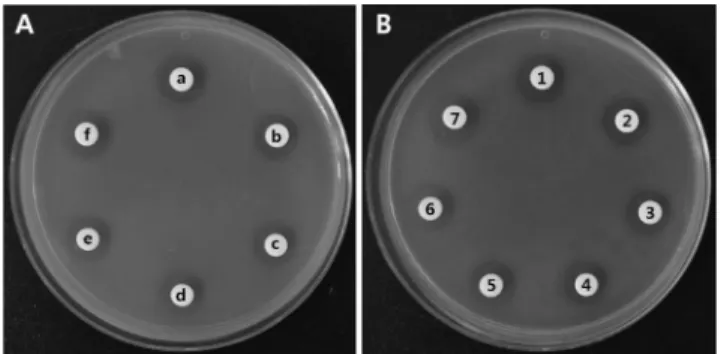
신은 낮은 pH에서 활성을 보이거나, 국한된 범위의 pH에서 만 안정한 것으로 보고되고 있으나, KK3 균주가 생산하는 박테리오신은 pH 3.5~8.5의 산도에서 비슷한 크기의 지시균 생육저해환을 형성한 것으로 미루어 넓은 pH 구간에서 매 우 안정함을 알 수 있었다(Fig. 2A). 따라서 KK3 균주가 생 산하는 박테리오신은 다양한 pH 영역 식품의 보존기간 연 장에 적용 가능할 것으로 추정된다.
온도에 대한 안정성 또한 agar disk diffusion method를 사용하여 검토하였다. 농축한 KK3 배양상등액의 열처리는 4oC 및 30oC, 50oC, 70oC에서 24시간 수행하였고, 100oC 에서는 5분 및 30분 처리하였으며 autoclave를 이용하여 121oC에서는 15분간 열처리하였다. KK3 균주가 생산하는 박테리오신에 의한 지시균의 생육저해는 열처리 조건에 따 른 차이가 나타나지 않았고, 121oC 15분의 조건에서도 활성 의 감소는 미미하게 나타났다(Fig. 2B). KK3 균주가 생산하 는 박테리오신은 살균처리 조건에서도 불활성화 되지 않는 내열성을 가지고 있는 것으로 추정된다.
식품에서 분리된 L. plantarum 균주들이 생산하는 박테리 오신의 pH 안정성과 열안정성을 문헌조사를 통하여 비교해 본 결과, 대체로 높은 열안정성을 가지고 있었으며, 발효소 시지에서 분리된 lp 31 균주를 제외하고는 넓은 pH 범위에 서 항균활성을 나타내었다(Table 2). 특히 김치류에서 분리 된 균주들의 경우에는 높은 pH 및 열에 대한 안정성을 가 지고 있어, 이들 L. plantarum 균주가 생산하는 박테리오신 은 열처리를 비롯하여 다양한 가공조건을 가지고 있는 식품 에 적용 가능할 것으로 사료된다.
배추즙을 이용한 KK3 박테리오신 생산 KK3 균주가 생산하는 박테리오신을 식품에 적용할 경우, Fig. 1. Growth inhibition of St. aureus by the crude antibacte-
rial compounds produced from L. plantarum KK3 according to culture time. The growth of St. aureus was monitored in nutrient broth supplemented with the cell-free supernatant of L. plantarum KK3 culture. The culture times of L. plantarum KK3 in MRS broth were 0 h (●), 12 h (○), 24 h (▼), 36 h (▽), and 48 h (■).
Absorbance was the mean value of three replicates.
Fig. 2. Effects of pH (A) and heat treatment (B) on the antibac- terial activity of crude bacteriocin produced by L. plantarum KK3. The pHs of crude bacteriocin were adjusted to 3.5 (a), 4.5 (b), 5.5 (c), 6.5 (d), 7.5 (e), and 8.5 (f). Heat treatments of bacteri- ocin were done at 4oC, 24 h (1); 30oC, 24 h (2); 50oC, 24 h (3);
70oC, 24 h (4); 100oC, 5 min (5); 100oC, 30 min (6); 121oC, 15 min (7). The size of growth inhibition zone of St. aureus on nutri- ent agar indicates the antibacterial activity of bacteriocin.
과정에서 제기되는 문제점을 최소화할 수 있는 한 방편이 될 수 있다. 배추는 포도당이 주를 이루는 약 2% 정도의 발효 가능한 당을 함유하고 있어 효모의 균체 생산에 적용된 바 있으며, 이미 김치에서 분리된 유산균의 생장 및 제반 생리 적 특성 비교에 배추즙이 사용되었다[11, 17]. 따라서 배추 즙을 이용한 박테리오신의 생산 가능성을 검토해 보았다.
시중에서 구입한 배추의 겉잎을 제거한 후, 배추의 무게 와 동일한 양의 물을 첨가하여 믹서로 분쇄하고, 원심분리 (7,000×g, 20 min)하여 배추즙을 회수하였고, 배추즙은 autoclave로 멸균하여 KK3 균주의 배양을 위한 배지로 사용 하였다. 멸균한 배추즙과 MRS 배지에 KK3 균주를 1% 접 종하여 30oC에서 24시간 배양한 다음, 원심분리(7,000×g, 30 min)하여 상등액을 회수하고 냉동건조하여 냉장고에서 보관 하였다. 냉동건조하여 얻은 조박테리오신 1 g을 30 mL nutrient 배지에 첨가한 후, 지시균 St. aureus를 1% 접종하 여 30oC에서 배양하면서 흡광도로 생장을 측정하였고, 3번 수행한 실험의 평균값을 그래프로 나타내었다(Fig. 3). 배추 즙을 이용한 경우에 비해 MRS 배지를 이용하여 생산한 조 박테리오신이 짙은 색상을 띄고 있어, MRS 배지에서 생산 된 조박테리오신이 첨가된 배지 자체의 흡광도가 높게 나타
인류가 오랜 기간 섭취한 발효식품의 발효를 담당하는 유 산균은 GRAS(generally recognized as safe) 미생물로 인식 되고 있다. 따라서 유산균이 생산하는 박테리오신은 식품의 보존 및 저장에 사용될 안전한 천연보존제의 하나로 많은 연 구자들의 관심의 대상이 되고 있다. 지금까지 다양한 유산 균 유래의 박테리오신에 대한 연구가 국내외에서 진행되었 지만, 상업적으로 생산되어 식품첨가물로 사용되고 있는 것 은 Lactococcus lactis 유래의 nisin에 불과하고[5], 우리나라 에서는 nisin의 첨가가 가공치즈에만 250 mg/kg 이하의 농 도로 허용되고 있다(식품첨가물공전). 따라서 다양한 유산균 유래의 박테리오신이 식품에 적용되기 위해서는 새로운 박 테리오신의 발굴 및 특성 규명뿐만 아니라 식품산업에서의 용도 개발과 함께 식품의약품안전청이 납득할 수 있는 박테 리오신의 빠른 안전성 평가법의 개발이 시급히 요구된다.
감사의 글
본 연구는 중소기업청에서 지원하는 2008년도 산학연협 력 기업부설연구소 설치 지원사업(산기연 08-1-054)의 지원 에 의해 이루어진 것으로 이에 감사드립니다.
REFERENCES
1. Achemchem, F., M. Martinez-Bueno, J. Abrini, E. Valdivia, and M. Maqueda. 2005. Enterococcus faecium F58, a bac- teriocinogenic strain naturally occurring in Jben, a soft, farmhouse goat’s cheese made in Morocco. J. Appl.
Microbiol. 99: 141-150.
2. Cha, D.-S., S.-G. Han, and D.-M. Ha. 1994. Identification of bacteriocin-producing lactic acid bacteria from kimchi and partial characterization of their bacteriocin. Korean J.
Microbiol. Biotechnol. 4: 305-315.
3. Chang, J.-H., Y. Y. Shim, S.-K. Cha, and K. M. Chee. 2010.
Probiotic characteristics of lactic acid bacteria isolated from kimchi. J. Appl. Microbiol. 109: 220-230.
4. Chi, H., D.-H. Kim, and G.-E. Ji. 2005. Transformation of ginsenosides Rb2 and Rc from Panax ginseng by food microorganisms. Biol. Pharm. Bull. 28: 2102-2105.
5. Hata, T., R. Tanaka, and S. Ohmomo. 2010. Isolation and characterization of plantaricin ASM1: A new bacteriocin produced by Lactobacillus plantarum A-1. Int. J. Food Microbiol. 137: 94-99.
6. Im, D. S. and S. M. Lim. 2007. Bactericidal effect of Fig. 3. Growth inhibition of St. aureus by the crude bacterio-
cins produced from L. plantarum KK3 cultured in MRS broth and Chinese cabbage juice. The growth of St. aureus was moni- tored in nutrient broth supplemented with the crude bacteriocin.
Crude bacteriocins were prepared from the cell-free supernatants of L. plantarum KK3 cultured in MRS broth (○) and Chinese cab- bage juice (▼). The growth of St. aureus in nutrient broth without crude bacteriocin was also monitored as the control (●). Absor- bance was the mean value of three replicates.
bacteriocin of Lactobacillus plantarum K11 isolated from Dongchimi on Escherichia coli O157. J. Food Hyg. Safety 22: 151-158.
7. Jung, S.-S., J.-I. Choi, W.-H. Joo, H.-H. Suh, A.-S. Na, Y.-K.
Cho, J.-Y. Moon, K.-C. Ha, D.-H. Paik, and D.-O. Kang.
2009. Characterization and purification of the bacteriocin produced by Bacillus licheniformis isolated from soybean sauce. J. Life Sci. 19: 994-1002.
8. Kim, H.-T., J.-Y Park, G. G. Lee, and J. H. Kim. 2003.
Isolation of a bacteriocin-producing Lactobacillus plantarum strain from kimchi. Korean J. Food Sci. Biotechnol. 12: 166- 170.
9. Kim, H. S., J. Y. Kim, M. S. Park, H. Zheng, and G. E. Ji.
2009. Cloning and expression of β-glucuronidase from Lactobacillus brevis in E. coli and application in biocon- version of baicalin and wogonoside. J. Microbiol. Bio- technol. 19: 1650-1655.
10. Kwon, T., S. Shim, and J.-H. Lee. 2008. Characterization of lactobacilli with tannase activity isolated from kimchi. Food Sci. Biotechnol. 17: 1322-1326.
11. Lee, N.-S. and K.-H. Kyung. 1991. Single cell protein production from Chinese cabbage juice. Korean J. Food Sci.
Technol. 23: 646-648.
12. Lee, H.-J., C.-S. Park, Y.-J. Joo, S.-H. Kim, J.-H. Yoon, Y.- H. Park, I.-K. Hwang, J.-S. Ahn, and T.-I. Mheen. 1999.
Identification and characterization of bacteriocin-producing lactic acid bacteria isolated from Kimchi. Korean J.
Microbiol. Biotechnol. 9: 282-291.
13. Leroy, F. and L. de Vuyst. 2004. Lactic acid bacteria as functional starter cultures for the food fermentation industry.
Trends Food Sci. Technol. 15: 67-78.
14. Muller, D. M., G. G. Tonarelli, M. S. Carrasco, and A. C.
Simonetta. 2009. Characterization and purification of a new bacteriocin with a broad inhibitory spectrum produced by Lactobacillus plantarum lp 31 strain isolated from dry- fermented sausage. J. Appl. Microbiol. 106: 2031-2040.
15. Rekha, C. R. and G. Vijayalakshmi. 2010. Bioconversion of isoflavone glycosides to aglycones, mineral bioavailability and vitamin B complex in fermented soymilk by probiotic bacteria and yeast. J. Appl. Microbiol. 109: 1198-1208.
16. Rodriguez, H., J. A. Curiel, J. M. Landete, B. de las Rivas, F. L. de Felipe, C. Gomez-Cordoves, J. M. Mancheno, and R. Munoz. 2009. Food phenolics and lactic acid bacteria. Int.
J. Food Microbiol. 132: 79-90.
17. So, M.-H., H.-J. Oh, S.-Y. Park, and S.-H. Kim. 1994.
Cultivation of psychrotrophic lactic acid bacteria isolated from Kimchi in Korean cabbage-juice. Korean J. Food Nutr.
7: 392-398.
18. Yang, E. J. and H. C. Chang. 2007. Characterization of bacteriocin-like substances produced by Bacillus subtilis MJP1. Korean J. Microbiol. Biotechnol. 35: 339-346.
19. Yang, E. J. and H. C. Chang. 2008. Antifungal activity of Lactobacillus plantarum isolated from Kimchi. Korean J.
Microbiol. Biotechnol. 36: 276-284.
20. Yang, E. J. and H. C. Chang. 2010. Purification of a new antifungal compound produced by Lactobacillus plantarum AF1 isolated from kimchi. Int. J. Food Microbiol. 139: 56- 63.
(Received Aug. 5, 2010/Accepted Oct. 19, 2010)