
Medetomidine에 유발된 정좌반사소실에 대한 Tricyclic Isoxazole 유도체들의 항우울성에 관한 3D-QSAR 분석
최민성·성낙도·명평근*,#
(주)스카이 솔루션, *충남대학교 약학대학
(Received August 27, 2010; Revised April 6, 2011; Accepted April 8, 2011)
3D-QSAR Analysis on Antidepressant Activity of Tricyclic Isoxazole Analogues against Medetomidine-induced Loss of Righting
Min-Sung Choi, Nack-Do Sung and Pyung-Keun Myung*,#
Sky Solution Inc., Business Incubation Center, Chungnam National University, Daejeon 305-764, Korea
*College of Pharmacy, Chungnam National University, Daejon 305-764, Korea
Abstract — To search the minimum structural requirement of tricyclic isoxazole analogues (1~30) as new class potent antidepressant, thee-dimensional quanti- tative-structure relationship (3D-QSAR) models between substituents (R1~R5) of tricyclic isoxazoles and their antidepressant activity against medetomidine-induced loss of righting were performed and dis- cussed quantitatively using comparative molecular field analysis (CoMFA) and comparative molecular similarity indies anal- ysis (CoMSIA) methods. The correlativity and predictability (r2=0.484 and q2=0.947) of CoMSIA-2 model were higher than those of the rest models. The inhibitory activity against medetomidine-induced loss of righting was dependent on elec- trostatic field (43.4%), hydrophobic field (35.3%), and steric field (21.2%) of tricyclic isoxazoles. From the CoMSIA-2 contour maps, it is predicted that the antidepressant activity of potent antidepressants against medetomidine-induced loss of righting will be able to increase by the substituents (R1~R5) which were in accord with CoMSIA field.
Keywords □ tricyclic isoxazoles, medetomidine-induced loss of righting, antidepressant activity, 3D-QSAR
스트레스와 연관된 질환으로 일컬어지는1)우울증은 기능적 으로 중추 신경계에서 모노아민들(noraderenaline; NA, 5- hydrocytryptamine; 5-HT, norepine- phrine; NE 및 dopamine;
DA, 등)이 결여된 결과로 나타난다는 모노아민 가설에 기반을 두 고 있다.2)신경전달 물질인 모노아민들의 분비 조절에 아주 중 요한 역할을 한다고 알려져 있는 α2-adrenoceptor는3) G-protein coupled receptor(GPCR) family에 속하며 3가지 아형으로 나눠 지는데(α2A, α2B, α2C),4-9)주로 중추 신경계에 분포하며 대뇌피 질의 각성과 mouse에서 α2C agonist들에 의한 진정작용에 대해 길항작용을 한다고 보고되어 있다.10)또한 mRNA의 분포11)와 immunoresctivity의 결과를 통하여 뇌에서 모노아민 경로의 조 절에 중요한 작용을 할 것이라고 알려져 왔다.12)α2-adrenoceptor agonist들은 human therapy에 널리 사용되며 고혈압, 녹내장, 아
편의 금단현상에 대한 저해, 주의결핍 및 일반 마취 보조제로써 적용되고 있다. Agonist 뿐만이 아니라 antagonist들도 치료제로 서의 중요성을 지니고 있으며 시냅스 후, α2-adrenoceptor antagonist는 혈관확장제로서 임상적으로 사용되고 있다.13)이러 한 α2C-Aderenoceptor들은 신경전달물질(NE)의 분비를 자극하 고 분비된 NE는 시냅스 전에 존재하는 α2-autoreceptor들을 자 극함으로써 분비를 차단시키는 negative feedback mechanism을 담당하게 된다. 이러한 α2-autoreceptor들의 억제는 효과적으로 noraderenergic neuron의 저해를 막고 NE의 생성을 증가시킬 수 있을 뿐 아니라, 이와 더불어 5-HT의 분비도 증가시키는 결과를 가져올 수 있다.14,15)
실제로 α2-adrenoceptor 저해가 쥐와 인간에서 세포 외부의 DA,16) 아세틸콜린,17) 5-HT18)의 level을 증가시킨다고 보고된 바 있다. 따라서 5-HT와 NE를 모두 다 증가시킬 수 있는 α2- antagonism의 combined action은 좀 더 빠르고 증진된 항우울 효과를 생성시킬 것이라고 여겨진다,19,20) Medetomidine(4-(2,3- dim-ethylphenyl)ethyl-1H-imidazole hydrochloride, ME)은 α2-
#본 논문에 관한 문의는 저자에게로 (전화) 042-821-5929 (팩스) 042-823-6566 (E-mail) [email protected]
종설
adrenoceptor에 대하여 강력하고 선택성이 큰 agonist로 주로 진 정작용, 근육이완, 진통작용을 목적으로 사용된다.21,22) ME는 개 와 고양이에서 농도 의존적인 진정작용,23)진통작용을 보이고 중 추신경계의 α2-adrenoceptor를 통하여 심혈관계의 변화를 유도 한다고 알려져 있고 폐와 위장계, 내분비계 역시 영향을 준다.24) ME에 의한 심혈관계 변화는 가장 큰 부작용으로 대두되고 있기 때문에 임상에서의 사용을 금지하고 수의과 약물로의 사용으로 제한하고 있다. 이러한 부작용에도 불구하고 ME와 같은 agonist 들은 혈류의 안정성을 증진시키고 스트레스를 완화하며 빈박성 부정맥을 막고 떨림을 완화시키기 위해 사람의 마취에도 이용되 고 있는 실정이다.25-27) ME는 설치류에서 중추신경계의 α2- adrenoceptor의 강력한 agonist로 작용하여 정좌반사 소실(loss of righting)을 유도한다. 따라서, 특정 신약후보 물질이 투여된 후에 ME투여 시, ME의 α2-adrenoceptor 자극에 의해 나타나는 정좌반사 소실반응을 억제한다면, 즉, 정좌반사 소실을 회복한다 면 이는 투여한 신약후보물질이 α2-adrenoceptor를 차단함을 의 미한다.28)따라서 이러한 ME 투여 모델에서의 특정 신약후보물 질의 반전효과는 중추신경계 α2-adrenoceptor 차단 작용을 나타 냄을 의미하며 이는 기존 항우울 약물의 단점인 α2-adrenoceptor 작용에 의한 치료지연 현상을 신약 후보물질이 극복할 가능성을 의미하는 것으로 해석될 수 있다.
본 연구에서는 특이적으로 5-HT의 재흡수를 억제하면서 동시에 presynaptic α2-adrenergic autoreceptors의 기능을 차단하는 것으 로 보고된 3a,4-dihydro-3H-[1]-benzopyronao[4,3]isoxazoles28-31) 유도체(이하, 'tricyclic isoxazole'로 략함)의 치환기(R1~R5) 변화 에 따라 ME에 의하여 유도되는 정좌반사소실에 관한 항우울 활 성(이하, 'ME반전 활성값'으로 략함)(p[Me]I50)에 미치는 3차원적 인 정량적 구조와 활성과의 관계(3D-QSAR)인 비교분자장분석 (CoMFA) 및 비교분자 유사성 지수분석(CoMSIA) 방법을 이용 하여32)최적의 항우울 신약후보 물질로서 tricyclic isoxazole이 갖추어야 할 최소한의 구조적인 요건들에 대하여 검토하였다.
실험방법
3D-QSAR 모델의 유도
In vivo에서 Serotonin(5-HT)의 흡수 저해와 α2-andrenoceptor 차단의 이중성 효과를 가지는 기질 분자로서 tricyclic isoxazoles 유도체(1~30)들의 ME반전 활성값 (p[Me]I50)은 문헌값28-31)을 활용하였다. 3D-QSARs에 대한 CoMFA 및 CoMSIA 분석은 Sybyl(Ver. 8.1.1) 프로그램(Tripos Inc.)으로 실시하였다.32) 3D- QSAR 분석을 실행하기 위하여 가장 안정한 형태에서 수소원자 를 제외한 기질분자의 공통부분(R=H)을 분자틀(template)로 정 하여 모든 유도체들의 위치 에너지가 최소화된 가장 안정한 형 태를 simulated annealing 방법33)으로 탐색하였다. 가장 안정한
형태의 기질분자들을 atom based fit(AF) 방법과 field fit(FF) 방
법으로34,35) 3차원 공간상에 각각 정렬하였다. 최적의 모델은 정
렬된 training set(n=25) 화합물을 대상으로 유도되었으며 test set(n=5)로부터 모델의 예측성을 검토하였다. 공통적으로 두 정 렬조건, Grid(Å), 주성분수(1-5) 그리고 특성장(CoMFA장: 입체 장, 정전기장, 소수성장 및 CoMSIA장: 입체장, 정전기장, 소수 성장, H-결합주게장 및 H-결합 받게장)의 조합조건에서 가장 양 호한 통계값을 나타내는 최적화된 모델을 전보의 조건과 방법으 로 유도하였다.36)
부분 최소자승 분석
3차원 공간상에 정렬된 화합물들의 구조적 특징과 ME반전 활 성값 사이의 상관성을 부분최소자승(PLS)법으로37)분석하였다.
화합물이 하나씩 data set에서 제거되는 leave-one-out(LOO)방 법으로 교차확인된 예측성값인 r2cv.값(또는 q2)과 최적의 잠재적 인 변수에 해당하는 주성분 수를 탐색하고 이를 바탕으로 비교 차 확인 과정을 통하여 상관성 값인 r2(r2ncv.값)을 얻었다. 이 같 은 과정을 거쳐서 모델의 상관성이 r2ncv.≥0.90 이상이고 예측성 이 r2cv.(q2)≥0.50 이상의 값이 얻어질 때 유도된 모델들이 통계적 으로 양호한 안정성과 예측성을 갖는다고 판단한다.38)또한,Me 에 의하여 유발된 정좌반사소실에 대하여 최적화 모델이 가지고 있는 기질 분자들의 구조적인 정보들을 시각적으로 분석하기 위 하여 가장 저해활성이 제일 높은 29번 화합물의 구조상에 최적 화된 모델의 특성장에 관한 등고도를 favor : disfavor=80 : 20의 비율(%)로 각각 나타내었다.
실험결과 및 고찰
정좌반사 소실의 반전효과
투여한 신약후보 물질이 Medetomidine(ME)의 α2-adrenoceptor 자극에 의한 정좌반사 소실반응을 억제한다면 α2-adrenoceptor 를 차단함을 의미한다.28)이는 기존 항우울 약물의 단점인 α2- adrenoceptor 작용에 의한 치료지연 현상을 극복할 수 있는 반 전효과로 해석될 수 있다. 이 같은 Tricyclic isoxazole 분자(Fig.
1)와 반전효과의 관계를 정량적으로 이해하기 위하여 training set 화합물들의 관측된 ME반전 활성값(Obs.pI50)28-31)과 통계값이 양
Fig. 1 − General structure of 3a,4-dihydro-3H-[1]-benzopyronao [4,3]isoxazole analogues (1~30) as new class potent antidepressant.
Table I − Observed antidepressant activity (Obs.p[ME]I50) of tricyclic isoxazoles against ME-induced loss of righting and predicted activity (Pred.p[ME]I50) by the 3D-QSAR models.
No. Atom (X) & Substituents (R)
Obs. CoMFA-2 CoMSIA-2a)
X 1 2 3 4 5 Pred.b) ∆c) Pred.b) ∆c)
01 O MeO- MeO- H H 5.00 4.83 0.17d) 4.86 0.14d)
02 O OMe- MeO- H Me- 5.57 5.82 -0.25 5.74 -0.17
03 O MeO- MeO- Me- H 5.88 5.80 0.08 5.87 0.01
04 O MeO- MeO- H Me- 5.27 5.16 0.11 5.19 0.08
05 O MeO- MeO- Me- H 5.58 5.51 0.06 5.50 0.07
06 O MeO- MeO- H H 4.97 4.78 0.19 4.95 0.02
07 N MeO- MeO- H H 4.95 4.92 0.03 5.09 -0.14
08 O MeO- MeO- H Me- 5.87 5.77 0.10 5.87 0.00
09 O MeO- MeO- H Me- 5.59 5.62 -0.03 5.48 0.11
10 O MeO- MeO- Me- H 5.39 5.79 -0.40 5.45 -0.06
11 O H H H 6.16 6.27 -0.11 6.23 -0.07
12 O H Me- H 5.29 5.25 0.04 5.22 0.07
13 O MeO- MeO- H Me- 6.45 6.32 0.13 6.46 -0.01
14 O MeO- MeO- H H 5.27 5.32 -0.05 5.14 0.13
15 O H Me- H 5.89 5.85 0.04 5.91 -0.02
16 O H Me- H 6.13 6.06 0.07 6.13 0.00
17 O MeO- MeO- Me- H 5.67 4.83 0.84d) 5.02 0.65d)
18 N MeO- MeO- Me- H 6.36 4.94 1.42d) 4.99 1.37d)
19 O MeO- MeO- H H 4.68 4.82 -0.14 4.79 -0.11
20 O MeO- MeO- Me- H 4.70 4.93 -0.23 4.92 -0.22
21 O MeO- MeO- Me- H 5.18 5.18 0.00 5.08 0.10
22 O H H H H 5.29 5.99 -0.70d) 6.19 -0.90d)
23 O MeO- MeO- Me- H 5.87 5.45 0.42 5.51 0.36
24 O MeO- MeO- Me- H 4.96 5.16 -0.20 5.27 -0.31
25 O H Me- H 5.92 5.86 0.06 5.85 0.07
26 O MeO- MeO- Me- H 4.68 4.82 -0.14 4.75 -0.07
27 O MeO- MeO- H H 5.25 5.10 0.15 5.12 0.13
호한 CoMFA-2 및 CoMSIA-2 모델에 의하여 예측된 ME반전 활성값(Pred.pI50) 그리고 두 값의 차이값(∆)을 Table I에 각각 정 리하였다. 관측된 ME반전 활성값(Obs.p[ME]I50)은 4.68~7.08의 범위를 나타내었으며 화합물 중, 19와 26(Obs.p[ME]I50=4.68) 이 가장 낮은 활성을 보인 반면에 화합물, 29(Obs.p[ME]I50= 7.08)가 가장 높은 활성을 보여주고 있는데, 이러한 ME 반전효 과는 α2-adrenoceptor 저해효과를 나타내는 것으로 해석된다.28) 유도된 3D-QSAR 모델들의 예측성을 판단하기 위하여 Table II 에는 test set 화합물들의 관측된 ME반전 활성값(Obs.p[ME]I50) 및 두 모델들에 의하여 예측된 ME반전 활성값(Pred.p[ME]I50) 그리고 그들 두 값 사이의 차이값(∆)를 각각 정리하였다.
최적화 모델
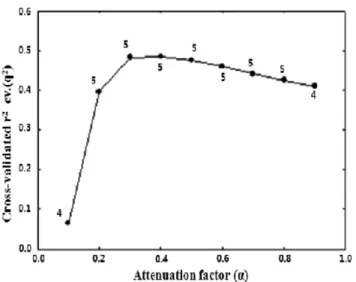
Medetomidine에 유발된 정좌반사소실에 대하여 높은 반전활 성을 나타내는 기질화합물들의 구조적인 특성을 탐색하기 위하 여 tricyclic isoxzole 유도체들(1-30)의 gird변화(1.0~3.0 Å), 정 렬조건 및 다양한 CoMFA장의 조합에 따른 모델들의 통계값을 Table III에 정리하였다. CoMFA 모델들의 경우, 예측성이 결여 된(q2=0.329~0.483) 반면에 상관성이 부분적으로 무난한 (r2=0.825~0.923) 모델을 얻을 수 있었으며 CoMFA-2 모델이 양호하였으나 어느 경우이든 원만한 모델이 아니므로 논의 대상 이 아니었다. CoMSIA 모델들의 경우에는 5개의 CoMSIA장(입 체장, 정전기장, 소수성장, H-결합 주게장 및 H-결합 받게장), 두 정렬조건(AF 및 FF), grid범위(1.0~3.0) 및 attenuation factor (α=0.1~0.9)의 변화에 따라 CoMSIA 모델들을 유도하였다. 그 결과, 최적화된 모델은 CoMSIA-2 모델이었다. 따라서 Fig. 2는 최적화된 CoMSIA-2 모델의 경우, 상관성이 크고(r2=0.947), field fit 조건에서 probe atom과 분자내 원자들과의 거리에 관여하는 α값의 변화에 따라 cross-validated r2값(또는 q2)과의 관계로부 터 α=0.3일때 예측성이 적정하며 (q2=0.500) 그리고 조성의 수 가 5임을 나타내었다. Table IV에는 각 모델들의 특성장에 대한 기여비율(%)과 training set 및 test set의 오차(Ave. 및 PRESS) 를 정리하였다. 촤적화된 CoMSIA-2 모델의 기여비율(%)은 입 체장 21.2%, 정전기장 43.4% 그리고 소수성장이 35.3% 기여하 였으며 정전기장이 가장 크게 영향을 미치는 요소이었다. 또한, Table I − Continued
No. Atom (X) & Substituents (R)
Obs. CoMFA-2F CoMSIA-2F
X 1 2 3 4 5 Pred.a) ∆c) Pred.b) ∆c)
28 O MeO- MeO- Me- H 5.30 5.12 0.18 5.22 0.08
29 O H Me- H 7.08 7.10 -0.02 7.14 -0.06
30 N MeO- MeO- H Me- 5.27 6.05 -0.78d) 5.70 -0.43d)
a)optimized model, b)predicted values by the optimized models, c)difference between observed and predicted value, d)average residual of training set.
Table II − Observed antidepressant activity (Obs.p[ME]I50) against ME-induced loss of righting and predicted activity (Pred.p[ME]I50) for test set by the 3D-QSAR models and their deviation
No. CoMFA-2
No. CoMSIA-2a) Obs. Pred.b) ∆c) Obs. Pred.b) ∆c)
01 5.00 4.83 -0.17 01 5.00 4.86 -0.14
17 5.67 4.83 -0.84 17 5.67 5.02 -0.65
18 6.36 4.94 -1.42 18 6.36 4.99 -1.37
22 5.29 5.99 -0.70 22 5.29 6.19 -0.90 30 5.27 6.05 -0.78 30 5.27 5.70 -0.43
a)optimized model, b)predicted values by the optimized CoMFA-2 and CoMSIA-2, c)difference between observed and predicted value.
Table III − Summary of the statistical results for 3D-QSAR models with two alignments
Model No. Alignments PLS Analyses
Grid (Å) aa) NC r2cv.b) r2ncv.c) SEncvd) Fe)
CoMFA-1 AF 2.5 - 5 0.329 0.825 0.243 32.926
CoMFA-2 FF 3.0 - 5 0.483 0.923 0.182 45.772
CoMSIA-1 AF 1.0 0.4 5 0.198 0.888 0.240 30.047
CoMSIA-2f) FF 1.0 0.3 5 0.500 0.947 0.152 67.230
Notes: AF; atom based fit, FF; field fit, NC; number of major component, a)attenuation factor, b)cross-validated r2, c)non-cross-validated r2, d)standard error estimate., e)fraction of versus unexplained variance., f)optimized model (training set; n=25 & test set; n=5).
최적화된 CoMSIA-2 모델은 training set 보다 test set 화합물 들의 오차값들이 작은값이므로 예측성보다는 상관성이 큰 모델 임을 나타내고 있다. 그리고 Fig. 3은 관측된 ME반전 활성값 (Obs.p[ME]I50)과 최적화된 CoMSIA-2 모델에 의한 예측값 (Pred.p[ME]I50) 사이의 관계(Pred.p[Me]I50=0.947(Obs.p[Me]I50)+
0.290, n=25, s=0.134, F=410.384, r2=0.947 및 q2=0.932)를 나타낸 것이다. 이로부터 training set 화합물들이 직선상에 근접 하는 것으로 보아 최적화된 CoMSIA-2 모델은 상관성이 높음을 나타내고 있으며 test set 화합물들은 직선에서 벗어나는 것으로 보아 예측성은 낮음을 잘 설명하고 있다.
CoMSIA 등고도
Medetomidine에 의하여 유발된 정좌반사소실에 대한 정보들 을 시각적으로 분석하고자 관측된 ME반전 활성값(Obs.p[ME]I50) 에 대하여 최적화된 CoMSIA-2 모델의 CoMSIA장에 관한 기여 비율(입체장; 21.2%, 정전기장; 43.4% 및 소수성장; 35.3%)을 등 고도 Fig. 4에 나타내었다. ME반전 활성에 기여하기 위한 구조
적인 조건들은 다음과 같다. 먼저, 입체장(A)에서 푸른색은 steric favored group 그리고 노랙색은 steric disfavored group을 나타 낸다. 그러므로 R1, R2및 R5위치는 입체적으로 작은 치환기 (yellow)가 도입되어야 하나 특히, R1-치환기의 phenyl 고리방향 은 입체적으로 크고 좌우의 끝 부분은 입체적으로 작아야 할 것 을 암시하고있다. 정전기장(B)에서 파란색(blue)은 positive charge favored group 그리고 붉은색은 negative charge favored group 을 나타낸다. 따라서 R1및 R3위치는 음하전 그리고 R2위치는 양하전이어야 하며, 소수성장(C)에서 보라색은 hydrophobic favored group을, 그리고 회색은 hydrophilic favored group을 각 각 나타낸다. 따라서 R1및 R5위치는 소수성 그리고 R4및 R5 위치는 친수성이어야 하나 특히, R5-치환기로서 phenyl 고리상 para-치환기는 친수성, ortho- 및 meta-치환기는 소수성으로 분리 되어있다. 전체적으로 R1-치환기는 입체적으로 크고 음하전과 소 수성을 띄어야하며 R2-치환기는 입체적으로 작고 양하전과 소수 성 이어야 한다. 그리고 R5-치환기는 입체적으로 작고 음하전을
Table IV − Summary of field contribution ratio (%) and error (PRESS and Ave.) of training set and test set with 3D-QSAR models
Model No. Field contribution (%) Training set Test set
S H E PRESSa) Ave.b) PRESSa) Ave.b)
CoMFA-1 50.5 10.8 38.7 1.23 0.17 3.20 0.79
CoMFA-2 52.3 4.0 43.6 0.70 0.13 3.85 0.78
CoMSIA-1 100 - - 1.72 0.17 4.01 0.76
CoMSIA-2c) 21.2 35.3 43.4 0.44 0.10 3.31 0.70
Notes: S; steric, E; electrostatic, H; hydrophobic, HD; hydrogen-bond donor, a)predictive residual sum of squares, b)average residual,
c)optimized model.
Fig. 3 − Relationships between observed antidepressant activity (Obs.p[Me]I50) against ME-induced loss of righting and predicted inhibition activity (Pred. p[Me]I50) by CoMSIA-2 model. (For training set; Pred.p[Me]I50=0.947(Obs.
p[Me]I50)+0.290, n=25, s=0.134 F=410.384, r2=0.947 &
q2=0.932).
Fig. 2 − Variation of q2 upon changing the attenuation factor (a) used in the distance dependence between the probe atom and the atoms of the molecules in CoMSIA-2 model. (The number on top & bottom of the point indicates the optimum number of components).
띄어야하며 소수성과 친수성이 분리된 치환기가 도입되어야 할 것이다. Fig. 5에는 이상과 같은 기질 분자와 ME반전 활성과의 관계를 설명하는 CoMSIA 등고도들에 의한 가능한 결합 메커니 즘을 정리하였다. 이 같은 CoMSIA장을 만족하는 구조적인 요건 들이 ME반전 활성의 증가에 기여할 것으로 기대되었다.
결 론
Tricyclic isoxazole 유도체(1~30)들의 치환기(R1~R5) 변화에 따라 Medeto-midin(ME)에 의하여 유도되는 정좌반사소실에 관 한 항우울활성 즉, ME 반전활성(p[Me]I50)에 관한 3D-QSAR (CoMFA 및 CoMSIA) 분석을 실시한 결과, 통계적으로 가장 양 호한 최적화 모델은 CoMSIA-2 모델(r2cv.=0.500 및 r2ncv.=0.947) 이었다. 최적화된 CoMSIA-2 모델의 CoMSIA장에 대한 기여비 율은 입체장 21.2%, 정전기장 43.4% 그리고 소수성장이 35.3%
로, 정전기장의 기여비율이 가장 높았다 CoMSIA장에 관한 등고 도 분석 결과로부터 CoMSIA장에 부합하는 치환기(R1~R5)들이 ME반전 활성을 증가시킬것으로 예상된다.
감사의 말씀
이 논문은 2010년도 정부(교육과학기술부)의 재원으로 한국 연 구재단의 지원을 받아 수행된 연구임(No. 2010-0001351).
참고문헌
1) Nestler, E. J., Barrot, M., DiLeone, R. J., Eisch, A. J., Gold, S. J. and Monteggia, L. M. : Neurobiology of depression.
Neuron. 34, 13 (2002).
2) Hindmarch, I. : Expanding the horizons of depression: beyond the monoamine hypothesis. Hum. Psychopharmacol. 16, 203 (2001).
3) French, N. : Alpha 2-adrenoceptors and I2 sites in the mammalian central nervous system. Pharmacol. Ther. 68, 175 (1995).
4) Bylund, D. B. : Subtypes of alpha 2-adrenoceptors: pharma- cological and molecular biological evidence converge. Trends.
Pharmacol. Sci. 9, 356 (1988).
5) Bylund, D. B. : Subtypes of alpha 1- and alpha 2-adrenergic receptors. FASEB J. 6, 832 (1992).
6) Bylund, D. B., Eikenberg, D. C., Hieble, J. P., Langer, S. Z., Lefkowitz, R. J., Minneman, K. P., Molinoff, P. B., Ruffolo, R. R., Jr. and Trendelenburg, U. : International Union of Pharmacology nomenclature of adreno-ceptors. Pharmacol.
Rev. 46, 121 (1994).
7) Bylund, D. B., Ray-Prenger, C. and Murphy, T. J. : Alpha-2A and alpha-2B adrenergic receptor subtypes: antagonist binding in tissues and cell lines containing only one subtype. J.
Pharmacol. Exp. Ther. 245, 600 (1988).
8) Hein, L. and Kobilka, B. K. : Adrenergic receptor signal transduction and regulation. Neuropharmacology 34, 357 (1995).
9) Lomasney, J. W., Cotecchia, S., Lorenz, W., Leung, W. Y., Schwinn, D. A., Yang-Feng, T. L., Brownstein, M., Lefkowitz, R. J. and Caron, M. G. : Molecular cloning and expression of the cDNA for the alpha 1A-adrenergic receptor. The gene for which is located on human chromosome 5. J. Biol. Chem. 266, 6365 (1991).
10) Puolivali, J., Bjorklund, M., Holmberg, M., Ihalainen, J. A., Scheinin, M. and Tanila, H. : Alpha 2C-adrenoceptor mediated regulation of cortical EEG arousal. Neuropharmacology 43, 1305 (2002).
11) MacDonald, E. and Scheinin, M. : Distribution and Fig. 4 − The CoMSIA contour plots of the steric (A), electrostatic
(B) and hydrophobic (C) fields (stdev*coeff) for anti- depressant activity against ME-induced loss of righting.
(Green; steric favor, Yellow; steric disfavor, Blue; positive charge favor, Red; negative charge favor, Pupple;
hydrophobic favor & Gray; hydrophobic favor).
Fig. 5 − The possible binding mechanism by CoMSIA contour maps between ligand and antidepressant activity (Obs.p[ME]I50) against ME-induced loss of righting displayed for visualization.
pharmacology of alpha 2-adrenoceptors in the central nervous system. J. Physiol. Pharmacol. 46, 241 (1995).
12) Rosin, D. L., Talley, E. M., Lee, A., Stornetta, R. L., Gaylinn, B. D., Guyenet, P. G. and Lynch, K. R. : Distribution of alpha 2C-adrenergic receptor-like immunoreactivity in the rat central nervous system. J. Comp. Neurol. 372, 135 (1996).
13) Orito, K., Kishi, M., Imaizumi, T., Nakazawa, T., Hashimoto, A., Mori, T. and Kambe, T. : alpha(2)-adrenoceptor antagonist properties of OPC-28326, a novel selective peripheral vasodilator. Br. J. Pharmacol. 134, 763 (2001).
14) Starke, K. : Regulation of noradrenaline release by presynaptic receptor systems. Rev. Physiol. Biochem. Pharmacol. 77, 1 (1977).
15) Starke, K. : Presynaptic alpha-autoreceptors. Rev. Physiol.
Biochem. Pharmacol. 107, 73 (1987).
16) Hertel, P., Fagerquist, M. V. and Svensson, T. H. : Enhanced cortical dopamine output and antipsychotic-like effects of raclopride by alpha2 adrenoceptor blockade. Science 286, 105 (1999).
17) Tellez, S., Colpaert, F. and Marien, M. : Acetylcholine release in the rat prefrontal cortex in vivo: modulation by alpha 2- adrenoceptor agonists and antagonists. J. Neurochem. 68, 778 (1997).
18) Raiteri, M., Maura, G., Folghera, S., Cavazzani, P., Andrioli, G.
C., Schlicker, E., Schalnus, R. and Gothert, M. : Modulation of 5-hydroxytryptamine release by presynaptic inhibitory alpha 2-adrenoceptors in the human cerebral cortex. Naunyn Schmiedebergs Arch. Pharmacol. 342, 508 (1990).
19) Beyer, C. E., Lin, Q., Rosenzweig-Lipson, S. and Schechter, L. E. : Alpha 2A-adrenoceptors enhance the serotonergic effects of fluoxetine. Eur. J. Pharmacol. 539, 164 (2006).
20) Blier, P. : Pharmacology of rapid-onset antidepressant treatment strategies. J. Clin. Psychiatry 62 Suppl 15, 12 (2001).
21) Greene, S. A. : Pros and cons of using alpha-2 agonists in small animal anesthesia practice. Clin. Tech. Small. Anim. Pract. 14, 10 (1999).
22) Hirst, G. and McKirdy, H. : Presynaptic inhibition at mammalian peripheral synapse? Nature 250, 430 (1974).
23) Doze, V. A., Chen, B. X. and Maze, M. : Dexmedetomidine produces a hypnotic-anesthetic action in rats via activation of central alpha-2 adrenoceptors. Anesthesiology 71, 75 (1989).
24) Sinclair, M. D. : A review of the physiological effects of alpha2- agonists related to the clinical use of medetomidine in small animal practice. Can. Vet. J. 44, 885 (2003).
25) Flacke, W., Flacke, J., McIntee, D., Blow, K. and Bloor, B. : Dexmedetomidine: effects of the alpha2 agonist on the isolated mammalian heart. Anesthesiology 71, A543 (1989).
26) Maze, M. : Clinical Uses of [alpha] 2 Agonists. ASA Refresher
Courses in Anesthesiology 20, 133 (1992).
27) Vainio, O. : Alpha-2 adrenergic agonists and antagonists. 6th Proc Int Cong Vet Anaes, 75 (1997).
28) Andres, J. I., Alcazar, J., Alonso, J. M., Alvarez, R. M., Cid, J. M., De Lucas, A. I., Fernandez, J., Martinez, S., Nieto, C., Pastor, J., Bakker, M. H., Biesmans, I., Heylen, L. I. and Megens, A. A. : Synthesis of 3a,4-dihydro-3H- [1]benzopyrano [4,3-c]isoxazoles, displaying combined 5-HT uptake inhibiting and alpha(2)-adrenoceptor antagonistic activities: a novel series of potential antidepressants. Bioorg. Med. Chem. Lett.
13, 2719 (2003).
29) Andres, J. I., Alcazar, J., Alonso, J. M., Alvarez, R. M., Bakker, M. H., Biesmans, I., Cid, J. M., De Lucas, A. I., Fernandez, J., Font, L. M., Hens, K. A., Iturrino, L., Lenaerts, I., Martinez, S., Megens, A. A., Pastor, J., Vermote, P. C. and Steckler, T. : Discovery of a new series of centrally active tricyclic isoxazoles combining serotonin (5-HT) reuptake inhibition with alpha2-adrenoceptor blocking activity. J. Med. Chem. 48, 2054 (2005).
30) Andres, J. I., Alcazar, J., Alonso, J. M., De Lucas, A. I., Iturrino, L., Biesmans, I. and Megens, A. A. : Synthesis of 7-amino-3a, 4-dihydro-3H-[1]- benzopyrano[4,3-c]isoxazole derivatives dis- playing combined alpha2- adrenoceptor antagonistic and 5-HT reuptake inhibiting activities. Bioorg. Med. Chem. 14, 4361 (2006).
31) Pastor, J., Alcazar, J., Alvarez, R. M., Andres, J. I., Cid, J. M., De Lucas, A. I., Diaz, A., Fernandez, J., Font, L. M., Iturrino, L., Lafuente, C., Martinez, S., Bakker, M. H., Biesmans, I., Heylen, L. I. and Megens, A. A. : Synthesis of 3a,4-dihydro- 3H-[1]benzopyrano [4,3-c]isoxazoles, displaying combined 5- HT uptake inhibiting and alpha2-adrenoceptor antago- nistic activities. Part 2: Further exploration on the cinnamyl moiety.
Bioorg. Med. Chem. Lett. 14, 2917 (2004).
32) Tripos, S. : Molecular modeling and QSAR software on CD- Rom (Ver. 7.3), Tripos Associates, Inc., 1699 S. Hanley Road, Suite 303, 63144 (2001).
33) Vasan, A. and Raju, K. : Comparative analysis of Simulated Annealing, Simulated Quenching and Genetic Algorithms for optimal reservoir operation. Applied Soft Computing 9, 274 (2009).
34) Clark, M. and Cramer, R. : Comparative molecular field analysis (CoMFA). 2. Toward its use with 3D-structural databases. Tetrahedron Computer Methodology 3, 47 (1990).
35) Marshall, G., Barry, C., Bosshard, H., Dammkoehler, R. and Dunn, D. : The conformational parameter in drug design: the active analog approach. In Computer-assisted Drug Design 112, 205 (1979).
36) Soung, M., Lee, Y. and Sung, N. : 3D-QSARs of Herbicidal 2- N-Phenylisoindolin-1-one Analogues as a New Class of Potent
Inhibitors of Protox. Bull. Korean Chem. Soc. 30, 613 (2009).
37) Wold, S., ohansson, E. and Cocchi, M. : PLS, partial least squares projections to latent structures. 3D QSAR in Drug Design, 523 (1993).
38) Lindberg, W., Persson, J. and Wold, S. : Partial least-squares method for spectrofluorimetric analysis of mixtures of humic acid and lignin sulfonate. Anal. Chem. 55, 643 (1983).
![Fig. 1 − General structure of 3a,4-dihydro-3H-[1]-benzopyronao [4,3]isoxazole analogues (1~30) as new class potent antidepressant.](https://thumb-ap.123doks.com/thumbv2/123dokinfo/5019515.308135/2.892.482.794.986.1072/general-structure-dihydro-benzopyronao-isoxazole-analogues-potent-antidepressant.webp)
![Table I − Observed antidepressant activity (Obs.p[ME]I 50 ) of tricyclic isoxazoles against ME-induced loss of righting and predicted activity (Pred.p[ME]I 50 ) by the 3D-QSAR models.](https://thumb-ap.123doks.com/thumbv2/123dokinfo/5019515.308135/3.892.88.815.193.1133/observed-antidepressant-activity-tricyclic-isoxazoles-righting-predicted-activity.webp)
![Table II − Observed antidepressant activity (Obs.p[ME]I 50 ) against ME-induced loss of righting and predicted activity ( Pred.p[ME]I 50 ) for test set by the 3D-QSAR models and their deviation](https://thumb-ap.123doks.com/thumbv2/123dokinfo/5019515.308135/4.892.77.821.171.353/observed-antidepressant-activity-induced-righting-predicted-activity-deviation.webp)
![Fig. 5 − The possible binding mechanism by CoMSIA contour maps between ligand and antidepressant activity ( Obs.p[ME]I 50 ) against ME-induced loss of righting displayed for visualization.](https://thumb-ap.123doks.com/thumbv2/123dokinfo/5019515.308135/6.892.89.415.154.381/possible-binding-mechanism-antidepressant-activity-righting-displayed-visualization.webp)
