1. Introduction
Integrated logistics support (ILS) is an integrated and iterative process for developing military weapon systems
*Corresponding author, E-mail: [email protected]
Copyright ⓒ The Korea Institute of Military Science and Technology
and is a support strategy that optimizes the functional support and guides the system engineering process for the lower life cycle cost of the weapon system. Also, it is widely used to support commercial products and the customer service organization in various industries. In some cases, the logistics support analysis (LSA) is used to identify the tasks within each logistics support Research Paper 체계공학 부문
정비절차 생성을 위한 자동 분해/조립절차 연구
허길환*,1) ․ 이 원1) ․ 권기상2)
1)국방과학연구소 6기술연구본부
2)LIG넥스원㈜ ILS연구센터
A Study on the Automatic Assembly/Disassembly Procedure for Generating Maintenance Guideline
Gilhwan Heo*,1) ․ Won Lee1) ․ Kisang Kwon2)
1)The 6th Research and Development Institute, Agency for Defense Development, Korea
2)ILS R&D Center, LIGNex1 Co., Ltd., Korea
(Received 21 March 2015 / Revised 31 July 2015 / Accepted 25 September 2015)
ABSTRACT
The purpose of this research is to propose a maintenance support system for deciding assembly sequence of the product and appropriate tools that are used to assembly and disassembly of parts in the product when geometric properties of the product. The digital maintenance system (DMS) is developed to generate the maintenance guideline and the initial experiment is conducted especially for an underwater weapon system with cylindrical structure. DMS considers four factors to find the efficient assembly and disassembly procedure automatically: (1) assembly tree, (2) properties of each part, (3) distance from the center of the product, and (4) volume. Based on the factors, DMS simulate the movement of each tool virtually and the properties of tools are investigated to find an appropriate tool for using assembly and disassembly of each part in the product. The proposed approach integrates modeling, simulation, data configuration, and virtual reality to allow a development of preliminary maintenance guidance.
Key Words : Integrated Logistics Support, Virtual Reality, Maintenance Manual, Modeling & Simulation
element. A number of studies have studied ILS in the military and industry areas. Interactive electronic technical manual (IETM) and computer based training (CBT) were developed to provide the convenient maintenance by using the functional information of weapon systems on computer. However, they did not present sufficient manuals that help the mechanical assembly and the repair of weapon systems.
In general, the research and development of weapon systems goes through the following process: (1) system requirement review (SRR), (2) system functional review (SFR), (3) preliminary design review (PDR), (4) critical design review (CDR), (5) prototype production, (6) development test and evaluation (DT&E), (7) operational test and evaluation (OT&E). In practice, the logistics support elements are developed after the critical design review because most of ILS works should be performed in the middle of development process. In addition, weapon developers ideally start to analyze the maintenance of weapon systems when a prototype of developing weapon systems is manufactured. For that reason, if the entire plan of the development and design of weapon systems are changed, it may critically affect the schedule of ILS and increase the development cost.
Maintainability is one of the most important factors to evaluate the logistics of the weapon systems and physical mock-up has been used to validate the design and maintenance procedure of weapon system in the development phase. If the product design is changed, its mock-up should be manufactured again. Creating the maintenance manual of weapon systems using the physical mock-up is a labor-intensive and needs the high cost task. Also, it is important to search the important information from various sources such as manufacturing data, design data and maintenance data because the weapon systems require the high reliable and precise documentation for supporting their maintenance effectively and efficiently. However, it is difficult to make the maintenance manuals of weapon systems perfectly because the task is a large and complex and it results that the costs is increased with the mostly lower qualities. For example, the Boeing Company developed the maintenance manual using a stack of paper over
100,000 feet high in 1998 and presented that enormous amount of labors are required to create the maintenance manual of their systems.
In this paper, we develop a maintenance support system, called DMS (digital maintenance system), to determine the assembly sequence of the product automatically when a description of the part’s geometry in the product is only given. DMS can simulate the disassembly and assembly of the parts in the product and verify the maintenance and manufacturing processes of the product in the early development phase. Forty percent of whole development costs are assigned for the assembly and disassembly tasks and DMS can be reduce the costs and labor hours because it provides the effective assembly sequence of the product and appropriate tools which are used to disassembly and assembly of each part in the product.
Also, it is expected that errors and accidents which can happen in operating a system and the creation of maintenance manual can be improved. The purpose of this research is to propose an automatic maintenance procedure and to verify an appropriate tool which is used for the maintenance using the virtual analysis method. The procedure of the maintenance and motion of tools are assessed using a custom software program, DMS, developed at the Agency for Defense Development (ADD). Virtual reality (VR) technologies are used to perform a job assessment model for predicting the procedure of preliminary maintenance automatically.
Features and design of products are investigated in CAD data and are used to find the model outcome in DMS.
In addition to describing the maintenance procedure of a weapon system with cylindrical shape, a byproduct of this research is to help understanding a complex assemblies which mechanics are not fully aware of its design.
1.1 Literature Review
Virtual reality technologies have been applied to generate the maintenance sequence of weapon systems by using 3D computer aided design (CAD) data to improve the problem[1,5,8]. Virtual Reality (VR) is a term that applies to computer-simulated environments that can simulate physical presence in places in the real world,
as well as in imaginary worlds. VR can trace its roots to the 1860s, when 360-degree art through panoramic murals began to appear. In the late 1980s, it was popular and often used due to the improvement of hardware and software technologies. For that reason, it was applied to the pilot training simulation, computer game, and medical science[3,6,7]. A lot of engineers have investigated VR associated with the maintenance. Lee[10] studied the use of the virtual mock-up for collaborative maintenance simulation system. Applying maintenance simulation based on the virtual mock-up in product design phase enables the maintainability test before developing the prototyping of the physical products and it can be expected to reduce the cost of product development[10]. Romney et al.[1] developed a software system which can automatically determine how to assemble a product from its parts with given only a geometric description of the assembly. They also presented the Stanford assembly analysis tool (STAAT) which can determine the assembly sequence of the product much more quickly than the previous systems[1]. Russell[2] found that “Technical writers must obtain data from numerous sources to assemble maintenance manuals. This labor-intensive task adds excessive cost to the development of complex systems such as aircraft”. They proposed a new framework and architecture for the maintenance manual development through an automated approach and virtual environment analysis, called service manual generation (SMG)[3]. Based on the studies reviewed above, we propose a new maintenance support software program to generate maintenance instructions from solid models using CAD data and validate the instructions in a haptics- enabled virtual environment.
2. Automatic Maintenance Procedure
For keeping the high performance of underwater weapon systems during the life cycle, we need to restore the failed system to the good condition quickly.
Therefore, it is important to develop the algorithms to define the effective assembly and disassembly tasks for the parts in the system because most of underwater
weapon systems consist of many electronic components in the cylindrical structure. In order to find the automatic assembly and disassembly procedure, four factors should be considered as the assembly tree graph, properties of each part, distance from its center, and volume.
2.1 Assembly Tree Graph
The first factor is the assembly tree graph of the product and the assembly tree graph are used for rating the level of the components that are assembled to complete the product. The components would be assembled or disassembled based on the level but there is a technical limitation that bill of material (BOM).
Thus, the assembly tree graph should be properly made.
For example, the description of the tire assembly tree graph is as shown in Figure 1.
Fig. 1. An example of tree graph of tire assembly
2.2 Properties of each part
Second, the product can be assembled or disassembled based on the properties of each part in the product which is manually inputted by the user’s interface. DMS determine the maintenance sequence of the product based on the properties of the parts. Figure 2 shows a sample of a component information in DMS.
2.3 Distance from its center
Third, the distance from the center of the product is used for finding the maintenance procedure and the geometry information of the product is used in DMS to determine the disassembly sequence of the product.
Based on this approach, we decide the following rule
; a part which is most apart from the center of the product should be disassembled firstly. As shown in Figure 3, part ⓔ is disassembled firstly and part ⓒ, ⓓ,
and ⓑ are disassembled sequentially. Finally, part ⓐ will be remained.
Fig. 2. A sample of component information in DMS
Fig. 3. Distance from the center of the product
2.4 Volume
The fourth step in setting up the procedure is to import the component’s volume embodied as native CAD data. The size of each component is determined by using the bounding box and then a smaller size of the bounding box is disassembled firstly. This approach enables to remove a screw before disassembling a main part of product.
3. Verification of suitable tool
Verification of tools is a new method to find for a suitable tool which can handle a screw and DMS simulates the movement of each tool in the virtual
reality. Then, the virtual reality generates a set of possible assembly or disassembly sequences representative of actions used to perform a particular maintenance task.
The simulation enables a screw driver or wrench to rotate in 360 degree and uses to do the collision detection by visualizing.
The database of tools should be inputted to DMS for verifying a suitable tool which may be used for maintenance tasks. In DMS, tools are classified into two groups as the general and special tools. The general tool represents appliances which are generally used in most of weapon system and the special tool indicates appliances which are only used in particular weapon systems. Once the description of the tools is classified, their features and movements should be designed in 3D to be analyzed in DMS. The sequence of finding appropriate tools is based on four modules in DMS: (1) search of tool, (2) placement of tool, (3) analysis of motion, and (4) result of analysis. These modules provide an assembly or disassembly sequence to be viewed and the visualization tool is used as an interface to interact with an analyst.
3.1 Search for Tool
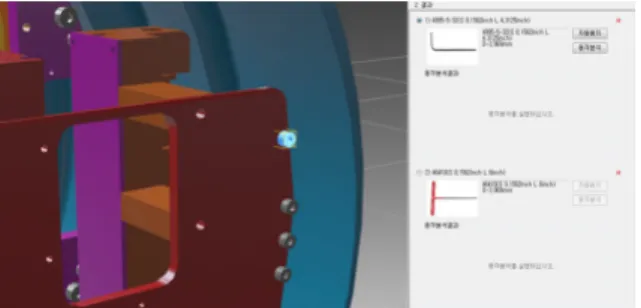
First, tools can be searched and selected manually or automatically in the virtual environment. If the users want to find a suitable tool for disassembling a screw in the product automatically, the information of screws and tools should be stored in the database of DMS. In the DB library of DMS, there is data that explain how screws and tools can be used. Also, the tolerance of their errors should be considered. Finally, DMS proposes the most suitable appliances for each screw spontaneously and an automatic search of tool is shown in Figure 4.
Fig. 4. Search of tool in DMS
3.2 Placement of Tool
Once a tool is correctly chosen, it may be automatically moved to the expected position for user visibility. There may be cases where the accuracy of system is not sufficient and it is necessary to know the axis information and pivot position of screws and tools.
A head of the screws and tools should be aligned with X, Y and Z axis. The pivot position of the tool should be faced with the screw. Tools can always be rotated in Y axis. A tool can be placed as shown in Figure 5.
Fig. 5. Placement of tool 3.3 Analysis of motion and Result
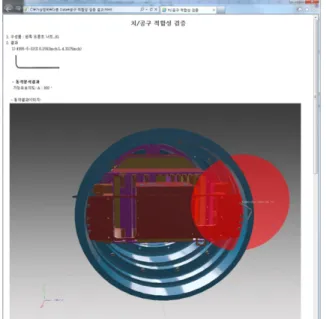
Fig. 6. Result of analysis
In third phase, the motion of the tool is analyzed and the collision detection is verified during that tools are rotating. The user is able to view a disassembly animation sequence and intervene at any step in the virtual environment.
Finally, DMS shows the result of motion analysis. The properties and the available motion scope of the proper tool are visualized as shown in Figure 6.
4. Application of other field
In this section, we define the extended DMS and describe how it is constructed and applied using its computations. We also provide a few details about the algorithm. The first task, once an object for maintenance has been identified, is to input the name of the job and press the automatic selection button. In this manner, we obtain a list of one or more subassemblies which is available to disassemble for the completion of maintenance tasks. Figure 7 shows the disassembly sequence in DMS. We can determine if there is a collision between them by projecting parts in a proposed direction of the motion. If the part is found which cannot be disassembled at the same point, DMS instructs to find the alternative sequence of actions to bypass that the particular subassembly. However, if we cannot extract a given part, then we might reform the structure of system.
Fig. 7. Selection of subassembly
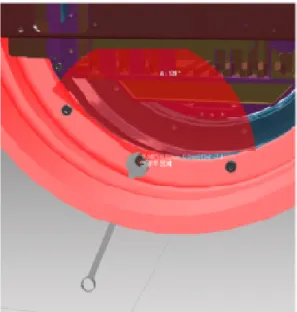
Once a part is selected, DMS uses the part to find an appropriate tool and recursively place the tool as shown in Figure 8, 9. As DMS proceeds with the disassembly, it builds up the database that the information of screws and tools are stored in DMS’s memory. The motion of the tool is visualized and DMS checks that if there is a collision between the tool and other parts next to it.
Upon the completion in DMS, the sequence of actions can be reversed to produce an assembly plan. This plan can be outputted with a graphical demonstration and with assembly instructions.
Fig. 8. Finding tool
Fig. 9. Finding other tool
5. Further Research
We dealt with a major step forward toward the realization of this goal with the creation of the Digital Maintenance System, DMS. DMS is a stand-alone software system able to perform automatic assembly- sequence generation and complexity analysis when a geometric description of the proposed assembly is only given. Currently, DMS is only able to handle certain types of assembly motions, namely, single-step translations but the theoretical framework for DMS extends to other classes of manuals such as IETM and CBT.
Fig. 10. Characteristic of IETM
IETM is a kind of the electronic technical manual in which the operation and supply information, sequence of maintenance, multimedia function are included. The digitalized data related to the operation and maintenance of the product is stored in DMS and it is provided to the users.
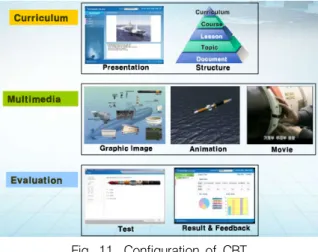
CBT is an instruction software system developed to improve the traditional education system. Engineers can study themselves using the interactive courseware multimedia system consisting of the curriculum, multimedia, and evaluation.
DMS can provide the database of the maintenance of the product such as the assembly/disassembly procedure, tool information, and accessibility of human for IETM
and CBT. We can expect the reduction in time spent looking for needed maintenance information, reproduction costs, and improvement in accuracy.
Fig. 11. Configuration of CBT
The work is presently underway on applying this more advanced reasoning to a practical system. In fact, a new but related procedure to handle maintenance has just recently been developed. Nonetheless, within the context of assembly plans, DMS represents a significant advance in speed and efficiency over previous work.
6. Conclusions
This research studied a new and innovative preliminary maintenance procedure being developed by ADD. New approaches for generating a procedure automatically and verifying a proper tool for disassembly tasks were discussed. Results of this study indicate that the DMS will reduce the labor-intensive tasks and cost of developing maintenance manual by automation. Such a system would be mainly useful in complex assemblies where mechanics are not fully aware of the design of products as a whole. The system will also provide a selection of available tools and support the use of these tools in performing steps of the maintenance sequence.
This study has helped to improve the understanding of problems encountered by designers and mechanics as well as add awareness about possible path ways to the
development of software program for assembly and disassembly job. We are now working on fixing a standard to make assembly and disassembly sequence much more quickly and building sufficient database of tools. In addition, we are going to investigate stresses that can be loaded for workers using human models.
This excellent approach to development of automatic maintenance procedure will help to propose more complete software program while reducing labor and time. An additional benefit of this technology is the cost of developing maintenance manuals will be reduced due to these tasks will be automated.
References
[1] Bruce Romney, Cyprien Godard, Michael Goldwasser, and G. Ramkumar, “An Efficient System for Geometric Assembly Sequence Generation and Evaluation,” Journal of the Int. Computers in Engineering, pp. 699-712, 1995.
[2] Jeff Wampler, Russell S. Blue, Louis J. Hoebel, Christopher R. Volpe, Pascale Rondot, and Bowden Wise, “Service Manual Generation: An Automated Approach to Maintenance Manual Development,” 16th Human Factors in Aviation Maintenance Symposium, 2002.
[3] Russell S. Blue, Jeff Wampler, Louis J. Hoebel, Boris Yamrom, Christopher R. Volpe, Bruce Wilde, Pascale Rondot, Ann E. Kelly, Anne Gilman, Welsey Turner, Steve Linthicum, and George Ryon, “An Automated Approach and Virtual Environment for Generating Maintenance Instructions,” Journal of CHI., pp. 494-495, 2002
[4] Junkyu Lee, Hyunjun Ju, Nahyeon Jung, Jiyoun Yang, and Taekyu Ryu, “Implementation of an Assembly/Disassembly Simulation for the Maintenance Task Verification,” Journal of the Korean Society for Aeronautical & Space Sciences, 09 pp. 1173-1176, 2004.
[5] Hang-geun Shim, and Sang-gu Park, “The Study of Virtual Reality Maintenance System which applies the M&S,” Journal of Institute of Ocean Science and
Weapon, pp. 75-85, 2008.
[6] Gil-hwan Heo, Won-jae Kim, “Application on VSM System Based Virtual Reality,” Journal of the Korea Institute of Military Science and Technology, 1:15, 2009.
[7] Hyun-soon Kim, Ho-keun Lee, Sung-ho Kim, “The Aircraft External POD Compatibility Check System with Augmented Reality Functionality,” Journal of the Korea Institute of Military Science and Technology, pp. 181-184, 2009.
[8] Young-geun Park, In-won Lee, and Dae-yul Lee,
“Augmented Reality Applications in Defence,”
Journal of the Korea Institute of Military Science
and Technology, pp. 75-78, 2009.
[9] Yongwan Kim and Jinah Park, “A study on Virtual Assembly Simulation Using Virtual Reality Technology,” Journal of Korea Multimedia Society, 13: pp. 1715-1727, 2010.
[10] Junkyu Lee, “Collaborative Maintenance Simulation System Using Virtual Mockup,” Journal of Korea Multimedia Society, 15: pp. 148-165, 2012.
[11] Youngkeun Park, Hyunjun Ju, Cheonyoung Kim, Nahyeon Jung, Junkyu Lee, and Inwon Lee, “Virtual Simulation for Assembly and Maintenance Tasks,”
Journal of the Korea Society for Simulation, 21:
pp. 75-80, 2012.