Effects of the Red Garlic Extract for Anti-Obesity and Hypolipidemic in Obese Rats Induced High Fat Diet
Soo-Jung Lee
1, Ra-Jeong Kim
1, Ji-Hyun Ryu
1, Jung-Hye Shin
2, Min-Jung Kang
2, In-Soo Kim
1and Nak-Ju Sung
1,2*
1
Department of Food Science and Nutrition, Institute of Agriculture and Life Sciences, Gyeongsang National University, Jinju 660-701, Korea
2
Namhae Garlic Research Institute, Namhae 668-812, Korea
Received December 22, 2010 /Accepted February 9, 2011This study tested the anti-obesity and hypolipidemic effects of red garlic extract in obese rats induced by a high fat diet over a period of 4 weeks. Red garlic extract of 15 brix was added in 1, 3, 5 and 7% ratios in diets. The obesity index and body fat content significantly decreased in rats fed a diet with over 3% red garlic extract compared to the control group. There was no significant difference in weight of visceral and epididymal fat in rats fed red garlic extract. Total lipid and triglyceride lev- els in serum were significantly decreased in a dose-dependent manner, and AI and CRF also fell. ALT and AST activities in groups fed red garlic extract were decreased compared to the control group.
Total lipid level in liver tissue of the groups fed 5-7% red garlic extract exhibited a significant de- crease compared to the control group. Total cholesterol and triglyceride levels in feces were sig- nificantly increased in rats fed a diet with over 5% red garlic extract. Lipid peroxide levels were sig- nificantly decreased in the groups fed diets with 5-7% red garlic and antioxidant activity in serum was significantly increased in the group fed a diet with 7% red garlic extract compared to the control group. Our results suggest that red garlic extract could have anti-obesity and hypolipidemic effects for suppressing obesity index and decreasing lipid profiles.
Key words : Anti-obesity, hypolipidemic, red garlic extract
*Corresponding author
*Tel:+82-55-751-5975, Fax:+82-55-751-5971
*E-mail : [email protected]
Introduction
As the choice for a high-calorie and high-fat diet in- creases due to the economic stability and affluence, so does the occurrence of metabolic disease caused by over-weight [27]. Obesity is the condition under which surplus energy is accumulated as lipids, which is attributable to the increase of energy intake and the decrease of consumption. From the balance is lost, obesity or hyperlipidemia develops, lead- ing to a serious disease. In Korea, the social and economic cost incurred by the increase of obese population rises annually. Given that 40% of people who die by circulating system disease including atherosclerosis, cerebro-, car- dio-vascular complications, hypertention, diabetes and func- tional depression of certain organs are obese, it is necessary to take a fundamental measure to improve the situation [47].
Although the drug therapy proved to be effective as a behavior correction therapy used for the control of lipid me-
tabolism in obese, it accompanies side-effects such as head-
aches, insomnia, and vomiting [29]. Thus, there is a growing
attention on the way to improve obesity using phyto-nu-
trient that does not cause side-effects, among which garlic
is known to effective for the control of lipid metabolism and
obesity [1,16,24,31,51]. A major bioactive substances of garlic
(Allium sativum L.) are an organic sulfur compounds contain-
ing allicin [11,18,22], which has the cardioprotective function
among others [25]. Reportedly in Korea, the bioactive effect
is elevated through the heat-treatment which turns fresh gar-
lic into aged black garlic [22,46] or red garlic [36]. This is
reportedly attributable to melanoidins [35,36,46,49], which
are the browning substance in aged heat-treated garlic. Also,
black garlic is known to variable bioactivities such as anti-
oxidant [45,46], improvement of cardiovascular complica-
tions of diabetes [42], decline of lipids accumulation in hy-
percholesterolemic rats [22]. It was demonstrated that S-allyl
cysteine [10,20] and polyphenol compounds in garlic exert
strong antioxidant effect [48]. Otherwise, antioxidant activ-
ities of red garlic - light color than black garlic -was more
higher than the fresh garlic but was more lower than the
black garlic, was reported that the antioxidant activity by
Table 1. Composition of experimental diets (g/kg diet)
Diet composition Normal1) Control4) Experimental groups5)
RG-1 RG-3 RG-5 RG-7
Casein 200 200 200 200 200 200
L-cystein 3 3 3 3 3 3
Dextrin 132 132 132 132 132 132
Corn starch 417.5 267.5 267.5 267.5 267.5 267.5
Sucrose 100 100 100 100 100 100
Soybean oil 50 50 50 50 50 50
Lard 0 150 150 150 150 150
Cellulose 50 50 50 50 50 50
Vitamin mixture2) 10 10 10 10 10 10
Mineral mixture3) 35 35 35 35 35 35
Choline bitartrate 2.5 2.5 2.5 2.5 2.5 2.5
Red garlic extract - - 10 30 50 70
Total energy (kcal) 3629.66 4439.66 4439.66 4439.66 4439.66 4439.66
Fat energy ratio (%) 12.40 40.54 40.54 40.54 40.54 40.54
1)Normal: Modified AIN-93G diet
2)AIN-93 vitamin mixture
3)AIN-93 mineral mixture
4)Control: High fat diet
5)RG-1: supplemented with 1% red garlic extract of 15 brix concentration, RG-3: supplemented with 3% red garlic extract, RG-5:
supplemented with 5% red garlic extract, RG-7: supplemented with 7% red garlic extract.
production of the browning substance through the thermal process was the main parameter of the biological activity [36].
Despite such excellent bioactive function of black garlic compared to fresh garlic, the heat treatment of garlic has a down side such as high cost due to long times of its processing and limitations of 2
ndprocessing due to dark black color and high viscosity [36]. Therefore, this study aims to explore the anti-obesity and hypolipidemic effects by combining heat-treated red garlic extract in obese rats induced high fat diet, considering the fact that the red garlic developed through the aging process with low temperature showed higher bioactive effects than fresh garlic [36].
Materials and Methods Preparation of extract
Red garlic used in this experiment were prepared man- ually, whole parts of fresh garlic were utilized for the manu- facture of red garlic. The manufacturing protocol followed the patent application (No. 10-2010-0036798) by controlling of temperature and moisture. One hundred grams of red garlic removed peel was refluxed 2 times in 1000 ml water for 3 hr, at the 120℃. The hot-water extract was filtrated,
concentrated under reduced pressure, and then fixed to 15 brix concentration. The extract was stored at 4℃.
Animals
Male Sprague-Dawley (SD) rats were purchased from Samtako Bio Korea Inc. (Osan, Korea). The anti-obesity and hypolipidemic studies were performed, aged 4 weeks and weighing 100±10 g for this experiment. All rats were housed individually in polypropylene cages and maintained under standard conditions of 22±2℃, relative humidity of 50±5%
and a constant 12 hr (07:00-19:00) light and dark cycle. To help them adapt to the laboratory conditions, the rats were fed a standard pellet diet (SuperFeed Inc., Korea) with water ad libitum for the first week prior to the experiment.
For the experiments, the animals were randomly divided into 6 groups of 7 rats each. At the second week, rats were fed with a normal diet (12.40% of calories as fat) or high fat diet (40.54% of calories as fat). Control group fed high fat diet was not supplemented red garlic extract.
Experimental group was divided to 4 groups by RG-1, -3,
-5 and -7 group with supplemented red garlic extract of 1%,
3% 5% and 7% in total diet, respectively. All treatments con-
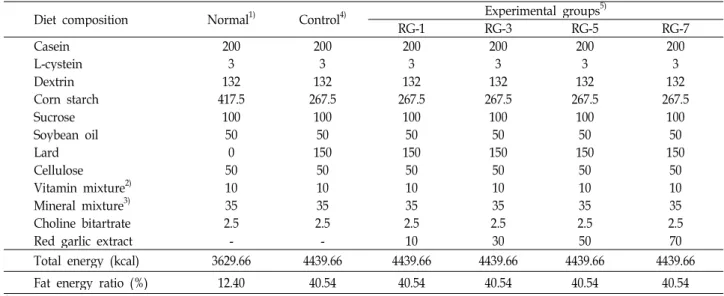
tinued for 4 weeks. Composition of the experimental diet
is presented in Table 1.
Measuring of weight gains, food intakes and food efficiency ratio (FER)
During the experimental period, food intakes were moni- tored daily at the same time, while body weight was tested every week at same time. FER was calculated by total body weight gain (g)/total food intake amount (g) for 4 weeks.
Measuring of obesity index and fat content
To evaluate of obesity in rats, body weight and length from the tip of the nose to the anus in rats were measured at the last day for this experiment [26]. Obesity index such as Rӧhrer index, Lee index, T. M. index and body fat content was calculated using Rӧhrer index=[weight (g)/length (cm)
3]×10
3, Lee index=[weight (g)
1/3/ length (cm)]×10
3, T.M.
index=weight (g)/length (cm)
2.823×10
3and body fat content (%)=(0.581×T. M. index)-22.03.
Treatment of experimental rats
At the end of the experiment, after overnight fasting, all rats were anesthetized with diethyl ether. Blood samples from the heart were collected, cooled on ice and 30 min later the serum was separated by centrifuge (Mega 17R, HANILE, Korea) at 3000 rpm for 15 min at 4℃. Liver, heart, kidney, spleen and testis were excised rapidly, chilled and rinsed in ice-cold 0.9% NaCl, and weighed. The serum and organs of rat were stored under -70℃ before analysis.
Determination of lipids level in serum
Total lipid level was determined according to the meth- od of Frings et al. [14]. 20 μl of serum was heated with 200 μl concentrated H
2SO
4in a boiling water bath for 10 min, then 10 ml of phospho-vanillin solution was added, and the mixture was incubated 37℃ for 15 min, measured at 540 nm, and olive oil (0-500 mg) was used as standard for calibration curve. Total cholesterol, triglyceride and high density lipoprotein cholesterol (HDL-C) levels were determined with each kit reagent for total cholesterol (AM 202-k, Asan pharm. Co., Seoul, Korea), triglyceride (AM 157S-k, Asan, Korea) and HDL-C (AM 203-k, Asan, Korea). The low density lipoprotein cholesterol (LDL-C) and very low density lipoprotein cholesterol (VLDL-C) levels were calculated by the following formulas; LDL-C = TC-(HDL-C+TG/5) [13] and VLDL-C = TC-(HDL-C+
LDL-C) [9]. Atherogenic index (AI) was calculated by (TC
-HDL-C)/HDL-C [17] and cardiac risk factor (CRF) was calculated by TC/HDL-C [23].
Determination of ALT and AST activities
To evaluate liver function, serum ALT (alanine amino- transferase) and AST (aspartate aminotransferase) activities were determined by commercial AM kit reagents (Asan, Korea) respectively.
Determination of lipid peroxide in serum
Serum (100 μl) was mixed 1/12 N H
2SO
4solution and 10% phosphotungstic acid, then centrifuged at 4000 rpm for 10 min. The residue except the supernatant was mixed with distilled water and thiobarbituric acid (TBA) reagent. The mixture was incubated in a 95℃ water bath for 60 min and then cooled to room temperature in the ice bath. The mixture was added to exactly 4 ml n-butanol before being centri- fuged at 3000 rpm for 10 min. The absorbance of the butanol fraction was measured at 532 nm. 1,1,3,3-tetraethoxypropan (TEP, Sigma Co., USA) was used as standard for calibration curve, its value was expressed as mmol/ml.
Antioxidant activity assay in serum
Antioxidant activity in the serum of rats was assayed according to the method of Lim et al. [38] with slight modifications. Serum (100 μl) was thoroughly mixed with 1 ml Tris-HCl buffer (100 mM, pH 7.4) and 2 ml of 1,1-di- phenyl-2-picrylhydrazyl (DPPH, 2.5 mg/100 ml ethanol) was added rapidly. The mixture was incubated at 37℃ for 15 min before it was added to 4 ml chloroform. After cen- trifugation at 5000 rpm for 5 min, at 4℃, the absorbance of the chloroform layer was measured at 517 nm and chloroform was used as the blank. The antioxidant activity was expressed as the scavenging ratio of DPPH reagent color (%).
Determination of lipids level in tissues and feces
Lipids from the tissues were extracted according to the method of Folch et al. [12]. Tissue of 0.5 g or feces of 1 g were blended with the homogenizing stirrer (DAIHAN wise stir® HS-30E, Korea), and extracted well in a chloroform:
methanol solution (2:1, v/v) at the room temperature for 24
hr, respectively. Three hundred μl each of the filtrate were
exhausted by a rotary vacuum evaporator at 30-40℃ for de-
termination of total lipids, total cholesterol and triglyceride
content in tissues and feces. Determination of lipids level
such as total lipid, total cholesterol and triglyceride in tissues
and feces were evaluated using the same methods of lipids
determination in serum, described above.
Table 2. Body weight gain, food intake, FER and obesity index in obese rats induced high fat diet Groups1) Total body weight
gain (g/4 wk) Food intake
(g/day) FER (%) Röhrer index Lee index T.M. index Body fat content (%) Normal 157.75±7.23a2,3) 20.00±0.09b 28.84±1.81a 31.37±2.125)a6) 309.29±6.86a 53.98±3.44a 9.36±0.70a Control 186.75±13.55b 18.74±1.03a 38.77±0.94bc 37.85±0.99d 329.39±2.85c 64.31±1.67b 15.34±0.97b RG-1 200.75±11.32b 18.21±0.43a 39.80±1.75c 35.83±0.94cd 323.45±2.58bc 61.66±1.45b 13.86±0.77b RG-3 192.00±25.10b 18.61±0.71a 41.06±1.72c 34.58±1.95bc 319.37±6.05b 57.03±4.28a 11.10±2.49a RG-5 198.25±24.07b 19.19±0.58ab 40.27±1.93c 32.14±1.52a 318.82±10.73b 55.76±2.42a 10.36±1.41a RG-7 179.75±17.17ab 19.15±0.35ab 37.03±2.13b 32.97±0.74ab 314.46±2.39ab 56.85±1.08a 11.00±0.63a
1)See the legend of Table 1
2)Values are mean±SD (
n
=7).3)Values in a column sharing the same superscript letter are not significantly different at
p
<0.05.FER: food efficiency ratio.
Statistical analysis
Values were presented as means±SD with n=7. Statistical difference between the treatments and controls were tested by one-way analysis of variance (ANOVA) followed by the Duncan’s multiple range test. A difference in the mean val- ues of p<0.05 was considered to be statistically significant.
All statistical tests were performed using the computer soft- ware program SPSS for Windows (SPSS, version 12.0) for statistics and data analysis.
Results and Discussion Weight change, FER and obesity index
The effects of the red garlic extract on the weight change, FER and obesity index in obese rats fed high fat diet are presented in Table 2. The control group fed high fat diet showed a weight gain of 186.75 g during the 4 weeks, which is about 1.2 fold higher than a normal group (157.75 g), whereas the experimental group fed with high fat diet added the red garlic extract did not show significant difference in weight change with compared to the control group. The sig- nificant difference was little depending on the amount of extracts. Food intake of the control and the red garlic extract groups was a little in significant difference with compared to the normal group, while FER was the highest in the con- trol group fed high fat diet. Especially, the groups fed with 1-5% of red garlic extract had a higher than the control group, whereas the group fed with 7% of extract had a some- what lower compared to the control group.
Obesity index using the body length and weight of rats were presented including Röhrer, Lee and T.M. index and body fat content. According to the experiment, the body length was similar to all experiment groups about 20.7 cm (data not shown), but the obesity index was significantly
higher in the control group than that of the normal group.
Meanwhile the obesity index in the experimental group was significantly decreased dose dependent of the added red gar- lic extract. Especially the groups fed with more than 5% of red garlic extract showed Röhrer index reduction to the level equal to the normal group. Lee and T.M index were sig- nificantly decreased in the groups fed over the 3% red garlic extract. Body fat content of the rats fed red garlic extract of 3% have declined with significant difference compared to the control group, except that there were no significant difference depending on the amount of added extract at the concentration of 3-7%.
In this study, we discovered that the high fat diet show higher FER in obese rats induced high fat diet even though it reduced the overall intake due to high fat content (40.54%
of the total calorie) compared to that of the normal diet (12.40% of the total calorie). These result are similar to a reports that obese rats induced high fat diet takes in food at lower degree than a normal group, but the FER was high- er [37,49], and which is reported to stem from the high calo- ries by high fat [37]. Rats are considered obese when T.M.
index is over 55 [30] or Röhrer index is over 30 [8]. Thus all the control and normal groups of this experiment were considered as an obese, though they are more or less obese.
The evaluation by the obesity index results in difference out- comes depending on the lipids used for evaluation, and high fat diet-induced obese a somewhat higher obesity index than that is the case for cholesterol diet [8,26].
Weights of organs and fat in body
Table 3 is shown the effects of red garlic extract for the
organs and fat weights in the obese rats induced high fat
diet. The weights of a liver, heart and spleen of the control
group has significantly increased compared to the normal
Table 3. Effect of red garlic extract in the weight of organs, visceral and epididymal fat in obese rats induced high fat diet
Groups1) Normal Control RG-1 RG-3 RG-5 RG-7
Tissues (g/100 g body weight)
Liver 2.98±0.36a2,3) 3.56±0.21c 3.30±0.21abc 3.41±0.08bc 3.08±0.20ab 3.03±0.05a Heart 0.31±0.02b 0.35±0.02c 0.30±0.01b 0.29±0.01ab 0.28±0.01a 0.31±0.01b
Kidney 0.61±0.05NS 0.66±0.02 0.64±0.03 0.61±0.03 0.62±0.04 0.66±0.07
Spleen 0.17±0.03a 0.21±0.01b 0.17±0.01a 0.18±0.02ab 0.17±0.02a 0.16±0.02a Testis 0.95±0.06bc 0.98±0.06c 0.85±0.03a 0.88±0.06ab 0.91±0.03abc 0.90±0.08abc Fat (g/100 g body weight)
Visceral fat 0.94±0.51NS 1.41±0.27 1.18±0.41 1.16±0.14 1.12±0.11 1.15±0.14
Epididymal fat 1.48±0.38a 2.21±0.47b 1.96±0.37ab 2.09±0.24b 1.93±0.50ab 1.91±0.07ab
1)See the legend of Table 1
2)Values are mean±SD (
n
=7).3)Values in a same row sharing the same superscript letter are not significantly different at
p
<0.05.NS: Not significant.
Table 4. Effect of red garlic extract on lipid profiles in serum of the obese rats induced high fat diet
Groups1) Normal Control RG-1 RG-3 RG-5 RG-7
Total lipid (mg/dl) 208.95±8.30d2,3) 267.72±6.87e 190.17±9.95c 176.42±9.76b 156.84±7.88a 146.99±9.28a Total cholesterol (mg/dl) 53.03±3.52a 61.38±5.67b 59.12±2.09ab 59.75±5.79ab 59.51±2.66ab 58.19±6.26ab Triglyceride (mg/dl) 43.81±2.09c 64.56±1.62d 42.30±5.74bc 38.84±2.55ab 38.07±2.35ab 34.31±2.73a HDL-C (mg/dl) 31.57±0.63bc 28.17±0.98a 30.67±0.47b 30.27±1.42b 32.21±0.97c 32.21±0.72c LDL-C (mg/dl) 14.46±3.14a 22.15±4.73b 21.01±1.49ab 19.82±4.40ab 18.87±2.38ab 16.84±3.66ab VLDL-C (mg/dl) 8.76±0.42c 12.91±0.32d 8.46±1.15bc 7.77±0.51ab 7.61±0.47ab 6.86±0.55a
AI 0.68±0.14a 1.18±0.18c 0.93±0.08b 0.97±0.13b 0.85±0.08ab 0.81±0.18ab
CRF 1.68±0.14a 2.18±0.18c 1.93±0.08b 1.97±0.13b 1.85±0.08ab 1.81±0.18ab
1)See the legend of Table 1
2)Values are mean±SD (
n
=7).3)Values in a column sharing the same superscript letter are not significantly different at
p
<0.05HDL-C: High density lipoprotein cholesterol, LDL-C: Low density lipoprotein cholesterol, VLDL-C: Very low density lipoprotein cholesterol, AI: Atherogenic index, CRF: Cardiac risk factor.
group, whereas the weight of kidney and testis did not show any significant difference. The weight of liver tissue was sig- nificantly decreased in the group fed 5% of red garlic extract, while the weight of heart decreased for all groups fed with red garlic extract significantly to reach the level similar to the normal group. The weight of visceral fat did not show significant difference among all the experimental groups.
But, the weight of epididymal fat in the control group was significantly increased compared to the normal group, whereas they showed no significant difference with groups fed red garlic extract.
In obese rats induced high fat diet, supplementation of Allium victorialis var. platyphyllum leaves in their diet showed decrease in the weight of total abdominal and epididymal fat compared to control group fed high fat diet [7]. In this study, however, feeding of the red garlic extract did not show a significant difference on the weight of internal body fat. But, feeding over 5% of red garlic extract was effective
in the weight decline of liver and heart tissues compared to the control group.
Lipids level in serum
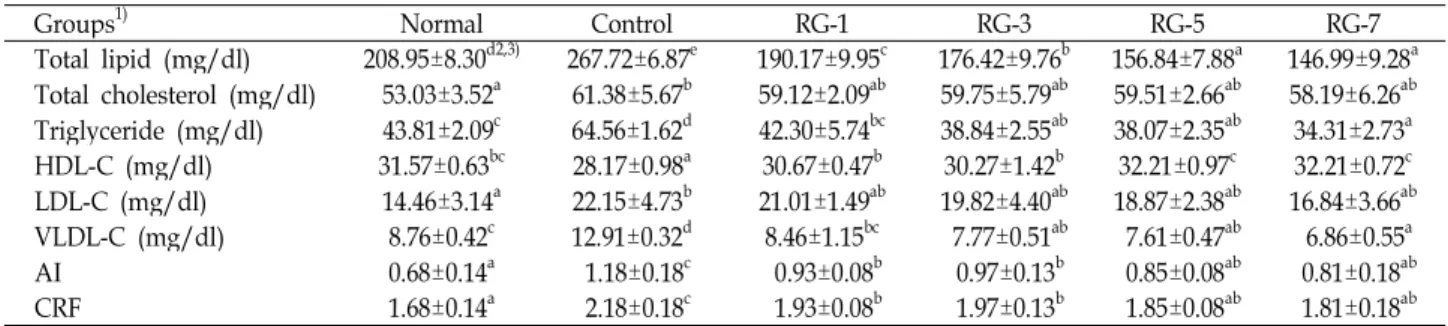
The serum lipids level of rats fed high fat diet added red
garlic extract for 4 weeks were described in Table 4. Total
lipid level of the control group was significantly higher than
the normal group, and which decreased depending on the
supplementation of red garlic extract in the experimental
groups. The total cholesterol level did not show significant
difference between the control group and the groups fed red
garlic extract (RG-1-7). Triglyceride level of the control
group was about 1.5 fold higher than the normal group, and
which showed the decrease of 34.5-46.9% in those groups
fed with red garlic extract. The HDL-C level of the control
group fell compared to the normal group, though that of
the experimental groups was recovered to similar level with
the normal group. In terms of LDL-C level, there were no
significant difference between the control group and the group fed red garlic extract, whereas the VLDL-C level of groups fed red garlic extract decreased significantly com- pared to the control group and the ratio of drop was higher than that of LDL-C.
AI and CRF due to high fat diet were increased compared to the normal group, while tend to decrease by feeding of red garlic extract. Among the supplementation level of red garlic extract did not show significant difference, but in the groups fed 5-7% of red garlic extract, it reduced the AI by 28.0-31.4% and the CFR by 15.1-17.0%, compared to the con- trol group.
Choi et al. [7] reported that feeding with Allium victorialis var. platyphyllum leaves in the rats induced high fat diet for 2 weeks revealed remarkable reduction of the total cholester- ol, LDL-C and triglyceride in serum. The decline of HDL-C level and the increase of LDL-C level in serum are known as major contributors of arteriosclerosis [3,32]. According to Chi et al. [4], the elevation of cholesterol level in serum re- sults from the increase of VLDL-C, and garlic is known to reduce the risk of arteriosclerosis by decreasing the VLDL-C in serum. In particular, the drop of triglyceride is due to the decomposition of chylomicrone, and VLDL-C is stimu- lated by the lipoprotein on the blood vessel walls [28]. Also, there is a report that AI was reduced due to the increased absorption of garlic, which in turn was possible by the gen- eration of allithiamine when garlic was injected in combina- tion with fermented soybean gemmule [6]. Ajoene, a type of allicin, of garlic decreased microviscosity of internal re- gion within the lipid bilayer membrane of intact platelets as well as artificial lipid membrane, without affecting the outer hydrophilic properties of the bilayer [41]. Reportedly, effect of lipid improvement in garlic is due to an emulsion that is formed between lipid and components of garlic [1].
It is inferable that this applies to red garlic, as well.
ALT and AST activities
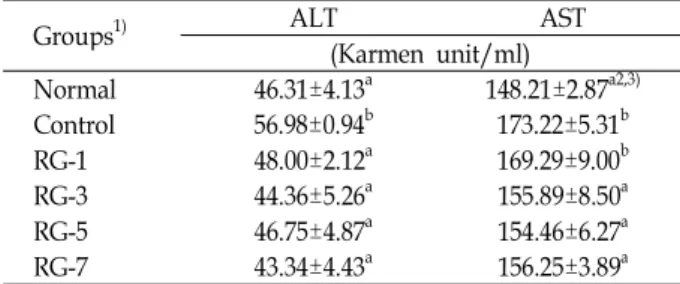
Serum ALT and AST activities in obese rats induced high fat diet presents in Table 5. It was significantly higher in the control group than the normal group. All experimental groups fed with red garlic extract showed significant de- crease of ALT activity, and in the groups fed with 3-7% of red garlic extract, the AST activity significantly was decreased. The ALT activity rises in the liver disorder such as hepatitis, hepatic necrosis, and cirrhosis occur, wheras AST activity is known to be increasing in hepatitis, ob-
Table 5. Effect of red garlic extract on ALT and AST activities in serum of the obese rats induced high fat diet
Groups1) ALT AST
(Karmen unit/ml)
Normal 46.31±4.13a 148.21±2.87a2,3)
Control 56.98±0.94b 173.22±5.31b
RG-1 48.00±2.12a 169.29±9.00b
RG-3 44.36±5.26a 155.89±8.50a
RG-5 46.75±4.87a 154.46±6.27a
RG-7 43.34±4.43a 156.25±3.89a
1)See the legend of Table 1
2)Values are mean±SD (
n
=7).3)Values in a column sharing the same superscript letter are not significantly different at
p
<0.05.ALT: Alanine aminotransferase, AST: Aspartate aminotransferase.
structive jaundice and myocardial infarction occur [43].
However ALT and AST activation tend to decreases accord- ing to the antioxidant activity of components added to diet of rats [40]. Lee et al. [36] noted that red garlic has the anti- oxidant activities higher than fresh garlic and similar to black garlic because it has a lot of polyphenol, flavonoids, thiosulfate and browning components more than fresh garlic. Thus it is regarded that ALT and AST activities in the serum of obese rats induced high fat diet is related to the above mentioned substance of the ingredients.
Lipids level in liver and heart tissues
Lipids level in liver and heart tissues after 4 weeks feed-
ing of the red garlic extract to obese rats induced high fat
diet are shown in Table 6. The total lipid level in liver was
27.12 mg/g for the normal group and 37.06 mg/g for the
control group, meaning that the control group has about 1.4
fold higher than the normal group. Its level showed decreas-
ing trend disproportionately to the dose amount of red garlic
extract and the decline was significant in the supplementa-
tion for 5-7% red garlic extract to the control group. The
total cholesterol and triglyceride levels of the control group
increased significantly compared to the normal group, but
supplementation of red garlic extract with high fat diet did
not show significant difference with compared to the control
group. The total lipid level in heart tissue of the control
group (25.82 mg/g) was about 1.3 fold higher than that of
the normal group (19.38 mg/g). The groups fed with red
garlic extract showed decreasing trend as the amount of ex-
tract increase and there was a significant decrease in the sup-
plementation of red garlic extract for over 5%. The total cho-
Table 6. Effect of red garlic extract on lipid profiles in liver and heart tissues the obese rats induced high fat diet
(mg/g, wet tissues)
Groups1) In liver In heart
Total lipid Total cholesterol Triglyceride Total lipid Total cholesterol Triglyceride Normal 27.12±1.31a2,3) 2.04±0.11a 2.04±0.11a 19.38±2.44a 1.34±0.21a 3.30±0.67a Control 37.06±1.84d 2.55±0.15b 2.55±0.15b 25.82±1.96c 2.01±0.11b 7.94±0.27b RG-1 35.80±3.56cd 2.45±0.43b 2.45±0.43b 24.57±2.37bc 1.57±0.51a 7.44±0.97b RG-3 34.14±2.13acd 2.47±0.26b 2.47±0.26b 22.38±1.31abc 1.44±0.21a 7.01±0.13b
RG-5 33.19±2.06ac 2.41±0.24b 2.41±0.24b 20.91±3.14a 1.44±0.19a 6.82±0.92b
RG-7 32.11±1.47a 2.43±0.08b 2.43±0.08b 21.17±1.51ab 1.23±0.25a 6.86±1.25b
1)See the legend of Table 1
2)Values are mean±SD (
n
=7)3)Values in a column sharing the same superscript letter are not significantly different at
p
<0.05.Table 7. Lipid profiles in feces after 1 and 4 weeks’ feeding of red garlic extract in the obese rats induced high fat diet (mg/g, dried feces)
Groups1) Total lipid Total cholesterol Triglyceride
1 week 4 weeks 1 week 4 weeks 1 week 4 weeks
Normal 15.43±1.11a2,3) 15.85±0.37a 1.58±0.18a 1.61±0.09a 0.23±0.02a 0.24±0.02a Control 29.75±2.23b 27.56±1.39b 2.57±0.08b 2.56±0.11b 0.61±0.06a 0.57±0.02b
RG-1 27.92±2.78b 27.78±3.09b 2.46±0.08b 2.44±0.26b 0.67±0.10ab 0.69±0.34b
RG-3 30.05±0.80b 29.85±3.08b 2.73±0.11b 3.70±0.71c 0.86±0.18b 0.87±0.13bc
RG-5 29.74±0.82b 29.25±0.54b 2.71±0.33b 3.78±0.59c 0.68±0.05ab 1.02±0.24c
RG-7 28.20±1.73b 30.02±1.08b 2.75±0.03b 3.54±0.06c 0.67±0.16ab 1.08±0.04c
1)See the legend of Table 1
2)Values are mean±SD (
n
=7).3)Values in a column sharing the same superscript letter are not significantly different at
p
<0.05.lesterol level went down significantly in the groups fed red garlic extract compared to the control group, but there was no significant difference in the triglyceride level.
Yoon et al. [51] reported that supplementation of spices (red pepper, garlic and ginger) in the high fat diet showed more effective of the lipids improving for the fat tissue and serum in the garlic compared to pepper or ginger. The phe- nolic compounds in plant kingdom decreased lipid level in serum [48] and liver tissues [19], curtailing the occurrence of cardiovascular disease. Especially, it was reported that allicin is a major substance that decreases lipids level in the body [52]. Also, it was reported that the fresh garlic is heat-treated into red garlic and black garlic, the phenolic compounds level tend to elevate [36,45]. Therefore, the red garlic extract is believed to be improving the lipid profiles in the liver and heart tissues of obese rats.
Lipids level in feces
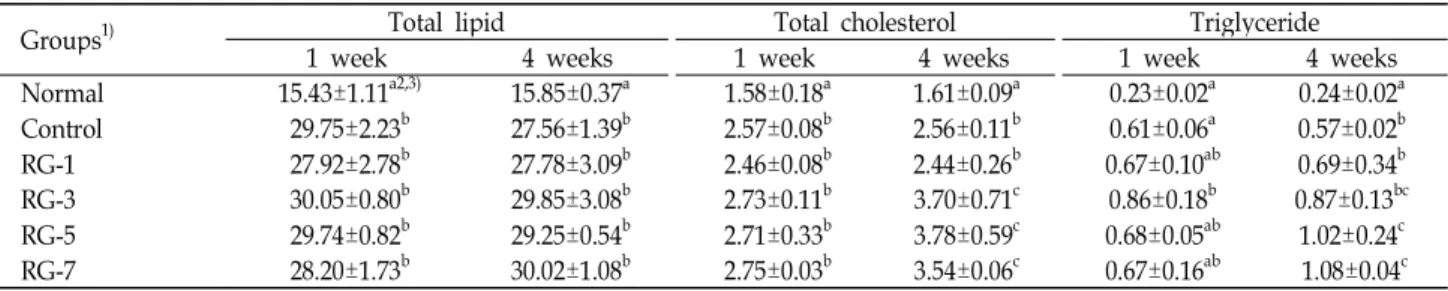
Table 7 presented the measurements of the lipids level of excrements depending on the period of red garlic extract feeding in obese rats induced high fat diet. The total lipid level of the control group was higher than that of the normal
group after 1 week and 4 weeks, but in the groups fed red garlic extract, no significant difference as added amount of red garlic extract. Excrements of the total cholesterol re- corded an increase when rats are fed with red garlic extract for 4 weeks, and the significant difference from the control group was appeared when the extract accounted for over 3%. Triglyceride level of the control group in the feces showed a significant increase compared to the normal group, while significantly higher increase was observed from the groups fed 5-7% red garlic extract than the control group.
Grape seed extract was reported to be effective in restrict- ing absorption of dietary lipids in the body by increased excretion of triglyceride in obese rats induced high fat diet was about 1.2 fold with compared to the control group [5].
Lee [34] and Shimomura et al. [44] reported that even if rats
take in large amount of fat, the amount of excrements remain
consistent and thus lipid absorption rate of high fat diet
group stands on a high level. However, this study revealed
that supplementation of red garlic extract for obese rats re-
stricts absorption of dietary lipids while increasing lipids ex-
cretion at the same time, resulting in the reduction lipids
Table 8. Effect of red garlic extract on lipid peroxide level and antioxidant activity in serum of the obese rats induced high fat diet
Groups1) Lipid peroxide (mmol/ml) Antioxidant activity (%)
Normal 29.59±1.51c2,3) 57.29±0.93c
Control 40.95±1.89d 46.26±2.45b
RG-1 13.23±1.54b 38.60±5.48a
RG-3 12.00±2.96b 43.48±1.57ab
RG-5 8.05±1.14a 47.37±1.35b
RG-7 8.30±0.74a 52.51±2.85c
1)See the legend of Table 1
2)Values are mean±SD (
n
=7).3)Values in a column sharing the same superscript letter are not significantly different at
p
<0.05.level in vivo.
Lipid peroxidation and antioxidant activity in serum
Lipid peroxide level and antioxidant activity in serum were significantly higher in the control group compared with the normal group, as shown in Table 8. Lipid peroxide level was significantly decreased in the groups fed red garlic extract; such that the level in the groups fed 5-7% extract was lower compared to the groups fed 1-3% of red garlic extract. Lipid peroxide level in serum increased with high fat diet consumption [15], high fat diet was more prone to oxidation and generation of free radicals which was pos- itively correlated with total cholesterol and triglyceride in serum [39].
Antioxidant activity by DPPH radical scavenging in se- rum was significantly increased in the group fed 7% red gar- lic extract compared to the control group. Its activity was similar to the normal group. Jastrzebski et al. [21] reported plasma antioxidant activity in the rats fed cholesterol was found a significant increase in the groups added the fresh and heat-treated garlic for 20 min. It is known that phenolic compounds in the plants have antioxidant activity [33] by obstructing generation of malondialdehyde [2]. We suggest that the results of this experiment involved interaction of phenolic and browning compounds of red garlic by heat treatment. And dietary hypolipidemic garlic was effective in reducing the oxidative stress, which was indicated by an increase of antioxidant activity and a decrease of lipids level in the rats.
Acknowledgement
This research was supported by Technology Development Program for Agriculture and Forestry (109137-03), Ministry
for Food, Agriculture, Forestry and Fisheries, Republic of Korea.
References
1. Aziz, H. A., Y. T. F. Tan, K. K. Peh, and M. F. Yam. 2010.
Direct effect of khat and garlic extracts on blood lipids con- tents: Preliminary
in vitro
study.Obes. Res. Clin. Pract
. 4, e247-e252.2. Azuma, K., M. Nasayoshi, M. Koshioka, K. Ippoushi, Y.
Yamaguchi, K. Kohata, Y. Yamauchi, H. Ito, and H.
Higashio. 1999. Phenolic antioxidants from the leaves of
Corchorus olitorius
L.J. Agric. Food Chem.
47, 3963-3966.3. Ban, S. S., H. D. Yoon, O. C. Shin, Y. J. Shin, C. S. Park, J. H. Park, and B. I. Seo. 2006. The effects of
Artemisiae capil- laris
,Ponciri fructus
andCartaegi fructus
in obese rats in- duced by high fat diet.Korean J. Herbology
21, 55-67.4. Chi, M. S., E. T. Koh, and T. J. Stewart. 1982. Effect of garlic on lipid metabolism in rats fed cholesterol or lard.
J. Nutr
. 112, 241-248.5. Cho, Y. S., E. M. Jang, S. M. Jang, M. S. Chun., M. Y. Shon, M. J. Kim, and M. K. Lee. 2007. Effect of grape seed water extract on lipid metabolism and erythrocyte antioxidant de- fense system in high-fat diet-induced obese C57BL/6 mice.
J. Korean Soc. Food. Sci. Nutr
. 36, 1537-1543.6. Choi, H. T., E. S. Kim, S. S. Ham, S. Y. Park, and H. Y.
Chung. 2008. Effects of complex food ingredient composed of garlic and fermented soybean hypocotyl on the serum lipid profiles of the rats fed high-fat diet.
Korean J. Food Sci.
Technol
. 40, 215-219.7. Choi, J., K. T. Lee, W. B. Kim, K. K. Park, W. Y. Chung, J. H. Lee, S. C. Lim, H. J. Jung, and H. J. Park. 2005. Effect of
Allium victorialis
var. platylphyllum
leaves on triton WR-1339-induced and poloxamer-407-induced hyper- lipidemic rats and on diet-induced obesity rats.Korean J.
Pharmacogn
. 36, 109-115.8. Choi, M. K., J. S. Lee, W. J. Park, M. H. Kim, and M. H.
Kang. 2009. Effects of ethanol extract from
Lycii folium
leaves on obesity and blood biochemical indices in high-fat diet induced obese rats.J. Korean Soc. Food Sci. Nutr
. 38, 1707-1711.9. Cheung, P. C. K. 1998. Plasma and hepatic cholesterol levels and fecal neutral sterol excretion are altered in hamsters fed straw mushroom diets.
J. Nutr.
128, 1512-1516.10. Corzo-Martinez, M., N. Corso, and M. Villamiel. 2007.
Biological properties of onions and garlic.
Trends Food Sci.
Technol.
18, 609-625.11. Cristol, L. S., I. Jialal, and S. M. Grundy. 1992. Effect of low dose probucol therapy on LDL oxidation and the plasma lipoprotein profile in male volunteers.
Atherosclerosis
97, 11-20.12. Folch, J., M. Lees, and G. H. Sloane-Stanley. 1957. A simple method for the isolation and purification of total lipids from animal tissues.
J. Biol. Chem
. 226, 497-502.13. Friedewald, W. T., R. I. Levy, and D. S. Fredrickson. 1972.
Estimation of the concentration of low density lipoprotein cholesterol in plasma, without use of the preparative ultracentrifuge.
Clin. Chem
. 18, 499-502.14. Frings, C. S., T. W. Frendley, R. T. Dunn, and C. A. Queen.
1972. Improved determination of total serum lipids by the sulfo-phospho-vanillin reaction.
Clin. Chem
. 18, 763-764.15. Gökkuşu, C. and T. Mostafazadęh. 2003. Changes in oxida- tive stress in various tissues by long-term administration of vitamin E in hypercholesterolemic rats.
Clin. Chem. Acta
. 328, 155-161.16. Gorinstein, S., M. Leontowicz, H. Leontowicz, K. Najman, J. Namiesnik, Y. S. Park, S. T. Jung, S. G. Kang, and S.
Trakhtenberg. 2006. Supplementation of garlic lowers lipids and increases antioxidant capacity in plasma of rats.
Nutr.
Res.
26, 362-368.17. Haglund, O., R. Loustarinen, R. Wallin, I. Wibell, and T.
Saldeen. 1991. The effect of fish oil on triglycerides, choles- terol, fibrinogen and malondialdehyde in humans supple- mented with vitamin.
Eur. J. Nutr
. 121, 165-172.18. Hwang, W. I., S. D. Lee, H. S. Son, N. G. Baik, and R. H.
Ji. 1990. Effect of fresh garlic extract on the tumor cell growth and immunopotentiating activity.
J. Korean Soc. Food Nutr
. 19, 494-508.19. Igarashi, K. and M. Ohmuma. 1995. Effect of isorhamnetin, rhamnetin and quercitin on the concentration of cholesterol and lipoperoxide in the serum and liver and on the blood and liver antioxidative enzyme activities of rats.
Biosci.
Biotechnol. Biochem
. 59, 595-598.20. Imai, J., N. Ide, S. Nagae, T. Moriguchi, H. Matsuura, and Y. Itakura. 1994. Antioxidant and radical scavenging effects of aged garlic extract and its constituents.
Planta Med.
60, 417-420.21. Jastrzebski, Z., H. Leontowicz, M. Leontowicz, J. Namiesnik, Z. Zachwieja, H. Barton, E. Pawelzik, P. Arancibia-Avila, F. Toledo, and S. Gorinstein. 2007. The bioactivity of proc- essed garlic (
Allium sativum
L.) as shownin vitro
andin vivo
studies on rats.Food Chem. Toxicol
. 45, 1626-1633.22. Kang, M. J., S. J. Lee, J. H. Shin, S. K. Kang, J. G. Kim, and N. J. Sung. 2008. Effect of garlic with different process- ing on lipid metabolism in 1% cholesterol fed rats.
J. Korean Soc. Food Sci. Nutr
. 37, 162-169.23. Kang, S. M., J. Y. Shim, S. J. Hwang, S. G. Hong, H. E.
Jang, and M. H. Park. 2003. Effects of
Saengshik
supple- mentation on health improvement in diet-induced hyper- cholesterolemic rats.J. Korean Soc. Food Sci. Nutr
. 32, 906-912.24. Kempaiah, R. K. and K. Srinivasan. 2006. Beneficial influence of dietary curcumin, capsaicin and garlic on erythrocyte in- tegrity in high-fat fed rats.
J. Nutr. Biochem.
17, 471-478.25. Kerckhoffs, D. A. J. M., F. Brouns, G. Hornstra, and R. P.
Mensink. 2002. Effects on the human serum lipoprotein pro- file of β-glucan, soy protein and isoflavones, plant sterols and stanols, garlic and tocotrienols.
J. Nutr
. 132, 2494-2505.26. Kim, H. S., S. Y. Lee, C. H. Kim, S. J. Ohh, J. S. Shin, and K. I. Sung. 2003. Effect of chromium methionine sup- plementation on obesity index and serum lipids in rats.
J. Korean Soc. Food Sci. Nutr
. 32, 706-709.27. Kim, S. W., S. J. Moon, and B. M. Popkin. 2001. The nutrition transition in South Korea.
Am. J. Clin. Nutr
. 71, 44-53.28. Kim, S. Y., H. S. Kim, S. H. Kim, I. S. Su, and S. Y. Chung.
2003. Effects of the feeding
Platycodon grandiflorum
andCodonopsis ianceolata
on the fatty acid composition of serum and liver in rats.J. Korean Soc. Food Sci. Nutr
. 27, 1211-1216.29. Ko, D. U. 2004. Effect of job's tears on the obesity range of rat. Ph. D. Thesis, Yongin University, Yongin, Korea.
30. Koh, J. B. and M. A. Choi. 2001. Effect of
Cordyceps militaris
on lipid metabolism in rats fed cholesterol diet.Korean J.
Nutr
. 34, 265-270.31. Kong, C. S. and K. Y. Park. 2008. Anti-obesity effect of gar- lic-added
kochujang
in 3T3-L1 adipocytes.J. Food Sci. Nutr
. 13, 66-70.32. Kwon, J. Y., H. S. Cheigh, and Y. O. Song. 2004. Weight reduction and lipid lowering effects of kimchi lactic acid powder in rats fed high rat diets.
Korean J. Food Sci. Technol.
36, 1014-1019.
33. Kwon, T. D., S. W. Choi, S. J. Lee, K. W. Chung, and S.
C. Lee. 2001. Effects of polyphenol or vitamin C ingestion on antioxidative activity during exercise in rats.
Korean J.
Physical Education
3, 891-899.34. Lee, J. S. 1985. Effect of age on the lipid metabolism in the rats fed diets with different levels of dietary fat. M. S.
Thesis, Ewha Women University, Seoul, Korea.
35. Lee, J. W. and J. H. Do. 2006. Current studies on red reaction products and acidic polysaccharide in Korean red ginseng.
J. Ginseng Res.
30, 41-48.36. Lee, S. J., J. H. Shin, M. J. Kang, W. J. Jung, J. H. Ryu, R.
J. Kim, and N. J. Sung. 2010. Antioxidants activity of aged red garlic.
J. Life Sci
. 20, 775-781.37. Lee, S. K., S. H. So, E. I. Hwang, B. S. Koo, G. H. Han, S. B. Ko, and N. M. Kim. 2008. Effect of ginseng and herbal plant mixtures on anti-obesity in obese SD rat induced by high fat diet.
J. Korean Soc. Food Sci. Nutr.
37, 437-444.38. Lim, B. O., T. W. Seo, H. M. Shin, D. K. Park, S. U. Kim, K. H. Cho, and H. C. Kim. 2000. Effect of
Betulae platyphyllae
Cortex on free radical in diabetic rats induced by streptozotocin.Korean J. Herbology
15, 69-77.39. Matanjun, P., S. Mohamed, K. Muhammad, and N. M.
Mustapha. 2010. Comparison of cardiovascular protective effects of tropical seaweeds,
Kappaphycus alvarezi
,Caulerpa
초록:홍마늘 추출물이 고지방식이로 유도된 비만 흰쥐의 항비만 및 지질개선에 미치는 영향 이수정
1․김라정
1․류지현
1․신정혜
2․강민정
2․김인수
1․성낙주
1,2*
(
1경상대학교 식품영양학과․농업생명과학연구원,
2(재)남해마늘연구소)
고지방식이로 유도된 비만흰쥐에 15 brix의 홍마늘 열수추출물을 1%, 3%, 5% 및 7%로 식이 중에 혼합급이하 여 체내 지질 함량 및 항비만 효과를 측정하였다. 비만지수와 체지방량은 3% 이상의 홍마늘 추출물의 급이시 대조군에 비해 유의적으로 감소되었으나, 내장 지방 및 부고환 주변 지방 함량은 홍마늘 추출물의 급이에 따른 유의차가 없었다. 혈청 중의 총 지질 및 중성지방은 추출물의 첨가량이 증가됨에 따라 유의적으로 감소하였으며, 동맥경화지수와 심혈관질환 위험지수도 감소되었다. ALT 및 AST 활성은 홍마늘 추출물 급이시 대조군에 비해 감소되었다. 간 조직 중 총 지질 함량은 5-7%의 홍마늘 추출물 급이군에서 유의적으로 감소되었으며, 홍마늘 추 출물의 5% 이상 급이시 분변 중에 총 콜레스테롤 및 중성지방의 배설이 증가되었다. 혈청 중 지질 과산화물 함량 은 5-7%의 홍마늘 추출물 급이군에서 유의적으로 감소되었으며, 항산화 활성은 7% 급이군에서 유의적으로 상승 되었다. 따라서 홍마늘 추출물은 분변으로 콜레스테롤 및 중성지방의 배출을 증가시킴으로써 체내 지질 저하 및 항비만 효과를 내는 것으로 사료된다.
lentillifera
, andSargassum polycystum
, on high-cholester- ol/high-fat diet in rats.J. Med. Food
13, 792-800.40. Mun, J. H. 2004. The risk factors of metabolic syndrome and the association between metabolic syndrom and γ-GPT. Ph.
D. Thesis, Chungang University, Seoul, Korea.
41. Rendu, F., D. Daveloose, J. C. Debouzy, N. Bourdeau, S.
Levy-Toledano, M. K. Jain, and R. Apitz-Castro. 1989.
Ajoene, the antiplatelet compound derived from garlic, spe- cifically inhibits platelet release reaction by affecting the plasma membrane internal microviscosity.
Biochem.
Pharmacol
. 38, 1321-1328.42. Seo, Y. J., O. C. Gweon, J. Im, Y. M. Lee, M. J. Kang, and J. I. Kim. 2009. Effect of garlic and aged black garlic on hy- perglycemia and dyslipidemia in animal model of type 2 diabetes mellitus.
J. Food Sci. Nutr.
14, 1-7.43. Sheo, H. J. 2000. Toxic effects of the megadose garlic juice in the rats.
J. Korean Soc. Food Sci. Nutr
. 29, 485-492.44. Shimomura, Y., T. Tamura, and M. Suzuki. 1990. Less body fat accumulation in rats fed a safflower oil diet than in rats fed a beef tallow diet
. J. Nutr
. 120, 1291-1296.45. Shin, J. H., D. J. Choi, M. J. Chung, M. J. Kang, and N.
J. Sung. 2008. Changes of physicochemical components and antioxidant activity of aged garlic at different temperatures.
J. Korean Soc. Food Sci. Nutr
. 37, 1174-1181.46. Shin, J. H., D. J. Choi, S. J. Lee, J. Y. Cha, and N. J. Sung.
2008. Antioxidant activity of black garlic (
Allium sativum
L.).J. Korean Soc. Food Sci. Nutr.
37, 965-971.47. Shin, M. K. and S. H. Han. 2006. Effects of lotus (
Nelumbo nucifera
Gaertner) leaf powder on lipid concentrations in rats fed high fat diet rats.Korean J. Food Culture
21, 202-208.48. Woo, M. N., S. H. Bok, and M. S. Choi. 2009. Hypolipidemic and body fat-lowering effects of Fatclean in rats fed a high-fat diet.
Food Chem. Toxicol
. 47, 2076-2082.49. Yang, S. T. 2007. Antioxidative activity of extracts of aged black garlic on oxidation of human low density lipoprotein.
J. Life Sci.
17, 1330-1335.50. Yoon, H. J. and Y. S. Park. 2010. Effects of
Scutellaria baica- lensis
water extract on lipid metabolism and antioxidant de- fense system in rats fed high fat diet.J. Korean Soc. Food Sci. Nutr
. 39, 219-226.51. Yoon, J. Y., K. O. Jung, J. H. Kil, and K. Y. Park. 2005.
Antiobesity effect of major Korean spices (red pepper pow- der, garlic and ginger) in rats fed high diet.
J. Food Sci.
Nutr
. 10, 58-63.52. Yu, Y. Y. and M. Y. Shaw. 1994. Garlic reduces plasma lipids by inhibiting hepatic cholesterol and triacylglycerol synthesis.