Anti-obesity Effects of Sparassis crispa on High-fat Diet-induced Obese Mice
Mi Ra Lee1, Jing Gang Hou1, Shahnaz Begum1, Yun Bo Wang1, Deuk Sil Oh2, An Jin Wi2, Byung Sun Yoon2 and Chang Keun Sung1*
1Department of Food Science and Technology, Chungnam National University, Daejeon 305-764, Korea
2Jeollanam-do Forest Resource Research Institute, Naju 520-833, Korea
Received May 26 , 2014 /Revised June 28, 2014 /Accepted July 15, 2014
The present study investigated the anti-obesity effects of Sparassis crispa (SC) on mice fed a high-fat (HF, 45 kcal% fat) diet. Mice were fed either a normal control diet and an HF diet or an HF diet supplemented with SC (1%, 3%, and 5%) for 12 weeks. The consumption of an HF diet compared to the NC group resulted in increases in body weight, the food efficiency ratio (FER), retroperitoneal and subcutaneous fat weights, cholesterol and triglyceride levels, fecal fat, and liver lipids. However, the administration of SC significantly decreased body weight gain, food intake, FER, cholesterol and tri- glyceride levels, and liver lipids in a dose-dependent manner. In particular, treatment with 5% SC sig- nificantly reduced the occurrence of fatty liver deposits and steatosis, which are associated with the increased adipocyte size in mice fed an HF diet. Therefore, these results suggested that dietary supple- mentation with SC exerts anti-obesity effects and could be used as a functional food to control obesity.
Key words : High fat-diet, obesity, sparassis crispa, steatosis
*Corresponding author
*Tel : +82-42-821-6722, Fax : +82-42-822-2287
*E-mail : [email protected]
This is an Open-Access article distributed under the terms of the Creative Commons Attribution Non-Commercial License (http://creativecommons.org/licenses/by-nc/3.0) which permits unrestricted non-commercial use, distribution, and reproduction in any medium, provided the original work is properly cited.
Journal of Life Science 2014 Vol. 24. No. 9. 952~958 DOI : http://dx.doi.org/10.5352/JLS.2014.24.9.952
Introduction
Obesity is a chronic global health issue associated with coronary heart disease, diabetes, hypertension, fatty liver, kidney disease, certain cancers, osteoarthritis, disability and mortality [4, 20]. In general, it is accepted that obesity re- sults from an imbalance between energy intake and ex- penditure, and is characterized by increased fat accumu- lation in adipose tissue and elevated lipid concentrations in the blood [32]. Various investigations revealed that high in- take of dietary fat could result in increased body weight and glucose metabolism disorder [1, 22]. Two types of an- ti-obesity drugs, orlistat and sibutramine, have been ap- proved for long-term weight control by the U.S. Food and Drug Administration, but both drugs have side effects in- cluding increased blood pressure, dry mouth, constipation, headache, and insomnia [12, 25]. Recently, because of dis- satisfaction with the high costs and potentially hazardous side-effects, the search for new drugs capable of reducing and regulating serum cholesterol and triglyceride levels has
gained momentum over the years, resulting in numerous reports on significant activities of natural agents [34]. Plant products are frequently considered to be less toxic and freer from side effects than synthetic agents. These properties have led to the discovery of new therapeutic agents includ- ing antioxidants, hypoglycemics, and hypolipidemics [5, 10].
Sparassis crispa (S. crispa, SC) is a mushroom, commonly called cauliflower mushroom in English, hanabiratake in Japanese. Nowadays, this mushroom is very popular among consumers because it is sweet, tender, and rich in nutrients. SC has various medicinal properties and contains large amounts of β-1,3-D-glucan, i.e. about 43.6% of its dry weight [8]. The primary structure of β-glucan isolated from SC was a 6-branched 1, 3-β-glucan, having one branch in every third main-chain [27]. SC has been reported to have many biological effects such as tumor suppression [8], an- ti-allergy [33], and wound-healing [13], as well as enhance- ments in hematopoietic responses [7]. In a clinical trial, β- glucan itself had strong anticancer effects on patients with lung, stomach, colon, breast, and prostate cancers [21].
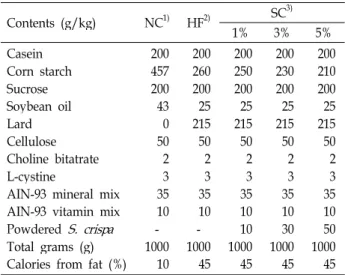
However, no studies have been performed to elucidate the anti-obesity properties of SC. The selected dosages were based on the previous study [3], which showed anti-obesity effect of edible mushrooms. In the present study, we de- termined SC’s pharmacological effects via dietary in- tegration with 1%, 3%, and 5% supplementation on mice
Table 1. Composition of the experimental diets Contents (g/kg) NC1) HF2) SC3)
1% 3% 5%
Casein Corn starch Sucrose Soybean oil LardCellulose Choline bitatrate L-cystine
AIN-93 mineral mix AIN-93 vitamin mix Powdered S. crispa Total grams (g) Calories from fat (%)
200 457 20043 500 23 35 -10 100010
200 260 20025 21550 23 35 -10 100045
200 250 20025 21550 23 35 1010 100045
200 230 20025 21550 23 35 1030 100045
200 210 20025 21550 23 35 1050 100045
1)Normal control diet
2)High-fat diet
3)High-fat diet with powdered S. crispa fed with a high-fat (HF) diets.
Materials and Methods
Sample collectionS. crispa was provided by Jeonnam Forest Resource Research Institute (Naju, Korea). It was freeze-dried and then ground into a powder.
Animal experiments
C57BL/6 mouse is quite susceptible to obesity on an HF diet [2]. In this present study, 6 week-old male C57BL/6 mice were obtained from DaHanBioLink Co., Ltd. (Eum- seong, Korea). They were individually housed in stainless steel cages in a room maintained at 22±2°C with 50-55% rel- ative humidity and 12 hr of light/dark cycle (light on at 08:00). The animals were fed a pelletized chow diet for 1 week. Then, they were randomly divided into 5 dietary groups (n=6). Two groups were fed either a normal control (NC) diet or a high-fat (HF, 45 kcal% fat) diet [11]. The oth- er three groups were given an HF diet supplemented with SC (1%, 3%, and 5%). The composition of the experimental diet was based on the AIN-93 semisynthetic diet [23] (Table 1). The mice were allowed free access to food and water during the 12-week experimental period. Food consumption checked twice a week and weight gain were measured weekly. All experimental procedures were approved by the Institutional Animal Care and Use Committee at Chung-
nam National University (CNU-00028).
Collection of serum, organs, and feces
At the end of the experiments, all animals were induced to fast for 12 hr. All mice were anesthetized by carbon dioxide. Blood was collected using a polyethylene tube with no heparin and centrifuged at 1,000× g for 15 min at 4°C to obtain the serum and stored at -70°C until analysis.
Selected organs, the liver, kidneys, spleen, brain, heart, testes, and visceral fat pad were weighed. Feces were col- lected during the final 3 days using metabolic cages, and dried feces were used for fecal lipid analysis.
Analytical procedures
The concentrations of total cholesterol (TC), triglyceride (TG) and high density lipoprotein cholesterol (HDL-C) in serum were determined using a commercial kit (Asan Pharmaceutical, Seoul, Korea). Hepatic and dried fecal lipid extractions were determined using a modified Tsuchidaet.
al. method [29]. Briefly, hepatic and dried fecal lipids were extracted by chloroform and methanol (2:1, v/v). The ex- tract was dried under N2 and weighted.
Histopathology
Liver and epididymal adipose tissues were preserved in a 10% buffered formaldehyde solution. They were proc- essed into paraffin blocks, sectioned at a nominal 5 μm, mounted on glass microscope slides and stained with hem- atoxyline and eosin using the autostainer (Autostainer XL, Leica, Germany).
Statistical analysis
All the results were expressed as means ± SD. All data were analyzed using the SPSS statistical software package, version 20. Differences between groups were analyzed us- ing one-way ANOVA followed by Duncan’s multiple range tests. A difference ofp<0.05 was regarded as being statisti- cally significant.
Results and Discussion
Body weight, food intake, and food efficiency Mean weights of the various groups were presented in Table 2. Initial body weights of experimental diet groups were similar in all groups, however, after 12 weeks, there was a significant body weight increase in the HF diet group.
Table 2. Effect of powderedS.crispasupplementation on body weight gain, food intake, and food efficacy ratio in mice fed with a high-fat diet
Group1) Initial weight (g) Final weight (g) Food intake (g/day) FER2) (%) NCHF
1% SC 3% SC 5% SC
24.75±3.711) 23.45±0.90 23.08±0.86 23.00±1.79 23.08±0.92
33.08±3.58b 40.15±6.09a 37.75±5.38a 32.58±3.35b 30.75±3.00b
2.78±0.08b 3.10±0.09a 2.66±0.05bc 2.50±0.08c 2.46±0.08c
3.57±0.11c 6.40±0.14a 6.57±0.19a 4.57±0.10b 3.70±0.12c
1)Values are expressed as means ± SD (n=6).
2)FER (food efficiency ratio) = (body weight gain / food intake) × 100
3)Different superscripts in the same column indicate significant differences between the groups (p<0.05).
Table 3. Effect of powdered S. crispasupplementation on organ weights fed with a high-fat diet
(g/100 g b.w.) NC HF 1% SC 3% SC 5% SC
Liver Spleen
Heart Brain Kidney Testicles
2.94±0.05ab 0.29±0.06 0.39±0.02 0.96±0.06a 1.04±0.09a 0.63±0.04a
3.23±0.15a 0.21±0.00 0.32±0.01 0.78±0.03b 0.86±0.02bc 0.52±0.03b
3.20±0.11ab 0.23±0.05 0.34±0.03 0.80±0.06b 0.77±0.04c 0.50±0.02b
2.77±0.93b 0.23±0.02 0.39±0.03 0.97±0.04a 0.95±0.05ab 0.66±0.02a
3.14±0.17ab 0.25±0.02 0.36±0.07 1.08±0.04a 1.00±0.03a 0.72±0.04a
1)Values are expressed as means ± SD (n=6).
2)Different superscripts in the same column indicate significant differences between the groups (p<0.05).
Consistent with previous study [26], the HF diet used in this study was effective in promoting obesity, which was demonstrated by increased adipose tissues in association with higher body weight. On the other hand, SC supple- mentation with an HF diet significantly suppressed body weight gain and food intake dose-dependently. The food ef- ficiency ratio (FER) in the HF group was significantly high- er than that of the NC group. 1% SC diet did not affect FER, however, the FER of 3% and 5% SC supplemented groups were significantly decreased compared to the HF group. It seems to be due to a high content of β-glucan causing swol- len or viscous activity [31]. β-glucan increases postprandial fullness and reduces food intake via increasing the viscosity of the bowel content. Consequently, food rich in dietary fi- bers may assist body weight management.
Organs weight
Organ weights were expressed as relative weight per body weight (mg / 100 g body weight) (Table 3). Relative weight of the liver increased in the HF group more than in the NC group, but not significantly. The 3% SC group showed a significant decrease compared to the HF group.
This might be explained that long-term ingestion of an HF diet leads to dyslipidemia, increased liver mass and hepatic steatosis [19]. The weights of the spleen and heart did not
differ between groups. The brain, kidney, and testicle weights were significantly lower in the HF group than in the NC group. However, the 3% and 5% SC supplemented groups had significantly increased brain, kidney, and tes- ticle tissue weights compared to the HF group.
Adipose tissue weight
As shown in Table 4, there was no difference in epi- didymal adipose tissue weight among groups. An HF diet ingestion for 12 weeks significantly increased retro- peritoneal and subcutaneous adipose tissues by 166% and 208%, compared to the NC group, respectively. However, SC supplementation decreased the amount of adipose tissue compared to the HF group in a dose-dependent manner.
Particularly, retroperitoneal and subcutaneous adipose tis- sue were decreased by 67% and 47% in the 5% SC group compared to the HF group, respectively, and were similar to those in the NC group. Consuming an HF diet increases adipocytes size and number, and changes fat deposition as compared to a balanced diet [30]. Moreover, it was reported that despite only an acute exposure to the HF diet for 9 days, these animals gained more weight and adipose tissue than the control diet [17].
Table 4. Effects of powdered S.crispasupplementation on white adipose tissue weight in mice fed with a high-fat diet (g/ 100 g b.w.) Group Epididymal fat Retroperitoneal fat Subcutaneous fat Adipocyte size % of NC
NCHF 1% SC 3% SC 5% SC
4.06±1.07 4.88±0.73 4.60±1.09 5.01±0.78 4.81±1.49
1.44±0.50b 2.39±0.49a 2.07±0.64ab 2.02±0.41ab 1.60±0.50ab
2.12±0.70c 4.40±1.06a 3.72±1.20ab 2.42±0.45ab 2.08±0.68ab
100.00±13.84b 126.24±24.37a 131.38±21.98a 141.71±24.44a 73.52±18.83c
1)Values are expressed as means ± SD (n=6).
2)Different superscripts in the same column indicate significant differences between the groups (p<0.05).
Table 5. Effects of powdered S.crispasupplementation on se- rum lipid profiles of mice fed with a high-fat diet Group Cholesterol
(mg/dL) Triglyceride
(mg/dL) HDL-cholesterol (mg/dL) NC
1% SCHF 3% SC 5% SC
177.44±8.97b 197.74±8.16a 193.93±5.73a 148.21±3.88c 122.56±1.58d
82.79±1.65b 101.02±3.19a 72.40±1.30c 58.21±2.67d 56.77±4.10d
89.50±11.69bc 93.78±8.11b 112.72±10.02a
83.51±2.43bc 79.21±6.19c
1)Values are expressed as means ± SD (n=6).
2)Different superscripts in the same column indicate significant differences between the groups (p<0.05).
Table 6. Effects of powderedS. crispasupplementation on fecal weight, fecal lipid, and liver lipid in mice fed with a high-fat diet
Group Fecal weight
(g/day) Fecal lipid
(mg/g) Liver lipid (mg/g) NC
1% SCHF 3% SC 5% SC
0.17±0.01ab 0.14±0.03b 0.14±0.01b 0.18±0.02a 0.19±0.01a
39.27±1.09d 85.27±1.20a 51.75±0.38c 65.90±0.82b 83.47±0.32a
129.22±18.5ab 189.62±15.07a 171.78±17.76a 151.43±21.60ab 102.12±21.49b
1)Values are expressed as means ± SD (n=6).
2)Different superscripts in the same column indicate significant differences between the groups (p<0.05).
Serum lipid profiles
Table 5 displayed serum TC, TG, and HDL-C level in dif- ferent groups. The HF diet group had elevated serum TC and TG level by 11% and 22% compared to the NC group, respectively. The 3% and 5% SC diet significantly lowered the serum TC level by 25% and 38% compared to the HF group, respectively. Moreover, SC supplementation with an HF diet significantly reduced serum TG level by 28%, 42%, and 44% compared to the HF group, respectively. There was no significant difference between the NC and HF group concerning HDL-C level. The 1% SC group showed the highest HDL-C value, while the 5% SC group exhibited the lowest HDL-C serum value. This result is inconsistent with Lee et al. [15]. However, Tirupathi Pichiah et. al. re- ported that obese mice fed 60 kcal% fat diet showed in- creased HDL-C serum value than those of normal control diet group [28]. It was also reported that no significant al- teration of the HDL-C level in the experiment to take soup containing 30 g dried oyster mushrooms on a daily basis for 21 days [24]. There maybe an indication that a higher dosage or oral administration route could improve HDL-C level. The hypocholesterolemic action of edible mushrooms has been reported in the early work [9]. The formation of viscous gels from soluble dietary fiber such as glucans
might contribute to inhibiting cholesterol and triglycerol ab- sorption [16]. Thus, SC may have an anti-obesity effect through the suppression of dyslipidemia and hepatostea
tosis in obese mice.
Fecal weight, fecal fat and liver lipid
As shown in Table 6, the HF group and 1% SC group showed decreased fecal weight compared to the NC group without statistical difference. However, the 3% and 5% SC group had significantly increased fecal weight by 129% and 136% compared to the HF diet, respectively. The mice fed with an HF diet showed a marked increase in the fecal fat compared with the NC group. The results of total fecal weight and fecal fat excretion in this study were also in agreement with previous study conducted on rats [6]. The 24 hr dry fecal weight and fecal fat in this study were pro- portional to dietary fiber levels. The increase in total fecal weight and fecal fat excretion may have been due to the fat binding capacity of β-glucan. The hypocholesterolemic effect of β-glucan has been explained that its binding with bile acids and their fecal excretion tend to lower cholesterol level in the body [14]. The HF diet ingestion caused the liv- er to accumulate a higher lipid content. The liver lipid level
Fig. 1. Hematoxylin and eosin-stained photomicrographs showing the liver. Fat accumulation, indicat- ed by the arrowhead, in the form of large fat droplet is pres- ent in liver of mice fed with an HF diet. NC, normal control di- et; HF, high-fat diet; SC, high- fat diet with powderedS. crispa
; Bar = 100 μm.
Fig. 2. Hematoxylin and eosin-stained photomicrographs showing the epididymal tissue. NC, normal control diet; HF, high-fat diet;
SC, high-fat diet with powdered S. cripsis ; Bar = 100 μm.
was 1.47 fold than that of the NC group. However, the 3%
and 5% SC group inhibited the accumulation of hepatic lip- id caused by an HF diet and the 5% SC group showed a markedly lower hepatic lipid level than that of the HF group.
Histopathology
High ratio of fat consumption accompanies excessive growth of adipose tissue in both cell number and cell size, and consequently induces fat accumulation. In the present study, mice fed with an HF diet developed hepatic steatosis (Fig. 1). However, SC supplementation within an HF diet significantly reduced the occurrence of fatty liver deposit and steatosis compared to the HF group. Especially, fat ac- cumulation in 5% SC was almost completely improved comparable to the NC group. Animal studies showed that an HF diet induced fatty liver or steatosis which is charac- terized by an excess accumulation of lipid, primarily tri-
acylglycerol within hepatocytes [18].
Microscopic epididymal adipose and the size of adipo- cytes were shown in Fig. 2 and Table 4, respectively. The epididymal adipose cell diameter in the HF group increased to 126.24% compared to the NC group. However, the 5%
SC treated group showed the smallest adipocytes among all the groups and decreased the epididymal adipose cell size by 61% compared to the HF group. These results showed that SC efficiently inhibited fat accumulation in liver and epididymal adipocyte tissues. Moreover, our results sub- stantiated the previous study that SC water extract en- hanced lipolysis and up-regulated the expression of lip- olytic enzymes such as CPT-1 and UCP-2 in differenciated 3T3-L1 cell [15].
In conclusion, the present study first evaluated the effect of SC on anti-obesity function in mice fed with a 45 kcal%
HF diet. Treatment with SC improved many parameters of an HF diet-induced obesity. Collectively, inhibition of fat
absorption and fat accumulation by SC are responsible for the reduction of fat accumulation in liver and adipocyte, which leads to recover liver function and lipid metabolism.
Therefore, SC appears to exert an anti-obesity effect through fat digestion inhibition.
Acknowledgement
This study was supported by Jellanam-do Forest Resource Research Institute, Republic of Korea.
References
1. Bray, G. A., Paeratakul, S. and Popkin, B. M. 2004. Dietary fat and obesity: a review of animal, clinical and epidemio- logical studies. Physiol Behav 83, 549-555.
2. Buettner, R., Schölmerich, J. and Bollheimer, L. C. 2007.
High-fat diets: modeling the metabolic disorders of human obesity in rodents. Obesity 15, 798-808.
3. Chandra, L. C., Smith, B. J., Clarke, S. L., Marlow, D., D'Offay, J. M. and Kuvibidila, S. R. 2011. Differential effects of shiitake- and white button mushroom-supplemented di- ets on hepatic steatosis in C57BL/6 mice.Food Chem Toxicol 49, 3074-3080.
4. Gonzalez-Castejon, M. and Rodriguez-Casado, A. 2011.
Dietary phytochemicals and their potential effects on obe- sity: a review. Pharmacol Res64, 438-455.
5. Grundy, S. M. 2000. Metabolic complications of obesity.
Endocrine13, 155-165.
6. Handayani, D., Meyer, B. J., Chen, J., Tang, P., Kwok, P.
C. L., Chan, H. K. and Huang, X. F. 2012. The comparison of the effect of oat and Shiitake mushroom powder to pre- vent body weight gain in rats fed high fat diet.Food Nutr Sci 3, 1009-1019.
7. Harada, T., Miura, N., Adachi, Y., Nakajima, M., Yadomae, T. and Ohno, N. 2002. Effect of SCG, 1,3-beta-D-glucan fromSparassis crispaon the hematopoietic response in cy- clophosphamide induced leukopenic mice.Biol Pharm Bull 25, 931-939.
8. Hasegawa, A., Yamada, M., Dombo, M., Fukushima, R., Matsuura, N. and Sugitachi, A. 2004.Sparassis crispaas bio- logical response modifier. Gan To Kagaku Ryoho31, 1761- 1763.
9. Hossain, S., Hashimoto, M., Choudhury, E. K., Alam, N., Hussain, S., Hasan, M., Choudhury, S. K. and Mahmud, I.
2003. Dietary mushroom (Pleurotus ostreatus) ameliorates atherogenic lipid in hypercholesterolaemic rats. Clin Exp Pharmacol Physiol 30, 470-475.
10. Hwang, C. R., Tak, H. M., Kang, M. J., Suh, H. J., Kwon, O. O. and Shin, J. H. 2014. Antioxidant and antiobesity ac- tivity of natural color resources. J Life Sci 24, 633-641.
11. Jeong, J. H., Park, H. G. and Lee, W. L. 2013. Effect of high-fat diet on peritoneal macrophage immunocom-
petence in C57/BL6 mice. J Life Sci 23, 779-788.
12. Karamadouk, L., Shivashankar, G. H., Ludeman, L. and Williams, A. J. 2009. An unusual complication of treatment with orlistat. Clin Nephrol 71, 430-432.
13. Kwon, A. H., Qiu, Z., Hashimoto, M., Yamamoto, K. and Kimura, T. 2009. Effect of medicinal mushroom (Sparassis crispa) on wound healing in streptozotocin-induced diabetic rat. Am J Surg197, 503-509.
14. Lazaridou, A. and Biliaderis, C. G. 2007. Molecular aspects of cereal β-glucan functionality: physical properties, tech- nological applications and physiological effects.J Cereal Sci 46, 101-118.
15. Lee, M. A., Park, J. K., Um, M. H., Jeon, J. W., Lee, J. M.
and Park, Y. K. 2012. Lipolytic effect of Sparassis crispaex- tracts in differentiated 3T3-L1 cells and high fat diet-in- duced obese mice. J Korean Soc Food Sci Nutr41, 1708-1715.
16. Marlett, J. A., McBurney, M. I. and Slavin, J. L. 2002.
Position of the American Dietetic Association: health im- plications of dietary fiber. J Am Diet Assoc102, 993-1000.
17. Melhorn, S. J., Krause, E. G., Scott, K. A., Mooney, M. R., Johnson, J. D., Woods, S. C. and Sakai R. R. 2010. Acute exposure to a high-fat diet alters meal patterns and body composition. Physiol Behav99, 33-39.
18. Nakamura, A. and Terauchi, Y. 2013. Lessons from mouse models of high-fat diet-induced NAFLD. Int J Mol Sci14, 21240-21257.
19. Neves, R. H., Alencar, A. C., Aguila, M. B., Mandarim- de-Lacerda, C. A., Machado Silva, J. R. and Gomes, D. C.
2006. Somatic, biochemical and hepatic alterations in wild type mice chronically fed high fat diet. Int J Morphol 24, 625-632.
20. Ogden, C. L., Yanovski, S. Z., Carroll, M. D. and Flegal, K. M. 2007. The epidemiology of obesity. Gastroenterology 132, 2087-2102.
21. Ohno, N., Miura, N. N., Nakajima, M. and Yadomae, T.
2000. Antitumor 1,3-beta-glucan from cultured fruit body of Sparassis crispa. Biol Pharm Bull 23, 866-872.
22. Petro, A. E., Cotter, J., Cooper, D. A., Peters, J. C., Surwit, S. J. and Surwit, R. S. 2004. Fat carbohydrate and calories in the development of diabetes and obesity in the C57BL/6J mouse. Metabolism53, 454-457.
23. Reeves, P. G. 1997. Components of the AIN-93 diets as im- provements in the AIN-76A diet. J Nutr 127, 838S-841S.
24. Schneidera, I., Kressela, G., Meyer, A., Krings, U., Berger, R. G. and Hahn, A. 2011. Lipid lowering effects of oyster mushroom (Pleurotus ostreatus) in humans.J Funct Foods3, 17-24.
25. de Simone, G. and D’Addeo, G. 2008. Sibutramine: balanc- ing weight loss benefit and possible cardiovascular risk.
Nutr Metab Cardiovasc Dis 18, 337-341.
26. Su, J. B., Rico, C. W., Um, I. C. and Kang, M. Y. 2012.
Hypoglycemic and antioxidative effects of hydroxylethyl methylcellulose in mice fed with high fat diet.Food Chem Toxicol 50, 1716-1721.
27. Tada, R., Harada, T., Nagi-Miura, N., Adachi, Y., Nakajima, M., Yadomae, T. and Ohno, N. 2007. NMR characterization
초록:고지방식이로 유도한 비만 흰쥐에 대한 꽃송이 버섯의 항비만 효과 이미라1․하지강1․샤나즈베검1․왕운보1․오득실2․위안진2․윤병선2․성창근1* (1충남대학교 식품공학과, 2전라남도 산림자원연구소)
본 연구는 고지방식이로 유도한 비만 흰쥐에 대한 꽃송이 버섯의 항비만 효과를 관찰하였다. 6주령 수컷 C57BL/6 마우스를 이용하여 칼로리의 45%를 지방으로 구성한 고지방식이를 이용하여 비만을 유도하였으며, 대
조군은 정상식이를 제공하였다. 처리군은 고지방 식이에 꽃송이 버섯 분말을 1%, 3%, 5% 수준으로 첨가하여 12주
간 제공하였다. 체중, 식이섭취, 장기무게, 내장지방, 혈청지질, 변무게 및 변지방, 간지방, 조직병리실험을 실시하
였다. 고지방식이 섭취군은 체중, 식이섭취, 피하지방 및 복막하지방, 혈청 콜레스테롤 및 중성지방농도, 변지방,
간지방, 부고환지방 조직의 지방세포 크기가 증가하였다. 그러나 고지방식이에 꽃송이 버섯 분말을 첨가한 실험군
에서는 체중증가, 식이섭취 및 식이효율, 간 콜레스테롤 함량, 내장지방 무게가 꽃송이 버섯 첨가량에 따라 감소하
였다. 특히, 5% 꽃송이버섯 첨가군은 간세포의 지방축적과 지방간 현상이 현저히 개선되었으며, 부고환 지방조직
에서의 지방세포 크기도 현저히 감소하였다. 본 연구결과를 통하여 볼 때, 꽃송이 버섯은 뛰어난 항비만 효과를
가지고 있어, 비만 조절을 위한 기능성 식품으로의 이용이 가능할 것으로 사료된다.
of the structure of a beta (1→3)-D-glucan isolate from cul- tured fruit bodies of Sparassis crispa. Carbohydr Res 342, 2611-2618.
28. Tirupathi Pichiah, P. B., Moon, H. J., Park, J. E., Moon, Y.
J. and Cha, Y. S. 2012. Ethanolic extract of seabuckthorn (Hippophae rhamnoides L) prevents high-fat diet-induced obesity in mice through down-regulation of adipogenic and lipogenic gene expression. Nutr Res32, 856-864.
29. Tsuchida, T., Fukuda, S., Aoyama, H, Taniuchi, N., Ishihara, T., Ohashi, N., Sato, H., Wakimoto, K., Shiotani, M. and Oku, A. 2012. MGAT2 deficiency ameliorates high-fat di- et-induced obesity and insulin resistance by inhibiting in- testinal fat absorption in mice.Lipids Health Dis 11, 75-84.
30. Votruba, S. B., Mattison, R. S., Dumesic, D. A., Koutsari, C. and Jensen, M. D. 2007. Meal fatty acid uptake in viscer
al fat in women. Diabetes56, 2589-2597.
31. Huth, M., Dongowski, G., Gebhardt, E., and Flamme, W.
2000. Functional properties of dietary fibre enriched ex-trudates from barley. J Cereal Sci 32, 115-128.
32. Woods, S. C., D'Alessio, D. A., Tso, P., Rushing, P. A., Clegg, D. J., Benoit, S. C., Gotoh, K., Liu, M. and Seeley, R. J. 2004. Consumption of a high-fat diet alters the homeostatic regulation of energy balance.Physiol Behav83, 573-578.
33. Yao, M., Yamamoto, K., Kimura, T. and Dombo, M. 2008.
Effects of Hanabiratake (Sparassis crispa) on allergic rhinitis in OVA-sensitized mice. Food Sci Technol Res14, 589-594.
34. Yun, J. W. 2012. Possible anti-obesity therapeutics from nature. Phytochemistry 71, 1625-1641.