197
Anti-obesity Effect of Monascus pilosus Mycelial Extract in High Fat Diet-induced Obese Rats
Sang-Il Lee1, Jae-Won Kim2, Ye-Kyung Lee3, Seung Hwan Yang3, In-ae Lee3, Joo-Won Suh3*, and Soon-Dong Kim3*
1Departent of Food, Nutrition and Culinary Arts, Keimyung College, Daegu 704-703, Republic of Korea
2Faculty of Food Science and Industrial Technology, Catholic University of Daegu, Gyeongsan 712-702, Republic of Korea
3Division of Bioscience and Bioinformatics, College of Natural Science, Myongji University, Cheoin-gu, Yongin, Gyeonggi-Do 449-728, Republic of Korea.
Received September 3, 2011; Accepted September 3, 2011
This study was carried out to investigate the dietary effects of Monascus pilosus mycelial extract on obesity in high-fat with cholesterol-induced obese rat models. It was observed that M. pilosus mycelial extract contains 25.85±1.98 mg% of total monacolin K without citrinin by high- performance liquid chromatography (HPLC). The rats were randomly divided into 2 groups;
normal control and a high-fat with cholesterol diet group. The high-fat with cholesterol diet group was fed a 5L79 diet with an added 15% lard and 1% cholesterol supplemented diet for 3 weeks for induction of obesity. After induction, obesity was confirmed by checking obesity indexes, the animals were divided into 4 groups (n=5); first, the normal control (NC), and then taken from the obese model of rats, a high-fat with cholesterol diet obesity control group (HF), 0.5% M. pilosus mycelial extract supplemented high-fat with cholesterol diet group (MPMs), 2% conjugated linoleic acid supplemented high-fat with cholesterol diet group (CLA) for 7 weeks. Body weight gains, obesity indexes, and body fat contents in the experimental groups (MPMs and CLA) were decreased compared with HF group. Feed Efficiency Ratio (FER) in MPMs was significantly lower than that of HF without change of feed intake. These results suggested that the anti-obesity effects of the M. pilosus mycelial extracts (MPMs) could prevent obesity induced by high-fat with cholesterol diet possibly via inhibition of lipid absorption.
Key words: conjugated linoleic acid, high-fat with cholesterol diet, Monascus pilosus mycelial extract, obe- sity, reactive oxygen species scavenging enzyme activities
Introduction
Worldwide, the dietary lifestyle has changed to the western- style diet containing a high level of fat and calories [Won et al., 2007]. It is well known that excessive intakes of high caloric western-style food are closely related with metabolic syndrome including obesity, hyperlipidemia, hypertension, atherosclerosis and diabetes [Lew, 1985; Hill et al., 1992]. It is well known that obesity is a condition of excessive fat accumulation in the body caused by energy imbalance through a high-calorie diet intake
such as high-fat diet, deficient energy consumption, or genetic susceptibility. Many studies suggest that obesity is thought to be a definite risk factor for serious diseases such as cardiovascular disease, diabetes, non-alcoholic fatty liver, certain cancers, dementia, and osteoarthritis [Kopelman, 2000; Wellen and Hotamisligil, 2005]. It is well documented that hyper- cholesterolemia causes ischemic heart disease and atherosclerosis, and despite the advanced medical technology, cardiovascular diseases have still been one of the most important cause of mortality [Song and Son, 2008].
According to a recent report from the International Obesity Task Force (IOTF), it was estimated that 1.7 billion people, which is a quarter of the world population, must be classified overweight or obese [Friedrich, 2002]. In the past 10 years between 1990 and 2001, obese Koreans over 25 kg/m2 (BMI) increased 2 folds from 16.7% to 30.6%, respectively [Lee and Cho, 2005]. And by the report of National Health and Nutrition Examination Survey, obese adults over 20 years of age in Korea have increased to 31.7%, annually [Ahn et al., 2007].
J. W. Suh* and S. D. Kim* contributed equally.
*Corresponding authors
Phone: 82-31-330-6190; Fax: 82-31-336-0870 E-mail: [email protected] (Soon-Dong Kim) Phone: 82-31-330-6190; Fax: 82-31-336-0870 E-mail: [email protected] (Joo-Won Suh) http://dx.doi.org/10.3839/jabc.2011.033
Red mold rice fermented by the species of Monascus has been used as a traditional foodstuff for therapy for diarrhea, indigestion, and women's diseases in Asian countries [Ma et al., 2000]. Furthermore, it is reported that species of Monascus have produced statin related compounds including monacolin K, mevinolin and lovastatin, which inhibit cholesterol biosynthesis [Endo, 1980] and stimulate bone formation and decrease bone fracture [Edwards et al., 2000]. Recently, many studies reported that red pigments such as rubropuntain and monascorubin, and yellow pigments such as monascin and ankaflavin, and purple pigment such as rubropunctamine and monascorubramine derived from species of Monascus, [Ma et al., 2000; Pyo and Lee 2007] have antibacterial and anticancer effects [Birch et al., 1962]. Especially, it is well known that monacolin K have various pharmacological activities on fungal infection, hyper- glycemia, hypertension, hypercholesterolemia and certain cancer [Kiyoshi et al., 1995; Yasukawa et al., 1996; Martinkova et al., 1999]. On the other hand, Yu et al. [2003] found that has been used to prepare red fermented rice (anka, red koji) have anti- obese effect. It is widely accepted that Monascus have various pharmacological effects due to fermentation products by species of Monascus on steamed rice [Kim et al., 2010]. However, the anti-obesity effect of Monascus mycelial extract has not been clearly demonstrated.
Therefore, we investigated the anti-obesity effect of M. pilosus mycelial ethanol extract on the body weight gain, obesity indexes, and serum, hepatic and fecal lipid contents in the high- fat with high cholesterol diet induced obese rats and compared with commercial CLA (conjugated linoleic acid).
Materials and Methods
Strains and growth conditions. The strain, M. pilosus KCCM 60084, used for the experiments was purchased from Korean Culture Center for Microorganisms (KCCM, Seoul, Korea).
The strain was maintained on Mizutani medium (5.0 g glucose, 2.0 g peptone, 0.8 g KH2PO4, 0.05 g MgSO4· 7 H2O, 0.2 g CH3COOK, 0.1 g NaCl made up in 100 mL distilled water, pH 6.0) [Youn et al., 2003] slanted at 10oC and transferred monthly. Seed cultures were prepared by transferring a loopful of spore from the Mizutani agar slanted into a 500-mL Erlenmeyer flask containing 100 mL basal Mizutani medium.
The cultures were incubated at 30oC for 3 days at 150 rpm. After that 5% inoculum (v/w) was transferred for solid state fermentation.
Quantitative analysis of monacolin K and citrinin contents. Monacolin K in the M. pilosus mycelial was extracted with 75% ethanol by the method of Roman and Vladimir [1993]. After centrifuging for 10 min at 10,000 rpm, and
filtering through a 0.45µm filter, the supernatant was directly applied for high-performance liquid chromatography (HPLC) analysis of monacolin K and citrinin analysis was carried out as described by Reinhard and Zimmerli [1999]. HPLC analysis was carried out using Agilent Technologies series 1200 HPLC (UV-237 detector; Palo Alto, CA) equipped with a Waters 120 ODS-AP column (5µm, 4.6×150 mm).
Standard monacolin K (lovastatin lactone form, Sigma- Aldrich, St. Louis, MO) was dissolved in 75% ethanol solution and acid form of standard monacolin K was dissolved in 2 mL of 75% ethanol solution, and let stand for 30 mins at room temperature after addition of 0.5 mL of 0.05 N sodium hydroxide solution. The concentration of acid and lactone form of monacolin K in sample were calculated using formula from the standard calibration curve; y=69576.81x−19.36 and y=
54904.07x+15.96, respectively. The 1 mg of citrinin (Sigma- Aldrich) was dissolved in 1 mL of methanol solution. The concentration of citrinin in sample was calculated using formula from the standard calibration curve; y=81097.48×−15.97.
Animal experiment and diets. Male Sprague-Dawley rats (150±5 g) were supplied by Oriental Co. Ltd. (Busan, Korea).
The rats were fed standard diet (5L79 diets, PMI Nutrition, Brentwood, MO) and acclimatized to the environment for 1 week before commencement of the experiments. The rats were randomly divided into 2 groups, normal control (n=5) and obese group (n=15). The high-fat and high-cholesterol diet group was fed a standard pellet chow with an added 15% lard and 1%
cholesterol supplemented diet for 3 weeks for induction of obesity. After obesity was confirmed by checking obesity indexes, the animals were divided into 3 groups (5/group), high- fat (HF) and obese group diet, 0.5% mycelial ethanol extract mixed with high-fat and high-cholestrol diet (MPN), 2%
conjugated linoleic acid (Natural ASA, Sandvika, Norway) high-fat and high-cholestrol diet (CLA) group for 7 weeks as given in Table 2. The rats were individually housed in stainless steel wire-bottom cages in a room maintained at 20±2oC and 60±5% relative humidity. The room was exposed to alternating 12-h periods of light and dark. The experimental protocols were conducted in accordance with internationally accepted principles for laboratory animal use and care as found in the Korea food and drug administration (KFDA) guidelines.
Feed Intakes, weight gain, and feed efficiency ratio. Body weight and feed intake were measured every day at the same hour during all experimental periods. The feed efficiency ratio (FER) was calculated as daily weight gain (g)/daily dietary intake (g).
Obesity index. In order to calculate the obesity index, the length from the tip of the nose to the anus and body weight of rats were measured every week according to Kim and Sung [2001] during experimental periods. The Rõhrer and Lee index
[Dubuc, 1981], and TM index [Tsuchimoto et al., 1992] were calculated for the obesity index. And the content of body fat was estimated using TM index [Tsuchimoto et al., 1992].
Rõhrer index={Body weight (g)/Naso-anal length (cm)3}×103 Lee index={Body weight (g)1/3/Naso-anal length (cm)}×103 TM index=Body weight (g)/Naso-anal length (cm)2.823×10³ Body fat content=0.581×TM index-22.03
Preparation of analytical samples. After 7 weeks on the experimental diets, rats were fasted for 24 h, and blood was collected from the abdominal aorta while being under anesthetic with ether. The liver was exhaustively perfused with cold physiological saline solution through the portal vein and quickly removed. Liver was rinsed with cold physiological saline and homogenized with 0.25 M sucrose by using a biohomogenizer.
The collected blood was centrifuged at 2,500 rpm for 10 mins at room temperature and the separated serum and hepatic homogenate were kept frozen at −70oC.
Biochemical Analysis. Content of triglyceride, total cholesterol and (High-density lipoprotein (HDL)-cholesterol in serum were measured by using commercial kit reagents (AM 157S-K, AM 202-K, AM 203-K, Asanpharm Co., Seoul, Korea). The content of Low-density lipoprotein (LDL)- cholesterol was calculated by using the method of Friedewald et al. [1972]. The Atherogenic index (AI) was calculated from (total cholesterol-HDL-cholesterol)/total-cholesterol]. Hepatic and oven-dried fecal lipid was extracted by the method of Folch et al. [1957]. After removal of extracted solvent, the hepatic and fecal total lipid was measured according to the procedure of Frings and Dunn [1970]. And the hepatic and fecal triglyceride and cholesterol were measured by using commercial kit (AM 157S-K, AM 202-K, Asanpharm Co.).
Statistical analysis. Samples were measured in triplicate and the main treatment effects were analyzed by Duncan’s multiple range test after one-way analysis of variance (ANOVA) using the general linear model procedure of SPSS (Statistical Package for Social Sciences, Ver. 12, SPSS Inc., Chicago, IL) software package. The significance level was set at p <0.05. Data were expressed as means ± SD.
Results and Discussion
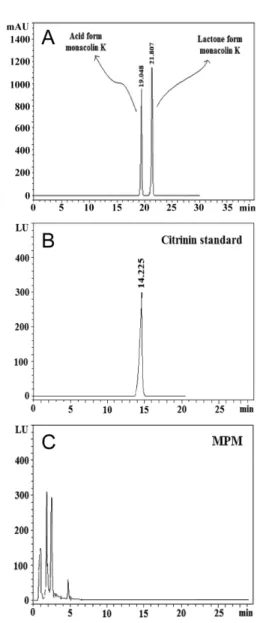
The content of monacolin K and citrinin. Figure 1 show the HPLC chromatograms of the active acid form and non-active lactone form of monacolin K standard (A), citrinin standard (B), and freeze dried M. pilosus mycelial ethanol extract (C). And Table 1 shows contents of monacolin K and citrinin in M.
pilosus mycelial ethanol extract (MPM).
It is revealed that retention time (Rt) of active form and non- active form of monacolin K standard is 19 min and 21 min,
respectively, and Rt of citrinin standard is 14 min. The active form content of monacolin K (3.3 mg%, dry basis) in MPM sample is lowered than that of non-active form (25.85 mg%, dry basis), and the content of total monacolin K is 25.85 mg% (dry basis) (Fig. 1). However, the content of citrinin in MPM was not detected (Table 1).
It is reported that active acid form of monacolin K coexisted with non-active form in red-yeast rice [Juzlova et al., 1996].
Fig. 1. HPLC chromatograms of standard monacolin K (A), citrinin (B), and M. pilosus mycelial ethanol extract (MPM; C).
The compounds were identified by comparing the retention time (RT) with that of the standard compound.
Table 1. Monacolin K and citrinin contents of M. pilosus mycelial ethanol extracts mg% (dry basis)
Monacolin K
Citrinin Acid form Lactone form Total
3.38±0.82b,1) 22.47±1.65a 25.85±1.98a ND2)
1)Values are mean ± standard deviations of triplicate determinations, and different superscripts within a row (a-b) indicate significantly different at p <0.05.
2)Not detected.
Furthermore, non-active form is converted to active form by cellular enzyme, and active form of monacolin K inhibits 3- hydroxy-3-methylglutaryl-coenzyme A (HMG) Co-A reductase
which is rate-limiting enzyme in cholesterol biosynthesis [Manzoni & Rollini, 2002]. The above results show that MPM does not contain citrinin, which is strictly prohibited in foods.
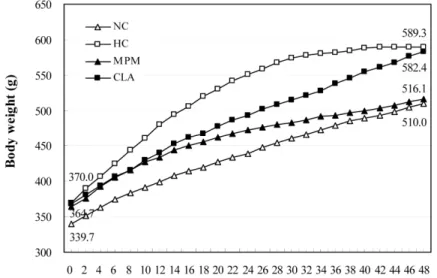
Weight gain, feed intakes, FER, and fecal weight. After the induction of obesity, animals were fed with experimental diet (Table 2) for 7 weeks, and subsequently, body weight gain, feed intakes, FER, and fecal weight were examined (Fig. 2 and Table 3). Body weight in NC was gradually increased according to the experimental period. While, body weight in HF was rapidly increased during 4 week, those of HF were gradually increased after 4 weeks. Although, body weight in CLA was lower than that of HF during 5 weeks, those of CLA was similar with HF at 7 week. Whereas body weight in MPM was similar with CLA during 2 weeks and then that was significantly retarded after 2 weeks. And that was similar with NC at 7 week. In addition, mean weight gain per day in MPM (3.09 g) and CLA (4.38 g) were lower 31.03% and 2.24%, respectively than those of HF (4.48 g), However, mean feed intakes per day in HF and MPM (23.01~24.91 g) were not significant compared to the NC (29.60 Table 2. Compositions of high-fat diet used to induce in laboratory
animals
Ingredients Experimental groups
NC HF MPM CLA
Pellet stew (5L79 diets)1) 100 83.75 83.25 81.75
Lard - 15.00 15.00 15.00
Cholesterol - 1.00 1.00 1.00
Sodium chlorate 0.25 0.25 0.25
Freeze dried ethanol extracts of MPM - - 0.50 -
CLA - - - 2.00
NC, normal control group; HF, high fat and high cholesterol diet group;
MPM, freeze dried M. pilosus mycelial ethanol extracts 0.5%
supplemented diet group; CLA, conjugated linoleic acid 2%
supplemented diet group.
1)The diets for animal experiments manufactured in the PMI Nutrition, LLC, PO Box 19798, Brentwood MO 63144, USA. Guaranteed analysis: crude protein, 18%; crude fat, 5%; crude fiber, 5%; ash, 8%.
Fig. 2. Effects of M. pilosus mycelial ethanol extracts on the changes in body weight of obese rats fed high fat with cholesterol diets for 7 weeks. Abbreviations: NC; normal control group, HF; high fat and high cholesterol diet group, MPM; freeze dried ethanol extracts of M. pilosus mycelium (MPM) 0.5% supplemented diet group, CLA; conjugated linoleic acids 2% supplemented diet group. Values are mean of 5 rats.
Table 3. Effects of M.pilosus mycelial ethanol extracts on the weight gain, feed intakes, feed efficiency ratio and weight of feces in obese rats fed high fat with cholesterol diet for 7 weeks
Measurements Experimental groups
NC HF MPM CLA
Initial weight (g) 339.70±9.93b,2) 370.00±4.16a 364.70±7.93a 368.00±13.30a
Final weight (g) 510.00±14.30b 589.30±16.05a 516.10±13.57b 582.40±15.36a
Weight gain (g/day) 003.48±0.34b 004.48±0.41a 003.09±0.40b 004.38±0.51a
Feed intake (g/day) 029.60±2.01a 024.91±2.11b 023.01±1.15b 023.33±1.35b
FER1) 000.12±0.02b 000.18±0.03a 000.13±0.01b 000.19±0.02a
Feces (g/day, wet basis) 010.23±0.60NS,3) 009.98±0.39a 010.55±0.58a 010.08±0.76a
1)Feed efficiency ratio: daily weight gain/daily feed intake.
2)Values are mean ± SD of 5 rats, different superscripts in the same row indicates significant differences (p <0.05).
3)NS: not significant.
g). While, FER in MPM (0.13) was slightly lower than those of HF and CLA (0.18~0.19), fecal weight in all experimental groups were not significantly different.
Many studies reported that conjugated linoleic acid (CLA), which is widely distributed in nature, could have anti- mutagenicity, anti-cancer, anti-hypertension and anti-dibetic effect, and anti-obese effect via inhibition of body fat [Ip and Scimeca 1997; Munday et al., 1999; Park et al., 1999]. On the other hand, immunostimulatory response growth factor-induced catabolic response is decreased by CLA [Miller et al., 1994].
Decreased catabolic response may stimulate growth and FER [Benson et al., 1993], but body weight and FER animals fed CLA supplemented diet was higher than that of normal diet group animal [Park et al., 1999]. Moreover, dietary effects of CLA were different according to the sex, age and experimental period [Sisk et al 2001]. In this study, dietary effect of body weight reduction in CLA is in similar with Park et al. [1999].
Furthermore, these results indicated that higher reduction rate of body weight in MPM group without significantly affecting feed intakes may be caused by improvement of indigestion and anti- obesity effect [Li et al., 1998]. However, more detailed work is required on antiobese effect of the M. pilosus mycelial extract in
vivo systems to determine their exact mechanism of action.
Obesity indexes. Figure 3 show changes in Rõhrer index, TM index, Lee index, and Fat content of obese rats fed with MPM supplemented high fats with cholesterol diets during 7 weeks feeding. In this study, we observed Rõhrer index (over 30), Lee index (over 300) and TM index (over 55) in animals fed with high fat with cholesterol diet for 3 weeks for the induction of obesity.
It is well known that obesity is confirmed in the case of a Rõhrer index of over 30, a Lee index of over 300, and a TM index of over 55 [Kim and Sung, 2001]. Therefore, we could confirm that the experimental animals had become an obesity model by high-fat with high-cholesterol diet feeding for the 3 weeks. In this experimental condition, we observed the dietary effects of experimental diets on the obese animal model.
In the initial experiments, the Rõher index in all experimental groups was not significantly different. After 7 weeks, the Rõher index of HF (33.43) was higher than that of NC (22.53).
Furthermore, that of MPM (27.79) and CLA (29.23) was lower than that of HF. Moreover, the TM index in NC before experimental diet feeding was 44.70, that of HF, MPM and CLA was 55.14~55.23. After 7 weeks, the TM index of NC and HF Fig. 3. Changes in Rõhrer index, TM index, Lee index and body Fat content of obese rats fed with M. pilosus mycelial ethanol extracts supplemented high fat with cholesterol diets during feeding. Abbreviations: See Table 2. Values are mean ± standard deviations of 5 rats, different superscripts indicates significant differences (p <0.05).
continuously increased to 48.29 and 59.77, respectively. In contrast, MPM and CLA decreased to 49.89 and 52.67, respectively. On the other hand, the Lee index in NC, and HF, MPM and CLA before experimental diet feeding was 293.81, and 311.97~312.86 respectively. Whereas, that in NC and HF after 7 weeks was increased 299.42 and 321.34 respectively, that in MPM and CLA was decreased 302.23 and 307.39 respectively.
Moreover, although slight difference, the content of body fat in all experimental groups showed similar tendency of other obese indexes changes. While, body weight and obese indexes in MPM was reduced in spite of continuous high-fat with high- cholesterol diet, obese indexes in CLA group was reduced without body weight reduction (Fig. 2).
Park and Kang [2003] reported that Rõher index is increased according to duration of high-fat diet and degree of obesity. It is well known that anti-obese effect of CLA is due to increment of heparin-releasable lipoprotein lipase (HSL) activity and stimulation of lipid degradation in adipose tissue [Pariza et al., 2000]. It was reported that this effect of CLA is due to reduction of fat cell numbers, body fat, inhibition of preadipocytes growth and differentiation, inhibition of free fatty acid and triglyceride biosynthesis, and increment of energy expenditure in adipose tissues [Bee, 2000]. However, DeLany and West [2000] reported that accumulation of fat and lipid oxidation is increased by CLA.
On the other hand, Sisk et al. [2001] reported that feed intakes and growth rate in SD female rat was not affected by feeding of 0.5% CLA supplemented diet. In addition, Sisk et al. [2001]
reported that body fat in SD male rat was not affected by diet of 12% triglyceride supplemented with 1% CLA for 4 weeks.
Wahle et al. [2004] suggests different effect of body reduction by CLA may be according to the species of animals, and different lipid metabolism in liver and adipose tissues.
Thus above results indicated that reduction of obese indexes, adipose tissues, serum and hepatic lipid profile, and increment of excretion of fecal lipid in MPM group may prevent obesity due to stimulation of lipid degradation and lipid excretion.
Weight of liver and adipose tissue. Table 4 shows the effects of MPMs on the weight of liver and body fat such as perirenal and epididymal adipose tissue in obese rats fed high fats with cholesterol diet for 7 weeks. The liver weight per body weight (relative liver weight) in HF was markedly higher (1.70 fold)
than that of NC, whereas, that in MPM was significantly higher (1.51 folds) than that of NC, these in HF and CLA group higher (1.09~1.13-folds) than that of MPM. Furthermore, the weight of perirenal adipose tissue in HF was markedly higher (2.05 folds) than that of NC. While that in MPM and CLA was higher (1.44~1.89 folds) than that of NC, that in CLA was higher (1.31 folds) than that of MPM. And that of CLA was not significantly different from HF. Additionally, although slight difference of degrees, the weight of epididymal adipose tissue in all experimental groups showed similar tendency to perirenal adipose tissue weight changes.
These results suggest that M. pilosus mycelial ethanol extract may ameliorate and/or prevent obesity without inhibition of feed intakes.
Serum lipid profile. Table 5 shows the levels of serum lipid in obese rats fed high fats with cholesterol diet for 7 weeks. The content of serum triglyceride in HF was higher (1.12 folds) compared with NC. While, the level of triglyceride in MPM was lower (24%) than that of NC, those of MPM was not significantly different from CLA. However, that of CLA was not significantly different from NC. Moreover, the level of total cholesterol in MPM and CLA was lower 11.94~20.23% than that of HF, while that of CLA was higher (1.23 folds) than that of NC. However, that of MPM was not significantly different from NC. On the other hand, although slight difference, the levels of LDL-cholesterol and atherogenic index in all experimental groups were similar tendency of total cholesterol changes. On the contrary, HDL-cholesterol in HF was significantly lower (14.64~19.30%) than those of MPM and NC.
Whereas, that of MPM was not significantly different from NC and CLA, that of CLA was lower (13.27%) than that of NC.
It was well documented that serum cholesterol and transport of cholesterol (TG) is transported by lipoprotein, and three quarter of serum cholesterol is contained as LDL, which is related to the occurrence of atherosclerosis [Gordon et al., 1981].
Nicolosi et al. [1997] reported that intake of CLA may prevent antherosclerosis via inhibition of serum LDL-cholesterol.
Furthermore, Lee et al. [1994] confirmed that the levels of total cholesterol, LDL-cholesterol and TG, and the ratio of total cholesterol/HDL-cholesterol as atherogenic index in rabbit fed CLA supplemented diet for 12 weeks were markedly decreased Table 4. Effects of M. pilosus mycelial ethanol extracts on liver weight and adipose tissue lipid content of obese rats fed high fat with cholesterol diet for 7 weeks (g/100 g body weight)
Organs Experimental groups
NC HF MPM CLA
Liver 02.56±0.06c,1) 4.35±0.07a 3.86±0.30b 4.22±0.53ab
Perirenal 1.84±0.40c 3.78±0.19a 2.65±0.48b 3.48±0.27a
Epididymal 1.61±0.30b 2.27±0.21a 01.80±0.22ab 2.09±0.26a
1)Values are mean ± SD of 5 rats, different superscripts in the same row (a-c) indicate significant differences (p <0.05).
compared to the control. And, Park et al. [1997] found that CLA may regulate the level of serum TG via increment of carnitine palmitoyltrasferase-I (CPT-I), which is the rate-limiting enzyme of fatty acid β-oxidation in adipose tissue and skeletal muscle.
Pariza et al. [2000] reported that CLA may inhibit obesity due to reduction of serum TG via induction of heparin-releasable lipoprotein lipase (HSL) and stimulation of norepinephrine- induced lipid degradation in adipose tissue, although action mechanism is not clear. Yu et al. [2003] reported that the level of HDL-cholesterol in rat fed 2% red-yeast rice supplemented diet was increased, while the level of LDL-cholesterol and atherogenic index was significantly decreased. And, many studies revealed that the levels of total cholesterol, LDL- cholesterol and TG by the administration of red-yeast rice in clinical test were significantly decreased without side effects [Li et al., 1998; Heber et al., 1999]. It is well known that M. pilosus could produce monacolin K, which is a strong inhibitor of cholesterol biosynthesis [Kroon et al., 1982]. Especially, it is reported that monacolin K could reduce the level of serum cholesterol in severe hypercholesterolemic patients [Arad et al., 1990]. Therefore, above results implied that MPM which contains monacolin K produced by M. pilosus could reduce the serum lipid level possibly by the inhibition of HMG-CoA reductase.
Hepatic lipid profile. Table 6 shows the hepatic lipid profile in obese rats fed high fats with cholesterol diet for 7 weeks. The level of hepatic total lipid in HF was markedly higher (1.47 folds) than that of NC. Although, hepatic total lipid level in CLA and MPM was significantly lower (12.69~20.56%) than that of
HF, that of MPM was lower than that of CLA. Additionally, that of MPM and CLA was higher (1.17~1.28 folds) than that of NC.
And, TG level in HF was higher (1.44 folds) than that of NC.
That of MPM was significantly lower (19.18%) than that of HF, while that of MPM was higher (16.16%) than that of NC. On the other hand, that of CLA was slightly lower than that of HF.
Moreover, hepatic total cholesterol in HF was extremely high (3.25 folds) than that of NC. Whereas that of CLA and MPM was significantly lower (29.54~50.77%) than that of HF, that of MPM and CLA was markedly higher (1.60~2.29) folds than that of NC and that of MPM was significantly lower (30.13%) than that of CLA.
It is well known that lipid metabolism is highly associated with the liver and insufficient removal of biosynthesized TG in the liver may induce fatty liver via accumulation of TG [Schaefer et al., 1995]. These are in agreement with Lee et al.
[2006] that the levels of hepatic total lipid, cholesterol and TG in rat fed high-fat diet. Results of hepatic TG in this study suggests that M. pilosus mycelial ethanol extract may regulate hepatic and serum TG level due to increment of fecal lipid excretion via retardation and/or inhibition of intestinal absorption.
Furthermore, Kang et al. [2003] reported that inhibition of bile acid reabsorption may prevent hypercholesterolemia via control of endogenous cholesterol.
Therefore, markedly decreased hepatic total cholesterol content in MPM suggests that M. pilosus mycelial ethanol extract could ameliorate the hypercholesterolemia via inhibition of bile acid reabsorption.
Fecal lipid content. Table 7 shows the fecal weight and the Table 5. Effect of Monascus pilosus mycelial ethanol extracts on serum lipids content in obese rats fed high fat with cholesterol diet for 7 weeks
Measurements Experimental groups
NC HF MPM CLA
Triglyceride (mg/dL) 0074.59±6.49ab,3) 083.79±7.67a 56.70±8.42c 68.89±6.12bc
Total cholesterol (mg/dL) 115.75±6.55c0 162.31±7.05a 0129.48±7.87bc0 142.93±6.53b00
HDL-cholesterol (mg/dL) 55.91±2.65a 045.12±2.15c 052.86±1.72ab 48.49±1.47bc.
LDL-cholesterol (mg/dL)1) 44.92±3.45d 109.43±5.92a 65.28±3.86c 80.66±4.75b0
Atherogenic index2) 01.07±0.12d 002.60±0.16a 01.45±0.15c 1.95±0.13b
1)LDL-cholesterol content=total cholesterol−(triglyceride/5+HDL-cholesterol)
2)Altherogenic index=(Total cholesterol−HDL-cholesterol)/HDL-cholesterol
3)Values are mean ± SD of 5 rats, different superscripts in the same row (a-b) indicate significant differences (p <0.05).
Table 6. Effect of M.pilosus mycelial ethanol extracts on hepatic lipids content in obese rats fed high fat with cholesterol diet for 7 weeks (unit: mg/g tissue)
Measurements Experimental groups
NC HF MPM CLA
Total lipid 064.24±4.96d,1) 94.59±5.28a 75.14±2.97c 82.59±3.43b
Triglyceride 32.54±2.49c 46.77±4.31a 37.80±2.32b 40.11±2.90ab
Total cholesterol 10.14±0.68d 32.97±3.31a 16.23±2.33c 23.23±2.32b
1)Values are mean ± SD of 5 rats, different superscripts in the same row(a-d) indicate significant differences (p <0.05).
level of fecal lipid in obesity rats fed high fats with cholesterol diet for 7 weeks. Daily fecal weight in all experimental groups was not significantly different. On the other hand, the content of fecal total lipid in HF was higher (1.18 folds) than that of NC.
Furthermore, while, the content of fecal total lipid in CLA and MPM was markedly higher (1.21 to 1.41 folds) than that of HF, that of MPM was higher (1.16 folds) than that of CLA.
Additionally, the content of fecal total cholesterol in HF was greatly higher (1.54 folds) than that of NC. Whereas, that of CLA and MPM was markedly higher (1.69~2.07) folds than that of HF and that of MPM was significantly higher (1.23 folds) than that of CLA.
These results support that M. pilosus mycelial ethanol extract may prevent hyperlipidemia via inhibition of intestinal lipid absorption, and stimulation of fecal lipid excretion.
In conclusion, although the precise action mechanisms of anti- obese effects of MPM diet is not known, our study provides experimental evidence that M. pilosus mycelial ethanol extract may regulate obesity via improvement of serum lipid contents in rats fed high-fat with cholesterol diet.
Acknowledgments. This research was supported by Industrialization Support Program for Bio-technology of Agriculture and Forestry (810007-03-1-SU000), Ministry for Food, Agriculture, Forestry and Fisheries, Republic of Korea.
References
Ahn IS, Park KY, and Do MS (2007) Weight control mechanisms and antiobesity functional agents. J Koran Soc Food Sci Nutr 36, 503- 513.
Arad Y, Ramakrishnan R, and Ginsberg HN (1990) Lovastatin therapy reduces low density lipoprotein apoB levels in subjects with combined hyperlipidemia by reducing the production of apoB- containing lipoproteins: Implications for the pathophysiology of apoB production. J Lipid Res 31, 567-582.
Bee G (2000) Dietary conjugated linoleic acid consumption during pregnancy and lactation influences growth and tissue composition in weaned pigs. J Nutr 130, 2981-2989.
Benson BN, Calvert CC, Roura E, and Klasing KC (1993) Dietary energy source and density modulate the expression of immunologic stress in chicks. J Nutr 123, 1714-1723.
Birch AJ, Cassera A, Fitton P, Holker JSE, Smith H, Tompson GA, and Whalley WB (1962) Studies in relation to biosynthesis. Part XXX. Rotiorin, monascin and rubropunctatin. J Chem Soc 3583- 3587.
DeLany JP and West DB (2000) Changes in body composition with conjugated linoleic acid. J Am Coll Nutr 19, 487S-493S.
Dubuc PU (1981) Non-essential role of dietary factors in the development of diabetes in ob/obmice. J Nutr 111, 1742-1748.
Edwards CJ, Hart DJ, and Spector TD (2000) Oral statins and increased bone mineral density in postmenopausal women. Lancet 355, 2218-2219.
Endo A (1980) Monacolin K, a new hypocholesterolemic agent that specifically inhibits 3-hydroxy-3-methylglutaryl coenzyme A reductase. J Antibiot (Tokyo) 33, 334-336.
Folch J, Lees M, and Sloane Stanley GH (1957) A simple method for isolation and purification of total lipids from animal tissues. J Biol Chem 226, 497-509.
Friedewald WT, Levy RI, and Fredrickson DS (1972) Estimation of the concentration of low-density lipoprotein cholesterol in plasma, without use of the preparative ultracentrifuge. Clin Chem 18, 499- 502.
Friedrich MJ (2002) Epidemic of obesity expands its spread to developing countries. JAMA 287, 1382-1386.
Frings CS and Dunn RT (1970) A colorimetric method for determination of total serum lipid based on the sulfo-phospho- vanillin reaction. Am J Clin Path 53, 89-91.
Gordon T, Kannel WB, Castelli WP, and Dawber TR (1981) Lipoprotein, cardiovascular disease, and death. Arch Intern Med 141, 1128-1131.
Heber D, Yip I, Ashley JM Elashoff DA, Elashoff RM, and Go W (1999) Cholesterol-lowering effects of a proprietary Chinese red- yeast-rice dietary supplement. Am J Clin Nutr 69, 231-236.
Hill JO, Lin D, Yakubu F, and Peters JC (1992) Development of dietary obesity in rats: influence of amount andcomposition of dietary fat. Int J Obes Relat Metab Disord 16, 321-333.
Ip C and Scimeca JA (1997) Conjugated linoleic acid and linoleic acid are distinctive modulators of mammary carcinogenesis. Nutr Cancer 27, 131-135.
Juzlova P, Martinova L, and Kren V (1996) Secondary metabolites of the fungus Monascus. A review. J Ind Microbiol 15, 163-170.
Kang SM, Shim JY, Hwang SJ, Hong S, Jang HE, and Park MH (2003) Effects of Saengshik supplementation on health improvement in diet-induced hypercholesterolemic rats. J Korean Soc Food Sci Nutr 32, 906-912.
Kim HS and Sung CJ (2001) Effects of dietary zinc and iron levels on serum trace minerals and obesity index in high fat diet-induced Table 7. Effect of M. pilosus mycelial ethanol extracts on weight of feces, total lipid and total cholesterol content in feces of obese rats fed high fat with cholesterol diet for 7 weeks
Measurements Experimental groups
NC HF MPM CLA
Feces (g/day, dry basis) 005.78±0.45NS,1) 05.43±0.35a 05.06±0.37a 05.34±0.32a
Total lipid (mg/g dry basis) 91.76±5.84d,2) 108.90±8.37c0 153.12±9.07a0 132.14±7.58b0
Total cholesterol (mg/g) 28.54±3.79d0 44.03±5.83c 91.06±6.59a 74.60±5.80b
1)NS: not significant.
2)Values are mean ± SD of 5 rats, different superscripts in the same row (a-d) indicate significant differences (p <0.05).
obese rats. J Korean Soc Food Sci Nutr 30, 325-330.
Kim JW, Kim SD, and Youn KS (2010) Effects of chicken treated with Hwangki-Beni Koji sauces on body weight, serum and hepatic lipid profiles of rats fed high fat and high cholesterol diets. J Korean Soc Food Sci Nutr 39, 1270-1278.
Kiyoshi I, Yoshio M, Keisuke T, Nobukazu T, Sjpiocjo T, Sjorpi A, and Makoto T (1995) Effect of beni-koji extracts on blood pressure in primary hypertensive volunteers. Jpn J Nutr 53, 263- 271.
Kopelman PG (2000) Obesity as a medical problem. Nature 404, 635- 643.
Kroon PA, Hand KM, Huff JW, and Alberts AW (1982) The effects of mevinolin on serum cholesterol levels of rabbits with endogenous hypercholesterolemia. Atherosclerosis 44, 41-48.
Lee BH and Cho KD (2005) Effects of herb and fiber-rich dietary supplement on body weight, body fat, blood lipid fractions and bowel habits in collegians. J Korean Soc Food Sci Nutr 34, 644- 651.
Lee JJ, Hee CM, and Lee MY (2006) Effect of Pimpinella brachycarpa extract on lipid metabolism in rats fed high cholesterol diet. J Korean Soc Food Sci Nutr 35, 1151-1158.
Lee KN, Kritchevsky D, and Pariza MW (1994) Conjugated linoleic acid and atherosclerosis in rabbits. Atherosclerosis 108, 19-25.
Lew EA (1985) Mortality and weight: insured lives and the American Cancer Society studies. Ann Intern Med 103, 1024-1029.
Li C, Zhu Y, Wang Y, Zhu J, Chang J, and Kritchevsky D (1998) Monascus purpureus-fermented rice (Red Yeast Rice): A natural food product that lowers blood cholesterol in animal models of hypercholesterolemia. Nutr Res 18, 71-81.
Ma JY, Li Y, Ye Q, Li J, Hua Y, Ju D, Zhang D, Cooper R, and Chang M (2000) Constituents of red yeast rice, a traditional Chinese food and medicine. J Agric Food Chem 48, 5220-5225.
Manzoni M and Rollini M (2002) Biosynthesis and biotechnological production of statins by filamentous fungi and application of these cholesterol-lowering drugs. Appl Microbiol Biotechnol 58, 555- 564.
Martinkova L, Patakova-Juzlova P, Krent V, Kucerova Z, Havlicek V, Olsovsky P, Hovorka O, Rihova B, Vesely D, Vesela D, Ulrichova J, and Prikrylova V (1999) Biological activities of oligoketide pigments of Monascus purpreus. Food Addit Contam 16, 15-24.
Miller CC, Park Y, Pariza MW, and Cook ME (1994) Feeding conjugated linoleic acid to animals partially overcomes catabolic responses due to endotoxin injection. Biochem Biophys Res Commun 198, 1107-1112.
Munday JS, Thompson KG, and James KA (1999) Dietary conjugated linoleic acids promote fatty streak formation in the C57BL/6 mouse atherosclerosis model. Br J Nutr 81, 251-255.
Nicolosi RJ, Rogers EJ, Kritchevsky D, Scimeca JA, and Huth PJ (1997) Dietary conjugated linoleic acid reduce plasma lipoproteins and early aortic atherosclerosis in hypercholesterolemic hamsters.
Artery 22, 266-277.
Pariza MW, Park Y, and Cook M (2000) Mechanisms of action of conjugated linoleic acid. Evidence and speculation. Proc Soc Exp Biol Med 223, 8-13.
Park GY, Lee SJ, and Lim JG (1997) Effects of green tea catechin on cytochrome P450, xanthine oxidase activities in liver and liver damage in streptozotocin induced diabetic rats. J Korean Soc Food Sci Nutr 26, 901-907.
Park SJ and Kang MH (2003) The effect of dietary noodle with glucomannan on the weight loss in high fat diet-induced obese rats. J Korean Soc Food Sci Nutr 32, 893-898.
Park Y, Albright KJ, Storkson JM, Liu W, Cook ME, and Pariza MW (1999) Changes in body composition in mice during feeding and withdrawal of conjugated linoleic acid. Lipids 34, 243-248.
Pyo YH and Lee TC (2007) The potential antioxidant capacity and angiotensin I-converting enzyme inhibitory activity of Monascus- fermented soybean extracts. Evaluation of Monascus-fermented soybean extracts as multifunctional food additives. J Food Sci 72, S218-S223.
Reinhard H and Zimmerli B (1999) Reversed-phase liquid chromatographic behavior of the mycotoxins citrinin and ochratoxin A. J Chromatogr A 862, 147-159.
Roman K and Vladimir K (1993) Determination of lovastatin (mevinolin) and mevinolinic acid in fermentation liquids. J Chromatogr A 630, 415-417.
Schaefer EJ, Lichtenstein AH, Lamon-Fava S, McNamara JR, and Ordovas JM (1995) Lipoproteins, nutrition, aging and atherosclerosis. Am J Clin Nutr 61 (3 Suppl), 726S-740S.
Sisk MB, Hausman DB, Martin RJ, and Azain MJ (2001) Dietary conjugated linoleic acid reduces adiposity in lean but not obese Zucker rats. J Nutr 131, 1668-1674.
Song EK and SonYJ (2008) The analysis of type D personality research as a psychosocial risk factor in cardiovascular disease for elders with a chronic disease. J Korean Acad Nurs 38, 19-28.
Tsuchimoto S, Nishimura Y, and Ohtsubo E (1992) The stable maintenance system pem of plasmid R100. Degradation of PemI protein may allow PemK protein to inhibit cell growth. J Bacteriol 174, 4205-4211.
Wahle KW, Heys SD, and Rotondo D (2004) Conjugated linoleic acids: Are they beneficial or detrimental to health? Prog Lipid Res 43, 553-587.
Wellen KE and Hotamisligil GS (2005) Inflammation, stress, and diabetes. J Clin Invest 115, 1111- 1119.
Won SR, Kim SK, Kim YM, Lee PH, Ryu JH, Kim JW, and Rhee HI (2007) Licochalcone A. A lipase inhibitor from the roots of Glycyrrhiza uralensis. Food Res Int 40, 1046-1050.
Yasukawa K, Takahashi M, Yamanouchi S, and Takido M (1996) Inhibitory effect of oral administration of Monascus pigment on tumor promotion in two-stage carcinogenesis in mouse skin.
Oncology 53, 247-249.
Youn UK, Kim YH, and Kim SD (2003) Pigment and monacolin K content of beni-koji fermented with soybean curd residue. Korean J Food Preserv 10, 360-364.
Yu TS, Kim HH, and Yoon CG (2003) Hepatic oxygen free radical metabolizing enzyme activities and serum lipid profile in rats fed diet supplemented with Monascus pigment. J Korean Soc Food Sci Nutr 33, 244-249.