J. Fish Pathol., 34(1) : 001~007 http://dx.doi.org/10.7847/jfp.2021.34.1.001
Introduction
Megalocytiviruses including red sea bream iridovi- rus (RSIV), infectious spleen and kidney necrosis vi- rus (ISKNV) and turbot reddish body iridovirus (TRBIV) are pathogens that infect marine and fresh- water species (Kurita and Nakajima, 2012). The first outbreak of RSIV infection occurred in red sea bream (Pagrus major) in Japan in 1990 (Inouye et al., 1992).
Since then, megalocytiviruses have been identified from more than 30 marine and freshwater fish species (OIE, 2019). Understanding viral transmission be- tween hosts is important for disease control. And identifying the natural transmission route and detect- ing the pathogenic agent are also important criteria for determining susceptible aquatic animal hosts.
However, studies reported that some hosts show no clinical signs or mortality after megalocytivirus in- fection, although viral particles were detected by mo- lecular assays, indicating asymptomatic infections (He et al., 2002; Wang et al., 2007). Therefore, the viral
Experimental transmission of red sea bream iridovirus (RSIV) between rock bream (Oplegnathus fasciatus) and
rockfish (Sebastes schlegelii)
Joon Gyu Min1, Ye Jin Jeong1, Min A Jeong1, Jae-Ok Kim2, Jee Youn Hwang3, Mun-Gyeong Kwon3 and Kwang Il Kim1†
1Department of Aquatic Life Medicine, Pukyong National University, Busan, 48513, Republic of Korea
2Tongyeong Regional Office, National Fishery Products Quality Management Service (NFQS)
3Aquatic Disease Control Division, National Fishery Products Quality Management Service (NFQS)
Red sea bream iridovirus (RSIV), belonging to the genus Megalocytivirus, is the predominant cause of mortality in marine fishes in Korea, including rock bream (Oplegnathus fasciatus). Rockfish (Sebastes schlegelii) are the host fish for RSIV, exhibiting no clinical signs or mortality. Cohabitation challenges, which mimicked natural transmission conditions, were performed to evaluate viral trans- mission between rock bream and rockfish, and to determine the pathogenicity and viral loads. In cohabitation challenge, artificially RSIV-infected rock bream were the viral donor, and healthy rockfish were the recipient. The results showed that although the donor rock bream had 95-100 % cumulative mortality (>108 viral genome copies/mg of spleen 7-14 days after viral infection), the recipient rockfish did not die, even when the viral genome copies in the spleen were >105 copies/mg. These results indicated asymptomatic infections. Notably, in a reverse-cohabitation challenge (artificially RSIV-in- fected rockfish as the viral donor and healthy rock bream as the recipient), RSIV horizontally infected from subclinical rockfish to rock bream (107 viral genome copies/mg of spleen 21 days after cohab- itation) with 10-20% cumulative mortality. These results suggest that an asymptomatic, infected rock- fish can naturally transmit the RSIV without being sacrificed.
Key words: Megalocytivirus, Red sea bream iridoviral disease, Transmission, Rock bream, Rockfish
†Corresponding author: Kwang Il Kim Tel: +82-51-629-5946; Fax: +82-51-629-5938 E-mail: [email protected]
transmission between species, pathogenicity, and viral quantitation in viral exposed fish should be evaluated under conditions that mimic the natural pathway.
Rock bream (Oplegnathus fasciatus) and rockfish (Sebastes schlegelii) and are a valuable marine fish species in Korea, accounting for 1.1% (about 902 tons) and 28.2% (about 22 686 tons) and of cultured marine fish nationwide, respectively (KOSIS, 2018).
Notably, in Korea since the 1990s, RSIV-subtype II Megalocytivirus has been the predominant genotype in marine fishes, causing high mortality in rock bream (Oplegnathus fasciatus) (Jung and Oh, 2000; Jeong et al., 2003; Kim et al., 2019). Cultured rockfish are affected by several pathogens during aquaculture, and a recent study highlighted the parasitic (70.3%) and bacterial (27.3%) infections from diseased rockfish between 2013 and 2016 in aquafarms in Korea (Han et al., 2020). Although parasitic and bacterial in- fections are the primary cause of mortality in cultured rockfish, RSIVs were still detected from randomly sampled rockfish during the national surveillance for aquatic animals (Kim et al., 2018). Furthermore, RSIVs were detected from seemingly healthy rockfish that showed no clinical signs or mortality, indicating asymptomatic infections (Kwon et al., 2015). Thus, assessing RSIV infections and transmission is im- portant for achieving effective control measures against asymptomatic infections. In this study, the transmission of RSIV (pathogenicity and viral quanti- tation) between rock bream (the most susceptible host) and rockfish (the asymptomatic host) were ex- perimentally evaluated in a cohabitation experiment.
Materials and methods
Fish
Healthy rock bream (body length 7.28 ± 0.58 cm;
body weight 5.72 ± 1.35 g) and rockfish (body length 4.58 ± 0.15 cm; body weight 1.08 ± 0.45 g) were obtained from aquaculture farms in Geoje and Seosan in Korea, respectively. Fish were acclimated at 25.0
± 0.5°C for 2 weeks in a 500 L circular tank (a flow through system in National Institute of Fisheries Science) and were fed with a commercial diet twice daily. The rearing water was changed continuously (10 L/h). The experimental fish were confirmed to be megalocytivirus infection-free by polymerase chain reaction (PCR) assay, described in the Manual of Diagnostic Tests for Aquatic Animals for RSIVD (OIE, 2019).
Virus culture
Primary cells originating from rock bream fins (Lee et al., 2020) were propagated at 25°C in L-15 medium (Gibco, USA) and supplemented with 10% fetal bo- vine serum (FBS; Gibco, USA) and 1% antibiotic- antimycotic solution (Gibco, USA). The 17Rb24Gs strain (RSIV-subtype II) identified from rock bream was used. Viral infections were induced in a 25-cm2 tissue culture treated flask (Greiner Bio-one, Ger- many) containing a monolayer (80-90% confluency) with a multiplicity of infection of 1. Virus inoculated cells were propagated at 25°C in L-15 medium sup- plemented with 5% FBS and 1% antibiotic-anti- mycotic solution for 7 days. After the cytopathic ef- fect appeared, the supernatant was collected after cen- trifuging at 1500 × g for 10 min and stored at -80°C until use. A fragmented copy of the major capsid pro- tein (MCP) gene was quantified using peptide nucleic acid (PNA)-based real-time PCR described by Lee et al. (2020) to quantify the cultured virus. Briefly, the quantitative PCR (qPCR) analysis was performed us- ing the CFX 96 Touch Real-time PCR detection sys- tem (Bio-Rad, USA) according to the manufacturer’s instructions (denaturation at 95°C for 10 min, fol- lowed by 40 cycles of 95°C for 30 s, 54°C for 40 s, and 76°C for 50 s). Standards (1.0 × 102 to × 108 copies/µL of fragmented MCP gene) were generated using a synthetic oligonucleotide containing the green fluorescent protein, primers, and the PNA-probe sequences.
Cohabitation challenges for mortality Cohabitation challenges were used to mimic the natural conditions for viral transmission. In the cohab- itation challenge, the RSIV-infected rock bream co- habitated with healthy rockfish. In the reverse-cohab- itation challenge, RSIV-infected rockfish cohabitated with healthy rock bream. Rock bream (n = 20; cohab- itation challenge group) and rockfish (n = 20; re- verse-cohabitation challenge group) were intraperi- toneally (I.P.) injected with the 17RbGs strain (1.0
× 105 copies/0.1 mL/fish; the donor group) and each placed in a separate tank (50 L), respectively. The megalocytivirus-free rockfish (n = 20; cohabitation challenge group) and rock bream (n = 20; reverse-co- habitation challenge group) as recipient cohabitated with the donor group in a separate tank, respectively.
As a negative control, 0.1 mL of phosphate buffered saline (PBS) was I.P. injected into rockfish (n = 20) and rock bream (n = 20) and placed into a separate tank (50 L), respectively. After the viral challenge, the fish were maintained at 25.0 ± 0.5°C using auto- matic cooling and heating system. The rearing water was continuously changed (5-6 L/h), and effluent was discharged by an automatic ozone treatment system.
The experimental fish were observed for mortality for 21 days. The experiment was performed twice. DNA was extracted from the spleen of dead and surviving fish using a Patho Gene-spinTM DNA/RNA Extraction Kit (Intronbio, Korea) according to the manufac- turer’s protocol and used to determine the viral in- fection by qPCR as described in section 2.2. The stat- istical significance of the mortality rate between the recipient and control fish was determined by log-rank test using GraphPad Prism (Ver. 8.4.3). P-values of
< 0.05 were considered statistically significant. All experiments were performed with permission from the Animal Ethics Committee of the National Institute of Fisheries Science (Permission No. 2019-NIFS- IACUC-4).
Cohabitation challenges for viral load quanti- tation
To determine the vial loads from cohabitated fish, 0.1 mL of diluted 17RbGs was I.P. injected into rock bream (n = 30) and rockfish (n = 30) as donor groups.
The megalocytivirus-free rockfish (n = 30) and rock bream (n = 30) as recipient groups cohabitated with the injected rock bream and rockfish, respectively.
Viral challenged fish were maintained for 3 weeks in 50 L tanks in the same condition as described in section 2.3. As negative controls, PBS-injected mega- locytivirus-free rock bream (n = 30) and rockfish (n
= 30) were each maintained in a separate tank. Five fish from each group were sampled on post-cohab- itation days 5, 7, 9, 11, and 14. Viral genome copy numbers were determined by qPCR using DNA ex- tracted from the spleen as described in section 2.3.
Results and Discussion
In the mortality cohabitation challenge, RSIV (17 RbGs strain as RSIV-subtype II)-infected rock bream cohabitated with healthy rockfish. The RSIV-injected rock bream (i.e., the donor) had 95.0 % and 100.0
% cumulative mortality within 14 days post-challenge in experiments 1 and 2, respectively (Fig. 1A and B), and died from the enlargement of the spleen by viral infection. However, the recipient rockfish had neither clinical signs nor mortality after 3 weeks despite RSIV detection in 10 % (experiment 1) and 15 % (experiment 2) of the rockfish (data not shown). In the mortality reverse-cohabitation challenge, RSIV- infected rockfish cohabitated with healthy rock bream.
Although the RSIV-injected rockfish (i.e., the donor) possessed the RSIV genomes, there was no mortality.
However, the recipient rock bream had 10 % and 20
% cumulative mortality within 21 days post-cohab- itation in experiments 1 and 2, respectively (Fig. 2A and 2B). Of the surviving rock bream, 33.3 % (6/18) and 25.0 % (4/16) were RSIV-positive by real-time PCR in experiments 1 and 2, respectively.
Previous studies showed that the RSIV-subtype II Megalocytivirus-infected rock bream had a high mor- tality rate (60-100% cumulative mortality; Jung and Oh, 2000; Jeong and Jeong, 2008) and the cumulative mortality of rock bream, which experimentally co- habitated with RSIV- subtype II infected rock bream, reached 100% mortality (Jeong et al., 2008). Howev- er, artificially infected-rockfish (body weight 5-7 g) had only a 50% cumulative mortality rate (Jeong and Jeong, 2008). In this study, artificially RSIV-infected rockfish (the recipient in the cohabitation challenge and the donor in the reverse cohabitation challenge) did not die, supporting the conclusions of Kwon et al. (2015), who identified asymptomatic RSIV in- fections in rockfish. Previous studies also showed that
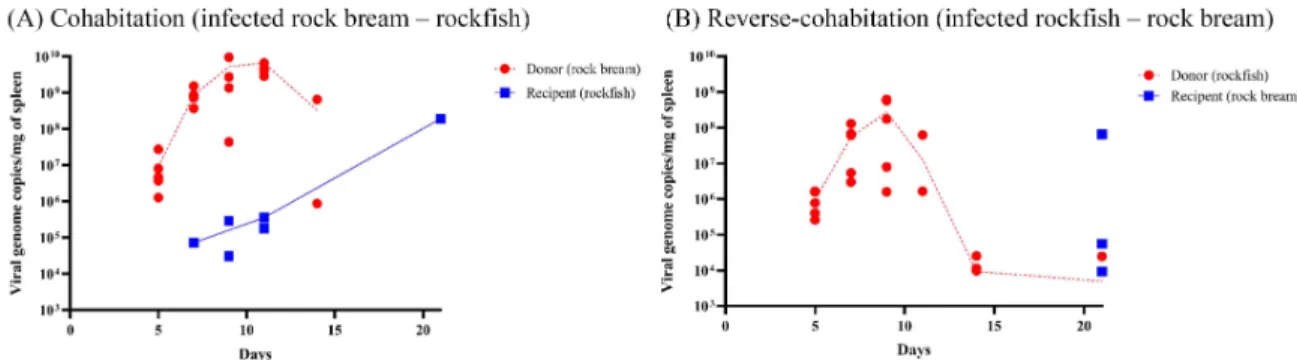
rock bream was the most susceptible species for RSIV subtype II infections. Jin et al. (2011) reported >106 viral genome copies/mg of tissue at the moribund stage, and Lee et al. (2020) reported 108 viral genome copies/mg of tissue. Furthermore, viruses released in- to the seawater from artificial RSIV-infected juvenile rock bream (104 copies/0.1 mL/fish; Kwon et al., 2020) and Japanese amberjack (Seriola quinquer- adiata; 104.7 median tissue culture infectious dose/0.1 mL/fish; Kawato et al., 2016) were approximately 104 copies/mL 9 days and 102.3 copies/mL 10-14 days after viral injection, respectively. In this study, RSIV-in- fected donor rock bream also had >108 viral genome copies/mg of spleen 7 days after the viral injection (Fig. 3A and Table 1). Notably, the rockfish had ap- Fig. 1. Cumulative mortality (%) of cohabitated rockfish as the recipient after exposure to artificially RSIV-infected rock bream (105 viral genome copies/fish) in the cohabitation challenge. All experiments were repeated twice (A), (B). No significant differences in pathogenicity were observed between the recipient and control rockfish.
Fig. 2. Cumulative mortality (%) of cohabitated rock bream as the recipient after exposure to artificially RSIV-infected rockfish (105 viral genome copies/fish) in the reverse-cohabitation challenge. All experiments were repeated twice (A), (B). A significant difference (*P < 0.05) in pathogenicity was observed between the recipient and control rock bream in experiment 2 (B).
proximately 105 viral genome copies 9-11 days after cohabitation (Table 1), but the dead RSIV-infected rock bream had this viral load approximately 8-9 days after the viral injection (Fig. 1A and 1B). These re- sults suggest that viruses released from the infected rock bream at the moribund stage could shed enough viral particles into the rearing water, leading to re-in-
fected rockfish.
The minimal infectious dose for inducing asympto- matic infection in rockfish is still unclear. In the field, asymptomatic RSIV infections in rockfish (the viruses were detected by nested-PCR) were identified in 23.1-70.0 % of fish in 15 aquaculture farms between July and December in Tongyeong in 2013, but RSIV Fig. 3. Viral genome copies in rockfish (A) and cohabitated rock bream (B) as the recipient after cohabitation with artificially RSIV-infected rock bream (A) and rockfish (B) as the donor (105 viral genome copies/fish).
Table 1. Identification and viral loads of RSIV in rock bream and rockfish after cohabitation or reverse-cohab- itation challenge
Experimental
group Days
Donora Recipientb Controlc
real-time PCR
Viral gene copies/
mg of spleen
real-time PCR
Viral gene copies/
mg of spleen
real-time PCR
Viral gene copies/
mg of spleen
Cohabitationd 5 7 9 11 14 21
5/5 5/5 5/5 5/5 2/2 -
9.10×10⁶±1.06×10⁷ 8.54×10⁸±4.26×10⁸ 5.31×10⁹±5.57×10⁹ 6.71×10⁹±4.86×10⁹ 3.31×10⁸±4.67×10⁸
-
0/5 1/5 2/5 2/5 0/5 1/5
N.D.f 7.2×10⁴ 1.61×10⁵±1.84×10⁵ 2.68×10⁵±1.24×10⁵
N.D.
1.98×10⁸
0/5 0/5 0/5 0/5 0/5 0/5
N.D.
N.D.
N.D.
N.D.
N.D.
N.D.
Reverse- cohabitatione
5 7 9 11 14 21
5/5 5/5 5/5 2/5 3/5 1/5
9.36×10⁵±6.48×10⁵ 5.40×10⁷±5.27×10⁷ 2.78×10⁸±3.04×10⁸ 3.24×10⁷±4.35×10⁷ 1.55×10⁴±8.56×10³
2.50×10⁴
0/5 0/5 0/5 0/5 0/5 2/5
N.D.
N.D.
N.D.
N.D.
N.D.
2.19×10⁷±3.79×10⁷ 0/5 0/5 0/5 0/5 0/5 0/5
N.D.
N.D.
N.D.
N.D.
N.D.
N.D.
aDonor, RSIV-infected rock bream in cohabitation challenge group or rockfish in reverse-cohabitation challenge group;
bRecipient, healthy rockfish in cohabitation challenge group or rock bream in reverse-cohabitation challenge group;
cControl, phosphate buffered saline injected rockfish in cohabitation challenge group or rock bream in reverse-cohab- itation group;
dCohabitation, RSIV-infected rock bream cohabitated with healthy rockfish;
eReverse-cohabitation, RSIV-infected rockfish cohabitated with healthy rock bream;
fN.D., Not detected
identified from field-derived rockfish did not lead to mortality in rock bream by I.P. injection (Kwon et al., 2015). In the reverse-cohabitation challenge, RSIV re- plicated in rockfish after I.P. injection (>107-108 viral genome copies 7-11 days after viral injection; Fig.
3B and Table 1). However, viral particles released from the infected rockfish could not induce acute re-infection and death in the rock bream for a shorter period than in the cohabitation challenge. Neverthe- less, in reverse-cohabitation challenge, rock bream cohabitated with RSIV-infected rockfish showed 10
% and 20% mortality within 21 days (Fig. 2A and 2B) and had a viral load of 2.19 × 10⁷ viral copies/mg of spleen on day 21 (Table 1). These results suggest that asymptomatic infected rockfish can transmit the RSIV without their natural sacrifice. Future studies are needed to determine the minimal infectious dose and develop a risk assessment model for asympto- matic transmission between fish species at the field level. Especially, active surveillance to asymptomatic infected fish species, such as rockfish, needs to be conducted in aquaculture regions with various fish species, such as Tongyeong and Namhae.
Pathogenicity and viral loads of RSIV-subtype II Megalocytivirus were determined by cohabitation challenges between rock bream and rockfish. RSIV infected and replicated in asymptomatic rockfish with- out mortality from artificially infected rock bream.
RSIV infections were also induced in rock bream by asymptomatic-infected rockfish through silent viral transmission.
Acknowledgments
This work was supported by a grant from National Fishery Products Quality Management Service (De- velopment and management of disease control pro- gram for aquatic life, R2021071)
Declaration of Competing Interest
The authors declare that they have no conflicts of
interest.
References
Han, H. J., Song, J. Y., Cho, M. Y., Choi, H. S., Jung, S. H. & Seo, H. G. (2020). Monitoring of diseases including nematode Clavinema mariae infections in the cultured Korean rockfish Sebastes schlegeli dur- ing 2013-2016. Korean Journal of Fisheries and Aquatic Sciences, 53, 432-442. https://doi.org/10.5657/
KFAS.2020.0432.
He, J. G., Zeong, K., Weng, S. P. & Chan, S. M. (2002).
Experimental transmission, pathogenicity and phys- ical-chemical properties of infectious spleen and kidney necrosis virus (ISKNV). Aquaculture, 204, 11-24. https://doi.org/10.1016/S0044-8486(01)00639-1.
Inouye, K., Yamano, K., Maeno, Y., Nakajima, K., Mat- suoka, M., Wada, Y. & Sorimachi, M. (1992). Irido- virus infection of cultured red sea bream, Pagrus major. Fish Pathology, 27, 19-27. https://doi.org/
10.3147/jsfp.27.19.
Jeong, J. B., Cho, H. J., Jun, L. J., Hong, S., Chung, J. K. & Jeong, H. D. (2008). Transmission of iridovi- rus from freshwater ornamental fish (pearl gourami) to marine fish (rock bream). Disease of Aquatic Organisms, 82, 27-36. http://doi.org/10.3354/dao01961 Jeong, J. B., Jun, J. L., Yoo, M. H., Kim, M. S., Komisar,
J. L. & Jeong, H. D. (2003). Characterization of the DNA nucleotide sequences in the genome of red sea bream iridoviruses isolated in Korea. Aquaculture, 220, 119-133. https://doi.org/10.1016/S0044-8486 (02)00538-0.
Jeong, J. B. & Jeong, H. D. (2008). Pathogenicity of iridovirus against marine fish and its detection in culturing seawater. Korean Journal of Fisheries and Aquatic Sciences, 41, 20-25. https://doi.org/10.5657/
kfas.2008.41.1.020.
Jung, S. J. & Oh, M. J. (2000). Iridovirus-like infection associated with high mortalities of striped beak- perch, Oplegnathus fasciatus (Temminck et Schle- gel), in southern coastal areas of the Korean peninsula. Journal of Fish Diseases, 23, 223-226.
https://doi.org/10.1046/j.1365-2761.2000.00212.x.
Jin, J. W., Cho, H. J., Kim, K. I., Jeong, J. B., Park, G. H. & Jeong, H. D. (2011). Quantitative analysis of the clinical signs in marine fish induced by Mega- locytivirus infection. Journal of Fish Pathology, 24, 53-64. https://doi.org/10.7847/jfp.2011.24.2.053.
Kawato, Y., Ito, T., Kamaishi, T., Fujiwara, A., Ototake,
M., Nakai, T. & Nakajima, K. (2016). Development of red sea bream iridovirus concentration method in seawater by iron flocculation. Aquaculture, 450, 380- 312. https://doi.org/10.1016/j.aquaculture.2015.08.016.
Kim, K. I., Lee, E. S., Do, J. W., Hwang, S. D., Cho, M., Jung, S. H., Jee, B. Y., Kwon, W. J. & Jeong, H. D. (2019). Genetic diversity of Megalocytivirus from cultured fish in Korea. Aquaculture, 509, 16- 22. https://doi.org/10.1016/j.aquaculture.2019.05.014.
Kim, Y. C., Hwang, J. Y., Jeon, H. R., Lee, D. W., Seo, J. W., Kim, K. I., Kwon, M. G., Jee, B. Y.
& Hwang, S. D. (2018). Molecular characterization of megalocytiviruses from diseased fishes in Korean aquatic farms from 2013-2017. Journal of Fisheries and Marine Sciences Education, 30, 2024–2035.
https://doi.org/10.13000/JFMSE.2018.12.30.6.2024.
KOSIS (Korean Statistical Information Service) (2019).
Fishery Production Survey: Status of fish culture.
http://kosis.kr.
Kurita, J. & Nakajima, K. (2012). Megalocytiviruses.
Viruses, 4, 521-538. https://doi.org/10.3390/v4040 521.
Kwon, W. J., Kim, Y. C., Yoon, M. J. & Jeong, H. D.
(2015). Characterization of asymptomatic Megalo- cytivirus infection in farmed rockfish (Sebastes schlegeli) in Korea. Journal of Fisheries and Marine
Sciences Education, 27, 1184-1193. https://doi.org/
10.13000/JFMSE.2015.27.4.1184.
Kwon, W. J., Choi, J. C., Hong, S., Kim, Y. C., Jeong, M. G., Min, J. G., Jeong, J. B., Kim, K. I. & Jeong, H. D. (2020). Development of a high-dose vaccine formulation for prevention of megalocytivirus in- fection in rock bream (Oplegnathus fasciatus).
Vaccine, 38, 8107-8115. https://doi.org/10.1016/j.
vaccine.2020.11.001.
Lee, E. S., Cho, M., Min, E. Y., Jung, S. H. & Kim, K. I. (2020). Novel peptide nucleic acid-based re- al-time PCR assay for detection and genotyping of Megalocytivirus. Aquaculture, 518, 734818. https://
doi.org/10.1016/j.aquaculture.2019.734818.
OIE (World Organization for Animal Health) (2019).
Manual of Diagnostic Tests for Aquatic Animal.
Chapter 2.3.8. Red sea bream iridoviral disease.
https://www.oie.int/fileadmin/Home/eng/Health_
standards/aahm/current/chapitre_rsbid.pdf.
Wang, Y. Q., Lu, L., Weng, S. P., Huang, J. N., Chan, S. M. & He, J. G. (2007). Molecular epidemiology and phylogenetic analysis of a marine fish infectious spleen and kidney necrosis virus-like (ISKNV-like) virus. Archives of Virology, 152, 763-773. doi: 10.1007/
s00705-006-0870-4.
Manuscript Received : May 12, 2021 Revised : May 26, 2021 Accepted : May 28, 2021