The immune-adjuvant effect and safety of recombinant CC chemokine 1 (rRbCC1) in rock bream, Oplegnathus fasciatus
Mun-Gyeong Kwon
*10), Ju-Won Kim
†, Seong-Don Hwang, Eun-Gyeong Kim, Dae-Won Park
**, Chan-Il Park
†*Pathology Division, National Fisheries Research and Development Institute, Busan 619-900, Republic of Korea
Department of Marine Biology & Aquaculture, Institute of Marine Industry, College of Marine Science,
Gyeongsang National University, 455, Tongyeong, 650-160, Republic of Korea
**Gyeongsangnam-do Fisheries Resources Research Institute, Tongyeong, Gyeongnam 650-947, Republic of Korea
Adjuvants are immune enhancers that are often used in vaccination to augment the immune response of a vaccine, thereby enhancing the protective immunity against the targeted disease. In the present study, we used the recombinant protein, such as rRbCC1, this protein was produced from rock bream CC chemokine 1. To verify the adjuvant effects of this recombinant protein, the immune responses of rock bream to Streptococcus iniae (S. iniae) FKC vaccination, which alone or in combination with recombinant protein was analyzed and then also performed experimental challenge with live S. iniae. The result of serum agglutination titres was showed relatively low levels however, the efficacy of FKC vaccine still conferred protection against S. iniae. Moreover, the adverse effects result showed that no statistically significant difference was revealed between high concentration injected and non-injected fish groups, generally. The relative percent survival (RPS) of FKC + recombinant vaccination group was significantly higher than that of vaccinated group with FKC alone. After experimental challenge to the rock bream by injection with live bacteria (S. iniae), the FKC + rRbCC1 vaccination group was showed 87.0% RPS, however, the RPS of FKC alone vaccination was 68.2%. The results indicated that the recombinant protein as an adjuvant had a clear synergism to injection vaccine of rock bream.
Key words :Rock bream, Adjuvant, Recombinant protein, Vaccine, Streptococcus iniae
In the Republic of Korea, the marine aquaculture industry had been developed with the advancing scientific technology, however, the production losses were also increased from infection of various diseases in recent years (Park, 2009). Most fish diseases are occurred to be caused by bacterial pathogens infection, such as edwardsiellosis, vibriosis, and streptococcosis
†Corresponding author: Chan-Il Park, Ju-Won Kim
Tel: +82-55-772-9153; Fax: +85-55-772-9159 E‐mail [email protected], [email protected]
are leading bacterial diseases that pose serious threats to aquaculture industries worldwide (Sun et al., 2011).
In aquaculture, due to its economic benefit, formalin-killed cell vaccine was most general applied strategy to control or prevent against various bacterial infection. Commercial aquaculture vaccines, primarily in the form of bacterin, against vibriosis and streptococcosis have been in use for some years in European and other countries and played an important
role in aquaculture industry (Hastein et al., 2003;
Sommerest et al., 2005; Agnew and Barnes, 2007; Sun et al., 2011). Protective efficiency correlates well with the ability of the vaccine to stimulate an immune mechanism with broad effect (Bercovier et al., 1997).
In Japan, inactivated bacterial-whole cells of Streptococcus iniae (S. iniae) have been used as a prophylactic treatment to prevent streptococcosis in Japanese flounder (Paralichthys olivaceus) (Shutou et al., 2007). In Israel, formalin-killed bacteria were successfully used as a vaccine against S. iniae infections in rainbow trout (Oncorhynchus mykiss) farm (Bercovier et al., 1997). Furthermore, the stability and efficacy of formalin-killed S. iniae vaccine had been performed to verify from olive flounder in Korea (Cho et al., 2006).
Adjuvants (from the Latin, adjuvare = to help) are immune enhancers that are often used in vaccination to augment the immune response of a vaccine, thereby enhancing the protective immunity against the targeted disease (Cox and Coulter, 1997; Jiao et al., 2010).
Among the adjuvants that have been studied in association with fish vaccines are oil-based adjuvants and aluminum-based adjuvants (Horne et al., 1984;
Mulvey et al., 1995; berg et al., 1997; Poppe and Breck, 1997; Mutoloki et al., 2004; Mutoloki et al., 2008; Jiao et al., 2010). Adjuvants such as aluminium hydroxide gels or mineral oil emulsions have been effectively used in traditional vaccines to enhance humoral or cell mediated immune responses to levels required to confer protection, but have been found to be inadequate for use with subunit antigens which lack the intrinsic immunogenicity of whole-organism preparations (Altman and Dixon, 1989; Lofthouse et al., 1995). Therefore, it is necessary to develop various immune adjuvants to enhance immune effects of vaccines (Shi et al., 2007).
Recently, the concept of adjuvant has been expanded to include the employment of recombinant cytokines in combination with newly developed vaccines, this group of adjuvants is considered as genetic or molecular adjuvants (Singh and O’Hangan, 1997; Scheerlinck, 2001).
In the present study, we used the recombinant protein to verify the adjuvant effects, rRbCC1 was produced by our previously studies from rock bream CC chemokine 1 (Kim et al., 2013). The immune responses of rock bream to S. iniae FKC vaccination, which alone or in combination with recombinant proteins were conducted. The specific antibody response were analysed in immunized versus non-immunized fish at different periods after immunization and also conducted experimental challenge with live S. iniae. To examine the toxic effects of recombinant proteins, the plasma chemistry were analysed.
Materials and methods
Recombinant protein
In this study, to verify the adjuvant effects, we used the recombinant proteins such as rRbCC1 (recombinant rock bream CC chemokine 1 protein) which was produced using an Escherichia coli BL21 (DE3) expression system followed by purification from our previously study (Kim et al., 2013). The studies of molecular identification, expression analysis concerning this cDNA had been analysed and the biological activity of its recombinants were also confirmed from our previously researches (Kim et al., 2013).
Fish and breeding condition
Rock bream (weighing approximately 70 g) was supplied from the Gyeongsangnam-do Fisheries
Resources Research Institute in TongYeong (Republic of Korea). Rock bream were kept in 5 tons indoor tanks supplied filtering sea water with a constant flow of aeration and fed with commercial pelleted diet twice a day. The sea water was kept at 23 ± 1 °C. The experimental fish were acclimatised in the experimental tanks for at least 2 weeks prior to vaccination.
FKC preparation and vaccination scheme
For the FKC (formalin-killed cell) preparation and bacterial challenge experiment, Streptococcus iniae (FP5228) were obtained from the Fish Pathology Division, National Fisheries Research & Development Institute (Republic of Korea). S. iniae was cultured in Brain Heart Infusion agar (Difco, USA) supplemented with 1.5% NaCl at 27 °C for 24 h. To prepare FKC, the bacteria were suspended in a final concentration of 4% formalin in phosphate buffered saline (PBS), incubated at room temperature for 48 h, washed 3 times and re-suspended in PBS.
The vaccination was designed to evaluate the immune response of rock bream after stimulation with different preparations including recombinant proteins (FKC alone or in combination with rRbCC1). The rRbCC1 was also added at concentration of 100 μg/mL into prepared S. iniae FKC. This concentration had been evaluated by previously studies (Kim et al., 2013). 150 fishes were placed in each of the net-cage in the 5 tons indoor tank containing filtered, aerated sea water at a temperature of 23 ± 1 °C. Experimental groups were injected intraperitoneally (IP) with 100 μL of S. iniae FKC (equivalent to 1 mg/fish) alone or S. iniae FKC combination with recombinant proteins. The control fish were injected with 100 μL of PBS.
Serum agglutination test
Nine fish from each experiment group were sacrificed on every week after vaccination for serum agglutination test. Blood samples were collected from the caudal vein and allowed to clot at 4 °C for 4 h. After centrifugation, serum was collected to new flash tube and then frozen at-80 °C until use. Serum agglutination titre against S.
iniae was determined for each fish in experiment group by a modified microtiter assay (Cho et al., 2006). Briefly, 50 μL of vaccination and/or control serum was serially diluted with 50 μL of PBS and then 50 μL of S.
iniae FP5228 FKC (OD 0.8 at 600 nm) was added.
Plates were incubated at room temperature overnight prior to microscopic examination (Leica DM2500, Germany) for agglutination. Antibody titre was expressed as the reciprocal of the highest dilution of serum that was positive for agglutination.
Toxic effect investigation
To examine the toxic effects of recombinant proteins, high concentration (2-, 5-, 10-fold) of each recombinant protein were prepared as flow: rRbCC1 was 200, 500, 1000 μg/mL, respectively. Experimental groups were injected intraperitoneally (IP) with 100 μL of each high concentration of recombinant protein. The control fish were injected with 100 μL of PBS. After 24 and 48 h for injection, blood samples were obtained from the caudal vein of three fish from each experiment group and allowed to clot at 4 °C for 4 h. After centrifugation, serum was collected to new flash tube and then plasma chemistry (albumin, blood urea nitrogen, aspartate aminotransferase, alanine aminotransferase, glucose, total protein, triglyceride,) was immediately analyzed following the published literature (Jung et al., 2006).
Plasma chemistry was analyzed by establishing baseline
ranges for a dry chemical system of FUJI DRY-CHEM 4000i according to the manufacturer’s instructions (FUJI PHOTO FILM Co., Japan).
Experimental challenge test
At 4 weeks after vaccination, ninety rock bream from each experimental group (PBS injection, FKC alone vaccination, FKC + recombinant vaccination) were injected intraperitoneally (IP) with OD 1.0 at 600 nm live cells of S. iniae (FP 5228). Then, the 30 fish of each experiment group were kept in three-individual 80 L FRP tanks for 10 days (for three replication), symptoms, morbidity and mortality in each group were recorded for every day, the dead fish were necropsy, the pathogenic bacteria were re-isolated and identified.
Cumulative mortality was registered and relative percent survival (RPS) was calculated according to the formula:
RPS = [1-% mortality in vaccinated group / % mortality in control group] × 100.
Statistical analysis
Results were subjected to one-way analysis of variance (ANOVA) followed by Fisher’s protected least significant difference (PLSD) test using SPSS version 17 software. For all analyses, a P
value <
0.05 was taken to indicate statistical significance. All data represent the mean ± SD.
Results and Discussion
Serum agglutination
Here, we describe the adjuvant effects of recombinant proteins, such as rRbCC1, this protein was well-known to induce immune response by our previously studies (Kim et al., 2013). Streptococcosis has been one of the
infections associated with acute to chronic mortalities in aquaculture species in Korea. High mortality rate usually occurs in many rock bream farms especially during warm water season. Presumptive diagnosis of streptococcosis is based on clinical signs, including the isolation of gram positive cocci in internal organs (Baeck et al., 2006). Serum agglutination test is method which basically conducted for verification of vaccine efficacy.
Kinetics of the rock bream serum agglutination response to FKC combine recombinant and FKC vaccines is shown in Fig. 1. In FKC alone injection, serum agglutination response showed the most significant increases at 1 weeks after immunization (agglutination titre; 21), and then reached a peak at 2 weeks and maintained 3 weeks (23), decreased 4 weeks (22). In FKC combine recombinant injection, serum agglutination response showed the most significant increases at 1 week (21), however, reached a peak at 3 weeks and then maintained 4 weeks (23) (Fig. 1).
Cho et al. (2006) had been performed to verify the stability and efficacy of Streptococcus iniae formalin killed cells on storage at refrigerator temperature in olive flounder (Paralichthys olivaceus). They had been reported that the antibody titre and protection efficacy to challenge test were significantly higher in booster immunized group than prime immunized group.
Especially, above 60% of relative percent survival (RPS) was obtained at low antibody level (22) in prime immunized group (Cho et al., 2006). Although agglutination titres observed in this study were relatively low, the efficacy of FKC vaccine still conferred protection against S. iniae. These results also indicated that even though between FKC anole and FKC combine recombinant have not shown significantly differences in serum agglutination response, recombinant-vaccination
Fig. 1. Change in agglutination titres against Streptococcus iniae FKC of serum collected from rock bream vaccinated by S. iniae FKC alone or S. iniae FKC combination with recombinant proteins (rRbCC1).
showed the longer maintenance of higher serum agglutination titre than FKC alone vaccination. Therefore, further investigation for obvious serum agglutination response at more longer experiment period are required.
The result of toxic effect on rRbCC1
Freund’s complete adjuvant (FCA) first described in 1935 has been used for many years with experimental vaccines in animal models (Freund et al., 1937;
McElrath, 1995). FCA is a classical oil adjuvant, which, with the aid of an emulsifying agent, forms a water-in-oil emulsion with the antigen and is effective in eliciting strong immune response at both humoral and cellular levels that in general have not been surpassed by any other adjuvant (Jiao et al., 2010; Lindblad, 2004).
However, the use of Freund’s adjuvant, especially FCA, is often accompanied with various adverse effects, such as the development of granuloma, necrosis, and tissue
impairment, which cause considerable stress to the animal under vaccination (Jiao et al., 2010). For this reason, Freund’s adjuvant has been prohibited in human clinical vaccine. In the several researches, oil-based and/or aluminum-based adjuvants also have been used for the development of fish vaccine (Horne et al., 1984;
Mulvey et al., 1995; berg et al., 1997; Poppe and Breck, 1997; Mutoloki et al., 2004; Mutoloki et al., 2008; Jiao et al., 2010). However, their immune effects and toxicities (adverse effect) are still in questionable. In this regard, we examined the effects of small cytokine for development of more safety adjuvant in the rock bream.
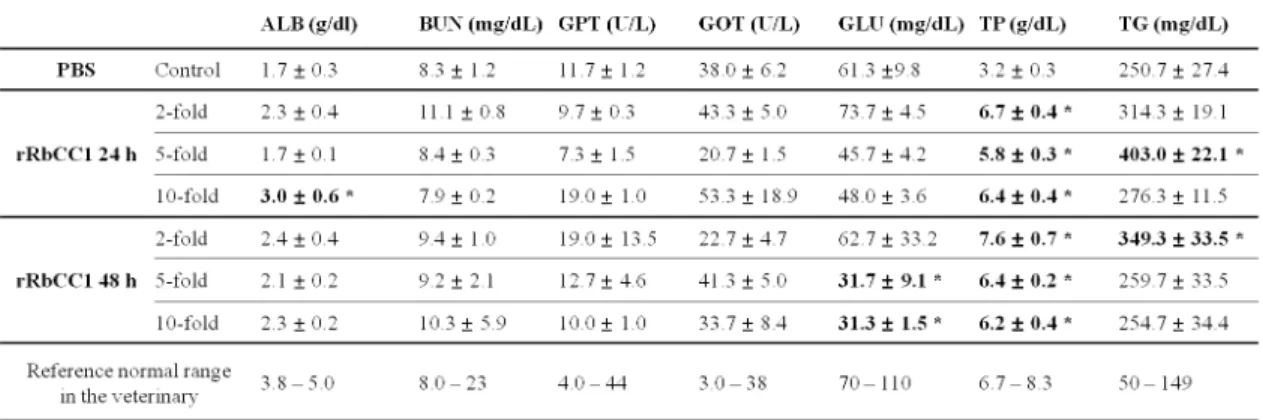
In present study, to examine the adverse effects of recombinant proteins in vivo, haematological parameters are presented in Table 1. Generally, no statistically significant difference was revealed between high concentration injected and non-injected fish groups on day 2 after injection. Especially, compared with control
Table 1. Plasma chemistry parameters of rock bream serum after injection with high concentration recombinant protein (Application of indices of veterinary chemistry analyzer used in the present experiment for hematological parameter)
fish group, no statistically significant differences showed in GOT and GPT compared with control group. This result suggested that rRbCC1 might have a no adverse effect. Statistically significant differences were found in TP, however, control group had a low numerical value than normal range (Table 1).
Blood parameters are increasingly used as indicators of the physiological or sublethal stress response in fish to endogenous or exogenous changes. The possibility of evaluation depends on the availability of reference values as close as possible to ‘normal’ values of the various blood components considered as reliable descriptors of healthy fish under natural conditions (Cataldi et al., 1998). In the Republic of Korea, Jung et al. (2006) had been analysed haematological parameter using dry chemical system (FUJI DRI-CHEM 3000) in various fish, such as black rockfish, red seabream, rock bream, and black seabream for haematological health diagnosis. However, Jung and associates (2006) inferred that except the several analysis items, veterinary chemistry analyzer was not suitable for the confidence of its data, because the normal value of haematological
analysis was not established in the fish. In the present study, TG (triglyceride) showed higher numerical value than reference normal range in the veterinary (Table 1).
For this reason, further investigation for establishment of haematological normal value was needed urgently.
Experimental challenge
In our report, the adjuvant activity of rRbCC1 was analyzed. Immune-stimulants are used as adjuvants in vaccines to activate antigen presenting cells (e.g.
macrophages) and to stimulate these cells to produce more of the signal molecules (cytokines) which activate the group of lymphocytes (B cells in warm-blooded animals) which produce specific antibodies (Chu, 2006).
Several researches about the contribution of adjuvant to immune response of fish have been reported (Rorstad et al., 1993; Aakre et al., 1994; Chu, 2006; Jiao et al., 2010). Most of them proved that adjuvant could enhance immune response through increasing activity of leukocyte and plasmocyte as well as speeding up production of specific antibody (Williams et al., 1989;
Robertsen et al., 1990). As an effective cell activator, (*: P<0.05).
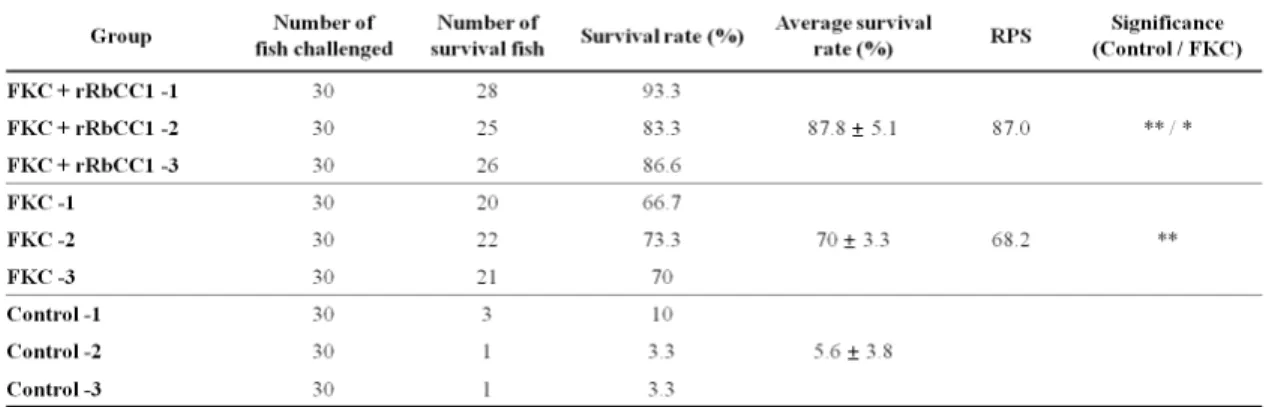
Table 2. The relative percent survival (RPS) of vaccinated and control fish after challenged with Streptococcus iniae
complete freund’s adjuvant could induce cellular and humoral immunity, however, they were restricted to use by serious side effect. In this regard, several approaches were used to investigate the immune modulating effects of combined rRbCC1 as adjuvant on formalin killed Streptococcus iniae vaccination, in present study.
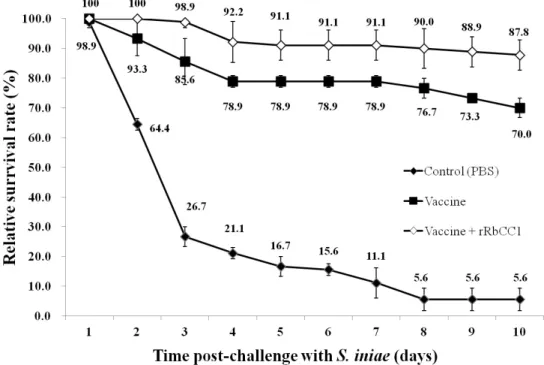
Survival rate of vaccinated-rock bream after intraperitoneal injection with Streptococcus iniae (FP5228) were shown in Fig. 2. Survival rate of PBS-injected group (control) showed at 5.6 ± 3.8%, FKC alone injected group had a survival rate to 70 ± 3.3%, furthermore, survival rate of FKC combine rRbCC1 showed at 87.8 ± 5.1%.
Relative percent survival (RPS) was 87.0%, after experimental challenge by injection with live bacteria in rock bream vaccinated with FKC + rRbCC1, the RPS in groups vaccinated with FKC was 68.2%. The RPS in the vaccinated groups with FKC + recombinant was significantly higher than that of vaccinated groups with FKC (Table 2). It was suggested that this recombinant might be enhanced the cell-mediated immunity, which was consistent with their known biological function (Kim et al., 2013). Furthermore, we observed most
highly RPS in FKC combined rRbCC1 group. This may be due to that rRbCC1 could more attract leukocytes and enhanced the cell-mediated immunity. Moreover, it was suggested that rRbCC1 as a molecular adjuvant had a clear synergism to vaccine injection in rock bream, also it was indicated that molecular adjuvant might act as a stimulant for innate and non-specific immune system against S. iniae challenged. Further experiments, such as ELISA analysis and non-specific immune parameter experiment were needed to test our hypothetic explanation,
In conclusion, rRbCC1 can stimulate the immune response in rock bream against Streptococcus iniae. It may have a potential as a molecular adjuvant or immunostimulant in fish vaccines.
Acknowledgements
This work was supported by grants from the National Fisheries Research and Development Institute (NFRDI) in Korea (RP-2013-AQ-135).
(*: P<0.05, **: P<0.01).
Fig. 2. Survival rate of vaccinated-rock bream after intraperitoneal injection with Streptococcus iniae. OD 1.0 at 600 nm live cells of S. iniae was injected intraperitoneally to 30 fish (three replication) per each group.
References
Aakre, R., Wergeland, H.I., Aasjord, P.M., Endresen, C.: Enhanced antibody response in Atlantic salmon (Salmo salar L.) to Aeromonas salmonicida cell wall antigens using a bacterin containing β- 1,3-M-glucan as adjuvant. Fish Shellfish Immunol., 4:47-61, 1994.
Agnew, W., Barnes, A.C.: Streptococcus iniae: an aquatic pathogen of global veterinary significance and a challenging candidate for reliable vaccination.
Vet. Microbiol., 122:1-15, 2007.
Altman, A., Dixon, F.J.: Immunomodifiers in vaccines.
Adv. Vet. Sci. Comp. Med., 23:301-41, 1989.
Baeck, G.W., Kim, J.H., Gomez, D.K., Park, S.C.:
Isolation and characterization of Streptococcus sp. from diseased flounder (Paralichthys olivaceus) in Jeju island. J. Vet. Sci., 7:53-8, 2006.
Bercovier, H., Ghittino, C., Eldar, A.: Immunization with bacterial antigens: infections with streptococci and related organisms. Dev. Biol. Stand., 90:153-60, 1997.
Berg, A., Rodseth, O.M., Hansen, T.: Fish size at vaccination influence the development of side-effects in Atlantic salmon (Salmo salar L.). Aquaculture, 265:9-15, 2007.
Cataldi, E., Marco, P.D., Mandich, A., Cataudella, S.:
Serum parameters of Adriatic sturgeon Acipenser naccarii (Pisces: Acipenseriformes):
effects of temperature and stress. Comp.
Biochem. Physiol. Part A, 121:351-4, 1998.
Cho, M.Y., Lee, D.C., Lee, J.S., Do, J.W., Kim, M.S., Choi, M.Y., Kim, Y.C., Kang, B.K., Yoon, Y.D., Kim, J.W.: Stability and efficacy of formalin-killed Streptococcus iniae vaccine for olive flounder, Paralichthys olivaceus. J. Fish pathol., 19:165-72, 2006.
Chu, W.H.: Adjuvant effect of propolis on immunisation by inactivated Aeromonas hydrophila in carp (Carassius auratus gibelio). Fish Shellfish Immunol., 21:113-7, 2006.
Cox, J.C., Coulter, A.R.: Adjuvants-a classification and review of their modes of action. Vaccine, 15:248-56, 1997.
Freund, J., Casals, J., Hosmer, E.P.: Sensitization and antibody formation after injection of tubercle bacilli and paraffin oil. Proc. Soc. Exp. Biol.
Med., 37:509, 1937.
Hastein, T., Gudding, R., Evensen, O.: Bacterial vaccines for fish--an update of the current situation worldwide. Dev. Biol (Basel)., 121:55-74, 2005.
Horne, M.T., Roberts, R.J.,Tatner, M., Ward, P.: The effects of the use of potassium alum adjuvant in vaccines against vibriosis in rainbow trout, Salmo gairdneri Richardson. J. Fish Dis., 7:91-9, 1984.
Jiao, X.D., Cheng, S., Hu, Y.H., Sun, L.: Comparative study of the effects of aluminum adjuvants and Freund’s incomplete adjuvant on the immune response to an Edwardsiella tarda major antigen.
Vaccine, 28:1832-7, 2010.
Jung, S.H., Byun, S.G., Jee, B.Y., Choi, H.S.: Application of veterinary chemistry analyzer used to
hematological analysis of marine fish cultured in floating netcage. J. Fish pathol., 19:253-65, 2006.
Kim, J.W., Kim, E.G., Kim, D.H., Shim, S.H., Park, C.I.: Molecular identification and expression analysis of the CC chemokine gene in rock bream (Oplegnathus fasciatus) and the biological activity of the recombinant protein.
Fish Shellfish Immunol., 34:892-901, 2013.
Lindblad, E.B.: Aluminium compounds for use in vaccines. Immunol. Cell. Biol., 82:497-505, 2004.
Lofthouse, S.A., Andrew, A.E., Nash, A.D., Bowles, V.M.: Humoral and cellular responses induced by intradermally administered cytokine and conventional adjuvants. Vaccine, 13:1131-7, 1995.
McElrath, M.J.: Selection of potent immunological adjuvants for vaccine construction. Semin.
Cancer Biol., 6:375-85, 1995.
Mulvey, B., Landolt, M.L., Busch, R.A.: Effects of potassium sulphate (alum) used in Aeromonas salmonicida bacterin on Atlantic salmon, Salmo salar L. J. Fish Dis., 18:495-506, 1995.
Mutoloki, S., Alexandersen, S., Evensen, O.: Sequential study of antigen persistence and concomitant inflammatory reactions relative to side-effects and growth of Atlantic salmon (Salmo salar L.) following intraperitoneal injection with oil-adjuvanted vaccines. Fish Shellfish Immunol., 16:633-44, 2004.
Mutoloki, S., Alexandersen, S., Gravningen, K., Evensen, O.: Time-course study of injection site inflammatory
reactions following intraperitoneal injection of Atlantic cod (Gadus morhua L.) with oil-adjuvanted vaccines. Fish Shellfish Immunol., 24:386-93, 2008.
Park, S.I.: Disease control in Korean aquaculture. Fish Pathol., 44:19-23, 2009.
Poppe, T.T., Breck, O.: Pathology of Atlantic salmon Salmo salar intraperitoneally immunized with oil-adjuvanted vaccine. A case report. Dis. Aquat.
Organ., 29:219-26, 1997.
Robertsen, B., Rerstad, G., Engstad, R.: Enhancement of non-specific disease resistance in Atlantic salmon, Salmo salar L., by a glucan from Saccharomyces cerevisiae cell walls. J. Fish Dis., 13:391-400, 1990.
Rorstad, G., Aasjord, P.M., Robertsen, B.: Adjuvant furunculocis in Atlantic salmon (Salmo salar L.). Fish Shellfish Immunol., 3:179-90, 1993.
Scheerlinck, J.Y.: Genetic adjuvants for DNA vaccines.
Vaccine, 19:2647-56, 2001.
Shi, X.J., Wang, B., Wang, M.: Immune enhancing effects of recombinant bovine IL-18 on foot-and-mouth
disease vaccination in mice model. Vaccine, 25:1257-64, 2007.
Shutou, K., Kanai, K., Yoshikoshi, K.: Role of capsule in immunogenicity of Streptococcus iniae to Japanese flounder Paralichthys olivaceus. Fish Pathol., 42:101-6, 2007.
Singh, M., O’Hangan, D.: Advances in vaccine adjuvant.
Nat. Biotechnol., 17:1075-81, 1999.
Sommerset, I., Krossøy, B., Biering, E., Frost, P.: Vaccines for fish in aquaculture. Expert Rev. Vaccines, 4:89-101, 2005.
Sun, Y., Liu, C.S., Sun, L.: A multivalent killed whole-cell vaccine induces effective protection against Edwardsiella tarda and Vibrio anguillarum.
Fish Shellfish immunol., 31:595-9, 2011.
Williams, D.L., Yaeger, R.G., Pretus, H.A., Browder, I.W., McNamee, R.B., Jones, E.L.: Immunization against Trypanosoma cruzi: adjuvant effect of glucan. Int. J. Immunopharmacol., 11;403-10, 1989.
Manuscript Received : July 26, 2013 Revised : September 06, 2013 Accepted : September 06, 2013