J. Fish Pathol., 32(1) : 001~008 http://dx.doi.org/10.7847/jfp.2019.32.1.001
Iridoviridae is a family of large double-stranded DNA virus (120~300 nm) with an icosahedral mor- phology (Williams, 1996). The family includes five genera: Iridovirus, Chloriridovirus, Ranavirus, Lym- phocystivirus and Megalocytivirus. Megalocytivirus cause disease in more than 50 fish species and cur- rently threaten the aquaculture industry, causing great economic losses in Korea, Japan, China and Southeast Asia (Inouye et al., 1992; Nakajima and Sorimachi, 1994; Chua et al., 1994; Matsuoka et al., 1996; Miyata et al., 1997; Chou et al., 1998; Jung and Oh, 2000;
He et al., 2002). Rock bream iridovirus (RBIV), which belongs to the genus Megalocytivirus (Do et al., 2004; Song et al., 2008; Kurita and Nakajima, 2012) remains an important health problem in rock
bream Oplegnathus fasciatus (Jung and Oh, 2000).
Various indices have been used to evaluate the con- dition or well-being of fish, including the relative con- dition factor (Le Cren, 1951), relative weight (Wege and Anderson, 1978), gut index (Jensen, 1980), RNA- DNA ratios of liver and muscle (Bulow et al., 1981), visceral somatic index (Delahunty and de Vlaming, 1980; Adams et al., 1982) and liver somatic index (Edwards et al., 1972; Tyler and Dunn, 1976; Valto- nen, 1974; Heidinger and Crawford, 1977; Bulow et al., 1978; Delahunty and de Vlaming, 1980; Allen and Wootton, 1982; Adams and McLean, 1985). Liver so- matic index is a useful biomarker to detect the envi- ronmental stressors, and it is one of the most sensitive growth indicators (Edwards et al., 1972; Valtonen, 1974; Tyler and Dunn, 1976; Heidinger and Craw- ford, 1977; Bulow et al., 1978; Allen and Wootton, 1982; Adams and McLean, 1985). Liver is the meta-
Correlation of virus replication and spleen index in rock bream iridovirus infected rock bream Oplegnathus fasciatus
Myung-Hwa Jung and Sung-Ju Jung†
Department of Aqualife Medicine, Chonnam National University, 50 Daehak-ro, Yeosu, Jeonnam, 59626, Korea
Rock bream iridovirus (RBIV) is a member of the Megalocytivirus genus that causes severe mortality to rock bream (Oplegnathus fasciatus) with characteristic clinical signs of spleen enlargement. In this study, we assessed spleen size and RBIV copy number patterns in RBIV-infected rock bream to determine lethal and safe levels of virus copy number/spleen index that may define disease progress.
We found that rock bream infected with RBIV (1.1 × 10⁷ virus copy number/100 μl) and held at 29, 26, 23 or 20°C exhibited significantly higher levels of spleen size compared to 17°C. In dead condition (100% mortality at 20~29°C), the spleen index (spleen weight / fish weight × 100) and virus copy number were 3.00~5.38 and 106~108/μl, respectively. Conversely, in survived condition (0% mortality at 17°C), spleen index and virus copy number was as low as not-infected control (0.34~1.22/100~101/μl, respectively). These findings suggest that spleen index can be an indicator of disease severity of RBIV disease.
Key words: rock bream iridovirus, rock bream, virus replication, spleen index, spleen enlargement
†Corresponding author: Sung-Ju Jung Tel: +82-61-659-7175; Fax: +82-61-659-7179 E-mail: [email protected]
bolic organ, and fish store energy in the liver during periods of high energy intake. Most of this stored en- ergy is in the form of glycogen (Busacker et al., 1990). Therefore, the relative size of the liver should be correlated to the nutritional state of the fish as well as the growth rate.
Other organ indexes except liver have not been commonly used as biomarkers for the evaluation of fish health. Spleen is one of the major filtering organs in the vascular system, removing effete blood cells and foreign agents. In humans, vertebrate and fish, the spleen is the major site of pathogen growth and disease pathology (Chinabut et al., 1990; Toranzo et al., 1991; Inouye et al., 1992; Santos et al., 1992;
Fryer and Mauel, 1997; Jung and Oh, 2000; Kim et al., 2005; Kim et al., 2009; Jeffery et al., 2010).
Hence, the spleen is frequently used in the diagnosis of damage caused by pathogen infection. Studies on fish disease such as Flexibacter psychrophilus (Santos et al., 1992), Pasteurella piscicida (Toranzo et al., 1991), Piscirickettsia salmonis (Fryer and Mauel, 1997), Francesella sp. (Jeffery et al., 2010), Micro- bacteriosis (Chinabut et al., 1990), Cyprinid herpesvi- rus 2 (Jeffery et al., 2007), Viral haemorrhagic septi- caemia (Kim et al., 2009), Trypanoplasma salmosi- tica (Li et al., 2013) and Haemogregarina sachai (Kirmse, 1980) have demonstrated a clear clinical sign of spleen enlargement (splenomegaly). Nearly all deaths by RBIV are accompanied by enlargement of spleen (Jung and Oh, 2000; Zhang et al., 2012). The simplest diagnostic method of RBIV disease is to con-
firm presence of abnormally enlarged cells in Giemsa- stained stamp-smear of the spleen. Basophilic enlarged cells by Giemsa stain are compactly packed with virus particles in the cytoplasm. Hence, we hypothesised that splenomegaly of rock bream can be an indicator of severity of RBIV disease.
In the present study, rock bream were artificially infected with RBIV, and RBIV copy number and spleen size were measured. Furthermore, lethal and safe levels of RBIV copy number and spleen size (index) were estimated.
Materials and Methods
Experimental infection
The RBIV was obtained from RBIV-infected rock bream in 2010 (Jung et al., 2014). Virus amount was quantified by quantitative real-time polymerase chain reaction (qRT-PCR). The RBIV major capsid protein (MCP) gene copies of the original virus in the super- natant preparations were 7.5 × 10⁷/100 μl MCP gene copies, and that was suspended in phosphate-buffered saline (PBS) to 1.1 × 10⁷/100 μl as previously de- scribed (Jung et al., 2014).
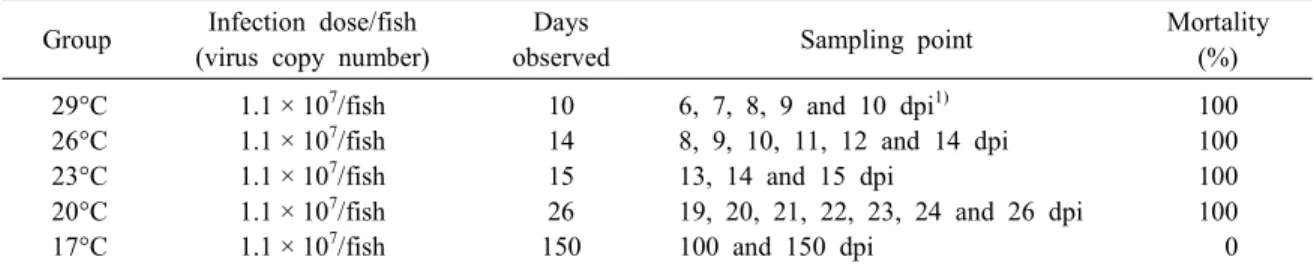
The RBIV-free rock bream were reared by the Fisheries Science Institute at Chonnam National University. The experimental design was identical to that explained previously (Jung et al., 2015). Rock bream (10.8 ± 1.5 cm, 25.1 ± 3.1 g) were used for evaluation of spleen weight at different water temper- atures (29, 26, 23, 20 and 17°C) (Table 1). For viral
Table 1 Experimental details of artificial infection Group Infection dose/fish
(virus copy number)
Days
observed Sampling point Mortality
(%) 29°C
26°C 23°C 20°C 17°C
1.1 × 10⁷/fish 1.1 × 10⁷/fish 1.1 × 10⁷/fish 1.1 × 10⁷/fish 1.1 × 10⁷/fish
10 14 15 26 150
6, 7, 8, 9 and 10 dpi1) 8, 9, 10, 11, 12 and 14 dpi 13, 14 and 15 dpi
19, 20, 21, 22, 23, 24 and 26 dpi 100 and 150 dpi
100 100 100 100 0
1)dpi: days post infection
infection, 15 fish was intraperitoneally (i.p.) injected with 100 μl/fish containing 1.1 × 10⁷ MCP gene copy, while the control fish was i.p. injected with the PBS (100 μl/fish) and then maintained in the aquaria con- taining 30 L of UV-treated seawater. To determine the RBIV replication pattern, spleen was collected from dead fish at 29, 26, 23 and 20°C and surviving fish at 17°C. Samples were stored at -80°C after being flash frozen in liquid nitrogen. Table 1 summarizes experimental conditions.
Determination of RBIV copy number in the spleen and spleen index
Genomic DNA was extracted from the whole spleen tissues (20~150 mg) of the sampled fish using an AccuPrep®Genomic DNA extraction kit (Bioneer, Korea) according to the manufacturer’s instructions.
Quantification of RBIV copy numbers were deter- mined by qRT-PCR using Exicycler 96 Real-Time Quantitative Thermal Block (Bioneer) with RBIV MCP gene specific primer set (F 5’ tgcacaatctagttgagg aggtg 3’ and R 5’ aggcgttccaaaagtcaagg 3’) according to the standard curve and method described pre- viously (Jung et al., 2014). The virus copy number was expressed as viral DNA copies 1 μl of DNA of 100 μl of total DNA from a whole spleen. The de- tection limit level of RBIV MCP copy number was 1.0 × 101/µl. The spleen indexes were defined by the following formula:
Spleen index = (Spleen weight (g)/ Fish weight (g))
× 100.
Results
RBIV replication and spleen size at different infection condition
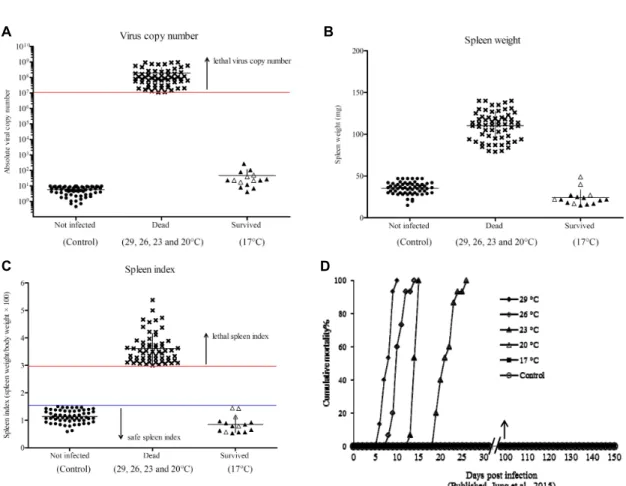
Dead condition (RBIV infection at 29, 26, 23 and 20°C). The virus copy number from 60 dead fish ranged from 1.11 × 10⁷ to 9.56 × 10⁸/μl and was re- garded as ‘lethal’ virus copy number (Fig. 1A). The spleen weight from all of the dead fish ranged from
79 to 140 mg (average 110.3 mg) (Fig. 1B), and spleen index was in the range of 3.06 to 5.38 (average 3.65) and was regarded as ‘lethal’ (Fig. 1C). Fig. 1D shows cumulative mortality of fish sampled for this study (previously published by Jung et al., 2015).
Survived condition (RBIV infection at 17oC) At 17°C, all the fish survived with no clinical signs. The five sampled fish at 17°C did not have enlarged spleens (range of 17 to 49 mg) and had low virus copy numbers (average 3.0 × 101/μl) at 100 dpi (Fig. 1A). The remaining survivors (10 fish) were placed in increased water temperature to 26°C; at 100 dpi, the fish did not die and had low virus copy num- bers (average 5.6 × 101/μl) at 150 dpi. All the 15 surviving fish showed a spleen weight of below 50 mg against RBIV infection during the experimental period (Fig. 1B). The spleen index in survivors was in the range of 0.53 to 1.44 (average 0.84) (Fig. 1C).
Control
PBS-injected fish maintained at 29, 26, 23 and 20°C had a 100% survival rate. The fish sampled in all groups were distributed in the below detection lim- it level of RBIV MCP copy number (1.0 × 101/μl) (Fig. 1A). Spleen weight of all control fish was under 50 mg in the experimental period (Fig. 1B). The spleen index was in the range of 0.58 to 1.50 (average 1.13) and was regarded as ‘safe’ (Fig. 1C).
Discussion
Spleen acts as an important immune responsive or- gan against a variety of pathogens. It is crucial for the capture and destruction of pathogens and the for- mation of adaptive immunity (Mebius and Kraal, 2005). Spleen size of the fish is considered as a sim- ple measurable immune parameter with a potential role in immune response against pathogens (Skarstein et al., 2001; Taskinen and Korter, 2002; Korter and Taskinen, 2004; Lefebvre et al., 2004), and European
starlings (Sturnus vulgaris) with larger spleens have been shown to mount stronger immune responses (Ardia, 2005). However, RBIV-infected rock bream are characterised by enlargement of spleen (Jung and Oh, 2000), and spleen size may reflect disease status after virus infection.
First, absolute MCP gene copy and spleen weight were evaluated from the dead fish obtained from the RBIV-injected group and maintained higher than 20°C. A threshold (dangerous limit) was then set up for the virus copy number and spleen index indicating possible virus copy number and spleen index, which causes fish death. The virus copy range was 107 to
108/μl (109~1010/100 μl/whole spleen weight 79~140 mg), and the lethal ratio of the spleen index due to RBIV infection was 3.06 to 5.38. A similar virus copy range and spleen index of dead rock bream against megalocytivirus was observed in the range of 2.03 × 10⁷/mg and 4.85 ± 1.06, respectively (Jin et al. 2011).
In addition, control and surviving fish had very low virus copy at below 101/μl (detection limit level, be- low 103/100 μl/whole spleen weight 20~47 mg) and a similar range of spleen index (0.59~1.50 in the con- trol group and 0.34~1.22 in the surviving group).
These levels were regarded as safe. A contrasting ob- servation has been reported by Hadidi et al., (2007)
A B
C D
Fig. 1. Absolute major capsid protein (MCP) gene copies (A), spleen weight (B) and spleen index (C) of rock bream intraperitoneally injected with 1.1 × 10⁷ MCP gene copy/fish at different water temperatures (29, 26, 23, 20 and 17°C). Surviving fish at 17°C were sampled at 100 (△) and 150 (▲) days post infection. The cumulative mortality (D) of rock bream previously published (Jung et al. 2015) is shown for reference. Virus copy number, 1.0 × 101/µl, in the PBS injected control group (A) was regarded as negative.
that enlarged spleen (approximately 65 mg) and high index (1.4) was observed in an Flavobacterium psy- chrophilum-resistant rainbow trout Oncorhynchus my- kiss group, while reduced spleen weight (approxim- ately 30 mg) with low index (0.7) was observed in a susceptible group. Hence, spleen size and RBIV copy number in this study suggest that the spleen size (spleen enlargement due to virus infection) is not cor- related with RBIV disease resistance but severity of the disease.
This was evident from our supplementary data that previously published in shown the reference (Jung et al., 2017). In fixed water temperatures of higher than 23°C, rock bream mortality was extreme at 100%
(Jung et al., 2014; Jung et al., 2015; Jung et al., 2016). For this reason, water temperature shifting from 23°C to 17°C was tried in order to obtain survi- vors and detail the RBIV replication effect on the rock bream spleen index and evaluate the spleen index for a recovery stage from RBIV infection (Jung et al., 2017). Rock bream infected with RBIV and held for 7, 4 and 2 days at 23°C before the water temperature was reduced to 17°C had mortality rates of 28%
(group A1), 0% (group A2) and 0% (group A3), re- spectively (Jung et al., 2017). In groups A1, A2 and A3, the acute stage of RBIV infection was from 7 to 22 dpi; when virus replication reached peak at 20 to 22 dpi (average range of 105~107/μl), spleen weight and spleen index reached their highest (average range of 108~125 mg and 2.97~3.76, respectively) (Supple- mentary Fig. 1). Furthermore, no mortality occurred from 30 to 100 dpi, and these fish showed no clinical signs of RBIV. This time period was regarded as a recovery stage from infection. It was evident that gradual decrease of virus copy numbers (average 107 reduced to 101/μl) accompanied with gradual reduc- tions of spleen weight and spleen index (average 94 to 27 mg and 2.79 to 0.84, respectively) (Supplemen- tary Fig. 1). This indicates that the spleen size of RBIV-infected rock bream was positively co-related with virus replication. A similar observation has been
reported for malaria-infected mouse (i.e. enlarged spleen reduced to its normal size at several weeks after primary malaria infection in the mouse) (Steven- son and Kraal, 1989; Weiss, 1989; Achtman, 2003).
Use of the size of immune system organs as an index of investment in the immune system is a com- mon approach, and the spleen is of particular interest.
The spleen is a relatively small but critical organ that is involved in the production of lymphocytes that are used to fight against infections (John, 1994). Use of the size of the spleen as a proxy measure of immuno- logical activity has been widespread, particularly in birds (Møller, 1997; Møller et al., 1998; Shutler et al., 1999), mammals (Cowan et al., 2009; Schulte- Hostedde and Elsasser, 2011) and fish (Korter and Taskinen, 2004; Lefebvre et al., 2004; Skarstein et al., 2001; Taskinen and Korter, 2002), under the as- sumption that a larger spleen produces and stores more lymphocytes than a smaller spleen (Nunn, 2002);
hence, it can be induced disease resistance. Although RBIV-infected rock bream are characterised by en- largement of spleen, it may not be due to the incre- ment of lymphocytes but expansion of virus-infected cell size or number; it can be concluded that rock bream spleen enlargement is not related to disease re- sistance and that spleen size reflects RBIV disease status.
This study clearly showed spleen size (index) has a strong positive relationship with mortality and virus copy number, and suggests the possibility of using spleen index as an indicator for the severity of RBIV disease.
Acknowledgement
This research was a part of the project titled ‘Fish Vaccine Research Center’, funded by the Ministry of Oceans and Fisheries, Korea
References
Achtman, A.H.: The B cell response to Plasmodium cha-
baudi chabaudi malaria in the mouse model. Open University, London, United Kingdom, 2003.
Adams, S.M., McLean, R.B. and Parrotta, J.A.: Energy partitioning in largemouth bass under conditions of seasonally fluctuating prey availability. T Am Fish Soc, 111: 549-558, 1982.
Adams, S.M. and McLean, R.B.: Estimation of large- mouth bass, Micropterus salmoides Lacepede, growth using the liver somatic index and physiological variables. J Fish Biol, 26: 111-126, 1985.
Allen, J.R.M. and Wootton, R.J.: Effect of food on the growth of carcase, liver and ovary in female Gaster- osteus aculeatus L. J Fish Biol, 21: 537-547, 1982.
Ardia, D.R.: Cross-fostering reveals an effect of spleen size and nest temperatures on immune responses in nestling European starlings. Oecologia, 145: 327-334, 2005.
Bulow, F.J., Coburn Jr, C.B. and Cobb, C.S.: Compar- isons of two bluegill populations by means of the RNA-DNA ratio and liver-somatic index. T Am Fish Soc, 107: 799-803, 1978.
Bulow, F.J., Zeman, M.E., Winningham, J.R. and Hud- son, W.F.: Seasonal variations in RNA-DNA ratios and in indicators of feeding, reproduction, energy storage, and condition in a population of bluegill, Lepomis macrochirus Rafinesque. J Fish Biol, 18:
237-244, 1981.
Busacker, G.P., Adelman, I.R. and Goolish, E.M.:
Growth. In Methods for Fish Biology (Schreck C.B.
& Moyle P.B., eds), pp. 363-387. Bethesda, Mary- land: American Fisheries Society, 1990.
Chinabut, S., Limsuwan, C. and Chanratchakool, P.:
Mycobacteriosis in the snakehead, Channa striatus (Fowler). J Fish Dis, 13: 531-535, 1990.
Chou, H.Y., Hsu, C.C. and Peng, T.Y.: Isolation and characterization of a pathogenic iridovirus from cul- tured grouper (Epinephelus sp.) in Taiwan. Fish Pa- thol, 33: 201-206, 1998.
Chua, F.H.C., Ng, M.L., Ng, K.L., Loo, J.J. and Wee, J.Y.: Investigation of outbreaks of a novel disease,
‘Sleepy Grouper Disease, affecting the brown-spot- ted grouper, Epinephelus tauvina Forskal. J Fish Dis, 17: 417-427, 1994.
Cowan, K.M., Shutler, D., Herman, T.B. and Stewart, D.T.: Splenic mass of masked shrews, Sorex ciner- eus, in relation to body mass, sex, age, day of the year, and bladder nematode, Liniscus (= Capillaria) maseri, infection. J Parasitol, 95: 228-230, 2009.
Delahunty, G. and Vlaming, V.D.: Seasonal relation-
ships of ovary weight, liver weight and fat stores with body weight in the goldfish, Carassius auratus (L.). J Fish Biol, 16: 5-13, 1980.
Do, J.W., Moon, C.H., Kim, H.J., Ko, M.S., Kim, S.B., Son, J.H., Kim, J.S., An, E.J., Kim, M.K., Lee, S.K., Han, M.S., Cha, S.J., Park, M.S., Park, M.A., Kim, Y.C., Kim, J.W. and Park, J.W.: Complete genomic DNA sequence of rock bream iridovirus. Virology, 325: 351-363, 2004.
Edwards, R.R.C., Finlayson, D.M. and Steele, J.H.: An experimental study of the oxygen consumption, growth, and metabolism of the cod (Gadus morhua L.). J Exp Mar Biol Ecol, 8: 299-309, 1972.
Fryer, J.L. and Mauel, M.J.: The rickettsia: an emerging group of pathogens in fish. Emerg Infect Dis, 32:
137-144, 1997.
Hadidi, S., Glenney, G.W., Welch, T.J., Silverstein, J.T.
and Wiens, G.D.: Spleen size predicts resistance of rainbow trout to Flavobacterium psychrophilum challenge. J Immunol, 180: 4156-4165, 2008.
Heidinger, R.C. and Crawford, S.D.: Effect of temper- ature and feeding rate on the liver-somatic index of the largemouth bass, Micropterus salmoides. J Fish Res Board Can, 34: 633-638, 1977.
He, J.G., Zeng, K., Weng, S.P. and Chan, S.M.: Exper- imental transmission, pathogenicity and physical- chemical properties of infectious spleen and kidney necrosis virus (ISKNV). Aquaculture, 204: 11-24, 2002.
Inouye, K., Yamano, K., Nakajima, K., Matsuoko, M., Wada, Y. and Sorimachi, M.: Iridovirus infection of cultured red sea bream, Pagrus major. Fish Pathol, 2: 19-27, 1992.
Jeffery, K.R., Bateman, K., Bayley, A., Feist, S.W., Hul- land, J., Longshaw, C. and Way, K.: Isolation of a cyprinid herpesvirus 2 from goldfish, Carassius aur- atus (L.), in the UK. J Fish Dis, 30: 649-656, 2007.
Jeffery, K.R., Stone, D., Feist, S.W. and Verner-Jeffreys, D.W.: An outbreak of disease caused by Francisella sp. in Nile tilapia Oreochromis niloticus at a re- circulation fish farm in the UK. Dis Aquat Organ, 91: 161-165, 2010.
Jensen, A.J.: The ‘Gut index’, a new parameter to meas- ure the gross nutritional state of arctic char, Salveli- nus alpinus (L.) and brown trout, Salmo trutta L.
J Fish Biol, 17: 741-747, 1980
John, J.L.: The avian spleen: a neglected organ. Q Rev Biol, 69: 327-351, 1994.
Jin, J.W., Cho, H.J., Kim, K.I., Jeong, J.B., Park, G.H.,
Jeong, H.D. Quantitative analysis of the clinical signs in marine fish induced by Megalocytivirus infection.
J Fish Pathol, 24: 53-64, 2011.
Jung, S.J. and Oh, M.J.: Iridovirus-like infection asso- ciated with high mortalities of striped beak perch, Oplegnathus fasciatus (Temminck et Schlegel), in southern coastal areas of the Korea peninsula. J Fish Dis, 23: 223-236, 2000.
Jung, M.H., Nikapitiya, C., Song, J.Y., Lee, J.H., Lee, J.H., Oh, M.J. and Jung, S.J.: Gene expression of pro- and anti-apoptotic proteins in rock bream (Oplegnathus fasciatus) infected with megalocytivi- rus (family Iridoviridae). Fish Shellfish Immunol, 37: 122-130, 2014.
Jung, M.H., Jung, S.J., Vinay, T.N., Nikapitiya, C., Kim, J.O., Lee, J.H., Lee, J. and Oh, M.J.: Effects of water temperature on mortality in Megalocytivirus-infected rock bream Oplegnathus fasciatus (Temminck et Schlegel) and development of protective immunity.
J Fish Dis, 38: 729-737, 2015.
Jung, M.H., Lee, J. and Jung, S.J.: Low pathogenicity of FLIV (flounder iridovirus) and the absence of cross-protection between FLIV and RBIV (rock bream iridovirus). J Fish Dis, 39: 1325-1333, 2016.
Jung, M.H., Nikapitiya, C., Vinay, T.N., Lee, J. and Jung, S.J.: Rock bream iridovirus (RBIV) replication in rock bream (Oplegnathus fasciatus) exposed for different time periods to susceptible water temper- atures. Fish Shellfish Immunol, 70: 731-735, 2017.
Kim, W.S., Oh, M.J., Jung, S.J., Kim, Y.J. and Kitamura, S.I.: Characterization of an iridovirus detected from cultured turbot Scophthalmus maximus in Korea. Dis Aquat Organ, 64: 175-180, 2005.
Kim, W.S., Kim, S.R., Kim, D., Kim, J.O., Park, M.A., Kitamura, S.I., Kim, H.Y., Kim, D.H., Han, H.J., Jung, S.J. and Oh, M.J.: An outbreak of VHSV (viral hemorrhagic septicemia virus) infection in farmed olive flounder Paralichthys olivaceus in Korea.
Aquaculture, 296: 165-168, 2009.
Kirmse, P.: Observations on the pathogenicity of Hae- mogregarina sachai Kirmse, 1978, in farmed turbot Scophthalmus maximus (L.). J Fish Dis, 3: 101-114, 1980.
Kortet, R. and Taskinen, J.: Parasitism, condition and number of front head breeding tubercles in roach (Rutilus rutilus L.). Ecol Freshw Fish, 13: 119-124, 2004.
Kurita, J. and Nakajima, K.: Megalocytiviruses. Viruses, 4: 521-538, 2012.
Le Cren, E.D.: The length-weight relationship and sea- sonal cycle in gonad weight and condition in the perch (Perca fluviatilis). J Anim Ecol, 20: 201-219, 1951.
Lefebvre, F., Mounaix, B., Poizat, G. and Crivelli, A.J.:
Impacts of the swimbladder nematode Anguillicola crassus on Anguilla anguilla: variations in liver and spleen masses. J Fish Biol, 64: 435-447, 2004.
Li, M., Leatherland, J.F. and Woo, P.T.: Cortisol and dexamethasone increase the in vitro multiplication of the haemoflagellate, Cryptobia salmositica, possi- bly by interaction with a glucocorticoid receptor-like protein. J Parasitol, 43: 353-360, 2013.
Matsuoka, S., Inouye, K. and Nakajima, K.: Cultured fish species affected by red sea bream iridoviral dis- ease from 1991 to 1995. Fish Pathol, 31: 233-234, 1996.
Mebius, R.E. and Kraal, G.: Structure and function of the spleen. Nat Rev Immunol, 5: 606-616, 2005.
Miyata, M., Matsuno, K., Jung, S.J., Danayadol, Y. and Miyazaki, T.: Genetic similarity of iridovirus in Japan and Thailand. J Fish Dis, 20: 127-134, 1997.
Møller, A.P.: Immune defence, extra-pair paternity, and sexual selection in birds. P Roy Soc Lond B Bio, 264:
561-566, 1997.
Møller, A.P., Christe, P., Erritzøe, J. and Mavarez, J.:
Condition, disease and immune defence. Oikos, 83:
301-306, 1998.
Nakajima, K. and Sorimachi, M.: Biological and phys- io-chemical properties of the iridovirus isolated from cultured red sea bream, Pagrus major. Fish Pathol, 29: 29-33, 1994.
Nunn, C.L.: Spleen size, disease risk and sexual se- lection: a comparative study in primates. Evol Ecol Res, 4: 109-131, 2002.
Santos, B., Huntly, P.J., Turnbull, A. and Hastings, A.S.:
Isolation of cytophaga psychrophila (Flexibacter psychrophilus) in association with rainbow trout mortality in the United Kingdom. B Eur Assn Fish P, 12: 209-210, 1992.
Schulte-Hostedde, A.I. and Elsasser, S.C.: Spleen mass, body condition, and parasite load in male American mink (Neovison vison). J Mammal, 92: 221-226, 2011.
Shutler, D., Alisauskas, R.T. and McLaughlin, J.D. Mass dynamics of the spleen and other organs in geese:
measures of immune relationships to helminths?.
Can J Zool, 77: 351-359, 1999.
Song, J.Y., Kitamura, S.I., Jung, S.J., Miyadai, T., Tanaka,
S., Fukuda, Y. and Oh, M.J.: Genetic variation and geographic distribution of megalocytiviruses. J Mic- robiol, 46: 29-33, 2008.
Skarstein, F., Folstad, I. and Liljedal, S.: REGULAR ARTICLES/ARTICLES RÉGULIERS Whether to reproduce or not: immune suppression and costs of parasites during reproduction in the Arctic charr.
Can J Zool, 79: 271-278, 2001.
Stevenson, M.M. and Kraal, G.: Histological changes in the spleen and liver of C57BL/6 and A/J. mice dur- ing Plasmodium chabaudi AS infection. Exp Mol Pathol, 51: 80-95, 1989.
Taskinen, J. and Kortet, R.: Dead and alive parasites:
sexual ornaments signal resistance in the male fish, Rutilus rutilus. Evol Ecol Res, 4: 919-929, 2002.
Toranzo, A.E., Casal, J.F., Figueras, A., Magarin, B. and Barja, J.L.: Pasteurellosis in cultured gilthead seab- ream (Sparus aurata): first report in Spain. Aquacul- ture, 99: 1-15, 1991.
Tyler, A.V. and Dunn, R.S.: Ration, growth, and meas- ures of somatic and organ condition in relation to meal frequency in winter flounder, Pseudopleur- onectes americanus, with hypotheses regarding pop- ulation homeostasis. J Fla Med Assoc, 33: 63-75, 1976.
Valtonen, T.: Seasonal and sex-bound variation in the carbohydrate metabolism of the liver of the white- fish. Comp Biochem Phys A, 47: 713-727, 1974.
Wege, G.J. and Anderson, R.O.: Relative weight (W,):
A new index of condition for largemouth bass. In New approaches to the management of small im- poundments (G.G. Novinger & J.G. Dillard. Eds), pp. 79-91. North Central Division, American Fish- eries Society, Special Publication 5, 1978.
Weiss, L.: Mechanisms of splenic control of murine ma- laria: cellular reactions of the spleen in lethal (strain 17XL) Plasmodium yoelii malaria in BALB/c mice, and the consequences of pre-infective splenectomy.
Am J Trop Med Hyg, 41: 144-160, 1989.
Williams, T.: The Iridoviruses. Adv Virus Res, 46: 345- 412, 1996.
Zhang, M., Xiao, Z.Z., Hu, Y.H. and Sun, L.: Characteri- zation of a megalocytivirus from cultured rock bream, Oplegnathus fasciatus (Temminck & Schlege), in China. Aquac Res, 43: 556-564, 2012.
Manuscript Received : Dec 10, 2018 Revised : May 14, 2019
Accepted : Jun 5, 2019