Effects of long double-stranded RNAs on the resistance of rock bream Oplegnathus fasciatus fingerling against rock
bream iridovirus (RBIV) challenge
Zenke Kosuke and Ki Hong Kim†1)
Department of Aquatic Life Medicine, Pukyong National University, Pusan 608-737, Korea
To determine whether rock bream Oplegnathus fasciatus can be protected from rock bream iridovirus (RBIV) infection by intramuscular injection of long double-stranded RNAs (dsRNAs), we compared protective effect of virus-specific dsRNAs corresponding to major capsid protein (MCP), ORF 084, ORF 086 genes, and virus non-specific green fluorescent protein (GFP) gene. Furthermore, to determine whether the non-specific type I interferon (IFN) response was associated with protective effect, we estimated the activation of type I IFN response in fish using expression level of IFN inducible Mx gene as a marker. As a result, mortality of fish injected with dsRNAs and challenged with RBIV was delayed for a few days when comparing with PBS injected control group. However, virus-specific dsRNA injected groups exhibited no significant differences in survival period when compared to the GFP dsRNA injected group. Semi-quantitative analysis indicated that the degree of antiviral response via type I IFN response is supposedly equal among dsRNA injected fish.
These results suggest that type I IFN response rather than sequence-specific RNA interference might involve in the lengthened survival period of fish injected with virus-specific dsRNAs.
Key words :Rock bream iridovirus, Double-stranded RNA, RNA interference, Mx gene expression, Mortality
RNA interference (RNAi) is a cellular mechanism induced by double-stranded RNA (dsRNA) for post-transcriptional gene silencing in cells. In eukaryotic cells, dsRNA is degraded to short dsRNA fragment called short interfering RNA (siRNA) by RNase III like enzyme Dicer, and, together with RNA-induced silencing complex (RISC), siRNA can degrade mRNA in sequence specific manner (Hannon, 2002). Although the precise mechanism of RNAi is not fully understood, the potential
†Corresponding Author : Ki Hong Kim Department of Aquatic Life Medicine, Pukyong National University, Pusan 608-737, Korea.
Tel.: +82-51-620-6145;
Fax.:+82-51-628-7430;
E-mail: [email protected]
availability for therapeutics especially in virus infection is now one of the most concerning application of this newly found phenomenon (Bagasra, 2005; Bumcrot et al., 2006; Kim and Rossi, 2007).
In fish species, relatively a few studies have been reported on the use of RNAi for the protection from virus infection. It was shown that the transfection of virus specific siRNAs protected Epithelioma papulosum cyprinid (EPC) cell lines from infection of rahbdovirus (Schyth et al., 2006), and muscle cells of fathead minnow (FHM) cell lines from iridoviral infection (Xie et al., 2005). Schyth et al. (2007) also demonstrated that rainbow trout injected with virus specific siRNAs with liposomal transfection reagent survived from rahbdoviral
infection, although protective effect was thought to be partially due to type I interferon (IFN) response which was non-specifically induced by siRNAs, and the degree of specific effect of RNAi was not clear.
In Korea, culture of rock bream (Oplegnathus fasciatus) has been suffering from serious damage caused by iridoviral infection. Rock bream iridovirus (RBIV), the causative agent of iridoviridosis of rock bream, is large double-stranded DNA virus, which can reach severe mortality in rock bream. Recent study has completed whole genomic sequencing of RBIV, which revealed more than 100 ORFs encoding virus proteins (Do et al., 2004).
In this study, to determine whether rock bream can be protected from RBIV infection by intramuscular injection of long dsRNAs, we compared protective effect of virus specific dsRNAs corresponding to the major capsid protein (MCP), ORF084, ORF086 genes, and virus non-specific green fluorescent protein (GFP) gene.
Furthermore, to determine whether the non-specific type I IFN response affects on protective efficacy, activation of type I IFN response in fish was analyzed using expression level of IFN inducible Mx gene as a marker.
Materials and Methods
Fish
Rock bream (Oplegnathus fasciatus) juveniles (1∼2 g) were obtained from a commercial hatchery in South Korea. Fish were fed with commercial pellet, and water was renewed once a day. Until the experiment, water temperature was kept at 18∼20°C.
Virus
RBIV stock solution was prepared from the spleen of dead rock bream infected with RBIV. The spleen was homogenized in minimum essential medium (MEM;
GIBCO), and cell debris was removed by several centrifugations at 4000 rpm for 10 min at 4°C.
Supernatant was then filtered through 0.45 μm syringe filter (Advantech), and used as virus stock solution.
Polymerase chain reaction (PCR)
Before the experiment, RBIV infection state of rock bream was checked by PCR. Twenty fish were randomly sampled and genomic DNA was purified from spleen of each fish using Labo Pass tissue kit (Cosmo Genetech, Korea). Two oligonucleotide primers MCP-F (5’-ATG TCTGCAATCTCAGGTG-3’) and MCP-R (5’-TTA CA GGATAGGGAAGCCTGC-3’) which amplify full length of RBIV MCP gene (1362 bps) were used for the first round PCR, and MCPN-F (5’-CACCGCAACGTGCA AAGCAA-3’) and MCPN-R (5’-TTGACTGCAATA ACGACCAGTTCAAAC-3’) that amplify 369 bp of MCP gene were used for nested PCR. PCR was carried out in a 10 μl reaction containing followings: 5 μl of 2×Prime Taq Premix (Genet Bio), 0.5 μM each primer, 100 ng of template DNA, and distilled water. First round amplification procedure included 1 cycle of 3 min at 95°C, 30 cycles of 30 sec at 95°C, 30 sec at 55°C, 1 min at 72°C, with a final extension step of 7 min at 72°C using an automated thermal cycler (iCycler, BioRad). PCR product was analyzed by electrophoresis on a 0.7% agarose gel. If no amplification was observed in first round PCR, nested PCR was done with 1 μl of first PCR product as a template using above
amplification procedure. As a result, we found that all sampled fish were negative in the first round PCR, but were positive in the nested PCR.
Double-stranded RNA (dsRNA) preparation dsRNA was synthesized in vitro using the Megascript RNAi kit (Ambion), following the manufacturer’s instructions. Briefly, DNA fragments in the coding region of RBIV MCP, ORF 084, ORF 086 genes were PCR amplified using the following primers: MCP (5′
-TAATACGACTCACTATAGGGTTCCTTGACTTTT GGAA CGC-3′ and 5′-TAATACGACTCACTATAGG GAGGCAGATTCACCTTGTTGT-3′; expected size 640 bp), ORF 084 (5′-TAATACGACTCACTATAG GGATGTACCGGTGGGCATACAA-3′ and 5′-TAA TACGACTCACTATAGGGCTATAACACTCCACG GGAA T-3′; expected size 442 bp), ORF086 (5′
- TA A TA CGA CTCA CTA TA GGGT G C T G G C CAATGTGGACATT-3′ and 5′-TAATACGACTCA CTATAGGGAGCTTGTCCGATGCGATTGC-3′;
expected size 540 bp). T7 RNA promoter sequence was included in each primer (bold letters). Nucleotides corresponding to the partial sequence of GFP open reading frame were also PCR amplified using primers 5′-TAATACGACTCACTATAGGGCAACATACGGA AAAC-3′ and 5′-TAATACGACTCA CTATAGGG TGTCGA CAGGTA ATG-3′ (expected size 540 bp). The PCR product was purified using Labo Pass PCR purification kit (Cosomo Genetech). Sense and antisense single-stranded RNA (ssRNA) were then synthesized using 1 μg of PCR product in the same reaction tube, and allowed to anneal to produce dsRNA. The template DNA and any single-stranded RNA remaining in the reaction were
digested by RNase A and DNase I treatment. Finally, dsRNA was purified by ethanol precipitation. The quality of dsRNA was checked by agarose gel electrophoresis and quantified using a spectrophotometer.
dsRNA injection and RBIV challenge
A total of 200 fish were randomly divided into 2 groups (group I and group II) and placed in separated tanks. Then, each group was re-divided into 5 subgroups of 20 fish separated by small net cage. Fish of group I were injected intramuscularly with 5 μl of each dsRNA (1 μg/μl) or phosphate buffered saline (PBS) as control and 5 μl of 10-1 diluted RBIV stock solution, and fish of group II received 5 μl of each dsRNA (1 μg/ μl) or PBS and 5 μl of 10-4 diluted RBIV stock solution using insulin syringe. From the day of injection, water temperature was gradually raised to 23°C and mortality of fish was monitored.
Estimation of Mx gene expression by semi-quantitative RT-PCR
For the comparison of Mx gene expression, a total of 50 fish were placed in same tank and re-divided into 5 groups of 10 fish separated by small net cage. Fish of each group were injected with 5 μg dsRNA (0.5 μg/μl) in PBS or PBS only using insulin syringe and total RNA was isolated at 24 h and 72 h after injection.
The purified total RNA (500 ng) was then reverse transcribed to cDNA in the same way mentioned above.
Mx gene was PCR amplified from cDNA using RBMxF (5’- GAACCAGCAGTATGAGGAGA-3’) and RBMxR (5’- ATCTGATCAGCCAGACGCTG-3’) designed to detect all 3 isoforms of rock bream Mx (Zenke and
Kim, 2009) in a 10 μl reaction containing followings:
5 μl of 2×Prime Taq Premix (Genet Bio), 0.5 μM each primer and 1 μl of 10-1 diluted cDNA, and distilled water. The amplification procedure included 1cycle of 4 min at 95°C, 30 cycles of 30 sec at 95°C, 30 sec at 64°C, 30 sec at 72°C, with a final extension step of 7 min at 72°C. Two oligonucleotides : RBBAF (5’-CGGATCCGGTATGTGCAAAG-3’) and RBBA R(5’-ACCGTGCTCGATGGG GTACT-3’) were used to amplify β-actin gene of rock bream, which served as an internal control. PCR product was electrophoresed on a 1.5% agarose gel and intensity of each signal was analyzed by gel doc software (Biorad).
Results
Fish mortality
In group I (high virus titer challenge), fish injected with PBS showed 50% mortality at 9 days post injection
(p.i.), while, in the same day, mortalities in fish injected with MCP, ORF 084, ORF 086, and GFP dsRNA were 5.26%, 5.26%, 10%, 26.3%, respectively. All fish had 100% mortality in PBS group at 10 days p.i., and in MCP, ORF 084, and GFP dsRNA injected groups at 11 days p.i., and ORF 086 dsRNA injected group at 13 days p.i. (Fig. 1A). In group II (low virus titer challenge), mortality in PBS injected group was reached to 100% at 15 days p.i., while, in the same day, mortalities in MCP, ORF 084, ORF 086, and GFP dsRNA injected groups were 70%, 66.7%, 83.3% and 89.4%, respectively. Mortality were then reached to 100% in ORF 086 and GFP dsRNA injected groups at 16 days p.i., and in MCP and ORF 084 dsRNA injected groups at 18 days p.i. (Fig. 1B). All moribund fish were checked for RBIV infection by PCR, and showed positive in the first round PCR (data not shown).
Fig. 1. Cumulative mortalities expressed as percentage after injection of dsRNAs and rock bream iridovirus. Fish were injected with MCP, ORF084, ORF086, GFP dsRNAs or PBS together with high titer virus solution (A) or low titer virus solution (B).
Semi-quantitative RT-PCR
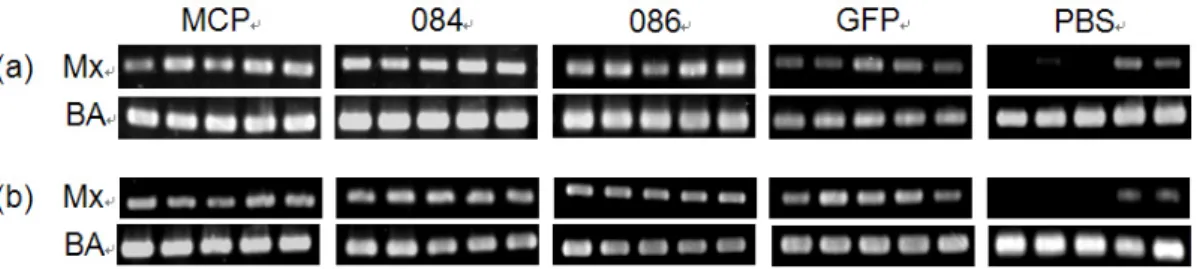
At 24 h post injection, up-regulation of Mx gene was
detected by RT-PCR in all fish injected with each dsRNA, and it persisted to at least 72 h post injection (Fig. 2).
Fig. 2. Detection of Mx gene mRNA expression from spleen of rock bream intramuscularly injected with MCP, ORF084, ORF086, GFP dsRNA or PBS at 24 h (a) and 72 h (b) post injection. The Mx and β-actin (BA) PCR products were run on the same agarose gel, and visualized by staining with etidium bromide (n=5).
Semi-quantitative analysis revealed that the relative expression value of Mx gene were about 2 times higher in all dsRNA injected groups when compared with PBS injected control group, and there was no difference in relative expression value among each dsRNA injected groups at 24 h and 72 h post injection (Table 1).
dsRNAs Relative expression of Mx gene
24 h 72 h
MCP 0.75 ± 0.06 0.70 ± 0.10
ORF084 0.79 ± 0.05 0.79 ± 0.09 ORF086 0.72 ± 0.09 0.80 ± 0.09
GFP 0.73 ± 0.14 0.80 ± 0.10
Control 0.42 ± 0.09 0.36 ± 0.13 Mx gene expression value was normalized to β-actin gene intensity and showed as a mean value with standard deviation (n=5) Table 1. Relative expression of Mx gene in fish injected
with dsRNA at 24 h and 72 h post injection.
Discussion
In the present study, we selected three genes (MCP, ORF 084, and ORF 086) from RBIV genome for preparation of long dsRNAs. Among them, the protein
encoding ORF 084 has the leucine zipper motif that is known as one of the most common mediators of protein-protein interactions (Lupas and Gruber, 2005) and is also found in a DNA-binding domain of transcription factors (Ramji and Foka, 2002). The MCP and ORF 086-encoding protein were reported as effective candidates of antigens in protection of fish against seabream iridovirus infection by genetic immunization (Caipang et al., 2006).
Besides triggering RNAi response, long dsRNA is known to be a strong inducer of type I IFN pathway which is one of the important components of innate immune system of vertebrate. Type I IFNs of mammalian is known to regulate hundred of genes, which classified to several different functional categories such as antiviral, antiproliferative, immune modulation, antigen processing, antigen presentation, signaling and several others (de Veer et al., 2001). Mx gene, one of the well characterized type I IFN inducible genes in vertebrates, was isolated from various species from fish, and its product was reported to have antiviral activity, although true mechanism of inhibition is yet to be known (Caipang et al., 2003; Larsen et al., 2004; Lin et al., 2006). In
this study, fish injected with each dsRNAs equally exhibited up-regulation of Mx gene, which indicated the induction of type I IFN response. Furthermore, the result of semi-quantitative analysis showed no difference in Mx gene expression level among dsRNA injected fish, which indicated that the degree of antiviral state induced by non-specific type I IFN response in each fish is supposedly equal. Thus, delayed mortality observed in fish injected with dsRNAs including GFP dsRNA in this study is thought to be the result of non-specific antiviral effect via type I IFN response which was sequence-independently induced by various dsRNAs.
Acknowledgments
This work was supported by the Pukyong National University Research Fund in 2010 (PK-2010-016).
References
Bagasra, O.: RNAi as an antiviral therapy. Expert. Opin.
Biol. Ther., 5: 1463-1474, 2005.
Bumcrot, D., Manoharan, M., Koteliansky, V. and Sah, D.W.: RNAi therapeutics: a potential new class of pharmaceutical drugs. Nat. Chem. Biol., 2:
711-719, 2006.
Caipang, C.M., Hirono, I. and Aoki, T.: In vitro inhibition of fish rhabdoviruses by Japanese flounder, Paralichthys olivaceus Mx. Virology, 317:
373-382, 2003.
Caipang, C.M., Takano, T., Hirono, I. and Aoki, T.: Genetic vaccines protect red seabream, Pagrus major, upon challenge with red seabream iridovirus (RSIV).
Fish Shellfish Immunol., 21: 130-138, 2006.
de Veer, M.J., Holko, M., Frevel, M., Walker, E., Der, S., Paranjape, J.M., et al.: Functional classification of interferon-stimulated genes identified using microarrays. J. Leukoc. Biol., 69: 912-920, 2001.
Do, J.W., Moon, C.H., Kim, H.J., Ko, M.S., et al.: Complete genomic DNA sequence of rock bream iridovirus.
Virology, 325:351-363, 2004.
Hannon, G.J.: RNA interference. Nature, 418: 244-251, 2002.
Kim, D.H. and Rossi, J.J.: Strategies for silencing human disease using RNA interference. Nat. Rev. Genet., 8: 173-184, 2007.
Larsen, R., Røkenes, T.P. and Robertsen, B.: Inhibition of infectious pancreatic necrosis virus replication by Atlantic salmon Mx1 protein. J. Virol., 78:
7938-7944, 2004.
Lin, C.H., Christopher John, J.A., Lin, C.H. and Chang, C.Y.: Inhibition of nervous necrosis virus propagation by fish Mx proteins. Biochem. Biophys.
Res. Commun., 351: 534-539, 2006.
Lupas, A.N. and Gruber, M.: The structure of alpha-helical coiled coils. Adv. Protein Chem., 70: 37-78, 2005.
Ramji, D.P. and Foka, P.: CCAAT/enhancer-binding proteins:
structure, function and regulation. Biochem. J., 365: 561-575, 2002.
Schyth, B.D., Lorenzen, N. and Pedersen, F.S.: Antiviral activity of small interfering RNAs: specificity testing using heterologous virus reveals interferon-related effects overlooked by conventional mismatch controls. Virology, 349: 134-141, 2006.
Schyth, B.D., Lorenzen, N. and Pedersen, F.S.: A high throughput in vivo model for testing delivery and antiviral effects of siRNAs in vertebrates. Mol.
Ther., 15: 1366-1372, 2007.
Xie, J., Lu, L., Deng, M., Weng, S., Zhu, J., Wu, Y., Gan, L., Chan, S.M. and He, J.: Inhibition of reporter gene and Iridovirus-tiger frog virus in fish cell by RNA interference. Virology, 338:43-52, 2005.
Zenke, K. and Kim, K.H.: Molecular cloning and expression analysis of three Mx isoforms of rock bream,
Oplegnathus fasciatus. Fish Shellfish Immunol., 26: 599-605, 2009.
Manuscript Received : October 22, 2009 Revised : November 22, 2010 Accepted : November 29, 2010