단 보
돌돔 ferritin H 유전자의 클로닝과 발현 분석
권문경*⋅정지민⋅김주원⋅박찬일†17)
*국립수산과학원 병리연구과, 경상대학교 해양생명과학과
Molecular cloning and expression analysis of a ferritin H subunit from rock bream, Oplegnathus fasciatus
Mun-Gyeong Kwon*, Ji-Min Jeong, Ju-Won Kim, Chan-Il Park†
Department of Marine Biology & Aquaculture, Institute of Marine Industry, College of Marine Science, Gyeongsang National University, 455, Tongyeong, 650-160, Republic of Korea
*Pathology Division, National Fisheries Research and Development Institute, Busan 619-900, Republic of Korea
Ferritin is an evolutionarily conserved protein that plays an important role in iron storage and detoxification. In this study, the gene encoding a ferritin H subunit homologue (RbFH) was cloned from rock bream (Oplegnathus fasciatus) and analyzed at the expression. The full-length ferritin H cDNA was 1162 bp long and contained an open reading frame (ORF) of 531 bp that encoded 177 amino acid residues with a predicted molecular mass of 20.8 kDa.
The 5’ UTR was 297 bp in length, and the 3’ UTR 298 bp, and preceded by a 5'-untranslated region that contains a putative Iron Regulatory Element (IRE). The deduced amino acid sequence of RbFH shares extensive sequence identities with the H ferritins of a number of fish species and contains the ferroxidase center that is preserved in ferritin H subunits. Examination of tissue specific expression indicated that RbFH expression was most abundant in PBLs, RBC, liver and muscle.
Key words :Rock bream, Ferritin, Iron, IRE, Real-time PCR
Iron은 생명체가 살아가는데 필수적인 물질이고, 호흡과 DNA 복제와 같은 여러 가지 생물학적인 대사 의 보조인자로서 작용한다. 그러나 유리된 iron은 free radical을 형성하는 촉매작용에 의해 독성을 띄게 되 므로 세포막이나 필수적인 생물학적인 요소에 손상 을 준다. Iron은 ferrous (Fe2+)와 ferric (Fe3+)의 두 가지 의 산화력 있는 상태로 존재하는데, 이것은 전자를 더하거나 뺄 수 있고, 또한 oxygen derived radical과 생체에 유해한 reactive oxygen species (ROS)를 발생
†Corresponding Author : Chan-Il Park
Tel: 82-55-772-9153, Fax: 85-55-772-9159 E-mail: [email protected]
시켜 iron 독성을 가지게 된다 (Hentze and Kuhn, 1996;
Baker et al., 2003). 그러므로 iron결합 단백질 (iron-binding protein, IBPs)에 의한 iron의 조절은 생물 이 살아가는데 필수적이다. Transferrin과 ferritin은 iron 신진대사에 관여하는 iron결합 단백질이다 (Law, 2002; Nichol et al., 2002; Dunkov and Georgieva, 2006).
Ferritin은 세균, 곰팡이, 식물, 동물을 포함한 다양 한 종에서 높게 보존되는 단백질이다. 이것은 보통 450 kDa의 단백질이고, apoferritin 이라 불리는 다공 성 구형의 단백질에 둘러싸인 central hydrous ferric-oxide phosphate core를 가지고 있다. 고등 척추
동물에서 apoferritin은 서로 다른 유전자로 암호화 되는 H (heavy) 와 L (light) subunit이라 불리는 두 종류의 subunit을 구성한다 (Cairo et al., 1991; Orino et al., 1997). 그들은 기능적인 역할에서 높은 상보성 을 나타낸다. Hsubunit은 iron의 신속한 해독작용을 하는 것으로 추측되고, 이것은 ferroxidase canter에서 아미노산 잔기가 높게 보존되어 있다. L subunit은 iron 핵형성, 무기화, 장기간의 보존에서 iron을 축적하 는 역할을 위한 micelle nucleation sites에 영향을 주는 특이적인 carboxylic groups을 포함하고 있다 (Harrison and Arosio 1996; Theil 1990; Rucker et al., 1996).
포유류의 ferritin에 관한 연구는 오랜 시간동안, 많은 진보를 이루었으나, 경골어류에서의 ferritin은 많이 연구되지 않았다. 그리고 기존 경골어류의 보고 에서는 ferritin을 동정하고, 특징을 밝히는데 집중했 으며 (Geetha and Deshpande 1999; Huang et al., 2004), 그 후 이 유전자의 특징과 발현분석이 이루어 졌고, 최근 ferritin H cDNA가 sea bass (Dicentrarchus labrax) (Neves et al., 2009)와 yellow croaker (Pseudosciaena crocea) (Zhang et al., 2010)의 간에서 분리 되었고, H과 M (middle) cDNA는 A. salmon (Salmo salar) (Andersen et al., 1995), Trematomus bernacchii 그리고 T. newnesi (Giorgi et al., 2008)에서 각각 보고되었다.
고등 척추동물의 ferritin과 유사한 ferritin H subunit은 S. salar (Miller et al.,2007), channel catfish (Ictalurus punctatus) (Peatman et al., 2007), D. labrax (Neves et al., 2009)과 Hippoglossus hippoglossus (Peatman et al., 2007)에서 다양한 세균과 바이러스에 감염된 많은
어류 종에서 높게 발현한 것이 보고되었다.
본 연구에서 돌돔 (Oplegnathus fasciatus)의 ferritin H 유전자를 동정하였으며, 특징과 발현 분석을 수행 하였다.
재료 및 방법
시험어
경남 통영시에 위치한 중앙시장에서 평균체중이 275 ± 25 g인 돌돔을 구입하여 실험에 이용하였다.
돌돔(Rock bream) Ferritin H cDNA (RbFH)의 동정 Ferritin H cDNA는 LPS (lipopolysaccharide)로 자극 한 적혈구 cDNA library의 Expressed Sequence Tag (EST) 분석을 통하여 동정하였다. ABI 3100 automatic DNA sequencer (PE Applied Biosystems, CA, USA)와 ABI Prism Big Dye Terminator Cycle Sequencing Ready Reaction kit (PE Applied Biosystems, USA)를 이용하 여 sequence 분석 한 cDNA clone에 기초하였다.
Bioinformatic 분석은 Genetyx ver. 8.0 software (SDC Software, Japan)를 이용하여 유전자의 상동성을 검정 하였다.
RbFH의 특징분석
GENETYX ver. 8.0 (SDC Software Development Co.
Ltd., Tokyo, Japan)를 이용하여 염기서열과 아미노산 서열을 분석하고, multiple alignment는 Clustal W program (Thompson et al., 1994)을 이용하여 수행하였 으며, 비교에 이용된 종의 GenBank accession number 는 rock bream (AB618039), African clawed frog (NP_001083072), beluga whale (BAG82938), cattle (NP_776487), channel catfish (ADE09343), chicken (NP_990417), Zebra fish (NP_571660), dog (NP_001003080), European seabass (ACN80998), house mouse (NP_
034369), human (NP_002023), large yellow croaker (ACY75475), ocellated icefish (CAL92185), rainbow trout (NP_001153993), rhesus monkey (NP_001182309), sablefish (ACQ59065), turbot (ADI24353), yellow grouper (ABI95136)이다. Domain은 PROSITE와 SMART programmes (http://smart.embl-heidelberg.de/)
를 이용하여 동정하였고, 계통발생학적 분석은 Mega 4의 neighbour-joining (NJ) method를 이용 하여 2,000 번의 bootstrap 반복수행 하였다.
RbFH의 조직별 발현분석
RbFH의 조직별 발현분석을 위해 건강한 돌돔의 백혈구 (PBLs), 적혈구(RBC), 두신, 신장, 비장, 간, 장, 아가미, 근육을 적출하여 실험에 이용하기 까지 -80℃에 보관하였다. 각 조직의 total RNA는 Trizol Reagent (Invitrogen, USA)를 이용하여 추출하였고, PrimeScript 1st strand cDNA Synthesis kit (TaKaRa, Japan)를 이용하여 제조사의 방법에 따라 first-strand cDNA로 합성하였다. RbFH의 cDNA 단편을 증폭하 기 위해 사용된 oligonucleotide primer는 RbFH-F (5'-ACC ATG AGT TCC CAG GTG AG-3') 과 RbFH-R (5'-AAA GTT GTG CAA TGC CTG GT-3') 이다. 각 장기들의 cDNA는 real-time PCR을 수행하기 위한 template로 이용하였다. Real-time PCR 분석은 SYBR Green I (Takara, Japan)을 이용하여 94℃에서 5분간 1 cycle, 그리고 94℃에서 30초, 60℃에서 30초, 72℃
에서 1분을 30 cycle, 그리고 72℃에서 7분간반응 하 였고, Thermal Cycler DICE Real Time System (TaKaRa, Tokyo, Japan)를 이용하였다. 대조구와 각 실험구 사이의 통계학적 유의성은 Student’s t-test로 비교하여 P < 0.05 일 때 통계학적 유의성이 있는 것으로 간주하였다.
결과 및 고찰
대부분의 모든 생물체에서 iron은 수많은 근본적
인 생물학적 과정을 포함하는 필수적인 영양소이다.
그러나 과량의 iron은 세포에 유독하며, 산소와 iron 은 Fenton 반응에 의해 세포성분에 손상을 초래하는 hydroxyl radical의 생산을 촉진 한다 (Orino et al., 2001). 결과적으로 iron의 흡수와 대사작용은 호기성
생물에서 엄격하게 조절된다. Ferritin은 원핵생물과 진핵생물을 포함한 광범위한 생물형태에서 iron의 항 상성을 유지하는 단백질이다 (Andrews et al., 1992).
본 연구에서 Full-length의 돌돔 ferritin H cDNA를 동정 하였고, 특징과 발현 분석을 수행하였다.
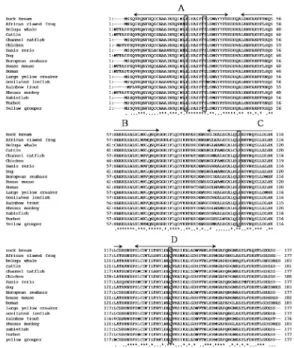
Full-length ferritin H cDNA는 1,162 bp 이고 open reading frame (ORF) 는 531 bp 로 177 개의 아미노산 을 암호화 하며 분자중량은 20.8 kDa이다. 5’ UTR은 297 bp, 3’UTR은 331 bp 이고, polyadenylation signal (AATAA) 와 polyadenylation site를 가지고 있다 (accession number: AB548677) (Fig. 1). In silico analysis에서 RbFH의 두 개의 ferritin iron binding region signature인 (58EEREHAEKLMKLQNQRGGR76 와 123DPHMCDFIETHYLDEQVKSIK143) 그리고 특이 적인 tyrosine 잔기인 Tyr26, Tyr29, Tyr31 와 함께 ferroxidase diiron center를 확인하였다. 포유류 L subunit의 nucleation site에 보존되어 있는 세 개의 음 성 잔기 (Glu54, Glu57, and Glu61)에 상응하는 하나의 잔기 (Glu61)를 RbFH에서 확인할 수 있었다. 두 개의 potential N-glycosylation site인 54NQS 와 109NQS는 많 은 ferritin에 보존 되어 있으며, RbFH에서 또한 보존 하고 있는 것을 확인할 수 있었다. RbFH의 5' UTR을 분석한 결과 iron responsive element (IRE)의 예상되는 CAGUGN motif가 잘 보존되어 있었다. (Thomson et al., 1999)(Fig. 2A). 예상되는 IRE는 IRE-signature sequence 인 CAGUGC가 stem-loop 구조의 꼭대기에 위치한다 (Fig. 2B). RbFH IRE의 stem은 UGC/C sequence의 돌 출된 부분에 의해서 붕괴되는데 이것은 ferritin mRNA 의 특징이다 (Piccinelli and Samuelssonn 2007).
돌돔의 예상되는 아미노산 sequence는 European seabass 와 97 %, yellow croaker와 96 %, yellow grouper 와 95 %, Atlantic salmon과 91 %, turbot과 93 %, channel catfish와 91 %, zebrafish와 88 %, African clawed frog와 79 % 그리고 chicken과 79 %의 상동성이 나타났다.
Fig. 1. The cDNA and deduced amino acid sequence of RbFH. The putative iron response elements (IREs) in the 5’UTR of cDNA is in gray shadow. Putative ferritin iron-binding region signatures (IBRS) 1 and 2 are dotted and bold underlined, respectively. The ferroxidase diiron center with the characteristic tyrosine residues are boxed.
The amino acids that constitute the mammalian H subunit ferroxidase center are in bold and the polyadenylation signal is shown in italic and the polyadenylation signal (AATAA) is underlined with double lines.
Fig. 2. Comparison of the iron response element (IRE) sequences and stem-loop structures of ferritins from different species. (A) Alignment of the rock bream ferritin H IRE with IREs of ferritins from a number of species.
(B) Predicted IRE stem-loop structures of the ferritins from rock bream, turbot, zebrafish, and human.
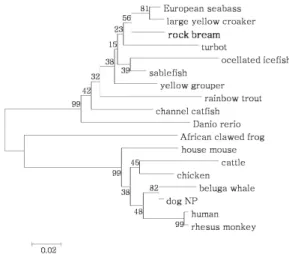
돌돔 ferritin H subunit의 2차 구조 분석에서 4-36, 43-69, 90-116, 120-149 position에서 4개의 helix 구조 가 존재 하는 것으로 나타났다 (Fig. 3). 이 4개의 helix 패턴은 포유류 ferritin의 four-helix bundle과 유사다 (Harrison and Arosio 1996). 계통발생학적 분석에서 RbFH는 척추동물의 cluster 안에 위치하고, 고등 척추 동물의 sub-cluster와는 다른 cluster를 이루었다 (Fig. 4).
생물정보 분석에 따르면 RbFH는 척추동물 ferritin H 의 homolog와 유사하다. 이것은 peptide의 ferroxidase site가 이를 뒷받침 한다. 7개의 아미노산 잔기가 정확 하게 이러한 척추동물의 ferritin H 과 같은 위치에 있고 (Harrison and Arosio, 1996), 세포질에서 ferrous ion (Fe2+)를 ferric ion (Fe3+)으로 산화 시키며 (Lawson et al., 1989;Wade et al., 1991), 5’ UTR에서 IRE를 확인할 수 있다 (Nichol et al., 2002).
Fig. 3. Comparison between the rock bream ferritin H amino acid sequence and other known ferritin H sequences. The amino acids identical to the rock bream sequence are indicated by an asterisk (*), and the absent amino acids are indicated by dashes (-). Amino acids that constitute the ferritin H subunit ferroxidase center are boxed, Black arrows indicate the four predicted helices (A, B, C, and D).
Fig. 4. Neighbour-joining tree of ferritin H constructed with Mega 4. The bootstrap confidence values shown at the nodes of the tree are based on 2000 bootstrap replications.
돌돔 조직에서 Real-Time PCR을 통해 ferritin H 유전자의 발현 분석을 수행하였다. ferritin 유전자는
돌돔의 모든 조직에서 발현하였다. RBC에서 가장
높게 발현된 것을 확인할 수 있었으며, PBLs, 간, 근육 에서 비교적 높게 발현하였고, 비장에서 가장 낮은 발현이 나타났다 (Fig. 5).
Fig. 5. Expression of RbFH mRNA in various tissues of healthy rock bream. PBLs, RBC, head kidney, trunk kidney, spleen, liver, intestine, gill, and muscle were examined. The data are presented as the mean relative ratio of RbFH/β-actin mRNA levels. Errors bars represent SEM (n = 3).
몇 종의 어류에서 ferritin의 전사단계가 보고되었 고, sea bass, Atlantic salmon, Antarctic notothenioid의
H ferritin은 간과 혈액에서 높게 발현 하는 것이 알려 졌다 (Andersen et al., 1995; Neves et al., 2009; Scudiero et al., 2007). 마찬가지로 남극에 서식하는 경골어류 인 T. bernacchii 와 T. newnesi 에서 H ferritin이 간에서 발견되었다 (Giorgi et al., 2008). 그러므로 어류의 간 과 혈액은 H ferritin의 발현이 높게 유지되는 중요한 기관이고, 간과 혈액이 iron 대사와 저장을 하는 중요 한 역할을 한다고 보고되었으며 (Graham et al., 2007), 본 연구에서 간과 혈액에서 높게 발현한 결과와 일치 한다. 근육에서 RbFH의 높은 발현은 경골어류인 turbot에서의 보고와 일치한다(Zheng et al., 2010).
Hemoglonbin은 적혈구의 혈색소로 Fe에 산소를 가역 적으로 결합시켜 산소를 운반하고, myoglobin은 근육 에서 Fe를 통하여 산소의 공급과 신진대사를 조절한 다. 돌돔 근육에서 Ferritin H mRNA의 발현이 높게 나타난 것은 근육 세포에 존재하는 myoglobin이 iron 을 이용하여 산소의 대사를 조절하기 때문일 것으로 생각된다(Raffaella and Miguel, 2013). 또한 이러한 결과는 iron의 신속한 산화와 iron의 전환이 필요한 생물학적 절차에 가담하는 조직에 많은 경향이 있다 는 일반적인 통념과 일맥상통 한다.
결론적으로 본 연구에서 돌돔 ferritin H 유전자를 cloning 하였으며, ferritin H 유전자는 돌돔의 모든 조직에서 발현하는데 특히 RBC, PBLs, 간, 근육에서 높게 발현하고, 두신에서는 그보다 낮았으며, 비장에 서 가장 낮았다.
Iron의 항상성 유지와 숙주의 자연면역은 복잡하 게 연결되어 있으며, 숙주의 세균 감염에서 ferritin은 세균의 증식과 성장을 억제 한다고 보고되었다(Ong Et al., 2006). 추후 연구에서 세균과 바이러스의 인위 감염에서 ferritin H의 발현 패턴 분석과 재조합단백 질과 항체를 이용한 기능분석을 통하여 이 유전자의
면역학적인 기능을 이해하기 위한 연구가 필요하다.
감사의 글
이 연구는 국립수산과학원(RP-2013-AQ-135)의 지원으로 수행되었습니다.
참고문헌
Andersen, O., Dehli, A., Standal, H., Giskegjerde, T.A., Karstensen, R. and Rørvik, K.A.: Two ferritin subunits of Atlantic salmon (Salmo salar):
cloning of the liver cDNAs and antibody preparation. Mol. Mar. Biol. Biotechnol., 4:
164-170, 1995.
Andrews, SC., Arosio, P., Bottke, W., Briat, J.F., Von, Darl. M., Harrison, PM, et al.: Structure, function, and evolution of ferritins. J. Inorg.
Biochem., 47: 161-174, 1992.
Baker, H.M., Anderson, B.F. and Baker, E.N.: Dealing with iron: common structural principles in proteins that transport iron and heme. Proc.
Natl. Acad. Sci. USA., 100: 3579-3583, 2003.
Cairo, G., Rappocciolo, E., Tacchini, L. and Schiaffonati, L.: Expression of the genes for the ferritin H and L subunits in rat liver and heart: evidence for tissue-specific regulations at pre-and post-translational levels. Biochem. J., 275:
813-816, 1991.
Dunkov, B. and Georgieva, T.: Insect iron binding proteins: insights from the genomes. Insect Biochem. Mol. Biol., 36: 300-309, 2006.
Geetha, C. and Deshpande, V.: Purification and characterization of fish liver ferritins. Comp.
Biochem. Physiol. B., 123: 285-294, 1999.
Giorgi, A., Mignogna, G., Bellapadrona, G., Gattoni, M., Chiaraluce, R., Consalvi, V., et al.: The unusual co-assembly of H-and M-chains in the ferritin molecule from the Antarctic teleosts Trematomus bernacchii and Trematomus newnesi.
Arch. Biochem. Biophys., 478: 69-74, 2008.
Gish, W. and David, J.S.: Identification of protein coding regions by database similarity search. Nature Genetics., 3: 266-272, 1993.
Graham, RM., Chua, ACG., Herbison, CE., Olynyk, JK.
and Trinder, D.: Liver iron transport. World J. Gastroenterol., 13: 4725-4736, 2007.
Harrison, PM. and Arosio, P.: The ferritins: molecular properties, iron storage function and cellular regulation. Biochim. Biophys. Acta., 1275:
161-203, 1996.
Hentze, M.W. and Kuhn, L.C.: Molecular control of vertebrate iron metabolism: mRNA based regulatory circuits operated by iron, nitric oxide, and oxidative stress. Proc. Natl. Acad. Sci. USA., 93: 8175-8182, 1996.
Huang, H.Q., Xiao, Z.Q., Chen, X., Lin, Q.M., Cai, Z.W. and Chen, P.: Characteristics of structure, composition, mass spectra, and iron release from the ferritin of shark liver (Sphyrna zygaena).
Biophys. Chem., 111: 213-222, 2004.
Law, J.H.: Insects, oxygen, and iron. Biochem. Biophys.
Res. Commun., 292: 1191-1195, 2002.
Lawson, D.M., Treffry, A., Artymiuk, P.J., Harrison, P.M., Yewdall, S.J., Luzzago, A. et al.:
Identification of the ferroxidase centre in ferritin.
FEBS Lett., 254: 207-210, 1989.
Miller, K., Traxler, G., Kaukinen, K., Li, S.R., Richard,
J. and Ginther, N.: Salmonid host response to infectious hematopoietic necrosis (IHN) virus:
cellular receptors, viral control, and novel pathways of defense. Aquaculture,. 272:
217-237, 2007.
Neves, J.V., Wilson, J.M. and Rodrigues, P.N.S.:
Transferrin and ferritin response to bacterial infection. The role of the liver and brain in fish. Dev. Comp. Immunol., 33: 848-857, 2009.
Nichol, H., Law, J.H. and Winzerling, J.J.: Iron metabolism in insects. Annu. Rev. Entomol., 47: 535-559, 2002.
Ong, S. T., Ho, J. Z. S., Ho, B., Ding, J. L.: Iron-withholding strategy in innate immunity. Immunobiology., 211: 295-314 2006.
Orino, K., Eguchi, K., Nakayama, T., Yamamoto, S.
and Watanabe, K.: Sequencing of cDNA clones that encode bovine ferritin H and L chains.
Comp. Biochem. Physiol., 118B: 667-673, 1997.
Orino, K., Lehman, L., Tsuji, Y., Ayaki, H., Torti, S.V.
and Torti, F.M.: Ferritin and the response to oxidative stress. Biochem. J., 357: 241-247, 2001.
Peatman, E., Baoprasertkul, P., Terhune, J., Xu, P., Nandi, S., Kucuktas, H., et al.: Expression analysis of the acute phase response in channel catfish (Ictalurus punctatus) after infection with a Gram-negative bacterium. Dev. Comp. Immunol., 31: 1183-1196, 2007.
Piccinelli, P. and Samuelsson, T.: Evolution of the iron-responsive element. RNA., 13: 952-966, 2007.
Raffaella, G. and Miguel, P. S.: Coupling heme and iron metaboilsm via ferritin H chain. Antioxidants.
& Redox. Signaling., 2013.
Rucker, P., Torti, F.M. and Torti, S.V.: Role of H and L subunits in mouse ferritin. J. Biol. Chem., 271: 33352-33357, 1996.
Scudiero, R., Trinchella, F., Riggio, M. and Parisi, E.:
Structure and expression of genes involved in transport and storage of iron in red-blooded and hemoglobin-less antarctic notothenioids.
Gene., 397:1-11, 2007.
Theil, E.C.: The ferritin family of iron storage proteins.
Adv. Enzymol. Relat. Areas. Mol. Biol., 63:
421-449, 1990.
Thompson, J.D., Higgis, D.G. and Gibson, T.J.: CLUSTAL W: improving the sensitivity of progressive multiple sequence alignment through sequence weighting, position specific gap penalties and weight matrix choice. Nucleic Acids Res., 22: 4673-4680, 1994.
Thomson, A.M., Rogers, J.T. and Leedman, P.J.:
Iron-regulatory proteins, iron-responsive elements and ferritin mRNA translation. Int. J. Biochem.
Cell Biol., 31: 1139-1152, 1999.
Wade, V.J., Levi, S., Arosio, P., Treffry, A., Harrison, P.M. and Mann, S.: Influence of site directed modification on the formation of iron cores in ferritin. J. Mol. Biol., 221: 1443-1452, 1991.
Zheng, W. J., Hua, Y. H., Xiao, Z.Z., Sun, L.: Cloning and analysis of a ferritin subunit from turbot (Scophthalmus maximus) Fish Shellfish Immunol 28: 829-836 2010.
Manuscript Received : October 17, 2013 Revised : December 09, 2013 Accepted : December 09, 2013