Comparison of Various Single Chemical Extraction Methods for Predicting the Bioavailability of Arsenic in Paddy Soils
Woo-Ri Go, Seon-Hee Jeong, Anitha Kunhikrishnan, Gyeong-Jin Kim, Ji-Hyock Yoo, Namjun Cho, Kwon-Rae Kim
1, Kye-Hoon Kim
2, and Won-Il Kim*
Chemical Safety Division, National Academy of Agricultural Science, RDA, Jeonju 565-851, Korea
1
Department of Agronomy and Medicinal Plant Resources, GNTECH, Jinju 660-758, Korea
2
Department of Environmental Horticulture, University of Seoul, Seoul 130-743, Korea
(Received: October 17 2014, Revised: November 21 2014, Accepted: November 22 2014)
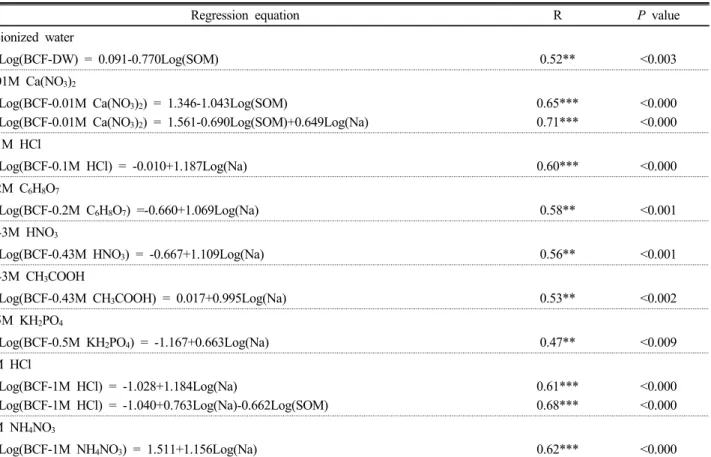
The Codex Committee of Contaminants in Food (CCCF) has been discussing a new standard for arsenic (As) in rice since 2010 and a code of practice for the prevention and reduction of As contamination in rice since 2013. Therefore, our current studies focus on setting a maximum level of As in rice and paddy soil by considering bioavailability in the remediation of As contaminated soils. This study aimed to select an appropriate single chemical extractant for evaluating the mobility of As in paddy soil and the bioavailability of As to rice. Nine different extractants, such as deionized water, 0.01 M Ca(NO
3)
2, 0.1 M HCl, 0.2 M C
6H
8O
7, 0.43 M HNO
3, 0.43 M CH
3COOH, 0.5 M KH
2PO
4, 1 M HCl, and 1 M NH
4NO
3were used in this study. Total As content in soil was also determined after aqua regia digestion. The As extractability of the was in the order of: Aqua regia > 1 M HCl > 0.5 M KH
2PO
4> 0.43 M HNO
3> 0.2 M C
6H
8O
7> 0.1 M HCl > 0.43 M CH
3COOH
> deionized water > 1 M NH
4NO
3> 0.01 M Ca(NO
3)
2. Correlation between soil extractants and As content in rice was in the order of : deionized water > 0.01 M Ca(NO
3)
2> 0.43 M CH
3COOH > 0.1 M HCl > 0.5 M KH
2PO
4> 1 M NH
4NO
3> 0.2 M C
6H
8O
7> 0.43 M HNO
3> 1M HCl > Aqua regia. BCF (bioconcentration factor) according to extractants was in the order of : 0.01M Ca(NO
3)
2> 1 M NH
4NO
3> deionized water > 0.43 M CH
3COOH > 0.1 M HCl > 0.43 M HNO
3> 0.2 M C
6H
8O
7> 0.5 M KH
2PO
4> 1 M HCl > Aqua regia.
Therefore, 0.01 M Ca(NO
3)
2(r=0.78**) was proven to have the greatest potential for predicting As bioavailability in soil with higher correlation between As in rice and the extractant.
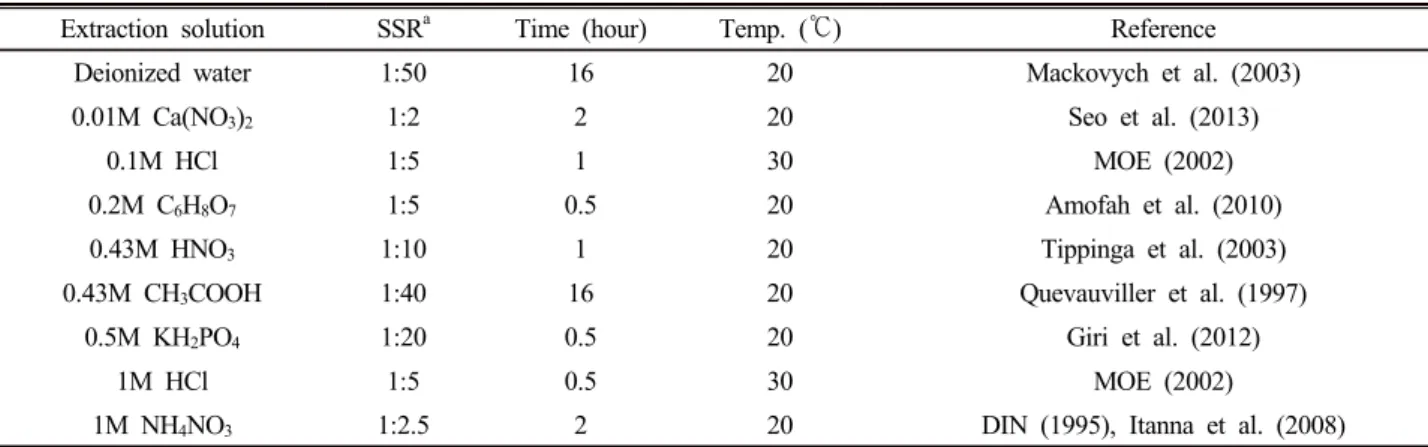
Key words: Arsenic, Paddy soil, Bioavailability, Single extraction method Extraction conditions of the nine extracting solutions for arsenic in soil.
Extraction solution SSR
aTime (hour) Temp. (℃) Reference
Deionized water 1:50 16 20 Mackovych et al. (2003)
0.01M Ca(NO
3)
21:2 2 20 Seo et al. (2013)
0.1M HCl 1:5 1 30 MOE (2002)
0.2M C
6H
8O
71:5 0.5 20 Amofah et al. (2010)
0.43M HNO
31:10 1 20 Tippinga et al. (2003)
0.43M CH
3COOH 1:40 16 20 Quevauviller et al. (1997)
0.5M KH
2PO
41:20 0.5 20 Giri et al. (2012)
1M HCl 1:5 0.5 30 MOE (2002)
1M NH
4NO
31:2.5 2 20 DIN (1995), Itanna et al. (2008)
a
Soil to solution ratio
1)
*Corresponding author : Phone: +82632383245, Fax: +82632383837, E-mail: [email protected]
§
Acknowledgement: This study was financially supported by “Research Program for Agricultural Science & Technology Development
(Project No. PJ 009219)” National Academy of Agricultural Science, Rural Development Administration, Korea.
Introduction
The Ministry of Environment established the criteria of soil contamination for heavy metal(loid)s in the agricultural fields designated by the Soil Environment Conservation Law in 1996 (MOE, 1996). The Ministry of Food and Drug Safety also established the criteria of 0.2 mg/kg for cadmium (Cd) in polished rice in Korea (KFDA, 2000). Recently, our regulations for agricultural environment including soil, irrigation water, agricultural materials (fertilizer and compost etc.), and agricultural products are being gradually reinforced (KFDA, 2011; MOE, 2010a). The CCCF (Codex Committee of Contaminants in Foods) have been under discussion on the maximum levels for arsenic (As) in polished rice since 2010 (FAO/WHO, 2014).
In Korea, the standard method of analyzing heavy metal(loid)s contamination in soils is by aqua regia digestion (MOE, 2010b).
This method is acceptable to evaluate the environmental burden of pollutants to the soil and to decide the proper environmental management and human safety. However, this method is not useful for assessing the metal bioavailability to crops. In order to minimize the risk of heavy metal(loid)s to the agricultural environment, crops, livestock, and humans exposed during the agricultural activities, considering bioavailability for the remediation of heavy metal(loid)s is necessary for agro-food safety (Naidu et al., 2003; Heemsbergen et al., 2009; Kim et al., 2009; Salazar et al., 2012; Bolan et al., 2014). Even though the development of analytical methods for measuring the bioavailability of heavy metal(loid)s in agricultural soils was rare in Korea, various assessment techniques were already developed worldwide. Bioavailability of metal(loid)s in agricultural soils was determined mainly by the concentration of metal(loid)s, the species and fractions of a specific metal(loid), and the physico-chemical properties of soils (Ruby et al., 1993; Geebelen et al., 2002; Kim et al., 2012a). Various single and stepwise sequential extraction methods were suggested to estimate the bioavailability of heavy metal(loid)s in agricultural soils. The Soil Environment Conservation Law recommended the use of 0.1 M HCl for cadmium (Cd), lead (Pb), copper (Cu), chromium (Cr), nickel (Ni), and zinc (Zn) and 1.0 M HCl for As to evaluate their bioavailability (MOE, 2002). It was reported by regression analysis that the bioavailability of Cd and Zn to rice was higher than those of Cu and Pb. It was also concluded that the 0.1 M HCl extractable heavy metal(loid)s in soil were more closely correlated with heavy metal(loid)s in husked rice than 0.1 M HNO
3, 0.005 M DTPA and 0.05 M EDTA extractable heavy metal(loid)s in soil (Jung et al., 2000). It was also reported that the 0.01 M Ca(NO
3)
2extraction method was effective than the 1 M NH
4NO
3extraction method for the bioavailability of Cd and other metal(loid)s in soils (Seo et al., 2013). However, there are few studies on the As bio- availability in agricultural soils in Korea. Therefore, the objectives
of this study were (i) to propose a suitable single extraction method for assessing the bioavailability of As in soils, (ii) to verify the physico-chemical factors affecting As uptake and its transformation to rice, and (iii) to finally identify and develop the countermeasure techniques to conserve the As contaminated paddy soils.
Materials and Methods
Soil and rice sampling Thirty As contaminated sites with various levels of As in soils were selected based on the result of a detailed survey at the 300 abandoned mines by the Ministry of Environment during 2007~2009 due to high concentration of As (MOE, 2007~2009). Soil and rice samples were collected within a 100~1,000 m distance from each site in 2012. All soil samples comprised of 3~6 sub-samples collected within a depth of 15 cm from the surface in each mine site. Soil samples were air-dried, crushed, passed through a 20-mesh sieve, and ground with a mortar. The harvested rice samples were air-dried, polished with a rice mill (Husked : SYTH88, Ssangyong Instrument, Korea, Polished : McGill miller, HT McGill Inc, USA), and then pulverized with a homogenizer.
Soil properties The soil pH value was measured at the ratio of 1:5 soil:deionized water suspension using pH meter (250A, Thermo Orion, Beverly, MA). The soil organic matter (SOM) was determined by Tyurin method with K
2Cr
2O
7(Tyurin, 1931). The exchangeable cations, i.e. calcium (Ca), potassium (K), magnesium (Mg), sodium (Na), were measured using 1 N ammonium acetate at pH 7.0, and analyzed by Inductively Coupled Plasma Optical Emission Spectroscopy (ICP-OES, GBC XMP, Australia) (NIAST, 2000).
Determination of arsenic in soil and rice Standard reference material (SRM; Contaminated soil BAM-U112;
BAM Federal Institute for Materials Research and Testing, Berlin, Germany) and 3 g soil samples were acid digested with aqua regia as described by the Ministry of Environment (MOE, 2010b). Aqueous soil samples were filtered with Whatman No. 5B filter, and analyzed for As using hydride generation (HG)-ICP-OES (GBC XMP, Australia). To compare the bioavailability of As in paddy soils, nine different soil extractants such as deionized water, 0.01 M Ca(NO
3)
2, 0.1 M HCl, 0.2 M C
6H
8O
7, 0.43 M HNO
3, 0.43 M CH
3COOH, 0.5 M KH
2PO
4, 1 M HCl, and 1 M NH
4NO
3were used (Table 1).
These extractants were generally selected on soil extraction
efficiency, phytoavailability and soil pollution index. Previous
studies have shown that soil extraction or washing process
has the potential to remove As from contaminated soils using
inorganic phosphate salts (KH
2PO
4), inorganic acids (HCl
and HNO
3) and organic acids (CH
3COOH, C
6H
8O
7). We
Table 1. Extraction conditions of the nine extracting solutions for arsenic in soil.
Extraction solution SSR
aTime (hour) Temp. (℃) Reference
Deionized water 1:50 16 20 Mackovych et al. (2003)
0.01M Ca(NO
3)
21:2 2 20 Seo et al. (2013)
0.1M HCl 1:5 1 30 MOE (2002)
0.2M C
6H
8O
71:5 0.5 20 Amofah et al. (2010)
0.43M HNO
31:10 1 20 Tippinga et al. (2003)
0.43M CH
3COOH 1:40 16 20 Quevauviller et al. (1997)
0.5M KH
2PO
41:20 0.5 20 Giri et al. (2012)
1M HCl 1:5 0.5 30 MOE (2002)
1M NH
4NO
31:2.5 2 20 DIN (1995), Itanna et al. (2008)
a
Soil to solution ratio
selected water and neutral salt extracts (Ca(NO
3)
2and NH
4NO
3) since they are the most widely used, have a small effect on pH, and best correlated with plant uptake. 0.5 M KH
2PO
4and 0.43 M HNO
3were also proved to be available to plants. Soil extracts were continuously shaken at 30°C for 1 h, filtered with Whatman No. 5B filter, and analyzed by HG-ICP-OES.
The accuracy of As in SRM was 8.41 ± 0.52 with certified values of 10.4 ± 0.4 mg/kg. The recovery values of As was 81.27 ± 4.98. 0.5 g of polished rice samples were transferred into a high pressured-polytetrafluoroethylene (PTFE) vessel and digested with 8 mL of 70% HNO
3and 1 mL H
2O
2(Sigma-Aldrich, St. Louise, MO) using microwave digestion system (ETHOS, Milestone, Italy). After cooling to room temperature, the extracts were filtered through a 0.45-μm membrane filter, and adjusted to a final volume of 25 mL. The As contents in polished rice were determined by ICP-MS (Agilent technologies 7500a). The SRM accuracy value of As was 0.29 ± 0.05 with certified value of 0.29 ± 0.03 mg/kg.
Extraction efficiencies (%), determined by dividing the extracted As content by total As content were 100.58 ± 17.59.
Calculation of bioconcentration factor (BCF) Biocon- centration factor (BCF, Eq. (1)) is defined as the ratio of the As concentration in crops (mg/kg DW) and soil (mg/kg DW) considering the crop uptake from soils and its transformation to the edible part of crops (Kim et al., 2012b).
Bioconcentration factorBCF
(1)
Calculation of soil-water partition coefficient for arsenic (Kd) The soil water partition coefficient (Kd, Eq. (2)) describes the partitioning of As over two phases (Krishnamurti and Naidu, 2000; Naidu et al., 1994; Sauve et al., 2000). Equation 3 was used in this study to estimate the As bioavailability in soil.
Partitioning coef ficientK
d
(2)
Partitioning coef ficients K
d
(3)
Statistical Analysis Single and multiple regression analysis were performed using SPSS statistical program ver. 12.0 (SPSS Co., Chicago, IL) to investigate the influence of soil characteristics, i.e. pH, organic matter, and exchangeable cations on As contents in soil and rice. In regression analysis, the total and extractable As contents in soil, and As concentration in rice were log
10-transformed to make homogeneous variances.
Results and Discussion
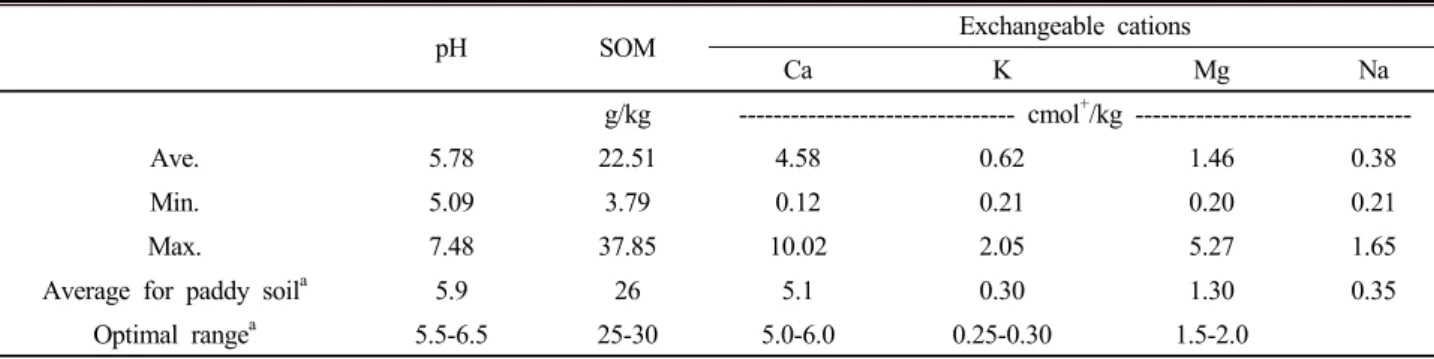
Soil Characteristics The results of characterized soil samples (n=30) are as follows: soil pH ranged from 5.1 to 7.5, SOM contents ranged from 3.79 to 37.85 g/kg dry soil, with a mean value of 22.51 g/kg dry soil. This value was slightly lower than 26.0 g/kg which was the average content of paddy soils in Korea. The concentration of cations ranged between 0.12 - 10.02 cmol
+/kg for Ca, 0.21 - 2.05 cmol
+/kg for K, 0.20 - 5.27 cmol
+/kg for Mg, and 0.21 - 1.65 cmol
+/kg for Na (Table 2).
Soil pH 7.0 of paddy soils near SS mine was higher than 5.5 of MB mine and 5.6 of TC mine. Ca and Mg content in SS paddy soil were also higher than those of MB and TC mine. It means there was soil reclamation activity for the metal(loid)s contaminated paddy soils near SS mine by the addition of lime material.
Arsenic Contents in Soils and Polished Rice Average
content and range of As in the surveyed paddy soils were
26.87 and 10.90 - 88.92 mg/kg, respectively. It was found out
that thirteen samples among 30 exceeded the As concern level
Table 2. Chemical properties of the soils used in this study.
pH SOM Exchangeable cations
Ca K Mg Na
g/kg --- cmol
+/kg ---
Ave. 5.78 22.51 4.58 0.62 1.46 0.38
Min. 5.09 3.79 0.12 0.21 0.20 0.21
Max. 7.48 37.85 10.02 2.05 5.27 1.65
Average for paddy soil
a5.9 26 5.1 0.30 1.30 0.35
Optimal range
a5.5-6.5 25-30 5.0-6.0 0.25-0.30 1.5-2.0
a
RDA, 2011.
Table 3. Total arsenic content in the soils and polished rice.
Total As content in soil Total As content in rice --- mg/kg ---
Ave. 26.87 0.09
Min. 10.90 0.03
Max. 88.92 0.23
Average for paddy soil
a7.5
Concern level in area 1
b25
a
RDA, 2011.
b
MOE, 2010a.
Table 4. Arsenic contents with the nine single-extracting solution.
Soil Deionized water
0.01M
Ca(NO
3)
20.1M HCl 0.2M C
6H
8O
70.43M HNO
30.43M CH
3COOH
0.5M
KH
2PO
41M HCl 1M NH
4NO
3--- mg/kg ---
Ave. 0.181 0.013 0.665 2.132 2.455 0.497 3.357 5.489 0.018
%
10.67 0.05 2.47 7.93 9.14 1.85 12.49 20.43 0.07
Min. 0.010 0.001 0.040 0.220 0.170 0.020 0.410 0.330 0.001
Max. 1.440 0.112 6.830 11.824 14.25 6.140 14.75 30.04 0.197
1