584
FOREST SOCIETY
Impact of Pruning Intensity on Tree Growth and Closure of Pruning Wounds of Pinus strobus L. and
Acer palmatum Thunb.
Kyu Hwa Lee* and Kyung Joon Lee
Department of Forest Sciences, Seoul National University, Seoul 151-921, Korea
Abstract :The objective of this study was to examine the impact of pruning intensity on the vigor and cambial growth of the treated trees, and on the closure of pruning wounds for one year after pruning treatment. Two tree species, Pinus strobus and Acer palmatum, planted broadly in the urban forest of Korea were selected for the experiment. Intensity of pruning, which was estimated by proportion of removed branches, was categorized into five levels with about 10% intervals from lowest 8% up to 46%. Following parameters were examined; cambial electrical resistance (CER) and the cambial growth of trunk at 30 cm above the ground for the years before and after pruning, the cambial growth of stem at 1.5 cm above the branch bark ridge (BBR) of the pruned branch, and closure of pruning wound for one year after pruning.
Tree vigor inferred from CER had a tendency to be weakened as pruning intensity increased in P. strobus, while that of A. palmatum was not affected. The trunk growth decreased significantly when the pruning intensity was higher than 30% in both species. The closure of individual pruning wound was related more to the cambial growth of stem at 1.5 cm above BBR than to the pruning intensity. Comparing the closure rate of pruning wound for one year, P. strobus with 72.1% was faster than A. palmatum with 39.3%, which corresponded with the rate of cambial growth of the two species.
Key words :tree vigor, cambial electrical resistance, tree growth, branch bark ridge, closure of wound, cambial growth
Introduction
Various trees have been planted in urban area for many reasons. Diverse practices are applied to mainte- nance of the trees in urban forest, and the pruning of trees is probably the most noticeable and important activity of all tree maintenance practices (Hartman et al., 2000). The pruning is the selective removal of portions of trees to meet specific goals and objectives, while trees store their energy reserves in branches, stems, trunk, and roots. Excessive branch removal, therefore, depletes these reserves and reduces the ability of the trees to pho- tosynthesize more energy, which may have an adverse effect on tree growth (Gillman and Lilly, 2002). In the mean time, this kind of indiscreet pruning practice is still committed, and clear understanding on the impact of pruning on tree growth and health is necessary.
Researches on the influence of pruning on the growth of trees were originated from silvicultural purposes in
plantations to produce knot-free wood without unduly affecting growth. Møller (1960) thoroughly reviewed the principal literatures published by that time regarding the influence of pruning on the growth of conifers. He con- cluded the commonly accepted maxim that one-third of the vertical length of the live crown can be removed without reducing cambial increment was not always cor- rect, even though it might have little effect on height growth. A research on Eucalyptus nitens, growing in plantations in Tasmania showed 50% removal of the lower green crown length had no impact on height or diameter increment in the two years following the treat- ment (Pinkard and Beadle, 1998). Another experiment on Quercus myrisinaeforia proved that 50% leaf removal did not affect the radial growth of trunk (Ishii et al., 2003). While Gartner et al. (2005) who conducted a research on young Douglas-fir reported a similar result that removal of 50% of the live crown in young trees caused some one-year decline in growth of ring width at breast height, while removal of 30% of the live crown did not.
Pruning inevitably induces wounds, and wound heal-
*Corresponding author E-mail: [email protected]
ing may have different physiological interpretation. Neely (1970; 1973) reported that the rate of healing of wounds was directly correlated with radial growth of the tree, and tree species affected the rate of healing of wounds, but the amount of healing per unit of radial growth was different from species to species.
Removal of a quarter or one third of the length of the live crown is generally suggested as a reference of prun- ing intensity (American National Standard Institute, 2001; Smith et al., 1997), though it is still controversial, and is based on the researches on the limited species for plantation, not on the trees in urban forests. Similarly, a few researches to determine the impacts of tree vigor on wound closure have been conducted on artificial wounds made on the trunks, not on pruning wounds resulted from branch cut. These researches, therefore, are not directly applicable to the maintenance of urban forests which consisted of various species of trees with having different pruning responses and requiring different treat- ments.
The aim of this study described here was to determine the impact of pruning intensity on the vigor and cambial growth of the treated trees, and on the closure of pruning wounds. The trees selected for this experiment were Pinus strobus L., a evergreen conifer, and Acer palma- tum Thunb., a deciduous hardwood, both of which are planted broadly in the urban forest of Korea.
Materials and Methods 1. General description of experimental species
Field-grown Pinus strobus L. (eastern white pines) and Acer palmatum Thunb. (Japanese maple) with forty trees each were used for this experiment. Of the forty trees, twenty five trees were chosen for pruning treatments, while remaining fifteen trees each were left untouched for a control treatment to observe health and cambial growth of each species. The P. strobus growing in Jin- cheon, Chungbuk, Korea (36.49.543N, 127.27.020E) were eleven years old, 11.6 cm thick in average diameter at 30 cm above the ground and 460 cm tall in average height. The A. palmatum growing in Yeoju, Gyeonggi, Korea (37.10.841N, 127.38.900E) were thirteen years old, 10.9 cm thick in average diameter at 30 cm above the ground and 360 cm tall in average height. Both of the species were growing on well-drained brown forest soil, which is the prevailing forest soil in Korea (Jin et al., 1994).
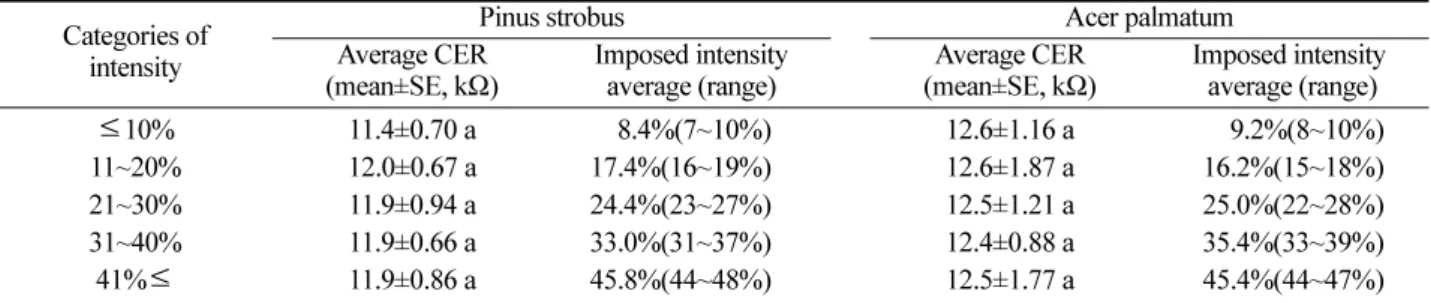
Intensity of pruning was classified into five categories at about 10% intervals starting from lowest 8% up to 46% (Table 1). Five trees were assigned to each category so that average tree vigor of the category may not be significantly different using cambial electrical resistance
(CER) of the trees. The CER of each tree was deter- mined by averaging two readings per tree on opposite sides of the stem (Shigo and Shortle, 1985). The CER was measured for five months on around the tenth of every month from July 2007 to November 2007 with a Shigometer (Model: OZ-93).
2. Terminology
Specific definitions for trunk, stem and branch for this study were introduced to avoid confusion with the understanding of general biological terms. A trunk means a part of tree between the root collar and the first branch developed on the main stem of the tree. A stem is a relative concept to the branch, that is, the stem means a part of tree bearing a branch or branches which may be removed when a pruning is made. So a branch can be called a stem if the particular branch has a devel- oped branch or branches which are cut off by pruning. A branch, which is used as a relative concept to the stem above mentioned, means a part of tree that grows out from the main stem or trunk and has leaves, fruit, or smaller branches growing from it. In this study, the size of the branches for pruning was between 1 cm and 4 cm in diameter at 1.5 cm above the branch bark ridge (BBR).
3. Pruning cuts and experimental period
Pruning cuts were conformable to the American National Standard (American National Standard Insti- tute, 2001). A pruning cut was made close to the trunk or parent limb, without cutting into the branch bark ridge (BBR) or collar, or leaving a stub (Figure 1). In case where branch collar was not readily apparent, the cut bisected the angle between its BBR and an imaginary line perpendicular to the branch. A branch that was too large to support with one hand was precut to avoid split- ting of the wood or tearing of the bark. The proper angle of cut depends on the branch collar. Conifers have flat branch collars and a straight cut close to the collar was made for P. strobus (Shigo, 1989). The number of the cuts per tree was minimum two in case of the tree for low pruning intensity up to sixteen for high pruning intensity. A total of 180 cuts for P. strobus and 133 for A. palmatum were made.
Pruning treatments were made in early March 2008 before the spring growth flush, which was generally rec- ommended time for pruning in temperate zone. All treated trees were harvested in early March 2009, one year after those pruning. Three trees in the control group were harvested simultaneously to compare their cambial growth with that of treated groups. The harvested trees were the trees whose CERs were the closest to the arith- metic mean of the group.
4. Estimation of pruning intensity
Pruning intensity was estimated by making a compar- ison between the amount of removed branches by prun- ing and whole branches existing on a tree at the time of pruning. In case of P. strobus the amount of branches of a tree was estimated by summing diameters at 1.5 cm above the BBR of all branches, while it was considered a branch if a diameter at 1.5 cm above the BBR was smaller than 5 cm even if it was a main stem when prun- ing was made. Consequently, the pruning intensity of P.
strobus was calculated by dividing the sum of diameters of removed branches with the total amount of diameters of a tree. Pruning intensity of A. palmatum was esti-
mated by the proportion of number of removed shoots about 1 cm thick. The number of shoots of each tree was counted before pruning. Imposed average intensity after pruning was between 8.4% and 45.8% (Table 1).
5. Measurements
Prior to pruning, diameters of branches and stems at 1.5 cm above the BBR were gauged with a caliper.
Immediately after each cut, horizontal width and vertical length of the pruning wound crossing the center of branch were measured, and the wound area was calcu- lated for an ellipse. CER was checked every month from March to November during the growing season to mon- Figure 1. A pruning cut was made close to the stem without cutting into the branch bark ridge (BBR), or leaving a stub.
A branch too large to support with one hand was precut to avoid splitting of the wood or tearing of the bark (1: American National Standard Institute, 2001). Pinus strobus with flat branch collars (Figure A) was pruned with straight cut close to the collar as suggested by Shigo (1989). Locations of BBRs and branch collars, and the results of pruning after correct cuts for Acer palmatum (2, 3) and P. strobus (B, C) were shown.
itor the impact of the intensity on the tree vigor with the Shigometer as the same manner mentioned earlier.
Disks of the trunks and samples around the pruning wounds were secured when the trees were harvested.
The disks were collected from treated trees and three trees in control group, at 30 cm above the ground to examine the impact of branch removal on cambial growth. After harvesting, the width of annual rings for the year immediately before and after pruning on two radii at right angles was measured from the disks, and the average width of the each ring was considered as an annual cambial growth of the tree (Husch et al., 2003).
Stem diameters at 1.5 cm above the BBR, and horizontal width and vertical length of the unenclosed pruning wound were gauged to determine cambial growth of the stem around the pruning wound, and the enclosure of the pruning wound, respectively.
6. Data analysis
Some indicators like CER for tree vigor were intro- duced for this study (Table 2). Trunk growth rate (TGR)
for the relative cambial growth at 30 cm above the ground was calculated by comparing the width of annual rings of the year immediately after pruning to the width of the year immediately before the pruning. On the other hand, stem growth rate (SGR) for the cambial growth at 1.5 cm above the BBR was estimated by comparing the diameter of the stem at 1.5 cm above the BBR one year after the pruning to the diameter of the stem at the same point at the time of pruning. Wound closure rate (WCR) was introduced to examine the enclosing extent of the pruning wound during the year after the cut was made.
WCR, expressing the change of open area of pruning wound, indicated vitality of the cambium around the wound forming wall 4 (a wall formed by cambium after wounded) in CODIT, compartmentalization of decay in trees (Shigo and Marx, 1977).
The statistical difference among the means of the treatments expressed by indicator was determined using the Duncan’s multiple comparison procedure. In all sta- tistical analyses the significance level, á-value, was 0.05 unless otherwise specified.
Table 1. Intensity categories of branch removal, average and range of imposed intensity of each category, and average cambial electrical resistance (CER) of the trees allocated to the categories from July to November 2007 before pruning.
(Means±SE (standard error) with the same letter are not significantly different at P ≤ 0.05) Categories of
intensity
Pinus strobus Acer palmatum
Average CER
(mean±SE, kΩ) Imposed intensity
average (range) Average CER
(mean±SE, kΩ) Imposed intensity average (range)
≤10% 11.4±0.70 a 8.4%(7~10%) 12.6±1.16 a 9.2%(8~10%)
11~20% 12.0±0.67 a 17.4%(16~19%) 12.6±1.87 a 16.2%(15~18%)
21~30% 11.9±0.94 a 24.4%(23~27%) 12.5±1.21 a 25.0%(22~28%)
31~40% 11.9±0.66 a 33.0%(31~37%) 12.4±0.88 a 35.4%(33~39%)
41%≤ 11.9±0.86 a 45.8%(44~48%) 12.5±1.77 a 45.4%(44~47%)
Table 2. Indicators to analyze growth of trunks and stems, and changes in areas of pruning wound after pruning.
Indicators Formulae
Trunk Growth Rate (TGR, %)
: width of an annual ring at 30 cm above the ground for the year immediately after pruning : width of an annual ring at 30 cm above the ground for the year immediately before pruning Stem Growth Rate (SGR, %)
: stem diameter at 1.5 cm above the BBR adjacent to the pruning wound at the time of pruning : stem diameter at 1.5 cm above the BBR adjacent to the pruning wound one year after pruning Wound Closure Rate (WCR, %)
: area of pruning wound at the time of pruning : area of pruning wound 1 year after pruning
TGR WARy 1+ WARy 1–
--- 100×
=
WARy 1+ WARy 1–
SGR SDy 1+ –SDy0 SDy0
--- 100×
=
SDy0 SDy 1+
WCR PWAy0–PWAy 1+ PWAy0
--- 100×
=
PWAy0 PWAy 1+
Results
Figure 2 shows relationship between pruning intensity and average cambial electrical resistance (CER) during one year after pruning. Tree vigor represented by CER had a tendency in P. strobus that the higher the pruning intensity was the weaker the vigor was, while the dif- ferences of the annual average CERs among the each treatment were not statistically significant (P=0.20). The annual average CER increased from 9.7 kΩ of control group to 11.3 kΩ of the intensity of 31~40%, and decreased again at the intensity of 41% or more to 10.8 kΩ. A. palmatum did not show a distinct relationship between the pruning intensity and the CER. The annual average CER at the intensity of 11~20% with 13.7 kΩ was the lowest, and the average CERs at the intensity of 21~30%, 31~40% and 41% or more were 15.2 kΩ, 14.8 kΩ and 14.7 kΩ, respectively, which were little differ- ence with that of control group with 14.4 kΩ.
On the other hand, cambial growth rate of the trunk (TGR) for one year after pruning showed negative rela- tions with the pruning intensity, that is, the severer the intensity was the lower the TGR was (Figure 3). The TGRs at the intensity of 10% or less for both of the spe- cies were 106.7% and 100.3%, respectively, which
meant the cambial growth of trunk was not affected by the branch removal for that intensity. However, the TGRs at the intensity of 31~40% for both species, imposed average intensities of 33.0% for P. strobus and 35.4% for A. palmatum, were reduced significantly to 82.5% for P. strobus and 79.9% for A. palmatum, respectively (P=0.015 for P. strobus and 0.034 for A.
palmatum). These results suggest that branch removal higher than one-third would affect the cambial growth of those species.
Figure 4 shows relationship between pruning intensity and wound closure rate (WCR) during one year after pruning. The impact of pruning intensity on the closure of individual pruning wound (WCR) was not clear. The WCR of P. strobus was the highest at the intensity of 41% or more with 74.7%, but the highest WCR for A.
palmatum was at the intensity of 31~40% with 49.8%.
This implies that the closure of the pruning wound is related more to other factors than to the vigor or growth of the trunk.
Figure 5 shows relationships between the cambial growth rate of stem (SGR) at 1.5 cm above the BBR adjacent to the pruning wound and WCR during one year after pruning. It shows that the pruning wounds were closed fast when the cambial growth rate of the
Figure 2. Relationship between pruning intensity and average cambial electrical resistance (CER) during one year after pruning.
Figure 3. Relationship between pruning intensity and trunk growth rate (TGR) at 30 cm above the ground during one year after pruning.
stem bearing the pruning wound was high. In case of P.
strobus, 75.2% of the wound area in average was healed for one year after pruning when the SGR was 21~30%, which was significantly higher than the WCR of the SGR at 10% or less with 63.8% (P=0.026). Such a rela- tionship in A. palmatum was more obvious. The WCR at the SGR of 11~15% with 35.7% was significantly higher than that at the SGR of 10% or at less with 24.0%
(P=0.012), and that at the SGR of 31% or more with 54.8% was also significantly higher than that at the SGR of 16~20% with 38.3% (P=0.036).
In the rate of pruning wound closure A. palmatum with 39.3% was lower than P. strobus with 72.1%. Such a disparity in the WCR between two species corre- sponded with differences in the rates of the cambial growth of stems. The stems bearing the pruning wounds of P. strobus grew by 1.58cm in average in diameter for one year after pruning, but those of A. palmatum grew by 0.61 cm only.
Discussion
As the cambial zone increases in thickness, it can hold more moisture, and more moisture can hold more ions.
The thicker the cambial zone is, the lower the electrical resistance and the more vigorous the tree is. Thus CER is used to help determine relative tree vigor (Shigo and
Shortle, 1985). Shortle et al. (1977) reported the resis- tance to a pulsed electric current in the cambial zone of sprout red maple and hybrid poplar was inversely pro- portional to the rate of growth. Similar results about cor- relations between CER and the tree growth were obtained from the studies on balsam fir (Abies balsamea L.) in three states including Maine (Blanchard et al., 1983), on peach trees (Prunus persica) in West Virginia (Wisniewski and Wilson, 1985), and on Norway spruce (Picea abies Karst.) in Sweden (Lindberg and Johans- son, 1989).
However different results were revealed in the studies on trees planted in urban landscapes. Kostka and Sherald (1982) reported that measurements of CER did not reflect tree vigor as accurately as growth measurement based on the experiments with Pinus strobus planted along the street in Washington, D.C., and Clark et al. (1992) also claimed that CER measurements for sweet- gum trees planted on streets in Seattle, Washington could not related to growth parameters such as seasonal shoot increment and diameter growth. The discrepancy between CER and TGR in the present study could hap- pen because CER values alone could not be used to pre- dict the diameter development.
Most researches on the influence of pruning on the tree growth were conducted by silviculturists in the first half of the twentieth century. Those experiments were Figure 4. Relationship between pruning intensity and wound closure rate (WCR) during one year after pruning.
Figure 5. Relationships between stem growth rate (SGR) at 1.5 cm above the branch bark ridge adjacent to the pruning wound and wound closure rate (WCR) during one year after pruning.
mainly made on the trees in plantations with Douglas-fir, various American pine species, and rarely Norway spruce. Even though pruning had little effect on height growth (Lehtpere, 1957; McClay, 1953; Stein, 1955), most authors found a depressing effect on diameter increment by pruning of one-third of the living crown or more (Møller, 1960), which was confirmed in the present study. Bennett (1955) reported that diameter growth of slash pine, Pinus elliottii, was reduced significantly in the first year after 35% removal of live crown. Pruning 25% or more of the living crown reduced diameter increment in young western white pine, Pinus monticola (Buchanan, 1944), and heavy pruning (removing 26~35%
of living whorls) reduced diameter growth of the eastern white pine, Pinus strobus (Barret and Downs, 1943).
According to Lehtpere’s (1957) experiment on 12- year-old Douglas-fir with reducing the crown length by 32%, a significant reduction in the girth increment at breast height was obtained at the end of the first growing season following pruning, but the growth of the pruned trees in the third growing season was a little better, but not significantly, than that of the control trees. Such a recovery by the third year was not surprising, because the three lost whorls of the Douglas-fir was replaced by three new whorls. Another study on young Douglas-fir for 13 years showed that one third of the live crown length can be removed without harmful effect (Stein, 1955).
Some latest studies on hardwoods showed different results. The 50% crown removal of Eucalyptus nitens had no impact on height or diameter increment in two years following treatment (Pinkard and Beadle, 1998), and 50% leaf removal of Quercus myrisinaeforia did not affect the growth of trunk neither (Ishii et al., 2003).
These diverse results of the researches imply that the effects of pruning intensity on the growth of trees may vary with the experimental conditions such as species, period, intensity of treatment, etc.
Few researches were made about the effect of pruning intensity on the closure of pruning wound. A similar experiment on sugar maple was done by Wargo (1977).
He defoliated the trees for 3 consecutive years during the growing season (between May and August), and made artificial wounds on trunk at 15 cm above the ground in early March of the forth year, and finally har- vested them in November following year. The results were that the areas of open wounds on defoliated trees were larger than those on undefoliated trees. Such severe treatments would affect on the closure of wounds made on 15 cm above the ground, considering the impact of branch removal higher than one-third on the cambial growth at 30 cm above the ground in the present study.
But it is hard to apply these results of extreme treat-
ments directly to the present study, and is necessary to find other factors to affect the closure of individual prun- ing wounds other than pruning intensity.
Figure 3 suggested that the growth of stem bearing the pruning wounds was the factor to affect the closure of individual pruning wounds when the intensity was below 50%. Researches on the wound closure so far supported the results of the present study. Experiments on wound closure until now were conducted on the artificial wounds made on stems. The results of the experiments showed high correlations between the wound closure and cambial growth of the stem, and the pruning wounds and the growth of stems bearing the pruning wounds of the present study could be substituted for the artificial wounds and the cambial growth of the stem, respec- tively. Neely (1970, 1973, 1983) reported the results of several researches about the correlation between wound closure and cambial growth. Three-year experiment on white ash, honey locust and pin oak revealed that the healing rate of wounds made 60 to 180 cm above the ground was directly correlated with cambial growth at 100 cm above the ground of the trees. Similar results were obtained from the experiments with six species including soft maple and American elm, and with five species including Plantanus occidentalis. Shortle (1979) also reported that wounds closed more quickly in hybrid poplar trees of high vigor, and aforesaid experiment done by Wargo (1977) had something in common with the results of the present study.
Researches on correlations between cambial growth and wound closure among tree species were limited.
Neely (1970; 1973; 1983) made experiments three times on the correlations with a total of 10 tree species, and reported that the species differed in the rate of cambial growth and wound closure. According to the experi- ments, tulip trees and pin oaks were the fastest in radial growth and wound closure, while American elm and soft maple trees were the slowest in the growth but faster in the wound closure than white ashes and honey locusts.
In the present study, P. strobus was faster in both of cambial growth and wound closure than A. palmatum, but the wound closure rate per unit of cambial growth of A. palmatum (39.5% vs. 6.1 mm=r6.5%/mm) was higher than that of P. strobus (72.1% vs. 15.8 mm=4.6%/mm), which showed a variation in healing efficiency as com- pared with previous studies.
Branch removal more than one-third in the present study brought in a reduction of the cambial growth of the tree, but variations of impacts by different pruning intensities could not be detected by the CER alone. It suggests the necessity of additional means to monitor the tree vigor more accurately. The rate of pruning wound closure was more correlated with the growth of the stem
bearing the wound than the growth of trunk of the tree, which means the vigor of the stem should be considered when pruning is made. Differences in growth patterns among trees caused variations in the rates of cambial growth and wound closure. Trees growing slowly some- times enclosed the wounds efficiently compared with the rate of cambial growth, but the rate of wound closure is more important, because the lower the closure rate is the longer the exposed period of the wounds to the decay fungi is, and the decay process continues as long as the wound remains open (Shigo and Larson, 1969). More researches are necessary for effective tree care consid- ering the engagement of innumerable factors and various patterns of tree growth, and this study would be a part of them.
Literature Cited
1. American National Standard Institute. 2001. ANSI A300 (Part 1)-2001 Pruning. National Arborist Association.
Manchester, NH.
2. Barret, L.J. and Downs, A.A. 1943. Growth response of white pine in southern Appalachians to green prun- ing. Journal of Forestry 41: 507-510.
3. Bennett, F.A. 1955. The effect of pruning on the height and diameter growth of planted slash pine. Journal of Forestry 53: 636-638.
4. Blanchard, R.O., Shortle, W.C. and Davis, W. 1983.
Mechanism relating cambial electrical resistance to periodic growth rate of balsam fir. Canadian Journal of Forest Research 13: 472-480.
5. Buchanan, T.S. 1944. Effects of pruning young western white pine. Journal of Forestry 42: 365-366.
6. Clark, J., Kjelgran, R., Hushagen, J. and Fiore, J. 1992.
Cambial electrical resistance does not assess vitality of individual sweet gum trees. Journal of Arboriculture 18: 1-5.
7. Gartner, B.L., Robbins, J.M. and Newton, M. 2005.
Effects of pruning on wood density and tracheid length in young Douglas-fir. Wood and fiber science 37: 304- 8. Gillman, E.F. and Lilly, S.J. 2002. Best Management313.
Practices: Tree Pruning. International Society of Arbo- riculture, Champaign, IL.
9. Hartman, J.R., Pirone, T.P. and Sall, M.A. 2000. Pirone's Tree Maintenance (7th ed.). Oxford University Press, New York.
10. Husch, B., Beers, T.W. and Kershaw, J.A., Jr. 2003.
Forest Mensuration (4th ed.). John Wiley & Son, Inc., Hoboken, NJ.
11. Ishii, M., Mishima, K. and Fujii, E. 2003. An experi- mental study on the effects of the intensity of pruning on the top-growth of Quercus myrisinaeforia Blume.
Landscape Research Japan 66: 477-480.
12. Jin, H.O., Yi, M.J., Shin, Y.O., Kim, J.J. and Chon, S.K.
1994. Forest Pedology. Hyangmunsa, Seoul, Korea.
13. Kostka, S. and Sherald, J. 1982. An evaluation of elec- trical resistance as a measure of vigor in eastern white pine. Canadian Journal of Forest Research 12: 463-467.
14. Lehtpere, R. 1957. The influence of high pruning on the growth of Douglas fir. Forestry 30: 9-20.
15. Lindberg, M. and Johansson, M. 1989. The use of elec- trical resistance of cambium and phloem as a measure of tree vigor. Scandinavian Journal of Forest Research 4: 175-185.
16. McClay, T.A. 1953. The relation of growth to severity and season of pruning open-grown loblolly pine. Jour- nal of Forestry 51: 287-288.
17. Møller, C.M. 1960. The influence of pruning on the growth of conifers. Forestry 33: 37-53.
18. Neely, D. 1970. Healing of wounds on trees. Journal of the American Society for Horticultural Science 95:
536-540.
19. Neely, D. 1973. Tree wound healing and radial growth correlations. Hort Science 8: 384-385.
20. Neely, D. 1983. Tree trunk growth and wound closure.
HortScience 18: 99-100.
21. Pinkard, E.A. and Beadle, C.L. 1998. Effects of green pruning on growth and stem shape of Eucalyptus nitens (Deane and Maiden) Maiden. New Forests 15: 107- 22. Shigo, A.L. 1989. Tree pruning: a worldwide photo126.
guide for the proper pruning. Shigo and Trees, Asso- ciates. Durham, NH.
23. Shigo, A.L. and Larson, E. vH. 1969. A photo guide to the patterns of discoloration and decay in living north- ern hardwood trees. U.S.D.A. Forest Service Research Paper NE-127.
24. Shigo, A.L. and Marx, H.G. 1977. Compartmentaliza- tion of Decay In Trees, Agriculture Information Bulle- tin No. 405. Forest Service, U.S.D.A.
25. Shigo, A.L. and Shortle, W.C. 1985. Shigometry: A reference guide, Agriculture Handbook No. 646. Forest Service, U.S.D.A.
26. Shortle, W.S., Shigo, A.L., Berry, P. and Abusamra, J.
1977. Electrical resistance in tree cambium zone: rela- tionship to rates of growth and wound closure. Forest Science 23: 326-329.
27. Shortle, W.C. 1979. Compartmentalization of decay in red maple and hybrid poplar trees. Phytopathology 69:410-413.
28. Smith, D.M., Larson, B.C., Kelty, M.J. and Ashton, P.M.S. 1997. The Practice of Silviculture: Applied For- est Ecology (ninth ed.). John Wiley and Sons, Inc., New York.
29. Stein, W.J. 1955. Pruning to different heights in young Douglas fir. Journal of Forestry 53: 352-355.
30. Wargo, P.M. 1977. Wound closure in sugar maple:
adverse effects of defoliation. Canadian Journal of For- est Research 7: 410-414.
31. Wisniewski, M. and Wilson, C.L. 1985. Seasonal growth in cambial electrical resistance and its relation to
growth in two cultivars of peach. Canadian Journal of Plant Science 65: 345-350.
(Received August 10, 2009; Accepted October 21, 2009)