• 검색 결과가 없습니다.

Species Composition of Benthic Macroinvertebrates and Water Evaluation Using Their Species in the Songji River in Korea

N/A
N/A
Protected

Academic year: 2021

Share "Species Composition of Benthic Macroinvertebrates and Water Evaluation Using Their Species in the Songji River in Korea"

Copied!
8
0
0

로드 중.... (전체 텍스트 보기)

전체 글

(1)

Species Composition of Benthic Macroinvertebrates and Water Evaluation Using Their Species in the Songji River in Korea

Byeong Ryong Lee

1

and Man Kyu Huh

2

*

1

Department of Biology Education, Seowon University, Cheongju 28674, Korea

2

Division of Applied Bioengineering, Dong-eui University, Busan 47340, Korea Received January 7, 2019 /Revised March 27, 2019 /Accepted March 28, 2019

Benthic macroinvertebrates were analyzed in March, June, September, and December 2018 to evaluate water quality in the Songji River in Sacheon-ci, Korea. The identified benthic macroinvertebrates in- cluded 447 individuals belonging to 20 species, 18 families, 12 orders, 5 classes, and 3 phyla. Various ecological parameters were estimated for evaluation of the river status. The total ecological score of benthic macroinvertebrate community (TESB) varied from 17 (Station D) to 41 (Station A). The sap- robic index and ecological score of benthic macroinvertebrate community (ESB) for the evaluation of river status revealed a water quality evaluation at Station A of II (oligosaprobic), indicating some sat- isfactory water protection. The benthic macroinvertebrate index (BMI) varied from 25.207 (Site C) to 39.348 (Station A). The evaluation of the river status at Stations C and D was polysaprobic, and sensi- tive taxa were absent. The mean Shannon-Weaver index (H´) of diversity varied from 1.288 (Station D) to 2.250 (Station A). The classification of saprobity based on H’ was β-mesosaprobic at Station A and α-mesosaprobic at the other stations. The value of geometric density was varied from 1.229 (Station A) to 2.071 (Station D), with a mean of 1.582. An artificial load is being added to this river. One of load is the rectal river construction which flows straight through the river physics. Thus, the environ- ment of living organisms deteriorates due to insufficient water. In order to secure the quality of the Songji River and a good environmental habitat, several low-height stepped-beam structures are required.

Key words : Benthic macroinvertebrate index (BMI), dominance index (DI), Shannon-Weaver index (H´), Songji River, water quality

*Corresponding author

*Tel : +82-505-182-6870, Fax : +82-51-890-1529

*E-mail : [email protected]

This is an Open-Access article distributed under the terms of the Creative Commons Attribution Non-Commercial License (http://creativecommons.org/licenses/by-nc/3.0) which permits unrestricted non-commercial use, distribution, and reproduction in any medium, provided the original work is properly cited.

Journal of Life Science 2019 Vol. 29. No. 5. 580~587 DOI : https://doi.org/10.5352/JLS.2019.29.5.580

Introduction

River pollution is a major environmental problem that has negative effects for humans and wildlife alike. To prevent its consequences, the sources and severity of pollution must be determined by monitoring water quality in river basins, followed by the measures necessary to control the con- tamination [33].

A macroinvertebrate community structure is the basis of a water quality monitoring program, which is popular in many European countries and North America [24]. Many countries or states or water authorities have developed in- dices for biological assessment of water quality [15]. The in- dex for biological assessment of water quality is an in-

tegrated assessment by monitoring habitat conditions, water quality, and organisms living in the water. The principle is that the summation of quality of both habitat and water can- reect the community structure of the organisms [24].

Benthic macroinvertebrates are aquatic bottom-dwelling (benthic) animals that can be seen with the naked eye (macro), but lack backbones (invertebrates). They live among the sediments and stones on the bottom of streams, rivers, and lakes. Benthic macroinvertebrates are the primary con- sumers in most systems and are an important link between primary resources and higher trophic levels, including many important recreational and commercial fish [6].

The importance of biological monitoring (biomonitoring)

of water quality is recognized in many countries worldwide

[1, 8, 27]. Benthic invertebrates have been favoured in envi-

ronmental effects monitoring because they are sessile or lim-

ited in their range of movement and therefore can not avoid

pollution [7]. Macroinvertebrates are particularly suitable in-

dicators of the condition of lotic systems as they are found

in almost all freshwater environments. Most macro-

invertebrates are relatively sessile, which means they are ex-

(2)

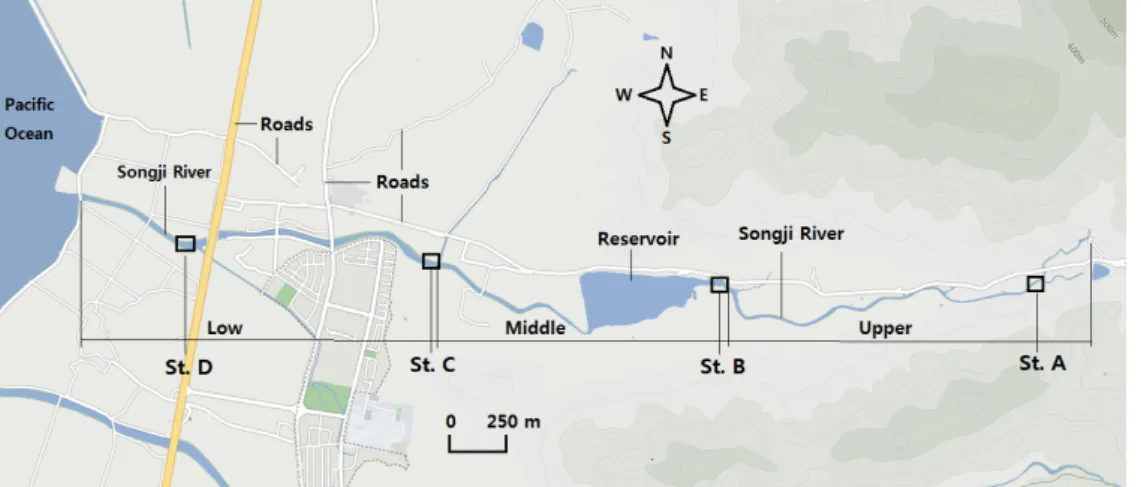
Fig. 1. Four sampling sites of the study area at Songji River.

cellent for evaluating site-specific impacts, and collection methods are relatively easy, straightforward, and inex- pensive. They are easy to sample and identify, and different taxa show varying degrees of sensitivity to pollution and other impacts [2].

According to the river Continuum Concept (RCC), the aquatic macroinvertebrate fauna responds to the physical changes along the riv er longitud inal gradient [30].

According to the RCC, shredders would be concentrated in headw ater sections, since they are highly dependent on al- loct honous or ganic matter from the riparian zone.

A four-lane road crossing the river was established ten years ago and there were many changes from agricultural land to industrial factory. Three years ago, there was a con- struction of a straight river to prepare for the flood. Because a four-lane road crossing the river was established ten years ago and there were many changes from agricultural land to industrial factory, water quality and benthic macro- invertebrate changes are predicted.

The aim of this study is to define the macroinvertebrate fauna and its spatial and temporal distribution along the- longitudinal gradient of the Songji River at Sacheon-ci, Gyeongsangnam-do province in Korea. In addition, this study focuses on the application of saprobic extent and other ecological biodiversity methods for the assessment of river water quality.

Materials and Methods

Surveyed regions

This study was carried out on the Songji River (upper region: 35°011‘014’‘N/128°100’014‘’E, low region: 35° 012‘

794’‘N/128°049’459‘’E), located at Yonghyeon-myeon prov- ince, Sacheon-ci in Korea (Fig. 1). The uplands of this river are usually no higher than 30 m above sea level. The length of the river is 5.2 km long and flows across the countryside.

Flood plains of this river are usually very fertile agricultural areas and out sides of this river consist of agricultural fields and farming houses. Mean annual temperature ranges from -0.1 (January) to 25.7℃(August) with 13.1℃, and mean annu- al precipitation ranges from 19.2 (December) to 316.9 mm (August) with 1512.8 mm.

Sampling procedures

Benthic macroinvertebrates were conducted on March 3, June 2, September 1, and December 1, 2018 to investigate water quality evaluation using benthic macroinvertebrates at Songji River in Sacheon-ci, Korea. Sample collection was carried out the protocol of USEPA [29] Rapid Bioassessment Protocol III (RBP III) for benthic macroinvertebrates. All samples are picked in the field, a process facilitated by field-preservation of some samples. Benthic sampling was based on qualitative (a general assessment of the benthic taxa present, possibly with some observations of their rela- tive abundance) and quantitative (an estimate of the num- bers present so that a statistical confidence interval of the estimate can be calculated).

In case of implementing the multihabitat sampling meth- od, the number of sub-samples (replicas) conforms to the percentage ratio of the bottom habitats, and a final compo- site sample representing represented for the monitoring si te is prepared.

Benthic macroinvertebrates are collected systematically

from all available in-stream habitats by kicking the substrate

(3)

Table 1. Classification scheme of the environmental quality score of benthic macroinverterates according to the indicator table from NIER [20]

Qi Saprobic value Saprobity BOD

5(mg/L)

5 4 3 2 1

≤0.1

>0.1~1.0

>1.0~2.0

>2.0~3.0

>3.0

Xenosaprobic Oligosaprobic β-mesosaprobic α-mesosaprobic Polysaprobic

≤1

>1~2

>2~4

>4~8

>8

Table 2. The scheme of ESB accrding to the phase of environmental quality [19]

ESB Environmental condition Area determination Water quality

81<

61-80 41-60 26-40 13-25

<12

Very satisfactory Satisfactory Some satisfactory Some defectiveness

Defectiveness Very defectiveness

First priority water Priority protection water

Protection water Improvement water Priority improvement water First priority improvement water

I I II II III IV-V or jabbing with a D-frame kick net with a mesh size of 500

μm and a Surber sampler (30×30 cm; net mesh size 1 mm).

A total of 20 jabs (or kicks) are taken from all major habitat types in the reach, resulting in sampling approximately 3.1

㎡ of habitat. Remove any large debris manually and use forceps or elutriation buckets to extract any organisms from the sample. All organisms identified from the same sample should be placed in a jar filled with 70% EtOH. Sampling was carried out four times a year, from April 2018 to November 2018. Different taxa richness criteria were devel- oped for each ecoregion to assign water quality classi- fications.

Taxonomic identification conducted by qualified pro- fessionals considered to be experts in the identification of aquatic invertebrates. Taxonomic identifications are checked against the most current and widely accepted list of names for a particular group [11, 14, 18, 26, 31, 32].

Water evaluation

Classification scheme of the environmental quality score of benthic macroinverterates according to the indicator table from NIER (Table 1) [20].

Dominance index (DI) was calculated using the following formula:

DI = (N1+N2)/N

N1 is the number of individuals in first dominant species and N2 is the number of individuals in second dominant species.

Beck-Tsuda's Biotic Index (BI) is based on the relative tol- erances of macroinvertebrates to organic pollution, with field-sorting undertaken and identification to species level.

BI = 2xA + B

A is the number of intolerant species and B is the number of tolerant species.

Total ecological score of benthic macroinvertebrate com- munity (TESB) was calculated by the method of Kong et al.

[13] (Table 2).

s: Total number of species, Q

i

: Environmental quality score of i species ( = 1, 2, 3, 4, 5)

Average ecological score of benthic macroinvertebrate community (AESB) was calculated by the method of Kong et al. [13]

An analysis was conducted of the Benthic Macroinverte- brate Index (BMI), a biometric assessment technique using the large scale animals that appeared at each station (Table 3) [12].

Si: Saprobic value of the species i, Hi : Relative abundance of the species i, Gi : Indicator weight value of the species i.

An estimate of the number of individuals per unit area, obtained by estimating the density of each species in the group and summing across species. Defining Dij to be the mean density (number of individuals per unit area) across sites of species i in season j, the index for season j is Aj

= Σ Dij.

Arithmetic mean of relative abundance indices. The spe-

cies-specific densities Dij are scaled by dividing the time ser-

ies for each species by its estimated density at the initial

time point [4].

(4)

Table 3. Classification of benthic macroinvertebrates index (BMI) for the evaluation of river status [13]

Class BMI Status

Diversity Disturbance sensitive taxa

A

B C

D E

80≤-100

65≤-80 50≤-65

35≤-50 0-35

Least signs of alteration from undisturbed levels

Slight alteration from undisturbed levels Significantly lower than alteration from

undisturbed levels Very low species richness Several species are present or not

Least signs of alteration from undisturbed levels

Slight alteration from undisturbed levels

Significantly lower than alteration from undisturbed levels

Most of the sensitive taxa are absent

Sensitive taxa are absent. Insensitive taxa shows high abundance or not

Table 5. Species composition for invertebrates in the studied areas

Phylum St. A St. B St. C St. D

Species Individuals Species Individuals Species Individuals Species Individuals Mollusca

Annelida Arthropoda Malacostraca Insecta Total

2 3

1 10 16

4 12

4 87 107

2 3

1 8 14

4 13

3 105 125

1 3

1 6 11

4 14

6 89 113

1 3

1 4 9

3 9

6 114 132 Table 4. Classification of saprobity based on Shannon-Weaver's

diversity, H' [28]

H' Saprobity

0-1 1-2 2-3 3-4.5

polysaprobic α-mesosaprobic β-mesosaprobic oligosaprobic

The resulting relative abundance indices are then aver- aged: Rj = 1/m∑

ni=1

Dij/Di1

Diversity, family richness and total abundance were used to summarise community data.

The Shannon-Wiener [25] diversity index (H’) was used, as it is not strongly influenced by rare taxa [23].

H' = - Σ pi ln pi

pi is the proportion of important value of the ith species (pi = ni / N, ni is the important value index of ith species and N is the important value index of all the species).

N1 = e

H'

N2 = 1/λ

Where λ (Simpson’s index) for a sample is defined as λ = ∑ ni(ni-1)/ N(N-1)

Species richness is the number of species of a particular taxon that characterizes a particular biological community,

habitat or ecosystem type [5]. The species richness of animals was calculated by using the method, Berger-Parker’s index (BPI) and Margalef’s indices (R1 and R2) of richness [17].

BPI = Nmax/N where Nmax is the number of individuals of the most abundant species, and N is the total of in- dividuals of sample. Species evenness indices (E1~E5) was calculated using important value index of species [9, 22].

Classification of saprobity based on Shannon-Weaver's di- versity, H' (Table 4) [28].

Results

Species composition

From the four seasons survey on 2018 year, the identified benthic macroinvertebrates were 447 individuals belonged to 20 species, 18 families, 12 orders, 5 classes and 3 phyla.

Mollusca accounted for only two taxa for four seasons with- in the four studied areas (Table 5). Annelida exhibited three species. Arthropoda exhibited greatest species diversity with 16 taxa identified. Culicini sp. exhibited greatest individuals (203) and second species was Musca do­mestica (65 individ- uals).

Water quality evaluation using benthic macroinver-

tebrates

(5)

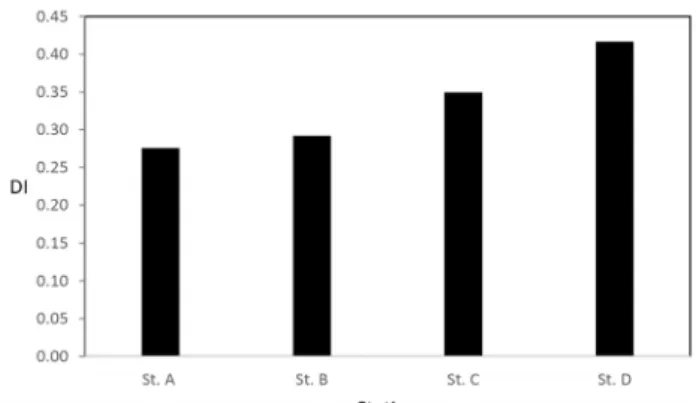
Fig. 2. Variability of the dominance indices (DI) of macroinverte- brate species at Songji River.

Fig. 3. Variability of the Beck-Tsuda's Biotic Index (BI) of macro- invertebrate species at Songji River.

Table 6. Total ecological score of benthic macroinvertebrate community (TESB), average ecological score of benth- ic macroinvertebrate community (AESB), and benthic macroinvertebrate index (BMI) for the evaluation of river status (Kong et al., 2018)

Station TESB AESB BMI

A B C D Mean

41 35 23 17 29

2.563 2.501 2.091 1.889 2.261

39.348 36.576 25.207 26.111 31.810

Fig. 4. The geometric mean of macroinvertebrate species at Songji River.

The value of dominance index (DI) was varied from 0.276 (St. A) to 0.417 (St. D) with a mean of 0.333 (Fig. 2). DI was significantly different among the four regions. Beck-Tsuda's Biotic Index (BI) was varied from 9 (St. D) to 19 (St. A) with a mean of 14 (Fig. 3). BI was not shown significantly differ- ent among the four regions.

Total ecological score of benthic macroinvertebrate com- munity (TESB) was varied from 17 (St. D) to 41 (St. A) with a mean of 29 (Table 6). Average ecological score of benthic macroinvertebrate community (AESB) was varied from 1.889 (St. D) to 2.563 (St. A) with a mean of 2.261. The saprobic

index and ESB for the evaluation of river status revealed that water quality at St. A was II (oligosaprobic) which means some satisfactory and protection water (Table 2).

Environmental status at St. B was some defectiveness and area determination was improvement water. However, wa- ter quality at St. C and D was III (β-mesosaprobic). Environ- mental status at St. C and St. D was defectiveness and area determination was priority improvement water. Benthic macroinvertebrate index (BMI) ) was varied from 25.207 (St.

C) to 39.348 (St. A) with a mean of 31.810. Classification of benthic macroinvertebrates index (BMI) for the evaluation of river status at St. A was significantly lower than alteration from undisturbed levels (Table 3). The evaluation of river status at St. A and St. B was Very low species richness and most of the sensitive taxa were absent. The evaluation of river status at St. C and D was polysaprobic and Sensitive taxa are absent. Namely, several species were present or not and insensitive taxa showed high abundance or not.

We formed a composite index from points in time (four seasons) by taking the geometric mean of the indices. The result was shown in Fig. 4. Species strongly resistant to pol- lution were restricted to the upper stream, while the density was lower than those of low stations.

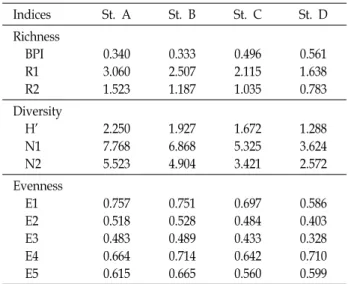
In order to assess macro-scale spatial variability of the animal community at Songji River, We analyzed distribu- tions of species richness, diversity, and evenness of large taxonomic groups as well as four station compositions along a geographic distance (Table 7).

Water quality evaluation using biological diversity

Mean Shannon-Weaver index (H´) of diversity was varied

from 1.288 (St. D) to 2.250 (St. A). H´ at the upper region

(St. A) was higher than those of low region (St. D). Classifica-

tion of saprobity based on Shannon-Weaver's diversity (H’)

(6)

Table 7. Biological diversity index for invertebrates in the studied areas

Indices St. A St. B St. C St. D

Richness BPI R1 R2

0.340 3.060 1.523

0.333 2.507 1.187

0.496 2.115 1.035

0.561 1.638 0.783 Diversity

H' N1 N2

2.250 7.768 5.523

1.927 6.868 4.904

1.672 5.325 3.421

1.288 3.624 2.572 Evenness

E1 E2 E3 E4 E5

0.757 0.518 0.483 0.664 0.615

0.751 0.528 0.489 0.714 0.665

0.697 0.484 0.433 0.642 0.560

0.586 0.403 0.328 0.710 0.599

was β-mesosaprobic at St. A and α-mesosaprobic at other stations (Table 4). Berger-Parker’s index (BPI) was varied from 0.333 (St. B) to 0.51 (St. D). N1 and N2 values were high at upper region. Richness indices for animal taxa were also varied among the stations and seasons. R1 and R2 val- ues were high at upper region. Although richness indices (R1-R2) for four stations were different from each other, there were not shown significant differences (p<0.05).

Evenness indices (E2-E4) except E5 were different from each other, there were not shown significant differences (p<0.05).

In this paper, the density of each species in the group and summing across species was shown in Fig. 4. The value of geometric density was varied from 1.229 (St. A) to 2.071 (St. D) with a mean of 1.582.

Discussion

Five years ago (2014), there was a species diversity includ- ing H' and species richness in this area [10]. The previous studies in this area revealed species diversity including H' and species richness were not very bad although water qual- ity is not good condition. The H´ values for vertebrates in this river were 2.415 (St. A), 2.225 (St. B), 2.156 (St. C), and 1.862 (St. D). In this study, the H´ values were 2.250 (St.

A), 1.927 (St. B), 1.672 (St. C), and 1.288 (St. D). Diversity has fallen in all four regions compared to three years ago.

Changes in water quality in a short time can affect in- vertebrates. These spatial and temporal distributions suggest that benthic species have different preferences for particular ranges of temperature, pH, current velocity, and types of

substrata.

In this study, the high total richness and abundance were observed at the St. A. This has been reported in many fast-fl owing streams with similar stream-beds [3, 16] and seems to be a general pattern in the forest streams [26]. It is due to the geographical characteristics of this river as a natural factor. Alpine stream-bed areas are likely to have high envi- ronmental stability and spatial heterogeneity, which may of- fer better conditions for fauna colonization.

There is a reservoir against the flood in this river (Fig.

1). Downstream of this river is almost dry on late fall, winter, and early spring. Therefore, many invertebrates are less like- ly to survive in the dry season and are less diverse. Artificial factors include stone construction and industrialization. In 2016, four-lane roads were built across the river. Contamina- tion through automobiles enters rivers and poses a threat to the habitat of species. There are aeronautical industrial complexes around.

According with European Water Framework Directive re- quirements (EWFD), the class boundaries in quality classi- fication are set using five ecological quality ratios (ERQ), i.e., a numeric index showing the degree of deviation of any studied parameter from the initial reference value [21].

Extent of deviation is usually classified on a 5-level scale.

According to the ERQ, Song Ji-cheon is evaluated the fourth grade based on several results of this study. The fouth grde is the value of the biological quality elements for the surface water body type deviate moderately from those normally associated with the surface water body type under undis- turbed conditions. The values show moderate signs of dis- tortion resulting from human activity and are significantly more disturbed than under conditions of good status. This river has been used as an agricultural incentive during the past years. In just ten years, industrialization has neglected water quality. Songji River main watercourse has been sub- jected to multiple discharges of wastewater, without pre- vious treatment, due to strong industrial textile activity. This situation caused the deterioration of the water quality, re- sulting in water at low region of this river that is not only inappropriate for several uses, such as water supply for do- mestic and industrial use, recreation uses, but also danger- ous for the public health.

Simply whether a study is spatially or temporal extensive

will emphasize different aspects of ecosystem structure and

function. Therefore, we suggest that adaptations of environ-

mental indices are needed to refleco the real situation of this

(7)

study area more accurately.

References

1. Barbour, M. T., Gerritsen, J., Griffith, G. E., Frydenborg, R., McCarron, E., White, J. S. and Bastian, M. L. 1996. A frame- work for biological criteria for Florida streams using benthic macroinvertebrates. J. N. Am. Benthol. Soc. 15, 185-211.

2. Boothroyd, I. K. G. and Stark, J. D. 2000. Use of invertebrates in monitoring, pp. 344-373. In: Collier, K. and Winterbourn, M. J. (eds.), New Zealand Stream Invertebrates: Ecology and Implications for Management. New Zealand Limnological Society: Hamilton, New Zealand.

3. Brown, A. V. and Brussock, P. P. 1991. Comparisons of benthic invertebrates between riffles and pools. Hydrobiologia 220, 99-108.

4. Buckland, S. T., Magurran, A. E. Green, R. E. and Fewster, R. M. 2005. Monitoring change in biodiversity through com- posite indices. Phil. Trans. R. Soc. B. 360, 243-254.

5. Colwell, R. K. 2011. Biogeographical gradient theory, pp.

309-330. In: Scheiner, S. M. and Willig, M. R. (eds.), The theo- ry of ecology. University of Chicago Press: Chicago, USA.

6. Flotemersch, J. E., Saavedra, J. M., Laffitte, L., Laurenzano, B., Bonardi, M. A. and Blocksom, K. A. 2017. Benthic macro- invertebrate field sampling effort required to produce a sample adequate for the assessment of rivers and streams of Neuquén Province, Argentina. Limnologica 65, 55-60.

7. Gaufin, A. R. 1973. Use of aquatic invertebrates in the as- sessment of water quality. biological methods for the assess- ment of water quality. ASTM Int. 528, 96-116.

8. Gilvear, D. J., Greenwood, M. T., Thoms, M. C. and Wood P. J. 2016. River Science: Research and Management for the 21st Century, pp. 197-220. John Wiley & Sons, Ltd.: West Sussex, UK.

9. Hill, M. O. 1973. Diversity and evenness: a unifying notation and its consequences. Ecology 54, 423-432.

10. Huh, M. K. 2016. Biodiversity of kingdom animalia at the Songji river in Sacheon-ci, Korea. Eur. J. Eng. Tech. 4, 48-58.

11. Kawai, T. 1985. An Illustrated Book of Aquatic Insects of Japan, pp. 25-148. Tokai Univ. Press: Tokyo.

12. Kong, D. S., Son, S. H., Kim, J. Y., Won, D. H., Kim, M. C., Park, J. H., Chon, T. S., Lee, J. E., Park, J. H., Kwak, I. S., Kim, J. S. and Ham, S. A. 2012. Revision of ecological score of benthic macroinvertebrates community in Korea. J. Kor.

Soc. Environ. 34, 251-269.

13. Kong, D. S., Park, Y. and Jeon, Y. R. 2018. Benthic macro- invertebrates in Hongseong and Yesan County. In: Ministry of Environment (eds.), Natural Environment in Yesan, Seosan and Hongseong. Seoul: Korea.

14. Kwon, O. 1990. Illustrated Encyclopedia of Fauna & Flora of Korea, vol. 32. Ministry of Education, Seoul: Korea.

15. Li, L., Zheng, B. and Liu, L. 2010. Biomonitoring and bio- indicators used for river ecosystems: denitions, approaches and trends. Procedia Environ. Sci. 2, 1510-1524.

16. Logan, P. and Brooker, M. P. 1983. The macroinvertebrate faunas of riffle and pools. Water Res. 17, 263-270.

17. Magurran, A. E. 1988. Ecological Diversity and Its Measure- ment, pp. 7-45. Princeton Univ. Press: Cambridge, USA.

18. Merritt, R. W. and Cummins, K. W. 1996. An Introduction to the Aquatic Insects of North America. 3rd. pp. 862.

Kendall/Hunt Publ. Co.: Iowa, USA.

19. National Institute of Environmental Research (NIER). 2002.

The 2nd National Ecosystem Survey Guide. National Insti- tute of Environmental Research, Seoul: Korea.

20. National Institute of Environmental Research (NIER). 2016.

Biomonitering Survey and Assessment Manual. National Institute of Environmental Research, Seoul: Korea.

21. Nõges, T. 2003. Final report on the relevant system of in- dicators and criteria for evaluating the ecological status a very large nonstratified lake and its river basin in WFD Context, Tartu University, Estonia.

22. Pielou, E. C. 1966. The measurement of diversity in different types of biological collection. J. Theor. Biol. 13, 131-144.

23. Pires, A. M., Cowx, I. G. and Coelho, M. M. 2000. Benthic macroinvertebrate communities of intermittent streams in the middle reaches of the Guadiana Basin (Portugal). Hydro- biologia 435, 167-175.

24. Rattanachan, N., Boonsoong, B., Getwongsa, P., Uttaruk, Y.

and Sangpradub, N. 2016. A benthic macroinvertebrate mul- timetric index for assessment of the ecological Integrity of Northeast Streams, Thailand. Environment Asia 9, 186-194.

25. Shannon, C. E. and Weaver, W. 1998. The Measurement Theory of Communication, pp. 1-144. Univ. of Illinois Press:

Urbana, USA.

26. Silveira, M. P., Buss, D. F., Nessimian, J. L. and Baptist, A, D. F. 2006. Spatial and temporal distribution of benthic mac- roinvertebrates in a Southeastern Brazilian river. Braz. J. Biol.

66, 623-632.

27. Spellerberg, I. F. 1991. Monitoring Ecological Change, pp.

1-334. Cambridge University Press: Cambridge, USA.

28. Staub, R., Appling, J. W., Hofstetter A. M. and Haas, I. J.

1970. The effects of industrial wastes of Memphis and Shelby County on primary planktonic producers. Bioscience 20, 905- 12.

29. USEPA. 2003. Sampling and Analytical Procedures for GLNPO’s Open Lake Water Quality Survey of the Great Lakes; Chapter 4 - Biological Parameters; LG406 - Standard Operating Procedure for Benthic Invertebrate Field Sam- pling Procedure, Revision 07. EPA 905-R-03-002. March 2003.

30. Vannote, R. L., Minshall, G. W., Cummins, K. W., Sedell, J. R. and Cushing, C. E. 1980. The river continuum concept.

Can. J. Fish. Aquat. Sci. 37, 130-137.

31. Won, D. H., Kown, S. J. and Jun, Y. C. 2005. Aquatic Insects of Korea, pp. 1-415. Korea Ecosystem Service, Seoul: Korea.

32. Yoon, I. B. 1995. An Illustrated Key Book of Aquatic Insects of Korea, pp. 1-262. Jung Hang Sa, Seoul: Korea.

33. Yuceer, M. 2016. Modeling water quality in rivers: A case study of Beylerderesi river in Turkey. Appl. Ecol. Env. Res.

14, 383-395.

(8)

초록:한국 송지천에서 저서성대형무척추동물의 종조성과 이를 이용한 수질 평가 이병룡

1

․허만규

2

*

(

1

서원대학교 생물교육과,

2

동의대학교 식품공학과)

저서성대형무척추동물은 수질 평가를 위해 다년간 이용되었다. 본 연구는 한국 송지천에서 저서성대형무척추 동물을 이용하여 이 하천의 수질을 평가하고자 수행되었다. 동정된 동물은 3문 5강 12목 18과 20종 447개체였다.

집모기류(Culicini sp.)가 가장 우점종이었고(203개체), 두번째 우점종은 집파리(Musca do­mestica)였다. 다양한 생태

학적 척도로 수질의 상태를 평가하였다. 전체 생태 점수(total ecological score of benthic macroinvertebrate com-

munity, TESB)은 17(St. D)에서 41(St. A)으로 평균은 29였다. St. A에서 부수성 지수와 저서성 대형무척추동물

생태 점수(ESB)는 II 등급으로 빈부수성, 수질은 약간 만족이며 보호가 요청되는 수질에 해당되었다. 저서성동물

지수(benthic macroinvertebrate index, BMI)은 25.207(St. C)에서 39.348(St. A)까지 이며 평균은 31.810였다. St. C

와 St. D의 하천 상태 평가는 강부수성이며 민감종이 결여되어 있었다. 다양도를 나타내는 Shannon-Weaver in-

dex (H´)는 1.288(St. D)에서 2.250(St. A)였다. H’에 근거한 부수성 정도는 St. A에서는 β-중부수성이었으며 나머

지 지점은 α-중부수성이었다. 지리적 밀도는 1.229(St. A)에서 2.071(St. D)으로 평균은 1.582였다. 송지천에서 사용

한 무척추동물을 이용한 여러 수질의 척도는 한국 내 다른 하천에서도 적용할 수 있을 것이다.

수치

Fig.  1.  Four  sampling  sites  of  the  study  area  at  Songji  River.
Table  2.  The  scheme  of  ESB  accrding  to  the  phase  of  environmental  quality  [19]
Table  3.  Classification  of  benthic  macroinvertebrates  index  (BMI)  for  the  evaluation  of  river  status  [13]
Fig.  2.  Variability  of  the  dominance  indices  (DI)  of  macroinverte- macroinverte-brate  species  at  Songji  River.
+2

참조

관련 문서

In this regard, to overcome the limitations associated with quantitative evaluation of ECT using the bobbin probe and to consider the field requirements in terms of scanning

A Study on the Evaluation of Space Recognition Space Recognition Space Recognition in the Space Recognition in the in the in the Concourse of Hospital using the

There are a lot of institutions for evaluation in the world, for example, Legislative Evaluation in the Continental Legal System, Regulatory Impact Analysis

A summer marine benthic algal flora and community of uninhabited islands in Haenamgun, southern coast of Korea. Seasonal Variations in the Macroalgal Flora and

In the present study, 10 study stations were established, and seasonal changes for various ecological aspects of the community such as species composition, number of

“Evaluation of R&amp;D investments in wind power in Korea using real option.” Renewable and Sustainable Energy Reviews. &#34;Real Option Valuation of a Wind Power Project Based

In Germany, and other European nations, a legislation evaluation system is implemented in order to prove the inevitable enactment of laws or the necessity

For the discharge described in Example 5.5 2, calculate the equilibrium partial pressure of the chemical above the river at the discharge point Is volatilization from the