650
JOURNAL OF KOREAN FOREST SOCIETY
개방형 액체대량배양 시스템을 통한 유칼리나무 펠리타 선발목의 대량증식
박소영1*·문흥규1·김용욱1·김선자1·이재선2
1국립산림과학원 생물공학과, 2강원대학교 산림자원학부
Application of Open-type Liquid Culture for Large-scale Production of Mature Plus Tree of Eucalyptus pellita
So-Young Park1*, Heung-Kyu Moon1, Yong-Wook Kim1, Seon-Ja Kim1 and Jae-Seon Yi2
1Biotechnology Division, Korea Forest Research Institute, Suwon 441-350, Korea
2Division of Forest Resources, College of Forest and Environmental Sciences, Kangwon National University, Chunchon 200-701, Korea
요 약: 유칼리나무 펠리타(Eucalyptus pellita) 선발목(5년생)의 기내 대량증식을 위해 1 L 규모로 1) 고체배양(대조구), 2) 액체정치배양, 3) 개방형 액체배양 등 3가지 배양법이 시도 되었고, 그 결과를 토대로 배양규모를 10 L로 확대하 여 대량배양 가능성을 조사하였다. 1 L 배양용기에서 4주간 배양한 결과, 공기가 공급된 개방형 액체배양에서 가장 좋은 생장 결과를 얻었다. 이는 액체배지에 의한 원활한 염류 공급과 배양용기내 공기의 환기에 의해 얻어진 결과 로 생각된다. 배양 규모를 10 L로 확대하여 액체대량배양을 실시한 결과, 식물체의 생장은 대조구인 고체배양에 비 교하여 마디 수에 있어서 370%, 엽 면적 3.6배 그리고 신초 길이 3.3배 신장하는 결과를 보였다. 이는 개방형 액체 대량배양 시스템이 유칼리나무 클론증식시 생산성을 향상시키는데 적합한 시스템임을 보여주는 결과라고 하겠다.
Abstract: In an attempt to establish the mass proliferation system, Eucalyptus pellita, a 5-year-old plus tree, was cultured with three different culture types in 1 L vessels: solid culture without ventilation (conventional culture), liquid culture without ventilation and open-type liquid culture with forced ventilation. Then the culture scale was subsequently increased from 1 L to 10 L in vessel volume. After 4 weeks of 1 L-scale culture, the best growth was obtained by culturing plantlets on open-type liquid culture, suggesting that the in vitro plantlets growth can be enhanced by liquid medium and ventilation. In open-type large scale culture in 10 L vessel, plantlets growth resulted in a 370% increase in the number of nodes, 3.6 times increase in leaf size and 3.3 times increase in shoot length, while the conventional culture suppressed shoot growth due to the callusing on the leaves and lack of CO2. The results indicated that the open-type large scale culture system was effective for enhancing productivity by improving growth of the plantlets in clonally proliferated plus tree, Eucalyptus pellita.
Key words : Eucalyptus pellita, large scale culture, liquid medium, clonal propagation
서 론
유칼리나무는 뉴기니아, 호주 등이 원산인 도금양과
(Myrtaceae)의 상록활엽수로서 산업적으로 중요한 경질목
(hardwood) 중 하나이다. 나무는 건축용 목재, 제지 및 연 료의 원료로, 잎은 정제 오일의 원료로 이용 된다(Eldridge 등. 1994). 또한 유칼리나무의 대사물질 중 하나인 cyclitols 때문에 건조에 대한 적응력이 강해 사막화 지역에 식재되 는 수종이기도 하다(Merchant 등, 2006).
우리나라는 현재 목재 자급률이 6%에 불과하여 장기적 으로 안정적인 목재공급원의 확보가 필요하고, 또한 1997 년 교토의정서에 입각한 기후변화협약 대비 탄소배출권 을 확보하기 위해서도 정부는 해외조림을 적극 권장하고 있다(해외조림 사업안내 www.foa.go.kr). 이를 위한 수종 으로는 Acasia mangium과 함께 유칼리나무가 주로 식재 되고 있는데, 이 중 유칼리 펠리타는 다른 종의 유칼리에 비해 생장이 빠르고 나무 재질이 우수하며 내건, 내한 및 내병충성이 강해 해외조림을 위해 적합한 수종이다 (Harwood 등, 1997).
우수한 형질을 가진 유칼리의 산업적 이용을 위해서는
*Corresponding author E-mail: [email protected]
클론증식을 통해 원하는 형질을 유지하는 하는 것이 중요 하다(Delaporte와 Sedgley, 2004). 유칼리에서 조직배양을 이용한 성공적인 클론증식은 액아배양을 통해 이루어진 바 있다(McComb 등, 1996).
조직배양을 이용한 미세증식 중 액체배양은 기존의 고 체배양에 비해 배양규모를 늘릴 수 있다는 점에서 많은 가능성을 가지고 있다. 최근 액체배양법을 이용해 수 백 개의 절편체를 하나의 용기에서 배양하는 대량배양 시스 템(large-scale culture system)이 여러 원예작물에서 보고 되고 있다(Hahn과 Paek, 2005; Park 등, 2000; Piao 등, 2003; Shohael 등, 2005). 이를 이용해 다수의 건전한 식물 체를 생산하기 위해서 기내 가스교환 등 미세환경 조절 또한 배양 시스템 개발과 함께 중요하게 다뤄져 왔다(Kozai 등, 2000; Zobayed 등, 2001; 2004). 이러한 대량배양 시 스템은 1) 기존 소규모 고체배양에 비해 인건비를 현저히 낮출 수 있고(Kozai 등, 2000), 2) 기외 순화시 생존율을 향상시키며, 3) 빠른 생장으로 생산기간을 단축시키고, 4) 증식과 배양 과정을 단순화 시킬 수 있다는 점에서 많은 장점을 갖는다(Zobayed 등, 2004).
유칼리나무에서는 지금까지 배양을 위한 적정 배지선 발(Glocke 등, 2006), 여러 종류의 조직에서 신초 재분화 (Nugent 등, 2001; Laine과 David,. 1994), 액아증식(Yang 등, 1995; Louro 등, 1999), 기내삽목(Schwambach 등,
2005) 등의 연구가 이루어졌고, 최근에는 유칼리 펠리타
유묘를 재료로 액아증식(Moon 등, 2003), LED하의 생장 반응(Kim 등, 2004) 및 부정아 유도 등(Kim 등, 2005)이 시험되었으나, 아직까지 선발된 개체의 대량증식에 대한 연구는 보고 된 바가 없다.
본 연구는 인도네시아 깔리만탄 지역에서 생장이 우수 한 수형목으로 선발 된 유칼리 펠리타의 기내 대량증식 체계를 확립하고자 액체배양으로 1 L에서 10 L까지 배양 규모를 확대하면서 대량증식의 가능성을 시험하였다.
재료 및 방법
1. 식물재료
기내배양을 위해 인도네시아 깔리만탄의 코린도 조림 지에서 선발 된 유칼리 펠리타 선발목의 삽수를 국립산림 과학원 생물공학과 온실에서 삽목, 재배하였다. 그로부터 신초를 채취하여 0.1% HgCl2로 5분간 표면살균하고 멸 균수로 3회 수세한 다음 BA 0.1 mg/L, 3%(w/v) sucrose 및 3 g/L phytagel(Sigma)이 첨가 된 DKW 배지(Driver 와 Kuniyuki, 1984)에 배양하여 무균묘를 얻었다(Moon 등,
2003). 이렇게 얻은 무균묘를 기내파종 후 20-25일 된 유
칼리 유묘에 미세접목(micrografting)하여 성숙목의 재령 화(rejuvenation)를 유도하였다. 미세접목을 통해 재유령화
된 신초를 BA가 0.1 mg/L 첨가 된 DKW 배지에서 4주 간격으로 계대배양하면서 1년 동안 마디 증식하여 본 실 험을 위한 재료로 이용하였다.
2. 1 L 규모 액체배양
유칼리 펠리타 대량증식 가능성을 조사하기 위해 1 L 부피의 사각배양병(9×8×14 cm)에서 액체배양을 실시하였 다. 실험에는 1) 기존 고체배양법, 2) 액체정치 배양, 3) 개 방형 액체배양 등 세 가지의 배양법이 이용 되었다(Figure 1, A-C). 개방형 액체배양(Open-type liquid culture)을 위 해 주입구(inlet)를 통해 필터(Mill-Seal, Millipore, Tokyo;
pore size 0.5 µm)를 통과한 멸균 공기가 배양병내로 주입 되게 하고 동시에 배출구(outlet)로 배양기내의 공기가 필 터를 통해 빠져 나가도록 하였다(Figure 1, C). 이때 공기 공급은 flow meter를 이용해 0.1vvm이 되게 유지하였다.
배지는 1/2 DKW 배지에 3% sucrose와 0.3 g/L의 활성 탄을 첨가하여 기본배지로 이용하였고, 대조구인 고체배 양을 위해서는 동종의 배지에 3 g/L phytagel을 첨가하여 고형화 한 배지가 이용되었다. 각 배양용기에는 200 mL 의 배지를 분주하고 배양용기 당 12개의 절편체를 배양하 였다. 배양 4주 후 처리에 따른 발근율, 잎 수, 생체중, 뿌 리길이, 잎의 캘러스 발생율 등을 조사하였다.
2. 10 L 개방형 액체대량배양
개방형 액체대량배양을 위해서 10 L 규모의 액체배양 기가 제작, 이용되었다. 배양기 아래에는 절편체가 액체배 지에 침지되지 않도록 고압증기멸균이 가능한 플라스틱
Figure 1. One liter cultures of E. pellita plus tree nodes with three different types of cultures. A-C. Solid culture (A), liquid culture (B) and open-type liquid culture (C, AI: air inlet, AO:
air outlet, GS: glass spargar) after 1 week of culture, D-F.
After 4 weeks of culture, plantlets grown in solid (D), liquid (E) and open-type liquid culture.
net를 10 cm 높이로 설치하여 절편체가 net 위에서 자라 게 하였다. 절편체는 1 L 배양시와 동일하게 고체배지에 서 자란 식물체를 한 마디씩 절단하여 배양용기 당 100개 씩 배양하여 총 12주간 배양하였다. 이때 배지는 1 L 배 양시 사용 된 동종의 배지를 대량배양용기 당 1.5 L 분주 하였고, 배양 8주 후 500 mL의 배지를 첨가한 다음 4주간 더 배양하였다. 본 실험의 대조구로는 동종의 배지에 3 g/
L의 phytagel을 첨가하여 사각배양용기(9.5×9.5×9 cm, Duchefa, The Netherlands)에 100 mL씩 분주한 다음 사 용하였다. 배양 12주 후 각각에서 자란 식물체의 길이와 엽 면적, 마디 수, 줄기 직경 등을 조사하였다.
모든 배지는 멸균 전 pH를 5.7-5.8로 적정 한 다음 121°C, 108 kPa 기압 하에서 20분 동안 고압증기멸균 후 사용하였다. 배양은 광량 35-40 µmol m−2s−1 PPF(16h명/8h 암주기)와 24±1oC 온도가 유지되는 배양실에서 이루어졌다.
3. 순화
각 시스템하에서 배양 된 식물체는 생육조사 후 마디삽 목을 위해 약 1-2마디 간격으로 절단 한 다음 플라스틱 박 스(45×65×25 cm)에 피트모스와 펄라이트를 1:1(v/v) 비율 로 혼합하고 삽목하였다. 순화는 15-20 µmol m−2s−1 PPF 광도와 주야간 온도가 25±1oC로 유지되는 순화실에서 삽 목상의 습도를 80-90%로 유지(2주 간격으로 관수)하면서 실시하였다. 삽목 4주 후 생존과 발근율을 조사하였다.
4. 통계분석
결과는 SAS 프로그램(Version 6.21, SAS Institute Inc.
Cary, NC, USA)을 이용하여 분석하였다. 평균간 차이의
통계적 유의성은 Duncan의 다중검정으로 평가하여 표내 에 서로 다른 문자로 표시하였다. 유의성의 수준은 p≤
0.05~0.001 등 3수준으로 나누어 그 정도를 표 하단에 표
기하였다.
결과 및 고찰
1. 1 L 액체배양
유칼리는 나무의 재질이 좋고 생장이 빨라서 선발 된 개
체의 클론증식 측면에서 의미가 크며, 또한 임목류 중 비 교적 배양이 용이하여 임목의 대량배양 시스템을 연구하 기 위한 적정 수종으로 여겨진다. 본 시험에서는 기내 미 세접목을 통해 재유령화 된 유칼리 펠리타 선발목을 원예 작물의 대량배양을 위해 고안 된 대형배양용기(Hahn과
Paek, 2005)에 배양함으로서 액체배양을 통한 임목류의 대
량배양 가능성을 타진하고 배양의 생력화를 꾀하고자 실 시되었다. 우선 유칼리가 액체배지에서 잘 자라는지를 조 사하기 위해 1 L 규모의 배양용기에서 1) 고체배양(대조 구), 2) 액체정치배양 그리고 3) 액체배양에 지속적으로 멸 균 된 공기를 공급해 주는 개방형 액체배양 등 3가지로 배 양방법을 달리하여 4주간 배양하였다. 배양 결과(Figure
1, D-F) 액체배지에서 배양했을 때 배양 2주 후부터 발근
이 시작되어 배양 4주 후 대조구에 비해 136~143% 이상 발근이 향상되었고, 뿌리 길이도 2배 이상 길었다.
지상부 역시 액체배양 시 생장이 유의성 있게 증가하여 식물체 길이에 있어서는 공기가 지속적으로 공급 된 개방 형 액체배양에서 대조구 대비 2.5배 생장하였고 개체 당 잎 수도 2배 이상 증가 하였다(Table 1). 통계분석 결과 뿌 리 발달은 공기공급 유무에 관계없이 모든 액체배양이 대 조구에 비해 좋았으나, 지상부 발달은 공기를 공급해 준 개방형 액체배양에서 월등히 향상되었다. 이는 강제로 배 양기내로 공기를 공급함으로써 배양 기간 내 지속적으로 CO2를 공급하는 효과를 주고 배양기내 집적 된 에틸렌 가 스 등을 배출시킴으로써 지상부 생장을 향상시킨 것으로 생각된다. 액체배양은 식물의 생장뿐 아니라 재분화에도 긍정적인 영향을 미치는데(Prasad와 Gupta, 2006) 이는 배 지로부터 식물체로 염류의 흡수가 고체배지보다 향상되 기 때문으로 보고되어 있다(Takayama와 Akita, 1994).
또한 흥미롭게도 액체배지에서 배양 된 식물체에서는 공기의 환기 유무에 관계없이 고체배지에서 자란 유칼리에 서 보이는 잎의 캘러스화가 현저하게 적게 나타나는 것이 관찰 되었다(Table 1). 배양과정 중 잎에 형성되는 이러한 캘러스는 유칼리 배양 시 흔히 발생하는 것으로 이 때문에 기내 배양 유칼리의 순광합성율이 현저히 저하되고 이는 식물체 생육 저하의 한 원인이기도 하다(Zobayed, 2001). 따 라서 본 결과에서 액체배양 시 이러한 현상이 현저히 감소 Table 1. Effect of culture systems on shoot and root growth after 4 weeks of culture in E. pellita (1 L culture vessel).
Culture system
Culture condition Rooting (%)
Plantlet length (cm)
No of leaves (per plantlet)
Fresh wt of shoot (mg per plantlet)
Root length (cm)
Callusing rate of leaf (%) Solidification Vent
Solid Solid Non 61.0 bz 06.3 c 06.0 c 076.2 b 3.8 b 75.0 a
Liquid Liquid Non 83.3 a 13.3 b 09.3 b 144.7 ab 9.1 a 12.5 b
Open-type liquid Liquid Vent 87.5 a 15.9 a 12.5 a 211.9 a 9.3 a 15.4 b
Pr<F *y *** *** * *** **
zMean separations within columns by different letters are significantly different according to Duncan’s multiple range tests at 5% level.
ySignificant correlations are indicated by asterisks: *=p=0.05, **=p=0.01, ***=p=0.001, ns: non-significant).
된 것과 생장이 월등히 향상 된 것과는 무관하지 않다고 하 겠다. Zobayed 등(2001)은 Eucalyptus camaldulenis 배양에 서 잎에 형성된 캘러스가 배양기내 높은 상대습도와 에틸 렌 집적에 의해 발생되었을 것이라고 추측하였으나, 이는 본 시험에서 고체배양과 마찬가지로 공기순환이 안된 액 체정치 배양에서 캘러스 발생이 감소한 결과를 설명하기 에 무리가 있다. 본 시험의 결과로 미루어 캘러스 발생은 고체배양 시 배지 응고를 위해 첨가 한 첨가물(agar와
gelrite 등)에 의해 염류 이동이 느려지고, 식물 분비물이
절편체 주변에 집적되어 발생 되는 것이 아닌가 생각된다.
결과적으로 액체배양은 잎에 발생하는 캘러스를 감소 시켜 식물체의 순광합성률을 높이고 원활한 염류 이동을 통해 식물체 생장을 촉진시키는 결과를 가져왔고, 공기를 환기 시킨 개방형 액체배양은 이와 함께 용기내 집적 된 에텔렌 가스 등을 배출해줌으로써 식물체의 생육을 더욱 현저히 증가시킬 수 있었던 것으로 여겨진다.
2. 10 L 개방형 액체대량배양
1 L 액체배양의 긍정적인 결과를 토대로 액체배양 규모 를 10 L로 scale-up하였다. 고체배지에서 배양 된 식물체 를 1-2 cm 길이로 한 마디씩 절단하여 100개의 마디를 10L 규모의 배양용기에 배양하였다. 배양 1주 후부터 액 아에서 신초가 자라기 시작하였고 배양 2주 후 발근이 시 작되어 net 아래로 자라기 시작하였다. 배양 초기부터 2주 까지는 고체배지와 개방형 대량배양 시스템 모두에서 비 슷한 생장을 보였으나 배양 기간이 지남에 따라 고체배지 에서 배양한 식물체의 생육은 점점 더뎌진 데 반해(Figure
2, A-C) 지속적으로 공기가 공급 된 개방형 배양시스템 하
에서는 계속 빠른 속도로 생장하여 배양 12주 후 총 길이 약 34 cm의 대형배양 용기 내에 밀식하게 되었다(Figure 2, D-F).
생장에 있어서는 공기를 환기시킨 개방형 액체대량배 양에서 신초 길이는 대조구 대비 약 3.2배, 엽면적은 약 3.6배 증가하였으며 생산 된 식물체의 기외 삽목 시 생산 량에 가장 큰 영향을 미치는 마디 수도 3.7배 이상 증가하 였다(Table 2). Kozai와 Kubota(2001)는 기내 배양 식물체 의 생육이 저조한 이유가 식물 자체의 광합성 능력이 낮
아서가 아니라 배양기내의 CO2 부족 때문이며, 따라서 배 양기내로 충분한 양의 CO2를 공급함으로써 식물체의 생 장이 향상될 수 있다고 하였다. 본 실험에서도 개방형 대 량배양시 지속적으로 배양기내로 유입 된 공기에 함유된 CO2에 의해 그와 같은 생장 증진 결과를 얻은 것으로 생 각된다.
고려할 사항은 고체배지에서 생장한 식물체가 개방형 액체배양에 비해 생장이 더디고 식물체 크기가 작았지만 전반적으로 고른 생장을 보인 반면, 개방형 액체대량배양 시스템 하에서 생장한 식물체는 접종한 식물의 약 70% 정 도만이 빠르고 크게 생장하였고 나머지 30% 정도의 식물 체는 잘 자라지 못하였다(결과 미제시). 이러한 개방형 배 양의 뷸균일한 생장은 대표적인 대량배양의 단점으로 지 적 되어 왔는데 Zobayed 등(2004)은 배양용기내의 불균일 한 CO2농도의 분포와 공기순환 속도 등이 그러한 불균등 한 생장을 초래한다고 하였다. 이는 배양용기의 규모가 커 짐에 따라 발생한 문제로 배양기의 디자인과 공기공급 방 법 등의 시스템 개선을 통해 점차 해결 되어야 할 부분일 것이다.
식물체의 마디 생산량 측면에서 고체배지와 개방형 액 체대량배양 시스템의 효율을 비교했을 때 외부 공기를 순 환시킨 액체대량배양에서 동일한 수(100개)의 절편체 당 Figure 2. Growth and multiplication of E. pellita as affected by culture systems after 12 weeks of culture. A-C. Plantlets grown in conventional solid culture, D-F. Plantlets grown in open-type large scale culture system (10 L vessel).
Table 2. Plantlets growth grown in conventional and open-type large scale culture system after 12 weeks of culture in E. pellita plus tree.
Culture type Culture condition Shoot length (cm)
Leaf area (cm2)
No of nodes (per plantlet)
No of branches (per plantlet)
Stem diameter (mm)
Root length solidification Vent (cm)
Conventional (400 mL) Solid Non 06.5 bz 2.4 b 09.0 b 1.8 b 0.9 b 07.8 b
Open-type liquid (10 L) Liquid Vent 21.3 a 8.6 a 33.7 a 9.0 a 2.2 a 28.3 a
Pr<F ***y ** *** *** ** ***
zMean separations within columns by different letters are significantly different according to Duncan’s multiple range tests at 5% level.
ySignificant correlations are indicated by asterisks: *=p=0.05, **=p=0.01, ***=p=0.001, ns:non-significant).
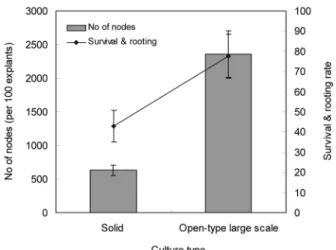
2,300개 이상의 마디를 생산하여 일반 배양방법(폐쇄형 고 체배양)에 비해 370% 이상의 식물체 생산이 가능하였다.
또한 생산된 식물체의 마디를 1-2마디씩 절단하여 기외 미세삽목을 실시한 결과 생존 및 발근율도 1.8배 이상 증 가하였다(Figure 3).
본 실험결과를 통해 결론적으로 공기를 환기시킨 개방 형 액체대량배양 시스템은 기존의 고체배양에 비해 액체 배지를 이용해 식물체로 염류의 흡수를 증가시키고 배양 기내 공기의 환기를 통해 상대습도와 CO2 농도를 조절함 으로써 기내 배양 중인 식물체의 생장을 극대화 할 수 있 었다. 이는 목적하는 형질을 가진 유칼리 펠리타 선발목 의 대량증식을 위해 유용한 배양시스템이라고 생각된다.
인용문헌
1. Driver, J.A. and Kuniyuki, A.H. 1984. In vitro propaga- tion of Paradox walnut rootstock. Horticultural Science 19: 507-509.
2. Delaporte, K. and Sedgley, M. 2004. Selection and breed- ing of eucalyptus for ornamental horticulture. Acta Horti- culturae 630: 77-84.
3. Eldrigde, K.J., Davidson, J., Hardwood, C., and van Wyk, G. 1994. Eucalypts demostication and breeding. Claredon Press, Oxford.
4. Glocke, P., Delaporte, K., Collins, G., and Sedgley, M.
2006. Micropropagation of juvenile tissue of Eucalyptus erythronema & Eucalyptus stricklandii cv. ‘Urrbrae Gem’.
IIn Vitro Cellular & Developmental Biology-Plant 42: 139- 143.
5. Hahn, E.J. and Paek, K.Y. 2005. Multiplication of Chry- santhemum shoots in bioreactors as affected by culture method and inoculation density of single node stems.
Plant Cell, Tissue and Organ Culture 81: 301-306.
6. Harwood, C.E., Alloysius D., Pomroy, P., Robson, K.W.
1997. Early growth and survival of Eucalyptus pellita provenances in a range of tropical environments, com- pared with E. grandis, E. urophylla and Acasia mangium.
New Forests 14: 203-219.
7. Kim, J.A. and Moon, H.K. 2004. Effect of light-emitting diodes (LED) and ventilation on the in vitro shoot growth of Eucalyptus pellita. Journal of Korean Forrest Society 95: 716-722.
8. Kim, J.A., Moon, H.K., Kang, H.D. 2005. Effect of BA and NAA on adventitious bud induction from in vitro ger- minant Eucalyptus pellita. Korean Journal of Plant Bio- technology 32: 201-207.
9. Kozai, T., Kubota, C., Zobayed, S.M.A., Nguyen, T.Q., Afreen-Zobayed, F., and Heo, J. 2000. Developing a mass-propagation system of woody plants. In: Watanabe, K., Komamine, A. eds. Challenge of plant and agricul- ture sciences to the crisis of biosphere on the Earth in the 21st century. Georgetown, Landes Biosphere, 293-306.
10. Kozai, T. and Kubota, C. 2001. Developing a photoau- totrophic micropropagation system for woody plants. Jour- nal of Plant Research 114: 525-537.
11. Laine, E. and David, A. 1994. Regeneration of plants from leaf explants of micropropagated clonal Eucalyptus grandis. Plant Cell Reports 13: 473-476.
12. Louro, R., Dos Santos, A. and Machado, R.D. 1999.
Ultrastructure of Eucalyptus grandis & Eucalyptus uro- phylla. 1. Shoots cultivated in vitro in multiplication and elongation-rooting media. International Journal of Plant Science 160: 217-227.
13. McComb, J.A., Bennett, I.J. and Tonkin, C. 1996. In vitro propagation of Eucalyptus species. In: Taji, A., Williams, R., eds. Tissue culture of Australian plants. Armidale, NSW:
University of New England, 112-156.
14. Merchant, A., Richter, A., Popp, M., and Adams, M. 2006.
Targeted metabolite profiling provides a functional link among Eucalypt taxonomy, physiology and evolution.
Phytochemistry 67: 403-408.
15. Moon, H.K., Kim, J., Lee, H.S., and Kang H.D. 2003.
Micropropagation via axillary bud induction of Eucalyp- tus pellita. Korean Journal of Plant Biotechnology 30:
269-273.
16. Nugent, G., Chandler, S.F., Phil W. and Stevenson, T.W.
2001. Adventitious bud induction in Eucalyptus globulus Labill. In Vitro Cellular & Developmental Biology-Plant 37: 388-391.
17. Park, S.Y., Murthy, H.N., and Paek, K.Y. 2000. Mass mul- tiplication of protocorm-like bodies (PLBs) using bioreactor system and subsequent plant regeneration in Phalaenop- sis. Plant Cell, Tissue and Organ Culture 63: 67-72.
18. Piao, X.C., Charkrabarty, D., Hahn, E.J., and Paek, K.Y.
2003. A simple method for mass production of potato microtubers using a bioreactor system. Current Science 8:
Figure 3. A comparison of mass propagation efficiency in terms of nodes number and survival rate ex vitro between conventional (solid culture) and open-type large scale culture.
1129-1232.
19. Prasad, V.S.S. and Gupta, E.S.D. 2006. In vitro shoot regeneration of gladiolus in semi-solid agar versus liquid cultures with support systems. Plant Cell, Tissue and Organ Culture 87: 263-271.
20. SAS. 1989. SAS/STAT User's Guide. Version 6, Ed 4. Vol 2. SAS Institute, Cary.
21. Schwambach, J., Fadanelli, C. and Fett-Neto, A.G. 2005.
Mineral nutrition and adventitious rooting in microcut- tings of Eucalyptus globules. Tree Physiology 25: 487- 494.
22. Shohael, A.M., Chakrabarty, D., Yu K.W., Hahn, E.J., and Paek, K.Y. 2005. Application of bioreactor system for large-scale production of Eleutherococcus sessiliflorus somatic embryos in an air-lift bioreactor and production of eleuth- erosides. Journal of Biotechnology 120: 228-236.
23. Takayama, S. and Akita, M. 1994. The types of bioreac-
tors used for shoots and embryos. Plant Cell, Tissue and Organ Culture 39: 147-156.
24. Yang, J.C., Chung, J.D. and Chen, Z.Z. 1995. Vegetative propagation of adult Eucalyptus grandis× urophylla and comparison of growth between micropropagated plantlets and rooted cuttings. Plant Cell Reports 15: 170-173.
25. Zobayed, S.M.A., Afreen F., and Kozai, T. 2001. Physiol- ogy of Eucalyptus plantlets grown photoautotrophically in a scaled-up vessel. In Vitro Cellular & Developmental Biology-Plant 37: 807-813.
26. Zobayed, S.M.A., Afreen, F., Xiao, Y., and Kozai, T. 2004.
Recent advancement in research on photoautotrophic micro- propagation using large culture vessels with forced venti- lation. In Vitro Cellular & Developmental Biology-Plant 40: 450-458.
(2008년 9월 30일 접수; 2008년 10월 24일 채택)