양유(洋乳)의 증숙 및 발효 추출물의 인지능 개선 활성
원진배*·윤보라*·이지우*·엄민례*·이현용***·박동식****·정희철*****·정재윤*****·마충제*,**,#
*강원대학교 생물의소재공학과, **강원대학교 생명공학연구소, ***서원대학교 차학과(식품공학과),
****농촌진흥청 국립농업과학원 기능성식품과, *****(주)뉴트리 (Received June 26, 2013; Revised August 16, 2013; Accepted September 10, 2013)
Cognitive Enhancing Activity of the Steamed and Fermented Extracts of Codonopsis lanceolata Radix
Jin Bae Weon*, Bo-Ra Yun*, Jiwoo Lee*, Min Rye Eom*, Hyeon Yong Lee***, Dong-Sik Park****, Hee-Chul Chung*****, Jae Youn Chung***** and Choong Je Ma*,**,#
*Department of Medical Biomaterials Engineering, College of Biomedical Science, Kangwon National University, Chuncheon 200-701, Korea
**Research Institute of Biotechnology, Kangwon National University, Chuncheon 200-701, Korea
***Department of Teaics, Seowon University, Cheongju 361-742, Korea
****Functional Food & Nutrition Division, Department of Agrofood Resources, Suwon 441-853, Korea
*****Newtree CO., LTD. 11F Tech Center, SKnTechno Park, 190-1, Sungnam 462-120, Korea.
Abstract — This study was designed to determine and compare the cognitive enhancing effect of various Codonopsis lan- ceolata extracts by steaming, fermentation and high hydrostatic pressure process. We prepared water extract of C. lanceolata, steamed C. lanceolata, steamed and fermented C. lanceolata and C.lanceolata by high hydrostatic pressure process and fer- mentation. Cognitive enhancing effect of extracts was evaluated in scopolamine-induced memory impairment mice using by passive avoidance test and Morris water maze tests. MTT assay was conducted to investigate neuroprotective effect on glutamate induced cell death in HT22 cells. Steamed and fermented C. lanceolata water extract decreased escape latency in Morris water maze test and increased the latency time of the passive avoidance test compared to other extracts. Fur- thermore, the steamed and fermented C. lanceolata water extract showed neuroprotective effect. These results suggest that steaming and fermentation process more improve cognitive enhancing effect of C. lanceolata than other process.
Keywords □ Codonopsis lanceolata, steaming, ferementation, high hydrostatic pressure, cognitive enhancing effect, neu- roprotective effect
최근 노인 인구의 증가와 더불어 퇴행성 뇌질환인 치매에 대 한 관심이 증가하였으며, 치매의 가장 대표적인 것이 알츠하이 머 병이다. 알츠하이머 병은 기억력 및 판단력의 감퇴와 언어 능 력 저하 등을 일으키는 특징을 가지고 있으며, 65세 이상 치매 환자의 70%가 알츠하이머 병이다.1,2)이 질환의 주요 병리 현상 은 신경 세포 주변에 신경반(neuritic plaque)과 신경섬유다발 (neurofibrillary tangle) 등이 축적 된다.3)알츠하이머 병의 발병 기전은 어느 한가지 정해진 이론은 없으며, 복합적인 원인으로 인해 발병되는 것으로 생각되고 있다. 현재 보고된 발병 기전은 산화적 스트레스에 의한 뇌신경 세포 사멸, free radical 생성, 단
백질 합성 저해, 유전자 발현 이상, 베타-아밀로이드 plaque 축 적 등이 있으며, 그 기전이 복잡하여 현재까지 정확한 기전이 밝 혀 지지 않아 계속적인 연구가 진행되고 있다.4-6) 현재까지 알츠 하이머 병의 치료제는 콜린성 가설(cholinergic hypothesis)에 근 거하여, acetylcholinesterase(AchE)를 억제하여 기억과 학습에 중요한 신경전달물질인 acetylcholine(Ach)의 농도를 일시적으로 상승시켜 치료한다.7,8) Acetylcholinesterase inhibitor 계열의 약 물로 donepezil HCl, rivastigmine, galantamine 등이 있다. 하지 만 현재 사용되고 있는 약물의 경우, 알츠하이머 병을 근본적인 치료제가 될 수 없고, 일시적인 간독성, 구토, 설사와 같은 위장 관 장애와 심장 서맥 유발 등의 부작용을 일으키기 때문에 새로 운 치료제들을 개발하고 있다.9)
천연물의 경우, 예로부터 사용되어와 인간의 몸에 적합하여 부 작용의 위험성이 적으며, 다양한 생리활성 성분을 가지고 있어
#본 논문에 관한 문의는 저자에게로 (전화) 033-250-6565 (팩스) 033-253-6560 (E-mail) [email protected]
종설
알츠하이머 병과 같은 발생 기전이 복잡한 질병의 치료제로 적 합하다.10) 현재 당귀, 현삼이 천연물 소재로 연구가 진행되고 있 다.11)
초롱꽃과(Campanulaceae) 더덕 속에 속하는 더덕(Codonopsis lanceolata Trautv.)은 한국, 일본 그리고 중국 각처에서 자라는 여 러해살이 덩굴식물이며, 사삼이나 백삼이라고도 부른다. 더덕의 주요 생리활성 성분은 saponin으로 대부분 triterpene saponin의 형태로 존재한다.12,13)더덕은 위, 허파, 비장, 신장을 튼튼하게 해 주는 효과가 있으며, 예로부터 민간에서 고혈압, 강장, 거담, 풍 열에 쓰인다고 전해지고 있다. 또한 더덕의 항암 활성, 항산화 효 과, 비장세포 증식능과 cytokine 분비 효과를 이용한 면역 활성, 등이 연구 최근에 보고 되었다.14-16)
본 연구에서는 일반 더덕과 더덕의 활성을 높이기 위해 증숙 공정, 증숙 공정 후 발효, 초고압 처리 후 발효 과정을 거친 물 추출물을 준비하였다. 추출물들의 인지능 개선 효과를 확인하기 위해 동물치매모델에서의 Morris water maze test(수중 미로 실 험)과 passive avoidance test(수동 회피 실험)을 진행하였으며, 각 추출물의 활성을 비교하였다. 또한 뇌신경 세포 보호 활성을 측정 하기 위해 MTT assay를 실시하였다.
실험방법
시약 및 시료
Glutamate와 positive control으로 사용되는 6-Hydroxy- 2,5,7,8-tetramethylchroman-2-carbboxylic acid(trolox), 3-(4,5- dimethylthiazol-2-yl)-2,5-diphenyl tetrazolium bromide(MTT), Scopolamine, carboxymethyl cellulose는 Sigma(St. Louis, U.S.A.) 로부터 구입하여 사용하였다. Dulbecco's modified Eagle's medium(DMEM)과 fetal bovine serum(FBS)은 Gibco BRL.
Co.(Eggenstein, Germany)로부터 구입하였다.
양유 시료의 제조
본 연구에 사용된 더덕은 강원도 횡성 지역에서 채취한 것을 사용 하였다. 양유를 세정하여 흙, 이물질 등을 제거 후 음건 조 건하에서 20~30oC, 1~2일 건조하였다.
SW와 SFW의 증숙 공정은 마하스팀기(Daechang stainless, Korea)를 사용하여 90oC에서 12시간 증숙한 후, 12시간 건조 하 였다. HFW의 초고압 공정은 양유를 70% 증류수 함께 넣어 진 공 포장 한 후, 초고압 추출장치(Ilshin Autoclave, Korea)를 이 용하여 400 Mpa의 압력으로 30분간 초고압 추출을 실행하였다.
증숙공정과 초고압 공정을 거진 SFW와 HFW는 발효공정을 위해 8배수의 물을 가한 후, 농업 미생물 은행(Korean Agricultural Culture Collection, KACC)에서 배양 받은 유산균인 Bifidobacterium longum(KACC 20587), Lactobacillus acidophilus(KACC 12419),
Leuconostoc mesenteroides(KACC 12312)을 각각 106CFU/g 의 농도로 혼합하여 접종하였으며 발효액과 발효물(양유)을 분리 하였다.
양유 추출물의 제조
CW, SW 그리고 발효액을 제거한 SFW와 HFW을 100 g씩 10배수(v/w)의 증류수을 사용하여 수직 환류 냉각기가 부착된 추출 flask에서 100oC에서 24시간 추출하였다. 추출액은 여과 후 회전식 감압농축기(EYELA N-1000, Japan)를 사용하여 여 과한 추출액을 농축시킨 후 동결건조기(ILSIN, Korea)를 통해 -70oC에서 3일간 건조 후 분말상태로 준비하여 실험에 사용하 였다.
실험 동물
4주령의 수컷 ICR mouse을 대한 바이오링크(충북 음성군, 한 국)에서 구입하여 사용하였다. 실험동물은 동물 사육실에서 일주 일 동안 적응시켰다. 적응기간 동안 사료와 물을 제한없이 자유 공급하였으며, 온도는 22±2oC, 습도는 50±10%를 유지시키고, 명암은 12시간을 주기(09:00~21:00)로 조절하였다. 각 그룹은 임의로 7마리씩 구성하였다. 실험 그룹은 대조군, scopolamine 투여군, donepezil 투여군, 농도별 일반 더덕, 증숙 더덕, 증숙 후 발효와 초고압 처리 후 발효 물 추출물 투여군으로 나누었다.
약물 투여
동물 실험인 수중 미로 시험 과 수동 회피 시험 120분 전에 양성 대조군인 1 mg/kg의 donepezil과 100, 300과 500 mg/kg의 농도로 일반 더덕, 증숙 더덕, 증숙 후 발효 과 초고압 처리 후 발효 물 추출물을 경구 투여 하였으며, 동물 실험 30분 전에 치 매를 유도하기 위한 scopolamine(1 mg/kg)을 피하투여 하였다.
대조군은 같은 량의 생리식염수만을 투여하였다.
수중미로 시험(Morris water maze test)
공간 기억력 측정을 위해 가장 일반적인 동물실험으로 Morris 가 제시한 수중 미로 시험을 응용하였다.16)직경 90 cm, 높이 40 cm 의 Water maze pool 안에 물(20±1oC)을 채우고 흰색 platform 이 보이지 않게 하기 위해 흰 우유를 섞어 불투명하게 하였고 Pool을 동서남북 4구간으로 나누고 그 중 한 구간의 중간에 platform(직경 10 cm, 높이 26 cm)를 수면아래 1 cm에 위치하도 록 하였다. 입수 지점은 매일 동서남북 방향으로 구간별 위치를 달리하였으며 platform의 위치는 실험기간 동안 한 곳에 고정하 였다. 4일 동안 2번 반복실험(trial 1과 trial 2)을 하였으며, trial 사이에 20분씩 간격을 두었다. 실험 첫날은 적응 실험을 위해 platform 없이 60초 동안 수영을 하도록 하였다. 2일째부터 측정 실험을 진행하였으며, 마우스가 platform에 도달하면 10초 동안
platform에 머물게 하였으며, 120초 동안 platform을 찾지 못하 면 실험을 멈추고 마우스를 platform에 올려놓은 후 10초 동안 기억 시킨 후 다음 실험을 진행한다. 입수 지점에서 trial 1과 trial 2의 평균 platform을 찾아가는 시간(escape latency)를 기록하여 공간 기억 개선 능력 평가하였다. Probe test를 위해 6일째 platform을 제거한 후, 1분 동안 마우스를 수영하게 한 후, platform이 위치한 구간에서의 머무름 시간을 측정(s)하여 기록 하였다. 모든 마우스의 행동은 Smart(ver. 2.5.21) video-tracking system을 통해 모니터링하였다.
수동회피 시험(passive avoidance test)
기억력 평가를 위해 수동회피 시험을 진행하였으며, 수동 회피 상자(GEMINITM Avoidance System, San Diego Instruments, San Diego, CA, USA)를 통해 step-through test를 실시하였다.
수동 회피 장치는 두 개의 아크릴 상자가 있고 상자 사이에는 마 우스가 이동할 수 있는 문이 설치되어 있다. 바닥에는 스테인레 스 막대가 깔려있어 전기충격을 가할 수 있다. 1일째, 한쪽 어두 운 상자에 1분간 적응을 하게 한 후 조명을 통해 불빛을 비추고 소음을 일으켜 마우스가 반대쪽 회피 상자로 이동하게 한다. 24 시간 후 쥐를 같은 위치의 어두운 상자에 넣은 후 20초 후에 다 시 불빛을 비추고 소음을 일으킨다. 마우스가 회피상자로 들어가 고 2초 뒤 전기충격(0.1 mA/10 g body)을 주어 인식하게 한다. 24 시간 후, 같은 실험을 진행하고 마우스 회피 박스로 이동하는 시 간을 step through latency으로 측정한다. 180초 동안 이동이 없 으면 실험을 멈추었다.
HT22 세포배양 및 뇌신경세포 보호 활성 측정
뇌신경세포 보호 활성을 측정하기 위해 MTT assay를 시행하 였다. 서울대학교로부터 분양 받은 생쥐 해마 유래 세포주인 HT22 세포를 10% FBS가 첨가된 DMEM 배지에 분주하고 37oC 에서 5% CO2 배양기에 배양하였다. 배양된 HT22 세포를 48- well plate에 6.7×10⁴cells/300µl를 분주하여 24시간 배양한 후 각 양유 추출물, Trolox(positive control)와 glutamate를 첨가한 후 24시간 동안 배양하였다. 배양 후 배지를 제거하고 MTT assay 를 시행하였다. 뇌세포 보호 활성은 relative protection(%)로 나 타냈다.
HPLC 분석
HPLC를 이용해 양유 추출물의 페놀성 화합물 함량을 측정하 였다. 7개의 페놀성 화합물, gallic acid, 4-hydroxybenzoic acid, caffeic acid, vanillic acid, 4-coumaric acid, trans-feulic acid 그 리고 caffecine을 분석하였으며, 각 공정별 함량을 비교하였다.
HPLC system은 Aglient 1260 series(Aglient technologies., California, USA)와 UV/VIS detector를 사용하였다. 컬럼은
ZORBAX Eclipse XDB-C18(250×4.60 mm i.d., 5µm)를 이용하 였으며, 온도는 35oC를 유지하였다. 이동상은 10% acetonitrile with 0.1% formic acid(A)과 0.1% formic acid in 40% acetonitrile and 40% methanol(B)을 사용하였으며, 유속은 1 ml/min로 하였 다. 이동상의 최적화를 위한 용매의 조성은 분석시간과 분리능을 고려하여, 0~15 min, 95% A; 15~23 min, 60% A; 23~33 min, 60% A; 33~42 min, 0% A; 42~45 min, 95% A; 45~50 min, 95% A으로 설정하였다. UV 검출기의 파장은 280 nm에서 확인 하였다.
통계처리
통계처리는 SPSS 통계(IBM SPSS statistics 20)을 이용하여 분산 분석(ANOVA)을 실시하였다. 수중 미로 실험의 escape latencies, probe test data와 수동 회피 실험의 the latency 그리 고 MTT assay data는 one-way ANOVA를 이용하였다. 모든 분 석 수치는 mean±SD로 나타내었고, 다중 분석을 위하여 Turkey test를 사후 검정으로 실시하였다. 각 처리군들의 유의성은 P<0.001의 수준까지 유의성을 판단하였다.
결과 및 고찰
수중 미로 시험(Morris water maze test)
대조군은 실험이 진행된 4일 동안 수중 미로 상의 platform을 찾아가는 평균 escape latency가 감소하였으나, scopolamine에 의해 치매가 유도된 마우스의 경우, 120초 동안 platform을 찾아 가지 못하였다. 일반 양유, 증숙 양유, 증숙 발효 양유, 초고압 발 효 양유 추출물 처리군은 실험기간 동안 100 mg/kg에서는 평균 escape latency가 큰 변화를 나타내지 않았으나 300 mg/kg과 500 mg/kg의 농도에서 escape latency가 감소하는 경향을 나타내었 다. 또한 네가지 양유 추출물은 trial 1과 trial 2t 사이의 escape latency time의 차이를 나타내지 않았다. 증숙 발효 양유 추출물 이 4일째 가장 낮은 escape latency를 나타내었다(Fig. 1A).
Platform을 제거한 Probe test에서 증숙 양유 추출물, 증숙 발효 양유 추출물 그리고 초고압 발효 양유 추출물의 구간 머무름 시 간이 일반 양유 추출물 보다 높았으며, scopolamine 처리군과 비 교하여 증숙 양유 추출물과 증숙 발효 양유 추출물의 platform 이 위치한 구간의 머무름 시간은 통계적으로 유의성 있는 기억 력 개선 효과를 확인하였다(Fig. 1B).
각 공정을 거친 양유 추출물 중 증숙 발효 양유 추출물이 가 장 좋은 활성을 나타냈으며, 공정을 거친 양유 추출물은 일반 양 유 추출출 처리군 보다 기억력 개선 효과가 높은 것으로 나타났다.
수동 회피 시험(Passive avoidance test)
기억력 증진 효과를 측정하기 위해 수동 회피 실험을 실시하
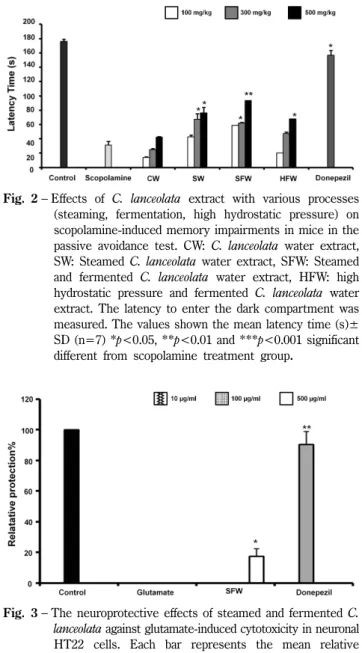
였다. 대조군의 step-through latency는 176.0±3.4초를 나타내었 고 Scopolamine에 의해 치매가 유도된 군은 31.0±5.3초를 나타 내었다. Scopolamine 처리군이 대조군에 비해 step-through latency가 감소되어 치매가 유발된 것을 확인 할 수 있었다. 증 숙 발효 양유 추출물 처리군의 경우, 100, 300과 500 mg/kg에서 각각 58.7±0.9초, 62.3±0.8초와 93.4±3.0초를 나타내어 처리군 중 step-through latency가 가장 높았으며, 공정 처리된 양유 추 출물은 scopolamine 처리군보다 유의적으로 증가하였음을 확인 하여 기억력 개선 효과가 있음을 나타내었다(Fig. 2). 각 공정 처 리된 군이 일반 양유 추출물 군보다 높은 step-through latency 를 나타내었다.
뇌신경세포 보호 활성 − Glutamate로 세포 사멸을 유발시킨 마 우스 유래 해마 세포주(HT22 cell line)을 사용하여 일반 양유, 증숙 양유, 증숙 발효 양유 추출물, 초고압 발효 양유의 뇌신경 세포 보호 활성을 측정하였다. 측정 결과, Fig. 3에 나타내었듯이 증숙 발효 양유 추출물은 500 µg/ml에서 19.13±2.95%의 relative protection을 나타내었으며, 일반 양유 추출물의 뇌신경세포 보 호 활성(relative protection: 17.73±.98%) 보다 높게 나타났다.
증숙 양유 추출물과 초고압 발효 양유 추출물의 HT22 cell에서 의 뇌신경 세포 보호 활성은 나타나지 않았다.
HPLC 분석
HPLC 분석법에 의해 일반 양유, 증숙 양유, 증숙 발효 양유 Fig. 1− Effect of C. lanceolata extract with various processes
(steaming, fermentation, high hydrostatic pressure) on the mean escape latencies in the Morris water maze (A) and on the time spent in the quadrant where the platform was once placed in the probe test (B). CW: C. lanceolata water extract, SW: Steamed C. lanceolata water extract, SFW:
Steamed and fermented C. lanceolata water extract, HFW:
high hydrostatic pressure and fermented C. lanceolata water extract. C. lanceolata extract (300 mg/kg and 500 mg/kg) and donepezil (1 mg/kg) was administered to mice 1.5 h before treatment to scopolamine. Memory impairment was induced by scopolamine treatment (1 mg/
kg). The values shown are the mean escape latency±
standard deviation (SD; n=7). *p<0.05, **p<0.01, and
***p<0.001 compared to the scopolamine group.
Fig. 2− Effects of C. lanceolata extract with various processes (steaming, fermentation, high hydrostatic pressure) on scopolamine-induced memory impairments in mice in the passive avoidance test. CW: C. lanceolata water extract, SW: Steamed C. lanceolata water extract, SFW: Steamed and fermented C. lanceolata water extract, HFW: high hydrostatic pressure and fermented C. lanceolata water extract. The latency to enter the dark compartment was measured. The values shown the mean latency time (s)±
SD (n=7) *p<0.05, **p<0.01 and ***p<0.001 significant different from scopolamine treatment group.
Fig. 3− The neuroprotective effects of steamed and fermented C.
lanceolata against glutamate-induced cytotoxicity in neuronal HT22 cells. Each bar represents the mean relative protection±SD of 3 independent experiments. *p<0.05,
**p<0.01, and ***p<0.001 vs. glutamate-injured cells.
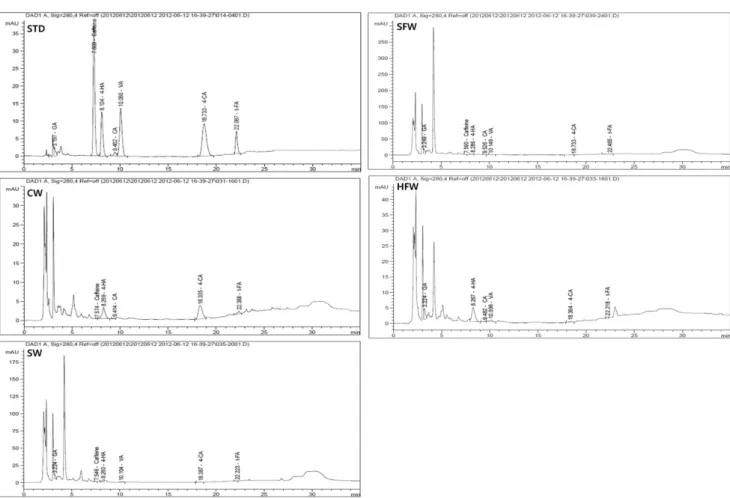
그리고 초고압 발효 양유의 페놀성 화합물, gallic acid, 4- hydroxybenzoic acid, caffeic acid, vanillic acid, 4-coumaric acid, trans-feulic acid 그리고 caffecine의 함량을 측정하였고 비 교하였다(Fig. 4). 총 페놀성 화합물의 함량은 일반 양유 추출물 (1,362µg/g)보다 증숙 양유 추출물(5,443 µg/g), 증숙 발효 양유 추출물(6,382 µg/g), 초고압 발효 양유 추출물(2,244 µg/g)의 함량 이 증가하였으며, 증숙 발효 양유 추출물의 총 페놀성 화합물의 함량이 가장 크게 나타났다. 증숙 발효 양유 추출물의 페놀성 화 합물 중 일반 양유 추출물 보다 gallic acid, vanillic acid, trans- ferulic acid 그리고 caffeine의 함량이 높게 나타났다(Fig. 5).
결 론
본 연구는 scopolamine에 의해 기억 손상이 유발된 마우스에 대한 각 공정 처리된 양유 물 추출물의 기억력 개선 효과를 측 정 하였으며, 각 공정에 의한 양유의 활성 증가를 평가하였다. 알 츠하이머병의 기억력 및 인지능 감퇴 증상은 acetylcholine과 같 Fig. 4− HPLC chromatogram of seven phenolic standard compounds (GA: Gallic acid, CA: Caffeic acid, 4-HA: 4-hydroxybenzoic acid, VA: Vanillic acid, 4-CA: 4-Coumaric acid, t-FA: Trans-ferulic acid, C: Caffeine) (A) and extract sample (B) (CW: C. lanceolata water extract, SW:
Steamed C. lanceolata water extract, SFW: Steamed and fermented C. lanceolata water extract and HFW: high hydrostatic pressure and fermented C. lanceolata water extract).
Fig. 5− The contents of phenolic compounds in the CW (C.
lanceolata water extract), SW (Steamed C. lanceolata water extract), SFW (Steamed and fermented C. lanceolata water extract) and HFW (high hydrostatic pressure and fermented C. lanceolata water extract). (Total: Total phenolic compound: GA: Gallic acid, 4-HA: 4-hydroxybenzoic acid, CA: Caffeic acid, VA: Vanillic acid, 4-CA: 4-Coumaric acid, t-FA: Trans-ferulic acid, C: Caffeine) Significantly different from the CW (*p<0.05).
은 콜린성 신경 전달물질과 관련이 있는 것으로 보고 되었으며, muscarinic receptor antagonist인 scopolamine의 경우, 신경 전 달 물질인 acetylcholine과 muscarinic receptor와 결합을 억제하 여 정보 전달을 차단함으로써, 치매를 유발시킨다.17,18)공간 기 억력을 평가하기 위해 Morris water maze test를 진행하였다.
실험 결과, 증숙 양유 추출물의 경우 실험 2일째부터, 증숙 발효 양유 추출물은 3일째부터 escape latency가 감소되었으며, scopolamine 처리군과 일반 양유 추출물 처리군보다 감소하였다.
Probe test에서도 증숙 양유 추출물과 증숙 발효 양유 추출물의 platform이 위치한 곳에서 머무름 시간은 scopolamine 처리군보 다 확인되어 공간 기억력 개선 효과가 있음을 보여 주었다. 단순 기억력 개선 효과를 평가하기 위해 수동 회피 실험을 진행하였 다. 각 공정 처리 양유 추출물 처리군은 scopolamine 처리군에 비해 step-through latency이 유의적으로 증가하였으며 증숙 발 효 양유 추출물이 가장 높은 step-through latency를 나타내었다.
또한 수중 미로 실험에서와 같이 일반 양유 추출물 처리군 보다 높은 활성을 나타내었다. 이 동물 실험을 통해 각 공정의 추출물 이 공간 인지 기억력 및 단순 기억력 손상에 대한 개선 효과를 나타내며, 각 공정 중 증숙 발효 공정이 일반 양유 추출물의 활 성을 증가 시킨 것으로 확인 되었다. Scopolamine으로 유도한 기 억력 감퇴 마우스 모델을 이용한 행동 실험에서의 증숙 발효 공 정 더덕의 인지 능력 향상 효과는 콜린신경계에서의 acetylcholine 의 합성, 분해, 분비 및 acetylcholine 수용체와 관련이 있는 것 으로 사료된다. 예전 연구에서는 증숙 발효 공정은 양유의 총 페 놀화합물과 플라보노이드 량을 증가시켰으며, 항산화 효과와 AchE 억제 효과를 증가 시키는 것으로 보고되었다.21)또한 초고 압 발효 공정도 양유의 총 페놀화합물과 플라보노이드 량을 증 가시켰으며, 항산화 효과를 증가 시킨 것을 예전 연구에서 확인 하였다.22)위와 같은 연구결과도 공정들이 양유의 활성을 증가 시킨 이유로 판단되어진다.
동물 실험 결과에서 활성이 가장 높게 나타난 증숙 발효 양유 물 추출물에 대한 뇌신경세포 보호 활성 결과, glutamate로 유도 된 마우스 해마 유래 세포주인 HT22 cells의 산화적 손상에 대 해 뇌신경 세포 보호 활성을 보였다. 흥분성 신경 전달 물질인 glutamate는 고농도에서 cystine/glutamate transport system Xc-을 통하여 cystine 섭취를 억제하며, glutathione의 농도를 저 하시킨다. 또한 활성 산소종을 생성하여 산화적 스트레스을 일 으켜 신경세포 사멸을 유도한다.19,20)이를 통해 증숙 발효 양유 추출물의 뇌신경 세포 보호 활성 또한 기억력 개선 효과에 관련 있을 것으로 판단된다.
HPLC 분석법을 통해 총 페놀성 화합물의 함량을 측정하였으 며, 일반 양유 추출물 보다 증숙, 증숙 발효, 초고압 발효 공정으 로 통해진 양유 물 추출물의 함량이 증가하였으며, 인지능 개선 효과가 가장 높은 증숙 발효 물 추출물의 함량이 가장 높게 나
타났다. 증숙 발효 공정이 일반 양유 추출물의 총 페놀성 화합물 의 함량을 증가시켰으며, gallic acid, vanillic acid 그리고 trans- ferulic acid가 크게 증가하였다. 페놀성 화합물은 대부분 항산화 활성을 가지고 있으며, gallic acid와 vanillic acid는 neuroprotective effect와 AchE inhibitor activity이 보고 되었다.23-27)증숙 발효 공정으로 인한 gallic acid, vanillic acid 그리고 총 페놀성 화합 물의 함량의 증가가 더덕의 인지능 개선 및 뇌신경세포 보호 활 성을 향상시킨 것으로 사료된다.
결론적으로 증숙, 증숙 발효, 초고압 발효 공정을 통해 얻어진 양유 물 추출물은 일반 물 추출물 보다 scopolamine으로 유도된 기억력 손상 마우스를 이용한 수중 미로 실험과 수동 회피 실험 에서 향상된 인지능력 개선 효과을 나타내었으며 증숙 발효 공 정은 가장 높은 활성을 나타내었다. 또한 증숙 발효 공정 양유 추출물은 일반 물 추출물 보다 높은 뇌신경세포 보호 활성을 나 타내었다. 추후 증숙 발효 양유 물 추출물의 생리활성 기전에 대 한 많은 연구를 수행하여 정확한 기전을 파악하고, 나아가 알츠 하이머 병의 예방 및 치료를 위한 소재를 제공 할 것이다.
감사의 말씀
본 논문는 농촌진흥청 공동연구사업(과제번호: PJ009001)의 지 원에 의해 이루어진 것임.
참고문헌
1) Crapper, D. R. and DeBoni, U. : Brain aging and Alzheimer’s disease. Can. Psychiatr. Assoc. J. 23, 229 (1978).
2) Boller, F., Mizutani, T., Roessmann, U. and Gambetti, P. : Parkinson disease, dementia, and Alzheimer disease:
clinicopathological correlations. Ann. Neurol. 7, 329 (1980).
3) Lewis, D. A., Campbell, M. J., Terry, R. D. and Morrison, J. H. : Laminar and regional distributions of neurofibrillary tangles and neuritic plaques in Alzheimer's disease: a quantitative study of visual and auditory cortices. J. Neurosci. 7, 179 (1987).
4) Bartus, R. T., Dean, R. L., Beer, D. and Lipa, A. S. : The cholinergic hypothesis of geriatric memory dysfunction.
Science 217, 408 (1982).
5) Portelius, E., Zetterberg, H., Andreasson, U., Brinkmalm, G., Andereason, N., Wallin, A., Westman-Brinkmalm, A. and Blennow, K. : An Alzheimer’s disease-specific beta-amyloid fragment signature in cerebrospinal fulid. Neurosci. Lett. 409, 229 (2006).
6) Citron, M. : Alzheimer's disease: treatments in discovery and development. Nat. Neurosci. 5, 1055 (2002).
7) McGleenon, B. M., Dynan, K. B. and Passmore, A. P. : Acetylcholinesterase inhibitors in Alzheimer’s disease. Br. J.
Clin. Pharmacol. 48, 471 (1999).
8) Ballard, C. G. : Advances in the treatment of Alzheimer's disease: benefits of dual cholinesterase inhibition. Eur. Neurol.
47, 64 (2002).
9) Dawson, G. R. and Iversen, S. D. : The effects of novel cholinesterase inhibitors and selective muscarinic receptor agonists in tests of reference and working memory. Behav.
Brain Res. 57, 143 (1993).
10) Dastmalchi, K., Damien, D. H. J., Vuorela, H. and Hiltunen, R. : Plants as potential sources of drug development against Alzheimer's disease. Int. J. Biomed. Pharmaceut. Sci. 1, 83 (2007).
11) Jeong, E. J., Ma, C. J., Lee, K. Y., Kim, S. H., Sung, S. H. and Kim, Y. C. : KD-501, a standardized extract of Scrophularia buergeriana has both cognitive-enhancing and antioxidant activities in mice given scopolamine. J. Ethnopharmacol. 121, 98 (2009).
12) Choi, W.-Y., Lee, C.-G., Seo, Y.-C., Song, C.-H., Lim, H.-W. and Lee, H.-Y. : Effect of high pressure and steaming extraction processes on Ginsenosides Rg3 and Rh2 contents of cultured- root in wild Ginseng (Panax ginseng C. A. Meyer). Korean J.
Med. Crop Sci. 20, 270 (2012).
13) Jeong, M. H., Choi, W. Y., Seo, Y. C., Kang, H. Y. Choi, G. P. and Lee, H. Y. : Anticancer activity of Acer mono Wood extracted by ultra high pressure extraction process. Korean J. Med. Crop Sci. 18, 157 (2012).
14) Han, C., Li, L., Piao, K., Shen, Y. and Piao, Y. : Experimental study on anti-oxygen and promoting intelligence development of Codonopsis lanceolata in old mice. Zhong. Yao. Cai. 22, 136 (1999).
15) Wang, L., Xu, M. L., Hu, J. H., Rasmussen, S. K. and Wang, M. H. : Codonopsis lanceolata extract induces G0/G1 arrest and apoptosis in human colon tumor HT-29 cells-involvement of ROS generation and polyamine depletion. Food Chem. Toxicol.
49, 149 (2011).
16) Ryu, H.-S. : Effect of Codonopsis lanceolatae extracts on mouse IL-2, IFN-, IL-10 cytokine production by peritoneal macrophage and the ratio of IFN-, IL-10 cytokine. Korean J. Food Nutr. 22, 69 (2009).
17) Ebert, U. and Kirch, W. : Scopolamine model of dementia:
electroencephalogram findings and cognitive performance.
Eur. J. Clin. Invest. 28, 944 (1998).
18) Blokland, A. : Acetylcholine: a neurotransmitter for learning and memory? Brain Res. Rev. 21, 285 (1995).
19) Coyle, J. T. and Puttfarchen, P. : Oxidative stress, glutamate, and neurodegenerative disorders. Science 262, 689 (1993).
20) Choi, D. W. : Glutamate neurotoxicity and diseases of the nervous system. Neuron. 1, 623 (1988).
21) Jung, L.-S., He, X., Song, C., Ma, C. J., Lee, H.-Y. and Ahn, J. : Antioxidant, antibiofilm, and anticholinesterase activities of fermented Deodeok (Codonopsis lanceolata) extracts. Food Sci.
Biotechnol. 21, 1413 (2012).
22) Park, S. J., Park, D. S., Lee, S. B., He, X., Ahn, J. H., Yoon, W. B. and Lee, H. Y. : Enhancement of antioxidant activities of Codonopsis lanceolata and fermented Codonopsis lanceolata by ultra high pressure extraction. J. Korean Soc. Food Sci. Nutr.
39, 1898 (2010).
23) Yena, G.-C., Duhb, P.-D. and Tsaia, H.-L. : Antioxidant and pro- oxidant properties of ascorbic acid and gallic acid. Food Chem.
79, 307 (2002).
24) Kumar, S., Prahalathan, P. and Raja, B. : Antihypertensive and antioxidant potential of vanillic acid, a phenolic compound in L- NAME-induced hypertensive rats: a dose-dependence study.
Redox Rep. 16, 208 (2011).
25) Ghayur, M. N., Kazim, S. F., Rasheed, H., Khalid, A., Jumani, M. I., Choudhary, M. I. and Gilani, A. H. : Identification of antiplatelet and acetylcholinesterase inhibitory constituents in betel nut. J. Integr. Med. 9, 619 (2011).
26) Ban, J. Y., Nguyen, H. T., Lee, H. J., Cho, S. O., Ju, H. S., Kim, J. Y., Bae, K., Song, K. S. and Seong, Y. H. : Neuroprotective properties of gallic acid from Sanguisorbae radix on amyloid beta protein (25--35)-induced toxicity in cultured rat cortical neurons. Biol. Pharm. Bull. 31, 149 (2008).
27) Weon, J. B., Kim, C. Y., Yang, H. J. and Ma, C. J. : Neuroprotective compounds isolated from Cynanchum paniculatum. Arch.
Pharm. Res. 35, 617 (2012).