Print ISSN: 2288-4637 / Online ISSN 2288-4645 doi:10.13106/jafeb.2020.vol7.no11.469
Validating the Entrepreneurial Intention Model on the University Students in Saudi Arabia
Najmul HODA
1, Naim AHMAD
2, Mobin AHMAD
3, Abdullah KINSARA
4, Afnan T. MUSHTAQ
5,
Mohammad HAKEEM
6, Mwafaq AL-HAKAMI
7Received: August 01, 2020 Revised: September 20, 2020 Accepted: October 05, 2020
Abstract
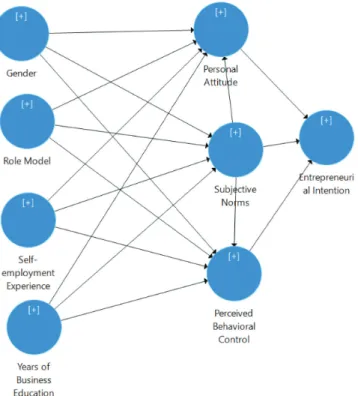
The main objective of this paper is to examine the applicability of Linan and Chen’s entrepreneurial intention model (EIM) in predicting the entrepreneurial intention. EIM is an adaptation of the Theory of Planned Behavior that focuses on entrepreneurial intention and hypothesizing slightly different patterns of relationship with regards to subjective norms. The model also includes human capital and demographic factors. Snowball sampling method was used to collect data using the entrepreneurial intention questionnaire (EIQ) through several social media platforms. The survey indicates that the overall entrepreneurial intention of Saudi students is high (mean = 5.41).
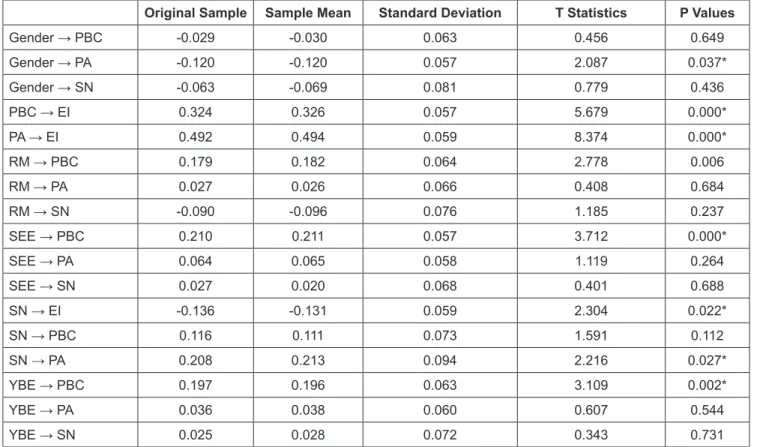
Eight out of the seventeen hypothesized relationships were found to be significant. Among the demographic variables, gender-personal attitude was significant whereas self employment experience and years of business education were found to be significantly related with perceived behavioral control. The statistical analysis using partial least square structural equation modelling validated the model. All the three antecedents of entrepreneurial intention were significantly related with entrepreneurial intention. The results of this study will help policy makers to get deep understanding into the phenomenon of entrepreneurship among Saudi university students and thereby develop a conducive environment. This study also validates the entrepreneurial intention model in a different cultural context.
Keywords: Entrepreneurial Intention, Theory of Planned Behavior, Entrepreneurial Intention Model, Entrepreneurial Intention Questionnaire, Saudi Arabia
JEL Classification Code: I23, L26, M13
1. Introduction
Entrepreneurship is gaining significant attention across the world because it contributes to the better utilization of resources and overcomes the problem of unemployment.
Increasing number of start-ups and nascent ventures are being treated as a benchmark for economic growth. In light of these, new researches are focusing on the factors that determine entrepreneurial behavior in individuals. Intention has been previously been found to be a good predictor of behavior (Rahman, et al. 2020; Choukir, et al. 2019; Kautonen, van Gelderen, & Fink, 2015; Bui, et al. 2020; Bosma, et al. 2008).
The youth, especially students, have been the most important subject of entrepreneurship research. The reason is that students make their career choices and a supportive environment may stimulate them to opt for entrepreneurship. Liñán et al. (2011a) point out an important reason why testing intention models are important. They opine that a good understanding of the underlying antecedents can be used to develop an educational environment that facilitates entrepreneurship.
1
First Author and Corresponding Author. Assistant Professor, Department of Business Administration, College of Business, Umm Al-Qura University, Kingdom of Saudi Arabia [Postal Address:
Al-Abidiyah, Makkah, 21955, Kingdom of Saudi Arabia]
Email: [email protected]
2
Lecturer, Department of Information Systems, College of Computer Science, King Khalid University, Kingdom of Saudi Arabia.
Email: [email protected]
3
Professor, Department of Mathematics, College of Science, Jazan University, Kingdom of Saudi Arabia. Email: [email protected]
4
Department of Business Administration, College of Business, Umm Al-Qura University, Kingdom of Saudi Arabia.
Email: [email protected]
5
Smart Dreams Tech, Umm Al-Qura University, Kingdom of Saudi Arabia. Email: [email protected]
6
Saudi Telecom Company, Riyadh, Kingdom of Saudi Arabia.
Email: [email protected]
7
Department of Business Administration, College of Business, Umm Al-Qura University, Kingdom of Saudi Arabia.
Email: [email protected]
© Copyright: The Author(s)
This is an Open Access article distributed under the terms of the Creative Commons Attribution Non-Commercial License (https://creativecommons.org/licenses/by-nc/4.0/) which permits unrestricted non-commercial use, distribution, and reproduction in any medium, provided the original work is properly cited.