Print ISSN: 2288-4637 / Online ISSN 2288-4645 doi:10.13106/jafeb.2021.vol8.no4.0349
Environmental Performance and Environmental Disclosure:
The Role of Financial Performance
Luluk Muhimatul IFADA1, Maya INDRIASTUTI2, Ewing Yuvisa IBRANI3, Yulita SETIAWANTA4
Received: November 30, 2020 Revised: February 20, 2021 Accepted: March 02, 2021
Abstract
This study aims to examine the effect of environmental performance, independent board of commissioners, and firm size on environmental disclosure measured by the Indonesian environmental index. The population in this study is manufacturing and coal mining companies that follow “PROPER” and are listed on the Indonesia Stock Exchange (IDX) from 2017 to 2019. This research was conducted by reviewing annual reports to collect information on environmental disclosures. The sampling used in this study was purposive sampling technique and obtained a sample of 117. Also, the data analysis technique used was multiple linear regression analysis with statistical hypothesis testing. The results showed that environmental performance and firm size had a positive effect on financial performance. Meanwhile, the independent board of commissioners does not affect financial performance. Furthermore, environmental performance, firm size, and financial performance have a positive effect on environmental disclosure. While the independent board of commissioners does not affect environmental disclosure. The findings of this research suggest that environmental performance has a significant positive effect on financial performance. The hypothesis is accepted, meaning that companies that are sensitive to environmental problems and run eco-efficiency operations will strengthen the company’s profitability.
Keywords: Environmental Performance, Financial Performance, Environmental Disclosure, Independent Board of Commissioners, Firm Size
JEL Classification Code: G32, G53, Q56
sustainable ways of working. Looking at indicators from an environmental perspective, the increasing number of companies is also a contributor to environmental damage.
The rise of environmental problems that occur such as global warming, natural resources sustainability, waste, and pollution makes society which one of the company’s stakeholders more sensitive to environmental issues caused by companies, especially related to pollution so that the public demand for companies to be environmentally responsible in which the company conducts its operation is increasing (Deswanto & Siregar, 2018).
In Indonesia, various cases of environmental damage are caused by the operations of companies such as nickel mining companies in Southeast Sulawesi, which left 5000 hectares of deforested forest areas with an estimated loss of one trillion rupiahs by local governments. Also, in the province of East Kalimantan, PT. Indomaco Mandiri, a subsidiary of PT. Indo Tambangraya Megah Tbk, destroyed nature and the quality of groundwater, thus harming the surrounding community who cannot utilize water contaminated by waste. These problems will affect the company in its daily operations and at the same time, the community will also be more sensitive
1 First Author and Corresponding Author. Lecturer, Faculty of Economics, Universitas Islam Sultan Agung, Indonesia [Postal Address: Jl. Kaligawe Raya No.KM, RW.4, Terboyo Kulon, Kec.
Genuk, Kota Semarang, Jawa Tengah 50112, Indonesia]
Email: [email protected]
2 Lecturer, Faculty of Economics, Universitas Islam Sultan Agung, Indonesia. Email: [email protected]
3 Lecturer, Faculty of Economics and Business, Universitas Sultan Ageng Tirtayasa, Indonesia. Email: [email protected]
4 Lecturer, Faculty of Economics and Business, Dian Nuswantoro University, Indonesia. Email: [email protected]
© Copyright: The Author(s)
This is an Open Access article distributed under the terms of the Creative Commons Attribution Non-Commercial License (https://creativecommons.org/licenses/by-nc/4.0/) which permits unrestricted non-commercial use, distribution, and reproduction in any medium, provided the original work is properly cited.
1. Introduction
In the era of economic globalization, corporate objectives and responsibility have begun to shift from focusing on profit to companies that care about the environment and social issues. In recent years, there has been a global shift towards more environmentally
to the pollution caused by the company. Companies are increasingly working with stakeholders to understand their views and concerns on various environmental, social, corporate governance, and economic issues and to incorporate and address those views and concerns in the company’s strategic decision-making processes.
Due to pressure from its stakeholders, private industry needs to take responsibility for the impact of its business activities on society. Private industry also needs to be accountable to a broader group of stakeholders, not just creditors, and shareholders (Hackston & Milne, 1996).
The Indonesian government requires companies to take environmental responsibility through “Law no. 32 of 2009 concerning Protection and Management of the Environment, Law No.40 of 2007 concerning Limited Liability Companies (Article 66 (2c) and Article 74 (1)), Government Regulation No. 47 of 2012 concerning Social and Environmental Responsibility of Limited Liability Companies and Regulation of the Indonesian Capital Supervisory Agency and Financial Institution No. X.K.6 concerning Obligations to Submit Annual Reports for Issuers and Public Companies”.
According to legitimacy theory, companies disclose social responsibility information to present a socially responsible image so that they can legitimize their behaviors to their stakeholder groups. They disclose information about the impact of their activities on the environment and respond to mitigating environmental consequences. Companies use environmental disclosures to manage stakeholder impressions and convince them that the company is responsible for its operational activities. Through environmental disclosure, companies try to gain and maintain their legitimacy. One of these efforts can improve the company’s financial performance (Kurnia et al., 2020). As a result of increasing environmental problems, companies are not only evaluated using financial performance but by using other performance dimensions such as environmental aspects (Belhaj & Damak- Ayadi, 2011). El Ghoul et al. (2011) stated that one of the benefits for companies that are socially and environmentally responsible is lower capital costs. This is because social and corporate responsibility increases the positive response of investors to companies that are sensitive to environmental issues and voluntarily disclose green investment initiatives (Moser & Martin, 2012).
The results of empirical research on financial performance, environmental performance and environmental disclosure have varied results. Stanwick and Stanwick (2000);
Al-Tuwaijri et al. (2004); Clarkson et al. (2008) found that there is a positive relationship between environmental performance and company performance. Good financial performance makes funds available for investment to improve the company’s environmental and social performance (Scholtens, 2008). Blacconiere and Patten (1994) found a negative relationship between environmental performance
and financial performance. Financial performance and environmental disclosure are positively related according to the research conducted by Al-Tuwaijri et al. (2004); Clarkson (2011); Rezaee (2016). Meanwhile, Patten (2002); Cho et al. (2010) proved a negative relationship between financial performance and environmental disclosure. Auliyah and Basuki (2021) showed that CSR disclosure has no significant effect on financial performance.
Wong and Fryxell (2004) stated that as a result of increasing awareness and concern for environmental issues, large companies are interested in projecting corporate image in environmental protection and considering environmental disclosure to enhance the company’s image and reputation.
Nehring et al. (2009); Chaddad and Mondelli (2013) stated that large companies with international economies of scale have high returns on assets, increased returns on equity or invested capital (Adenaeuer & Heckelei, 2011), high sales turnover (Garcia-Fuentes et al., 2013), as well as higher profit margins. This reinforces the statement that there is a positive relationship between firm size and the resulting financial performance. On the contrary, Hýblová (2014); Grant (1996); Denis et al. (2002) proved a negative relationship.
Large companies participate in a higher number of businesses and initiatives towards environmental management. Brammer and Pavelin (2006) and Patten (1992) documented a positive relationship between firm size and the level of environmental disclosure. Johan (2021) concluded that company size, profitability, and efficiency are variables that affect corporate social responsibility. Because large companies have more stakeholders, the company satisfies stakeholders with environmental disclosure information to maintain legitimacy. Monteiro and Aibar-Guzmán (2010);
Moneva and Llena (2000) found that there is no significant evidence that during the period analyzed the environmental reporting behavior of the company management has tried to satisfy their stakeholders.
Iatridis (2013) stated that environmental disclosure contains information that is relevant to the creation of a company’s good reputation. A company with a good reputation is one reflection of achieving corporate governance. With the effect of good governance, it is hoped that the company will be more optimal in achieving organizational goals. In corporate governance, there is an independent board that can contribute views independently and participate actively in discussions, and are considered decision experts (Fama, 2012). The independent board will represent shareholders on the company board. As an independent board, they must ensure that their presence and performance are free and are not intimidated by the influence of company management (Hermalin & Weisbach, 2012).
The company appoints an independent board of commissioners to monitor and play a role in mitigating conflicts of non-conformity with applicable regulations in
society. The independent board must have a diversity of perspectives that point not only to a short-term orientation concerning financial performance but also to the company’s social and environmental sustainability. Through an oversight approach that monitors compliance with established standards while also evaluating the potential impact of future expectations, boards have a significant role to play in establishing and reinforcing an overarching set of expectations with regard to the short- and long-term management of social and environmental risks (Sampaio et al., 2012). The board of directors is seen as a check and balance mechanism in improving the effectiveness and monitoring of company management. This will force company management to be more responsive to the external environment and its needs (Freeman, 1984).
Solakoglu and Demir (2016); Montreevat (2006) succeeded in confirming a positive relationship between the independent board of commissioners and financial performance. With strong independence and transparency, it can increase investment efficiency by gradually increasing the company’s financial performance. Meanwhile, Liu et al. (2017); Kathy Rao et al. (2012) stated that companies that have good corporate governance will tend to have high-quality corporate environmental disclosure. Fuzi et al. (2016); Ararat et al. (2015); Rahman and Mohamed Ali (2006) found empirical results that there is no relationship between board independence and financial performance.
An independent board exists to comply with business and company regulations (Fuzi et al., 2016).
To address the research gaps that have been discussed, this study used legitimacy theory and shareholder theory in analyzing the relationship between variables. This is in line with the importance of companies paying attention to financial and non-financial aspects such as environmental performance and good environmental disclosure. The legitimacy theory approach is based on the need for corporate environmental disclosure to preserve the company’s image and avoid negative consequences due to the legitimacy crisis (Carnahan et al., 2010). Meanwhile, the stakeholder theory approach, apart from the use of accounting information for shareholders and creditors, also attracts positive responses to other investors, so that they voluntarily report more environmental information to meet their demands (Moneva
& Llena, 2000).
2. Literature Review 2.1. Legitimacy Theory
Legitimacy can be interpreted as recognition and acceptance of the company’s existence by the community.
The main assumption of legitimacy theory is fulfilling the organization’s social contract, which enables the recognition
of its objectives. Legitimacy is a generalized perception or assumption that the actions of an entity are desirable, proper, or appropriate within some socially constructed system of norms, values, beliefs, and definitions (Cho et al., 2012).
Legitimacy theory is the theory most commonly used to explain social activities and disclosure of the company’s environment to fulfill their social contract (Campbell et al., 2003). According to Cho and Patten (2007), legitimacy theory implies that environmental disclosure is a function of the intensity of social and political pressures faced by a company on environmental performance. This is because legitimacy can guarantee the sustainability of the company’s business. Legitimacy theory suggests companies with poorer environmental performance would be expected to provide more extensive off-setting or positive environmental disclosures in their financial reports (Van de Burgwal &
Vieira, 2014). Besides, environmental disclosure information is a form of transparency in the business sector regarding the company’s environmental activities and shows the company’s concern and responsibility in front of stakeholders and the preservation of the surrounding environment which will build good legitimacy for the company.
2.2. Stakeholder Theory
Stakeholder theory is related to ethical organizational management, which not only describes the existing situation but also considers the needs of stakeholders when developing a company strategy, as stated by Robert Phillips et al.
(2014); Huang and Kung (2010). Furthermore, Clarkson (1995) stated that the sustainability of a company depends on the ability of its managers to create wealth, value, and satisfaction with stakeholder groups (such as shareholders, creditors, consumers, suppliers, government, society, and other parties). Companies must be able to balance the various demands of their stakeholders to get sustainable support that will have a good impact on the company in the form of market growth (Huang & Kung, 2010). This shows that the existence of a company is strongly influenced by stakeholder support for the company.
Stakeholder theory is used to explain how companies manage stakeholders and their conflicts of interest through disclosing their social and environmental accountability (Roberto et al., 2009). Social and environmental disclosure is considered as a means of communication (between companies and their stakeholders) that companies use to respond to the different needs of stakeholders (Huang &
Kung, 2010). Company environmental disclosures that contain non-financial information related to environmental impacts arising from company activities can be used as a company strategy to fulfill the interests of stakeholders (including employees, shareholders, investors, consumers, non-governmental organizations) (Reverte, 2009). Therefore,
stakeholder theory provides support to explain the dissemination of social aspects in company management, because the influence of shareholders, customers, government, society, and creditors is a possible determinant of social information disclosure.
3. Hypothesis Development
3.1. Environmental Performance on Financial Performance
The ISO 14001 standard (2004) considers that environmental performance is a measurable result of an organization’s management in its environmental aspects.
The company’s environmental performance includes the efforts the company makes in the rational use of resources, reducing the environmental impact of its activities on the environment, as well as improving the environmental management in which the company operates. Bragdon and Marlin (1972) stated that company responsiveness to the environment results in higher financial performance associated with a decrease in the level of pollution from the company. Whereas Cormier and Magnan (2003) have examined the level of chemical waste reported by the EPA resulted in a higher level of environmental performance associated with a lower level of chemical waste. Also, a well- managed environmental performance can be a marketing tool that can be used in providing a competitive advantage to an organization. So that the resulting product will get added value in the eyes of consumers and a better selling value.
Companies that are sensitive to environmental issues will implement environmental policies to improve financial performance. Environmental policies such as improving environmental performance will help direct management strategies to improve the company’s financial performance (Stanwick & Stanwick, 2000). This is in line the research by Ifada et al. (2019) that corporate social responsibility can improve company performance. Companies with good financial performance tend to have high company value (Machmuddah et al., 2020; Sudiyatno et al., 2020). Therefore, companies that are committed to their environment will have a positive image in the eyes of stakeholders, which in turn increases the company’s profitability (Ioannou & Serafeim, 2017). Furthermore, it was supported by Nor et al. (2016) that there is a positive influence on financial performance along with the increase in the company’s environmental performance. Based on the description above, the hypothesis can be formulated as:
H1: Environmental performance has a positive effect on financial performance.
3.2. Independent Board of Commissioners on Financial Performance
The independent board of commissioners is a corporate governance mechanism that is important in monitoring and supervising a company (Dahya et al., 2008). Generally, the board of commissioners not only monitors company managerial behavior but also ratifies company decisions and support company strategies which are expected to have a broader view of the business environment that will promote more effective decision making (Ararat et al., 2015; Solakoglu
& Demir, 2016). Furthermore, Nicholson and Kiel (2007) explained that the board of commissioners is considered the most important link to outside resources such as creditors, customer suppliers, and institutional investors for the benefit of the company. As a result, a strong relationship will have a positive impact on financial performance.
Farhan et al. (2021) examined the relationship between female boards of directors and financial performance and found that companies that had female boards of directors had a higher financial performance. Solakoglu and Demir (2016) confirmed the significant positive effect of the board of commissioners on financial performance. Furthermore, Montreevat (2006) explained that independent directors have a strong monitoring effect and can transparently increase investment efficiency and a company’s strong financial performance. Thus, the hypothesis can be formulated as:
H2: The independent board of commissioners has a positive effect on financial performance.
3.3. Firm Size on Financial Performance
Firm size is a description of the size of a company which can be measured by market capitalization, total capital used, total assets owned and total sales earned. Companies that have larger total assets certainly can generate higher profits. Large companies also have greater negotiating power with customers and suppliers and have easier access to international markets. Furthermore, a large company can lead to a higher rate of return on assets (Chaddad &
Mondelli, 2013), or a higher rate of return on equity or invested capital, higher profit margins (Adenaeuer &
Heckelei, 2011), or higher sales returns (Garcia-Fuentes et al., 2013). When the company gets a stronger position, it will also have an impact on increasing the company’s financial performance (Lopez-Valeiras et al., 2016). Thus, the hypothesis can be formulated as:
H3: Firm size has a positive effect on financial performance.
corporate environmental disclosure. Thus, the hypothesis can be formulated as:
H5: The independent board of commissioners has a positive effect on environmental disclosure.
3.6. Firm Size on Environmental Disclosure
Larger companies are more likely to be subject to public scrutiny, and will therefore disclose more information to legitimize communities and gain public support for their continued existence (Cormier & Gordon, 2001).
Furthermore, this is also in accordance with stakeholder theory, which states that stakeholders have the opportunity to control company resources. Larger firms disclose more environmental-related information than smaller firms. This finding suggests that firm size is an important determinant of environmental disclosure practice (Cowen et al., 1987).
Environmental disclosure is used by companies to meet pressure from the public and other external parties so that the company continues to operate and gain legitimacy from the community (Yinglu & Indra, 2012).
The majority of empirical studies found significant evidence that there is a positive relationship between firm size and the level of social and environmental disclosure (Brammer & Pavelin, 2006; Van de Burgwal & Vieira, 2014).
Aerts et al. (2006); Liu and Anbumozhi (2009) explained that firm size is a strong indicator to influence corporate social and environmental disclosure. Therefore, the hypothesis is formulated as;
H6: Firm size has a positive effect on environmental disclosure.
3.7. Financial Performance on Environmental Disclosures
Financial performance is a factor that enables company management to flexibly report on its social and environmental responsibilities. Companies that have high profits can allocate their expenses to many aspects, including involvement in environmental issues (Deswanto & Siregar, 2018). Very profitable companies are more trusted by the public to increase stakeholder accountability expectations.
When companies are more involved in social activities, they will have more information to disclose. Furthermore, Qiu et al. (2016) explained that the measurement of corporate environmental aspects, such as the greenhouse effect, tends to significantly increase company spending. Environmental disclosure also entails high costs, including the costs of identifying, measuring, and reporting this information.
Therefore, only companies with high financial performance are willing to bear these costs.
3.4. Environmental Performance on Environmental Disclosure
A company can enhance organizational and stakeholder relations by disseminating credible information about non- financial information such as environmental performance.
Companies are increasingly required to provide non-financial information in response to the information needs of investors regarding their environmental responsibilities (Rezaee, 2016). Companies with good environmental performance will more often convey environmental disclosures or company achievements as a strategy to gain sympathy and maintain a
“social contract” with the community. Furthermore, Cai et al.
(2016) explained environmental disclosure as the creation of a good corporate image. Thus, the community will be more accepting of the existence of the company or even increase customer and employee satisfaction (Edmans, 2011), and lead to better management relations with stakeholders (Chapple & Moon, 2005). Thus, the company will still get legitimacy from the community and longer sustainability.
Giannarakis et al. (2017); Ahmadi and Bouri (2017) have the same research results that environmental performance has a positive effect on the extent of corporate environmental disclosure. Thus, the hypothesis can be formulated as:
H4: Environmental performance has a positive effect on environmental disclosure.
3.5. Independent Board of Commissioners on Environmental Disclosure
As the supervisory board, the board of commissioners has the responsibility to monitor the performance of the board of directors in implementing good corporate governance in environmental matters. Ideally, along with the efficient supervisory function, and the independence of the commissioners, it can pressure company management to carry out non-financial disclosure activities (such as social and environmental) in the interests of internal and external stakeholder information (Siew et al., 2016). Liu et al. (2017) showed that companies with good corporate governance are more likely to have high-quality environmental disclosures.
Besides, Haniffa and Cooke (2005) stated that non-executive directors (more independent boards) are an effective mechanism to align stakeholder interests with company management from environmental disclosure information in company annual reports.
Nekhili et al. (2017) found that the independence board has a positive effect on environmental disclosure.
Lim et al. (2007); Kathy Rao et al. (2012) confirmed that board independence is positively associated with voluntary disclosure, and board independence has a positive effect on
Johan (2021) showed that financial performance, which is often represented by profitability, affects corporate social responsibility. If the company makes a profit, the company will allocate its funds for CSR activities. The allocation of funds for CSR activities will certainly make the company have a CSR program and will make disclosures. Environmental programs are part of the CSR program. Lu and Abeysekera (2014) confirmed that profitability is one of the characteristics of a company that significantly causes companies to disclose their social and environmental responsibility initiatives. Thus, the hypothesis is formulated as:
H7: Financial performance has a positive effect on environmental disclosure.
4. Research Method
The population of this study consists of companies listed on the Indonesia Stock Exchange (IDX) from 2017 to 2019. This research was conducted by using a quantitative approach by reviewing annual reports to collect information on environmental disclosures. Annual reports are used because they are acceptable and commonly used source for social disclosure and to communicate information to stakeholders (Tilt, 1994; Lodhia, 2004). Furthermore, Aerts et al. (2006); Buniamin (2010) stated that large companies are believed to have more information that allows them to be more involved with corporate governance, social and environmental responsibility, and high quality of disclosure.
4.1. Measurement of Variable 4.1.1. Environmental Performance
The environmental performance of the company is assessed by the Ministry of Environment (KLH) and reported through PROPER. PROPER is an assessment of a company’s environmental management performance that requires measurable indicators. This is carried out by the Ministry of Environment of the Republic of Indonesia to increase the role of companies in managing the environment and provide stimulant effects in accordance with environmental regulations and value-added on natural resource maintenance, energy conservation, and community development. This research shows that the sample companies have maintained and preserved the environment around the company in accordance with the criteria in PROPER. The environmental performance assessment is based on the PROPER performance rating system which has five color ratings, namely, gold, green, blue, red, and black (Choi et al., 2013).
4.1.2. Independent Board of Commissioners
The independent board of commissioners is calculated as the ratio of the number of independent board members to the total number of board members. As the main mechanism for corporate governance, the independent board of commissioners effectively represents the interests of various company stakeholders Jo and Harjoto, (2011); Nekhili et al., (2017). It is formulated as follows:
DK = Σ ×
Σ
Komisaris Indepeden
Anngota komaisaris Indepeden 100%
4.1.3. Firm Size
Firm size is an indicator used to determine the size of an entity (small or large). In this study, firm size can be seen from the total assets owned by the company, by adding all current and non-current assets owned by the entity.
According to Van de Burgwal and Vieira (2014), firm size can be measured by the following formula:
SIZE = Ln (Total Assets) 4.1.4. Environmental Disclosure
Environmental disclosure is the voluntary disclosure of a company’s environmental information in Indonesia. The measurement is an environmental disclosure in this research is conducted using the Indonesian Environmental Reporting (IER) index developed by Suhardjanto et al. (2008).
IER s item Disclosure IER's Total items
′ ×
= Σ
( )
4.1.5. Financial Performance
Financial performance can be measured by various indicators. According to Hackston and Milne (1996), a more reliable measure of financial performance is to measure financial performance over a long period.
Therefore, in this study, the five-year average return on assets (EAT / Total assets) is used as a measure of financial performance. Financial performance in this study is measured by using the Return on Assets (ROA) ratio Florio and Leoni (2017); Huang and Hilary, (2018) which is calculated from profit after tax divided by total assets. The formula is as follows:
ROA EAT
Total Asset
= ×100%
5. Results and Discussion
The Kolmogorov-Smirnov test results show Asymp. Sig.
value more than 0.05, means model 1 and model 2 of this study have a regression model with a normal distribution.
The classical assumption test consists of a multicollinearity test and a heteroscedasticity test. The results showed that all variables had a tolerance above 0.10 and a VIF value below 10. This indicated that model 1 and model 2 of this study did not have multicollinearity symptoms. While the heteroscedasticity test shows a number above 0.05 so that neither model 1 nor model 2 has heteroscedasticity.
Meanwhile, the R-Square value in model 1 = 22.6%, and model 2 = 23.9%. That is, in model 1, namely environmental performance, independent commissioners and firm size affect financial performance only by 22.6% and the remaining 77.4% is influenced by other variables. Whereas in model 2, namely environmental performance, independent board of commissioners, firm size, and financial performance affect environmental disclosure by 23.9% and the remaining 76.1%
is influenced by other variables.
5.1. Environmental Performance and Financial Performance (H1)
Hypothesis 1 stated that environmental performance has a significant positive effect on financial performance with a significance value of 0.001, α = 0.05. While the
value of the β coefficient is positive = 0.030. Thus, it can be concluded that H1 is accepted.
This is in line with Nor et al. (2016) that environmental performance has a significant positive effect on environmental disclosure. Companies that are sensitive to the environment will be careful in making management decisions related to their environmental policies. Branch and Cai (2012) explained that companies that are responsible for the environment show a significant positive return on investment. This is because companies that run eco-efficiency will strengthen company profitability (King & Lenox, 2001), or investment ethics make non-polluting companies preferred by many investors. Thus, it will result in a higher share price and a lower cost of capital (Heinkel et al., 2001). Edmans (2011); Setiawanta et al. (2021) stated that this reflects the measurable results of organizational management on overall financial performance. Therefore, companies that are committed to their environment will have a positive reputation in the eyes of stakeholders (Soedjatmiko et al., 2021), which in turn increases the company’s profitability (Ioannou & Serafeim, 2017).
5.2. Independent Commissioner and Financial Performance (H2)
Hypothesis 2 stated that the independent board of commissioners on financial performance has a coefficient of β 0.047 and a significance value of 0.326 > α = 0.05. Thus, it can be concluded that hypothesis (H2) is rejected.
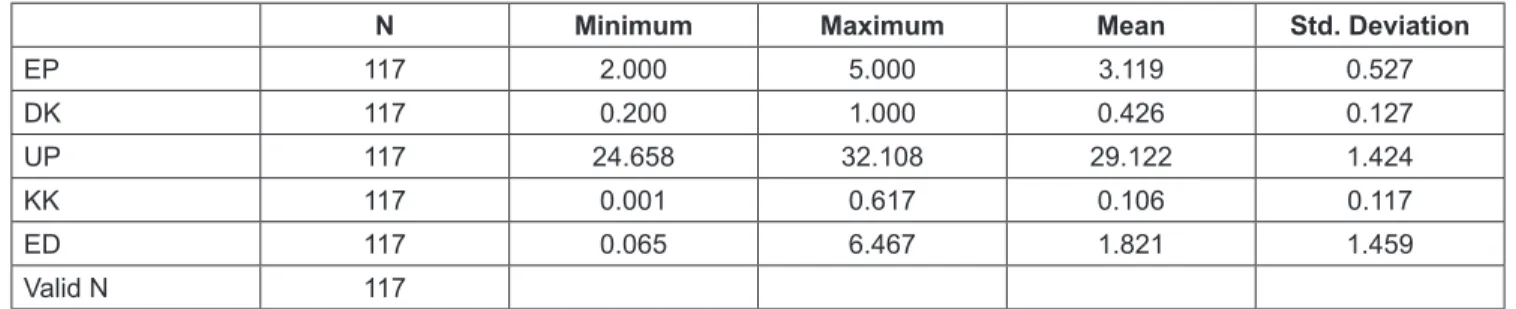
Table 1: Descriptive Statistics
N Minimum Maximum Mean Std. Deviation
EP 117 2.000 5.000 3.119 0.527
DK 117 0.200 1.000 0.426 0.127
UP 117 24.658 32.108 29.122 1.424
KK 117 0.001 0.617 0.106 0.117
ED 117 0.065 6.467 1.821 1.459
Valid N 117
Table 2: Results of Hypothesis Testing Model 1
Model Multicollinearity
Heteroscedasticity Unstandardized
Tolerance VIF Beta Sig.
(Constant) –0.299 0.002
EP 0.907 1.103 0.952 0.030 0.001
DK 0.931 1.075 0.700 0.047 0.326
UP 0.866 1.154 0.854 0.009 0.009
Dependent Variable: KK.
Normality Test Statistic 0,051. Asymp. Sig. (2-tailed) 0,051. Runs Test 0,913. P-Value 0,000. R Adjusted R Square 0,226.
& Heckelei, 2011), and higher sales returns as well (Garcia- Fuentes et al., 2013). Thus, a high-profile company that has a stronger position will have an impact on improving the company’s finance. Lopez-Valeiras et al. (2016) justified the argument of a direct and positive relationship between firm size and profitability and that high-profile companies focus on greater resources and market opportunities to increase economies of scale.
5.4. Environmental Performance and Environmental Disclosure (H4)
Hypothesis 4 stated that the effect of environmental performance on environmental disclosure. H4 is accepted.
The increase in environmental performance has a positive effect on environmental disclosure according to the coefficient β 0.586 and the significance value of 0.013. This means that the positive effect of environmental performance on environmental disclosure is significant. Companies that invest in environmental performance management will respond to the information needs of stakeholders that are more transparent and credible in environmental disclosure.
In line with the statement of Cai et al. (2016); Edmans (2011); Chapple and Moon (2005), environmental disclosure as a “social contract” strategy to gain legitimacy with the community and create a good corporate image so that sustainability will last a long time. On the other hand, information leads to more efficient operations and better environmental performance (Schlenker & Scorse, 2012;
Setiawanta et al. 2021). These demands can force companies to implement initiatives in reducing carbon emissions, increasing employee engagement and reducing turnover, changing suppliers, investing in environmental quality products and safety procedures as a response to the company’s strong commitment to environmental issues (Ioannou &
Serafeim, 2017). Therefore, the demands for environmental disclosure can provide incentives for companies to change In this study, the independent board of commissioners
was selected and appointed not based on the background of their abilities, but for the company such as expediting business to comply with regulations (Fuzi et al., 2016).
The results of the study by Ararat et al. (2015) explained that the independence board is not truly independent in carrying out its duties as a managerial. This is because independent directors have personal, financial, and social relationships with dominant shareholders so that it will affect their independent assessment as an independent board (Fuzi et al., 2016). This relates to the ineffectiveness of directors in the monitoring role due to the dominant role of managers and executive directors (Fuzi et al., 2016). This shows that having board independence does not guarantee to improve firm financial performance because of the poor monitoring role of the independent board (Garg, 2007). The results of this study contradict the research by Solakoglu and Demir (2016); Montreevat (2006); Farhan et al. (2021);
Dahya et al. (2008) which state that the independent board of commissioners has a positive effect on improving the company’s financial performance.
5.3. Firm Size and Financial Performance (H3) Hypothesis 3 stated that there is a positive influence of firm size on financial performance. Hypothesis 3 is thus accepted. In Table 3, it is shown that the β coefficient value is 0.009 and the significance level is 0.009 < α = 0.05.
This means that the positive effect of firm size on financial performance is significant. This significant influence can be interpreted that large companies are more careful in managing finances efficiently so that sales turnover and financial performance will increase.
The results of this study are in line with Chaddad and Mondelli (2013) who confirmed that large companies have a higher rate of return on assets, a higher rate of return on equity or invested capital, higher profit margins (Adenaeuer Table 3: Results of Hypothesis Testing Model 2
Model Multicollinearity
Heteroscedasticity Unstandardized
Tolerance VIF Beta Sig.
(Constant) –8.056 0.001
EP 0.922 1.085 0.922 0.586 0.013
DK 0.948 1.055 0.948 1.575 0.100
UP 0.907 1.102 0.907 0.242 0.006
KK 0.904 1.063 0.940 3.167 0.003
Dependent Variable: ED.
Normality Test Statistic 0,200. Asymp. Sig. (2-tailed) 0,20. Runs Test 0,403. P-Value 0,000. Adjusted R Square 0,239.
managerial practices so that they are more productive and efficient and also credible in improving organizational and stakeholder relations (Rezaee, 2016).
5.5. Independent Board of Commissioners and Environmental Disclosure (H5)
Hypothesis 5 stated that the independent board of commissioners on environmental disclosure has a coefficient of β 1.575 and a significance value of 0.100 > α = 0.05. Thus, it can be concluded that H5, which is, the independent board of commissioners has no effect on environmental disclosure, is rejected.
This suggests that having board independence does not guarantee to increase wider environmental disclosure due to the inefficient monitoring role of the independent board.
The result is in line with the research results of Haniffa and Cooke (2002), who proved the inefficiency of independent boards in monitoring due to the dominant role of managers and executive directors on the board. An independent board of commissioners that is too large will make the agreement and negotiation decisions lengthy (Yermack, 1996).
Donaldson and Davis (1991) also stated that in Malaysia, the independent board of commissioners did not affect the extent of environmental disclosure of the company, due to the dual roles of the managing director and the chairman of the board. Diamastuti et al. (2021) confirmed that corporate governance has no significant effect on corporate social and environmental responsibility disclosures. Therefore, the size of the independent board has not been said to be effective as a supervisory board and a recommendation provider so that management carries out activities in accordance with what stakeholders’ desire, related to social aspects and environmental disclosures.
5.6. Firm Size and Environmental Disclosure (H6) Hypothesis 6 stated that firm size has a significant positive effect on environmental disclosure with a significance value of 0.006, α = 0.05. While the value of the β coefficient is positive 0.242. Thus, it can be concluded that H6, firm size has a significant positive effect on environmental disclosure, is accepted.
This assumption is based on the fact that, in general, larger firms participate in a higher number of businesses and operate on an international scale. These activities have a greater impact on the environment, and consequently, on society (Brammer & Pavelin, 2006). This is consistent with the stakeholder theory. High-profile companies must satisfy a higher number of stakeholders to draw attention to environmental management and corporate initiatives (Deegan
& Gordon, 1996; Van de Burgwal & Vieira, 2014). Besides,
larger firms make much more detailed quality disclosures than smaller firms (Brammer & Pavelin, 2006). Wong and Fryxell (2004) realized that this positive relationship affects high-profile companies to become aware of the importance of building and maintaining a good corporate reputation so that companies try to disclose their environmental information to protect or expand their reputation and to keep the company operating.
5.7. Financial Performance and Environmental Disclosure (H7)
Hypothesis 7 that financial performance affects environmental performance, is accepted. Increased financial performance has a positive effect on environmental disclosure. This is in accordance with the results of the coefficient β 3.167 and a significance value of 0.003. This means that the positive effect of financial performance on environmental disclosure is significant. In accordance with Lu and Abeysekera (2014), profitability is one of the characteristics of a company that significantly makes environmental disclosures.
In a management survey of 766 managers conducted by Accenture and the United Nations Global Compact (UNGC), 93% of surveyed management believed that environmental disclosure information with good performance would be critical to future business success and 91% reported that companies would use new technologies for environmental problems in the next five years (Lacy et al., 2010). Meanwhile, Low (2016) stated that 12 percent of the reputation of financial information and the company’s environment significantly affects customer decisions in purchasing / repurchasing products, increasing demand for products and services and or reducing consumer price sensitivity (Sen & Bhattacharya, 2001), contributing to legitimacy (Hillman & Keim, 2001), even increasing customer and employee satisfaction with the existence of companies that are sensitive to the environment (Edmans, 2011). Therefore, environmental disclosure produces an effect on increasing stakeholder interesting (Kurnia et al., 2020) and long-term value creation.
6. Conclusion
This study proves the effect of environmental performance, independent board of commissioners, and firm size on environmental disclosure through financial performance. The main findings are:
1. Environmental performance has a significant positive effect on financial performance. The hypothesis is accepted, meaning that companies that are sensitive to environmental problems and run eco-efficiency
operations will strengthen the company’s profitability (King & Lenox, 2001). By implementing good environmental performance, it will provide a faster return on capital.
2. The independent board of commissioners has no effect on financial performance. The hypothesis is rejected, meaning that the independent board of commissioners in the company is only to expedite business and comply with regulations. So that the existence of an independent board does not guarantee that it can improve the company’s financial performance (Fuzi et al., 2016).
3. Firm size has a positive effect on financial performance. The hypothesis is accepted, a company with a high profile will have a faster sales turnover rate so that the return on capital is higher. This reflects that the larger company has a good financial performance.
4. Environmental performance has a positive effect on environmental disclosure. The hypothesis is accepted. Environmental disclosure is a means of creating a corporate image and social contracts with the dissemination of credible information about environmental performance so that it can reduce or enhance the company’s image.
5. The independent board of commissioners has no effect on environmental disclosure. The hypothesis is rejected, meaning that the independent board of commissioners has dual roles. When the managing director is also chairman of the board, the extent of the company’s environmental disclosure is not effective and maximized.
6. Firm size has a positive effect on environmental disclosure. The hypothesis is accepted, meaning that high-profile companies are aware of the importance of building and maintaining a good corporate reputation so that companies use environmental disclosures as a tool to communicate their operational results.
7. Financial performance has a positive effect on environmental disclosure. The hypothesis is accepted, meaning that good performance information in environmental disclosure can significantly influence customer decisions in repurchasing their products.
References
Adenaeuer, L., & Heckelei, T. (2011). Foreign direct investment and the performance of european agribusiness firms. Journal of Agricultural Economics, 62(3), 639–654. https://doi.
org/10.1111/j.1477-9552.2011.00300.x
Aerts, Cormier, Gordon, & Magnan. (2006). Performance disclosure on the web: an exploration of the impact of managers’
perceptions of stakeholder concerns. The International Journal
of Digital Accounting Research, 6(November), 159–194.
https://doi.org/10.4192/1577-8517-v6_6
Ahmadi, A., & Bouri, A. (2017). The relationship between financial attributes, environmental performance and environmental disclosure: Empirical investigation on French firms listed on CAC 40. Management of Environmental Quality: An International Journal, 28(4), 490–506. https://doi.org/10.1108/
MEQ-07-2015-0132
Al-Tuwaijri, S. A., Christensen, T. E., & Hughes, K. E. (2004).
The relations among environmental disclosure, environmental performance, and economic performance: A simultaneous equations approach. Accounting, Organizations and Society, 29(5–6), 447–471. https://doi.org/10.1016/S0361- 3682(03)00032-1
Ararat, M., Aksu, M., & Tansel Cetin, A. (2015). How board diversity affects firm performance in emerging markets:
Evidence on channels in controlled firms. Corporate Governance: An International Review, 23(2), 83–103. https://
doi.org/10.1111/corg.12103
Auliyah, R., & Basuki, B. (2021). Ethical Values Reflected on Zakat and CSR : Indonesian Sharia Banking Financial Performance
*. Journal of Asian Finance, Economics and Business Vol, 8(1), 225–235. https://doi.org/10.13106/jafeb.2021.vol8.no1.225 Authors, F. (2016). Article information.
Bae Choi, B., Lee, D., & Psaros, J. (2013). An analysis of Australian company carbon emission disclosures. Pacific Accounting Review. https://doi.org/10.1108/01140581311318968
Belhaj, M., & Damak-Ayadi, S. (2011). Financial performance , environmental performance and environmental disclosure : the case of Tunisian firms Montacer Belhaj * and Salma Damak- Ayadi. Journal of Finance and Accounting, 2(3), 248–269.
Blacconiere, W. G., & Patten, D. M. (1994). Environmental disclosures, regulatory costs, and changes in firm value. Journal of Accounting and Economics. https://doi.org/10.1016/0165- 4101(94)90026-4
Bragdon, J. H., & Marlin, J. a. (1972). Is pollution profitable? In Risk Management: Vol. April (pp. 9–18).
Brammer, S., & Pavelin, S. (2006). Voluntary environmental disclosures by large UK companies. Journal of Business Finance and Accounting, 33(7–8), 1168–1188. https://doi.
org/10.1111/j.1468-5957.2006.00598.x
Branch, B., & Cai, L. (2012). Do Socially Responsible Index Investors Incur an Opportunity Cost? Financial Review. https://
doi.org/10.1111/j.1540-6288.2012.00342.x
Buniamin, S. (2010). The Quantity and Quality of Environmental Reporting in Annual Report of Public Listed Companies in Malaysia. Issues In Social And Environmental Accounting, 4(2), 115. https://doi.org/10.22164/isea.v4i2.50
Cai, L., Cui, J., & Jo, H. (2016). Corporate Environmental Responsibility and Firm Risk. Journal of Business Ethics, 139(3), 563–594. https://doi.org/10.1007/s10551-015-2630-4 Campbell, D., Craven, B., & Shrives, P. (2003). Voluntary social
reporting in three FTSE sectors: A comment on perception and
legitimacy. Accounting, Auditing & Accountability Journal, 16(4), 558–581. https://doi.org/10.1108/09513570310492308 Carnahan, S., Agarwal, R., & Campbell, B. (2010). The Effect
of Firm Compensation Structures on the Mobility and Entrepreneurship of Extreme Performers. Business, December 2011, 1–43. https://doi.org/10.1002/smj
Chaddad, F. R., & Mondelli, M. P. (2013). Sources of firm performance differences in the US food economy. Journal of Agricultural Economics, 64(2), 382–404. https://doi.
org/10.1111/j.1477-9552.2012.00369.x
Chapple, W., & Moon, J. (2005). Corporate social responsibility (CSR) in Asia a seven-country study of CSR Web site reporting. Business and Society, 44(4), 415–441. https://doi.
org/10.1177/0007650305281658
Cho, C. H., Freedman, M., & Patten, D. M. (2012). Corporate disclosure of environmental capital expenditures: A test of alternative theories. Accounting, Auditing and Accountability Journal, 25(3), 486–507. https://doi.
org/10.1108/09513571211209617
Cho, C. H., & Patten, D. M. (2007). The role of environmental disclosures as tools of legitimacy: A research note. Accounting, Organizations and Society, 32(7–8), 639–647. https://doi.
org/10.1016/j.aos.2006.09.009
Cho, C. H., Roberts, R. W., & Patten, D. M. (2010). The language of US corporate environmental disclosure. Accounting, Organizations and Society. https://doi.org/10.1016/j.aos.20 09.10.002
Clarkson, J. (2011). Greenhouse gas emissions. In The Impact of Global Warming on Texas: Second Edition. https://doi.
org/10.9774/gleaf.9781315439723_8
Clarkson, M. E. (1995). A Stakeholder Framework for Analyzing and Evaluating Corporate Social Performance. Academy of Management Review, 20(1), 92–117. https://doi.org/10.5465/
amr.1995.9503271994
Clarkson, P. M., Li, Y., Richardson, G. D., & Vasvari, F. P. (2008).
Revisiting the relation between environmental performance and environmental disclosure: An empirical analysis. Accounting, Organizations and Society, 33(4–5), 303–327. https://doi.
org/10.1016/j.aos.2007.05.003
Cormier, D., & Gordon, I. M. (2001). An examination of social and environmental reporting strategies. In Accounting, Auditing & Accountability Journal. https://doi.org/10.1108/
EUM0000000006264
Cormier, D., & Magnan, M. (2003). Environmental reporting management: A continenal European perspective. Journal of Accounting and Public Policy. https://doi.org/10.1016/S0278- 4254(02)00085-6
Cowen, S. S., Ferreri, L. B., & Parker, L. D. (1987). The impact of corporate characteristics on social responsibility disclosure:
A typology and frequency-based analysis. Accounting, Organizations and Society, 12(2), 111–122. https://doi.
org/10.1016/0361-3682(87)90001-8
Dahya, J., Dimitrov, O., & McConnell, J. J. (2008). Dominant shareholders, corporate boards, and corporate value: A cross- country analysis. Journal of Financial Economics, 87(1), 73–100.
https://doi.org/10.1016/j.jfineco.2006.10.005
Deegan, C., & Gordon, B. (1996). A study of the environmental disclosure practices of Australian corporations. Accounting and Business Research. https://doi.org/10.1080/00014788.1996.97 29510
Denis, D. J., Denis, D. K., & Yost, K. (2002). Global diversification, industrial diversification, and firm value. Journal of Finance.
https://doi.org/10.1111/0022-1082.00485
Deswanto, R. B., & Siregar, S. V. (2018). The associations between environmental disclosures with financial performance, environmental performance, and firm value.
Social Responsibility Journal, 14(1), 180–193. https://doi.
org/10.1108/SRJ-01-2017-0005
Diamastuti, E., Muafi, M., Fitri, A., & Faizaty, N. E. (2021). The Role of Corporate Governance in the Corporate Social and Environmental Responsibility Disclosure. 8(1), 187–198.
https://doi.org/10.13106/jafeb.2021.vol8.no1.187
Donaldson, L., & Davis, J. H. (1991). Stewardship Theory or Agency Theory: CEO Governance and Shareholder Returns. Australian Journal of Management. https://doi.
org/10.1177/031289629101600103
Edmans, A. (2011). Does the stock market fully value intangibles?
Employee satisfaction and equity prices. Journal of Financial Economics, 101(3), 621–640. https://doi.org/10.1016/j.
jfineco.2011.03.021
El Ghoul, S., Guedhami, O., Kwok, C. C. Y., & Mishra, D. R. (2011).
Does corporate social responsibility affect the cost of capital?
Journal of Banking and Finance. https://doi.org/10.1016/j.
jbankfin.2011.02.007
Fama, E. (2012). Agency problems and the theory of the firm. In The Economic Nature of the Firm: A Reader, Third Edition.
https://doi.org/10.1017/CBO9780511817410.022
Farhan, A., Razaq, A., & Freihat, F. (2021). The Impact of Government Ownership and Corporate Governance on the Corporate Social Responsibility : Evidence from UAE.
8(1), 851–861. https://doi.org/10.13106/jafeb.2021.vol8.
no1.851
Florio, C., & Leoni, G. (2017). Enterprise risk management and firm performance: The Italian case. British Accounting Review, 49(1), 56–74. https://doi.org/10.1016/j.bar.2016.08.003 Freeman, E. R. 1984. (1984). Freeman, E.R. 1984. Strategic
Management: A Stakeholder Approach.
Fuzi, S. F. S., Halim, S. A. A., & Julizaerma, M. K. (2016). Board Independence and Firm Performance. Procedia Economics and Finance, 37(16), 460–465. https://doi.org/10.1016/s2212- 5671(16)30152-6
Garcia-Fuentes, P. A., Ferreira, G. F. C., & Kennedy, P. L. (2013).
Economic Performance of U.S. Multinational Agribusinesses:
Foreign Direct Investment and Firm Strategy. Agribusiness, 29(2), 242–255. https://doi.org/10.1002/agr.21316
Garg, A. K. (2007). Influence of board size and independence on firm performance: a study of indian companies. Vikalpa. https://
doi.org/10.1177/0256090920070304
Giannarakis, G., Konteos, G., Sariannidis, N., & Chaitidis, G.
(2017). The relation between voluntary carbon disclosure and environmental performance: The case of S&P 500. International Journal of Law and Management, 59(6), 784–803. https://doi.
org/10.1108/IJLMA-05-2016-0049
Grant, R. M. (1996). Prospering in Dynamically-competitive Environments: Organizational Capability as Knowledge Integration. Organization Science. https://doi.org/10.1287/
orsc.7.4.375
Hackston, D., & Milne, M. J. (1996). Some determinants of social and environmental disclosures in New Zealand companies.
Accounting, Auditing & Accountability Journal. https://doi.
org/10.1108/09513579610109987
Haniffa, R. M., & Cooke, T. E. (2002). Culture, corporate governance and disclosure in Malaysian corporations. Abacus, 38(3), 317–349. https://doi.org/10.1111/1467-6281.00112 Haniffa, R. M., & Cooke, T. E. (2005). The impact of culture
and governance on corporate social reporting. Journal of Accounting and Public Policy, 24(5), 391–430. https://doi.
org/10.1016/j.jaccpubpol.2005.06.001
Heinkel, R., Kraus, A., & Zechner, J. (2001). The Effect of Green Investment on Corporate Behavior. The Journal of Financial and Quantitative Analysis. https://doi.org/10.2307/2676219 Hermalin, B. E., & Weisbach, M. S. (2012). Information disclosure
and corporate governance. Journal of Finance. https://doi.
org/10.1111/j.1540-6261.2011.01710.x
Hillman, A. J., & Keim, G. D. (2001). Shareholder value, stakeholder management, and social issues: What’s the bottom line?
Strategic Management Journal. https://doi.org/10.1002/1097- 0266(200101)22:2< 125::AID-SMJ150>3.0.CO;2-H
Huang, C. L., & Kung, F. H. (2010). Drivers of Environmental Disclosure and Stakeholder Expectation: Evidence from Taiwan. Journal of Business Ethics, 96(3), 435–451. https://
doi.org/10.1007/s10551-010-0476-3
Huang, S., & Hilary, G. (2018). Zombie Board: Board Tenure and Firm Performance. Journal of Accounting Research, 56(4), 1285–1329. https://doi.org/10.1111/1475-679X.12209
Hýblová, E. (2014). Analysis of mergers in Czech agricultural companies. Agricultural Economics (Czech Republic). https://
doi.org/10.17221/15/2014-agricecon
Iatridis, G. E. (2013). Environmental disclosure quality: Evidence on environmental performance, corporate governance and value relevance. Emerging Markets Review, 14(1), 55–75. https://doi.
org/10.1016/j.ememar.2012.11.003
Ifada, L. M., Ghozali, I., & Faisal, F. (2019). Islamic Organizational Culture, Islamic Corporate Social Responsibility, and Corporate
Performance: Evidence From Sharia Bank in Indonesia.
International Journal of Financial Research, 10(6), 118.
https://doi.org/10.5430/ijfr.v10n6p118
Ioannou, I., & Serafeim, G. (2017). The Consequences of Mandatory Corporate Sustainability Reporting The Consequences of Mandatory Corporate Sustainability Reporting. Harvard Business School Research Working Paper, 11–100, 1–49. https://pdfs.semanticscholar.org/
f44a/77e9799017edb8a2a90e00b2c2ba742ea2f2.pdf
Jo, H., & Harjoto, M. A. (2011). Corporate Governance and Firm Value: The Impact of Corporate Social Responsibility. Journal of Business Ethics, 103(3), 351–383. https://doi.org/10.1007/
s10551-011-0869-y
Johan, S. (2021). Determinants of Corporate Social Responsibility Provision. 8(1), 891–899. https://doi.org/10.13106/jafeb.2021.
vol8.no1.891
Kathy Rao, K., Tilt, C. A., & Lester, L. H. (2012). Corporate governance and environmental reporting: An Australian study. Corporate Governance: The International Journal of Business in Society, 12(2), 143–163. https://doi.
org/10.1108/14720701211214052
King, A. A., & Lenox, M. J. (2001). Does it really pay to be green? An empirical study of firm environmental and financial performance. Journal of Industrial Ecology. https://doi.
org/10.1162/108819801753358526
Kurnia, P., Darlis, E., & Putra, A. A. (2020). Carbon Emission Disclosure, Good Corporate Governance, Financial Performance, and Firm Value. Journal of Asian Finance, Economics and Business, 7(12), 223–231. https://doi.
org/10.13106/JAFEB.2020.VOL7.NO12.223
Lacy, P., Cooper, T., Hayward, R., & Neuberger, L. (2010). A New Era of Sustainability: UN Global Compact-Accenture CEO Study. In United Nations Global Compact.
Lim, S., Matolcsy, Z., & Chow, D. (2007). The association between board composition and different types of voluntary disclosure.
European Accounting Review, 16(3), 555–583. https://doi.
org/10.1080/09638180701507155
Liu, M., Shi, Y., Wilson, C., & Wu, Z. (2017). Does family involvement explain why corporate social responsibility affects earnings management? Journal of Business Research. https://
doi.org/10.1016/j.jbusres.2017.02.001
Liu, X., & Anbumozhi, V. (2009). Determinant factors of corporate environmental information disclosure: an empirical study of Chinese listed companies. Journal of Cleaner Production.
https://doi.org/10.1016/j.jclepro.2008.10.001
Lodhia, S. K. (2004). Corporate environmental reporting media:
A case for the World Wide Web. Electronic Green Journal, 20.
https://doi.org/10.5070/g312010553
Lopez-Valeiras, E., Gomez-Conde, J., & Fernandez-Rodriguez, T.
(2016). Firm Size and Financial Performance: Intermediate Effects of Indebtedness. Agribusiness. https://doi.org/10.1002/
agr.21458