First author:Sung, Jung-Won, Division of Planning and Operations, Baekdudaegan National Arboretum, Researcher,
Bonghwa 36209, Korea,Tel : +82-54-810-3807, E-mail : [email protected]
Corresponding author:Kim, Keun-Ho, Department of Forest Resources and Landscape Architecture, Yeungnam
University, Professor, Gyeongsan 38541, Korea,Tel : +82-53-810-2976, Email : [email protected]
Received:12 November, 2019. Revised:22 February, 2020. Accepted:20 February, 2020.
- 37 -
중요생물다양성지역(KBAs) 기준 적용을 통한 설악산 보호구역 평가
성정원1)․강신구2)․김근호3)
1)국립백두대간수목원 기획운영본부 연구원․2)산림청 수목원조성사업단 연구원․
3)영남대학교 산림자원 및 조경학과 교수
Assesment of Protected Mt. Seorak Areas in Korea Applied by the Key Biodiversity Areas(KBAs)
Sung, Jung-Won
1)․Kang, Shin-Gu
2)and Kim, Keun-Ho
3)1)Division of Planning and Operations, Baekdudaegan National Arboretum, Researcher,
2)Department of Arboretum Development Project, Korea Forest Service, Researcher,
3)Department of Forest Resources and Landscape Architecture, Yeungnam University, Professor.
ABSTRACT
This study was aimed to design core areas applied by the global conservation criteria to promote the public awareness to the protected areas and the value cognition of the Key Biodiversity Areas (KBAs), targeting the Mt Seorak, according to the designation of globally important biodiversity areas.
As a method for carrying out this study, the biota were cataloged through literature reviews and field
trips. With applied by the Global Red List criteria of the International Union for Conservation of
Nature (IUCN), only nine species were categorized in the studied area; plants were classified into six
species as follows: Megaleranthis saniculifolia ohwi, Bupleurum euphorbioides Nakai, Hanabusaya asi-
atica Nakai, Thuja koraiensis Nakai, Leontopodium leiolepis Nakai, Androsace cortusaefolia Nakai,
fish was classified one species as follow: Pungitius sinensis Tanaka, and the mammal was classified
as two species as follows: Hydropotes inermis, Naemorhedus caudatus. According to the occupation
area (EoO, Extent of Occurrence) and Minimum Viable Population(MVP), the size of protected area
was 234.56㎢ for plants, 235.07㎢ for mammals, and 0.14㎢ for fish, and the Key Biodiversity Area
(KBA) of Mt. Seolak suggested as 286.72㎢.
Key Words : Global Red List, International Union for Conservation of Nature(IUCN), Key Biodiversity Area, Minium Viable Population
I. 서 론
전 세계 자원 및 자연보호를 위해 설립된 국 제자연보전연맹(IUCN)은 업무수행을 위해 11,000여명의 전문가가 6개 위원회로 나뉘어 각 자의 전문적인 역할에 맞게 지구생태계 보호를 위한 노력을 기울이고 있다. 특히, 종보전위원 회(SSC: Species Survival Commission)는 적색목 록(Red list)을 기준으로 생물다양성과 멸종위기 종의 보전 등을 위한 직접적 역할을 하고 있다 (Lee et al., 2018; Hong and Shim, 2018). 보호구 역위원회(WCPA)는 생물다양성 증진 및 멸종위 기종의 서식처 개념에서 보호지역과 관련한 전 문지식을 공유하고 있다. 2004년 태국 방콕에서 열린 세계보전총회(WCC)는 지구생물다양성의 보전을 위해 지구적으로 반드시 보전이 필요한 중요생물다양성지역(KBAs; Key Biodiversity Areas)을 국제적으로 인식하고 각 분야 전문가 들이 공동으로 연구를 진행하였고, 2016년 10월 하와이에서 중요생물다양성지역(KBAs) 평가기 준이 최종 확정되었다.
학술적 배경은 체계적인 보전 계획(SCP: Sys- tematic Conservation Planning)으로 공정한 의사 결정 수립과정이 대표성과 지속성을 만족시켜 야 된다고 정의하고 있다(Margules and Pressey, 2000). 또한, 생물서식처의 Gap분석은 중요생물 다양성지역(KBAs)을 식별하고 기존에 지정된 보호지역과 비교하여 생물다양성 요소의 반영 여부를 분석할 수 있는 방법으로 사용해왔다.
특히, 기존 보호지역 경계는 생물다양성 측면에 서 종의 분포에 따른 격차(gap)를 분석하고 (Hong et al., 2017), 생물종을 포함할 수 있도록
보호지역 경계를 확대할 수 있는 근거를 마련해 줄 수 있다(Langhammer et al., 2007a). 또한, 보 호지역 설정에 생태계(Olson and Dinerstein, 1998), 생물다양성 핵심지역(Mittermeier et al., 2004), 고유종에 해당한 조류의 보호지역(Sta- ttersfield et al., 1998) 등 국제적 규모에서 직․
간접적으로 생물다양성을 객관적, 정량적으로 보호하는데 효과가 있는 것으로 나타났다.
대표적인 사례가 터키에서는 1980년부터 일 괄된 생물종 자료를 구축하여 중요생물다양성 지역(KBAs) 평가지준을 적용하였고 그 결과 전 세계적으로 생물종의 중요한 위치가 포함된 자 료를 구축하였다(IUCN, 2007). 이는 국제적 조 류보호와 협력(Suzuki, 2011), 관계 대학 및 NGO 등 2003년 중요생물다양성지역(KBAs)의 초안 목록을 작성할 수 있는 계기가 되었다. 그 러나 우리나라의 보호지역은 IUCN 보호지역 카테고리에 의해 지정·관리하고 있으나, 생물종 관점에서는 국제적으로 중요한 생물다양성 핵 심지역(Biodiversity Hotspot)이 지정되지 않고 있다(Kim, 2019).
이에 본 연구는 설악산을 대상으로 IUCN의 중요생물다양성지역(KBAs) 지정기준을 적용하 여 우리나라 보호구역에 대한 중요성 인식제고와 더불어 국제적으로 중요생물다양성지역(KBAs) 의 가치인식을 도모하기 위한 방편으로 핵심지역 을 설정하고자 한다.
II. 연구방법
1. 연구대상지
연구대상지인 설악산은 지리적으로 동경
Figure. 1. The map of studied site
128°15′56″∼128°35′53″ 북위 38°00′06∼38°1 6′12″ 위치하고 있으며, 행정구역상 고성군, 속 초시, 양양군 및 인제군 등 4개의 행정구역으로 구분된다. 1965년 11월 163.4㎢의 천연보호지 역과 천연기념물 제 171호로 지정되었고 1970 년 3월 398.237㎢의 국립공원으로 지정되었다.
또한, 2005년 12월에 세계자연보호연맹(IUCN) 보호지역(Protected Area) 카테고리 Ⅱ로 지정 되었다. 이에 설악산은 우리나라의 중요한 유전 자원의 보고로서 자연환경의 변화를 연구하기 에 적합한 지역이다(Figure 1).
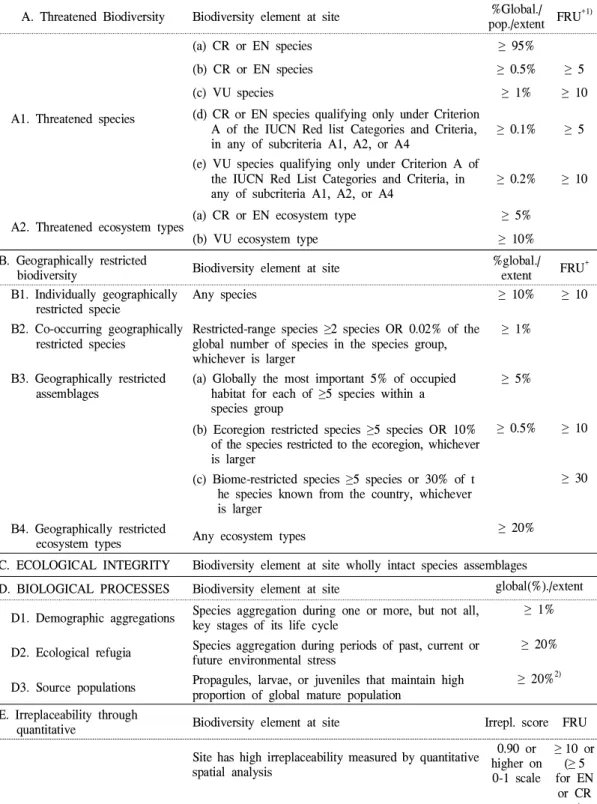
2. 중요생물다양성지역(KBAs)의 지정기준 중요생물다양성지역(KBAs) 지정기준을 적용
하기 위해 유전자, 종, 생태계 수준의 생물다양성 요소를 포함하는 정량적이고 객관적인 생물학적 데이터가 필요하다. 따라서 본 연구에서는 정확 한 데이터를 통한 중요생물다양성지역(KBAs) 지정기준을 적용하였다(Pressey et al., 1994;
Pressey and Taffs, 2001).
중요생물다양성지역(KBAs)의 자료 도출 기
준은 지역선정의 투명성, 객관성 및 반복성 등을
보장하기 위한 정량적 임계값을 가진다(Table
1). 그러나 개체군 수치 자료들은 적용 대상지역
이 종(species)의 전체 범위에서 개체군 중 필요
한 만큼의 비율을 가지고 있는지 정량적으로 객
관화 시킬 수 있는 방법은 미비하다(Shaffer,
1981, 1990). 이런 이유로 몇 가지 다른 측정방
A. Threatened Biodiversity Biodiversity element at site %Global./
pop./extent FRU
+1)A1. Threatened species
(a) CR or EN species ≥ 95%
(b) CR or EN species ≥ 0.5% ≥ 5
(c) VU species ≥ 1% ≥ 10
(d) CR or EN species qualifying only under Criterion A of the IUCN Red list Categories and Criteria, in any of subcriteria A1, A2, or A4
≥ 0.1% ≥ 5 (e) VU species qualifying only under Criterion A of
the IUCN Red List Categories and Criteria, in any of subcriteria A1, A2, or A4
≥ 0.2% ≥ 10
A2. Threatened ecosystem types (a) CR or EN ecosystem type ≥ 5%
(b) VU ecosystem type ≥ 10%
B. Geographically restricted
biodiversity Biodiversity element at site %global./
extent FRU
+B1. Individually geographically
restricted specie
Any species ≥ 10% ≥ 10
B2. Co-occurring geographically restricted species
Restricted-range species ≥2 species OR 0.02% of the global number of species in the species group, whichever is larger
≥ 1%
B3. Geographically restricted assemblages
(a) Globally the most important 5% of occupied habitat for each of ≥5 species within a species group
≥ 5%
(b) Ecoregion restricted species ≥5 species OR 10%
of the species restricted to the ecoregion, whichever is larger
≥ 0.5% ≥ 10
(c) Biome-restricted species ≥5 species or 30% of t he species known from the country, whichever is larger
≥ 30
B4. Geographically restricted
ecosystem types Any ecosystem types ≥ 20%
C. ECOLOGICAL INTEGRITY Biodiversity element at site wholly intact species assemblages
D. BIOLOGICAL PROCESSES Biodiversity element at site global(%)./extent D1. Demographic aggregations Species aggregation during one or more, but not all,
key stages of its life cycle
≥ 1%
D2. Ecological refugia Species aggregation during periods of past, current or future environmental stress
≥ 20%
D3. Source populations Propagules, larvae, or juveniles that maintain high proportion of global mature population
≥ 20%
2)E. Irreplaceability through
quantitative Biodiversity element at site Irrepl. score FRU
Site has high irreplaceability measured by quantitative spatial analysis
0.90 or higher on
0-1 scale
≥ 10 or (≥ 5 for EN
or CR sp) FRU
1): functional reproductive units;
2): Threshold refers to global mature population rather than propagules, lar-
vae or juveniles.
Table 1. Summary of the KBA criteria and thresholds
법이 사용하거나 임계값들이 성숙한 개체의 수, 서식지, 적합한 서식지의 정도, 범위, 지역의 수 및 독특한 유전적 다양성을 충족시키는지 추론 하기도 한다(IUCN, 2007). 개체수 관련 기준에 대한 구역 확인을 평가하는데 있어서 평가기준 이 보호지역을 지정하기에 충분하지 않다는 것 을 인정하면서도(Fahrig and Merriam, 1994), 명 시된 모든 평가기준이 적용되어야 할 것이다. 이 는 표본추출(sampling) 강도가 높고 종(species) 의 범위와 점유지역을 대표한다고 간주할 수 있 는 곳에서만 적절하다. 여러 지역은 하나의 중요 생물다양성지역(KBAs)에 들어갈 수도 있고, 개 체군의 규모는 다른 지역에 걸쳐서 중복지역으 로 적용될 수 있다. 선정 기준은 국제적인 기준 에 해당하는 지역을 확인하는데 사용되고 있지 만 중요생물다양성지역(KBAs)의 최종선정을 위한 조건은 아니다. 이는 지역적 기준치에 부합 하며, 국제적 중요성을 가진다고 판단되어지는 경우에 모든 지정기준에 맞지 않더라도 중요생 물다양성지역(KBAs)의 지정이 가능하다. 이에 기준을 살펴보면, 생물다양성 위험지역 A는 종 다양성 위험지역(A1)과 생태계유형 위험지역 (A2)으로 구분된다. 평가기준 A1은 국제적 Redlist의 멸종위기종(CR: Critically endangered) 또는 위기종(EN: Endangered) 95%이상 개체수 가 서식하는 지역(A1a), 국제적 Redlist의 멸종 위기종(CR) 또는 위기종(EN)의 생육을 위한 서 식지가 5개 이상 유지되고 0.5%이상의 개체수 가 분포하는 지역(A1b)을 뜻한다. 국제적 Re- dlist의 취약종(VU: Vulnerable)의 생육을 위한 서식지를 10개 이상 유지되고 1.0%이상의 개체 수가 분포하는 지역(A1c)으로 구분한다. 평가기 준 A2는 생태계 수준에서 지구생물다양성에 심 각한 영향을 주는 지역으로 국제적 멸종위기종 (CR), 위기종(EN)이 생태계유형의 5%이상 지역 (A2a)과 국제적 Redlist의 취약종(VU) 생태계유 형의 10%이상 지역(A2b)으로 구분한다. 지리적 으로 한정된 생물다양성 지역 B는 종다양성 한
정지역(B1), 한정종의 동시 출현지역(B2), 국제 적으로 한정된 집합(B3) 및 국제적으로 한정된 생태계 유형(B4)로 구분하는데 평가기준 B1은 전 세계의 개체수가 10% 이상 또는 종의 생육을 위한 서식처 면적의 10개 이상인 지역이다. 평가 기준 B2는 종 차원에서 2종 이상의 한정된 종의 개체수가 1% 이상 또는 종 개체수가 0.02%이상 서식하는 지역이다. 평가기준 B3은 종 내 5종 이 상이 서식하는 중요 지역으로 전 세계 개체수가 5%이상을 차지하는 지역(B3a), 한정된 생태권 역에서 종의 5종 이상이 각각 0.5%이상의 개체 수가 서식하는 지역 또는 한정된 생태권역에서 서식하는 종 중 10%이상이 서식하는 지역(B3b) 및 한정된 생물군계종 중 5종 이상이 서식하거 나 한정된 생물군계종 중 특정지역에 서식하는 것으로 알려진 종의 30%이상 서식하는 지역 (B3c)로 구분한다. 마지막으로 평가기준 B4는 특정 지구 생태계 유형을 20%이상 포함하는 지 역을 말한다. 생태적 온전성을 평가하는데 있어 서 평가항목 C, D, E는 조사자료 부족 및 관리가 가능한 10,000㎢ 규모의 지역에서 평가가 진행 되어야 하나 본 연구에서 적용하기 힘들다고 판 단되어 제외하였다.
3. 조사방법 및 분석
설악산지역의 중요생물다양성지역(KBAs) 평
가기준을 적용하기 위해서는 생물종, 생태계 수
준의 정량적이고 객관적인 생물학적 데이터가
필요하다. 평가기준 A, B를 적용하기 위해서는
설악산 일대에 출현하는 생물종을 파악한 후 이
를 대상으로 국제적 Redlist 등급과 해당종의 서
식처, 개체수 등의 파악이 필요하다. 따라서 설
악산 일대의 생물상 자료 수집을 우선으로 하였
다. 생물상은 2015년 9월부터 2016년 10월까지
10회 현지답사를 바탕으로 대상지 내 출현하는
식물종을 채집하여 기록한 뒤 동정․확인한 후
표본화 하였으며 식물, 포유류, 조류, 양서․파
충류, 어류 및 파충류는 문헌조사(Gang et al.,
2005; Han, 1998; Hong et al., 2010; Jang et al., 2002; Kim and Chun, 1992; Kim et al., 1997;
Kim et al., 1998; Korea National Park Service, 2005, 2006, 2010; Kwon, 2013; Ministry of Environment, 2005, 2009; Ministry of Environ- ment and National Institute of Biological Re- sources, 2010; National Institute of Environ- mental Research, 2010; Park, 1998; Park, 2002;
Park et al., 2011; Son et al., 2011)를 병행하였 다. 설악산 일대에 생물종의 위치정보는 국립공 원관리공단의 자연자원조사 보고서에 기록된 2.0km×2.0km 크기 132개의 격자(grid)를 본 연 구에 적용하였다(Korea National Park Service, 2010). 또한, 자생지의 환경을 분석하기 위해 국 립지리원에서 발행한 1:25,000 지형도, 한국디 지털 지형도(Garmin, MapSource V7), GPS(Gar- min, oregon300) 활용하여 중요생물다양성지역 (KBAs)의 평가기준에 부합하는 생물종은 자생 지의 위치를 표시하였다.
4. 중요생물다양성지역(KBAs) 설정 규모 생물종 중 동일종의 집단을 개체군이라 할 때, 개체군의 생장형을 토대로 환경이 수용할 수 있는 개체군의 최대크기를 환경수용능력이 라 하여 적정 개체군의 크기로 보며(Lee, 2018), 개체군이 지속적으로 유지되기 위해 최소한으 로 확보해야만 하는 개체군의 크기를 최소생존 가능개체군(Minimum Viable Population, MVP) 이라 한다. 이는 어떤 종이 장기간 생존에 필요 한 개체들의 수를 말하는데, 격리된 작은 규모 의 집단이 어떠한 서식처에서 최소 100년 동안 주변으로부터 가해질 수 있는 집단구조, 성공적 인 자손의 번식, 환경적(포식자, 경쟁 및 병해 충)․유전적․자연적(가뭄, 홍수, 지진 등) 요 인 등으로부터 99%이상 살아남을 수 있는 집단 의 규모로 정의 한 바 있다(Shaffer, 1981). 이에 생물종의 면적 산정에 필요한 서식처의 최소동 적면적(MDA, Minimum Dynamic Area) 크기를
파악하여 생존에 필요한 최소한의 경계를 설정 하였다. 1개체 당 최소동적면적은 포유류의 경 우 1개체 당 사슴 1,600㎡, 조류 2,500㎡(Way, 1978), 식물은 단일 종의 개체군 크기인 400㎡
(Shin, 1997)로 설정하였다. 양서․파충류, 어 류, 곤충류은 최소생존가능개체군의 크기에 관 한 연구가 수행된 바 없어 식물과 같은 규모인 400㎡로 설정하였다. 설정된 생물종의 최소생 존가능개체군의 크기를 생물종이 출현하는 면 적의 정도인 점유역(AoO, Area of Occupancy) 으로, 개체군의 가장 외곽에 위치한 개체군을 기준으로 직선으로 연결하여 만든 다각형 (Polygon)의 형태를 분포역(EoO, Extent of O- ccurrence) 개념을 도입하였다(IUCN, 2001). 수 치지도상에 생물종의 분포위치를 Auto-CAD (Auto-CAD, Dream ver. 2015, US)를 활용하여 중 요생물다양성지역(KBAs)의 면적을 산출하였다.
III. 결과 및 고찰
1. 생물종 현황
설악산 일대에 생육하는 생물종을 현장조사 와 문헌조사를 통해 확인하였다(Table 2). 식물 은 적색목록 113종, 특산식물 89종, 위기종 13 종을 포함한 113과 517속 1,343종을 확인하였 다. 포유류는 산양 등 총 13과 39속 45종을 확 인되었다. 어류는 설악산국립공원 내 주요 계곡 부와 하천을 대상으로 문헌조사를 한 결과 총 7 과 12속 89종 2,822개체를 확인하였다.
2. 설악산 일대 중요생물다양성지역(KBAs)의 평가
설악산 일대 중요생물다양성지역(KBAs) 평가
에 적용가능한 생물종은 국내 적색목록으로 볼
때 식물의 경우 멸종위기종(CR)은 산솜다리
(Leontopodium leiolepis Nakai) 1종이며, 위기종
(EN)은 모데미풀(Megaleranthis saniculifolia oh-
wi)과 금강봄맞이(Androsace cortusaefolia Nakai)
2종이고, 취약종(VU)은 등대시호(Bupleurum eu-
No. Division Family Genetic Species Red List Endemic Species
Endanger Species
Natural Monument
1 Plant 113 517 1,343 113 89 13
2 Mammalia 13 39 45 6 6 2
3 Algae 33 42 113 8 13 10
4 Amphibia 11 15 28 13 15 1
5 Fish 12 27 89 8 14 5 1
6 Insect 181 971 2,038 10 124 2
Table 2. Species distribution of area in Mt. Seorak
Division Scientific Name Endemic Red List Distribution Area(㎢) Assessment
Plant
Leontopodium leiolepis ○ d, g, q 12.36 B1
Megaleranthis
saniculifolia ○ EN f, g, j 2.51 A1b
Bupleurum euphorbioides EN f, q 48.75 A1b
Androsace cortusaefolia ○ k, q 10.87 B1
Hanabusaya asiatica ○ EN m, k 36.17 A1b
Thuja koraiensis VU l. m 7.66 A1e
Mammalia
Hydropotes inermis VU a, b, c, e, i, l,
n, o, p, r, s, t 122.08 A1e
Naemorhedus goral VU f, h, k, m, u,
v, w, x, y, z 219.18 A1e
Fish Pungitius sinensis VU aa 0.14 A1c
a: misilyeong, b: gombaelyeong, c: jeohanglyeong valley, d: chilseongbong, e: mog-u hill, f :daecheong, g: Mt.
mangdaeam, h: Mt. jeombong, i: heugseondong vally, j: gachilbong, k: kkeutcheong, l: jugeogbong, m: ansan, n:
hwachaebong, o: ognyeotang, p: jang-gunbawigol, q: socheong, r: gwittaegicheongbong, s: soseung waterfall, t:
onjeong-gol, u: hwangcheolbong, v: wang-gwanbong, w: gonglyong ridge, x: baegdam vally, y: Mt. gwanmo, z:
Mt. cheongdae, aa: mulji river
Table 3. Status on of the Key Biodiversity Areas(KBAs)
phorbioides Nakai), 금강초롱꽃(Hanabusaya asi- atica Nakai) 및 눈측백(Thuja koraiensis Nakai) 3종으로 총 6종이며, 어류의 경우 가시고기 (Pungitius sinensis Tanaka) 1종, 포유류는 고라니 (Hydropotes inermis) 및 산양(Naemorhedus cau- datus) 등 2종으로 총 9종이 적용되었다(Table 3).
특히, 고라니는 우리나라에서 유해동물로 지정되 어 있으나, 국제적 Redlist에는 취약종(VU)으로 분류되어 본 연구에 적용하였다. 이는 중국의 호 랑이, 팬더 등의 국제적인 교류와 확산으로 종 보존을 추진한 사례를 볼 때 고라니도 동일한 차 원의 후속조치가 필요하다. 한편, 국내 보호지역 은 해당지역의 지정기준에 부합되도록 평가되어
있어 국제적 기준을 적용하여 시행하기에는 보다 면밀한 검토가 필요한 것으로 판단된다.
현장조사와 문헌고찰을 통해 확인한 생물종
중 모데미풀은 10곳 230개체 2.51㎢, 등대시호
는 17곳 1,167개체 48.75㎢, 금강초롱꽃은 16곳
18,430개체 36.17㎢ 정도의 서식처, 개체수 및
면적을 확인하였다. 이들은 국제적 Redlist의 위
기종(EN, Endangered)이자 서식지를 5개 이상
유지하고 0.5%이상의 개체가 서식하고 있어 모
데미풀, 등대시호 및 금강초롱꽃 등 3종은 평가
기준 A1b로 평가하였다. 또한 눈측백 10곳 285
개체 7.66㎢, 고라니 122.08㎢, 산양 22곳 251
개체 219.18㎢ 및 가시고기 15곳 29개체 0.14㎢
정도의 서식처, 개체수 및 면적을 확인하였다.
이는 국제적 Redlist의 취약종(VU, Vulnerable) 이자 서식지를 10개 이상 유지하고 0.2% 이상 의 개체가 서식하고 있어 눈측백, 고라니, 산양 및 가시고기 등 4종은 평가기준 A1e로 확인되 었다. 아울러 산솜다리는 3곳 20개체 12.36㎢, 금강봄맞이는 3곳 15개체 10.87㎢ 정도의 서식 처, 개체수 및 면적을 확인하였다. 이는 국제적 Redlist에 포함하지는 않지만, 생물다양성 한정 지역으로 전 세계 개체수의 10%이상 또는 종의 서식지 면적의 10배 이상인 지역 또는 우리나 라에서만 국한적으로 분포하는 특산식물로 국 제적 가치정도가 우수한 산솜다리, 금강봄맞이 2종을 평가기준 B1으로 확인되었다.
3. 설악산 일대 중요생물다양성지역(KBAs)의 설정 보전우선순위 측면에서 생물다양성은 국제적 보호를 위해 중요생물다양성지역(KBAs) 설정 이 매우 중요하지만 보호구역 지정은 반드시 필 요한 것은 아니다. 보전우선순위 결정에는 보호 대상지역의 취약성 자료가 반드시 필요하며, 보 호구역에 관한 법률, 예산비용, 보호구역 간 연 결성 등을 포함되어야 한다. 따라서 중요생물다 양성지역(KBAs)은 보전우선순위를 대표하지는 않지만 국제적 시각에서 체계적 보전계획 수립 과 우선순위 확립에 객관적인 평가지표를 제시 할 수 있다.
이에, 설악산 일대에 자생하는 생물종을 대상 으로 중요생물다양성지역(KBAs)의 국제적 평 가기준을 적용한 결과 모데미풀, 등대시호, 금 강초롱꽃, 눈측백, 산솜다리, 금강봄맞이 가시 고기, 고라니 및 산양 등 9종을 확인되었다. 특 히, 기존 설악산 일대의 경계를 벗어난 종은 금 강초롱꽃 16.78㎢, 눈측백 3.21㎢으로 나타나 중요생물다양성지역(KBAs) 19.99㎢ 확대가 필 요한 것으로 판단된다. 포유류의 경우 산양은 22곳에서 분변과 개체수 251개체를 확인하였 다. 고라니는 12곳에서 나타났으며, 개체수는
문헌조사를 통해 확인할 수 없었으나 설악산 일 대를 관통하는 22.79km 거리의 국도 44번 도로 에서 로드킬 횟수가 지속적으로 증가하는 것을 확인할 수 있었다(Jo et al., 2015). 어류의 경우 가시고기는 물지천 일대에서만 서식하는 것으 로 확인되었다.
이상의 자료를 토대로 설악산 내 중요생물다 양성지역(KBAs)의 평가기준인 A1b, A1e, B1에 부합하는 9종의 생물종을 식물군집 400㎡, 포 유류 1,600㎡, 어류 2,500㎡의 범위로 최소생존 가능개체군의 크기를 적용한 뒤 생물종의 점유 역(AoO, Area of occupancy)과 분포역(EoO, Extent of Occurrence)을 산출하여 중요생물다 양성지역(KBAs)의 면적을 도출한 결과 식물은 234.56㎢, 포유류 235.07㎢ 및 어류 0.14k㎢ 으 로 총 286.72㎢로 나타났다(Figure 2).
IV. 결 론
본 연구는 세계자연보전연맹의 중요생물다양
성지역(KBAs) 지정기준을 적용하여 설악산 일
대를 대상으로 보호구역을 설정하고 기존 우리
나라 보호구역 현황과 비교 분석을 통해 적용
가능한 설악산 보호구역을 평가하였다. 국제 기
준의 평가내용은 성숙개체수, 적정 서식처의 규
모, 유전자 다양성 등 기초자료의 중요성을 강
조하고 있으나 본 연구에서 적용되는 평가기준
은 A, B항목만 해당되었다. 그 결과, 식물은 모
데미풀(Megaleranthis saniculifolia ohwi), 등대
시호(Bupleurum euphorbioides Nakai), 금강초
롱꽃(Hanabusaya asiatica Nakai), 눈측백(Thuja
koraiensis Nakai), 산솜다리(Leontopodium leio-
lepis Nakai) 및 금강봄맞이(Androsace cortusae-
folia Nakai) 등 6종이며, 어류는 가시고기
(Pungitius sinensis Tanaka) 1종, 포유류는 고라
니(Hydropotes inermis) 및 산양(Naemorhedus
caudatus) 등 2종으로 총 9종이다. 9종을 대상으
로 최소생존가능개체군(MVP, Minimum Viable
Figure. 2. Plant, mammalia, fish of the Key Biodiversity Areas(KBAs)
Population)을 적용하여 생물종의 서식처 면적 을 산출하고 이를 바탕으로 설악산 일대의 생물 종 점유면적(EoO, Extent of Occurrence)을 설정 한 결과, 식물 234.56㎢, 포유류 235.07㎢, 어류 0.14㎢로, 설악산 일대의 중요생물다양성지역 (KBAs)은 286.72㎢로 나타났다. 이를 통해 국 제적인 보호지역의 객관적, 정량적인 평가기준 을 바탕으로 생물다양성 측면에서 생태권역별 생태계 유형과 핵심 생물종에 따른 보호지역 설 정의 우선순위를 설정할 수 있으며, 이를 통한 산림생태계의 보호와 효과적 보호지역의 확대 및 관리방향 설정에 기초자료 제시에 도움이 될
것으로 판단된다.
한편, 본 연구수행에 있어 이와 유사한 연구
를 수행할 때 고려되어야 할 점은 보호지역 평
가에 사용할 적색목록집(Red Data Books)이 전
세계 수준에서 평가되어 정작 우리나라 차원에
서 보호해야할 생물종이 제외되었다. 특히, 고
라니와 같은 유해동물은 전 세계 수준에서 취약
종(VU)으로 기록되어 중요생물다양성지역
(KBAs)에 적용되었다. 이는 우리나라 실정에
맞지 않아 지역적 차원에서 보호지역을 평가할
수 있는 기준안이 필요하다. 또한, 중요생물다
양성지역(KBAs)의 경계는 본 연구에서 생물종
의 서식환경을 고려한 최소생존가능개체군과 점유면적(AoO)으로 설정하였으나 그 방법이 직 선으로 제안되어 있어 완충구역 및 제도적인 절 차를 고려한 후속연구가 필요하며, 생물종의 관 한 기초자료 부족으로 평가에 많은 어려움이 있 어 학제 간 지속적인 연구가 필요하다.
References