Print ISSN: 2288-4637 / Online ISSN 2288-4645 doi:10.13106/jafeb.2020.vol7.no12.245
The Determinants of Bank Regulations and Supervision on the Efficiency of Islamic Banks in MENA Regions*
Nor Halida Haziaton MOHD NOOR 1 , Mohammed Hariri BAKRI 2 , Wan Yusrol Rizal WAN YUSOF 3 , Nor Raihana Asmar MOHD NOOR 4 , Hasni ABDULLAH 5
Received: September 01, 2020 Revised: October 26, 2020 Accepted: November 05, 2020
Abstract
This study investigates the impact of the country’s governance on the revenue efficiency in the banking sectors of 42 Islamic banks in 15 countries offering Islamic banking and financial services. Technical efficiencies of individual Islamic banks were analyzed using the Data Envelopment Analysis method. The Ordinary Least Square estimation method is employed to examine the impact of country supervision and regulation on the technical efficiency of Islamic banks. With robustness check, the study assesses the impact of bank regulations and supervision on the efficiency of Islamic banks operating in different regions. The empirical findings suggest that supervisory power, activity restrictions, and private monitoring positively influence the efficiency of Islamic banks. On the other hand, we observe a negative impact of capital requirement on Middle East and North Africa (MENA) countries. The findings indicate that supervisory power, activity restrictions, and private monitoring positively influence the efficiency of Islamic banks in Asia, but vice versa on capital requirement in MENA countries. This study will contribute to the body of knowledge by assessing the types of reforms in bank regulations and supervision that work best for Islamic banks in order to increase the level of efficiency and the level of regulations and supervision of Islamic banks.
Keywords: Supervision, Bank Regulation, Islamic Banks, Data Envelopment Analysis, MENA JEL Classification Code: G20, G21, G28
1. Introduction
The financing activities of Islamic banking are carried out using two financing methods, namely, the profit-and-loss sharing (PLS) model and a model that involves trading on credit, with the buyer incurring debts (Idris et al., 2016). In comparison to a conventional bank, an Islamic bank offers similar products and services such as deposit accounts, various types of financing, credit cards and mortgage (Bakri et al., 2017).
However, Islamic bank products are based on the concept of profit-and-loss sharing, while conventional banks are not. At a theoretical level, Islamic banks not only share the same risk as conventional banks, but Islamic banks also have to deal with a new and unique risk as a result of their unique asset and liability structure (Alam et al., 2020). According to them, this new risk exists due to the compliance with Shariah requirement such as agency risk, payment risk and delivery risk.
This study sheds light the efficiency of Islamic banks by examining the determinants of the efficiency of Islamic banks.
*Acknowledgements:
*
The authors thank the Faculty of Business and Management, UiTM Kelantan, UITM Shah Alam and Faculty of Technology Management and Technopreneurship, Universiti Teknikal Malaysia Melaka,Malaysia and Centre of Technopreneurship Development, Universiti Teknikal Malaysia Melaka for their support.
1
First Author. Senior Lecturer, Faculty of Business and Management, UiTM Kelantan, Malaysia. Email: [email protected]
2
Corresponding Author. Associate Professor, Faculty of Technology Management and Technopreneurship, Universiti Teknikal Malaysia, Melaka, Malaysia [Postal Address: Hang Tuah Jaya, Durian Tunggal, Melaka,76100, Malaysia] Email: [email protected]
3
Senior Lecturer, Faculty of Business and Management, UiTM Kelantan, Malaysia. Email: [email protected]
4
Senior Lecturer, Faculty of Business and Management, UiTM Kelantan, Malaysia. Email: [email protected]
5
Research Fellow, Malaysian Academy of SME & Entrepreneurship Development, UiTM Shah Alam, Malaysia.
Email: [email protected]
© Copyright: The Author(s)
This is an Open Access article distributed under the terms of the Creative Commons Attribution
Non-Commercial License (https://creativecommons.org/licenses/by-nc/4.0/) which permits
unrestricted non-commercial use, distribution, and reproduction in any medium, provided the
original work is properly cited.
We determine the technical efficiency scores of 42 Islamic banks operating in 15 countries across the MENA (Middle East and North Africa) region, then we regress the technical efficiency scores as the dependent variable against the bank- specific, country-specific variables and banking regulations and supervision variables in association with Basel II’s tenet in order to determine the impact towards the efficiency of Islamic banks during year 2004-2010. To account for Basel II’s pillars on bank regulations and supervision, the study uses the data from Barth et al. (2008) and World Bank database. In this study, we perform two stages of analysis:
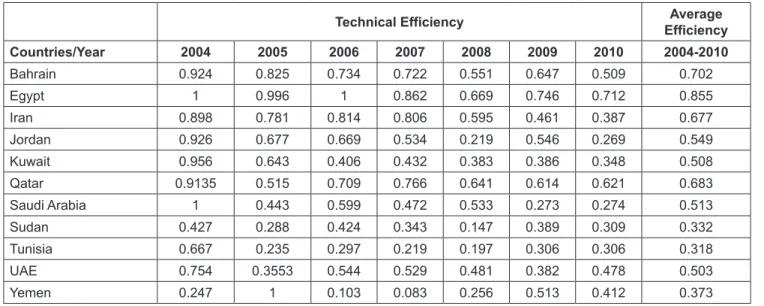
the first stage is Technical Efficiency (DEA) and Univariate Analysis, and the second stage is Multivariate Regression analysis. For estimating of efficiency, we perform the first- stage analysis where we established non-parametric methods (Data Envelopment Analysis) to set up the efficiency examination, and these scores are used in static panel data models to discover the impact of regulations and supervision on the level of Islamic bank efficiency. In this study, we will calculate DEA efficiency scores by using Data Envelopment Analysis (DEA). After determining the efficiency scores of the Islamic banks, we perform second-stage analysis, which is Multivariate Regression analysis. For the sake of checking the robustness of the results, we performed similar regression models by performing an interaction between the bank regulations and supervision variables with the dummy regions and dummy country income levels.
2. Literature Review
The literature on Islamic banking offers research from emerging markets and less developed countries, while conventional banking literature contains reports from both developed and less developed countries. The bulk of the research shows that in the evaluation of Islamic banking performance the focus has been primarily on profitability helped by financial ratios (Ismail et al., 2017). This method has been employed by numerous researchers in their comparisons of the performances of Islamic banks and conventional banks (Samad & Hassan, 1999; Iqbal, 2001; Haron, 2004; Hassan &
Bashir, 2005). On the other hand, this approach is hampered by the time span as well as the existence of some Islamic banks (Samad & Hassan, 1999; Iqbal 2001).
Despite the considerable development of Islamic banking in recent years, studies on the efficiency of Islamic banks is still limited in number due to the lack of sufficient data and its short history (Yudistira, 2004; Iqbal & Molyneux, 2005;
Sufian, 2007; Bader et al., 2008). The previous studies mostly focused on the technical, pure technical and scale efficiency in the Islamic banking sectors (Isik & Hassan. 2002; Hassan
& Hussein, 2003; Yudistira, 2004). Overall, few of the studies have addressed the issues of cost, revenue and profit efficiency of Islamic banks (Yudistira, 2004; Hassan, 2005; Brown &
Skully, 2005; Sufian et al., 2012) and the study of the impact of bank regulation towards the efficiency of Islamic banks has been carried out only (Bitar, 2015, Widarjono et al., 2020), which focus on liquidity and leverage.
Barth et al. (2004) were responsible for one of the earliest studies offering empirical evidence on each of the three pillars in relation to the Basel II capital accord. The study explored how bank regulations and supervision and bank development, performance and stability were associated, and they found that there was no relationship that was statistically significant between capital stringency, official supervisory power and bank performance and stability. In contrast, they show evidence that bank performance would be boosted if private monitoring was encouraged. Some studies maintained that there was no general agreement on what is meant by good regulations and supervision and how particular regulations impacted performance and stability of the banking sector. (Demirguc-Kunt et al., 2004) and Barth et al. (2004, 2006) provided evidence that various policies on bank performance can lead to moral hazard problems and distortions between regulated and unregulated institutions.
3. Data and Methodology
We gather data on 42 Islamic banks from 15 countries during the period from 2004 to 2010. The primary source of financial data is the BankScope database, while the IMF Financial Statistics (IFS) and the World Bank World Development Indicator (WDI) databases are the main source for the macroeconomic and market indicators. We retrieve the account for Basel II’s pillars on bank regulations and supervision the study follows the regulations and supervision variables from Barth et al. (2004b). The data for regulations and supervision variables are provided by the World Bank through two sets of surveys, which are The World Bank Regulations and Supervision Survey (2008), to cover the data for year 2004-2007 and the World Bank Regulations and Supervision Survey (2011) to cover the data for year 2008-2010.
The advantages of this database are its wide coverage (more than 100 countries) and it also measures many aspects of the regulatory environment. The data will be pooled across the selected countries and utilize the intermediation approach with assumption that all banks will have certain amount of regulated framework and all will have to utilize capital, assets and some form of liabilities to function (Ismail et al., 2014). The data cover the period of 2004 up to 2010.
3.1. Data Envelopment Analysis
In this study, we will calculate DEA efficiency scores by
using DEA method. Three types of scores are in estimates
efficiency: (1) technical efficiency (TE), (2) pure technical efficiency (PTE) and (3) scale efficiency (SE). The DEA method of evaluating (in) efficiency has its basis in Farrell’s (1957) work and continued by Charnes et al. (1978) and Banker et al. (1984). Charnes et al. (1978) were the first to use the term “DEA” whereby they introduced a model that had an input-oriented and assumed CRS. This method is named after the researchers Charnes and Cooper-Rhodes and is referred to as the CCR model. The DEA method permits an evaluation of the technical efficiency performance of an existing technology in relation to an ideal, best practice or frontier technology (Coelli et al., 1998) to frontier, which refers technology or production frontier that shows the most technically efficient mix of inputs and outputs. Each DMU is acquired as a maximum of a ratio of weighted outputs to weighted inputs in which the greater the outputs derived from given inputs means the more efficient is the production.
The weights for the ratio are determined by restricting the ratios for all DMUs to be less than or equal to unity. Banker, Charnes and Cooper in 1984 introduced a model with variable return to scale under input orientation as an extension of the CCR model by utilising the CRS assumption. The resulting
“BCC” model was employed to evaluate the efficiency of DMUs typified by variable returns to scale (VRS). Banker et al. (1984) proposed that VRS breaks down total TE into two parts. The first is TE under VRS or pure technical efficiency (PTE) and it is related to how managers are able to use DMUs’ given resources. The second is SE and it means to investigate scale economies by operating at a point where the production frontier shows CRS. If the TE and PTE scores of a specific DMU are different, it indicates the presence of scale inefficiency.
3.2. The Choice of Approach, Inputs, and Outputs Variables
Our analysis uses a variant of the intermediation approach by following the commonly-accepted intermediation proposed by Sealey and Lindley (1977). This approach assumes that banks act as an intermediary between the borrower and depositors, which is more consistent with the function of banks. The approach views banks as financial intermediaries whose primary business is to borrow funds from depositors and lend those funds to others for profit.
Berger and Humphrey (1997) state that ‘this approach has been found to be more relevant for financial institutions…’
Duong et al. (2020)
In this study, the banks’ inputs are total deposits (X1), which include deposits from customers and other banks, fixed assets (X2), which are measured by the book value of property and capital, general and administration expenses (X3), which include total expenditures on employees such as salaries, employee benefits and reserve for retirement pay.
While the banks’ outputs are loans (Y1), which include financing to customers and other banks, investments (Y2), which include income derived from investment of depositors’
fund and other income from Islamic banking operations.
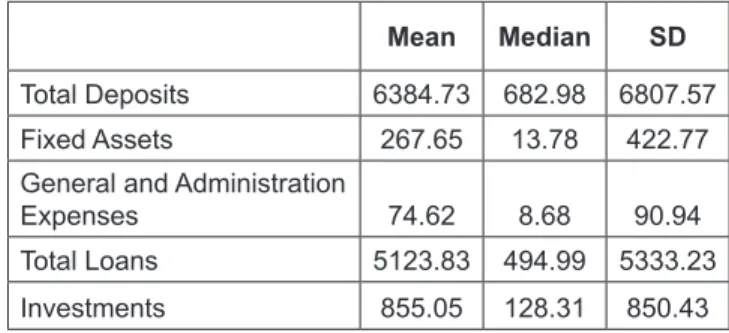
Islamic banks do not offer loans as the conventional banks, however, the term “total loans” is a generic term used to encompass the equity financing products that the Islamic banks use. Descriptive statistics of the DEA variables are presented in Table 1.
3.3. Multivariate Panel Regression Analysis
In the second stage, an investigation of the possible determinants of technical efficiency scores of Islamic banks is undertaken. The modeling framework is built from the approaches suggested by Chortareas et al. (2011) and we follow the regulatory and supervision variables of Barth et al. (2008, 2013). We consider three broad categories, the characteristics of the individual banks (Bank-Specifics), the characteristic of macroeconomics (Country-Specifics), and the characteristics of banking regulations and supervision (Basel II’ pillars). We incorporate Bank Specifics
j,tvector for bank-specific variables, Country Specifics
tvector for country specific controls and Bank Regulations and Supervision
tvector to account for Basel II’s pillars on bank regulations and supervision variables. The variables in the vectors are as follows:
Bank Specifics
j,t= ln (SIZE
j,t ++ EQASS
j,t+ LOANSTA
j,t+ LNIETA
j,t) Country Specifics
t= ln (GDP
t+ INFL
t+ CR3
t+ Z-SCORE
t)
Bank Regulations and Supervision
t= ln (SPOWER
t+ CAPRQ
t+PRMONIT
t+ ACTRS
t)
Table 1: Descriptive Statistics for the DEA Input and Output Variable
Mean Median SD
Total Deposits 6384.73 682.98 6807.57
Fixed Assets 267.65 13.78 422.77
General and Administration
Expenses 74.62 8.68 90.94
Total Loans 5123.83 494.99 5333.23
Investments 855.05 128.31 850.43
Note: All variables are reported in US$ millions at 2011 prices. The
number of observations in each year is 756 observations of 108
Islamic banks.
Where, j denotes bank, t denotes for time period, Bank Regulations and Supervision
tdenotes vector of bank regulatory, Bank Specifics
j,tdenotes vector of bank-specific variables and Country Specifics
tdenotes vector of country- specific control variables or macroeconomic and financial markets condition. We use log-linear form for the variables similar as De Bandt and Davis (2000) and Staikouras et al.
(2008) among others. According to them, the log-linear form is at advantages as it typically improves the regression’s goodness of fit and may reduce simultaneity bias.
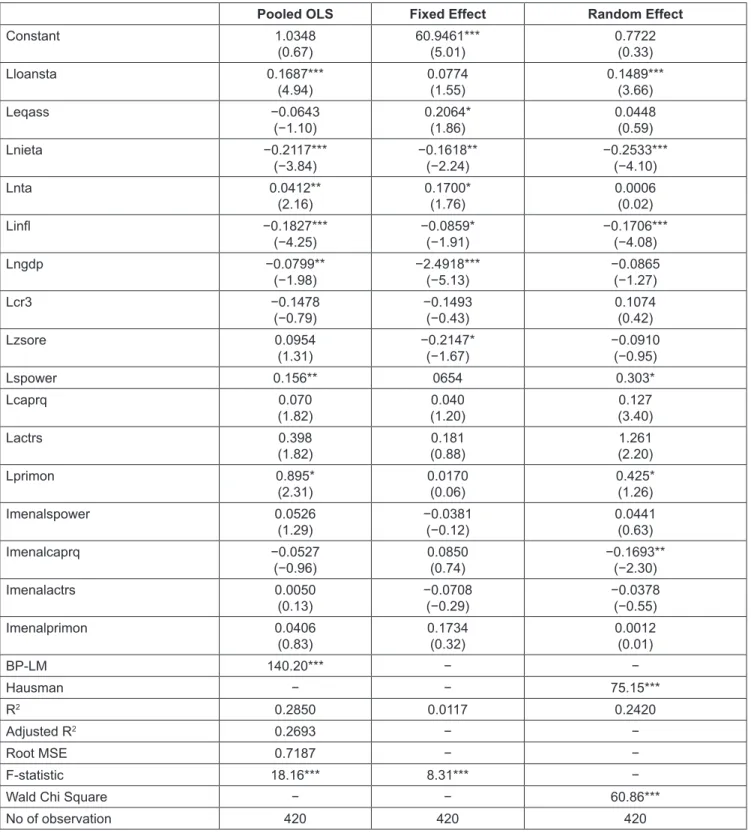
To investigate the determinants of Islamic bank’s efficiency, we construct a model as follow:
4 4
, 1 , 2
4
3 ,
j t n j t n t
n t j t