2009; Duan et al. 2012).
More than 120 species around the world are currently accepted taxonomically(Guiry and Guiry 2019). Of these, 16 species have been recorded in Korea(Lee and Kang 1986, 2002; Lee 2008; Bae 2010; Kim et al. 2013; Lee et al.
2014; An and Nam 2017). During a survey of marine algal flora, a species of Ulva was collected from Uljin in Korea.
Based on morphological and molecular analyses, it was identified as U. sublittoralis, which is newly recorded in the marine algal flora of Korea in the present study.
MATERIALS AND METHODS
Samples were collected from Uljin located on the eastern coast of Korea. They were preserved in 5% formalin sea- water with herbarium specimens. A portion of the material was dried and preserved in silica gel for molecular analysis.
Microscopic sections were mounted in 30% corn syrup
https://doi.org/10.11626/KJEB.2019.37.3.293
INTRODUCTION
Ulva, which is frequently seen in blooms called green tides caused by a huge proliferation of biomass(Blomster et al. 2002), is distributed globally in coastal areas(Hayden et al. 2003; Guiry and Guiry 2019). This genus shows highly morphological variations with habitat(van den Hoek et al.
1995).
Nevertheless, Ulva species have been distinguished by gross morphology, cell shape and size, plastid orienta- tion, pyrenoid number per cell, and presence or absence of marginal denticulations(Koeman and van den Hoek 1981; Maggs et al. 2007; Loughnane et al. 2008). However, because of their simple and plastic morphology, it is often difficult to identify them by the features(Loughnane et al.
2008; Matsumoto and Shimada 2015). Recently, analyses of the internal transcribed spacer(ITS) region have pro- vided good phylogenetic resolution at the species level in Ulva(Coat et al. 1998; Loughnane et al. 2008; Heesch et al.
Original article
New record of Ulva sublittoralis (Ulvales, Chlorophyta) in Korea
Jae Woo An, Pil Joon Kang and Ki Wan Nam*
Department of Marine Biology, Pukyong National University, Busan 48513, Republic of Korea
Korean J. Environ. Biol.
37(3) : 293-298(2019) ISSN 1226-9999(print) ISSN 2287-7851(online)
* Corresponding author Ki Wan Nam
Tel. 051-629-5922
E-mail. [email protected]
Received: 6 August 2019 Revised: 22 August 2019
Revision accepted: 23 August 2019
Abstract: A marine ulvalean species(Chlorophyta) was collected from the eastern coast of Korea. This species is morphologically characterized by a distromatic, dark to medium green and mostly irregularly orbicular or irregularly expanded thallus with entire or undulate margin without serrations. Vegetative cells are irregularly polygonal with distinctly rounded corners in shape, and have chloroplast completely covering the outer cell wall and one to two pyrenoids per cell. In a phylogenetic tree based on ITS (Internal Transcribed Spacer) sequences, this Korean alga nests in the same clade with Ulva sublittoralis, as a sister clade of U. californica, U. flexuosa and U. tanneri, which share the irregularly orbicular or expanded thallus normally without teeth cells. The genetic divergence between them is intraspecific within Ulva. Accordingly, it is identified as U.
sublittoralis based on the morphological and molecular data. This is the first record of Ulva sublittoralis in the Korean marine algal flora.
Keywords: green alga, molecular analyses, morphology, first report
for permanent preparation. Total genomic DNA was ex- tracted from silica-gel-preserved sample using the DNeasy Plant Mini Kit(Qiagen, Hilden, Germany) according to the manufacturer’s protocol. Extracted DNA were assessed by using gel electrophoresis on a 1% agarose gel and used for amplification of the internal transcribed spacer(ITS) region using published primers(Ogawa et al. 2013) and primer sequences are represented as follows: ITS primers (F: 5ʹ TCTTTGAAACCGTATCGTGA 3ʹ R: 5ʹ GGT- GAACCTGCGGAGGGAT 3ʹ). PCR amplifications were performed in a TaKaRa PCR Thermal Cycler Dice(Ta- KaRa Bio Inc., Otsu, Japan) with an initial denaturation step at 94°C for 1 min, 35 cycles at 94°C for 30 s, 55°C for 1 min and 68°C for 2 min and a final extension at 72°C for 5 min. The reaction volume was 30μL, consisting of 20ng of genomic DNA, 2μL of 10× PCR buffer, 2μL of 200μM dNTP, 2μL of each forward and reverse primer, and 0.5 units of Taq polymerase(TaKaRa Bio Inc.). Amplifications were examined using gel electrophoresis in a 1% agarose gel and amplified ITS region products were purified using a QIAquick Gel Extraction Kit(Qiagen). The PCR products were moved to Macrogen Sequencing Service for sequenc- ing(Macrogen, Seoul, Korea). The PCR primers were also used for sequencing. Sequences for the ITS region were aligned using BioEdit(Hall 1999). Phylogenetic analyses were performed using the maximum-likelihood(ML) methods. Bootstrap values were calculated with 1,000 repli- cations. ITS sequences of other species were obtained from GenBank. Umbraulva japonica was used as an outgroup.
RESULTS AND DISCUSSION
Ulva sublittoralis Segawa 1938: 132
Korean name: Dong-hae-gal-pa-rae nom. nov.
(신칭: 동해갈파래)
Specimens examined: MGARB012870, MGARB012 871, MGARB012872(Mangyang-ri, Uljin, 28 July 2016), MGARB012878-012880(Mangyang-ri, Uljin, 26 Sep.
2019)
Type locality: Kozu-sima, Japan Habitat: Epilithic near the intertidal.
Morphology: Thalli 5-15cm broad, mostly irregular- ly orbicular or expanded, dark to medium green in color (Fig. 1a, b), distromatic(Fig. 1c); margin entire, without serrations, undulate or strongly ruffled to plane(Fig. 1d);
vegetative cells rectangular to polygonal in the basal region
of the thallus(Fig. 1e), but irregularly polygonal with 3-6 distinctly rounded corners in the upper basal region; chlo- roplasts completely covering the outer cell wall, often con- taining many large starch grains, variously oriented to side of the outer cell wall; pyrenoids, one to two per cell, 3-8 μm in diam.; numerous rhizoidal cells present in the bas- al region of the thallus, bearing tubular extensions on the outside of the cell layer(Fig. 1f).
Ulva sublittoralis, which is distributed throughout tem- perate regions(Guiry and Guiry 2019), was originally des- cribed from Japan(Silva et al. 1996). According to previous reports(Segawa 1938; Bliding 1963; Brodie et al. 2007), it appears to be generally characterized by an irregularly expanded thallus normally with entire margin. Our spec- imens collected from Korea basically share this morpho- logical feature. Even though some dissimilarities between them are found, such as in gross morphology and chloro- plast shape(Segawa 1938; Ogawa et al. 2013; Phillips et al.
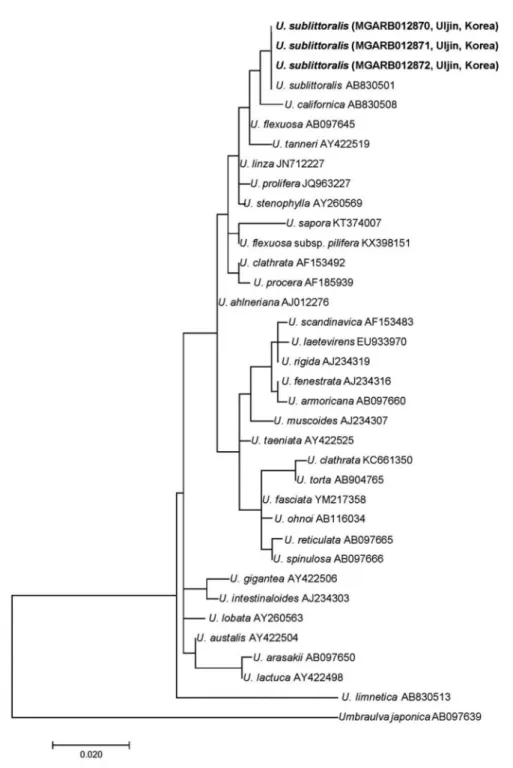
2016; the present study), the Korean alga is considered to be Ulva sublittoralis. This is also supported by molecular analysis(Fig. 2).
In morphology, this species is very similar to U. pertu- sa, which has been reduced to a synonym of U. australis Areschoug from South Australia. However, U. sublittoralis genetically differs from U. australis based on ITS sequence (Kirkendale et al. 2013; Ogawa et al. 2013; the present study). According to Ichihara et al.(2009), rhizoidal cells in most species of Ulva bear tubular extensions in the in- side of the cell layer in longitudinal sections of the lower thallus(Bliding 1968; Koeman and van den Hoek 1981, 1982; Phillips 1988; Hiraoka et al. 2004). However, Ulva sublittoralis Segawa and U. limnetica Ichihara et Shimada described from Japan produce tubular extensions on the outside of the cell layer in the stipe(Ichihara et al. 2009). It is also similar to Ulva limnetica in sharing this feature(Ichi- hara et al. 2009). However, it was confirmed that both spe- cies are readily distinguished from each other by interspe- cific genetic distance level of 16.3% in the present study.
They are currently accepted(Guiry and Guiry 2019).
In general, ITS regions have been used to analyze mo- lecular phylogeny in Ulva(Malta et al. 1999; Hayden et al.
2003; Hayden and Waaland 2004; Hofmann et al. 2010;
O’Kelly et al. 2010). In a phylogenetic tree based on the molecular data(Fig. 2), our specimens nest in the same clade with U. sublittoralis from Japan, as a sister clade of some species groups(U. californica and U. tanneri from USA and U. flexuosa from Italy), which share the irregu- larly orbicular or expanded thallus normally without teeth
cells. The genetic distance between them within the clade was 0.01%.
According to Kirkendale et al.(2013), the interspecific genetic distance is 0.9-5.56% in Ulva. The present analysis shows a divergence range of 1.2%-21.9%. This suggests
that the distance between sequences of the Korean spec- imens and U. sublittoralis is intraspecific. Based on these morphology and molecular data, our Korean specimens are identified as U. sublittoralis, which is newly recorded in the Korean marine algal flora.
Fig. 1. Ulva sublittoralis Segawa. a. Herbarium specimen (MGARB012870). b. Habit of the vegetative plant. c. Transverse section view of the thallus with two cell layers. d. Entire margin of the undulate or strongly ruffled plane blade in the lower part. e. Surface view of the veg- etative cells with rectangular to polygonal shapes. f. Longitudinal section view of the basal part of the thallus showing numerous rhizoidal cells bearing tubular extensions on the outside of the cell layer.
a b
c d
e f
ACKNOWLEDGMENTS
This work was supported by a grant from the National Institute of Biological Resources(NIBR) funded by the Ministry of Environment(MOE) of the Republic of Korea
(NIBR 201801101, NIBR 201902114), and by the Marine Biotechnology Program of the Korea Institute of Marine Science and Technology Promotion(KIMST) funded by the Ministry of Oceans and Fisheries(MOF)(No. 2017 0431).
Fig. 2. Phylogenetic tree of selected taxa obtained from maximum-likelihood analysis based on ITS sequences. Bootstrap percentages (1,000 replicates samples) are shown above the branches. Scale bar=0.02 substitutions/site.
REFERENCES
An JW and KW Nam. 2017. First record of Ulva torta(Ulvales, Chlorophyta) in Korea. Korean J. Environ. Biol. 35:329-334.
Bae EH. 2010. Ulotrichales, Ulvales. pp. 7-52. In Algal Flora of Korea. Volume 1, Number 1. Chlorophyta: Ulvophyceae:
Ulotrichales, Ulvales, Cladophorales, Bryopsidales. Marine Green Algae(Bae EH, HS Kim, CJ Kwon, IK Hwang, GH Kim and TA Klochkova, eds.). National Institute of Biological Re- sources, Incheon.
Bliding C. 1963. A critical survey of European taxa in Ulvales. Part I. Capsosiphon, Percursaria, Blidingia, Enteromorpha. Op.
Bot. Soc. Bot. Lund. 8:1-160.
Bliding C. 1968. A critical survey of European taxa in Ulvales. II.
Ulva, Ulvaria, Monostroma, Kornmannia. Bot. Not. 121:535- 629.
Blomster J, S Bäck, DP Fewer, M Kiirikki, A Lehvo, CA Maggs and MJ Stanhope. 2002. Novel morphology in Enteromor- pha (Ulvophyceae) forming green tides. Am. J. Bot. 89:1756- 1763.
Brodie J, CA Maggs and DM John. 2007. Green Seaweeds of Britain and Ireland. British Phycological Society, London.
Coat G, P Dion, MC Noailles, B De Reviers, JM Fontaine, Y Berg- er-Perrot and S Loiseaux- De Goër. 1998. Ulva armoricana (Ulvales, Chlorophyta) from the coasts of Brittany(France). II.
Nuclear rDNA ITS sequence analysis. Eur. J. Phycol. 33:81- 86.
Duan W, L Guo, D Sun, S Zhu, X Chen, W Zhu, T Xu and C Chen. 2012. Morphological and molecular characterization of free-floating and attached green macroalgae Ulva spp. in the Yellow Sea of China. J. Appl. Phycol. 24:97-108.
Guiry MD and GM Guiry. 2019. AlgaeBase. World-wide elec- tronic publication, National University of Ireland, Galway.
Available from http://www.algaebase.org. Accessed: 16 July 2019.
Hall TA. 1999. BioEdit: a user-friendly biological sequence align- ment editor and analysis program for Windows 95/98/NT.
Nucleic Acids Symp. Ser. 41:95-98.
Hayden HS, J Blomster, CA Maggs, PC Silva, MJ Stanhope and JR Waaland. 2003. Linnaeus was right all along: Ulva and En- teromorpha are not distinct genera. Eur. J. Phycol. 38:277- 294.
Hayden HS and JR Waaland. 2004. A molecular systematic study of Ulva(Ulvaceae, Ulvales) from the northeast Pacific. Phyco- logia 43:364-382.
Heesch S, JES Broom, KF Neill, TJ Farr, JL Dalen and WA Nelson.
2009. Ulva, Umbraulva and Gemina: genetic survey of New Zealand taxa reveals diversity and introduced species. Eur. J.
Phycol. 44:143-154.
Hiraoka M, S Shimada, M Uenosono and M Masuda. 2004. A new green-tide-forming alga Ulva ohnoi(Ulvales, Ulvophy- ceae) from Japan. Phycol. Res. 52:17-29.
Hofmann LC, JC Nettleton, CD Neefus and AC Mathieson. 2010.
Cryptic diversity of Ulva(Ulvales, Chlorophyta) in the Great Bay Estuarine System (Atlantic USA): introduced and indige- nous distromatic species. Eur. J. Phycol. 45:230-239.
Ichihara K, S Arai, M Uchimura, EJ Fay, H Ebata, M Hiraoka and S Shimada. 2009. New species of freshwater Ulva, Ulva limnetica(Ulvales, Ulvophyceae) from the Ryukyu Islands, Japan. Phycol. Res. 57:94-103.
Kirkendale L, GW Saunders and P Winberg. 2013. A molecular survey of Ulva(Chlorophyta) in temperate Australia reveals enhanced levels of cosmopolitanism. J. Phycol. 49: 69-81.
Kim HS, SM Boo, IK Lee and CH Sohn. 2013. National List of Species of Korea, Marine Algae. Jeonghaengsa, Seoul.
Koeman RPT and C van den Hoek. 1981. The taxonomy of Ulva (Chlorophyceae) in the Netherlands. Brit. Phycol. J. 16:9-53.
Koeman RPT and C van den Hoek. 1982. The taxonomy of Enter- omorpha Link, 1820, (Chlorophyceae) in the Netherlands. I.
The section Enteromorpha. Arch. Hydrobiol. Suppl. 63:279- 330.
Lee IK and JW Kang. 1986. A check list of marine algae in Korea.
Korean J. Phycol. 1:311-325.
Lee SH, PJ Kang and KW Nam. 2014. New record of two marine ulvalean species(Chlorophyta) in Korea. J. Ecol. Environ.
37:379-358.
Lee YP. 2008. Marine Algae of Jeju. Academy Publishing Co, Seoul.
Lee YP and SY Kang. 2002. A Catalogue of the Seaweeds in Ko- rea. Jeju National University Press, Jeju.
Loughnane CJ, LM McIvor, F Rindi, DB Stengel and MD Guiry.
2008. Morphology, rbcL phylogeny and distribution of distro- matic Ulva (Ulvophyceae, Chlorophyta) in Ireland and south- ern Britain. Phycologia 47:416-429.
Maggs CA, J Blomster, F Mineur and J Kelly. 2007. Ulva Linnae- us. In Green Seaweeds of Britain and Ireland(Brodie J, CM Maggs and DM John eds.). British Phycological Society, Lon- don.
Malta EJ, SGA Draisma and P Kamermans. 1999. Free-floating Ulva in the southwest Netherlands: species or morpho- types? A morphological, molecular and ecological compari- son. Eur. J. Phycol. 34:443-454.
Matsumono K and S Shimada. 2015. Systematics of green al- gae resembling Ulva conglobata, with a description of Ulva adhaerens sp. nov.(Ulvales, Ulvophyceae). Eur. J. Phycol.
50:100-111.
Ogawa T, K Ohki and M Kamiya. 2013. Differences of spatial distribution and seasonal succession among Ulva species
(Ulvophyceae) across salinity gradients. Phycologia 52:637- 651.
O’Kelly CJ, A Kurihara, TC Shipley and AR Sherweed. 2010. Mo- lecular assessment of Ulva spp.(Ulvophyceae, Chlorophyta) in the Hawaiian Islands. J. Phycol. 46:728-735.
Phillips JA. 1988. Field, anatomical and developmental studies on southern Australian species of Ulva(Ulvaceae, Chlorophyta).
Aust. Syst. Bot. 1:411-456.
Phillips JA, RJ Lawton, R Denys, NA Paul and C Carl. 2016. Ulva sapora sp. nov., an abundant tubular species of Ulva(Ulvales)
from the tropical Pacific Ocean. Phycologia 55:55-64.
Segawa S. 1938. On the marine algae of Susaki, prov. Izu, and its vicinity. III. Sci. Pap. Algol. Res. Hokkaido Univ. 2:131-153.
Silva PC, PW Basson and RL Moe. 1996. Catalogue of the ben- thic marine algae of the Indian Ocean. Univ. Calif. Publ. Bot.
79:1-1259.
van den Hoek C, DG Mann and HM Jahns. 1995. Algae. An In- troduction to Phycology. Cambridge University Press, Cam- bridge, UK.