Korean J. Environ. Biol. 35(3) : 329~334(2017) https://doi.org/10.11626/KJEB.2017.35.3.329
INTRODUCTION
Green marine algal genus Ulva Linnaeus (Ulvales) is a commonly abundant inhabitant of marine, estuarine and freshwater habitats worldwide and often causes harmful blooms in eutrophic estuaries and bays (Fletcher 1996).
About 120 species are currently accepted in this genus (Gui- ry and Guiry 2017). Those species exhibit a simple thallus structure along with a lack of differentiated reproductive or- gans (Bliding 1963, 1968; Womersley 1984; Phillips 1988;
Blomster et al. 1998, 1999; Hayden and Waaland 2004), which makes it difficult to identify the species. Moreover, the taxonomy of the genus is further complicated by the significant intraspecific variation and interspecific overlap in the relatively few morphological and anatomical charac- ters that occurred in response to the varying conditions of the habitat environments (Tanner 1979, 1986; Phillips 1988;
Malta et al. 1999).
For these, the molecular data, such as the nuclear internal transcribed spacer (ITS) and plastid ribulose-1, 5-bisphos- phate carboxylase/oxygenase (rbcL), have been used to delineate the species within the genus and phylogenetic analyses (Blomster et al. 1998, 1999; Shimada et al. 2008;
Hofmann et al. 2010; Mares et al. 2011; Ogawa et al.
2013).
Seventeen species in Ulva are currently recorded in the marine algal flora of Korea (Lee and Kang 1986, 2002; Lee 2008; Bae 2010; Kim et al. 2013; Lee et al. 2014). During a survey of marine algal flora, a species of Ulva was collected from Imgok, which is located on the eastern coast of Korea.
Based on morphological and molecular analyses conducted in the current study, it was identified as U. torta which is a newly recorded in marine algal flora of Korea.
MATERIALS AND METHODS
For the current study, samples were collected from Imgok, which is on the eastern coast of Korea. A part of the
* Corresponding author: Ki Wan Nam, Tel. 051-629-5922, Fax. 051-629-5922, E-mail. [email protected]
ⓒ2017. Korean Society of Environmental Biology.
First Record of Ulva torta (Ulvales, Chlorophyta) in Korea
Jae Woo An and Ki Wan Nam*
Department of Marine Biology, Pukyong National University, Busan 48513, Republic of Korea Abstract - A marine ulvalean species (Chlorophyta) was collected from Imgok, which is located on the eastern coast of Korea. This species is morphologically characterized by distromatic, filiform to strap compressed or tubular thallus. Many branches were found near the base, but lacked proliferations. Cells were longitudinally aligned in the younger part of the branch and were disordered in the older part of the branch. A cap-like parietal chloroplast with one or two pyrenoids was contained in each cell. In a phylogenetic tree based on ITS and rbcL sequences, this species was nested in the same clade as Ulva torta and U. clathratioides from Australia, but formed a sister clade to U. torta from Japan. However, the genetic divergence between them was included in an intraspecific variation range within Ulva. This finding suggests that U. clathratioides should be reduced to a synonym of U. torta. Accordingly, the Korean alga was identified as U. torta based on the morphological and molecular data. This investigation is the first record of U. torta in the Korean marine algal flora.
Key words : ulvalean species, molecular data, morphology, marine algal flora, new record
<Original article>
samples was preserved in 5% formalin seawater, and the others were made as herbarium specimens. A portion of the material was dried, and preserved in silica gel for DNA ex- traction. Sections of the thallus were mounted in 30% corn syrup for permanent preparation. The extraction of total ge- nomic DNA was made by using the DNeasy Plant Mini Kit (Qiagen, Hilden, Germany) according to the usual protocol.
The extracted DNA was assessed by using a gel electropho- resis on a 1% agarose gel and used for amplification of the internal transcribed spacer (ITS) and Ribulose-1, 5-bisphos- phate carboxylase/oxygenase (rbcL) regions by means of published primers (Ogawa et al. 2013). The primer sequenc- es were as follows: ITS primer (F: 5′ TCTTTGAAACCG TATCGTGA 3′ R: 5′ GGTGAACCTGCGGAGGGAT 3′) and rbcL primer (F: 5′ TGTTTACGAGGTGGTCTTGA 3′, R: 5′ TCAAGACCACCTCGTAAACA 3′) (Hayakawa et al. 2012). PCR amplifications were performed in a TaKaRa PCR Thermal Cycler Dice (TaKaRa Bio Inc., Otsu, Japan) with an initial denaturation step at 94°C for 1 minute, 35 cycles at 94°C for 30 seconds, 55°C for 1 minute, 68°C for 2 minutes and a final extension at 72°C for 5 minutes.
The reaction volume was 30 μL and consisted of 20 ng of genomic DNA, 2 μL of 10× PCR buffer, 2 μL of 200 μM dNTP, 2 μL each of forward and reverse primer, and 0.5 units of Taq polymerase (TaKaRa Bio Inc.). Amplifications were examined using a gel electrophoresis in a 1% agarose gel and the amplified ITS region products were purified using a QIAquick Gel Extraction Kit (Qiagen). The PCR products were moved to the Macrogen Sequencing Service for sequencing (Macrogen, Seoul, Korea). The PCR primers were also used for sequencing. In the sequences for the ITS, the rbcL region were aligned using BioEdit (Hall 1999).
Phylogenetic analyses were performed using the maxi- mum-likelihood (ML) method. The bootstrap values were calculated with 1,000 replications. ITS sequences of other species were obtained from GenBank. Umbraulva japonica was used as an outgroup.
RESULTS AND DISCUSSION
Ulva torta(Mertens) Trevisan 1841: 480
Type locality: Norderney, East Frisian Islands, Germany
Korean name: Sil-gal-pa-rae nom. nov. (신칭: 실갈파래) Specimens examined: MGARB012127, MGARB012128, MGARB012129, MGARB012130 (Imgok, 7 April 2017) Habitat: Epilithic near the intertidal zone
Morphology: Thalli 5-10 cm high, 1-8 mm wide (Fig. 1A, B), distromatic, filiform to strap compressed or tubular (Fig.
1A-C), branched near the base (Fig. 1A, B) but without proliferations, light green to green in color; branches slight- ly tapered, with a uniseriate apex in the juvenile stage (Fig.
1D); vegetative cells rectangular to slightly round shape in the surface view (Fig. 1E), 10-40 μm×10-20 μm, longi- tudinally aligned in the younger part of the blade (Fig. 1F), disordered in the older part (Fig. 1G); each cell with a one cap-like parietal chloroplast bearing one or two pyrenoids (Fig. 1H, I).
Ulva torta was originally described from Norderney, East Frisian Islands, Germany (Silva et al. 1996). This species is widely distributed throughout the temperate regions of both hemispheres (Guiry and Guiry 2017), and its morphological variation is common, particularly under certain conditions, such as in brackish water and on mud flats in estuaries (Pol- derman 1975; Burrows 1991). According to some authors (Bliding 1963; Koeman and van den Hoek 1984; Brodie et al. 2007), it is characterized by very narrow unbranched filaments of similar diameter (mostly 25-50 μm) and longi- tudinal alignment of cells throughout the thallus. However, Ogawa et al. (2013) reported highly branched thalli and dis- ordered cells in older plants of the species from Japan. Ulva clathratioides L.G. Kraft, Kraft et R.F. Waller, which was recently described from Australia (Kraft et al. 2010) but is genetically assignable to U. torta (Kirkendale et al. 2013;
the present study), also shows a densely branched main axis (Kraft et al. 2010). In our specimens, many branches are found near the base of the thallus, but they lack prolifera- tions (Fig. 1A, B). It appears that the features are variable based on those observations. The resulting morphological delimitation for U. torta seems to be more or less unclear, as commented by Phillips et al. (2016, see p. 62). Consid- ering these aspects, our specimens, which share many fea- tures in the gross morphology with some exceptions (Ogawa et al. 2013; Phillips et al. 2016; the present study), can be also referred to as U. torta.
According to Ogawa et al. (2013), U. torta is very similar
to U. clathrata (Roth) C. Agardh from Fehmarn, SW Baltic
in morphology. However, it has been known by the molec- ular analysis based on ITS and rbcL sequences that both species nest in different clades with interspecific genetic
distance, respectively (Ogawa et al. 2013; Kirkendale et al.
2013; the present study). It is also similar to U. clathratioi- des from Australia (Ogawa et al. 2013).
Fig. 1. Ulva torta(Mertens) Trevisan. (A) Herbarium specimen(MGARB012127); (B) Habit of the vegetative plant in a liquid-preserved specimen; (C) Cross-section of the blade with a tubular form; (D) A juvenile branch with a uniseriate apex(arrow); (E) Surface view of the vegetative cells with rectangular to slightly round shape(arrows); (F) Surface view of the vegetative cells with longitudinal align- ment in the younger part of the blade; (G) Surface view of the vegetative cells with a disordered alignment in the older part; (H) Surface view of a cap-like parietal chloroplast(arrow); (I) Surface view of the vegetative cells with one or two pyrenoid(arrows) per chloroplast.
A B C
D E F
G H I
1cm 1cm 80μm
80μm 20μm 20μm
10μm 10μm 10μm
In general, the ITS and rbcL regions have been used to analyze the molecular phylogeny in Ulva (Malta et al. 1999;
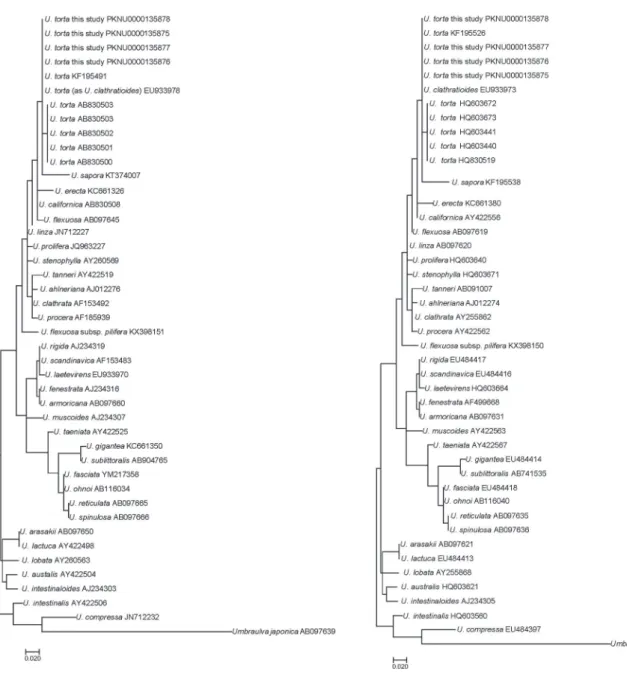
Hayden et al. 2003; Hayden and Waaland 2004; Hofmann et al. 2010; O’Kelly et al. 2010). In a phylogenetic tree based on molecular data (Figs. 2, 3), our specimens nested in the same clade with U. torta and U. clathratioides from Australia, but formed a sister clade to U. torta from Japan.
In this group supported by the tubular filiform thallus nor- mally without proliferations, the genetic distance between
our Korean specimens and U. torta from Australia and Japan ranged from 0.01% to 0.2%. The genetic divergence value between U. clathratioides and U. torta (from Austra- lia and Japan) was also calculated as 0.01-0.2%.
According to Lee et al. (2014), the interspecific ge- netic distance is 2.1-13.3% in Ulva. The current study demonstrated that the divergence range varies from 1.2%
to 21.9%. These suggest that U. clathratioides should be
Fig. 2. Phylogenetic tree of the selected taxa obtained from a max-imum-likelihood analysis based on ITS sequences. The boot- strap percentages(1000 replicates samples) are displayed above the branches. Scale bar=0.02 substitutions/site.
Fig. 3. Phylogenetic tree of the selected taxa obtained from a max- imum-likelihood analysis based on rbcL sequences. The bootstrap percentages(1000 replicates samples) are dis- played above the branches. Scale bar=0.02 substitutions/
site.
reduced to a synonym of U. torta. However, the name is ac- cepted until its evidence based on molecular data of U. tor- ta from the type locality (Germany) is obtained. In addition, this result leads to a conclusion that our Korean specimens are identified as U. torta based on the morphological and molecular data. This investigation is the first record of U.
torta in the Korean marine algal flora.
ACKNOWLEDGEMENT
This work was supported by a grant from the Marine Biotechnology Program (20170431) funded by the Ministry of Oceans and Fisheries, Korea, and by a grant from the National Institute of Biological Resources (NIBR) funded by the Ministry of Environment (MOE) of the Republic of Korea (NIBR201701204).
REFERENCES
Bae EH. 2010. Ulotrichales, Ulvales. pp. 7-52. In Algal Flora of Korea. Volume 1, Number 1. Chlorophyta: Ulvophy- ceae: Ulotrichales, Ulvales, Cladophorales, Bryopsidales.
Marine Green Algae(Bae EH, HS Kim, CJ Kwon, IK Hwang, GH Kim and TA Klochkova eds.). National Insti- tute of Biological Resources, Incheon.
Bliding C. 1963. A critical survey of European taxa in Ulvales.
Part I. Capsosiphon, Percursaria, Blidingia, Enteromor- pha. Op. Bot. Soc. Bot. Lund. 8:1-160.
Bliding C. 1968. A critical survey of European taxa in Ulvales.
II. Ulva, Ulvaria, Monostroma, Kornmannia. Bot. Notiser.
121:535-629.
Blomster J, CA Maggs and MJ Stanhope. 1998. Molecular and morphological analysis of Enteromorpha intestinalis and E. compressa(Chlorophyta) in the British Isles. J. Phycol.
34:319-340.
Blomster J, CA Maggs and MJ Stanhope. 1999. Extensive intraspecific morphological variation in Enteromorpha muscoides(Chlorophyta) revealed in molecular analysis. J.
Phycol. 35:575-586.
Brodie J, CA Maggs and DM John. 2007. The Green Seaweeds of Britain and Ireland. British Phycological Society, Lon- Burrows EM. 1991. Seaweeds of the British Isles. Volume 2. don.
Chlorophyta. Natural History Museum Publications, Lon- don.
Fletcher RL. 1996. The Occurrence of ‘Green Tides’-A Review. pp. 7-43. In Marine Benthic Vegetation. Recent Changes and the Effects of Eutrophication(Schramm W and PH Nienhuis eds.). Springer, Berlin.
Guiry MD and GM Guiry. 2017. AlgaeBase. World-wide elec- tronic publication, National University of Ireland, Galway.
http://www.algaebase.org. Accessed 16 July 2017.
Hall TA. 1999. BioEdit: A user-friendly biological sequence alignment editor and analysis program for Windows 95/98/
NT. Nucleic. Acids. Symp. Ser. 41:95-98.
Hayakawa Y, T Ogawa, S Yoshikawa, K Ohki and M Kamiya.
2012. Genetic and ecophysiological diversity of Clado- phora(Cladophorales, Ulvophyceae) in various salinity regimes. Phycol. Res. 60:86-97.
Hayden HS, J Blomster, CA Maggs, PC Silva, MJ Stanhope and JR Waaland. 2003. Linnaeus was right all along: Ulva and Enteromorpha are not distinct genera. Eur. J. Phycol.
38:277-294.
Hayden HS and JR Waaland. 2004. A molecular systematic study of Ulva(Ulvaceae, Ulvales) from the northeast Pacif- ic. Phycologia 43:364-382.
Hofmann LC, JC Nettleton, CD Neefus and AC Mathieson.
2010. Cryptic diversity of Ulva(Ulvales, Chlorophyta) in the Great Bay Estuarine System(Atlantic USA): introduced and indigenous distromatic species. Eur. J. Phycol. 45:230- 239.
Kim HS, SM Boo, IK Lee and CH Sohn. 2013. National List of Species of Korea, Marine Algae. Jeonghaengsa, Seoul(in Korean).
Kirkendale L, GW Saunders and P Winberg. 2013. A molec- ular survey of Ulva(Chlorophyta) in temperate Australia reveals enhanced levels of cosmopolitanism. J. Phycol.
49:69-81.
Koeman RPT and C Van Den Hoek. 1984. The taxonomy of Enteromorpha Link, 1820, (Chlorophyceae) in the Neth- erlands. 111. The sections Flexuosa and Clathratae and an addition to the section Profilerae. Cryptogam. Algol. 5:21- Kraft LGK, GT Kraft and RF Waller. 2010. Investigations into 61.
southern Australian Ulva(Ulvophyceae, Chlorophyta) tax- onomy and molecular phylogeny indicate both cosmopol- itanism and endemic cryptic species. J. Phycol. 46:1257- 1277.
Lee IK and JW Kang. 1986. A check list of marine algae in Korea. Kor. J. Phycol. 1:311-325.
Lee SH, PJ Kang and KW Nam. 2014. New record of two marine ulvalean species(Chlorophyta) in Korea. J. Ecol.
Environ. 37:379-358.
Lee YP. 2008. Marine Algae of Jeju. Academy Publishing Co,
Seoul(in Korean).
Lee YP and SY Kang. 2002. A Catalogue of the Seaweeds in Korea. Jeju National University Press, Jeju.
Malta EJ, SGA Draisma and P Kamermans. 1999. Free-floating Ulva in the southwest Netherlands: Species or morpho- types? A morphological, molecular and ecological compar- ison. Eur. J. Phycol. 34:443-454.
Mares J, E Leskinen, M Sitkowska, O Skacelova and J Blom- ster. 2011. The identity of European freshwater Ulva(Chlo- rophyta, Ulvophyceae) revealed by a combined molecular and morphological approach. J. Phycol. 47:1177-1192.
Ogawa T, K Ohki and M Kamiya. 2013. Differences of spatial distribution and seasonal succession among Ulva spe- cies(Ulvophyceae) across salinity gradients. Phycologia 52:637-651.
O’Kelly CJ, A Kurihara, TC Shipley and AR Sherweed. 2010.
Molecular assessment of Ulva spp.(Ulvophyceae, Chloro- phyta) in the Hawaiian Islands. J. Phycol. 46:728-735.
Phillips JA. 1988. Field, anatomical and developmental studies on southern Australian species of Ulva(Ulvaceae, Chloro- phyta). Aust. Syst. Bot. 1:411-456.
Phillips JA, RJ Lawton, R Denys, NA Paul and C Carl. 2016.
Ulva sapora sp. nov., an abundant tubular species of Ulva (Ulvales) from the tropical Pacific Ocean. Phycologia 55:55-64.
Polderman PJG. 1975. Some notes on the algal vegetation of two brackish polders on Texel(The Netherlands). Hydrobiol.
Bull. 9:23-34.
Shimada S, N Yokoyama, S Arai and M Hiraoka. 2008. Phylo- geography of the genus Ulva(Ulvophyceae, Chlorophyta), with special reference to the Japanese freshwater and brack- ish taxa. J. Appl. Phycol. 20:979-989.
Silva PC, PW Basson and RL Moe. 1996. Catalogue of the benthic marine algae of the Indian Ocean. Univ. Calif. Publ.
Bot. 79:1-1259.
Tanner CE. 1979. The taxonomy and morphological variation of distromatic Ulvaceous algae(Chlorophyta) from the northeast Pacific. PhD thesis. University of British Colum- bia, Vancouver. 249pp.
Tanner CE. 1986. Investigations of the taxonomy and morpho- logical variation of Ulva(Chlorophyta): Ulva californica Wille. Phycologia 25:510-520.
Trevisan VBA. 1842 ‘1841’. Sul geuere Bangia. Atti della Ter- za Riunione degli Scienziati italiani 1841:478-481.
Womersley HBS. 1984. The Marine Benthic Flora of Southern Australia. Part I. Government Printer, Adelaide.
Received: 20 August 2017 Revised: 8 September 2017 Revision accepted: 11 September 2017