• 검색 결과가 없습니다.

A 20 W GaN-based Power Amplifier MMIC for X-band Radar Applications

N/A
N/A
Protected

Academic year: 2021

Share "A 20 W GaN-based Power Amplifier MMIC for X-band Radar Applications"

Copied!
7
0
0

로드 중.... (전체 텍스트 보기)

전체 글

(1)

A 20 W GaN-based Power Amplifier MMIC for X-band Radar Applications

Bok-Hyung Lee * , Byung-Jun Park * , Sun-Youl Choi * , Byeong-Ok Lim ** , Joo-Seoc Go ** , and Sung-Chan Kim ***

Abstract

In this paper, we demonstrated a power amplifier monolithic microwave integrated circuit (MMIC) for X-band radar applications. It utilizes commercial 0.25 μm GaN-based high electron mobility transistor (HEMT) technology and delivers more than 20 W of output power. The developed GaN-based power amplifier MMIC has small signal gain of over 22 dB and saturated output power of over 43.3 dBm (21.38 W) in a pulse operation mode with pulse width of 200 μs and duty cycle of 4% over the entire band of 9 to 10 GHz. The chip dimensions are 3.5 mm × 2.3 mm, generating the output power density of 2.71 W/mm

2

. Its power added efficiency (PAE) is 42.6–50.7% in the frequency bandwidth from 9 to 10 GHz. The developed GaN-based power amplifier MMIC is expected to be applied in a variety of X-band radar applications.

Key wordsPower amplifier, MMIC, GaN, HEMT, X-band

* AESA Radar R&D Center, Hanwha Systems, Geonggi-do 17121, Korea

** R&D Division, GP Inc., Daejeon 34036, Korea

***★ Department of Electronic Engineering, Hanbat National University, Daejeon 34158, Korea E-mail:[email protected], Tel:+82-42-821-1130

※ Acknowledgment

This work was supported by a grant-in-aid of HANWHA SYSTEMS.

Manuscript received Mar. 2, 2019; revised Mar. 22. 2019; accepted Mar. 26, 2019

This is an Open-Access article distributed under the terms of the Creative Commons Attribution Non-Commercial License (http://creativecommons.org/licenses/by-nc/3.0) which permits unrestricted non-commercial use, distribution, and reproduction in any medium, provided the original work is properly cited.

Ⅰ. Introduction

Phased array systems were initially invented for use in military radar applications to detect aircrafts and missiles. However, these phased array systems are now also widely used in various civilian radar applications such as medical imaging scanners, meteorological radar systems, and so on. Phased array systems provide improvement in radar functionality and performance in terms of beam agility, effective radar source management, and conservative degradation with module failure. The current trend is toward active phased-array systems

with a large number of distributed transmitter and receiver (T/R) modules. The active phased array is typically an active electronically scanned array (AESA), and this is a phased array in which each antenna element has its own T/R module.

A high power amplifier is one of the most

important components in these T/R modules for

an AESA system. In particular, solid state power

amplifiers (SSPAs) are receiving much attention

because they can replace electronic tube amplifiers

now widely used in conventional radar applications,

such as a magnetron tube and a traveling-wave

tube amplifier (TWTA). These tube-type amplifiers

181

(2)

have limitations such as low linearity and a high failure rate, although they can deliver very high output power. Moreover, they are bulky and heavy. For these reasons, SSPAs are replacing tube-type amplifiers.

The device technology platforms for SSPAs have been constantly improved in the past decades to include materials such as indium phosphide (InP), gallium arsenide (GaAs), and gallium nitride (GaN). Among these new options, the most promising candidate is the GaN-based high electron mobility transistor (HEMT) technology. Due to its inherent and outstanding material properties, such as a high breakdown electric field and a high saturation carrier velocity in comparison with those of GaAs-based and InP-based devices, a GaN-based power amplifier monolithic microwave integrated circuit (MMIC) has the potential to fulfill demands for high output power in various applications [1-2].

Although the GaN-based HEMT technologies are well developed, higher-performance GaN-based power amplifiers at higher operating frequencies are still popular research topics. Over the last few years, GaN-based power amplifier MMICs for X-band radar applications have been demonstrated [3-8].

In the work reported in this paper, we demonstrated a high performance power amplifier MMIC based on 0.25 μm GaN-based HEMT technology for X-band radar applications. The design specifications provide a small signal gain of more than 20 dB, a power added efficiency (PAE) of more than 35 %, and output power of more than 42 dBm in the frequency bandwidth from 9 to 10 GHz.

Ⅱ. Power Amplifier MMIC Design

The GaN-based power amplifier MMIC was designed using the 0.25 μm GaN HEMT process, and performed by a Wireless Information Networking (WIN) Semiconductor foundry. The 0.25 μm GaN

HEMT at WIN shows a breakdown voltage of 120 V, a cutoff frequency of 24.5 GHz, a maximum oscillation frequency of 86 GHz, a PAE of 64%, a power density of 4.7 W/mm, and a small signal gain of 19 dB at 10 GHz with an operating voltage of 28 V.

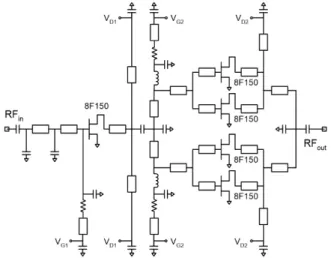
The power amplifier MMIC consists of two stages, with a first stage 1.2 mm gate-width periphery, and a second stage 4.8 mm gate-width periphery. The second stage is called the power cell and is composed of four unit HEMTs for an output power above 42 dBm. The output was thus designed as a 4-to-1 combiner. The output power of the each unit HEMT device (eight fingers and gate width of 150 μm) was about 37 dBm from load-pull simulation at a center frequency. The first stage was composed of one unit HEMT in order to achieve high efficiency and proper overall gain response characteristics.

The schematic diagram of the designed two- stage power amplifier MMIC is shown in Fig. 1.

The output matching network was synthesized for optimum output impedance. The input matching network was designed for small signal gain response and high efficiency. The inter-stage matching network was designed for considering proper small signal gain, power efficiency, and power matching, simultaneously.

In order to ensure unconditional stability of the power amplifier MMIC, a parallel RC network is adopted at the input of the each unit HEMT device [9] and series resistors are added to the gate bias lines. An odd mode oscillation is suppressed by a resistor connected in series between each adjacent unit HEMT device.

The circuit was then refined using an

electromagnetic simulation tool, NI’s AWR, in

order to ensure minimum deviation between the

model and the actual circuit layout. From the EM

simulation results, output power of over 42.5

dBm and small signal gain of over 23 dB were

obtained in the frequency bandwidth from 9 to 10

GHz.

(3)

Ⅲ. Experimental Results

The standard process for AlGaN/GaN HEMTs is fabricated on 100 mm GaN-on-SiC wafers and GaN process platforms are fully capable of enabling MMICs design. Front-side processing includes active-layer isolation, ohmic contact, 1

st

silicon nitride (SiN) passivation, NiAu-based T-gate, 2

nd

SiN passivation, source-coupled field-plate formation, thin-film tantalum nitride (TaN) resistor, two interconnect metal layers, and metal-insulator-metal (MIM) capacitors.

After front-side processing, wafer are thinned to 100 μm thickness. The back-side processing features via-holes [10]. The fabricated two-stage GaN-based power amplifier MMIC is shown in Fig. 2. The chip dimensions are 3.5 mm×2.3 mm.

Fig. 1. Schematic diagram of the designed two- stage GaN-based power amplifier MMIC.

Fig. 2. Chip photograph of the fabricated two-stage GaN-based power amplifier MMIC.

The fabricated GaN-based power amplifier MMIC was soldered to a 40 mil-thick copper molybdenum (CuMo) carrier plate using AuSn eutectic bonding. Then, the CuMo carrier plate was assembled in an aluminum test fixture. The input and output bond pads of the fabricated power amplifier MMIC were connected to 50 Ω microstrip lines on a 10 mil-thick alumina substrate using Au wire bonding. The inductance of the bonding wires at input and output ports was considered during the circuit simulation. The other ends of the 50 Ω microstrip lines were connected to K-type connectors. A single layer capacitor (SLC) of 100 pF was mounted at the DC bias pads as a bypass capacitor. The in- fixture measurements were performed under pulsed test conditions with a pulse width of 200 μs and a duty cycle of 4% at room temperature.

Typical S-parameters of the fabricated two- stage GaN-based power amplifier MMIC are shown in Fig. 3 at drain bias of 28 V with a quiescent drain current of 0.3 A. The measured results are reasonably consistent with the simulated results. The small signal gain (S

21

) is greater than 22 dB from 9 to 10 GHz. The input return loss (S

11

) and output return loss (S

22

) are better than -13 and -6.5 dB, respectively.

Fig. 3. Measured S-parameters characteristics of the fabricated two-stage GaN-based power amplifier MMIC.

Output power and power gain characteristics of

(4)

Frequency (GHz)

Device technology

Drain bias voltage (V)

Small signal gain (dB)

Saturated output power (dBm)

Power added efficiency (%)

MMIC area (mm

2

)

Power density (W/mm

2

) Ref.

8.8-10.8 0.25 μm GaN 28 24-26 46 38-44 20.7 1.92 [3]

8.5-10.5 0.25 μm GaN 28 > 20 44.7 35-37 13.26 2.19 [4]

8.5-10.5 0.25 μm GaN 30 21.5-24 42.5 37.3 9.13 1.95 [5]

8.8-10.4 0.25 μm GaN 26 > 25 41.6 38-43 18 0.79 [6]

8.6-10.6 0.5 μm GaN 25 18.5 42 33 9.25 1.71 [7]

9-12 0.25 μm GaN 30 24 41.7 38.6-51.1 7.25 2.05 [8]

8.5-10.5 0.25 μm GaN 25 14-20 46.3 34-52 18 2.39 [11]

8.5-11.5 0.25 μm GaN 28 22 43.4 35-40 13.5 1.62 [12]

8-10 0.25 μm GaN 25 14-16.5 46 20-38 18 2.22 [13]

8.8-10.2 0.25 μm GaN 30 24-27 45 36-37 22 1.44 [14]

9-10 0.25 μm GaN 30 20 44.77 40 9.8 3.06 [15]

8-11 0.25 μm GaN 28 28 45.44 40 17.28 2.02 [16]

9-10 0.25 μm GaN 28 35 42.5 > 40 13.1 1.35 [17]

8.5-11 0.25 μm GaN 30 24 41.76 40 13.97 1.07 [18]

9-10 0.25 μm GaN 28 22-23.5 43.4 42.6-50.7 8.05 2.71 This work

Table 1. The comparison of the developed X-band GaN-based power amplifier MMICs with other reported data.

the fabricated two-stage GaN-based power amplifier MMIC are shown in Fig. 4. Measured data shows that the saturated output power is better than 43.3 dBm at drain bias of 28 V in the frequency bandwidth from 9 GHz to 10 GHz.

Fig. 5 shows the drain current characteristics versus input power over the entire band of 9 to 10 GHz. The drain current at saturated output power (P

sat

) is a typical 1350–1600 mA.

Fig. 4. Measured output power and power gain characteristics of the fabricated two-stage GaN-based power amplifier MMIC.

Fig. 5. Measured drain current characteristics of the fabricated two-stage GaN-based power amplifier MMIC.

Fig. 6 shows the saturated output power and power added efficiency (PAE) characteristics of the fabricated GaN-based power amplifier MMIC.

The saturated output power is greater than 43.3 dBm (21.38 W), and the PAE is 42.6–50.7% over the entire band of 9 to 10 GHz.

All measured results of the fabricated power amplifier MMIC satisfied the design specifications.

Table I shows a comparison of the fabricated

(5)

GaN-based power amplifier MMIC results with those reported about other devices. The developed GaN-based power amplifier MMIC is very competitive in all performance aspects, including power density, compared with the previous state-of-the-art results, thus it is expected to be applied for a variety of X-band radar applications.

Fig. 6. Measured saturated output power and power added efficiency characteristics of the fabricated two-stage GaN-based power amplifier MMIC.

We expect the developed GaN-based power amplifier MMIC to be developed as a manufactured good using MMIC packaging technology.

Ⅳ. Conclusion

In this paper, we presented a GaN-based power amplifier MMIC for X-band radar applications.

The device technology relies on the 0.25 μm GaN HEMT process. The developed power amplifier MMIC has a small signal gain of over 22 dB and saturated output power of over 43.3 dBm (21.38 W) in the frequency bandwidth from 9 to 10 GHz with pulse width of 200 μs and duty cycle of 4%.

The PAE is 42.6–50.7% and the final chip dimensions are 3.5 mm × 2.3 mm. The developed two-stage GaN-based power amplifier MMIC is very competitive in all performance aspects, including power density, compared with previous state-of-the-art results, thus it is expected to be applied in a variety of X-band radar applications.

References

[1] D. Runton, et al., “History of GaN:High- Power RF Gallium Nitride (GaN) from Infancy to Manufacturable Process and Beyond,” IEEE Microwave Magazine, vol. 14, no. 3, pp. 82-466, 2013. DOI: 10.1109/MMM.2013.2240853

[2] R. Pengelly, et al., “A Review of GaN on SiC High Electron-Mobility Power Transistors and MMICs,” IEEE Transactions on Microwave Theory and Techniques, vol. 60, no. 6, pp. 1764- 1783, 2013. DOI: 10.1109/TMTT.2012.2187535 [3] D. Shin, et al., “X-band GaN MMIC power amplifier for the SSPA of a SAR system,” in Proc. of 2017 IEEE International Symposium on Radio-Frequency Integration Technology (RFIT), pp. 93-95, 2017. DOI: 10.1109/RFIT.2017.8048093 [4] K. Bae, et al., “X-Band GaN Power Amplifier MMIC with a Third Harmonic- Tuned Circuit,”

Electronics 2017, vol. 6, no. 4, p. 103, 2017. 

DOI: 10.3390/electronics6040103

[5] Y. S. Noh, et al., “A 16 watt X-band GaN high power amplifier MMIC for phased array applications,” in Proc. of 2016 IEEE International Conference on Microwave and Millimeter Wave Technology (ICMMT), vol. 2, pp. 979-981, 2016. 

DOI: 10.1109/ICMMT.2016.7762506

[6] D. Resca, et al., “X-Band GaN Power Amplifier for Future Generation SAR Systems,”

IEEE Microwave and Wireless Components Letters, vol. 24, no. 4, pp. 266-268, 2014.

DOI: 10.1109/LMWC.2014.2299552

[7] R. Giofre, et al., “X-band MMIC GaN Power Amplifier for SAR Systems,” Microwave and Optical Technology Letters, vol. 55, no. 11, 2013.

DOI: 10.1002/mop.27852|

[8] S. Masuda, et al., “GaN single-chip transceiver frontend MMIC for X-band applications,” in Proc.

of 2012 IEEE/MTT-S International Microwave Symposium Digest, pp. 1-3, 2012.

DOI: 10.1109/MWSYM.2012.6259470

[9] X. Yu, et al., “A Ka band 15W power amplifier

MMIC based on GaN HEMT technology,” in

(6)

Proc. of 2016 IEEE International Workshop on Electromagnetics: Applications and Student Innovation Competition (iWEM), pp. 1-3, 2016.

DOI: 10.1109/iWEM.2016.7505042

[10] Y. Lien, et al., “GaN technologies for applications from L- to Ka-band,” in Proc. of 2017 IEEE International Conference on Microwaves, Antennas, Communications and Electronic Systems (COMCAS), pp. 1-5, 2017.

DOI: 10.1109/COMCAS.2017.8244831

[11] S. Piotrowicz, et al., “43W, 52% PAE X-Band AlGaN/GaN HEMTs MMIC amplifiers,” in Proc.

of 2010 IEEE MTT-S International Microwave Symposium, pp. 505-508, 2010.

DOI: 10.1109/MWSYM.2010.5518097

[12] J. Kuhn, et al., “Design of highly-efficient GaN X-band- power-amplifier MMICs,” in Proc.

of 2009 IEEE MTT-S International Microwave Symposium Digest, pp. 661-664, 2009.

DOI: 10.1109/MWSYM.2009.5165783

[13] S. Piotrowicz, et al., “State of the Art 58W, 38% PAE X-Band AlGaN/GaN HEMTs Microstrip MMIC Amplifiers,” in Proc. of 2008 IEEE Compound Semiconductor Integrated Circuits Symposium, pp. 1-4, 2008.

DOI: 10.1109/CSICS.2008.39

[14] S. D'Angelo, et al., “A GaN MMIC chipset suitable for integration in future X-band spaceborne radar T/R module Frontends,” in Proc. of 2016 21st International Conference on Microwave, Radar and Wireless Communications (MIKON), pp. 1-4, 2016. DOI: 10.1109/MIKON.2016.7492014 [15] “APA091030D,” Ace technologies corp., [internet], http://www.rfmiso.com.

[16] “CMPA801B025D,” Wolfspeed, [internet], http://www.wolfspeed.com.

[17] “TGA2624,” Qorvo, [internet], http://www.qorvo.com.

[18] “CHA8610-99F,” United Monolithic Semi., [internet], http://www.ums-gaas.com

BIOGRAPHY

Bok-Hyung Lee (Member)

1999:BS degree in Electronic Engineering, Dongguk University.

2001:MS degree in Electronic Engineering, Dongguk University.

2006:Ph. D. degree in Electronic Engineering, Dongguk University.

2007~present:Research Engineer, Hanwha Systems.

Byung-Jun Park (Member)

2009:BS degree in Electronic Engineering, Kwangwoon University.

2011:MS degree in Electronic Engineering, Kwangwoon University.

2011~present:Research Engineer, Hanwha Systems.

Sun-Youl Choi (Member)

2013:BS degree in Electronic Engineering, Chonbuk University.

2016:MS degree in Electronic Engineering, Kyungpook University.

2016~present:Research Engineer, Hanwha Systems.

Byeong-Ok Lim (Member)

2003:MS degree in Electronic Engineering, Dongguk University.

2009:Ph. D. degree in Electronic Engineering, Dongguk University.

2010~2016:Research Engineer, Hanwha Systems.

2017~present:Research Engineer, GP Inc.

(7)

Joo-Seoc Go (Member)

2014:MS degree in Electronic Communication Engineering, Hongik University.

2016~2017:Research Engineer, U2SR 2018~present:Research Engineer, GP Inc.

Sung-Chan Kim (Member)

1999:BS degree in Electronic Engineering, Dongguk University.

2001:MS degree in Electronic Engineering, Dongguk University.

2006:Ph. D. degree in Electronic Engineering, Dongguk University.

2007~present:Professor, Hanbat National University.

수치

Fig. 1. Schematic diagram  of  the  designed  two- stage  GaN-based  power amplifier  MMIC.
Fig. 4. Measured output power and power gain characteristics  of  the  fabricated  two-stage  GaN-based power  amplifier  MMIC.
Fig. 6. Measured  saturated  output  power and  power  added  efficiency  characteristics  of the fabricated  two-stage  GaN-based power  amplifier  MMIC.

참조

관련 문서

The paper examines the incentives of power generating companies (GENCOs) for efficient fuel procurement for power generation under the Cost-Based Generation

Based on the results, this study concluded that competitive power of construction business in uncertain management environment lies in human resources rather

The reduction of power series ( , m→ ∞) to polynomials (m is finite) is a great advantage.. because then we have solutions for all x,

Ä White LED (Sold-State Lighting) Ä High Power (RF) Devices (Military).. Nichia’s Blue LED with GaN

¾ Q s and r are used to “steal” some base current away from Q 1 when the output is accidentally shorted to ground, preventing when the output is accidentally shorted

¾ Efficiency is defined as the average power delivered to the load divided by the power drawn from the supply:. Emitter Follower

Also, an intermodulation distortion is formed due to the nonlinear characteristics of power amplifier near the saturation region when more than two

“Evaluation of R&D investments in wind power in Korea using real option.” Renewable and Sustainable Energy Reviews. "Real Option Valuation of a Wind Power Project Based